









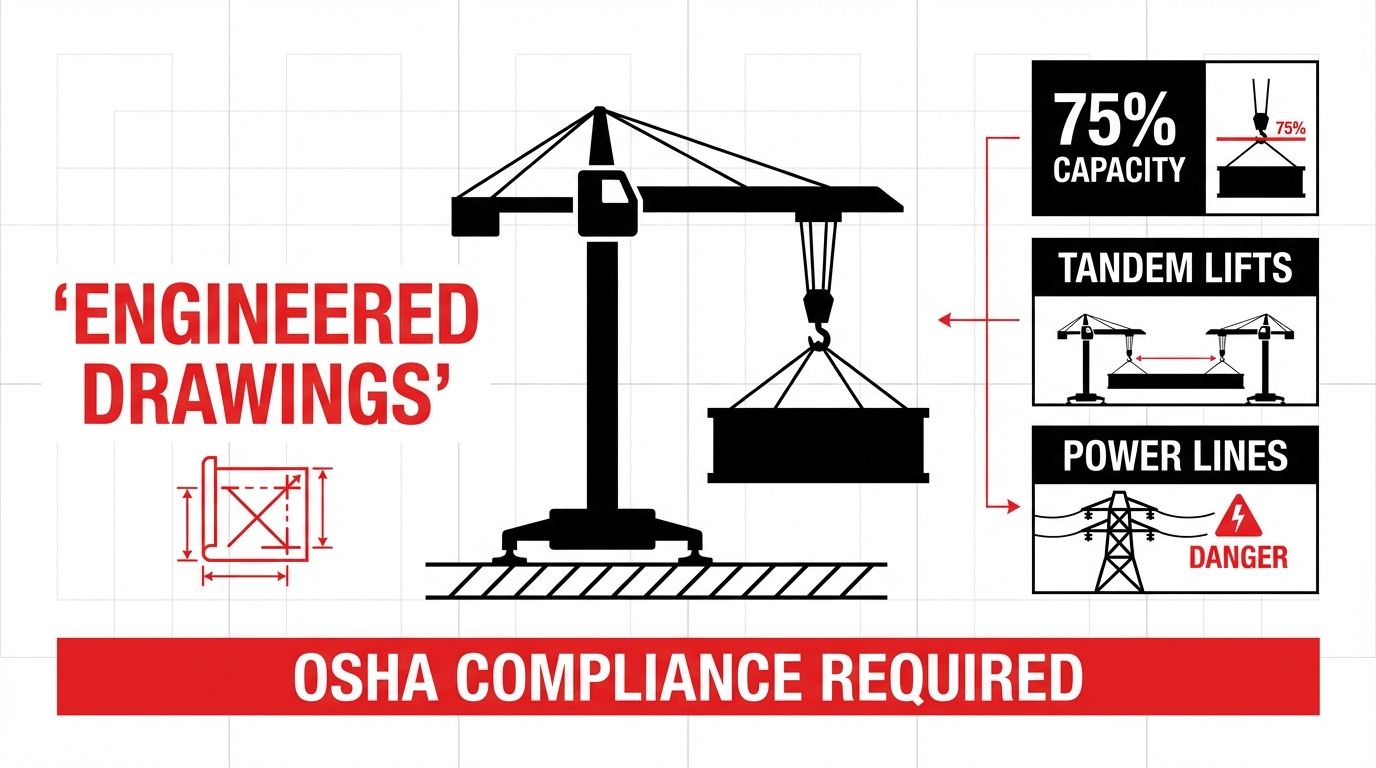

Engineered drawings for rental lifts are professionally prepared technical documents that specify crane configuration, load geometry, rigging arrangements, and ground-bearing pressures for high-risk or complex lifting operations. Not every rental lift requires them, but specific scenarios make them mandatory under OSHA regulations and industry standards.
This guide covers lift classification and regulatory triggers, drawing components and contractual responsibility, OSHA compliance requirements, the distinction between engineered drawings and standard lift plans, and the role rigging hardware plays in engineering calculations.
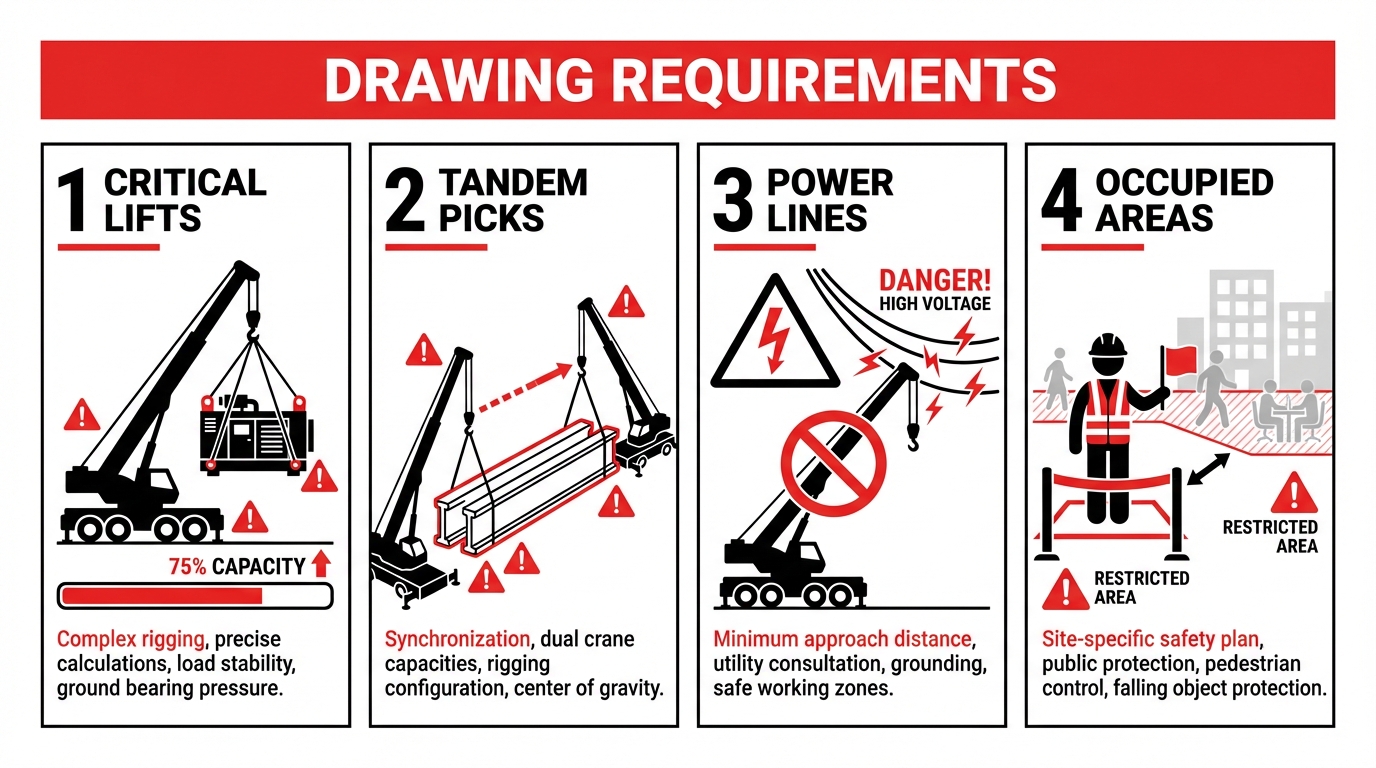
Lift classifications determine documentation needs. Standard lifts that fall well within rated crane capacity typically require only a basic lift plan, while critical lifts exceeding 75 percent of rated capacity, tandem picks, lifts near power lines, and hoisting over occupied areas all trigger engineered drawing requirements under 29 CFR 1926 Subpart CC.
Engineered drawings document crane specifications, load radius, swing paths, rigging geometry, and ground-bearing pressures verified by a qualified engineer. Responsibility for providing these drawings shifts depending on the contract structure; crane rental companies, general contractors, or third-party lift engineers may fulfill the obligation.
OSHA standards under Subpart CC set the federal baseline for when engineered planning is mandatory, covering personnel hoisting, multiple-crane lifts, and power line proximity. No federal law requires a PE stamp on every lift plan, though individual projects or site owners frequently mandate one.
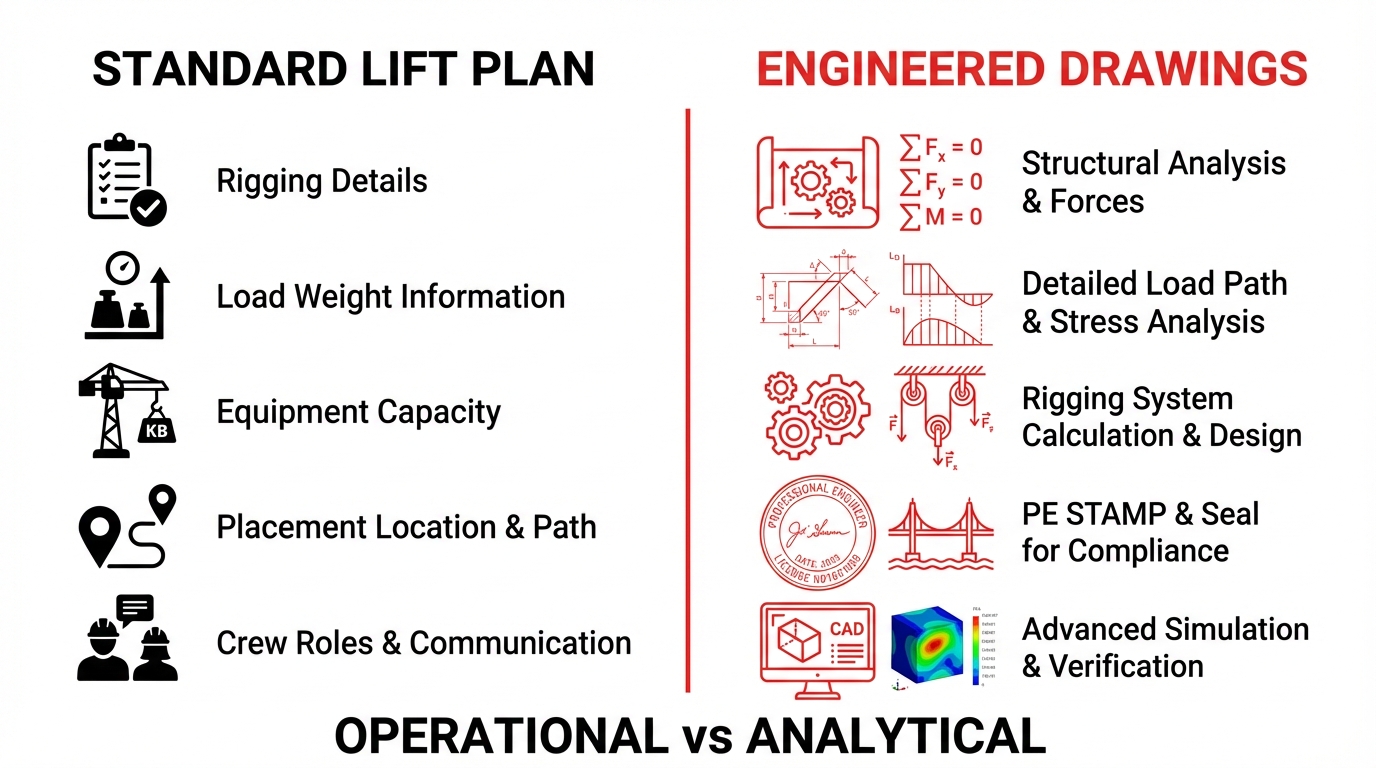
Standard lift plans answer what equipment goes where. Engineered drawings answer whether the forces, structures, and rigging will withstand a specific scenario. The technical depth separating these two documents directly affects project cost, compliance, and crew safety.
Rigging hardware selection, including wire rope, chain, and synthetic slings, feeds directly into engineered calculations. Sling type, angle, rated capacity, and environmental limitations all factor into the engineering that governs safe load handling on every rental lift project.
What Are Engineered Drawings for Lifting Operations?
Engineered drawings for lifting operations are detailed, professionally prepared technical documents that specify every critical parameter of a crane lift, including equipment configuration, load geometry, rigging arrangements, ground-bearing pressures, and travel paths. These drawings go beyond standard crane charts by providing site-specific engineering calculations and visual representations tailored to high-risk or complex lifts. Lifting operations that involve heavy loads, confined spaces, multiple cranes, or proximity to hazards often require this level of engineering documentation to verify that the planned lift falls within safe operational limits.
Unlike a basic lift plan, which may outline general procedures and equipment selection, an engineered drawing incorporates structural analysis, load distribution calculations, and rigging geometry verified by a qualified engineer. The distinction matters because not every rental lift demands engineered drawings, yet certain conditions make them essential for regulatory compliance and worksite safety. The sections that follow cover when engineered drawings are required, what information they contain, who provides them, applicable OSHA regulations, and how rigging hardware factors into the engineering process.
When Are Engineered Drawings Required for Rental Lifts?
Engineered drawings are required for rental lifts when the operation exceeds routine parameters, including critical lifts, tandem picks, work near power lines, and lifts over occupied areas. Each scenario carries distinct risk factors that determine documentation needs.
Do You Need Engineered Drawings for Critical Lifts?
Yes, you need engineered drawings for critical lifts. A critical lift exceeds the threshold where standard crane load charts alone cannot ensure safe execution. According to OSHA 29 CFR 1926 Subpart CC, a critical lift is one exceeding 75 percent of the crane’s rated capacity or involving lifts of personnel, hazardous materials, or multiple cranes.
The lifting industry categorizes operations into three tiers:
- Standard lifts are routine, repetitive, and lower-risk operations.
- Non-routine or critical lifts carry higher risk due to weight, complexity, or environment.
- Engineered lifts involve the highest risk, requiring engineered solutions beyond standard crane charts.
Any rental lift falling into the critical or engineered category should have drawings prepared by a qualified engineer before work begins. Skipping this step on a critical pick is one of the most avoidable mistakes in crane operations.
Do You Need Engineered Drawings for Standard Lifts?
No, you do not typically need engineered drawings for standard lifts. Standard lifts are routine operations where the load weight falls well within the crane’s rated capacity and site conditions present no unusual hazards. A competent lift director can execute these picks using the manufacturer’s load chart and a basic lift plan.
That said, certain job sites or project owners may still require documented lift plans even for routine work. The distinction matters: a standard lift plan is not the same as a full engineered drawing. When renting equipment for straightforward, repetitive picks on open ground, the operational documentation stays simpler and less costly.
Do You Need Engineered Drawings for Tandem Lifts?
Yes, you need engineered drawings for tandem lifts. Tandem lifts use two or more cranes to hoist a single load simultaneously, which introduces complex load-sharing calculations that standard crane charts cannot address independently. OSHA requires that multiple-crane lift plans be developed by a qualified person, and engineering expertise must be provided when that qualified person determines it is needed.
Engineered drawings for tandem picks must account for:
- Load distribution percentages between each crane.
- Synchronized boom angles and swing paths.
- Dynamic load shifts during travel or rotation.
Tandem operations are inherently higher-risk because miscommunication or miscalculation between crane operators can produce sudden, unbalanced forces. Engineered documentation is not optional here; it is a baseline safety requirement.
Do You Need Engineered Drawings for Lifts Near Power Lines?
Yes, you need engineered drawings for lifts near power lines in most cases. OSHA requires employers to determine if any part of the equipment, load line, or load could get closer than 20 feet to a power line before beginning operations. When the answer is yes, detailed planning that addresses clearance distances, boom swing limits, and spotter positions becomes essential.
Engineered drawings for power line proximity should specify:
- Minimum approach distances for the voltage present.
- Restricted operating zones for the boom and load line.
- Physical barriers or visual warning systems on site.
Even experienced operators can misjudge distances under real-world conditions, especially with longer boom configurations on rental cranes. Documented clearance calculations remove guesswork from a scenario where contact is fatal.
Do You Need Engineered Drawings for Lifts Over Occupied Areas?
Yes, you need engineered drawings for lifts over occupied areas. Hoisting loads above spaces where workers or the public are present creates fall-zone risks that demand precise load path documentation, rigging redundancy calculations, and exclusion zone planning.
Key elements these drawings address include:
- Defined load travel paths that minimize time over occupied zones.
- Redundant rigging configurations to prevent dropped loads.
- Evacuation and barricade plans for personnel below.
OSHA treats personnel hoisting with particular strictness, prohibiting the use of equipment to hoist employees except where conventional means would be more hazardous or structurally impossible. For any rental lift operating above occupied areas, engineered drawings serve as both a safety tool and a liability shield.
Understanding which lift scenarios require engineered drawings helps determine the right level of planning before any rental equipment arrives on site.
What Information Is Included in an Engineered Lift Drawing?
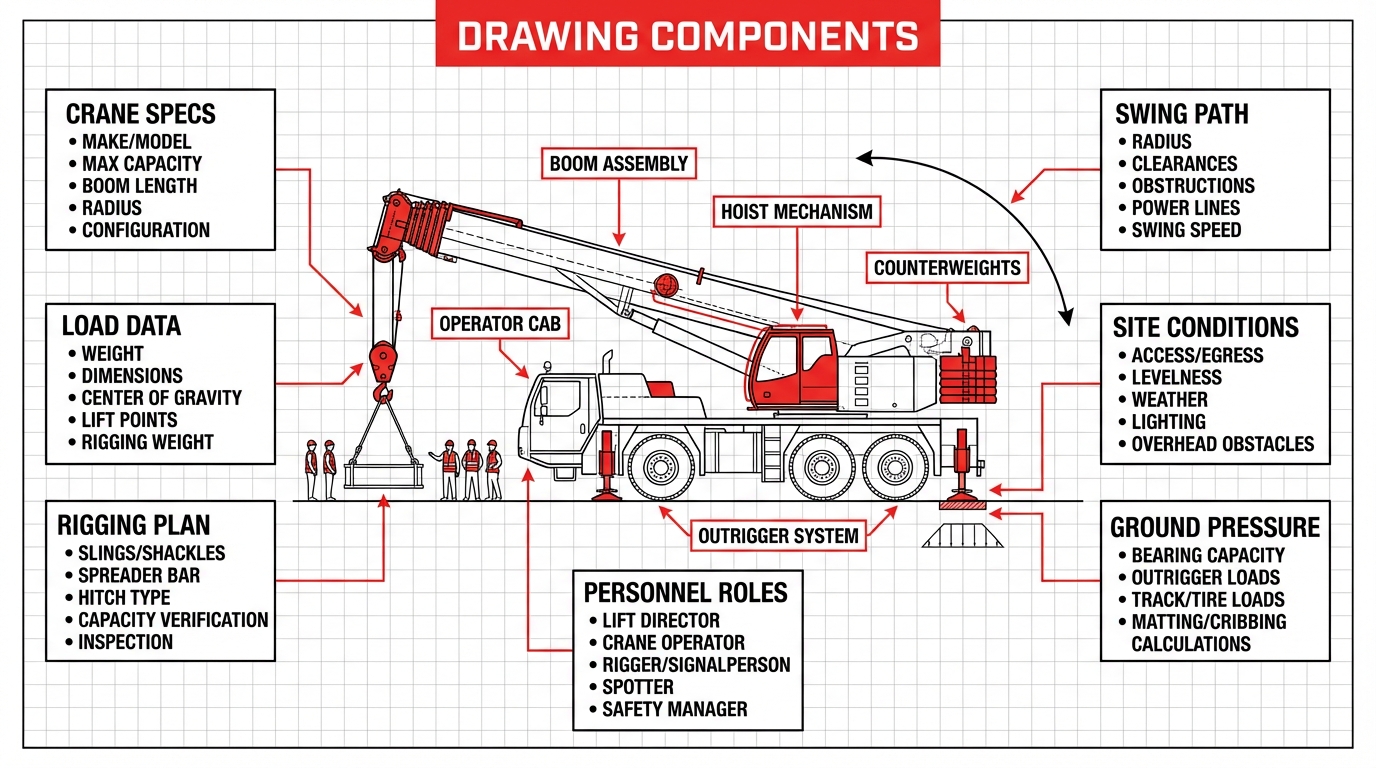
An engineered lift drawing includes crane specifications, load data, rigging configurations, site conditions, and ground-bearing pressures. These elements combine to form a comprehensive visual and technical document that governs every phase of a high-risk lift.
Key components typically documented in an engineered lift drawing include:
- Crane type and configuration, specifying boom length, counterweight, and operating radius.
- Load weight and geometry, including center of gravity and load distribution.
- Rigging plan, detailing sling types, shackle sizes, and connection points.
- Load radius and swing path, mapping the travel route from pick to set.
- Site conditions, covering ground-bearing capacity, slope, and overhead obstructions.
- Ground-bearing pressures, calculated to verify the surface can support crane outrigger loads.
- Personnel roles, identifying the crane operator, signal person, and rigger responsibilities.
According to Crane Briefing, lift plans serve as a visual representation of the crane setup area, crane configuration, load travel path, rigging details, and ground-bearing pressures. Engineered drawings take this further by adding PE-stamped calculations that verify each variable against rated capacities and site-specific constraints.
For anyone managing rental lift operations, understanding these components is essential; missing even one data point can invalidate the entire lift plan. Knowing who provides these drawings clarifies accountability on every project.
Who Is Responsible for Providing Engineered Drawings on Rental Lifts?
Responsibility for providing engineered drawings on rental lifts depends on the project’s contractual structure and lift complexity. The party who supplies these drawings varies among crane rental companies, general contractors, and third-party lift engineers.
Does the Crane Rental Company Provide Engineered Drawings?
The crane rental company sometimes provides engineered drawings, particularly when the rental agreement includes full-service lift planning. Some crane rental companies maintain in-house engineering departments capable of producing PE-stamped drawings as part of their service offerings. Whether this is included depends on the rental contract type; bare rentals typically exclude engineering services, while operated rentals may bundle lift planning into the scope.
For projects requiring custom rigging configurations, confirming engineering responsibilities before signing a rental agreement prevents costly delays and miscommunication on site.
Does the General Contractor Provide Engineered Drawings?
The general contractor provides engineered drawings when the project scope, site owner requirements, or contract language places that obligation on them. As the controlling entity on most job sites, the general contractor often bears overall responsibility for ensuring compliant lift documentation exists before operations begin.
In practice, general contractors frequently subcontract the actual drawing preparation to a qualified engineer while retaining accountability for delivery timelines. This arrangement is especially common on large commercial or industrial projects where the GC manages multiple subcontractors and crane vendors simultaneously.
Does a Third-Party Lift Engineer Provide the Drawings?
A third-party lift engineer provides the drawings when neither the crane rental company nor the general contractor has in-house engineering capability, or when independent verification is required. According to OSHA 29 CFR 1926.1432, for multiple-crane lifts, the plan must be developed by a qualified person, and where that person determines engineering expertise is needed, the employer must ensure it is provided.
No U.S. federal law requires a Professional Engineer to stamp a lift plan as of July 2018, though individual project owners or site specifications may mandate PE certification. Third-party engineers offer an objective review that adds credibility and reduces liability exposure for all parties involved.
Clarifying drawing responsibility early in the contract process helps every stakeholder plan timelines, budgets, and safety protocols before equipment arrives on site.
What OSHA Regulations Apply to Engineered Drawings for Rental Lifts?
OSHA regulations that apply to engineered drawings for rental lifts fall under 29 CFR 1926 Subpart CC, covering personnel hoisting, multiple-crane lifts, and power line proximity. Each standard triggers specific documentation and engineering requirements.
OSHA 29 CFR 1926.1431 governs the use of cranes to hoist employees. According to OSHA, the use of equipment to hoist employees is prohibited except where the employer demonstrates that conventional means would be more hazardous or is not possible due to structural design or worksite conditions. When personnel hoisting is permitted, detailed engineered documentation of the platform, load calculations, and safety systems becomes essential.
OSHA 29 CFR 1926.1432 addresses multiple-crane and derrick lifts. This standard requires that the lift plan be developed by a qualified person, and where that qualified person determines engineering expertise is needed, the employer must ensure it is provided. Tandem lifts involving rental equipment almost always demand engineered drawings that account for load sharing, swing coordination, and rigging geometry between cranes.
OSHA 29 CFR 1926.1408 establishes power line safety requirements. Before beginning equipment operations, the employer must determine if any part of the equipment, load line, or load could get closer than 20 feet to a power line. Lifts within this threshold require additional planning documentation, often including engineered drawings that map clearance zones and boom swing paths.
These three standards represent the most common OSHA triggers for engineered documentation on rental lift projects. In practice, the burden of compliance falls on the employer controlling the lift, regardless of whether the crane is owned or rented. Understanding which regulation applies to a specific job site scenario is the first step toward determining whether engineered drawings are legally required or simply best practice.
What Happens If You Operate a Rental Lift Without Required Drawings?
Operating a rental lift without required drawings exposes your crew to uncontrolled hazards and your company to serious legal and financial consequences. Without documented load calculations, rigging configurations, and site conditions, critical variables go unverified.
Unanswered questions create the greatest risk. According to La Grange Crane Service, common lift planning questions include “What is the weight and geometry of the load?”, “What is the center of gravity and load distribution?”, and “What type of lifting equipment is required?” Skipping engineered drawings means none of these questions receive a verified, documented answer.
The consequences of operating without required drawings include:
- OSHA can issue citations and penalties for failing to meet lift planning requirements under 29 CFR 1926 Subpart CC.
- Insurance carriers may deny claims when an incident occurs during an undocumented lift, leaving the contractor fully liable.
- Project owners and general contractors can halt work, back-charge costs, or terminate subcontracts for non-compliance.
- Criminal liability may apply if a worker is injured or killed during a lift that lacked required engineering documentation.
For any lift classified as critical, multi-crane, or near occupied areas, the absence of engineered drawings is not merely an oversight; it is a preventable failure point. Investing in proper documentation before the lift begins is always less costly than the aftermath of an incident without it.
How Do Engineered Drawings Differ From a Standard Lift Plan?
Engineered drawings differ from a standard lift plan in scope, technical depth, and professional certification requirements. Both documents support safe crane operations, but they serve distinct purposes.
A standard lift plan includes specific details such as the type of crane, weight of the load, load radius, site conditions, and people involved, according to AEA Integration. It functions as an operational checklist that a qualified rigger or crane operator prepares for routine lifts. The plan visually represents the crane setup area, travel path, and basic rigging configuration.
Engineered drawings go further. They incorporate structural calculations, load distribution analyses, ground-bearing pressure computations, and rigging geometry verified by a licensed professional engineer. While no federal law requires a PE stamp on every lift plan, individual projects or site owners frequently mandate one for complex or critical lifts.
The practical distinction matters: a standard lift plan answers “what equipment and where,” while engineered drawings answer “will the forces, structures, and rigging withstand this specific scenario.” For rental lift operations, understanding which document your project requires prevents costly delays and compliance gaps on the jobsite.
How Much Do Engineered Lift Drawings Typically Cost?
Engineered lift drawings typically cost between $100 and $120 per hour for professional engineering design services. Several factors influence the final price.
According to Cad Crowd, engineering design services for professional engineers typically range between $100 and $120 per hour. Total project costs depend on lift complexity, the number of crane configurations required, site-specific conditions, and whether a PE stamp is needed. A straightforward single-crane lift drawing may require only a few hours of engineering time, while complex tandem lifts or lifts in congested environments can demand significantly more analysis and documentation. For most rental lift projects, budgeting for engineering upfront is far less costly than the delays, citations, or incidents that result from skipping this step.
What Role Does Rigging Hardware Play in Engineered Lift Plans?
Rigging hardware plays a critical role in engineered lift plans by determining sling configurations, load angles, and capacity calculations that directly affect safety. The subsections below cover how wire rope, chain, and synthetic slings each influence lift engineering.
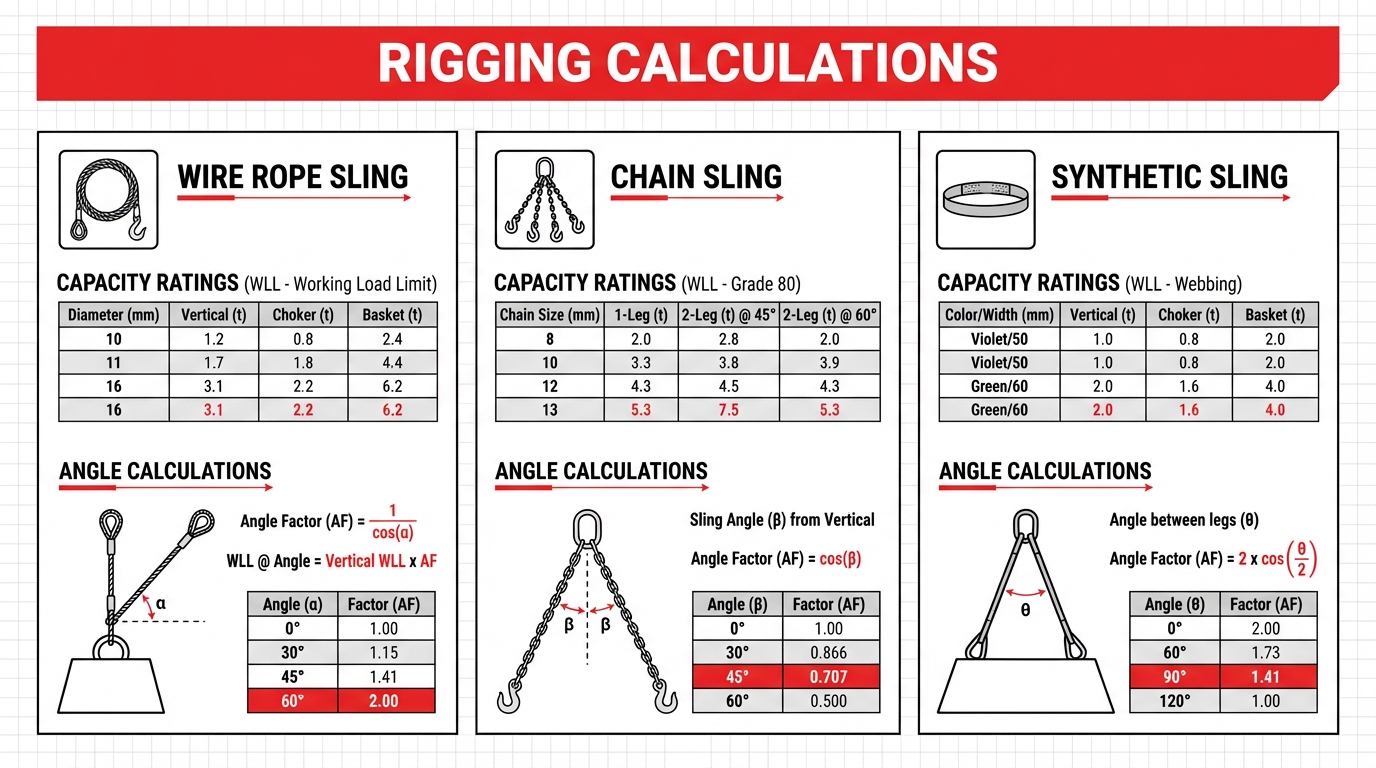
How Do Wire Rope Slings Affect Engineered Lift Calculations?
Wire rope slings affect engineered lift calculations by introducing variables for diameter, construction type, and sling angle that determine rated capacity under load. Every sling used in a lift plan must be verified against its rated limits before the crane leaves the ground.
According to the National Precast Concrete Association’s ASME B30.9 overview, the standard requires that all rigging, such as wire rope and slings, be marked with the manufacturer, diameter or size, and number of legs if more than one. Engineers reference these markings to confirm each sling matches the plan’s specifications.
Sling angle is equally critical. Best practice calls for keeping angles above 30 degrees, because lower angles sharply multiply leg tension. A wire rope sling rated at 10,000 pounds in a vertical hitch loses significant capacity when spread at shallow angles, a factor that must be calculated into every engineered drawing.
How Do Chain Slings Affect Engineered Lift Calculations?
Chain slings affect engineered lift calculations through their grade rating, working load limit, and resistance to heat and abrasion. Alloy steel chain slings, typically Grade 80 or Grade 100, each carry different rated capacities that engineers must specify in the lift drawing.
Unlike wire rope, chain slings tolerate higher operating temperatures without capacity loss, making them essential for foundry or steel production lifts. However, chain is heavier per foot than equivalent-capacity wire rope, so the rigging weight itself factors into total load calculations. Engineers must account for both the payload and the combined chain sling weight when determining crane capacity utilization. For environments involving sharp edges or elevated heat, chain slings often prove the most practical choice in an engineered plan.
How Do Synthetic Slings Affect Engineered Lift Calculations?
Synthetic slings affect engineered lift calculations by offering lighter rigging weight and surface protection for finished loads, while introducing specific environmental limitations. Polyester, nylon, and high-performance aramid fiber slings each have distinct stretch characteristics and chemical resistance profiles that engineers evaluate during plan development.
Synthetic slings conform to irregular load shapes more readily than wire rope or chain, which can simplify rigging geometry in the lift drawing. However, they degrade when exposed to ultraviolet light, certain chemicals, or temperatures above their rated thresholds. These vulnerabilities require engineers to document environmental conditions on the lift plan and specify sling material accordingly. For rental lift operations involving finished architectural or mechanical components, synthetic slings often minimize surface damage while still meeting calculated load requirements.
With rigging hardware specifications defined, professional rigging services can ensure these calculations translate into safe field execution.
How Can Professional Rigging Services Support Your Rental Lift Needs?
Professional rigging services support rental lift needs by providing certified personnel, properly rated equipment, and engineering expertise that align with project-specific lift requirements. The following sections cover how Tway Lifting addresses engineered lift requirements and the key takeaways from this article.
Can Tway Lifting’s Equipment Rentals and Certified Riggers Help With Engineered Lift Requirements?
Yes, Tway Lifting’s equipment rentals and certified riggers can help with engineered lift requirements. Tway Lifting manufactures, sells, and rents rigging equipment, including wire rope slings, synthetic slings, spreader beams rated from 2 to 100 tons, shackles, hoists, and load cells. Certified, factory-trained riggers ensure each piece of rental hardware matches the specifications outlined in an engineered lift drawing.
According to Cad Crowd, engineering design services for professional engineers typically range between $100 and $120 per hour. Pairing those drawings with Tway Lifting’s rental fleet and inspection services reduces the coordination burden on general contractors. With over 75 years of experience and ISO 9001 certification, Tway Lifting brings the technical depth that complex, high-risk lifts demand.
What Are the Key Takeaways About Engineered Drawings for Rental Lifts?
The key takeaways about engineered drawings for rental lifts are:
- Engineered drawings are required for critical lifts that exceed 75 percent of rated crane capacity, involve multiple cranes, or occur near power lines and occupied areas.
- Responsibility for providing drawings depends on the contract; crane rental companies, general contractors, or third-party lift engineers may fulfill this role.
- OSHA regulations under 29 CFR 1926 Subpart CC set the baseline for when engineered planning is mandatory, though site owners may impose stricter requirements.
- Rigging hardware selection, including sling type, angle, and rated capacity, directly affects the calculations within any engineered lift plan.
- Investing in proper engineered drawings before mobilizing rental equipment prevents costly delays, regulatory citations, and serious jobsite injuries.
Tway Lifting combines equipment rentals, certified riggers, and decades of rigging expertise to help project teams meet these requirements safely and efficiently.