



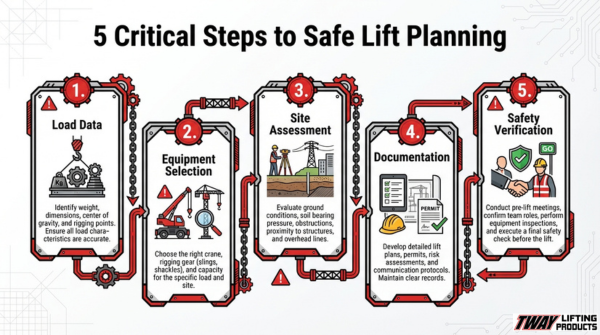

Planning a lift with rented equipment is the process of documenting every variable, from load weight to crew assignments, before unfamiliar machinery arrives on site. Rented cranes, hoists, and rigging lack the operational history your team knows from owned gear, so a written plan bridges that gap and satisfies OSHA Part 1926 Subpart CC requirements.
This guide covers pre-rental data gathering, equipment selection and load chart analysis, lift plan documentation, rental equipment safety verification, regulatory compliance and responsibility, and common planning mistakes to avoid.
Successful lift planning starts with collecting five critical data points: load weight and dimensions, lift radius and height, site conditions including ground bearing capacity, rigging hardware requirements, and environmental factors like wind speed limits. These inputs drive every downstream decision, from crane sizing to sling selection.
Equipment selection depends on matching crane net capacity, hoist type, and sling configuration to your specific load and site. Net capacity requires subtracting all rigging deductions from the gross capacity found on the manufacturer’s load chart, and even a small miscalculation at a long boom radius can push a crane past its tipping threshold.
A complete lift plan documents load specifications, site layout with outrigger positions and swing paths, named personnel roles with standardized communication signals, and contingency procedures for weather changes or mechanical failure.
Rented gear demands extra verification before any pick. Inspection records, load test certificates, and on-site visual checks confirm that every sling, shackle, and structural component meets rated capacity. Gear showing damage, expired certifications, or illegible load tags must be rejected immediately.
The employer controlling the job site, not the rental provider, holds OSHA compliance responsibility from assembly through disassembly. Penalties for serious violations now reach $16,550 per occurrence, making pre-lift meetings and documented role assignments essential for every rental setup.
Why Does Every Lift with Rented Equipment Require a Plan?
Every lift with rented equipment requires a plan because unfamiliarity with the specific machine, its rigging configuration, and the job site creates compounding risks that only a documented plan can control. Without one, crews rely on assumptions instead of verified data, and assumptions are where most lifting accidents begin.
According to Industrial Training International, employers are legally required to designate a qualified lift director and rigging engineer to oversee lifting and rigging operations, ensuring the development of lift plans and adherence to safe rigging practices in accordance with OSHA Part 1926 Subpart CC. This legal obligation exists regardless of whether the equipment is owned or rented.
Rented cranes, hoists, and rigging hardware arrive without the operational history your crew already knows from owned equipment. Load chart nuances, wear patterns, and control responsiveness all vary between units. A lift plan forces the team to evaluate these variables before steel leaves the ground, not during the pick. For any operation involving rented lifting equipment, the plan is both the legal baseline and the practical safeguard that connects unfamiliar gear to a safe outcome.
What Information Do You Need Before Renting Lifting Equipment?
The information you need before renting lifting equipment includes the load weight and dimensions, required lift radius and height, site conditions, rigging hardware, and environmental factors. Each of these data points directly shapes equipment selection and lift safety.
What Are the Load Weight and Dimensions?
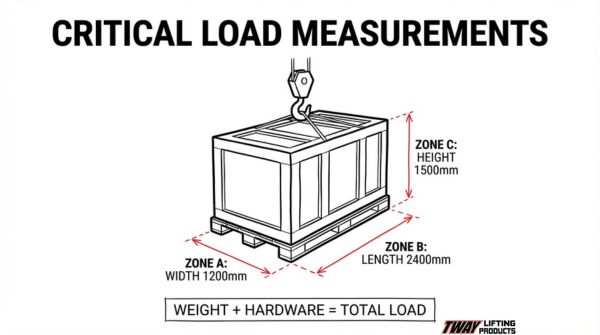
The load weight and dimensions are the most fundamental data points for any lift plan. Accurate weight includes not just the object itself but also rigging hardware, spreader beams, and any below-the-hook attachments that add to the total suspended load.
Dimensions determine the center of gravity, which shifts how the crane must be positioned and how slings are configured. Irregularly shaped loads require careful measurement of length, width, height, and any protruding features. Underestimating either weight or dimensions is one of the fastest paths to an overloaded crane, a topic covered later in this article.
What Is the Required Lift Radius and Height?
The required lift radius and height define the operational envelope the crane must work within. Lift radius measures the horizontal distance from the crane’s center of rotation to the load’s placement point. Lift height is the vertical distance the load must travel, including clearance above any obstacles.
Both values directly affect which crane size and boom configuration will be needed. As radius increases, a crane’s rated capacity decreases significantly, so even a few extra feet of reach can push the job into a larger equipment class. Confirming exact radius and height before contacting a rental provider prevents costly equipment swaps on lift day.
What Are the Site Conditions and Ground Bearing Capacity?
Site conditions and ground bearing capacity determine whether the ground can safely support the crane and its outriggers during a lift. Per OSHA 29 CFR 1926.1402, equipment must not be assembled or used unless ground conditions are firm, drained, and graded sufficiently to meet the manufacturer’s specifications for adequate support and level.
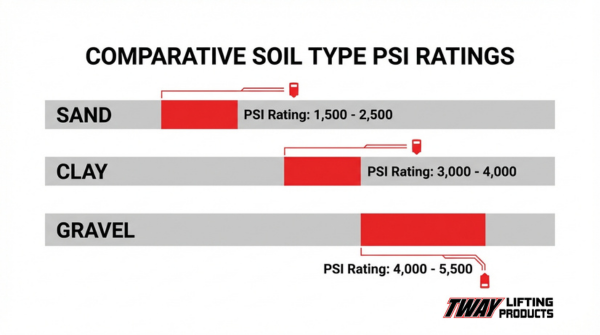
Soil type matters considerably. According to Bigfoot Construction Equipment, estimated ground bearing capacities range from 0.5 to 2 PSI for loose sand and 1 to 2 PSI for soft clay, up to 5 to 12 PSI for compacted gravel. The required outrigger pad area is calculated by dividing the maximum expected load per outrigger by the allowable ground bearing pressure. Overlooking this calculation risks equipment settlement or tip-over.
What Rigging Hardware Does the Lift Require?
The rigging hardware a lift requires includes slings, shackles, hooks, spreader beams, and any specialty below-the-hook devices matched to the load’s weight, shape, and attachment points. Each component must be rated at or above the total load it will bear, with appropriate safety factors applied.
A qualified rigging engineer should verify hardware selection before any rental order is placed. Per Industrial Training International, OSHA Part 1926 Subpart CC requires employers to designate a qualified lift director and rigging engineer to oversee rigging operations and ensure adherence to safe practices. Matching hardware to the specific lift, rather than relying on generic inventory, prevents dangerous mismatches.
What Environmental Factors Could Affect the Lift?
Environmental factors that could affect a lift include wind speed, temperature extremes, precipitation, lightning risk, and proximity to power lines. Wind is the most common disruptor; manufacturers typically restrict lifting operations to wind speeds below 22 miles per hour, though specific limits vary by crane type and configuration.
Temperature extremes affect both equipment performance and rigging material integrity. Rain or ice changes ground bearing capacity and reduces friction on load surfaces. Proximity to energized power lines introduces electrocution hazards requiring minimum approach distances. Assessing these factors before renting ensures the equipment and schedule align with actual jobsite conditions.
With these five data points documented, the next step is selecting the right rented equipment for the lift.
How Do You Select the Right Rented Equipment for a Lift?
You select the right rented equipment for a lift by matching crane capacity, hoist type, sling size, and rigging configuration to your specific load and site requirements. The sections below cover crane selection, hoist matching, sling sizing, and specialty rigging decisions.
How Do You Choose a Crane Based on Load Chart Capacity?
You choose a crane based on load chart capacity by calculating the Net Capacity at your required boom radius and boom length. According to American Crane School, Net Capacity is determined by subtracting all Capacity Deductions, including the main load block, overhaul ball, rigging weight, and any stowed or erected jibs, from the Gross Capacity found at the intersection of boom radius and boom length on the manufacturer’s load chart.
Key selection criteria include:
- Maximum vertical reach needed for the lift height
- Lifting radius from the crane’s center pin to the load placement point
- Job site terrain conditions, such as confined spaces or uneven ground
- Wind speed limits, which commonly restrict operations below 22 miles per hour
Errors in load chart interpretation carry serious consequences. Approximately 90% of crane accidents stem from human error, often tied to inadequate load planning. Always verify that your calculated load, including rigging deductions, falls within the crane’s rated capacity at the actual working radius.
How Do You Match Hoist Type to Lift Application?
You match hoist type to lift application by evaluating the load weight, required lift speed, duty cycle, and workspace constraints. Electric chain hoists suit repetitive, moderate-capacity indoor lifts where precise speed control matters. Manual chain hoists work well for lower-frequency lifts or locations without power access.
Wire rope hoists handle heavier capacities and longer lift distances, making them the standard choice for outdoor construction lifts. Pneumatic hoists are preferred in hazardous or explosive environments where electric spark risks exist. When renting, confirm the hoist’s rated capacity exceeds your rigged load weight, and verify the lift height matches your vertical travel requirement.
How Do You Size Slings for a Rented Equipment Setup?
You size slings for a rented equipment setup by calculating the actual forces each sling leg must bear based on load weight, number of legs, and sling angle. As sling angles decrease from vertical, tension on each leg increases significantly. A two-leg sling at a 60-degree angle from horizontal carries roughly 1.15 times the vertical load per leg.
Steps for proper sling sizing:
- Determine the total rigged load weight, including hardware.
- Identify the number of sling legs and their working angles.
- Apply the appropriate sling angle factor to calculate leg tension.
- Select a sling with a rated capacity exceeding the calculated tension.
- Confirm the sling’s reach length accommodates the load dimensions and hitch type.
When Should You Rent Specialty Rigging Over Standard Gear?
You should rent specialty rigging over standard gear when the lift involves non-standard load geometry, extreme weight distribution, or conditions that exceed the capability of general-purpose slings and shackles. Spreader beams, equalizer beams, and custom lifting frames distribute loads across multiple pick points, preventing structural damage to sensitive equipment.
ASME B30 standards govern design, inspection, and maintenance requirements for specialty lifting devices. Before accepting any rented specialty rigging, verify current load test certification and inspect for rejection criteria such as cracks, deformation, or illegible capacity markings. Standard gear may technically support the weight but fail to control load balance, rotation, or clearance. Renting purpose-built rigging for complex picks reduces risk and often costs less than the consequences of an improvised setup.
With equipment selection finalized, the next step is documenting every detail in a formal lift plan.
What Should a Lift Plan Document Include?
A lift plan document should include load specifications, equipment details, site layout, personnel assignments, communication protocols, and emergency procedures. The sections below break down each required component.
What Load and Equipment Details Belong in the Plan?
Load and equipment details that belong in the plan include the verified gross weight of the load, its dimensions, center of gravity, and any rigging deductions that affect net crane capacity. According to the American Crane School, a crane’s net capacity is determined by subtracting all capacity deductions, such as the weight of the main load block, overhaul ball, rigging, and any stowed or erected jibs, from the gross capacity found at the intersection of boom radius and boom length on the manufacturer’s load chart.
The plan should also document:
- Crane make, model, and configuration selected for the lift.
- Boom length and operating radius at pickup and set points.
- Sling type, rated capacity, and hitch configuration.
- All below-the-hook attachments, including spreader beams or lifting lugs.
- Percentage of the crane’s rated capacity the lift will use.
Recording these figures before mobilization prevents last-minute miscalculations that cascade into unsafe conditions on the ground.
What Site Layout and Positioning Info Is Required?
Site layout and positioning info required in a lift plan includes a scaled diagram showing the crane’s exact placement, swing radius, outrigger footprint, and load travel path. The document must identify overhead obstructions such as power lines, adjacent structures, and any exclusion zones where personnel cannot stand during the lift.
Key positioning elements to map include:
- Outrigger locations with confirmed ground bearing capacity for each pad.
- Load pickup point and final set-down coordinates.
- Tagline routing and clear swing path for the boom arc.
- Access routes for the crane and support vehicles entering the site.
Failing to document even one obstruction within the swing path can force mid-lift improvisation, which is exactly the kind of unplanned decision that turns routine picks into incidents.
What Personnel Roles and Communication Signals Are Needed?
Personnel roles and communication signals needed in a lift plan include every position assigned to the operation and the standardized hand or radio signals each person will use. According to OSHA Outreach Courses, approximately 90% of crane accidents stem from human error, often linked to improper communication, inadequate load planning, or failure to maintain control during hoisting.
At minimum, the plan should assign:
- Lift director responsible for overall operation authority.
- Crane operator certified for the specific equipment type.
- Signal person using ASME/OSHA-standard hand signals or dedicated radio channel.
- Riggers responsible for attaching, securing, and guiding the load.
Each role must be named, not just titled, so every crew member knows exactly who holds authority at each phase of the lift.
What Contingency and Emergency Procedures Should Be Defined?
Contingency and emergency procedures that should be defined cover every foreseeable disruption, from sudden weather changes to mechanical failure or load instability. The plan must specify clear stop-work triggers, including maximum wind speed thresholds; manufacturers commonly restrict lifting operations to below 22 miles per hour, though limits vary by crane type and configuration.
Essential contingency elements include:
- Step-by-step load-set-down sequence if a stop-work order is issued mid-lift.
- Emergency contact list for site medical response and equipment support.
- Evacuation routes for personnel in the crane’s operational zone.
- Procedures for controlled lowering in the event of hydraulic or mechanical failure.
Defining these responses in writing before the crane arrives ensures the crew reacts from a rehearsed protocol rather than improvisation under pressure. With every plan component documented, the next step is verifying that rented equipment meets safety standards before it reaches the site.
How Do You Verify Rented Equipment Is Safe Before the Lift?
You verify rented equipment is safe before the lift by checking inspection records, performing visual inspections, confirming load test certifications, and rejecting any gear that shows damage or missing documentation.
How Do You Confirm OSHA-Compliant Inspection Records?
You confirm OSHA-compliant inspection records by requesting documented proof of periodic and annual inspections from the rental provider before accepting delivery. Every crane, hoist, and rigging component should arrive with inspection logs that include dates, findings, and the name of the qualified inspector who performed the evaluation.
Key records to verify include:
- Annual comprehensive inspection reports covering structural components, safety devices, and mechanical systems.
- Documentation of any repairs or modifications performed since the last inspection cycle.
- Proof that the inspector holds recognized qualifications under OSHA 29 CFR 1926 Subpart CC or applicable ASME B30 standards.
Per OSHA regulation, for violations assessed after January 2025, serious penalties reach $16,550 per violation, while willful violations carry fines up to $165,514. Missing or incomplete inspection documentation is one of the most avoidable reasons a lift gets shut down, so treating record verification as non-negotiable protects both compliance and schedule.
What Pre-Lift Visual Inspections Should You Perform?
Pre-lift visual inspections should cover every rented component that will bear or control the load. These checks happen on-site, immediately before rigging begins, regardless of what the rental provider’s paperwork states.
Inspect the following:
- Wire rope slings for broken wires, kinking, bird-caging, and corrosion.
- Shackles, hooks, and connectors for cracks, deformation, and legible load ratings.
- Synthetic slings for cuts, abrasive wear, heat damage, and acid burns.
- Hoist brakes and controls for proper function during no-load testing.
- Spreader beams and lifting frames for visible weld cracks, bent members, or missing pins.
A qualified rigger or competent person should perform these checks. Even well-maintained rental fleets experience wear during transit, so the on-site visual inspection remains your last line of defense before committing to a lift.
How Do You Verify Load Testing and Certification on Rentals?
You verify load testing and certification on rentals by requesting the most recent load test certificate and confirming its validity period. According to OSHA regulation 29 CFR 1910.179(k)(2), rated load tests are mandatory for all new and altered cranes, with test loads not exceeding 125% of the rated load unless otherwise specified by the manufacturer, and unit proof tests are required before initial use and subsequently every four years.
Essential verification steps include:
- Confirming the test date falls within the required interval for that equipment type.
- Matching the serial number on the certificate to the actual unit delivered.
- Checking that the tested capacity meets or exceeds your lift plan requirements.
Never assume a rental unit has current load testing simply because it arrived from a reputable provider. Asking for certificates upfront avoids costly delays if documentation gaps surface during a job site audit.
What Condition Issues Should Cause You to Reject Rented Gear?
Condition issues that should cause you to reject rented gear include any defect that compromises rated capacity, structural integrity, or safe operation. According to ASME B30.9, synthetic round slings must be removed from service if they exhibit missing or illegible identification, acid or caustic burns, evidence of heat damage, or holes, tears, cuts, or abrasive wear that expose core yarns.
Reject rented equipment immediately if you find:
- Illegible or missing load tags, serial numbers, or manufacturer identification.
- Visible cracks, gouges, or deformation on hooks, shackles, or structural members.
- Wire rope with excessive broken wires, crushing, or corrosion beyond allowable limits.
- Chain slings with stretched, twisted, or gouged links.
- Any component that has been modified without documented engineering approval.
Refusing compromised gear is not overcaution; it is a legal obligation. Documenting the rejection with photos and written notes protects your team and creates a clear record if disputes arise with the rental provider. With equipment safety confirmed, attention shifts to clarifying who holds responsibility throughout the lift.
Who Is Responsible for Safety When Using Rented Lift Equipment?
The employer controlling the job site holds primary responsibility for safety when using rented lift equipment. OSHA Part 1926 Subpart CC assigns duty to the entity directing crane operations, regardless of equipment ownership. This means the renting company, not the rental provider, must ensure competent personnel operate the equipment, ground conditions meet manufacturer specifications, and all rigging complies with applicable standards.
Responsibility spans several roles and functions:
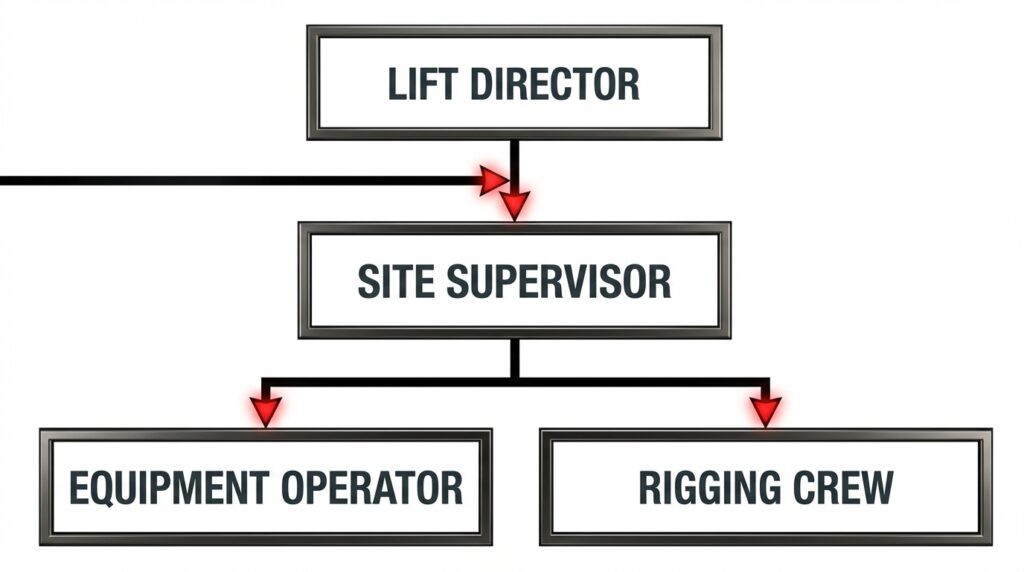
- The lift director oversees the entire operation and confirms the lift plan is followed.
- The equipment operator must hold valid certification for the specific crane type being used.
- The rigging crew is accountable for proper sling selection, connection integrity, and load security.
- The site supervisor verifies ground preparation, swing radius clearance, and pedestrian exclusion zones.
According to OSHA Outreach Courses, approximately 90% of crane accidents are attributed to human error, often stemming from improper communication, inadequate load planning, or failure to maintain control during hoisting operations. This statistic reinforces why clearly defined roles matter more than the equipment’s rental status.
Rental providers typically bear responsibility for delivering equipment in safe, mechanically sound condition and providing current inspection documentation. Once the equipment arrives on site, however, operational safety transfers to the employer. Pre-lift inspections, load chart verification, and personnel qualifications all fall under the renting party’s obligation. Failing to assign clear accountability across these roles is one of the most common and preventable breakdowns in rental lift planning. With responsibilities defined, understanding which OSHA regulations govern these operations adds the legal framework behind each role.
What OSHA Regulations Apply to Lifts Using Rented Equipment?
The OSHA regulations that apply to lifts using rented equipment fall primarily under 29 CFR 1926 Subpart CC, which governs cranes and derricks in construction. This standard addresses ground conditions, equipment assembly, operator qualifications, and lift planning requirements that apply regardless of whether the equipment is owned or rented.
Under 29 CFR 1926.1402, equipment must not be assembled or used unless ground conditions are firm, drained, and graded sufficiently so that the equipment manufacturer’s specifications for adequate support and degree of level are met. This requirement places direct responsibility on the entity controlling the job site, not the rental provider. For rented equipment specifically, the controlling entity must verify that the crane or hoist meets every condition outlined in Subpart CC before operations begin.
Penalty exposure reinforces why compliance matters. According to the Occupational Safety and Health Administration, OSHA violations assessed after January 15, 2025, carry a maximum penalty of $16,550 per serious violation and $165,514 per willful or repeated violation. These penalties apply to the employer directing the lift, even when using rented equipment. Ignorance of a rental unit’s condition or certification status does not reduce liability.
Key Subpart CC requirements applicable to rented lift equipment include:
- The controlling entity must ensure ground preparation meets manufacturer specifications before crane setup.
- Operators must hold valid certifications recognized under 29 CFR 1926.1427.
- A qualified person must inspect the equipment before each shift per 29 CFR 1926.1412.
- Lift planning and load chart compliance are mandatory, not optional, for every crane operation.
- Signal persons and riggers must meet competency standards defined within Subpart CC.
Renting equipment does not transfer regulatory obligations to the rental company. The employer who directs the work bears OSHA compliance responsibility from assembly through disassembly. Understanding these requirements before the pre-lift meeting ensures the entire operation stays within legal and safety boundaries.
How Do You Conduct a Pre-Lift Meeting for a Rental Setup?
You conduct a pre-lift meeting for a rental setup by gathering all personnel at the job site before any load leaves the ground to review the lift plan, confirm equipment readiness, and assign roles. This meeting covers load details, communication signals, hazard awareness, and emergency procedures specific to the rented equipment being used.
A thorough pre-lift meeting begins with the lift director or competent person walking the crew through the documented lift plan. Each participant should understand the load weight, rigging configuration, crane positioning, and planned load path. When rented equipment is involved, additional focus is needed on any operational differences between the rental unit and equipment the crew may be more familiar with.
Key topics every pre-lift meeting for a rental setup should address include:
- Load specifics: Confirmed weight, center of gravity, dimensions, and rigging attachment points.
- Equipment verification: Rental crane capacity at the planned radius, inspection status, and any operational limitations noted during the pre-use check.
- Personnel assignments: Designated crane operator, signal person, riggers, and lift director, with each person confirming they understand their role.
- Communication protocol: Agreed-upon hand signals or radio channels, including who has stop authority.
- Hazard review: Overhead power lines, adjacent structures, ground conditions, wind limits, and pedestrian exclusion zones.
- Emergency procedures: Steps for controlled load set-down, evacuation routes, and who contacts emergency services.
According to OSHA Outreach Courses, approximately 90% of crane accidents are attributed to human error, often stemming from improper communication, inadequate load planning, or failure to maintain control during hoisting operations. A structured pre-lift meeting directly targets these failure points by ensuring every crew member shares the same operational picture before work begins.
For rental setups specifically, the meeting should also confirm that all rented rigging hardware has been visually inspected and that certification documents are on-site. Any unfamiliar controls, load moment indicators, or safety devices on the rented crane should be demonstrated to the operator and reviewed with the crew. Skipping this step with rental equipment, where crews may lack hands-on familiarity, significantly increases risk.
The lift director should document attendance and key discussion points. This record serves as proof of compliance and provides a reference if conditions change mid-lift. With clear communication established during the pre-lift meeting, teams operating rented equipment can execute lifts with the same confidence and safety margins as operations using owned machinery.
What Common Mistakes Happen When Planning Lifts with Rentals?
Common mistakes when planning lifts with rentals include underestimating load weight, ignoring site conditions, skipping rigging inspections, and using mismatched slings or hardware. Each error introduces preventable risk that can escalate into equipment failure, injuries, or regulatory penalties.
What Happens If You Underestimate the Load Weight?
Underestimating the load weight causes the crane to operate beyond its rated capacity, which can lead to structural failure, tip-over, or dropped loads. Many planners account for the primary load but forget to include rigging weight, such as shackles, slings, spreader beams, and the load block itself. According to the American Crane School, a crane’s net capacity requires subtracting all capacity deductions, including the main load block, overhaul ball, rigging, and any stowed or erected jibs, from the gross capacity found on the manufacturer’s load chart.
Even a 5% miscalculation at a long boom radius can push a crane past its tipping threshold. This is one of the most avoidable errors in lift planning, yet it remains one of the most common.
What Goes Wrong When Site Conditions Are Not Assessed?
Site conditions that are not assessed create unstable foundations for cranes and hoists, increasing the risk of settlement, shifting, or outrigger punch-through during loaded lifts. Soft clay, loose fill, underground voids, and uneven grading all compromise stability.
Ground bearing capacities vary significantly by soil type:
- Loose sand supports approximately 0.5 to 2 PSI.
- Soft clay supports approximately 1 to 2 PSI.
- Compacted gravel supports approximately 5 to 12 PSI.
The required outrigger pad area is calculated by dividing the maximum expected load per outrigger by the allowable ground bearing pressure. Failing to perform this calculation before mobilizing rented equipment wastes time and money at best, and causes catastrophic crane failure at worst.
Why Is Skipping Rigging Inspections on Rentals Dangerous?
Skipping rigging inspections on rentals is dangerous because rented equipment may arrive with hidden wear, damage, or expired certifications that compromise load-bearing integrity. Unlike owned gear, rental rigging may have been used across multiple job sites under varying conditions, and its maintenance history is not always transparent.
According to OSHA Outreach Courses, approximately 90% of crane accidents are attributed to human error, often stemming from improper communication, inadequate load planning, or failure to maintain control during hoisting operations. Pre-lift inspections are the last line of defense against putting compromised components into service. Never assume rented rigging is lift-ready simply because it came from a rental provider.
What Risks Come from Mismatched Slings or Hardware?
Mismatched slings or hardware introduce uneven load distribution, reduced working load limits, and potential rigging failure during a lift. Using a sling with an insufficient capacity rating, incompatible hook size, or wrong material type for the application can cause the entire rigging assembly to become the weakest link.
According to ASME B30.9, synthetic round slings must be removed from service if they exhibit conditions such as missing or illegible identification, acid or caustic burns, evidence of heat damage, or holes, tears, cuts, or abrasive wear that expose core yarns. Proper sling selection requires matching material, capacity, and hitch type to the specific load characteristics documented in the lift plan.
With these planning pitfalls identified, partnering with an experienced rigging provider helps prevent them from reaching the job site.
How Can Tway Lifting’s Rental and Rigging Services Support Your Lift Plan?
Tway Lifting’s rental and rigging services support your lift plan by providing inspected equipment, certified expertise, and comprehensive rental options that simplify every phase of planning.
Can Tway Lifting’s Equipment Rentals and Inspections Simplify Your Lift Planning?
Yes, Tway Lifting’s equipment rentals and inspections can simplify your lift planning. With over 75 years of experience as a rigging manufacturer and distributor, Tway Lifting offers a rental fleet that includes wire rope slings, synthetic slings, spreader beams rated from 2 to 100 tons, shackles, hoists, load cells, and telescopic adjustable length bars. Every rental undergoes professional rigging inspection performed by certified, factory-trained specialists who verify OSHA compliance before the equipment reaches your site.
Tway Lifting also provides custom fabrication for specialized lifting assemblies when standard gear cannot meet unique load or configuration requirements. Free local delivery and pickup from the Indianapolis and Fort Wayne superstores reduce logistical burden, while same-day wire rope sling fabrication keeps tight project schedules on track.
What Are the Key Takeaways About Planning a Lift with Rented Equipment?
The key takeaways about planning a lift with rented equipment center on preparation, verification, and compliance:
- Every lift requires a documented plan that accounts for load weight, lift radius, site conditions, and personnel roles.
- Crane selection must be driven by load chart analysis, where net capacity is calculated after subtracting all rigging deductions from gross capacity.
- Ground bearing capacity must be confirmed before equipment setup, with outrigger pad sizing matched to soil conditions.
- All rented slings, shackles, and hardware need pre-lift visual inspection, and any gear showing damage such as exposed core yarns or illegible identification tags must be rejected immediately.
- Wind speed limits, typically below 22 miles per hour, must factor into scheduling decisions.
- OSHA Part 1926 Subpart CC requires a qualified lift director and rigging engineer to oversee every operation.
Partnering with a full-service provider like Tway Lifting, which manufactures, rents, inspects, and repairs rigging equipment under one roof, removes gaps between planning and execution.