







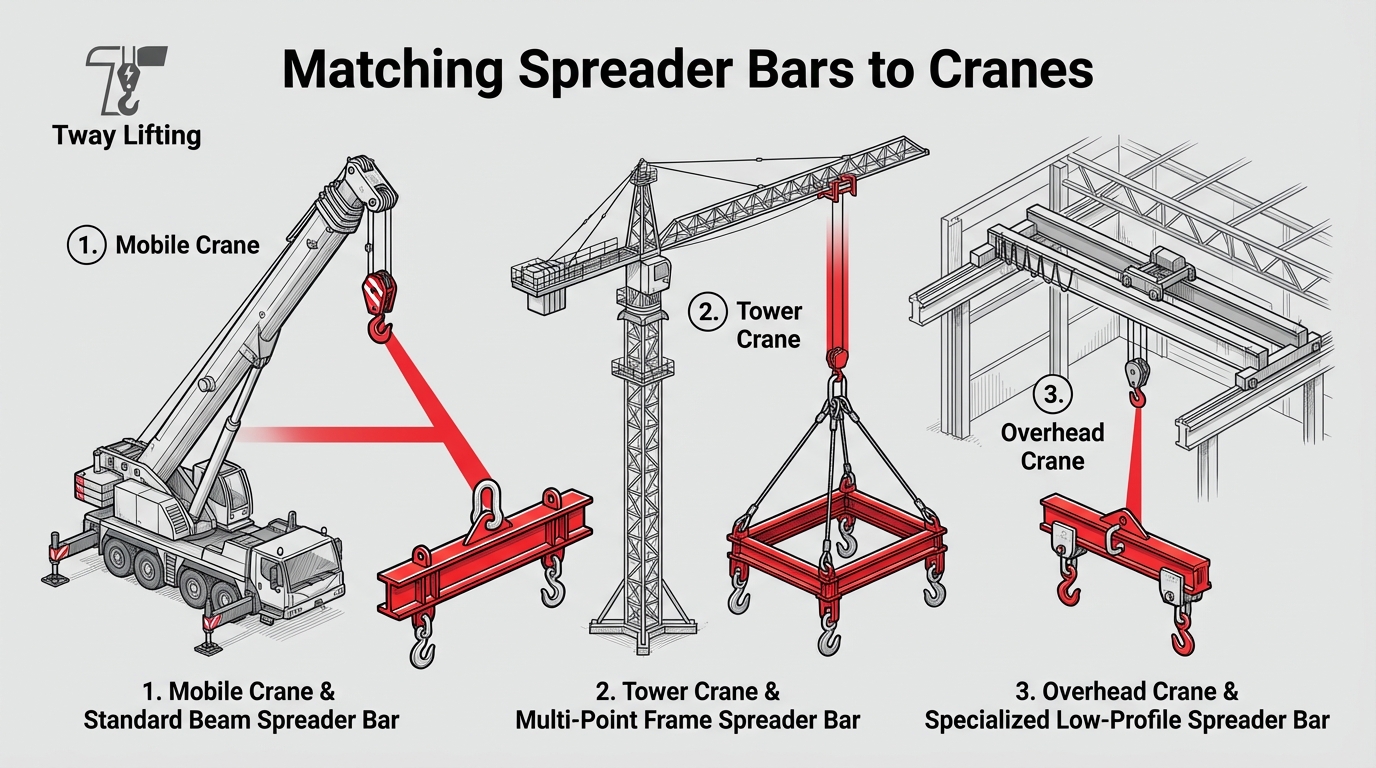

A spreader bar is a rigid compression member that distributes lifting loads across wider sling attachment points, and matching it correctly to a specific crane type is essential for safe, stable rigging. This guide covers spreader bar fundamentals and selection factors, crane-specific matching for mobile, tower, overhead bridge, gantry, and derrick cranes, spreader bar types and configurations, regulatory compliance, common mistakes, and custom rigging solutions.
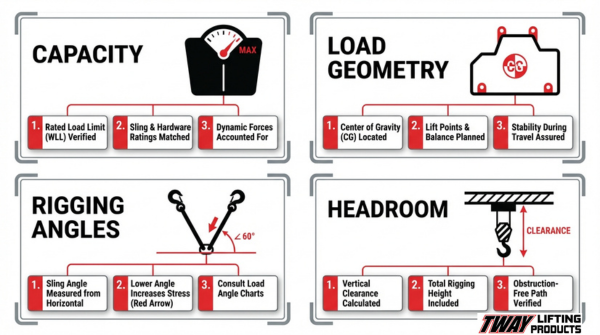
Spreader bar selection starts with core engineering variables. Crane lifting capacity sets the absolute ceiling for what the bar can handle, while load weight and geometry dictate the bar’s length, pick point placement, and sling arrangement. Rigging angles control compressive forces within the bar; as sling angles decrease from vertical, those forces increase dramatically. Available headroom determines whether a standard bar fits or a low-profile alternative is required.
Each crane category imposes distinct constraints. Mobile cranes ranging from hydraulic truck cranes to crawlers demand bars matched to capacity ranges spanning 2,000 lbs up to 250 tons, with ruggedness and portability varying by subtype. Tower cranes require compact vertical profiles and lightweight, high-strength bars that preserve payload capacity at extended boom radii. Overhead bridge cranes and gantry cranes operate within fixed runway spans and indoor clearance limits that set hard dimensional boundaries for bar sizing.
Fixed-length, adjustable, modular, and rotating spreader bars each serve different crane configurations. Fixed bars offer maximum rigidity for repetitive lifts, adjustable models adapt to varying load widths, modular systems scale from 6 to 2,000 tons, and rotating bars enable precision positioning in tight spaces.
OSHA 1926.251 and ASME BTH-1 mandate proof-testing to 125% of rated load, documented inspections, and proper safe working load markings on every below-the-hook device. When standard equipment falls short, custom fabrication and rental from Tway Lifting close the gap between job demands and available rigging solutions.
What Is a Spreader Bar and Why Does It Matter for Crane Lifts?
A spreader bar is a rigid compression member used in crane rigging to widen the distance between sling attachment points, distributing load forces evenly and preventing sling-induced crushing on the lifted object. Spreader bars convert vertical lifting loads into compressive forces within the bar and tensile forces in the attached slings, which stabilizes asymmetric or wide loads during crane operations.
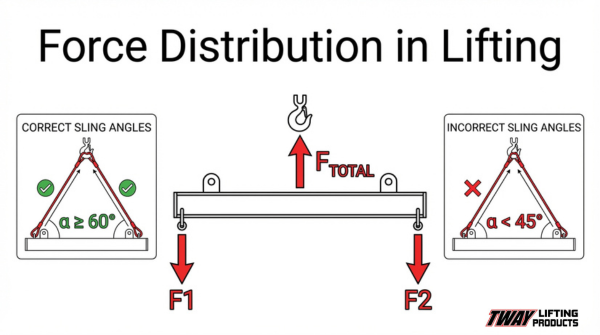
Composed typically of square or round steel tubes, spreader bars function as axial compression members. The compressive force in a symmetric two-point top lift follows the formula C = W / (2 × tanθ), where W equals total lifted weight and θ represents the sling angle from horizontal. As sling angles decrease, compressive loads on the bar increase dramatically, making proper bar selection critical for every crane configuration.
This distinction matters because mismatched spreader bars are a leading contributor to dropped-load incidents. According to an IBRT study, approximately 27% of crane-related fatalities result from dropped loads, with poor rigging identified as the most common root cause. The consequences of selecting the wrong bar extend beyond equipment damage; “crushed by the load” incidents account for 33.8% of all crane fatalities and 36.8% of all injuries.
For crane operators and lift planners, the spreader bar is not an accessory. It is a load-critical structural component that directly affects whether a lift succeeds or fails. Different crane types impose unique constraints on spreader bar selection, including:
- Lifting capacity and boom configuration
- Available headroom and vertical clearance
- Rigging geometry and sling angles
- Site terrain and environmental conditions
- Regulatory compliance under OSHA and ASME standards
Each of these factors changes which bar type, size, and configuration will perform safely. Understanding what a spreader bar does, and why its role varies by crane type, is the foundation for every matching decision that follows.
What Factors Determine the Right Spreader Bar for a Crane?
The right spreader bar for a crane depends on lifting capacity, load characteristics, rigging geometry, and available headroom. The following sections break down how each factor shapes the selection process.
How Does Crane Lifting Capacity Affect Spreader Bar Selection?
Crane lifting capacity affects spreader bar selection by setting the absolute ceiling for what the bar and rigging assembly can safely handle. The spreader bar’s rated capacity must fall within the crane’s allowable load chart at the planned radius and configuration; exceeding either limit creates catastrophic failure risk.
Capacity ranges vary dramatically across crane types. Gantry cranes used in construction and industrial environments typically range from 10 tons to over 500 tons, according to IQS Directory. Failing to match a bar to these ranges is among the most common critical errors, which include using uncertified attachments that lack proper locks and neglecting even load distribution. These mistakes strain hook mechanisms and compromise lift stability. Every spreader bar must be rated, certified, and matched to the specific crane’s working load limit before any pick begins.
How Does Load Weight and Geometry Influence the Choice?
Load weight and geometry influence the choice by determining both the bar’s required capacity and its physical dimensions. A spreader bar must support the total suspended weight while matching the load’s shape to maintain balance during the lift.
Symmetrical loads allow standard two-point top rigging with evenly distributed sling forces. Asymmetrical or irregularly shaped loads shift the center of gravity away from the geometric center, requiring offset pick points or multiple-bar configurations. Longer loads need wider spreads to keep sling angles manageable and prevent inward crushing forces on the object. Load weight dictates the bar’s structural rating, but geometry dictates its length, pick point placement, and sling arrangement. Ignoring geometry while focusing solely on weight is one of the fastest paths to an unstable lift.
How Do Rigging Angles Impact Spreader Bar Requirements?
Rigging angles impact spreader bar requirements by directly controlling the compressive force the bar must withstand. As sling angles decrease from vertical, compressive loads on the bar increase exponentially.
Spreader bars function as compression members where axial compression is calculated as C = W / (2 × tanθ), with W representing total lifted weight and θ representing the sling angle measured from horizontal, as detailed by Holloway Houston Inc. A steep angle near 90 degrees produces minimal compression, while a shallow 30-degree angle can more than double the force acting on the bar. This relationship means a bar rated for the load’s weight alone may still fail if rigging angles are too shallow. Maintaining sling angles above 45 degrees from horizontal is a practical baseline that keeps compressive forces within manageable limits for most standard spreader bars.
How Does Lift Height and Headroom Change the Decision?
Lift height and headroom change the decision by limiting the vertical space available for the spreader bar, slings, and rigging hardware between the crane hook and the load. Insufficient headroom forces the use of low-profile bars or shorter sling configurations.
Overhead bridge cranes illustrate this constraint clearly:
- Low-capacity units (1 to 10 tons) typically need 8 to 10 feet of headroom.
- Medium-capacity units (15 to 30 tons) require 12 to 15 feet.
- High-capacity units (40 tons and above) often necessitate 18 to 20 feet or more.
When vertical clearance is tight, standard spreader bars with long sling legs may not fit. Low-headroom lifting beams, which load through bending rather than compression, occupy less vertical space and become the preferred alternative. For practitioners, headroom should be measured and verified before selecting any below-the-hook device, not assumed from general facility specs.
With these selection factors established, the next step is matching specific bar types to individual crane categories.
Which Spreader Bar Works Best for Mobile Cranes?
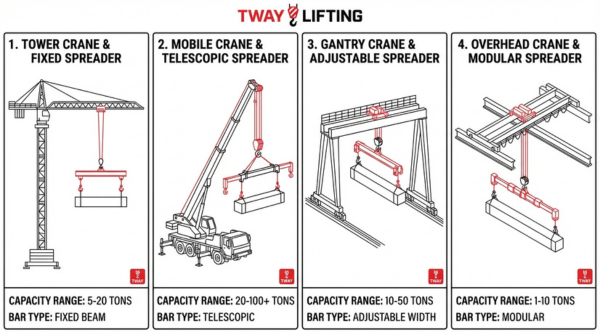
The best spreader bar for a mobile crane depends on the crane subtype, its lifting capacity, and jobsite conditions. Each mobile crane category presents distinct rigging demands, covered below for hydraulic truck cranes, rough terrain cranes, all-terrain cranes, and crawler cranes.
What Spreader Bars Suit Hydraulic Truck Cranes?
Spreader bars that suit hydraulic truck cranes are lightweight, fixed-length or adjustable models rated within the crane’s capacity range. Hydraulic truck cranes offer high on-road speed and quick setup, with lifting capacities from roughly 2,000 to over 14,000 lbs for service models. Larger hydraulic boom trucks achieve significantly higher capacities, though performance depends heavily on boom angle and extension.
Because these cranes frequently handle short-duration lifts across multiple jobsites, compact spreader bars that minimize setup time are ideal. Adjustable spreader bars in the 2- to 10-ton range work well for general picks, while heavier boom truck applications may require custom-rated bars matched precisely to the load chart at specific boom angles.
What Spreader Bars Suit Rough Terrain Cranes?
Spreader bars that suit rough terrain cranes are rugged, mid-capacity models designed to handle dynamic field conditions. Rough terrain cranes operate on off-road construction sites with difficult or uneven ground. According to BVM Transport, these cranes feature lifting capacities typically ranging from 15 to 100 tons, with large heavy-duty tires and all-wheel steering for superior maneuverability.
Spreader bar selection for these cranes must account for:
- Ground instability that can shift load angles during a pick.
- Mid-range capacities requiring bars rated between 10 and 50 tons for most applications.
- Frequent repositioning, which favors adjustable or modular designs that adapt to varying lift geometries.
Fixed-length bars work for repetitive picks at a single site, but adjustable models provide the flexibility rough terrain work typically demands.
What Spreader Bars Suit All-Terrain Cranes?
Spreader bars that suit all-terrain cranes range from standard adjustable models to high-capacity modular systems, matching the crane’s exceptionally broad performance envelope. All-terrain mobile cranes in the LTM series offer maximum load capacities from 35 tons to 1,200 tons with hoist heights reaching up to 188 meters.
This wide capacity spectrum means spreader bar selection varies dramatically by application. Lighter all-terrain picks may use standard adjustable bars, while heavy lifts at extended boom lengths often require modular spreader beams rated to several hundred tons. For the largest all-terrain cranes, the spreader bar’s self-weight becomes a meaningful deduction from net lifting capacity, making engineered, weight-optimized designs essential.
What Spreader Bars Suit Crawler Cranes?
Spreader bars that suit crawler cranes are heavy-duty, high-capacity models built for sustained, large-scale lifting operations. Hydraulic crawler cranes feature maximum lifting capacities from 50 to 250 US tons, with telescopic boom lengths between 35 and 223 feet and the ability to pick and carry loads across difficult terrain.
Crawler crane lifts often involve:
- Oversized or heavy structural components requiring modular spreader beams rated above 50 tons.
- Pick-and-carry operations where the spreader bar must maintain load stability during crane travel.
- Extended boom configurations that reduce net capacity, demanding precise bar weight calculations.
Modular systems offer the best versatility here, since components can be reconfigured for different spans without mobilizing entirely new equipment. Understanding each mobile crane subtype’s unique operating profile ensures the spreader bar protects both the load and the crane’s structural limits.
Which Spreader Bar Works Best for Tower Cranes?
The best spreader bar for tower cranes is typically a fixed-length or modular design rated for high capacity with a compact vertical profile. Limited headroom beneath the jib and long boom radii create unique constraints covered below.
How Does Limited Headroom on Tower Cranes Affect the Bar?
Limited headroom on tower cranes affects the bar by restricting the vertical space available for sling geometry, which forces riggers toward shorter sling legs and wider sling angles. Tower cranes are essential for high-rise construction, yet they often feature fixed jib angles and obstacle-laden environments where headroom and swing radius are limited, according to Crane Operations (book source). These conditions increase axial compression loads on the spreader bar because steeper sling angles reduce the vertical component of force.
Low-profile spreader bars or lifting beams with top-rigged attachment points minimize the height consumed between the hook and the load. For most tower crane applications, selecting a bar that keeps the rigging envelope as compact as possible is the safest approach to preserving usable lift height.
How Do Long Boom Radii on Tower Cranes Change Requirements?
Long boom radii on tower cranes change requirements by reducing available lifting capacity at the hook as distance from the mast increases. Tower crane load charts show significant capacity drops at extended radii, meaning the spreader bar’s own weight becomes a more critical factor in the overall lift plan.
Lightweight spreader bars with high strength-to-weight ratios suit long-radius picks because every pound of below-the-hook equipment subtracts directly from payload capacity. Modular spreader beams work well here since components can be configured to match exact span needs without carrying excess structural weight. Riggers should also account for wind-induced swing at longer radii, which can generate dynamic side loads the bar must withstand.
Understanding these tower crane constraints helps inform how spreader bars perform under the very different conditions of overhead bridge cranes.
Which Spreader Bar Works Best for Overhead Bridge Cranes?
The spreader bar that works best for overhead bridge cranes is a fixed-length or low-profile model sized to fit the crane’s runway span and indoor headroom constraints. Key factors include runway width and vertical clearance limits.
How Does Fixed Runway Span Affect Spreader Bar Sizing?
Fixed runway span affects spreader bar sizing by establishing a hard dimensional limit that the bar cannot exceed. Unlike mobile cranes that operate in open environments, overhead bridge cranes travel along fixed rails set at a permanent width. The spreader bar must fit within this span while leaving clearance on both sides to prevent contact with the runway structure or building columns.
Selecting a bar length too close to the full span creates collision risk during trolley travel. For most installations, the effective spreader bar length should remain several feet shorter than the total runway width. Adjustable spreader bars offer some flexibility here, but only within the fixed span boundary. This is one area where precise facility measurements matter more than catalog specifications alone.
How Do Indoor Clearance Limits Affect Spreader Bar Design?
Indoor clearance limits affect spreader bar design by restricting the total vertical space available for the bar, rigging, and load combined. According to Yuantai Better Crane, overhead bridge cranes require varying headroom based on capacity: low-capacity units (1–10 tons) typically need 8–10 feet, medium-capacity units (15–30 tons) require 12–15 feet, and high-capacity units (40 tons and above) often necessitate 18–20 feet or more of vertical clearance.
Every inch of spreader bar depth and rigging height subtracts from usable lift height. Low-profile spreader bars minimize this loss by reducing the overall below-the-hook assembly height. Facilities with tight overhead clearance should prioritize:
- Low-profile spreader bars that reduce vertical stack-up.
- Shorter sling configurations to maximize remaining headroom.
- Fixed-length designs that eliminate unnecessary adjustment hardware adding depth.
For operations running indoor bridge cranes at or near capacity, choosing the right spreader bar geometry is often more critical than choosing the right tonnage rating. Understanding gantry crane applications reveals similar headroom considerations in constrained environments.
Which Spreader Bar Works Best for Gantry Cranes?
The spreader bar that works best for gantry cranes depends on load capacity, headroom constraints, and whether the crane operates indoors or outdoors. Gantry cranes range from 10 tons to over 500 tons in capacity, and headroom between the beam and hook is a critical design factor in spatially constrained areas. Fixed-length spreader bars suit repetitive lifts with consistent load dimensions, while adjustable spreader bars accommodate variable load widths across different projects. For high-capacity gantry operations exceeding 50 tons, modular spreader beams offer the versatility to configure different spans without requiring multiple dedicated bars.
Indoor gantry setups with low ceilings often demand low-profile lifting beams that minimize vertical space consumption. Outdoor gantry cranes handling heavy structural steel or precast elements benefit from robust fixed bars rated well above the maximum anticipated load. Sling angles deserve close attention in gantry applications because the trolley’s fixed travel path limits repositioning options. When sling angles fall below 45 degrees from horizontal, compressive forces on the bar increase substantially, as axial compression follows the formula C = W / (2 × tan θ), where W is the total lifted weight and θ is the sling angle. Selecting a bar rated for these amplified forces prevents buckling under load.
According to a 2024 Growth Market Reports analysis, the global spreader bar market was valued at USD 765.4 million and is projected to reach USD 1,238.7 million by 2033, reflecting growing demand across crane types including gantry systems. This growth underscores the expanding range of specialized bar configurations now available for gantry crane operators. For operations running gantry cranes on recurring schedules, ownership of standard bars under 20-ton capacity typically becomes cost-effective when annual usage exceeds 30 to 35 days, while higher-capacity or specialized configurations often favor rental arrangements that include traceable inspection documentation.
Matching the right spreader bar to a gantry crane ultimately requires balancing structural capacity, dimensional fit within the crane’s working envelope, and compliance with ASME BTH-1 design factors. Understanding these constraints for derrick cranes presents its own distinct set of challenges.
Which Spreader Bar Works Best for Derrick Cranes?
The spreader bar that works best for derrick cranes depends on the crane’s unique boom and mast configuration, the operating environment, and the load geometry involved. Derrick cranes, which can be fixed or mobile, operate in specialized settings such as high-rise construction and oil rig installations where standard rigging approaches often fall short.
Because derrick cranes rely on a distinct boom-and-mast arrangement rather than a conventional telescopic or lattice boom, the spreader bar must be matched to site-specific load paths and clearance constraints. Fixed-length spreader bars suit repetitive derrick lifts with consistent load dimensions. Adjustable or modular spreader bars offer greater flexibility for variable loads encountered across multi-phase derrick operations, particularly on congested platforms or rooftops where repositioning is limited.
According to ZTM Tower Crane, derrick crane load capacity calculation requires a deep understanding of the crane’s unique boom and mast configuration to ensure safe operation. This complexity makes spreader bar selection more demanding than for conventional crane types, since the sling angles and connection points must align precisely with the derrick’s structural geometry.
For most derrick crane applications, prioritizing a spreader bar with clearly rated capacity, certified proof-testing documentation, and compatibility with the derrick’s specific rigging points is more critical than choosing the most versatile design. Understanding the next section on spreader bar types helps clarify which configuration fits best.
What Are the Main Types of Spreader Bars Used in Lifting?
The main types of spreader bars used in lifting are fixed-length, adjustable, modular, and rolling or rotating designs. Each type serves different crane configurations and load requirements.
Fixed-Length Spreader Bars
Fixed-length spreader bars are one-piece compression members built to a single, predetermined span. They offer the highest structural rigidity because there are no telescoping joints or connection points that could introduce flex under load. This simplicity makes them the most cost-effective option for repetitive lifts where the load geometry stays consistent. Fixed-length bars work well with overhead bridge cranes and gantry cranes that handle standardized loads on the same runway day after day. However, their lack of versatility means a facility may need multiple bars to cover different load widths, increasing storage demands.
Adjustable Spreader Bars
Adjustable spreader bars feature telescoping inner sections that allow operators to change the working span without swapping equipment. Standard models offer rated lifting capacities from 2 tons to 10 tons with adjustable spreads from 4 feet to 20 feet, while heavy-duty versions handle up to 50 tons, according to US Cargo Control. This adaptability makes them ideal for mobile crane operations, particularly hydraulic truck cranes and rough terrain cranes that encounter varying load dimensions across job sites. Pin-lock mechanisms secure each length setting, though operators must verify the correct pin placement before every lift to maintain rated capacity.
Modular Spreader Bars
Modular spreader bars use interchangeable end units and center sections that bolt together in different combinations to create custom spans and capacities. This design allows a single set of components to serve dozens of rigging configurations. DNV Type Approved modular systems from manufacturers like Modulift offer capacities ranging from 6 tons to 2,000 tons. The mix-and-match approach reduces the total inventory a contractor needs to own or rent, which is particularly valuable for crawler crane projects and heavy civil work where load dimensions shift frequently. Modular systems do require more setup time than fixed or adjustable bars.
Rolling or Rotating Spreader Bars
Rolling or rotating spreader bars incorporate a controlled rotation mechanism that allows the load to pivot horizontally during the lift. These bars enable precision positioning of out-of-balance loads or loads in environments with limited maneuvering space, while maintaining the compressive integrity of the bar. The rotating mechanism requires careful calibration to ensure load stability throughout the lift cycle. Tower crane and derrick crane applications benefit most from this capability, especially when placing structural steel or mechanical equipment into tight openings. For most lifting professionals, rotating bars represent the most specialized category and justify rental over ownership unless rotation is needed on a daily basis.
With the main spreader bar types defined, understanding the regulatory standards behind them ensures each selection meets compliance requirements.
How Do OSHA and ASME Standards Apply to Spreader Bar Selection?
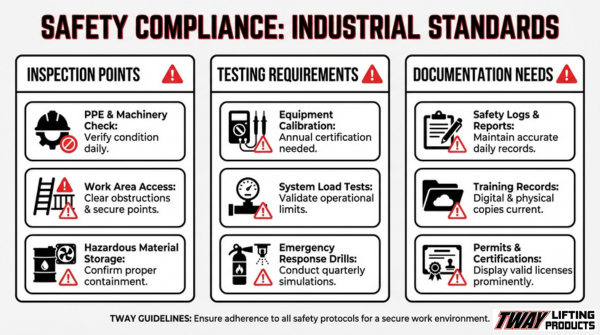
OSHA and ASME standards apply to spreader bar selection by establishing mandatory design factors, proof-testing requirements, and inspection intervals that every below-the-hook lifting device must meet. Key regulations include OSHA 1926.251, ASME BTH-1, and ASME B30.20.
OSHA 1926.251(a)(4) requires that special custom design grabs, hooks, clamps, or other lifting accessories be marked to indicate safe working loads and proof-tested prior to use to 125 percent of their rated load. This regulation directly governs any spreader bar used in construction rigging, whether standard or custom fabricated. Failing to mark a spreader bar with its safe working load is a citable violation, regardless of crane type.
Under the ASME BTH-1 standard, spreader bars must be designed with a minimum structural design factor of 3, depending on Design Category and Service Class, and proof-tested to 125% of rated capacity before initial use. This engineering standard defines how manufacturers calculate allowable stresses, weld requirements, and fatigue life for below-the-hook devices. Crane type influences which Service Class applies; a spreader bar on a high-cycle overhead bridge crane faces stricter fatigue criteria than one used intermittently on a mobile crane.
ASME B30.20 requires that all below-the-hook lifting devices, including spreader bars, undergo a “frequent” visual inspection before each shift and a “periodic” documented inspection at intervals not exceeding one year, with proof-testing required at 125% of the rated load for any new, altered, or repaired device. According to ASME B30.20 standards documented by Mazzella Companies, these inspection protocols ensure that wear, corrosion, and structural fatigue are caught before they lead to catastrophic failure.
For practitioners matching spreader bars to different crane types, compliance is not optional. The crane’s operating environment, cycle frequency, and load characteristics determine which ASME design category and service class apply, which in turn dictates the spreader bar’s required design factor and inspection schedule. Overlooking these regulatory intersections is one of the most consequential mistakes in rigging planning, because a spreader bar that meets capacity requirements but lacks proper certification, proof-testing documentation, or current inspection records remains non-compliant.
Understanding these regulatory frameworks transforms spreader bar selection from a simple capacity exercise into a compliance-driven decision, which becomes especially critical when avoiding common matching mistakes.
What Mistakes Should You Avoid When Matching Spreader Bars?
The mistakes you should avoid when matching spreader bars include using uncertified equipment, ignoring crane capacity limits, and neglecting load distribution. These errors compromise lift stability and create serious safety hazards on the job site.
One of the most dangerous oversights is using homemade or uncertified spreader bars that lack proper locks and anchor points. According to Star Industries, common critical errors in spreader bar selection include failing to account for the capacity limitations of both the bar and the crane, and neglecting even load distribution, which can strain hook mechanisms and compromise lift stability. Each of these mistakes introduces a failure point that puts workers and equipment at risk.
Equally problematic is selecting a spreader bar without verifying its compatibility with the specific crane type being used. A bar rated for an overhead bridge crane environment may not perform safely on a mobile crane operating at variable boom angles, where dynamic loading conditions differ significantly. Mismatched geometry between the bar’s spread width and the crane’s rigging configuration can create uneven sling angles, increasing compressive forces beyond the bar’s rated capacity.
Skipping pre-use inspections ranks among the most preventable yet frequently repeated errors. Progressive wear on rigging components often goes undetected without systematic visual checks before each shift. For most lifting operations, investing five minutes in a thorough walkaround inspection is far more cost-effective than managing the consequences of a dropped load.
Key mistakes to avoid include:
- Using uncertified or fabricated spreader bars without proper engineering documentation.
- Failing to match the bar’s rated capacity to both the load weight and the crane’s working load limit.
- Ignoring sling angle effects on compressive forces within the bar.
- Neglecting headroom and clearance requirements for the specific crane type.
- Skipping required pre-shift visual inspections and annual documented inspections.
- Assuming a spreader bar that works on one crane type is automatically suitable for another.
Understanding these pitfalls sets the stage for working with qualified rigging professionals who can help prevent them.
How Should You Approach Spreader Bar Selection with Custom Rigging?
You should approach spreader bar selection with custom rigging by matching every component to the specific crane type, load geometry, and site conditions of your lift. The subsections below cover how Tway Lifting supports this process and the key takeaways for safe, efficient spreader bar matching.
Can Custom Fabrication and Equipment Rental from Tway Lifting Help?
Yes, custom fabrication and equipment rental from Tway Lifting can help solve spreader bar challenges that off-the-shelf solutions cannot address. When a lift involves unusual load geometry, non-standard pick points, or crane configurations with tight clearance, a custom-fabricated spreader bar ensures precise compatibility. Tway Lifting manufactures custom wire rope slings and special lifting assemblies at its Indianapolis and Fort Wayne facilities, backed by over 75 years of rigging expertise and ISO9001 certification.
OSHA 1926.251(a)(4) requires that custom-designed lifting accessories be marked with safe working loads and proof-tested to 125 percent of their rated capacity before use. Tway Lifting builds every custom spreader bar to meet this standard.
For projects where purchasing is impractical, Tway Lifting rents spreader beams from 2 to 100 tons with spans up to 40 feet, including free local delivery and pickup. Rental eliminates storage costs and includes traceable inspection documentation.
What Are the Key Takeaways About Matching Spreader Bars to Crane Types?
The key takeaways about matching spreader bars to crane types center on three principles: capacity alignment, dimensional compatibility, and regulatory compliance.
- Every spreader bar must be rated at or below both the crane’s net capacity at the working radius and the rigging hardware limits for the specific configuration.
- Headroom, boom length, swing radius, and runway span each dictate whether a fixed, adjustable, modular, or rotating spreader bar is the right fit.
- All spreader bars require ASME BTH-1 and OSHA compliance, including proof-testing to 125 percent of rated load and documented inspections before each shift.
- Load geometry and sling angles directly affect compressive forces within the bar; ignoring these variables is a leading cause of rigging failure.
According to the Institute for Building Research and Training, approximately 27% of crane-related fatalities result from dropped loads, with poor rigging identified as the most common root cause. Proper spreader bar selection, matched precisely to the crane and lift plan, is the most effective way to prevent these incidents.
When standard options fall short, Tway Lifting provides custom fabrication and rental solutions to close the gap between what the job demands and what generic equipment can deliver.