








A modular spreader bar rental is a service that provides temporary access to a below-the-hook lifting device designed to convert crane loads into pure compressive forces along interchangeable strut sections, spreading lift points apart to protect the load and prevent sling interference.
This guide covers how modular spreader bars function and what components they use, the common configurations available for rental, which industries rely on them, how to size and inspect rental equipment for compliance, and how rental costs compare to ownership.
Modular spreader bars operate on a compression principle where angled top slings press inward on end units, loading the main strut axially rather than through bending. This allows significantly lighter assemblies than traditional lifting beams, with capacity governed by the slenderness ratio of the assembled components.
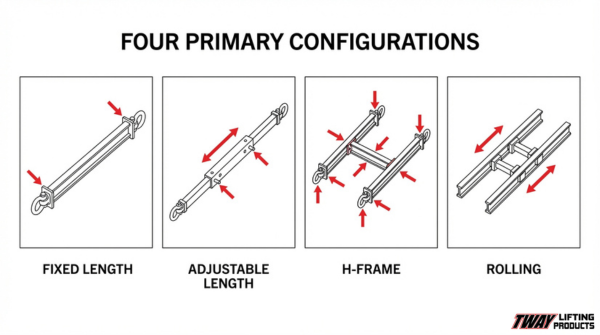
Four primary configurations serve different lifting scenarios: fixed-length bars for repetitive picks at identical spans, adjustable-length bars that reconfigure by swapping strut sections, H-frame designs for torsionally unstable loads, and rolling bars with trolleys that allow lateral hook travel.
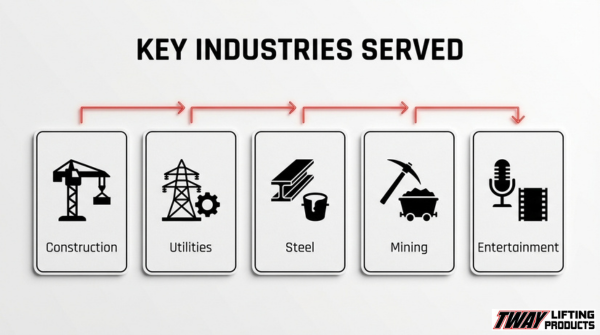
Construction, utilities, steel production, mining, and entertainment all use modular spreader bar rentals to match exact span and capacity requirements to each project phase. Renting eliminates capital outlay, transfers certification responsibilities to the provider, and prevents expensive assets from sitting idle between jobs.
Rental rates in major industrial hubs typically range from $150 to $300 per day, with long-term agreements reducing effective daily costs by 40% to 60%. OSHA 1926.251 and ASME B30.20 govern proof testing, design factors, and per-shift inspection requirements for every rented unit.
Correct sizing requires matching load weight, pick-point dimensions, and sling geometry to the assembled bar’s rated capacity, while pre-use inspection of pin holes, bolt torque, and certification records remains essential before every lift.
How Does a Modular Spreader Bar Work?
A modular spreader bar works by converting vertical lifting loads into pure compressive forces along its main strut, spreading the lift points apart to protect the load and prevent sling interference. The top slings attached to the crane hook press inward on the bar’s end units, placing the entire assembly under compression rather than bending. This compression-based design allows modular spreader bars to be significantly lighter than traditional lifting beams that must resist bending moments.
Assembly follows a specific sequence. The longest strut is placed centrally, with shorter struts positioned toward the end units. All flange pairs must be clear of debris before bolting to specified torque settings. According to Modulift’s 2023 assembly guide, this strut-in-compression principle is what enables modular systems to use interchangeable components while maintaining structural integrity across varying spans.
Spreader bar capacity depends on axial compression resistance and buckling limits. Manufacturers calculate these thresholds using the slenderness ratio of assembled components, which changes as struts are added or removed to adjust the span. This is why correct assembly order and bolt torque matter: they directly affect how well the bar resists buckling under load.
For rigging professionals evaluating rental options, understanding this compression principle clarifies why modular designs offer such versatility. The next sections break down the individual components that make this system possible.
What Are the Components of a Modular Spreader Bar?
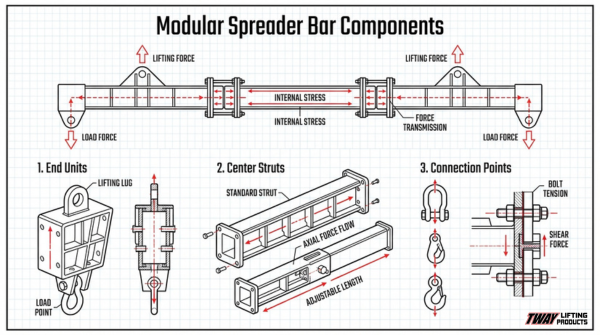
The components of a modular spreader bar are end units, center struts, shackles and connection hardware, and capacity-rated pins. Each component serves a specific structural role in distributing load forces safely.
End Units
End units are the termination fittings at each end of a modular spreader bar. They house the connection points where slings attach to the bar assembly. Each end unit transfers the lifting force from the crane’s rigging into the center struts as pure compression. Standard modular spreader beam systems include a pair of end units, a pair of drop links, and interchangeable struts that bolt together to achieve the required span. Because end units bear the full sling angle load, their geometry and material grade directly determine the bar’s maximum working load limit. Proper alignment during assembly is essential to prevent eccentric loading.
Center Struts
Center struts are the tubular compression members that form the main span of a modular spreader bar. These struts bolt together in series between the two end units, allowing riggers to adjust overall length by adding or removing sections. During assembly, the longest strut should be placed centrally with shorter struts toward the end units, and all flange pairs must be clear of debris before bolting to specified torque settings. High-capacity systems utilize grade 8.8 or 10.9 bolts for flange connections, where bolt number and grade are critical for structural integrity at maximum spans. Strut selection determines both the span and the load rating of the assembled bar.
Shackles and Connection Hardware
Shackles and connection hardware are the interface components that link a modular spreader bar to slings, hooks, and the lifted load. Proper sizing of this hardware is critical for safe load transfer. According to the U.S. Department of Energy’s lifting attachment evaluation guidelines, shackles must be sized so that at least 80 percent of the pin surface engages with the lifting attachment, ensuring proper load distribution and preventing point-loading. Undersized shackles concentrate stress on a narrow contact area, which can lead to premature wear or sudden failure under rated loads.
Capacity-Rated Pins
Capacity-rated pins are the load-bearing fasteners that secure end units, struts, and connection hardware within a modular spreader bar assembly. Each pin carries a stamped or engraved working load limit that corresponds to the system’s engineered capacity. Common failure modes for these components include elongation of pin holes and surface wear on the pins themselves, both of which develop gradually through repeated loading cycles. Pins must match the rated capacity of every other component in the assembly; mixing pin ratings creates a weak link that compromises the entire lift. Selecting the correct pin for each connection point is foundational to a safe modular spreader bar configuration.
What Are the Common Types of Modular Spreader Bars?
The common types of modular spreader bars are fixed-length, adjustable-length, H-frame, and rolling configurations. Each type serves distinct lifting scenarios based on load geometry, weight distribution, and jobsite requirements.
Fixed-Length Modular Spreader Bars
Fixed-length modular spreader bars are assemblies where interchangeable struts are bolted together to create a specific, predetermined span that remains constant during the lift. Once assembled, the overall length does not change, which simplifies load planning and reduces variables during crane operations.
These bars are widely used in modular construction, where precast concrete modules demand precise, repeatable pick points. According to a 2024 study published in the Journal of Building Engineering, modular construction projects utilize spreader bars to handle precast concrete modules, and avoiding suboptimal equipment sizes is critical for maximizing site cost-effectiveness and safety.
Fixed-length configurations are ideal when a project involves repetitive lifts at identical spans, since the assembly requires no field adjustment between picks.
Adjustable-Length Modular Spreader Bars
Adjustable-length modular spreader bars allow crews to change the overall span by adding or removing interchangeable strut sections. This flexibility makes a single bar system usable across multiple lift plans without mobilizing different equipment.
Key advantages include:
- Reduced rental inventory, since one bar covers several span requirements.
- Faster adaptation to changing load dimensions on active jobsites.
- Lower transportation costs, because fewer total units need to ship.
The trade-off is that each reconfiguration requires proper bolt torque verification and a capacity recheck, since working load limits change with span length. For projects with varied lift geometries, adjustable bars consistently prove more cost-effective than renting multiple fixed units.
H-Frame Modular Spreader Bars
H-frame modular spreader bars use two parallel top beams connected by cross-members, forming an H-shaped structure when viewed from the end. This geometry provides superior torsional stability compared to single-bar designs.
H-frames excel in situations involving:
- Asymmetric or offset center-of-gravity loads.
- Wide, flexible items such as large panels or vessels.
- Lifts requiring four-point rigging below the spreader.
The dual-beam layout distributes forces more evenly, reducing the risk of load rotation during the pick. Although heavier than single-strut alternatives, H-frames are often the safest choice when load geometry introduces twisting forces that a standard bar cannot resist.
Rolling Modular Spreader Bars
Rolling modular spreader bars incorporate trolleys or rollers along the top beam, allowing the crane hook attachment point to travel laterally during a lift. This movement compensates for shifting centers of gravity as loads are repositioned.
Common applications include loading and unloading operations where the pick point must move horizontally without re-rigging. The rolling mechanism is particularly valuable when handling long structural members that need controlled rotation or translation after leaving the ground.
Because the hook point is not fixed, rigging teams must verify that the trolley locking mechanism engages properly before each lift. With these four configurations understood, selecting the right type depends on matching your specific load characteristics to each bar’s strengths.
Why Would You Rent a Modular Spreader Bar Instead of Buying?
You would rent a modular spreader bar instead of buying because renting eliminates large capital outlays, removes storage and maintenance burdens, and gives you access to the exact capacity and span each project demands. This model has driven record adoption across heavy industry. According to Equipment Finance News, the equipment rental market is projected to grow by 5.7% in 2025 to reach approximately $82.6 billion, reflecting widespread preference for rental over ownership.
Renting also shifts compliance responsibilities. Reputable rental providers deliver spreader bars with current proof-test certificates and annual re-certifications already completed, so your crew avoids the cost and scheduling complexity of maintaining OSHA and ASME documentation in-house. For contractors who handle only a few heavy lifts per year, purchasing a modular spreader bar that sits idle between projects ties up capital that could be deployed elsewhere.
The financial case strengthens further when project specifications vary. A single purchased spreader bar locks you into one capacity range and span, while rental inventories let you select different configurations for each job. Seasonal demand patterns reinforce this advantage; infrastructure projects typically see peak lifting equipment needs during spring and fall construction windows, meaning ownership leaves expensive assets underutilized for months at a time.
From a practical standpoint, renting is often the smarter default for any operation that does not use spreader bars on a near-daily basis. Ownership only pencils out when utilization rates are consistently high and internal teams can manage inspection, recertification, and proper storage year-round.
What Industries Use Modular Spreader Bar Rentals?
Modular spreader bar rentals serve construction, utilities, steel production, mining, and entertainment. Each industry relies on adjustable lifting configurations to handle unique load shapes and site conditions.
How Are Modular Spreader Bar Rentals Used in Construction?
Modular spreader bar rentals are used in construction to lift precast concrete modules, structural steel beams, and prefabricated wall panels. These loads often have wide footprints that require multiple pick points to distribute weight evenly and prevent tipping during placement. According to a 2024 study published in the Journal of Building Engineering, modular construction projects utilize spreader bars to handle precast concrete modules, where avoiding suboptimal equipment sizes is critical for maximizing site cost-effectiveness and safety. Renting allows contractors to match the exact span and capacity to each phase of the project without storing equipment between jobs.
How Are Modular Spreader Bar Rentals Used in Utilities?
Modular spreader bar rentals are used in utilities to position transformers, switchgear, and transmission poles that require balanced, multi-point lifts. Utility infrastructure components are often heavy yet fragile, making controlled load distribution essential during installation. Because utility projects span different regions with varying equipment needs, renting modular spreader bars lets crews select the right configuration for each site. This flexibility is especially valuable for rural transmission line work, where transporting owned specialty equipment between remote locations would be cost-prohibitive.
How Are Modular Spreader Bar Rentals Used in Steel Production?
Modular spreader bar rentals are used in steel production to move coils, plate stacks, and finished structural members across fabrication yards and shipping docks. These loads demand precise balance to prevent shifting during overhead travel. According to OnePetro (Society of Petroleum Engineers), modern spreader bar designs often incorporate high-strength structural steel or lightweight composite materials to maximize the Working Load Limit while minimizing the self-weight of the rigging assembly. For steel mills handling variable product dimensions, renting modular configurations eliminates the need to stockpile multiple fixed-length bars.
How Are Modular Spreader Bar Rentals Used in Mining?
Modular spreader bar rentals are used in mining to lift dragline components, conveyor sections, and heavy processing equipment during maintenance shutdowns. Mine sites operate under tight turnaround windows where downtime directly impacts production output. Renting spreader bars sized for specific shutdown tasks avoids capital investment in equipment that may sit idle between scheduled outages. The harsh conditions typical of mining environments also make rentals practical, since the rental provider handles inspection, certification, and replacement of wear components.
How Are Modular Spreader Bar Rentals Used in Entertainment?
Modular spreader bar rentals are used in entertainment to lift complex stage equipment and lighting rigs that feature varying shapes and offset centers of gravity. According to Hercules SLR, adjustable spreader bars are frequently deployed in entertainment rigging for exactly these asymmetric loads. Concert tours, festival builds, and arena installations often require different spreader bar spans from one venue to the next. Renting modular systems gives production crews the adaptability to reconfigure for each show without purchasing dedicated rigging for every venue layout.
With industry-specific applications established, the next step is understanding available capacities.
What Capacities Are Available for Modular Spreader Bar Rentals?
The capacities available for modular spreader bar rentals range from compact spans under 10 feet to configurations exceeding 100 feet, with weight ratings from a few tons to over 200 tons. Span options and weight ratings determine the right rental for each lift.
What Spans Can You Rent in Modular Spreader Bars?
The spans you can rent in modular spreader bars typically range from 4 feet to over 100 feet, depending on the system configuration. Standard modular spreader beam components include a pair of end units, a pair of drop links, and interchangeable struts that are bolted together to achieve the required span, according to Lifting Gear Hire. Assembly requires the longest strut to be placed centrally, with shorter struts toward the end units. This interchangeable design means rental providers can configure nearly any span within a system’s range by swapping strut combinations. For reference, Tway Lifting offers spreader beams up to 40 feet, while specialty providers stock systems reaching well beyond that for large-scale infrastructure or energy sector lifts.
What Weight Ratings Can You Rent in Modular Spreader Bars?
The weight ratings you can rent in modular spreader bars generally start around 2 tons and extend past 200 tons for heavy industrial applications. Spreader bar capacity is primarily determined by the bar’s ability to withstand axial compression and resist buckling, with manufacturers calculating limits based on the slenderness ratio of assembled components, as noted by Holloway Houston Inc. Longer spans at the same weight rating require thicker struts and higher-grade connection hardware to maintain structural integrity. Tway Lifting stocks spreader beams rated from 2 to 100 tons, covering most construction, utility, and steel production needs. For ultra-heavy lifts, specialty rental fleets carry systems rated above 250 tons.
With capacity options defined, the next step is understanding rental costs.
How Much Does a Modular Spreader Bar Rental Cost?
A modular spreader bar rental cost depends on the duration, capacity, and span configuration required. Short-term and long-term rates differ significantly.
What Does a Short-Term Modular Spreader Bar Rental Cost?
A short-term modular spreader bar rental costs between $150 and $300 per day in major industrial hubs, according to 2026 rate data from Count Bricks. Weekly rates for these same markets typically range from $600 to $1,200. Several factors influence where a specific rental falls within that range:
- Capacity rating (higher-tonnage bars command premium pricing)
- Required span length and number of struts
- Delivery distance and mobilization fees
- Seasonal demand, which tends to peak during spring and fall construction windows
For projects lasting only a few days, daily rates offer the most flexibility. However, crossing into a second week often makes a weekly rate more economical than stacking daily charges. Planning lift schedules tightly can prevent unnecessary rental days from inflating the total cost.
What Does a Long-Term Modular Spreader Bar Rental Cost?
A long-term modular spreader bar rental cost is substantially lower on a per-day basis than short-term pricing. Monthly rental agreements typically reduce the effective daily rate by 40% to 60% compared to standard daily pricing, making them the preferred structure for extended infrastructure or energy projects.
This cost advantage reflects a broader industry shift. According to a 2025 Equipment Finance News report, the U.S. equipment rental market is projected to grow by 5.7% in 2025 to approximately $82.6 billion, driven partly by operators choosing rental models over ownership for specialty rigging. Long-term renters also benefit from included maintenance, current certifications, and the ability to swap configurations mid-project without capital expenditure.
For multi-month lifts, requesting a custom quote based on project scope consistently yields better pricing than published rate cards.
What Should You Inspect Before Using a Rented Spreader Bar?
You should inspect a rented spreader bar for structural integrity, proper documentation, and component condition before every use. Key inspection areas include visual checks, hardware verification, and certification records.
A thorough pre-use inspection covers several critical areas:
- Cracks and deformation: Examine the main struts, end units, and welds for visible cracks, bending, or permanent deformation that could signal fatigue or overloading.
- Pin hole elongation: Check all connection points for worn or elongated pin holes, a common failure mode that reduces load-bearing capacity.
- Connection hardware condition: Verify that shackles, pins, and bolts show no excessive wear, corrosion, or damage.
- Bolt torque and grade: Confirm all flange bolts match the manufacturer’s specified grade and torque settings.
- Sling attachment points: Ensure no unauthorized slings have been added along the span, since this introduces unintended bending moments that risk catastrophic failure.
- Certification documentation: Review the bar’s current re-certification records. According to Royal Rigging, spreader bars should undergo annual re-certification involving a visual inspection for cracks or deformation followed by a documented pull test.
- Rated capacity markings: Confirm legible WLL markings match the planned lift requirements.
Skipping even one of these checks on rental equipment creates unnecessary risk, particularly because you cannot verify the bar’s full usage history. A five-minute walkaround inspection is one of the simplest ways to prevent a serious incident on the job site. With the physical inspection complete, understanding the regulatory standards behind these checks adds another layer of protection.
What OSHA and ASME Standards Apply to Spreader Bar Rentals?
The OSHA and ASME standards that apply to spreader bar rentals include OSHA 1926.251 for proof testing and shift inspections, ASME B30.20 for design categories, and ASME BTH-1 for structural design criteria.
OSHA 1926.251 requires that all special custom-designed lifting accessories, including spreader bars, must be proof-tested to 125% of their rated capacity before initial use. This regulation also mandates that rigging equipment for material handling must be inspected prior to use on each shift and as necessary during use to ensure it remains in a safe operating condition, according to the U.S. Government Publishing Office (eCFR).
ASME B30.20 defines two distinct design categories for below-the-hook lifters:
- Category A applies to predictable loads and requires a 2.0 design factor.
- Category B addresses more severe or unknown loading conditions and requires a 3.0 design factor.
ASME BTH-1 provides the structural design criteria for below-the-hook lifting devices. This standard specifies allowable stresses for shear, bending, and compression based on the lifter’s designated service class. When renting modular spreader bars, confirming that equipment meets the correct BTH-1 service class for your application is just as important as verifying rated capacity.
For rental customers, these standards carry practical implications. Every rented spreader bar should arrive with current proof-test documentation, legible capacity markings, and certification records that align with ASME identification requirements. Operators remain responsible for per-shift visual inspections regardless of the rental provider’s maintenance history. Understanding how spreader bar sizing connects to these compliance requirements ensures each rental matches the lift plan.
How Do You Size a Modular Spreader Bar for Your Lift?
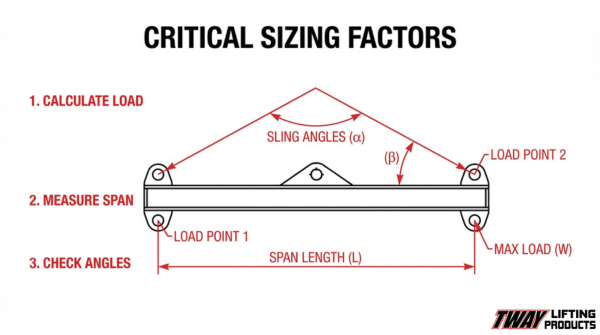
You size a modular spreader bar for your lift by matching three critical variables: the load’s weight, its dimensions, and the required sling geometry. Getting this right prevents overloading, buckling, and costly project delays.
Proper sizing follows a logical sequence:
- Determine the total lifted weight. Add the load’s gross weight to the weight of all rigging hardware, including slings, shackles, and the spreader bar itself.
- Measure the load’s dimensions and pick points. Identify the distance between lifting points and the load’s center of gravity to establish the minimum required span.
- Calculate sling angles. Top sling angles between the crane hook and the spreader bar’s end units directly affect compressive force on the strut. Steeper angles increase compression dramatically.
- Select strut combinations for the span. Modular systems use interchangeable struts bolted together to reach the target length, so verify that the assembled configuration is rated for both the span and the load.
- Apply the design factor. Confirm the spreader bar’s working load limit exceeds the calculated forces with the appropriate safety margin per ASME BTH-1 standards.
- Verify sling angle limits. Most modular spreader bars have a maximum allowable bottom sling angle; exceeding it introduces bending moments that can cause structural failure.
The growing demand for precision in these calculations reflects an industry-wide shift. According to a 2025 Archive Market Research report, the modular spreader beam market was valued at $500 million and is forecasted to reach $852 million by 2033, driven largely by the need for adaptable, correctly sized lifting solutions.
For teams managing complex or irregular loads, smart sensors and digital twin capabilities are increasingly integrated into modular lifting systems. These technologies provide real-time feedback on load distribution and structural health during the lift, catching sizing miscalculations before they become safety incidents. This kind of verification technology is especially valuable when field conditions differ from the original lift plan.
Sizing errors remain one of the most preventable causes of rigging failures. With the right data and a disciplined calculation process, the correct spreader bar configuration becomes a straightforward engineering decision rather than a guess.
What Is the Difference Between a Spreader Bar and a Lifting Beam?
The difference between a spreader bar and a lifting beam is how each device handles load forces. A spreader bar transfers weight as pure compression through its main strut, while a lifting beam carries weight through bending moments along its length.
A spreader bar connects to the crane hook via slings angled inward from both ends, creating compressive force along the bar. This compression-only loading allows spreader bars to use lighter structural profiles, since the bar does not need to resist bending. The top rigging slings form a triangle between the crane hook and each end unit, and the resulting geometry determines both headroom requirements and effective capacity.
A lifting beam, by contrast, attaches to the crane hook at a single central point along its top flange. The load hangs from multiple points along the beam’s underside, which subjects the beam to significant bending stress. This design requires a heavier, deeper cross-section to resist deflection.
The practical tradeoffs between these two devices come down to headroom, weight, and rigging complexity:
- Spreader bars require more headroom because angled top slings add vertical distance between the hook and the load.
- Lifting beams minimize headroom loss by connecting directly to the hook at a single top point.
- Spreader bars weigh less at equivalent capacities because compression-loaded members need less material than bending-loaded members.
- Lifting beams simplify rigging below the device, since load slings hang vertically from fixed attachment points.
According to Industrial Training International, ASME B30.20 classifies both spreader bars and lifting beams as below-the-hook lifting devices, with Category A requiring a 2.0 design factor for predictable loads and Category B requiring a 3.0 design factor for more severe or unknown conditions.
For most rental applications, spreader bars are the better choice when overhead clearance is available and weight savings matter. Lifting beams earn their place in tight headroom situations where vertical sling geometry is not practical. Understanding which device fits the lift plan ensures proper equipment selection from the start.
How Can Tway Lifting Help With Your Spreader Bar Rental Needs?
Tway Lifting can help with your spreader bar rental needs by providing rigging equipment rentals, certified inspection services, and expert guidance backed by over 75 years of industry experience. The sections below cover available services and key article takeaways.
Does Tway Lifting Offer Equipment Rentals and Rigging Services?
Yes, Tway Lifting offers equipment rentals and rigging services. Founded in 1945, Tway Lifting provides a wide range of rental rigging equipment, including spreader beams rated from 2 to 100 tons with spans up to 40 feet, along with shackles, hoists, load cells, and slings available on daily, weekly, or monthly terms. Free local delivery and pickup come standard with every rental.
Beyond rentals, Tway Lifting performs OSHA-required annual inspections, job site safety evaluations, and detailed compliance reporting through certified, factory-trained specialists. Rigging equipment for material handling must be inspected prior to use on each shift, according to federal safety regulations. Tway Lifting’s inspection team ensures every rented spreader bar meets these requirements before it reaches your site.
Custom wire rope sling fabrication, same-day repair services, and emergency response round out the full-service approach available from both superstore locations in Indianapolis and Fort Wayne, Indiana.
What Are the Key Takeaways About Modular Spreader Bar Rentals?
The key takeaways about modular spreader bar rentals center on flexibility, compliance, and cost efficiency:
- Modular spreader bars convert lifting loads into pure compression, enabling lighter, adaptable configurations compared to fixed lifting beams.
- Interchangeable struts and end units allow a single rental to serve multiple span and capacity requirements across different lifts.
- OSHA and ASME standards govern proof testing, design factors, and shift-level inspections for every spreader bar used on a job site.
- Renting eliminates long-term ownership costs for storage, annual recertification, and maintenance while providing access to properly sized equipment.
- Proper sling angle calculation and pre-use inspection remain critical safety steps regardless of whether equipment is rented or owned.
For projects requiring reliable, regulation-compliant spreader bar rentals with expert rigging support, Tway Lifting delivers the equipment and knowledge to keep lifts safe and efficient.