


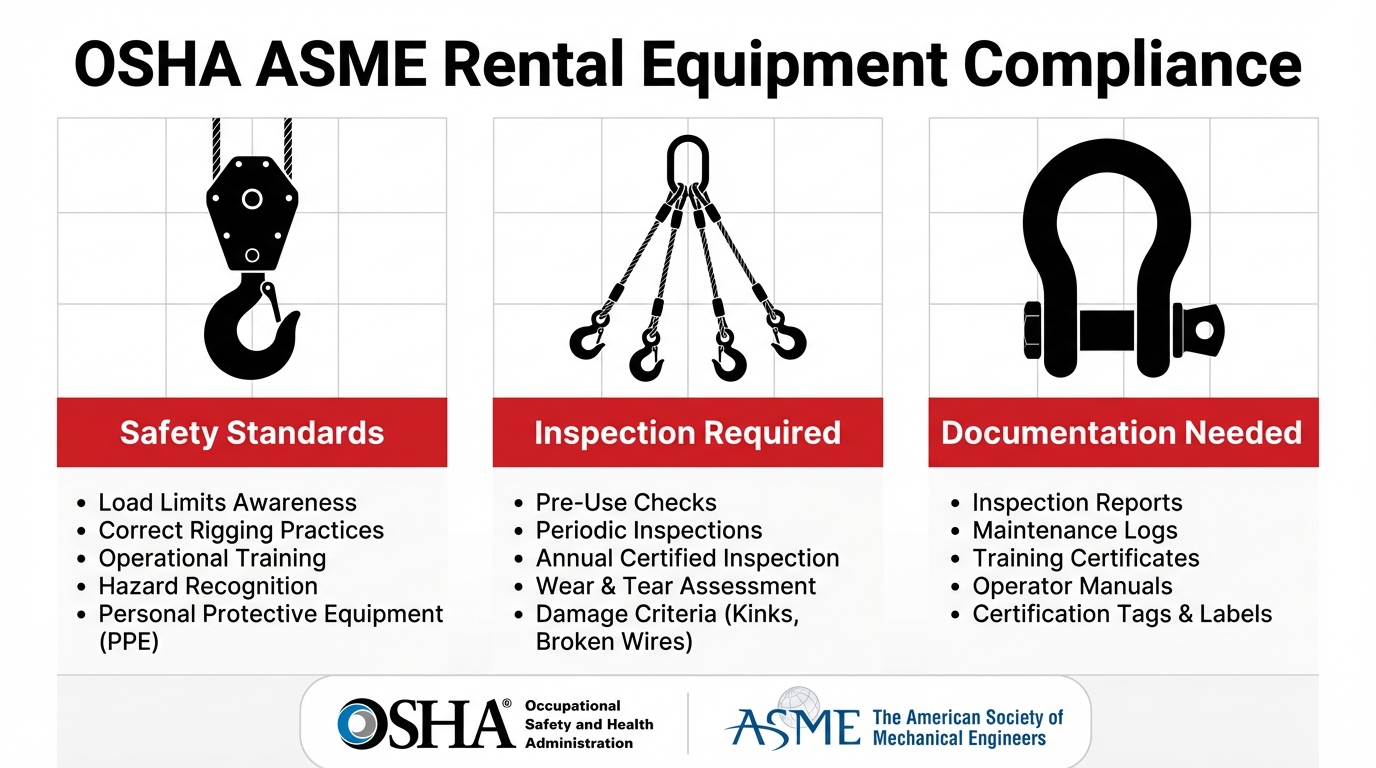

OSHA and ASME considerations for rental equipment are the regulatory and engineering standards that govern safe use, inspection, and maintenance of lifting gear regardless of ownership status. OSHA’s General Duty Clause and specific standards like 1926 Subpart CC apply to rented cranes, slings, and hoists exactly as they apply to owned equipment, while the ASME B30 series sets removal-from-service thresholds and rated load requirements for every rigging component in a rental fleet.
This guide covers regulatory obligations, equipment-specific standards, inspection responsibilities, common compliance failures, and rental agreement protections.
OSHA regulations under Subpart CC, 1910.184, 1926.1431, and 1910.179 establish operator certification requirements, daily sling inspection mandates, personnel hoisting safety protocols, and overhead crane design specifications that every renter must satisfy.
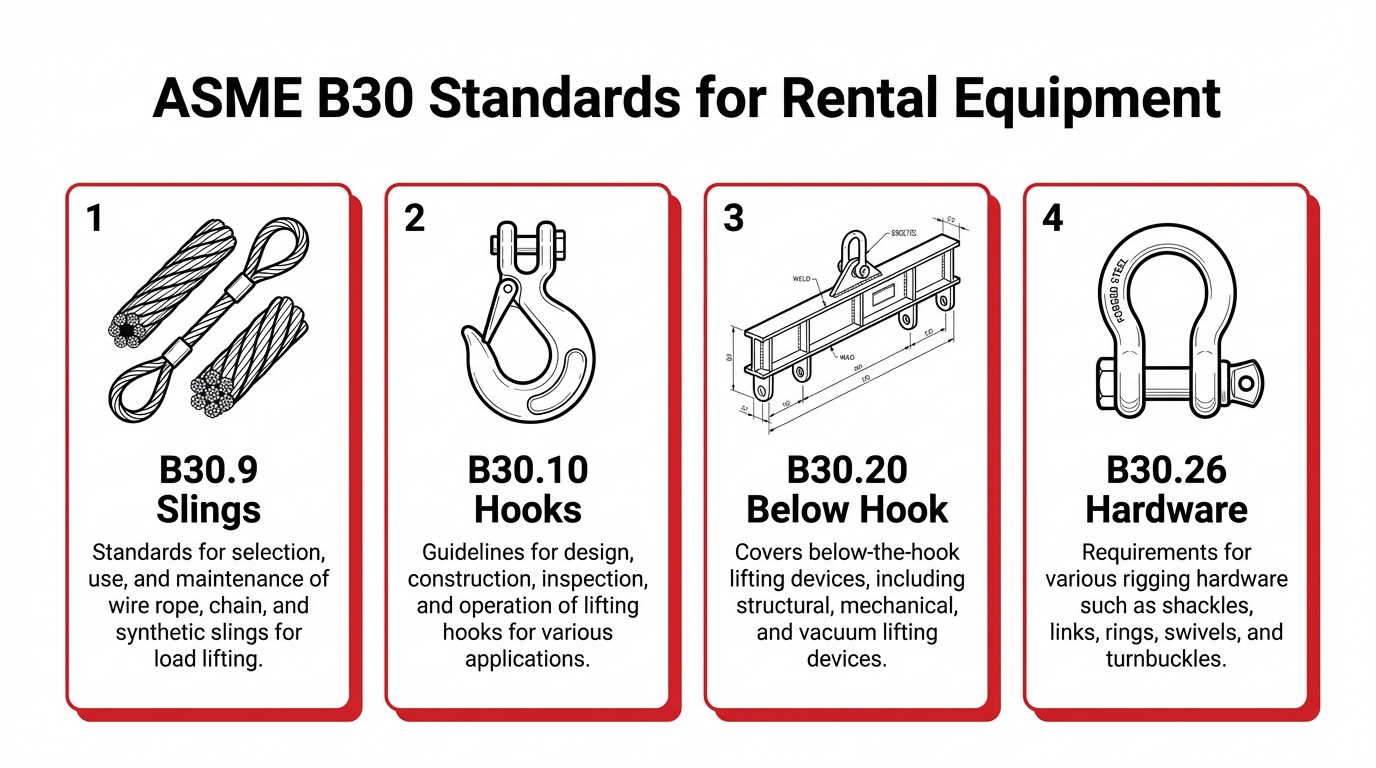
ASME B30 standards for slings (B30.9), hooks (B30.10), below-the-hook devices (B30.20), and rigging hardware (B30.26) define measurable inspection criteria, including hook throat opening limits of 5% and annual periodic inspection minimums for shackles and turnbuckles.
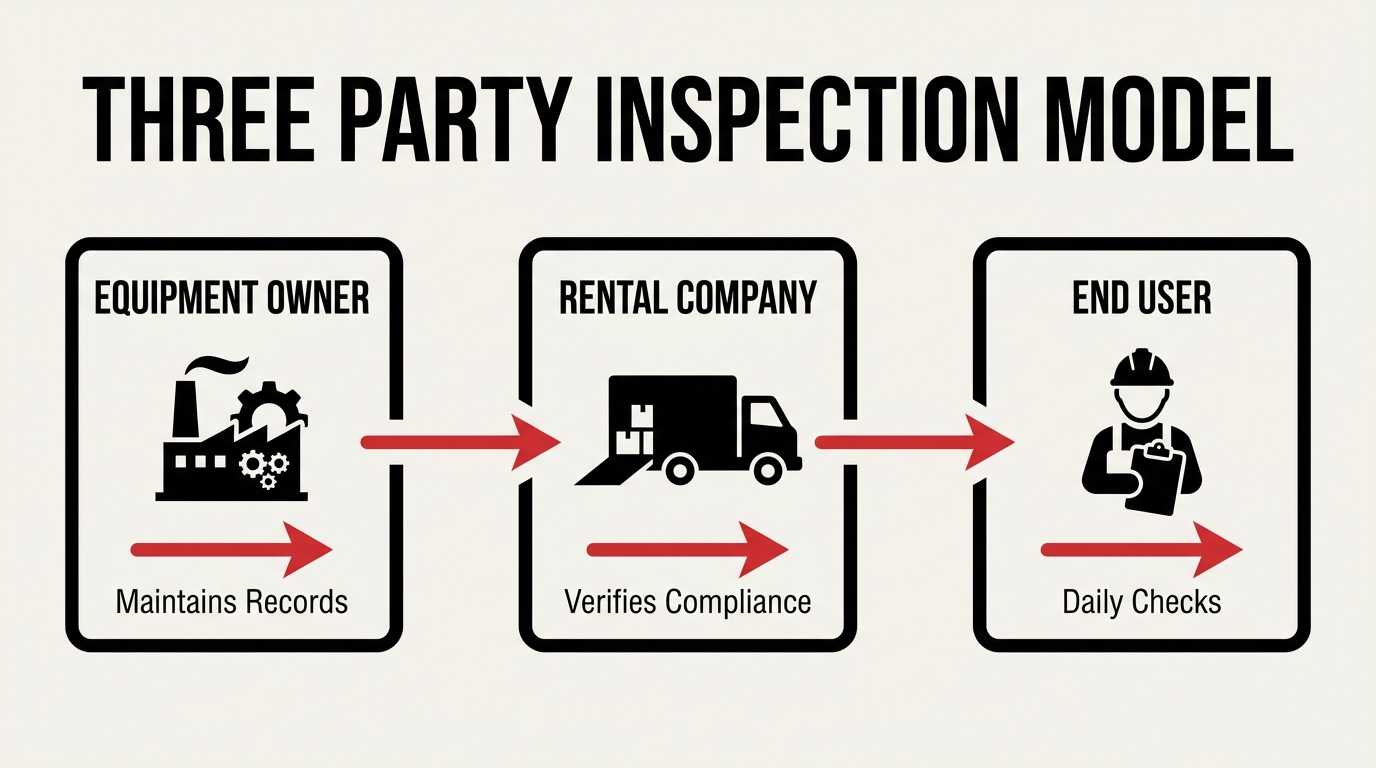
Inspection responsibility is shared among three parties: equipment owners maintain baseline condition and records, rental companies verify compliance before dispatch, and end users perform pre-shift visual checks and operational tests on every piece of gear they receive.
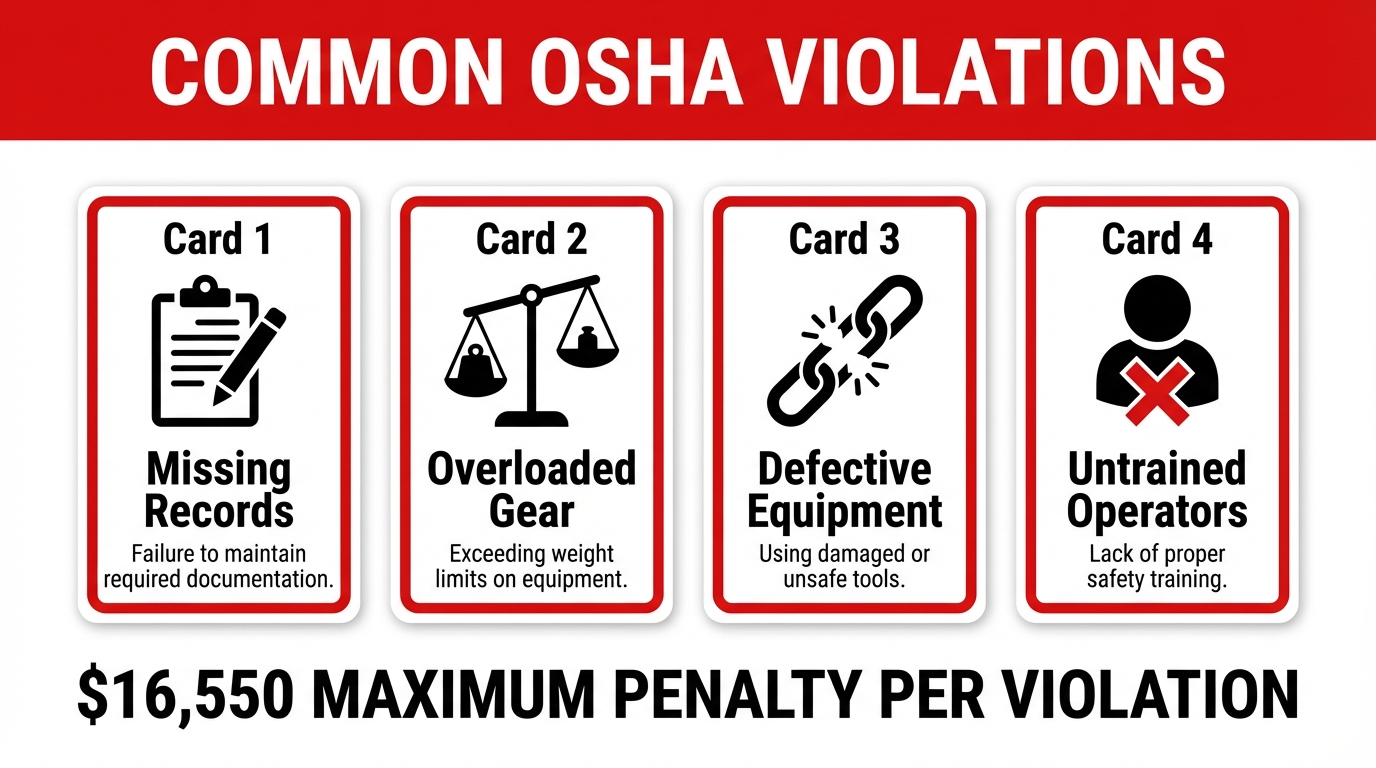
Common OSHA citations in the rental space stem from missing inspection records, overloaded components, defective gear left in service, and undocumented operator training; each carries penalties reaching $16,550 per serious violation.
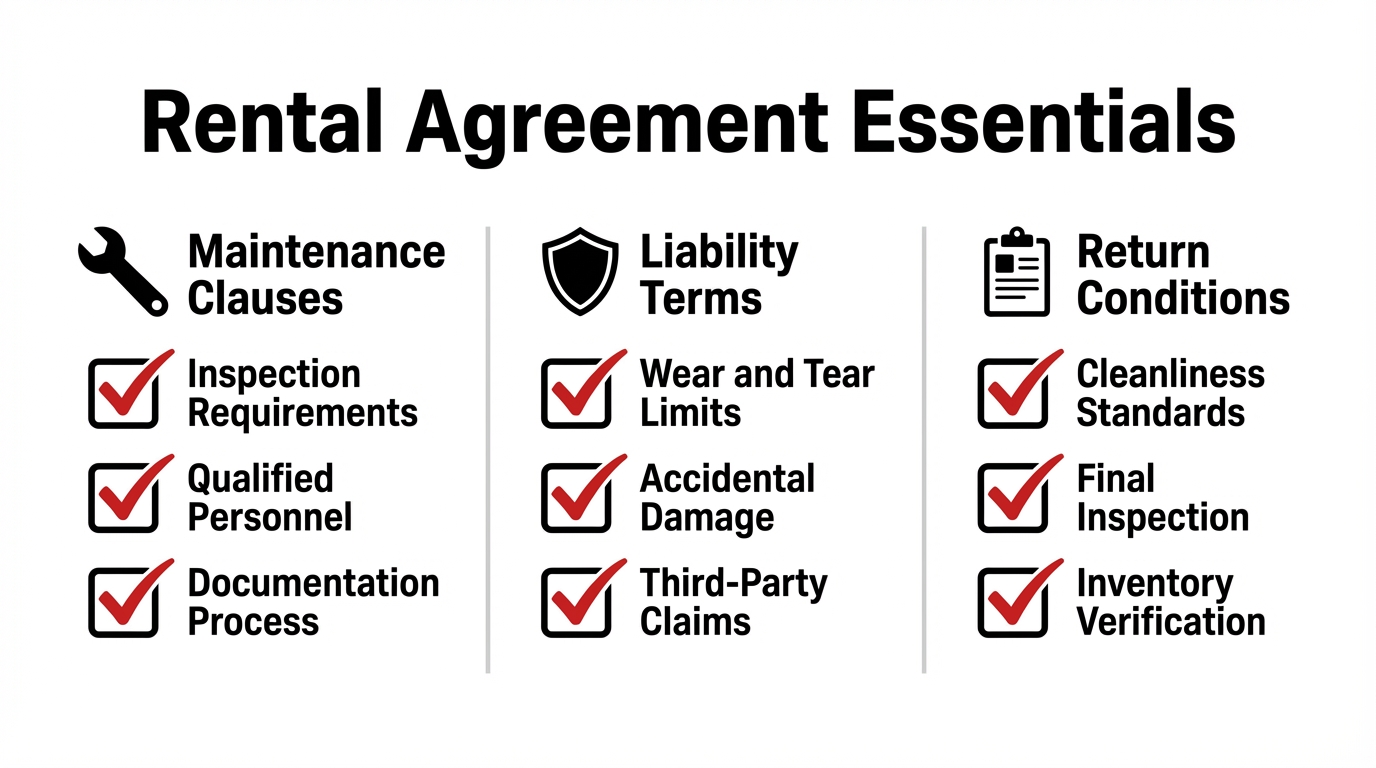
Rental agreements must define maintenance clauses, liability allocation, and return condition terms, while provider verification requires reviewing certifications, inspection documentation, and training records before accepting any equipment.
Why Do OSHA and ASME Standards Apply to Rental Equipment?
OSHA and ASME standards apply to rental equipment because workplace safety obligations do not change based on equipment ownership. The subsections below cover the General Duty Clause, ASME B30 lifting standards, and legal liability when rented gear fails.
What Is OSHA’s General Duty Clause for Rental Equipment?
OSHA’s General Duty Clause is Section 5(a)(1) of the Occupational Safety and Health Act, which requires employers to furnish a workplace free from recognized hazards likely to cause death or serious physical harm. This obligation applies whether equipment is owned, leased, or rented.
Rental status does not exempt employers from hazard prevention. Most equipment rental agreements include broad indemnification clauses that hold renters responsible for damage during the rental period, regardless of the cause. According to International Rental News, three quarters of all major accidents among equipment rental firms occur to workers in just three job functions: mechanics, delivery drivers, and yard workers. These figures reinforce why the General Duty Clause places compliance responsibility squarely on the employer controlling the job site.
How Does ASME B30 Apply to Rented Lifting Equipment?
ASME B30 applies to rented lifting equipment by establishing minimum inspection, maintenance, and operational safety criteria that govern the gear itself, not its ownership status. The ASME B30 family covers slings, hooks, below-the-hook devices, rigging hardware, and cranes.
Every piece of rented lifting equipment must meet the same ASME B30 removal-from-service criteria as purchased equipment. Organizations such as the Lifting Equipment Engineers Association (LEEA) provide accredited training focused on thorough examination and inspection of lifting equipment to these standards. Failing to apply ASME B30 criteria to rentals is one of the most common compliance oversights in the industry, because many renters assume the rental provider has already handled all inspection obligations.
Who Is Legally Responsible When Rental Equipment Fails?
Legal responsibility when rental equipment fails can fall on the rental company, the renter, or both, depending on the circumstances. Liability hinges on which party controlled, maintained, or operated the equipment at the time of the incident.
If a rental company fails to provide proper instructions or neglects maintenance on a tool that subsequently causes injury, that company may be held liable for negligence. At the same time, renters who ignore pre-use inspection requirements or operate equipment beyond its rated capacity assume their own share of liability. Contracts alone do not settle this question; courts examine the actual conduct of each party. For any organization renting lifting equipment, the safest approach is to treat every rented asset as if full compliance responsibility rests with your own team.
Understanding these shared obligations sets the stage for the specific OSHA regulations that govern rented lifting equipment.
What OSHA Regulations Cover Rented Lifting Equipment?
OSHA regulations covering rented lifting equipment span crane operations, sling inspections, personnel hoisting, and overhead crane design. The following subsections break down requirements under Subpart CC, 1910.184, 1926.1431, and 1910.179.
What Does OSHA 1926 Subpart CC Require for Rented Cranes?
OSHA 1926 Subpart CC requires that rented cranes meet inspection, operator qualification, and post-modification safety standards before use on construction sites. Any equipment with modifications or additions affecting safe operation must be inspected by a qualified person after those changes are completed, prior to initial use, per 1926.1412.
Operator certification is equally critical. According to OSHA 1926.1427, employers must ensure each operator is trained, certified or licensed, and evaluated before operating any covered equipment, with documentation including the operator’s name and evaluator’s signature.
For operations using rented cranes, failing to verify both equipment condition and operator credentials before the first lift is one of the most common compliance gaps on job sites.
What Does OSHA 1910.184 Require for Rented Slings?
OSHA 1910.184 requires that each day before being used, every sling and all fastenings and attachments shall be inspected for damage or defects by a competent person designated by the employer. This obligation applies regardless of whether the sling is owned or rented.
Key daily inspection checkpoints include:
- Visible cuts, tears, or abrasion on synthetic slings.
- Broken wires, kinking, or crushing on wire rope slings.
- Stretch, wear, or deformation on chain sling links.
- Cracked or distorted fittings, hooks, and end attachments.
Because rental slings may have unknown service histories, the competent person performing the inspection should treat each piece as if it were entering service for the first time.
What Does OSHA 1926.1431 Require for Hoisting Personnel?
OSHA 1926.1431 requires that employees hoisted by crane-suspended personnel platforms use personal fall protection equipment, including a full body harness, independently attached to the lower load block or overhaul ball. This standard applies whenever workers are lifted in a personnel platform on any crane, whether owned or rented.
Additional requirements under 1926.1431 include:
- A trial lift and proof test of the platform at 125% of the intended load before personnel are hoisted.
- A pre-lift meeting to review procedures and emergency protocols.
- Continuous visual monitoring by a competent person during the lift.
Personnel hoisting carries some of the highest risk in crane operations, making full compliance with 1926.1431 non-negotiable when using rented equipment.
What Does OSHA 1910.179 Require for Rented Overhead Cranes?
OSHA 1910.179 requires that all overhead and gantry cranes constructed and installed on or after August 31, 1971, meet the design specifications of the American National Standard Safety Code for Overhead and Gantry Cranes, ANSI B30.2.0-1967. Rented overhead cranes must comply with this standard before entering service at any facility.
Beyond design compliance, 1910.179 mandates:
- Frequent inspections (daily to monthly) covering items such as operating mechanisms, hooks, and hoist chains.
- Periodic inspections (one to twelve month intervals) covering structural members, bearings, and electrical apparatus.
- Load testing after any repairs or alterations that could affect capacity.
When renting overhead cranes, verifying that inspection records align with these intervals is essential before accepting delivery. Understanding ASME standards that complement these OSHA requirements adds another layer of protection for rented rigging and hoisting gear.
What ASME Standards Apply to Rented Rigging and Hoisting Gear?
ASME standards apply to rented rigging and hoisting gear through the B30 series, which governs slings, hooks, below-the-hook devices, and rigging hardware. Each standard defines inspection criteria, rated load requirements, and removal-from-service thresholds.
What Does ASME B30.9 Require for Rented Slings?
ASME B30.9 requires that rented slings meet proof test requirements, carry clearly marked rated loads, and follow defined operating practices for each sling type. According to the American National Standards Institute, the ASME B30.9-2021 update addresses proof test requirements, rated loads, and operating practices for various sling types, including wire rope, chain, and synthetic web configurations.
Renters should confirm that every sling delivered carries legible identification tags showing rated capacity and sling type. Missing or illegible tags signal a sling that may not meet current B30.9 standards. For operations involving multiple sling configurations, verifying compliance before the first lift prevents costly downtime and potential citations.
What Does ASME B30.10 Require for Rented Hooks?
ASME B30.10 requires that rented hooks meet specific dimensional thresholds and be removed from service when those thresholds are exceeded. According to Mazzella Companies, ASME B30.10 mandates hook removal if throat opening increases by 5% (not exceeding 1/4 inch or 6mm) or if wear exceeds 10% of the original section dimension.
Key removal-from-service criteria include:
- Throat opening has increased beyond the 5% threshold.
- Wear exceeds 10% of the original cross-section dimension.
- The hook shows cracks, nicks, or gouges.
- The latch is missing, damaged, or non-functional.
When receiving rented hooks, measuring throat opening against the manufacturer’s original specification is the most reliable way to verify compliance before putting the hook into service.
What Does ASME B30.20 Require for Rented Below-the-Hook Devices?
ASME B30.20 requires that rented below-the-hook lifting devices meet maintenance, training, inspection, and marking standards. The ASME B30.20-2021 standard, as outlined by CraneTech, establishes removal criteria and requires each device to be marked with the manufacturer’s name and rated load.
Spreader beams, lifting beams, and custom lifting fixtures all fall under this standard. Each device must display permanent markings visible to the operator. Before accepting rental equipment in this category, confirming that markings are intact and that the device’s rated load matches the planned lift is essential for both safety and regulatory compliance.
What Does ASME B30.26 Require for Rented Rigging Hardware?
ASME B30.26 requires that rented rigging hardware, such as shackles and turnbuckles, undergo visual inspection before each shift or day of use. According to Olsen Chain & Cable, periodic inspections must also be performed at least annually.
This dual inspection structure means renters carry daily visual inspection responsibility, while the rental provider must ensure annual periodic inspections are current. Checking for proper pin engagement, visible deformation, and legible load ratings during pre-shift walkthroughs satisfies the daily requirement. Requesting documentation of the most recent periodic inspection from the rental provider closes the compliance loop.
With ASME standards clarified for each equipment category, understanding who bears inspection responsibility becomes the next critical step.
Who Is Responsible for Inspecting Rental Equipment?
Responsibility for inspecting rental equipment is shared among three parties: the equipment owner, the renter or end user, and the rental company. Each carries distinct obligations under OSHA regulations and ASME standards.
What Inspection Duties Fall on the Equipment Owner?
The inspection duties that fall on the equipment owner center on maintaining equipment in safe, serviceable condition before it enters circulation. Owners must ensure periodic inspections are current, structural components meet ASME removal criteria, and all modifications are reviewed by a qualified person prior to reuse. Owners also bear responsibility for maintaining accurate inspection records, load ratings, and manufacturer markings on each piece of equipment. When an owner neglects these baseline duties, both the rental company and end user inherit risk they cannot easily detect. This makes the owner’s role the first and most critical layer of inspection accountability in any rental arrangement.
What Inspection Duties Fall on the Renter or End User?
The inspection duties that fall on the renter or end user begin the moment equipment arrives on site. OSHA’s General Duty Clause requires every employer to provide a workplace free from recognized hazards, which means the renter must verify equipment condition before putting it into service. Pre-shift visual inspections of slings, hooks, shackles, and hardware are the end user’s direct responsibility. According to OSHA 1910.184, each day before being used, slings and all fastenings must be inspected for damage or defects by a competent person designated by the employer. Relying solely on the rental provider’s assurances is never sufficient; the employer operating the equipment holds final accountability for safe use on site.
What Inspection Duties Fall on the Rental Company?
The inspection duties that fall on the rental company include verifying equipment condition at intake, performing or coordinating periodic inspections, and supplying accurate documentation to every customer. Rental companies must confirm that each item meets applicable ASME B30 criteria before dispatching it. They should provide current inspection certificates, load ratings, and any relevant operational limitations with every order. Failure to maintain equipment or provide proper instructions can expose the rental company to negligence liability if an injury occurs. For operations that demand verified compliance, partnering with a rental provider whose inspection protocols align with both OSHA and ASME standards reduces risk significantly.
With inspection responsibilities defined, knowing what specific pre-use checks to perform ensures these duties are met on every shift.
What Pre-Use Inspections Are Required for Rental Equipment?
Pre-use inspections for rental equipment include visual checks before each shift, operational testing before first use, and verification of accompanying documentation. The following subsections detail each requirement.
What Should a Visual Inspection Cover Before Each Shift?
A visual inspection before each shift should cover all load-bearing components and safety-critical surfaces for signs of damage, wear, or deformation. A competent person designated by the employer must examine the equipment before it enters service.
Key items to check during a pre-shift visual inspection include:
- Hooks for cracks, throat opening distortion, and latch function.
- Wire rope and slings for broken wires, kinks, crushing, or corrosion.
- Chain links for stretch, gouges, and excessive wear.
- Shackles and hardware for deformation, pin wear, and proper markings.
- Labels and load ratings for legibility and accuracy.
- Structural members for bending, weld cracks, or missing fasteners.
Skipping even one shift-level visual check exposes the end user to both safety hazards and potential OSHA citations, making this the single most important daily compliance habit on any job site.
What Should an Operational Test Cover Before First Use?
An operational test before first use should cover all mechanical, hydraulic, and electrical functions under controlled, no-load conditions. The operator verifies that controls respond correctly, safety devices engage properly, and braking systems hold as designed.
Essential operational test points include:
- Hoist raise and lower functions at slow speed.
- Trolley and bridge travel in all directions.
- Upper and lower limit switches for proper engagement.
- Brake holding capacity at rated test load.
- Emergency stop function.
- Warning devices such as horns and alarms.
According to Industrial Inspection & Analysis, common questions for evaluating lift service providers include asking what standards they test to, whether their technicians are certified, and if test reports are included in the price. Requesting this information before accepting rental equipment ensures operational tests align with recognized OSHA and ASME benchmarks.
What Documentation Must Accompany Rental Equipment?
Documentation that must accompany rental equipment includes current inspection records, load rating certificates, maintenance history, and a signed rental agreement with clearly defined compliance terms.
Critical documents to verify at delivery include:
- Most recent periodic inspection report with inspector credentials.
- Manufacturer’s load chart or rated load marking verification.
- Maintenance and repair logs covering the current rental period.
- Operator manual or safe-use instructions specific to the equipment model.
- Rental agreement with insurance, maintenance, and damage waiver sections.
According to LegalGPS, an equipment rental agreement must clearly highlight financial liabilities associated with equipment damage, loss, or theft, and include sections for insurance, maintenance, and damage waivers. Missing any of these documents at the point of delivery creates gaps in the compliance chain that can shift liability squarely onto the renter.
With pre-use inspections complete, establishing a periodic inspection schedule keeps rental equipment compliant throughout the entire rental term.
How Often Must Rented Lifting Equipment Be Periodically Inspected?
Rented lifting equipment must be periodically inspected at intervals ranging from monthly to annually, depending on the equipment type and applicable ASME B30 standard. Any equipment with modifications affecting safe operation must be inspected by a qualified person before returning to service. The following sections cover specific inspection frequencies for wire rope slings, chain slings, hoists, and shackles.
How Often Must Rented Wire Rope Slings Be Inspected?
Rented wire rope slings must be inspected periodically at least once per year under ASME B30.9, though more frequent intervals are recommended based on severity of service conditions. Slings used in harsh environments, high-cycle applications, or corrosive settings should be inspected monthly or quarterly. A qualified person must evaluate each sling for broken wires, kinking, crushing, bird-caging, and end fitting damage. For rental fleets that rotate across multiple job sites, tracking cumulative wear matters more than calendar dates alone. Missing even one periodic inspection on a rented sling creates a compliance gap that exposes both the rental provider and the end user to liability.
How Often Must Rented Chain Slings Be Inspected?
Rented chain slings must be periodically inspected at least annually, per ASME B30.9. Severe service conditions, such as exposure to chemicals, extreme temperatures, or heavy cycling, warrant quarterly or monthly inspections. The periodic inspection must be performed by a qualified person who checks for stretch, wear, gouges, nicks, cracks, and distortion in individual chain links. According to OSHA 1926.1412, equipment that has had modifications or additions affecting safe operation must be inspected by a qualified person after those changes, prior to initial use. Alloy chain slings in rental fleets accumulate damage unpredictably across different users, making strict periodic scheduling essential rather than optional.
How Often Must Rented Hoists Be Inspected?
Rented hoists must be periodically inspected at intervals not exceeding 12 months under ASME B30.16 for overhead hoists, with more frequent inspections required for heavy-use or severe-service environments. Monthly periodic checks are standard for hoists operating in continuous or demanding applications. A qualified person must examine:
- Load chain or wire rope for wear, distortion, and corrosion
- Hooks for deformation and throat opening increases
- Brake function and load-holding capability
- Limit switches and control mechanisms
- Labels, markings, and rated load legibility
Because rented hoists are often subjected to varying operational demands across different job sites, periodic inspection intervals should reflect actual usage severity rather than relying solely on fixed calendar schedules.
How Often Must Rented Shackles and Hardware Be Inspected?
Rented shackles and hardware must be periodically inspected at least annually under ASME B30.26. This standard also requires a visual inspection before each shift or day the hardware is used. Periodic inspections performed by a qualified person must evaluate:
- Pin straightness and thread condition
- Body distortion or elongation
- Corrosion, cracks, and surface defects
- Legibility of manufacturer markings and rated load stamps
Hardware that cycles through rental inventories across multiple customers faces accelerated wear patterns. Annual minimum intervals assume normal service; shackles and turnbuckles subjected to heavy or corrosive conditions should be inspected more frequently. Establishing documented inspection schedules ensures rental hardware remains compliant between users.
With periodic inspection intervals established, understanding common OSHA citations helps identify where rental compliance most often breaks down.
What Are the Common OSHA Citations for Rental Equipment?
The common OSHA citations for rental equipment involve missing inspection records, overloaded gear, defective components, and untrained operators. Each violation type carries distinct penalties and risks.
What Citations Arise From Missing Inspection Records?
Citations from missing inspection records occur when employers cannot produce documented proof that pre-use and periodic inspections were completed. OSHA 1910.184 requires that slings and all fastenings be inspected for damage by a competent person each day before use. Without written logs identifying the inspector, date, and findings, compliance officers treat the inspection as if it never happened.
As of January 2025, the National Association of Home Builders reported that OSHA serious violations carry penalties up to $16,550 per instance. Multiple undocumented rental items on a single jobsite can trigger stacked citations. Maintaining inspection records for every rented sling, hoist, and shackle is the simplest way to avoid this entirely preventable violation.
What Citations Arise From Exceeding Rated Load Capacity?
Citations from exceeding rated load capacity arise when operators or riggers subject rental equipment to loads beyond the manufacturer’s rated limits. OSHA treats overloading as a serious violation because it creates immediate collapse or structural failure risk.
Rated load markings must remain legible on every rented component. When tags are missing or illegible on rental gear, field crews often default to estimates, which is where overload incidents begin. ASME B30.20-2021 reinforces this by requiring below-the-hook lifting devices to be marked with the manufacturer’s name and rated load. Verifying load ratings against lift plan calculations before each pick is the most reliable safeguard against overload citations.
What Citations Arise From Damaged or Defective Rental Gear?
Citations from damaged or defective rental gear arise when equipment showing visible wear, deformation, or functional impairment remains in service. OSHA inspectors cite employers who fail to remove compromised components from active use.
ASME B30.10 specifies that hooks must be removed from service when throat opening increases by 5% (not exceeding 1/4 inch) or wear exceeds 10% of the original section dimension. Rental equipment accumulates wear across multiple jobsites and users, making it particularly susceptible to undetected degradation. The renter bears responsibility for catching defects during pre-use checks, regardless of the rental provider’s own inspection history.
What Citations Arise From Lack of Operator Training?
Citations from lack of operator training arise when employers allow workers to operate cranes, hoists, or rigging equipment without verified competency. OSHA 1926.1427 requires employers to ensure each operator is trained, certified or licensed, and evaluated before operating covered equipment, with documentation that includes the operator’s name and evaluator’s signature.
This citation is common with rental equipment because companies sometimes assume the rental provider’s delivery constitutes authorization to operate. It does not. The employing company must independently verify and document operator qualifications. Training gaps represent one of the most frequently cited and easily avoidable violations in the rental equipment space.
Understanding common citation categories helps organizations build stronger compliance programs around rental agreements and provider selection.
What Should a Rental Equipment Agreement Cover for Compliance?
A rental equipment agreement should cover maintenance responsibilities, liability allocation, and return condition requirements to ensure OSHA and ASME compliance. The following subsections break down each critical clause category.
What Maintenance and Inspection Clauses Should Be Included?
Maintenance and inspection clauses should define who performs pre-use checks, periodic inspections, and repairs throughout the rental period. These clauses must specify inspection frequency aligned with ASME B30 standards and identify whether the owner or renter supplies qualified inspectors.
Key maintenance clauses to include:
- A requirement that all equipment arrives with current inspection certifications and load ratings.
- Clear assignment of daily pre-shift inspection duties to the renter’s competent person.
- A process for removing defective equipment from service and notifying the rental provider.
- Documentation requirements for every inspection performed during the rental term.
According to High Reach Inc., site managers should ask if equipment is rated for their specific load and height requirements and what the rental rate actually includes to ensure compliance and safety on the job site. Without these clauses explicitly stated, gaps in inspection responsibility become a direct path to OSHA citations.
What Liability and Indemnification Terms Protect Both Parties?
Liability and indemnification terms protect both parties by clearly allocating financial and legal responsibility for equipment-related incidents during the rental period. These terms define who bears the cost of injuries, property damage, and regulatory penalties.
United Rentals’ standard agreement, for example, requires customers to indemnify and hold the company harmless from all liability arising out of the operation, use, or rental of equipment, except for losses caused solely by United’s intentional misconduct or negligence. This one-directional indemnification model is common across the industry, yet it often leaves renters exposed.
Agreements should also address:
- Insurance minimums for both general liability and workers’ compensation.
- Responsibility for OSHA penalty costs if a citation results from equipment condition versus operator error.
- Mutual indemnification language that accounts for shared fault scenarios.
For most rental situations, negotiating balanced indemnification language before signing is far more cost-effective than litigating fault after an incident.
What Return Condition and Damage Reporting Terms Are Needed?
Return condition and damage reporting terms are needed to prevent disputes over equipment wear, define acceptable condition at return, and create a clear record for compliance audits. According to EZRentOut, an equipment rental agreement must clearly highlight financial liabilities associated with equipment damage, loss, or theft, and include sections for insurance, maintenance, and damage waivers.
Essential return and damage reporting terms include:
- A documented condition checklist completed at both pickup and return.
- A defined timeframe for reporting damage discovered during the rental period.
- Distinction between normal operational wear and reportable damage requiring removal from service.
- A process for joint inspection at return, with both parties signing off on equipment condition.
These terms serve a dual purpose: they protect the renter from inflated damage claims and give the rental provider a traceable maintenance history that supports future ASME-compliant inspections. With agreement terms clearly defined, verifying your rental provider’s overall compliance posture becomes the logical next step.
How Do You Verify a Rental Provider Meets OSHA and ASME Standards?
You verify a rental provider meets OSHA and ASME standards by reviewing their certifications, inspection documentation, and operator training records. The following subsections cover what to look for in each area.
What Certifications Should a Rental Provider Hold?
A rental provider should hold certifications that demonstrate compliance with both OSHA regulations and ASME B30 standards. ISO 9001 certification confirms the provider maintains a documented quality management system for manufacturing, inspection, and service processes. Accreditation from the Lifting Equipment Engineers Association (LEEA) signals that technicians have completed thorough examination and inspection training specific to lifting equipment.
Ask providers directly what standards they test to and whether their technicians carry current certifications. According to Industrial Inspection & Analysis, key evaluation questions include asking whether test reports are included in the rental price and what credentials the inspection staff holds. Providers lacking these credentials introduce unnecessary compliance risk to every lift.
What Proof of Inspection Should a Rental Provider Supply?
A rental provider should supply documented proof of inspection for every piece of equipment before it leaves the yard. This documentation should include:
- Dates and results of the most recent periodic inspection performed by a qualified person.
- Visual inspection records confirming compliance with applicable ASME B30 standards, such as B30.9 for slings, B30.10 for hooks, and B30.26 for rigging hardware.
- Written confirmation that any modifications or additions affecting safe operation triggered a re-inspection prior to rental release.
- Load test certificates where required, showing rated load verification.
Providers who cannot produce these records on request are a liability. If inspection paperwork is missing or vague, treat it the same way you would a failed inspection: do not accept the equipment.
What Training Records Should a Rental Provider Maintain?
A rental provider should maintain training records for every employee who inspects, maintains, or delivers lifting equipment. OSHA 1926.1427 requires employers to ensure each operator is trained, certified or licensed, and evaluated before operating covered equipment, with documentation that includes the operator’s name and the evaluator’s signature.
Qualified rental providers keep records that confirm:
- Operator certification and evaluation completion for each equipment type.
- Competent person designations for employees performing pre-shift inspections.
- Ongoing refresher training aligned with ASME B30 and OSHA updates.
Thorough training documentation separates compliant providers from those cutting corners, making it one of the clearest indicators of operational reliability.
How Should You Approach OSHA and ASME Compliance with Rental Lifting Equipment Services?
You should approach OSHA and ASME compliance with rental lifting equipment services by partnering with a provider that maintains inspection records, supplies certified gear, and supports your regulatory obligations. The following sections cover how Tway Lifting helps and the key takeaways from this guide.
Can Tway Lifting’s OSHA-Compliant Rental and Inspection Services Help You Stay Compliant?
Yes, Tway Lifting’s OSHA-compliant rental and inspection services can help you stay compliant. Founded in 1945, Tway Lifting provides rigging equipment rental alongside professional inspection services performed by certified, factory-trained specialists. The rental fleet includes wire rope slings, synthetic slings, spreader beams rated from 2 to 100 tons, shackles, hoists, and load cells, all maintained to meet OSHA and ASME standards.
Tway Lifting also operates as a Peerless/Acco Welded Sling Repair Center, offering same-day wire rope sling fabrication and chain sling reconditioning. The stakes of non-compliance are significant; according to the National Safety Council, contact with objects and equipment resulted in 756 worker deaths in 2024, with over 860,050 nonfatal injuries reported during 2023 and 2024. Tway Lifting addresses these risks through complimentary OSHA-required annual inspections, detailed reporting, and job site safety evaluations from locations in Indianapolis and Fort Wayne, Indiana.
What Are the Key Takeaways About OSHA and ASME Considerations for Rental Equipment?
The key takeaways about OSHA and ASME considerations for rental equipment center on shared responsibility, consistent inspection, and proper documentation.
- OSHA’s General Duty Clause and standards like 1926 Subpart CC apply to rented equipment the same way they apply to owned equipment.
- ASME B30 standards set specific removal criteria, inspection intervals, and rated load requirements for slings, hooks, below-the-hook devices, and rigging hardware.
- Rental agreements should clearly define maintenance responsibilities, liability terms, and return condition expectations.
- Pre-use visual inspections and operational tests are required before each shift, regardless of whether equipment is rented or owned.
- Periodic inspections must follow manufacturer recommendations and ASME schedules, with qualified personnel documenting every examination.
- Rental providers should hold relevant certifications, supply proof of inspection, and maintain training records for their personnel.
Treating rented lifting gear with the same compliance rigor as owned equipment is the most reliable way to protect workers, avoid citations, and reduce legal exposure. Tway Lifting can support that effort with certified inspections, compliant rental inventory, and expert guidance at every stage.