



If you’re weighing the decision between renting or buying a spreader bar for your lifting operations, you’re likely concerned about making the most cost-effective choice while ensuring safety and operational efficiency. We understand that this decision can significantly impact your project budget and timeline, and we’re here to provide you with the comprehensive analysis you need to make an informed choice.
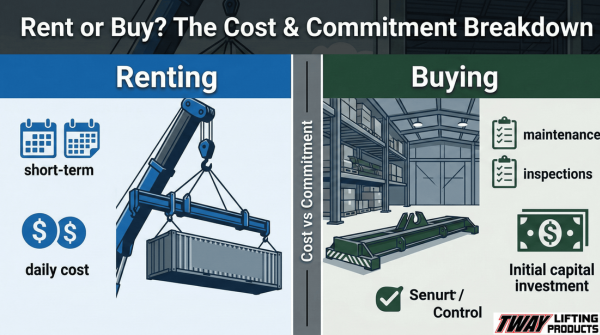
Renting versus buying a spreader bar is a complex decision that depends on your specific operational needs, frequency of use, and financial constraints. A spreader bar rental typically costs $100-$300 per day depending on location and capacity, while purchasing can range from $400 for basic 2-ton models to over $2,000 for adjustable units. For most operations, renting becomes more cost-effective for projects under 60 days per year, while purchasing offers better value for consistent, long-term use.
TL;DR Summary:
• Rental Process: Tway Lifting provides spreader bars on a quote-by-quote basis with daily, weekly, or monthly terms, requiring proof of insurance and including delivery nationwide
• Purchase Considerations: Buying requires upfront investment plus ongoing costs for maintenance, annual inspections, storage, and insurance compliance
• Safety Requirements: Both options must meet OSHA 1910.184 and ASME B30.20 standards, with 297 fatal crane injuries between 2011-2017 highlighting the importance of proper equipment
• Cost Analysis: Standard equipment typically breaks even at 60 days of annual use; specialty items around 30 days per year
• Industry Applications: Construction’s project-based nature favors renting, while manufacturing’s predictable needs often justify purchasing
• Tway Lifting Solutions: Offers 2-ton to 100-ton capacity spreader bars for rent or purchase with nationwide delivery and full certification documentation
Quick Tip: Before deciding, calculate your actual annual usage days and compare the total cost of ownership (including maintenance, storage, and inspections) against rental rates in your area. Many teams overestimate their usage needs, leading to equipment that sits idle most of the year.
What Are the Main Differences Between Renting and Buying a Spreader Bar?
The main differences between renting and buying a spreader bar involve process complexity, financial responsibility, and long-term obligations. Renting provides immediate access through streamlined processes, while buying requires upfront capital and ongoing maintenance responsibilities. These decisions impact your project timeline, budget allocation, and operational flexibility.
How Does the process of renting a spreader bar work?
The process of renting a spreader bar involves several straightforward steps that prioritize safety and compliance. Rental companies like Tway Lifting provide equipment quotes on a project-specific basis with flexible daily, weekly, or monthly rental periods.
Key rental requirements include:
- Insurance Documentation: Certificate of Insurance (COI) showing adequate Commercial General Liability coverage
- Contract Terms: Payment schedules, deposit requirements, and accepted payment methods clearly specified
- Equipment Delivery: On-site arrival with current inspection records and certification documentation
- Protection Options: Damage waivers or Rental Protection Plans (RPP) available for additional fees to limit financial responsibility
Tway Lifting offers nationwide delivery services, ensuring equipment availability regardless of project location. Equipment arrives ready for immediate use with all necessary certifications and inspection documentation.
What steps are involved in purchasing a spreader bar?
Purchasing a spreader bar involves higher upfront costs but provides long-term ownership benefits. Price ranges vary significantly based on capacity and features—a 2-ton capacity, 4-foot fixed-length spreader beam from US Cargo Control costs around $400, while a 2-ton adjustable spreader beam with 12-20 foot range from Caldwell exceeds $2,000.
Critical purchase considerations include:
- Certification Requirements: All purchased spreader bars must meet ASME BTH-1 design and testing standards
- Maintenance Responsibility: Buyers assume full responsibility for maintenance per manufacturer recommendations and ASME B30.20 requirements
- Documentation: Maintaining inspection records and certification becomes the owner’s obligation
Purchased equipment provides complete control over usage scheduling and eliminates rental availability concerns for ongoing projects.
What types of spreader bars are commonly available for rent and purchase?
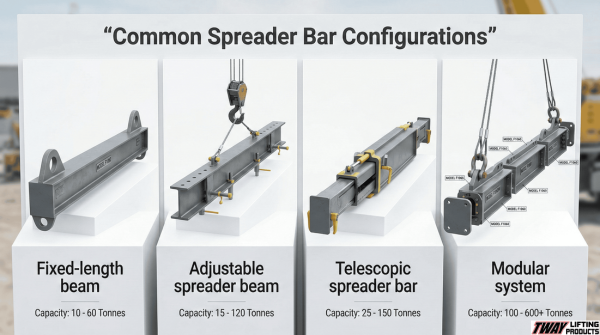
Spreader bars are available in multiple configurations to match specific lifting requirements. Tway Lifting offers equipment ranging from 2-ton to 100-ton capacity with both rental and purchase options available.
Common spreader bar types include:
| Spreader Bar Type | Primary Lifting Application | Load Capacity Range (Tons) | Material Specification |
| Fixed-length beams | Standard lifting | 2-100 tons | ASTM A36, A572 Grade 50 |
| Adjustable beams | Variable span needs | 2-50 tons | High-strength steel |
| Modular systems | Specialized lifts | Custom configurations | ASTM A514 steel |
| Telescopic bars | Field adjustments | 5-75 tons | Heat-treated steel |
| Container spreaders | Shipping operations | 20-45 tons | Corrosion-resistant steel |
Modulift beams provide customizable configurations for specialized lifts, while telescopic spreader bars allow quick length adjustments in the field. Container spreader bars are specifically engineered for shipping container handling in logistics operations.
The next sections will examine the specific advantages and limitations of each ownership option to help determine the optimal choice for your lifting operations.
What Are the Pros and Cons of Renting a Spreader Bar?
Renting a spreader bar offers advantages and disadvantages that vary based on project requirements, frequency of use, and operational circumstances. The decision involves weighing immediate benefits against long-term costs and operational flexibility.
When does renting a spreader bar offer the most advantages?
Renting a spreader bar offers the most advantages during short-term projects, specialized lifts, and when equipment access outweighs ownership costs. Enerfab, Inc. successfully rented Modulift spreader beams from LGH for a coal transfer conveyor tube replacement project, while Canadian crane rental company Guay Inc. rented Modulift spreader beams to install a six-section kiln.
Key rental advantages include:
- Access to latest equipment and technologies without being tied to specific models
- Rental companies handle periodic inspections and major maintenance, saving time and money
- Eliminates need for dedicated warehouse storage space
- Daily rental rates range from $100-$200 in Philadelphia and $150-$300 in Sacramento
Rental proves most beneficial for companies with variable project requirements, limited storage capacity, or infrequent lifting needs that don’t justify purchase costs.
Are there common drawbacks or limitations to renting a spreader bar?
Common drawbacks to renting a spreader bar include ongoing liability, potential availability issues, and hidden costs that can increase total project expenses. Renters remain responsible for conducting pre-use inspections before each lift and are liable for any damage occurring to equipment during the rental period.
Primary rental limitations include:
- Rental agreements may include penalties for late returns
- Equipment availability can be limited in remote locations, leading to higher costs and longer lead times
- Hidden fees for delivery and pickup can increase total rental costs
- Renters must meet insurance requirements specified by rental companies
Equipment availability becomes particularly challenging in remote areas where transportation costs and scheduling constraints can significantly impact project timelines and budgets.
How do rental agreements, liability, and support factor into renting?
Rental agreements, liability, and support factor into renting through comprehensive contracts that define responsibilities, limit company exposure, and ensure regulatory compliance. Rental agreements outline the renter’s obligation to return equipment in the same condition, less normal wear and tear.
Key contractual elements include:
| Responsible Party | Coverage Area | Defined Responsibility or Compliance Standard |
| Renter | Liability | Equipment damage during rental period |
| Renter | Indemnification | Hold rental companies harmless from claims |
| Tway Lifting | Liability Limit | Price of product ordered only |
| Rental Companies | Equipment Standards | OSHA 1910.184 and OSHA 1926.251 compliance |
Renters are typically required to indemnify and hold rental companies harmless from claims arising from equipment use. Tway Lifting’s liability is limited to the price of the product ordered and is not liable for special or consequential damages. Rental agreements restrict equipment use to intended purpose and may prohibit modifications, with default provisions defining remedies including equipment repossession and legal action.
This section establishes the foundation for understanding rental considerations, leading to the next section’s examination of ownership advantages and challenges.
What Are the Pros and Cons of Buying a Spreader Bar?
Buying a spreader bar involves weighing ownership benefits against ongoing responsibilities and costs. The decision depends on usage frequency, operational needs, and long-term project requirements.
In which scenarios is buying a spreader bar more beneficial?
Buying a spreader bar becomes more beneficial when standard rigging equipment is used more than 60 days per year. Amtrak’s use of Boscaro spreader bar system demonstrates benefits for recurring or specialized lifting needs. Specialized spreader bars may justify purchase with around 30 days of annual use.
Manufacturing facilities with consistent and predictable lifting needs often benefit from ownership. These operations provide stable utilization patterns that support cost-effective equipment purchases. Ports and shipping terminals commonly own specialized container spreader bars due to high-volume, repetitive operations.
Companies with long-term projects featuring consistent lifting requirements see better ROI from purchasing. This approach eliminates rental costs over extended periods while providing dedicated equipment availability.
What responsibilities come with owning a spreader bar?
Owners assume full liability for equipment and its use, including accidents from operator error. This responsibility extends to all aspects of equipment operation and maintenance throughout the ownership period.
Daily operational responsibilities include:
- Pre-use visual inspections before each lift to check for cracks, bending, or corrosion
- Frequent inspections by qualified persons at intervals from daily to monthly based on usage
- Maintaining detailed inspection and maintenance records per regulatory requirements
Owners must arrange Commercial General Liability and Inland Marine Insurance coverage for owned equipment. All repairs and recertification costs fall on the owner when damage or wear is discovered.
Are there long-term considerations for maintenance and compliance?
Annual periodic inspections including non-destructive testing (NDT) are mandatory per ASME B30.20. Spreader bars must maintain a minimum design factor of 3 per ASME BTH-1 (20-ton capacity must withstand 60-ton load). These requirements ensure equipment safety throughout its operational life.
Ongoing compliance requirements include:
- Proper storage facilities to protect equipment from damage and corrosion
- Ensuring compatibility with crane hooks, slings, and load attachment points
- Documentation and administrative costs for maintaining regulatory compliance records
- Training and certification costs for in-house inspectors or third-party inspection services
These considerations add to total ownership cost beyond the initial purchase price. The next section examines specific cost factors that influence rental versus purchase decisions.
How Do the Cost Factors Compare Between Renting and Buying a Spreader Bar?
The cost factors between renting and buying a spreader bar vary significantly based on usage frequency, geographic location, and equipment specifications. Rental costs provide immediate access without capital investment, while purchase costs offer long-term value for frequent users. Geographic pricing differences, equipment complexity, and hidden fees substantially impact total ownership costs for both options.
What influences the total cost of renting a spreader bar?
The total cost of renting a spreader bar depends on location-specific rates, equipment type, and additional service fees. Philadelphia rental rates range from $100-$200 daily, $400-$800 weekly, and $1,200-$2,500 monthly, while Sacramento commands $150-$300 daily, $600-$1,200 weekly, and $2,000-$4,500 monthly.
Specialized equipment increases rental expenses beyond standard rates. Modular spreader systems and telescopic models command premium pricing due to enhanced functionality and complexity. Additional costs include:
- Delivery and pickup fees based on distance
- Damage waivers or Rental Protection Plans
- Late return penalties
- Geographic location premiums reflecting local labor costs and industrial activity levels
What are the main upfront and ongoing costs of buying a spreader bar?
The main costs of buying a spreader bar include initial purchase price and ongoing operational expenses. Initial purchase prices range from $400 for basic 2-ton fixed beams to over $2,000 for adjustable models, with pricing influenced by capacity, length, material specifications, and manufacturer reputation.
Ongoing ownership costs include:
- Annual inspection costs for qualified personnel or third-party inspectors
- Repair and recertification expenses when damage occurs
- Warehouse storage space requirements
- Commercial General Liability and Inland Marine insurance premiums
- Administrative costs for maintaining regulatory compliance records
These ongoing expenses often exceed 15-25% of purchase price annually, making total ownership cost analysis essential for accurate decision-making.
How can you calculate the break-even point for renting versus buying?
The break-even point occurs when total ownership costs equal cumulative rental expenses over time. Standard hardware typically reaches break-even at roughly 60 days of annual use, while specialty items often break even around 30 days per year due to higher rental premiums.
Break-even calculations must include:
| Cost Factor | Spreader Bar Rental Costs | Spreader Bar Purchase Costs |
| Initial Investment | $0 | Purchase price |
| Annual Usage Cost | Daily rate × days used | Inspections + maintenance + insurance |
| Storage Cost | $0 | Warehouse space allocation |
| Capital Opportunity | $0 | Interest on invested capital |
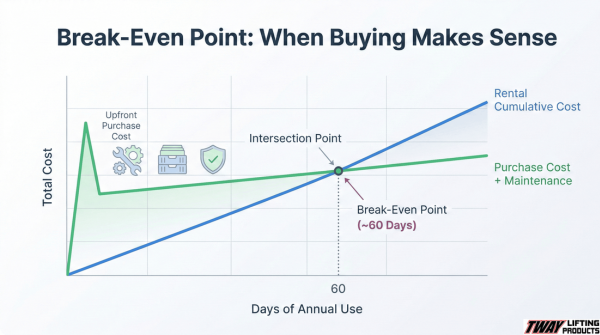
Capital availability and project duration significantly influence break-even analysis, as does equipment utilization rate consistency. Market conditions including inflation and interest rates affect both rental rates and financing costs, requiring periodic recalculation of break-even thresholds for optimal equipment strategies.
How Should You Decide Whether to Rent or Buy a Spreader Bar for Your Needs?
Deciding whether to rent or buy a spreader bar requires evaluating your project requirements, usage patterns, and long-term operational needs. This decision directly impacts your project costs, equipment availability, and compliance responsibilities. The following factors will guide you through making an informed choice that aligns with your lifting operations.
What project details or usage scenarios influence the best choice?
Project details and usage scenarios determine whether renting or buying a spreader bar provides better value. Construction’s project-based nature often makes renting more practical and cost-effective since projects have defined timelines. Manufacturing facilities with predictable lifting needs benefit more from ownership due to consistent equipment utilization.
Short-term projects almost always favor renting over purchasing. Companies working on a variety of projects with different requirements benefit from rental flexibility, allowing access to specialized equipment without large capital commitments. High-volume repetitive operations like container handling in ports justify ownership through economies of scale.
Many teams commit to purchases without evaluating actual usage patterns, leading to poor ROI. Effective decision-making requires analyzing your annual lifting frequency, project duration, and equipment specifications before choosing between rental and purchase options.
How do safety, certification, and insurance factor into the decision?
Safety, certification, and insurance requirements apply equally to rented and owned spreader bars. Between 2011-2017, there were 297 fatal crane injuries averaging 42 deaths per year, highlighting the critical importance of proper equipment selection and compliance.
Both rental and owned equipment must meet OSHA 1910.184 and OSHA 1926.251 standards. ASME B30.20 requires regular inspections by qualified persons regardless of ownership status. The end-user remains ultimately responsible for safe equipment use whether rented or owned.
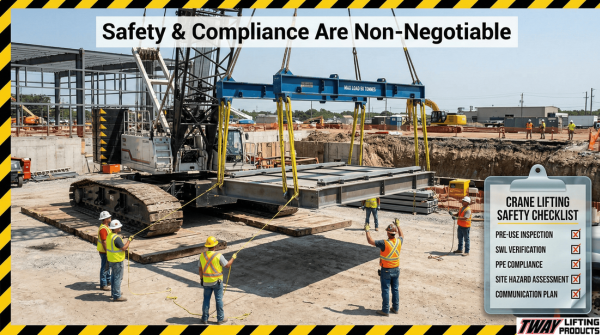
Key insurance and safety considerations include:
- Rental companies provide certified equipment with up-to-date inspection records
- Insurance requirements include proof of adequate Commercial General Liability coverage for rentals
- Both options require pre-use inspections and proper operator training
- Equipment must maintain current certification throughout use period
Are there industry or regulatory guidelines to consider?
Industry and regulatory guidelines establish mandatory standards for spreader bar design, operation, and maintenance. ASME BTH-1 specifies design criteria including minimum design factor of 3 for dynamic loading, ensuring equipment can handle three times its rated capacity.
Spreader bars must display clearly marked rated capacity in tons or pounds. Sling angles must stay within manufacturer-specified ranges to maintain rated capacity. Load attachment points must withstand forces exerted by lifting slings during operation.
Regulatory compliance requirements include:
- Equipment must be inspected and used according to manufacturer specifications
- Many manufacturers seek third-party certification from DNV, ABS, or Lloyd’s Register for critical lifts
- Regular documentation of inspections and maintenance activities
- Adherence to OSHA workplace safety standards throughout equipment lifecycle
These guidelines apply whether you rent or purchase equipment, but ownership transfers full compliance responsibility to your organization while rental companies often handle periodic maintenance and documentation.
How Can Tway Lifting Help With Renting or Buying a Spreader Bar?
Tway Lifting provides comprehensive spreader bar solutions for both rental and purchase decisions. The company simplifies equipment selection through expert guidance and nationwide service capabilities.
What spreader bar rental and purchase options does Tway Lifting offer?
Tway Lifting offers spreader bars from 2-ton to 100-ton capacity for both rent and purchase. The company provides modular and adjustable spreader bar options for specialized applications requiring custom configurations.
All Tway Lifting spreader bars meet or exceed OSHA and ASME standards with current inspection records and certification documentation. Key service features include:
- Nationwide delivery service for rental equipment
- Spreader bar selection guide matching equipment to existing crane hook configurations
- Quote-by-quote pricing for both rental and purchase options
- Expert consultation on capacity requirements and safety compliance
The company’s modular systems accommodate complex lifting scenarios where standard fixed-length beams cannot provide adequate load distribution or clearance requirements.
This section leads into the final decision-making framework that consolidates all factors for choosing between rental and purchase options.
What Are the Key Takeaways About Renting vs Buying a Spreader Bar: Pros, Cons & Cost Factors?
The decision between renting and buying spreader bars depends on specific organizational needs and circumstances. Organizations with infrequent or specialized needs typically benefit more from renting, while companies with consistent, predictable lifting requirements see better ROI from purchasing.
Total cost analysis should include maintenance, inspections, storage, and insurance beyond initial price. Break-even typically occurs around 60 days of annual use for standard equipment and 30 days for specialty items.
Emerging technologies enhance both rental and ownership strategies:
- Smart lifting systems with IoT sensors provide real-time data on load weight and equipment health
- Advanced composite materials like carbon fiber reduce equipment weight without compromising strength
- Data-driven decision-making using utilization rates and maintenance costs improves equipment strategies
The optimal choice balances project requirements, usage patterns, financial resources, and risk tolerance. Both options require adherence to OSHA and ASME safety standards, making equipment selection and proper use the critical success factors regardless of ownership model.