




A spreader bar rental is a temporary lease of a below-the-hook lifting device that stabilizes and distributes loads during overhead crane operations. Choosing between short-term and long-term rental structures directly affects project cost, contract obligations, and compliance responsibilities.
This guide covers spreader bar rental fundamentals, short-term and long-term rental structures, cost comparisons and ownership thresholds, duration selection factors, contract terms and liability, safety and compliance requirements, and how Tway Lifting supports rental needs nationwide.
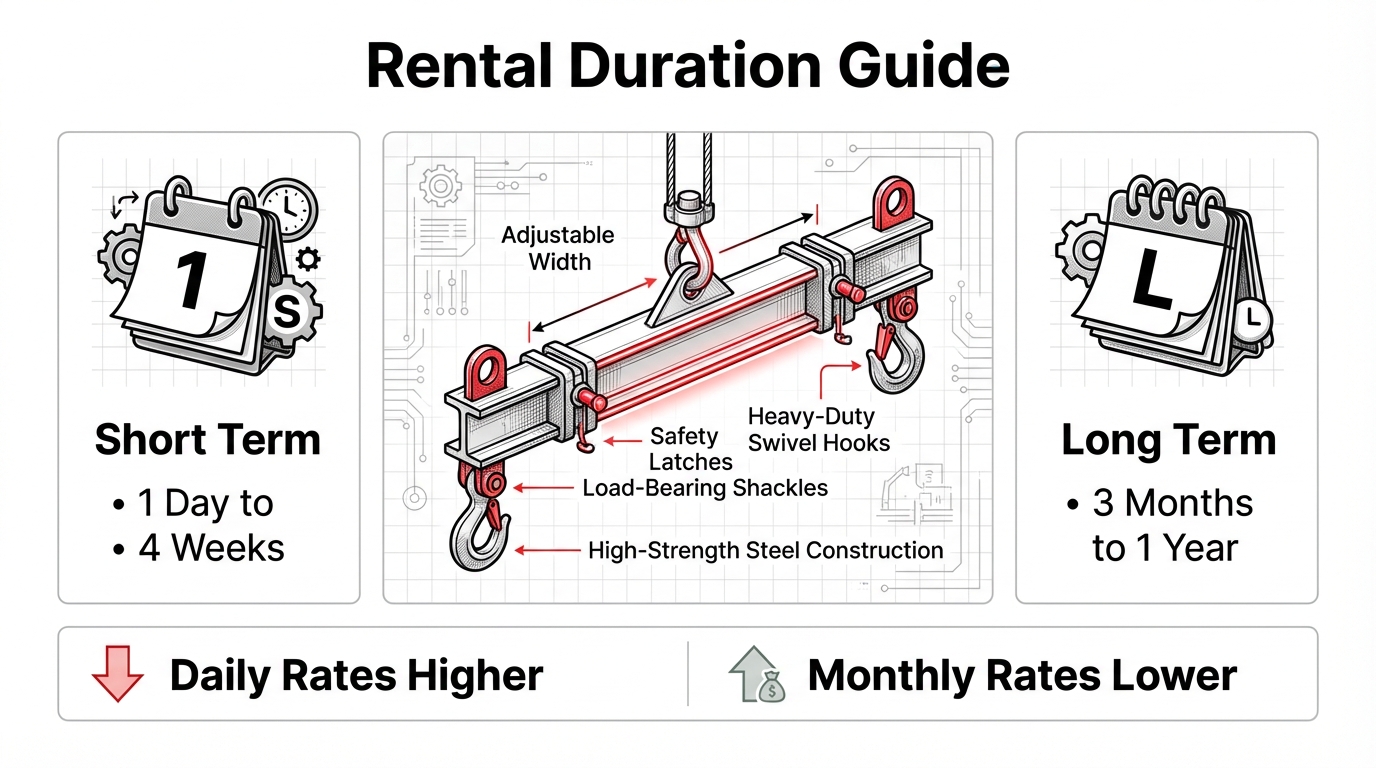
Short-term rentals typically span one day to four weeks, serving single-event lifts, shutdown maintenance, and emergency rigging needs. Daily rates range from $150 to $300, with weekly pricing cutting the effective per-day cost by roughly half. These arrangements keep storage and maintenance obligations with the provider but carry higher execution risk if project timelines shift.
Long-term rentals extend from three months to over a year, suiting multi-phase construction, offshore installations, and extended plant outages. Monthly rates between $2,000 and $4,000 push the per-day equivalent well below short-term pricing. The tradeoff is that renters assume greater storage, inspection, and on-site maintenance responsibilities.
Cost crossover points depend on cumulative rental days, mobilization frequency, and ancillary charges like delivery fees. For standard rigging hardware used above 60 days annually, ownership often becomes more economical than continued renting.
Every rented spreader bar must meet OSHA 29 CFR 1926.251(a)(4) proof-testing requirements and ASME B30.20 marking, inspection, and maintenance standards. Rental agreements should clearly define inspection clauses, damage liability, and extension or early return policies to prevent costly disputes and compliance gaps on the job site.
What Is a Spreader Bar Rental and Why Do Lifting Projects Require One?
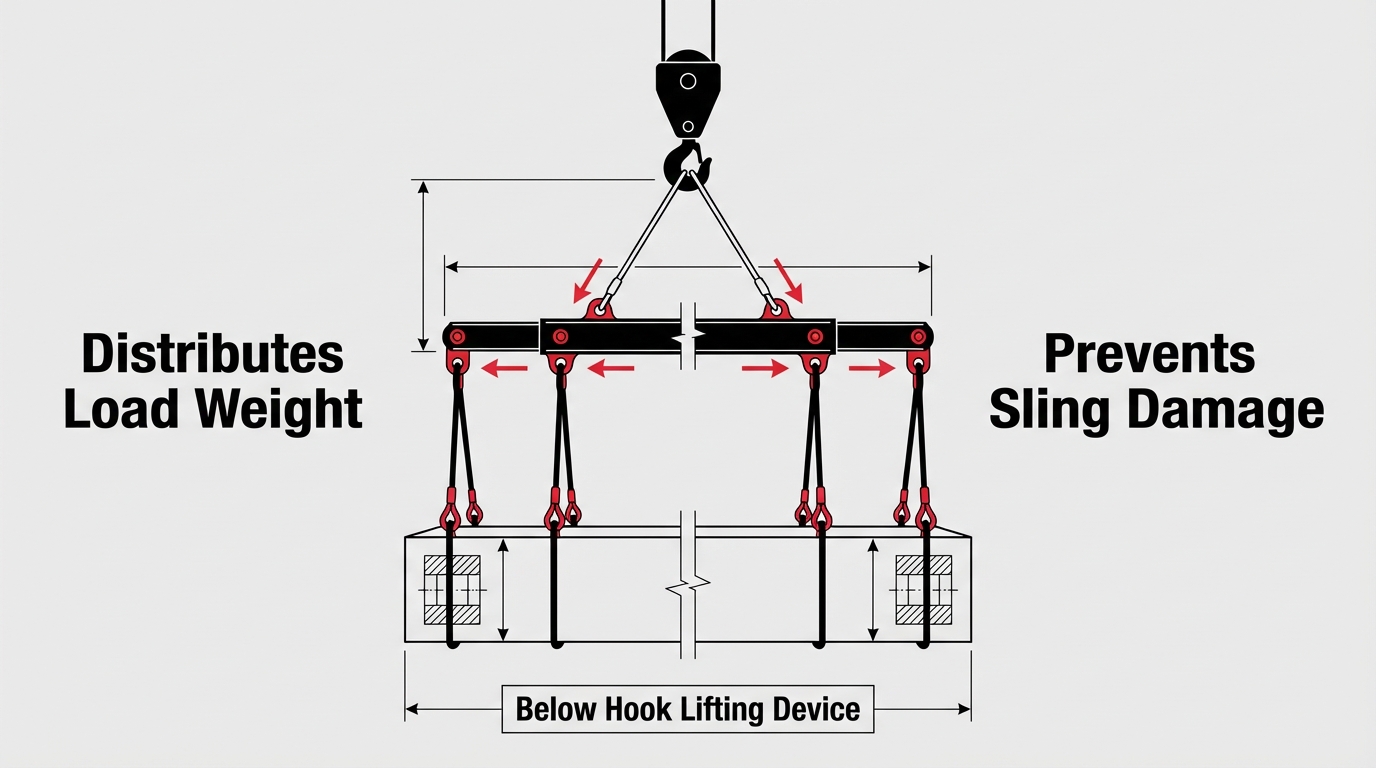
A spreader bar rental is a service that provides temporary access to a below-the-hook lifting device designed to stabilize and distribute loads during overhead crane operations. Lifting projects require spreader bars because these devices prevent sling damage, control load orientation, and protect both personnel and materials during complex picks.
Spreader bars experience compression stress along their length, which makes them lighter and more material-efficient than lifting beams of comparable capacity. This structural advantage allows modular configurations to handle varied loads up to 3,000 tonnes across construction, energy, and logistics applications. Renting, rather than purchasing, gives project teams access to the exact size and capacity needed without long-term capital commitment, storage obligations, or ongoing maintenance costs.
According to Basepoint Engineering, lifting and spreader beams must be designed in accordance with ASME BTH-1 and manufactured and used in compliance with ASME B30.20. These compliance requirements make rentals particularly practical; a quality rental provider delivers certified, inspection-ready equipment that meets OSHA and ASME standards from day one.
For projects where lift frequency is limited or job site conditions vary, renting eliminates the burden of recertification cycles and idle-asset depreciation. Whether the scope calls for a single weekend pick or a multi-month installation campaign, the rental duration directly shapes cost efficiency, contract terms, and compliance responsibilities. The sections that follow break down how short-term and long-term spreader bar rental structures differ in pricing, project fit, and contractual obligations.
What Is a Short-Term Spreader Bar Rental?
A short-term spreader bar rental is a temporary equipment lease that provides on-demand access to below-the-hook lifting devices for projects with defined, limited timelines. Duration, ideal project types, and typical costs are covered below.
How Long Does a Short-Term Spreader Bar Rental Typically Last?
A short-term spreader bar rental typically lasts anywhere from a single day to roughly four weeks. Most arrangements fall into daily or weekly billing cycles, with some providers offering monthly terms as the upper boundary before a long-term agreement begins.
According to McDowell Equipment, short-term rentals provide on-demand access and cost control for temporary projects, while long-term rentals offer stability and lower rates for extended durations. Because short-term timelines are compressed, they primarily carry execution risk; any delay in the lift schedule can push the rental beyond its original window and trigger additional charges. For single-lift operations or jobs with a clear end date, this flexibility is often worth the premium.
What Types of Projects Are Best Suited for Short-Term Rentals?
The types of projects best suited for short-term rentals are those with a defined scope, a limited number of lifts, or a one-time rigging need. Common examples include:
- Single-event heavy lifts, such as HVAC unit placements or structural steel erection
- Shutdown and turnaround maintenance at refineries or processing plants
- Emergency rigging situations requiring rapid equipment mobilization
- Bridge beam sets or precast concrete installations with a fixed schedule
- Offshore structure installations, where a National University of Singapore study confirmed that heavy lift installation involving spreader bars provides a viable solution for wind turbine jacket foundations
Short-term rentals eliminate storage and long-term maintenance obligations once the job wraps. For contractors who only need a spreader bar a handful of times per year, renting on demand is almost always more cost-effective than ownership.
What Does a Short-Term Spreader Bar Rental Usually Cost?
A short-term spreader bar rental usually costs between $150 and $300 per day, or $600 to $1,200 per week, based on 2026 Houston-area pricing reported by CountBricks. Daily rates carry the highest per-day cost, while weekly pricing reduces that figure significantly.
Total expense depends on several variables beyond the base rate:
- Spreader bar capacity and span length
- Mobilization, delivery, and pickup fees
- Required certification documentation and proof-test records
Rental analysis should also account for all ancillary costs, such as mobilization and delivery, to protect project profitability. For teams needing a spreader bar fewer than 30 days per year on specialty items, renting short-term keeps capital free and avoids the burden of inspection upkeep between jobs.
With short-term rental basics established, the next section covers how long-term agreements differ in structure and cost.
What Is a Long-Term Spreader Bar Rental?
A long-term spreader bar rental is an extended equipment lease that provides stable access to below-the-hook lifting devices for projects spanning several months or longer. The subsections below cover typical durations, ideal project types, and expected costs.
How Long Does a Long-Term Spreader Bar Rental Typically Last?
A long-term spreader bar rental typically lasts anywhere from three months to over a year, depending on the scope of the project. Some industrial leases extend even further. According to a 2025 analysis by Lucern Capital Partners, a long-term industrial lease typically ranges from five to fifteen years or more, offering greater stability for project planning. While most spreader bar rentals fall on the shorter end of that spectrum, durations of six to twelve months are common for phased construction, energy installation, and infrastructure programs. The extended commitment allows both parties to lock in predictable terms rather than renegotiating equipment access repeatedly.
What Types of Projects Are Best Suited for Long-Term Rentals?
The types of projects best suited for long-term rentals are those requiring repeated or continuous heavy lifts over an extended timeline. These include:
- Offshore platform construction and wind turbine jacket foundation installation
- Multi-phase bridge, highway, or commercial building projects
- Power plant outages and refinery turnarounds lasting several months
- Large-scale industrial facility expansions with ongoing steel erection
Research from the National University of Singapore confirms that heavy lift installation involving spreader bars provides a viable solution for offshore structures and wind turbine jacket foundations. For any project where lift schedules stretch across months, a long-term rental eliminates the logistical burden of sourcing equipment for each mobilization.
What Does a Long-Term Spreader Bar Rental Usually Cost?
A long-term spreader bar rental usually costs less per day than short-term arrangements because monthly pricing significantly reduces the effective daily rate. According to a 2026 pricing survey by CountBricks, renting a spreader bar for mobile cranes in Houston typically costs between $2,000 and $4,000 per month, compared to $150 to $300 per day. Over a six-month period, that monthly rate can cut the per-day cost by more than half. Total rental analysis should also factor in mobilization, delivery, and inspection expenses, since these ancillary costs directly affect project profitability. For projects with consistent lift needs, long-term agreements almost always deliver better value per dollar spent.
Understanding these long-term rental dynamics sets the stage for a direct cost comparison between short-term and extended agreements.
How Do Short-Term and Long-Term Spreader Bar Rental Costs Compare?
Short-term and long-term spreader bar rental costs compare through significant differences in daily rates, break-even thresholds, and ownership crossover points. The following subsections cover daily rate structures, long-term cost advantages, and when purchasing becomes the smarter investment.
How Does the Daily Rate Differ Between Short-Term and Long-Term Rentals?
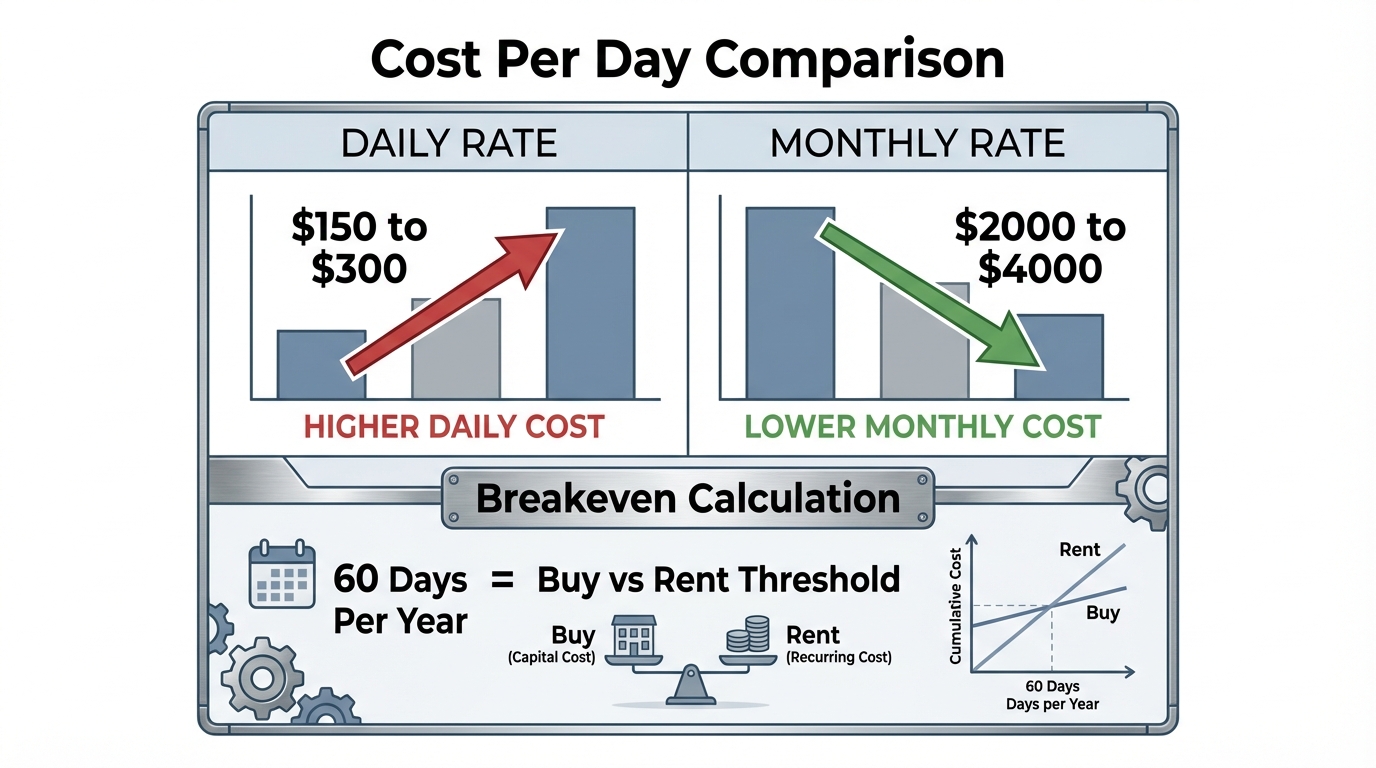
The daily rate differs substantially between short-term and long-term rentals because rental pricing follows a tiered discount structure. According to a 2026 CountBricks market analysis, renting a spreader bar for mobile cranes in Houston typically costs between $150 and $300 per day, $600 and $1,200 per week, and $2,000 and $4,000 per month.
These tiers reveal how quickly per-day costs drop with longer commitments:
- Daily rentals carry the highest per-day cost, suited for single lifts or emergency mobilizations.
- Weekly rentals reduce the effective daily rate by roughly 50% to 60% compared to daily pricing.
- Monthly rentals push the per-day equivalent even lower, often below $135 per day at the upper range.
Short-term rentals primarily carry execution risk for project timelines, while long-term rentals primarily carry pricing risk. For projects spanning more than two weeks, locking in weekly or monthly rates almost always delivers better cost efficiency than rolling day-to-day agreements.
When Does a Long-Term Rental Become Cheaper Than Repeated Short-Term Rentals?
A long-term rental becomes cheaper than repeated short-term rentals once total accumulated daily charges exceed the equivalent monthly rate. At $300 per day, a short-term renter reaches the $4,000 monthly ceiling in roughly 13 days. Every day beyond that represents pure overspend compared to a monthly agreement.
Mobilization and delivery costs accelerate this crossover further. According to Engineered Rigging, rental equipment analysis should include all potential costs, such as mobilization and delivery, to improve project profitability. Each separate short-term rental triggers new transport fees, rigging coordination, and potential downtime between mobilizations. For any project requiring spreader bar access across multiple weeks or phases, a single long-term contract eliminates redundant logistics costs that compound with every repeated rental cycle.
At What Point Does Purchasing a Spreader Bar Make More Sense Than Renting?
Purchasing a spreader bar makes more sense than renting when annual usage consistently exceeds a predictable threshold. According to HHI Lifting, regular use above roughly 60 days per year for standard rigging hardware, and around 30 days per year for specialty items, often leans toward ownership.
To calculate the exact crossover, divide the net annual ownership cost (purchase price, storage, inspection, maintenance, and insurance) by the daily rental rate. If your projected rental days exceed that quotient, buying delivers a lower cost per lift over time.
Ownership also eliminates availability risk. Long-term rental agreements still depend on fleet scheduling, while owned spreader bars remain accessible whenever a lift demands them. However, ownership requires ongoing ASME B30.20 compliance, proof testing, and semi-annual inspections, responsibilities that shift entirely to the buyer. For teams without dedicated rigging maintenance programs, renting often remains the more practical path despite higher per-day costs.
What Spreader Bar Sizes and Capacities Are Available for Rental?
Spreader bar sizes and capacities available for rental range from compact units rated at a few tons to modular systems capable of handling extreme loads across construction, energy, and logistics applications. The specific size you need depends on load weight, lift span, and project requirements.
Rental inventories typically include fixed-length spreader bars in standard capacities (2 to 100 tons) and lengths up to 40 feet, which suit most commercial construction and industrial maintenance lifts. For projects demanding greater flexibility, modular spreader bars allow adjustable lengths and configurable end fittings, scaling capacity significantly higher. According to Tway Lifting’s modular equipment guide, modular spreader bars can handle varied loads up to 3,000 tonnes in applications across construction, energy, and logistics.
Key factors that determine which size and capacity to rent include:
- Load weight: The spreader bar’s rated capacity must exceed the total rigged weight of the load, including rigging hardware.
- Lift span: Longer loads require longer bars to maintain proper sling angles and load distribution.
- Sling geometry: Wider spreader bars reduce sling angles, lowering horizontal compression forces on the bar itself.
- Crane compatibility: The bar’s weight counts toward the crane’s net capacity, so heavier bars reduce available lifting capacity.
- Compliance requirements: All spreader bars must be designed per ASME BTH-1 and used in compliance with ASME B30.20, regardless of size.
Because spreader bars experience compression stress along their length rather than bending stress, they tend to be lighter and more material-efficient than lifting beams of comparable capacity. This structural advantage means rental fleets can stock higher-capacity spreader bars without proportionally increasing transport and mobilization costs. For most rental scenarios, matching the bar’s rated capacity to the specific lift plan, rather than defaulting to the largest available unit, keeps costs lower and simplifies logistics. With the right size selected, evaluating rental duration becomes the next critical decision.
What Factors Should You Evaluate When Choosing a Rental Duration?
The factors you should evaluate when choosing a rental duration include project timeline, lift frequency, storage and maintenance obligations, and mobilization costs. Each factor shifts the balance between short-term and long-term spreader bar rentals.
How Does Project Duration Affect Your Rental Decision?
Project duration affects your rental decision by determining whether a short-term or long-term spreader bar rental delivers better cost efficiency. A two-week bridge lift calls for a daily or weekly rate, while a multi-month plant expansion benefits from lower monthly pricing. According to McDowell Equipment, short-term rentals provide on-demand access and cost control for temporary projects, while long-term rentals offer stability and lower rates for extended durations.
Mismatching rental length to project scope creates unnecessary expense. When timelines are uncertain, building buffer days into a longer rental term often costs less than extending a short-term agreement at premium daily rates. Aligning the contract window to your realistic project schedule is the single most effective way to control rental spend.
How Does Lift Frequency Across Multiple Job Sites Affect Your Choice?
Lift frequency across multiple job sites affects your choice by determining how many mobilization cycles and rental windows you need. A single spreader bar on one long-term rental can rotate between sites, eliminating repeated procurement and delivery charges.
Conversely, infrequent lifts spread across distant locations may justify separate short-term rentals sized to each job. According to HHI Lifting, regular use above roughly 60 days per year for standard rigging hardware often tips the decision toward ownership or a consolidated long-term agreement. Tracking cumulative lift days across all active sites reveals whether bundling into one extended rental reduces total cost compared to booking individual short-term contracts.
How Do Storage and Maintenance Responsibilities Differ by Rental Term?
Storage and maintenance responsibilities differ by rental term in that short-term rentals keep those obligations with the rental provider, while long-term rentals shift more responsibility to the renter. On a weekly rental, the spreader bar returns quickly, and the provider handles inspection and reconditioning between uses.
Long-term agreements typically require the renter to store the equipment on site, protect it from environmental damage, and coordinate periodic inspections. Under ASME B30.20, lifting beams and spreader bars require thorough examination at intervals not exceeding six months. For projects lasting beyond that threshold, the renter must budget for compliant storage facilities and scheduled inspections as part of the true rental cost.
How Do Mobilization and Delivery Costs Influence Rental Length?
Mobilization and delivery costs influence rental length by adding fixed expenses that erode the savings of short-term contracts. Every time a spreader bar ships to a job site, transport fees apply regardless of whether the rental lasts three days or three months. According to Engineered Rigging, rental equipment analysis should include all potential costs, such as mobilization and delivery, to improve project profitability.
When delivery costs represent a significant percentage of the total rental expense, extending the rental term spreads that fixed cost over more productive days. For projects requiring even occasional repeat lifts, one longer rental with a single mobilization often outperforms multiple short-term bookings that each carry separate delivery charges. Understanding your delivery logistics before signing any agreement helps avoid hidden costs that quietly shrink project margins.
What Are the Key Contract Terms to Review in a Spreader Bar Rental Agreement?
The key contract terms to review in a spreader bar rental agreement include inspection and compliance clauses, damage liability provisions, and extension or early return policies. Each area carries distinct financial and safety implications.
What Inspection and Compliance Clauses Should You Look For?
The inspection and compliance clauses you should look for cover proof testing documentation, pre-lift inspection requirements, and adherence to ASME B30.20 standards. A well-structured agreement specifies that the rental provider delivers the spreader bar with current certification, including load charts and inspection reports.
Look for clauses that confirm:
- The spreader bar has been proof-tested to validate rated load capacity before delivery.
- ASME B30.20 marking, inspection, and maintenance requirements are satisfied.
- Documentation accompanies the equipment for any prior load testing, modification, or repair.
According to the Crane Inspection & Certification Bureau, documentation is required for any operation or load testing of new, reinstalled, modified, or repaired below-the-hook lifting devices. Agreements that omit these clauses leave the renter exposed to compliance gaps that can trigger OSHA citations on the job site.
Who Is Responsible for Repairs and Damage During the Rental Period?
The party responsible for repairs and damage during the rental period is typically the renter, though the specific allocation depends on the agreement’s damage clause and damage waiver. Most rental agreements include broad liability clauses that hold renters responsible for any damage to the equipment regardless of cause, according to LegalGPS.
A damage clause paired with a damage waiver serves as the final word on a customer’s obligations for returned equipment. Because spreader bars operate under high-stress lifting conditions, even minor structural damage can compromise load-bearing integrity.
Key provisions to negotiate include:
- Whether normal wear is distinguished from operational damage.
- Liquidated damages amounts for specific breaches, such as late returns.
- Insurance or waiver options that cap the renter’s financial exposure.
Failing to clarify these terms before signing often results in disputes that are far more expensive than the rental itself.
What Are Common Extension and Early Return Policies?
Common extension and early return policies define the financial penalties, notice periods, and rate adjustments that apply when a project timeline shifts. Duration and termination clauses are critical elements in rental agreements, as MacDonald Crane & Rigging notes, because both parties need a clear project timeline.
Extension policies typically address:
- Whether the original rate carries forward or reverts to a higher daily rate.
- Required notice periods, often 24 to 72 hours before the contract end date.
- Availability guarantees if another customer has reserved the same spreader bar.
Early return policies vary more widely. Some agreements offer prorated refunds for unused time on long-term contracts, while others enforce the full contract value regardless of when the equipment comes back. Liquidated damages provisions may also predetermine compensation for early termination.
Reviewing these terms before signing protects your project budget from unexpected surcharges when schedules inevitably change. With contract terms clarified, the next step is understanding the safety and compliance obligations that apply once the spreader bar reaches your job site.
What Safety and Compliance Requirements Apply to Rented Spreader Bars?
The safety and compliance requirements that apply to rented spreader bars include OSHA proof-testing standards, ASME B30.20 marking and inspection mandates, and mandatory pre-lift visual inspections by a competent person.
What OSHA Standards Apply to Spreader Bars on Rental?
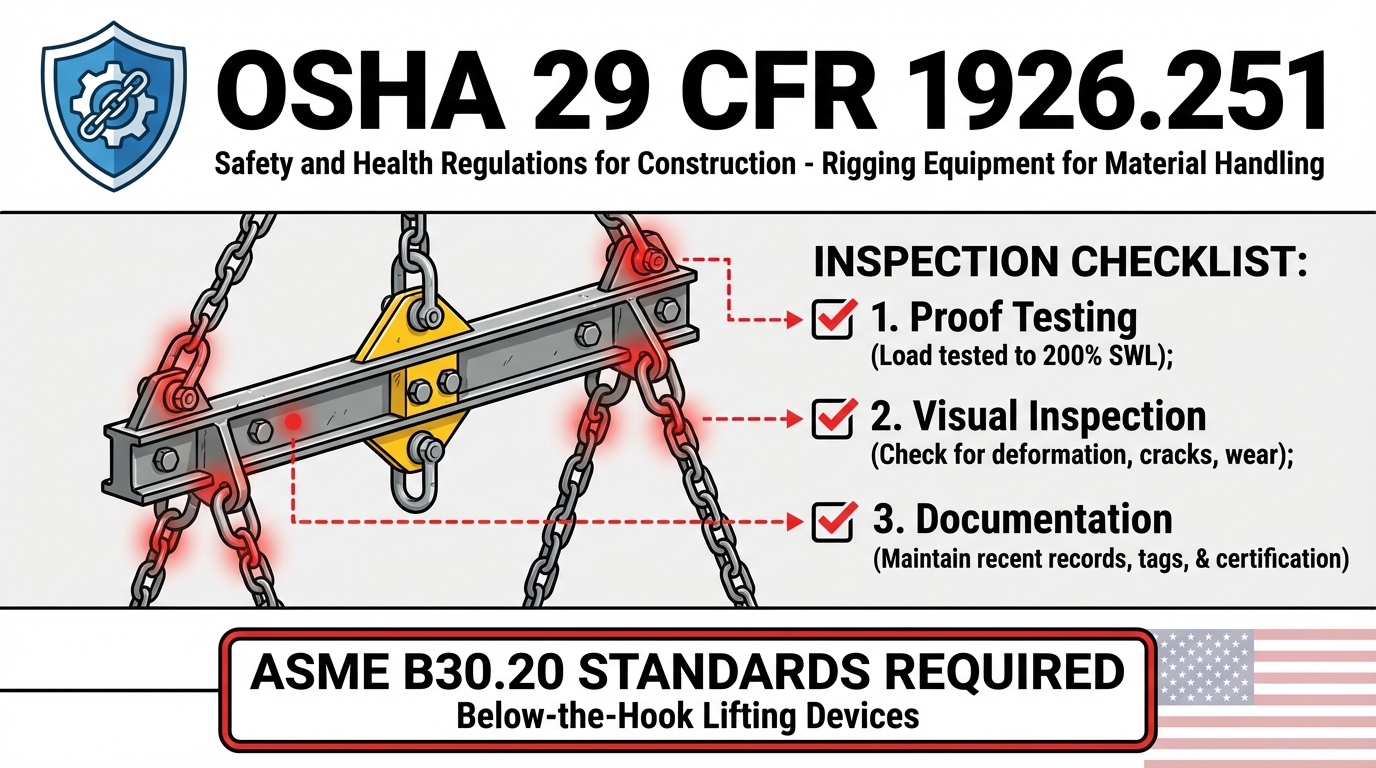
The OSHA standards that apply to spreader bars on rental center on 29 CFR 1926.251(a)(4) and the requirements defined under ASME B30.20. According to OSHA, 29 CFR 1926.251(a)(4) requires that special custom design lifting accessories be proof-tested prior to use to 125 percent of their rated load. ASME B30.20 defines additional requirements for spreader bars, including marking, inspection, testing, and maintenance protocols. Documentation is also required for any load testing of new, reinstalled, modified, or repaired below-the-hook lifting devices, as outlined by the Crane Inspection & Certification Bureau (CICB). Whether you rent for one week or six months, these standards apply identically; the rental duration never reduces the compliance obligation.
Who Is Responsible for Pre-Lift Inspections on a Rented Spreader Bar?
The responsibility for pre-lift inspections on a rented spreader bar falls on the party controlling the job site. According to the Electronic Code of Federal Regulations, a competent person must begin a visual inspection prior to each shift the equipment will be used, completing it before or during that shift. This obligation applies regardless of whether the spreader bar is owned or rented. Lifting beams and spreader bars should also undergo thorough examination by a competent person at intervals not exceeding six months. Reputable rental providers typically deliver equipment with current certification packages, but the end user remains responsible for daily shift inspections. Confirming inspection responsibilities in the rental agreement before mobilization prevents costly compliance gaps on the job site.
How Can Tway Lifting’s Rental and Rigging Services Support Your Next Lift?
Tway Lifting can support your next lift with spreader bar rentals, OSHA-compliant inspections, and professional rigging services backed by over 75 years of expertise. The sections below cover delivery options, compliance support, and key rental takeaways.
Does Tway Lifting Offer Spreader Bar Rentals With Free Delivery and OSHA-Compliant Inspections?
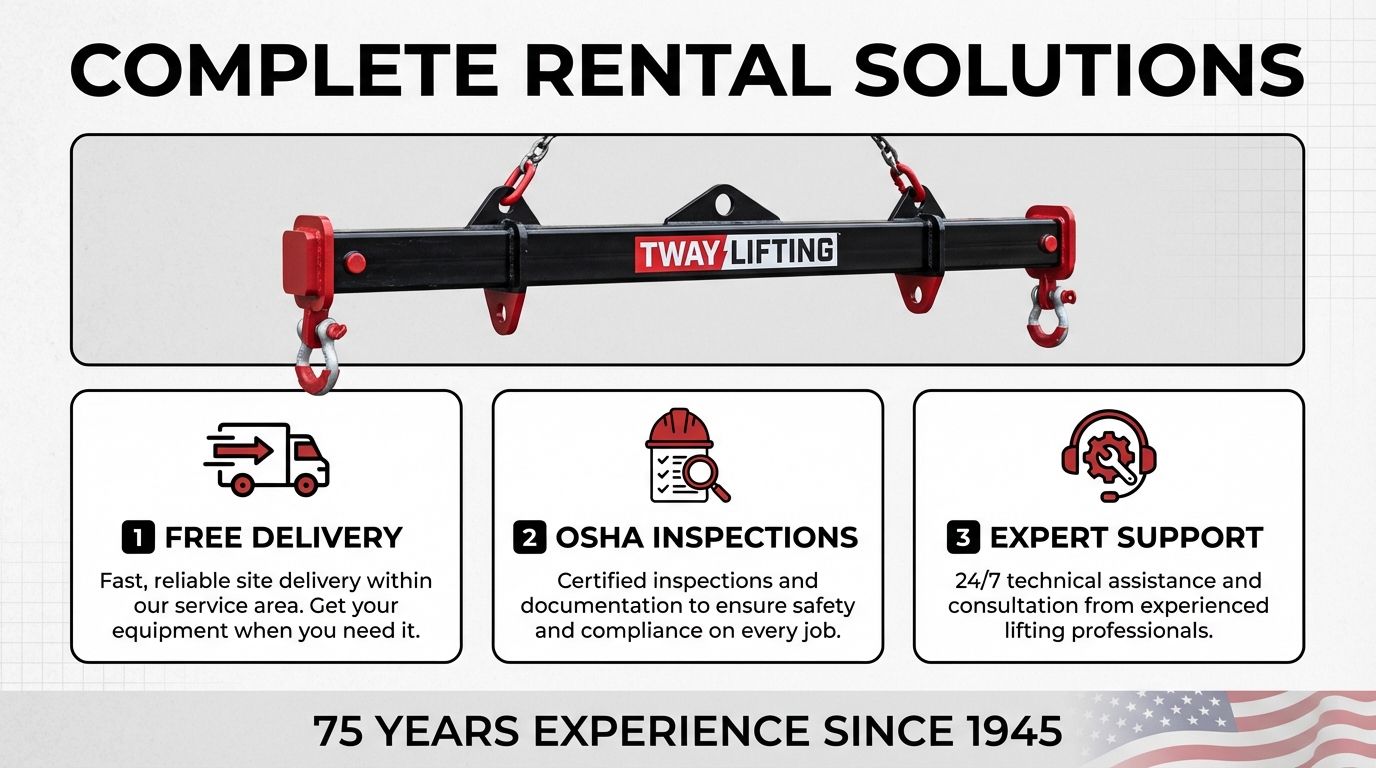
Yes, Tway Lifting offers spreader bar rentals with free local delivery and pickup, along with OSHA-compliant inspection services. Tway Lifting provides spreader beams ranging from 2 to 100 tons with lengths up to 40 feet, available on daily, weekly, or monthly terms. Every rental is supported by certified, factory-trained inspection specialists who perform rigorous safety checks aligned with OSHA standards. As a manufacturer and distributor since 1945, Tway Lifting handles fabrication, sales, and rentals under one roof, which simplifies coordination and reduces project delays. Tway Lifting also offers same-day wire rope sling fabrication, emergency service, and custom lifting assemblies for non-standard configurations.
What Are the Key Takeaways About Short-Term vs Long-Term Spreader Bar Rentals?
The key takeaways about short-term vs long-term spreader bar rentals center on matching rental duration to project scope, budget, and lift frequency.
- Short-term rentals suit single lifts and temporary projects where on-demand access and cost control matter most.
- Long-term rentals deliver lower per-day rates and scheduling stability for extended or multi-phase operations.
- Daily rates carry the highest cost per day, while weekly and monthly pricing reduces that figure significantly.
- Rental decisions should account for total costs, including mobilization, delivery, inspections, and potential late-return penalties.
- Projects requiring spreader bars beyond roughly 60 days per year for standard equipment may benefit from purchasing instead.
- Every rented spreader bar must meet OSHA and ASME B30.20 compliance requirements, regardless of rental term.
For projects of any duration, working with a provider that combines rental inventory, certified inspections, and rigging expertise keeps lifts safe and cost-efficient.