






When you’re planning a crane lift involving large, heavy, or irregularly shaped loads, you’re likely searching for the most efficient and safe way to distribute weight across multiple pick points. Whether you’re a construction manager facing a complex lift or a project engineer evaluating equipment options, understanding spreader bar rentals is crucial for your operation’s success. We’ll walk you through everything you need to know about renting these essential below-the-hook lifting devices.
A spreader bar rental for crane lifts is a cost-effective solution that provides specialized equipment designed to distribute load weight evenly across multiple attachment points, preventing damage and ensuring lifting stability without the capital investment of purchasing. These high-strength steel structures maintain proper sling angles above 60 degrees, meet ASME BTH-1 design standards with a 3:1 safety factor, and come in various configurations from fixed to modular designs with capacities ranging from 2 to 100 tons.
TL;DR Summary:
• Spreader bars consist of high-strength steel structures with main types including fixed, adjustable, telescopic, and modular configurations, all meeting ASME BTH-1 standards with a 3:1 safety factor
• Renting saves significant capital investment with costs ranging from $100-$200 daily to $1,200-$2,500 monthly, while providers like Tway Lifting offer free nationwide delivery and handle all maintenance
• The rental process requires providing load specifications, site conditions, and crane compatibility details, with typical terms available in daily, weekly, or monthly periods
• Proper selection depends on load capacity (2-100 tons available), site conditions including headroom and humidity levels, and expert assistance from certified professionals
• Critical safety considerations include maintaining sling angles above 60 degrees, conducting pre-use inspections, and avoiding common mistakes like exceeding Working Load Limits
• Tway Lifting provides comprehensive rental solutions with modular options, ASME/ISO certification, free delivery, and technical support for safe operations
Quick Tip: Always verify your crane’s hook compatibility and ensure sufficient headroom before finalizing any spreader bar rental—this simple check prevents costly delays and ensures your equipment arrives ready to work on day one.
What Is a Spreader Bar and How Is It Used in Crane Lifting Operations?
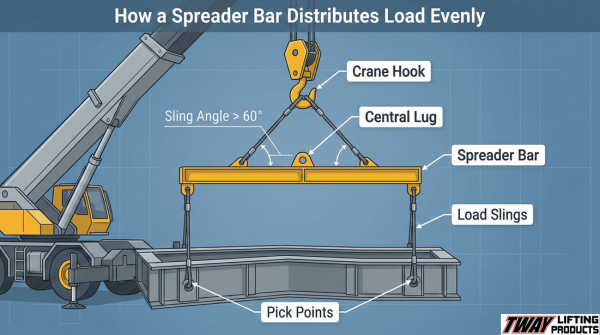
A spreader bar is a high-strength steel fabricated structure designed to withstand compressive forces during crane lifting operations. Spreader bars distribute loads evenly across multiple pick points, enabling safe lifting of large, heavy, or irregularly shaped objects that exceed single-point lifting capabilities.
What Are the Main Components of a Spreader Bar?
The main components of a spreader bar include high-strength steel fabricated structures with multiple attachment points and rigging hardware. Spreader bars feature central lifting lugs for crane attachment, end lifting points for load connections, and reinforced structural members to resist bending and compression forces.
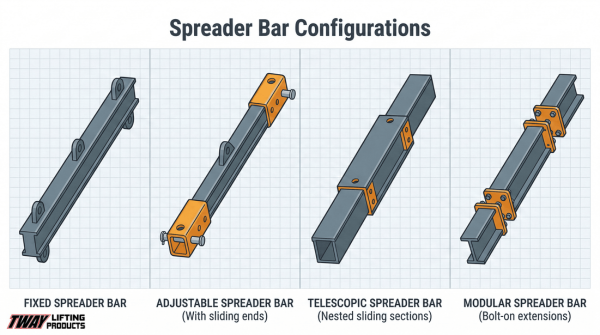
There are four primary types of spreader bars available for different applications:
- Fixed spreader bars for repetitive lifts with consistent dimensions
- Adjustable bars with variable pick point spacing for different load sizes
- Telescopic bars featuring nested sections for rapid length adjustments
- Modular bars with interchangeable components for custom configurations
All spreader bars must meet ASME BTH-1 design standards with a minimum design factor of 3.0, meaning they can withstand three times their rated Working Load Limit without failure. Rigging components like slings and shackles typically require a 5:1 safety factor for additional protection.
Why Do Crane Lifts Require Spreader Bars for Certain Loads?
Spreader bars are essential for lifting operations that require multiple pick points to maintain structural integrity. They prevent damage to loads by distributing weight evenly across multiple attachment points rather than concentrating stress at a single lifting point.
Spreader bars become necessary when lifting operations need to maintain specific sling angles above 60 degrees to minimize compressive forces on the rigging system. Sling angles below 30 degrees enter a warning zone with significantly increased risk of catastrophic failure due to excessive lateral forces.
Large structural components, prefabricated building sections, and heavy machinery often require spreader bars to achieve proper weight distribution and maintain safe sling geometry throughout the lifting operation.
How Does a Spreader Bar Improve Safety and Load Distribution?
Spreader bars ensure even weight distribution across all pick points, preventing concentrated stress that could damage the load or cause rigging failure. They maintain proper sling angles to reduce compressive forces and prevent structural failure of both the lifting equipment and the load itself.
Safety protocols for spreader bars include mandatory proof-load testing at 125% of rated Working Load Limit for all new, repaired, or modified equipment. According to OSHA case studies, failure to conduct regular inspections led to fatal accidents where defective spreader bars disengaged from cranes, killing workers due to frayed wire rope and lack of maintenance.
Regular inspections follow OSHA and ASME standards with three levels of oversight:
- Initial inspection before first use to verify compliance and structural integrity
- Frequent inspections conducted daily to monthly based on usage intensity
- Periodic annual inspections for equipment in normal service conditions
This comprehensive approach to spreader bar safety ensures reliable load distribution while meeting regulatory compliance requirements for crane lifting operations.
What Are the Benefits of Renting a Spreader Bar Versus Buying One?
Renting a spreader bar offers significant financial and operational advantages over purchasing, particularly for occasional lifting operations. This approach eliminates substantial capital investments while providing access to certified equipment and professional maintenance support.
The three primary benefits of spreader bar rentals include cost savings through eliminating capital investment and storage requirements, reduced maintenance responsibilities through professional equipment management, and access to specialized equipment for diverse project types. These advantages make rental the preferred choice for construction projects driving the USD 765.4 million spreader bar market.
How Can Renting a Spreader Bar Save Time and Money?
Renting a spreader bar saves money through predictable daily, weekly, and monthly rates without capital investment. Spreader bar rentals cost $100-$200 per day, $400-$800 per week, and $1,200-$2,500 per month based on capacity and type.
Key financial advantages include:
- Elimination of capital investment for equipment used occasionally
- No storage facility requirements for equipment ranging from 2 to 100 tons capacity
- Free nationwide delivery and pickup through Tway Lifting reduces transportation costs
- Access to maintained inventory without ownership responsibilities
This rental model provides immediate cost control compared to purchasing spreader bars that may cost thousands to tens of thousands of dollars for specialized applications.
Are There Maintenance and Inspection Responsibilities When Renting?
Maintenance and inspection responsibilities when renting spreader bars are primarily handled by the rental company with limited renter obligations. Rental companies manage all periodic inspections, lubrication, and repairs to maintain ASME and ISO certification standards.
Renter responsibilities include:
- Visual inspections before each use to identify obvious damage
- Verification of certification documentation upon delivery
- Immediate reporting of any equipment issues during use
According to Hercules Lifting guidelines, rental companies conduct annual inspections for normal service and monthly to quarterly inspections for severe service conditions. All rental spreader bars arrive certified to ASME and ISO standards with current documentation, ensuring compliance without renter investment in inspection programs.
What Types of Projects Commonly Require Spreader Bar Rentals?
Projects requiring spreader bar rentals span construction, infrastructure, and industrial applications with specific lifting challenges. Construction and infrastructure projects drive the spreader bar market, valued at USD 765.4 million in 2024 and projected to reach USD 1,238.7 million by 2033.
Common rental applications include:
- Repetitive lifts with consistent load dimensions using fixed spreader bars
- Operations with varying load sizes benefiting from adjustable or telescopic spreader bars
- Complex industrial lifting with modular spreader bars supporting capacities up to 100 tons
- Temporary projects where purchasing specialized equipment is not cost-effective
These diverse applications demonstrate how rental options provide access to appropriate equipment without the financial commitment of purchasing multiple spreader bar configurations for different project requirements.
Spreader bar rentals offer a strategic solution for accessing certified lifting equipment while minimizing capital investment and maintenance overhead, particularly valuable for the growing construction and infrastructure markets requiring specialized lifting capabilities.
How Does the Spreader Bar Rental Process Work?
The spreader bar rental process involves providing specific load and site information, selecting appropriate rental terms, coordinating delivery logistics, and ensuring compliance with safety regulations. This systematic approach ensures you receive the right equipment for safe, efficient crane lifting operations.
What Information Do You Need to Provide When Requesting a Rental?
When requesting a spreader bar rental, you must provide detailed load specifications including weight, dimensions, and center of gravity calculations. Site conditions such as available headroom and environmental factors must be assessed, with humidity levels maintained below 60% to prevent corrosion according to industry standards. Crane specifications and hook compatibility requirements ensure proper integration with your lifting equipment. The required Working Load Limit must be determined based on your specific lifting operation parameters.
Essential details include load geometry measurements, pick point locations, and any special handling requirements. Environmental considerations like temperature extremes, chemical exposure, and weather conditions affect equipment selection and performance.
How Long Can You Rent a Spreader Bar for a Crane Lift?
Typical rental terms are available in daily, weekly, and monthly periods to accommodate different project durations. Daily rentals range from $100-$200, weekly rentals cost $400-$800, and monthly rentals span $1,200-$2,500 depending on capacity and spreader bar type. Extended rental periods can be arranged with major providers like Tway Lifting, Holloway Houston, Sunbelt Rentals, and LGH for long-term projects.
Rental pricing varies based on equipment capacity, complexity, and regional market conditions. Volume discounts may apply for multiple units or extended rental periods.
What Is the Typical Delivery and Pickup Process for Rental Equipment?
Tway Lifting provides free nationwide delivery and pickup service for spreader bar rentals, eliminating transportation logistics for customers. Equipment arrives certified to ASME and ISO standards with current inspection documentation and proof-load testing certificates at 125% of rated Working Load Limit. Rental agreements outline specific terms, conditions, rental fees, duration periods, and responsibilities of both parties before equipment deployment.
Delivery scheduling coordinates with project timelines to ensure equipment availability when needed. Pickup arrangements include equipment inspection and damage assessment before return processing.
Are There Any Legal or Compliance Considerations for Spreader Bar Rentals?
ASME B30.20 safety standards cover marking, construction, installation, inspection, testing, maintenance, and operation requirements for below-the-hook lifting devices like spreader bars. OSHA regulations 29 CFR 1926.251 govern rigging equipment for material handling operations, while 29 CFR 1910.179 applies to overhead and gantry crane safety requirements. Renters typically need general liability insurance coverage for potential injuries or property damage during equipment use.
Many rental companies offer Rental Protection Plans or damage waivers to limit renter liability for equipment loss or damage during normal operations. These programs provide financial protection while ensuring compliance with industry safety standards.
The rental process connects directly to proper equipment selection, where understanding load capacities, site conditions, and expert assistance ensures optimal spreader bar choices for your specific crane lifting requirements.
How Do You Select the Right Spreader Bar for Your Crane Lift?
Selecting the right spreader bar for your crane lift requires evaluating load requirements, site conditions, and safety specifications. The selection process determines whether your lifting operation meets safety standards and achieves optimal performance.
What Load Capacities and Sizes Are Available for Rental Spreader Bars?
Rental spreader bars are available in capacities ranging from 2 tons to over 100 tons. Working Load Limit (WLL) represents the maximum load a spreader bar can safely handle during lifting operations.
Tway Lifting offers modular spreader bars with capacities spanning from 2 to 100 tons for diverse lifting applications. According to ISO 4308 standards, selection criteria for wire ropes used with lifting appliances must align with the spreader bar’s capacity specifications.
Available capacity ranges include:
- Light-duty applications: 2-10 tons for smaller construction projects
- Medium-duty operations: 10-50 tons for industrial equipment installation
- Heavy-duty lifts: 50-100+ tons for large infrastructure components
- Modular systems: Configurable units that adapt to varying load requirements
How Do Site Conditions and Load Types Affect Your Spreader Bar Choice?
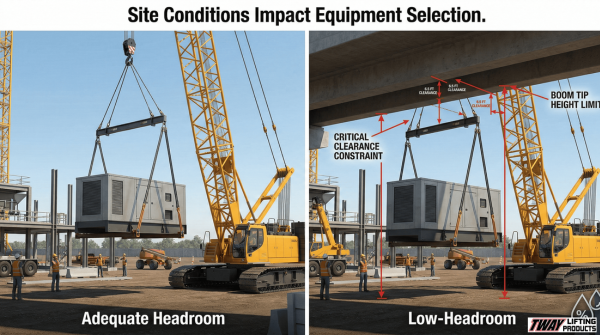
Site conditions and load geometry determine the appropriate spreader bar configuration for safe lifting operations. Low-headroom situations may require lifting beams instead of spreader bars due to reduced top rigging requirements.
Load geometry determines whether fixed, adjustable, telescopic, or modular spreader bars provide the most appropriate solution. Environmental factors like humidity, temperature extremes, and chemical exposure affect spreader bar structural integrity during operations.
According to Tway Lifting guidelines, relative humidity should be maintained below 60% to prevent corrosion. Site assessment factors include:
- Available headroom clearance for rigging assembly
- Ground conditions affecting crane positioning and stability
- Environmental exposure including moisture and chemical contaminants
- Access limitations for equipment delivery and setup
Can You Get Expert Assistance When Choosing a Spreader Bar?
Expert assistance is available through engineering firms and certified rigging professionals for complex lifting operations. ENSER engineering firm specializes in below-the-hook lifting devices and recommends evaluating load geometry, maintaining proper sling angles, and applying suitable safety factors.
Certified rigging professionals emphasize thorough planning and selection processes for spreader bars to ensure regulatory compliance. Major rental providers like Tway Lifting, Holloway Houston, and LGH offer technical support for equipment selection and operational guidance.
Technical support services typically include:
- Load analysis and center of gravity calculations
- Site condition assessment and equipment recommendations
- Safety factor verification and compliance review
- Operational training and best practices guidance
This comprehensive selection approach ensures your spreader bar rental meets project requirements while maintaining safety standards, preparing you for the implementation phase where proper equipment compatibility becomes critical.
What Common Challenges or Mistakes Should Be Avoided When Renting Spreader Bars?
Common challenges in spreader bar rentals stem from inadequate planning, compatibility issues, and improper usage that can lead to equipment failure or safety incidents. Avoiding these mistakes requires careful attention to crane compatibility, proper equipment selection, and adherence to safety protocols.
The following sections outline critical compatibility checks and risks associated with improper spreader bar selection to ensure safe and successful crane lifting operations.
How Can You Ensure Compatibility Between the Spreader Bar and Your Crane?
Ensuring compatibility between spreader bars and cranes requires verifying four critical factors before rental. These compatibility checks prevent equipment failure and ensure safe lifting operations.
Key compatibility requirements include:
- Hook specifications: Verify spreader bar compatibility with crane hook dimensions and lifting capacity ratings
- Headroom clearance: Ensure sufficient vertical space exists to accommodate the spreader bar and top rigging components
- Combined weight capacity: Confirm crane capacity exceeds the total weight of load, spreader bar, and all rigging components
- Sling angle maintenance: Check that proper sling angles above 60 degrees can be maintained with the selected spreader bar configuration
Proper compatibility verification prevents crane overloading and ensures all components work together safely during lifting operations.
What Are the Risks of Using the Wrong Spreader Bar?
Using the wrong spreader bar creates significant safety risks that can result in equipment failure, property damage, and worker fatalities. An OSHA case study documents a fatal accident where a defective spreader bar disengaged from a crane, killing two workers due to lack of regular inspections and frayed wire rope.
Critical risks include:
- Structural failure: Using spreader bars beyond their Working Load Limit can cause catastrophic structural failure
- Sling angle hazards: Improper sling angles below 30 degrees create warning zone conditions with significantly increased failure risk
- Inspection oversights: Failure to conduct pre-use inspections can miss critical defects like wear, damage, deformation, or corrosion
- Load distribution problems: Incorrect spreader bar selection can create uneven load distribution and concentrated stress points
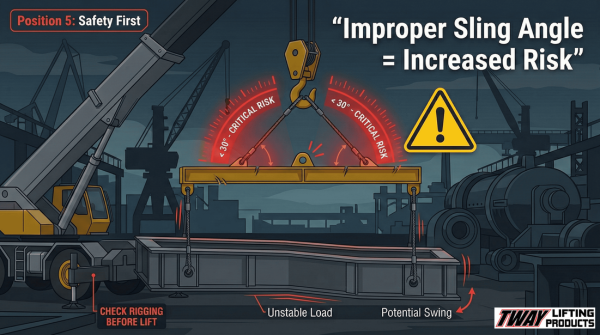
These risks emphasize the importance of proper equipment selection, regular inspections, and adherence to manufacturer specifications and industry safety standards.
How Should You Approach Spreader Bar Rentals for Crane Lifts with Tway Lifting?
Approaching spreader bar rentals for crane lifts requires selecting a reliable provider that offers comprehensive equipment, safety compliance, and technical support. Tway Lifting delivers these essentials through their nationwide rental program with certified equipment and expert guidance.
How Can Tway Lifting Help with Safe and Efficient Spreader Bar Rentals?
Tway Lifting helps with safe and efficient spreader bar rentals through comprehensive equipment inventory, rigorous safety standards, and streamlined logistics services. Their rental program provides spreader bars ranging from 2 to 100 tons capacity with modular and adjustable configurations for diverse lifting applications.
All equipment comes certified to ASME and ISO standards with mandatory proof-load testing at 125% of rated Working Load Limit. This testing ensures structural integrity and compliance with OSHA regulations for below-the-hook lifting devices under 29 CFR 1926.251.
Tway Lifting’s free nationwide delivery and pickup service eliminates transportation logistics challenges while reducing project costs. Their flexible rental terms include daily, weekly, and monthly options to match specific project timelines and budget requirements.
Technical support services assist customers with proper equipment selection based on load geometry, site conditions, and crane specifications. This expert guidance helps prevent equipment mismatches that could compromise lifting safety or operational efficiency.
What Are the Key Takeaways About How Spreader Bar Rentals Work for Crane Lifts?
The key takeaways about how spreader bar rentals work for crane lifts include emerging technology integration, material advances, and fundamental safety practices that ensure successful operations.
Smart spreader bars with IoT connectivity now provide real-time data on load weight, sling angles, and equipment health status during lifting operations. Modulift’s load monitoring spreader beams feature integrated load cells with wireless data logging capabilities for continuous monitoring at each beam end.
Advanced materials and manufacturing techniques are producing lighter, stronger spreader bars with improved load-to-weight ratios. These innovations reduce crane capacity requirements while maintaining structural integrity under demanding lifting conditions.
Working with reputable rental providers like Tway Lifting and adhering to industry standards ensures worker safety and project success. Regular inspections following ASME and OSHA guidelines, proper load evaluation, and maintaining sling angles above 60 degrees remain critical for safe lifting operations regardless of technological advances.
This comprehensive approach to spreader bar rentals balances cutting-edge technology with proven safety protocols, setting the foundation for exploring specific application scenarios and advanced lifting techniques in complex industrial environments.