









Whether you’re lifting heavy machinery, structural steel, or specialized equipment, you’re here because you need to understand how spreader bar weight capacities work to ensure safe and efficient lifting operations. We’ll guide you through everything you need to know about these critical lifting devices, from basic principles to advanced calculations, so you can make informed decisions that protect both your workers and your equipment.
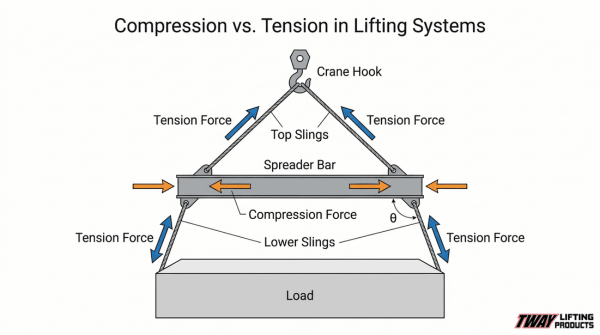
A spreader bar is a compressive load-bearing device used in lifting operations to distribute weight across multiple lifting points, preventing load damage and maintaining stability by keeping slings at optimal angles while the bar itself experiences compression forces rather than bending.
TL;DR Summary
Understanding spreader bar weight capacities requires knowledge of several critical factors that work together to ensure safe lifting operations:
- Basic Function: Spreader bars distribute loads through compression (not bending like lifting beams), with capacities ranging from 2-100 tons and the global market valued at $765 million in 2024
- Capacity Calculations: The tension formula Load/(Number of Slings × cos(θ)) shows why sling angles below 30° dramatically increase forces and should be avoided
- Material & Design: High-strength steels (API 5L grades) are standard, with safety factors of 5:1 and Finite Element Analysis used to verify stress distributions
- Safety Standards: OSHA 29 CFR 1926.251 mandates 125% proof testing and regular inspections, while ASME B30.20 provides comprehensive operational requirements
- Failure Prevention: Most accidents result from inadequate inspection, with 297 crane-related deaths from 2011-2017 highlighting the critical importance of proper procedures
- Modern Technology: Wireless load cells and IoT sensors now enable real-time monitoring, while modular systems like Modulift allow on-site configuration
- Tway Lifting Solutions: With 70+ years experience, we offer ISO 9001 certified spreader bars from 2-100 tons, including fixed, adjustable, and modular options with complete documentation
Quick Tip: Always verify the center of gravity alignment with your lifting points before any lift – even a slight offset can dramatically reduce your spreader bar’s effective capacity and create dangerous side-loading conditions.
What Is a Spreader Bar and How Does It Function in Lifting Operations?
A spreader bar is a compressive structural member that distributes load weight over a wider area during lifting operations. The bar experiences compression forces while connected slings remain in tension, creating a stable lifting configuration that prevents load damage and ensures operational stability.
The global spreader bar market reached approximately $765 million USD in 2024, reflecting widespread adoption across construction sites and manufacturing facilities. These devices enable safe handling of diverse loads by maintaining proper weight distribution throughout the lifting process.
The following sections detail spreader bar components, operational differences from lifting beams, and key design considerations for safe lifting operations.
What Are the Key Components of a Spreader Bar?
The key components of a spreader bar include lifting points on top, attachment points below, and structural elements that distribute forces safely. Standard spreader bars feature two or more lifting points on the upper surface and corresponding attachment points below for connecting to loads.
Essential components include:
- Main structural beam (primary load-bearing element)
- End fittings (connection hardware)
- Lifting lugs (upper attachment points)
- Connection hardware (shackles and pins)
Modern spreader bars incorporate wireless load cells and IoT sensors for real-time load monitoring. Modular systems like Modulift allow users to build spreader beams of exact length and capacity required on-site using interchangeable components.
How Does a Spreader Bar Differ from a Lifting Beam?
A spreader bar differs from a lifting beam primarily in force distribution and lifting configuration. Spreader bars experience compression forces while lifting beams experience bending forces during operations.
Key differences include:
- Force mechanics: Spreader bars handle compression; lifting beams handle bending
- Lifting points: Spreader bars use two or more top points; lifting beams use single-point lifting
- Weight efficiency: Spreader bars are lighter for equivalent capacity compared to lifting beams
- Application preference: Lifting beams suit shorter spans and limited headroom situations
This section establishes the foundation for understanding spreader bar mechanics and prepares for detailed capacity calculations and safety considerations.
What Factors Determine the Weight Capacity of a Spreader Bar?
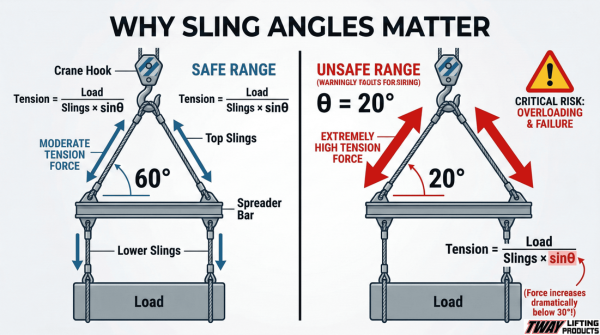
The weight capacity of a spreader bar depends on multiple critical factors including material properties, sling angle geometry, and engineering specifications. Sling angle significantly affects capacity – angles below 30 degrees dramatically increase forces and are not recommended. The tension in each sling equals Load divided by (Number of Slings × cos(θ)), where θ is the angle from vertical. Modern engineering employs Finite Element Analysis (FEA) to simulate stresses under various loading conditions, while center of gravity alignment with lifting points remains critical for maintaining rated capacity.
How Does Material Selection Impact Weight Capacity?
Material selection directly determines the ultimate strength and working capacity of spreader bars. High-strength, low-alloy (HSLA) steels are most common, offering excellent strength, toughness, and weldability for lifting applications. API 5L grades (X42, X52, X60) provide high strength and good mechanical properties for spreader bars, with yield strength determining maximum allowable working stress and tensile strength determining ultimate load capacity before fracture. For marine environments, 316 stainless steel provides superior corrosion resistance, while carbon fiber and fiberglass composites offer high strength-to-weight ratios, though long-term fatigue properties remain under investigation.
How Do Design and Engineering Specifications Affect Load Limits?
Engineering specifications control critical performance characteristics that directly impact load limits. The modulus of elasticity controls how much the spreader bar will deflect under load, affecting operational safety and precision. Weld quality proves critical – AWS (American Welding Society) standards must be followed during fabrication to ensure structural integrity. Non-destructive testing methods including Magnetic Particle Testing, Ultrasonic Testing, and Dye Penetrant Testing verify weld integrity throughout the fabrication process. Poor weld penetration during manufacturing can lead to metal fatigue and structural collapse under normal operating conditions.
What Role Do Safety Factors Play in Weight Ratings?
Safety factors provide essential protection against unforeseen loads and material variations in lifting operations. The typical safety factor for general lifting applications is 5:1, meaning spreader bars withstand five times their rated load before failure. Safe Working Load (SWL) or Working Load Limit (WLL) equals Minimum Breaking Strength (MBS) divided by the safety factor, establishing clear operational limits. Custom-designed lifting accessories must be proof-tested to 125% of rated capacity before initial use per OSHA requirements, while every Tway Lifting spreader bar rental is proof-load tested to 125% of rated capacity to ensure reliability.
This section establishes the fundamental engineering principles that determine spreader bar capacities, preparing readers for the calculation methods and practical applications discussed in the following sections.
How Are Spreader Bar Weight Capacities Calculated and Labeled?
Spreader bar weight capacities are calculated using engineering formulas and rigorous analysis methods, then labeled according to strict regulatory standards. The calculation process involves multiple factors including sling tensions, material properties, and safety factors, while labeling requirements ensure operators can safely identify equipment limitations during lifting operations.
What Methods Are Used to Calculate Safe Working Loads for Spreader Bars?
Engineers use the formula Tension = Load / (Number of Slings × cos(θ)) to calculate individual sling tensions during lifting operations. This calculation accounts for the sling angle θ from vertical, which dramatically affects the compressive force on the spreader bar.
Finite Element Analysis (FEA) visualizes stress concentrations and predicts deformation patterns before fabrication begins. There are several advanced calculation methods, such as computer modeling that simulates various loading scenarios, structural analysis that identifies critical stress points, and deformation prediction that ensures safe operating parameters.
ASME BTH-1 provides detailed design criteria including allowable stresses for various materials and loading conditions. The standard establishes maximum stress limits based on material properties and safety requirements for different applications.
How Should Weight Capacities Be Displayed or Marked on Spreader Bars?
OSHA regulations mandate that all lifting accessories must be marked with their rated capacity in clearly visible, permanent markings. Markings must comply with ASME B30.20 requirements for below-the-hook lifting devices, ensuring consistent identification across the industry.
ISO 9001 certified manufacturers provide comprehensive documentation including inspection records and proof-test certifications. There are several marking requirements, such as rated capacity in both pounds and kilograms, manufacturer identification and serial number, date of manufacture or proof testing, and applicable safety standards compliance.
Tway Lifting provides detailed documentation including operating manuals to ensure complete traceability and accountability throughout the equipment lifecycle. This documentation supports proper usage and maintenance while meeting regulatory compliance requirements.
The calculation and labeling of spreader bar capacities forms the foundation for safe lifting operations, with proper documentation ensuring operators have the information needed to prevent overloading and maintain workplace safety.
What Safety Standards and Compliance Guidelines Apply to Spreader Bar Weight Capacities?
Safety standards and compliance guidelines for spreader bar weight capacities are governed by comprehensive regulations that protect workers and ensure equipment reliability. 29 CFR 1926.251 serves as the primary OSHA regulation governing rigging equipment for material handling operations. Crane and rigging safety violations consistently rank among OSHA’s top 10 most frequently cited workplace violations, highlighting the critical importance of compliance. International standards complement U.S. regulations, with European standard EN 13155 governing cranes and non-fixed load lifting attachments in Europe, while Australia and Canada maintain specific regulations often based on or similar to ASME and ISO standards.
This section explores the key industry standards that govern spreader bar load ratings and provides practical guidance for ensuring compliance with OSHA and ASME requirements.
Which Industry Standards Govern Spreader Bar Load Ratings?
Industry standards that govern spreader bar load ratings include comprehensive requirements for design, construction, and operation. ASME B30.20 provides comprehensive requirements for marking, construction, installation, inspection, testing, maintenance, and operation of below-the-hook lifting devices. ASME BTH-1 establishes design criteria for below-the-hook lifting devices with specific allowable stresses for different materials and loading conditions.
Additional critical standards include:
- American Welding Society (AWS) standards governing welding procedures and welder qualifications
- EN 13155 serving as the harmonized European standard for lifting beams and spreaders
- ISO 9001 certification requirements for quality management systems
- API 5L grades providing material specifications for high-strength applications
These standards work together to ensure spreader bars meet stringent safety and performance requirements across different jurisdictions and applications.
How Can You Ensure Your Spreader Bar Meets OSHA and ASME Requirements?
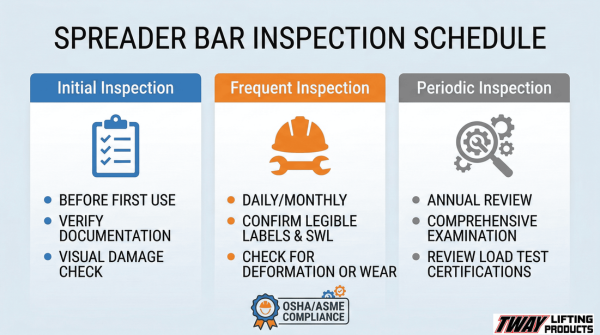
Ensuring your spreader bar meets OSHA and ASME requirements requires systematic inspection protocols and documentation procedures. Rigging equipment must be inspected prior to each shift and as necessary during use per OSHA requirements under 29 CFR 1926.251. ASME B30.20 defines three inspection tiers: Initial (before first use), Frequent (daily to monthly), and Periodic (annually), each with specific requirements and qualified personnel.
Required Inspection Procedures:
- Initial Inspections – Performed by a Qualified Person before first use with complete documentation
- Frequent Inspections – Daily to monthly visual examinations by operators or designated persons
- Periodic Inspections – Annual comprehensive evaluations by Qualified Persons with detailed records
- Immediate Removal – Defective equipment must be removed from service immediately upon discovery
Compliance documentation must include proof-test certifications to 125% of rated capacity, inspection records, and maintenance histories to demonstrate ongoing adherence to safety standards.
Contextual Bridge: Understanding compliance requirements establishes the foundation for recognizing the serious consequences that occur when spreader bars exceed their rated capacities, which we examine in the following section on operational risks.
What Are the Risks of Exceeding a Spreader Bar’s Weight Capacity?
Exceeding a spreader bar’s weight capacity creates severe safety hazards that can result in equipment failure, property damage, and fatal injuries. According to Bureau of Labor Statistics data from 2011 to 2017, 297 fatal injuries involving cranes occurred, averaging 42 deaths per year. Over half of all fatal crane injuries involved workers being struck by falling objects put in motion by cranes, with the private construction industry accounting for 43% of these fatalities.
The consequences of overloading spreader bars extend beyond individual accidents to broader workplace safety concerns. Crane operators and material moving occupations accounted for one-third of all crane-related deaths during this period. This section examines specific failure scenarios and prevention strategies to help ensure safe lifting operations.
What Could Happen if a Spreader Bar Is Overloaded?
Spreader bar overloading leads to catastrophic structural failures with potentially fatal consequences. Two workers were killed when a 2,500-pound spreader bar fell due to severed wire rope from lack of proper inspections. Container handling spreader failure occurred from poor weld penetration leading to metal fatigue and structural collapse under normal operating conditions.
Overloading causes plastic deformation beyond the material’s yield strength, leading to permanent damage that compromises future load capacity. The structural integrity of the spreader bar becomes permanently compromised even if immediate failure does not occur. Catastrophic failure scenarios include:
- Complete structural collapse of the spreader bar
- Dropped loads causing impact damage to equipment and structures
- Fatal injuries to workers positioned below lifting operations
- Equipment damage requiring costly repairs and project delays

How Can You Prevent Overloading During Lifting Operations?
Preventing spreader bar overloading requires careful load calculation and real-time monitoring throughout lifting operations. Account for sling angles which can dramatically increase compressive forces on the spreader bar—angles below 30 degrees create exponentially higher stresses. Ensure the center of gravity of the load is properly aligned with lifting points to maintain even force distribution.
Modern monitoring technologies provide enhanced safety through real-time load tracking. Use wireless load cells to provide real-time data on actual load being lifted, allowing operators to verify loads remain within safe parameters. IoT-enabled sensors can transmit data wirelessly for remote monitoring and overload prevention, while GPS and RFID tracking improves asset management and usage monitoring of lifting equipment.
| Technology | Function | Safety Benefit |
| Wireless Load Cells | Real-time weight measurement | Prevents overloading |
| IoT Sensors | Remote monitoring | Early warning systems |
| GPS Tracking | Equipment location | Improved asset management |
| RFID Systems | Usage monitoring | Maintenance scheduling |
Proper training and adherence to established procedures form the foundation of overload prevention, ensuring safe lifting operations across all industrial applications.
How Do Inspection and Maintenance Influence Spreader Bar Weight Capacities?
Inspection and maintenance directly preserve spreader bar weight capacities by identifying defects before catastrophic failure occurs. Defective rigging equipment must be removed from service immediately per OSHA regulations. Spreader bar failures rarely result from single factors but from chains of events including inadequate inspection. A robust safety culture emphasizing training, inspection, and adherence to procedures prevents incidents.
Lack of proper daily and periodic inspections can miss critical wear and tear leading to catastrophic failure. The following sections detail inspection frequencies and maintenance practices that preserve spreader bar capacity ratings throughout their service life.
How Often Should Spreader Bars Be Inspected?
Spreader bars require three distinct inspection levels based on ASME B30.20 standards. Frequent inspections are required daily to monthly based on service conditions, performed by the operator or designated person. Periodic inspections are required annually or as recommended by the manufacturer, performed by a qualified person with documentation. Initial inspections are required before first use by a qualified person to verify construction and marking requirements.
Visual examination of critical components must occur before each shift per OSHA 29 CFR 1926.251. This summary prepares readers for detailed maintenance practices that preserve weight capacity ratings.
What Maintenance Practices Help Preserve Weight Capacity Ratings?
Maintenance practices that preserve weight capacity ratings focus on detecting defects through non-destructive testing (NDT) methods. Regular NDT of welds and critical areas detects defects before failure occurs through three primary testing methods:
| Testing Method | Detection Capability | Material Application |
| Magnetic Particle Testing | Surface and near-surface discontinuities | Ferromagnetic materials only |
| Ultrasonic Testing | Internal flaws using high-frequency sound waves | All materials with sound conductivity |
| Dye Penetrant Testing | Surface-breaking defects | All non-porous materials |
Proper storage and corrosion prevention maintains material integrity and strength over time. These maintenance practices ensure spreader bars retain their original weight capacity throughout their service life.
How Do You Select the Right Spreader Bar Weight Capacity for Your Needs?
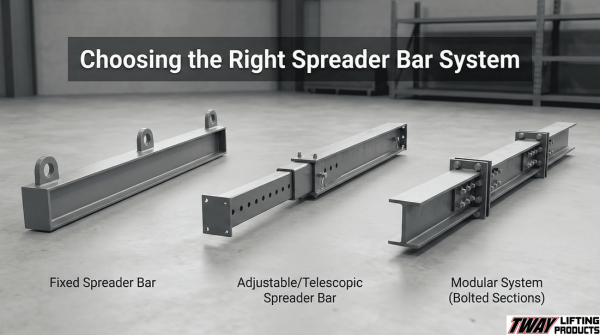
Selecting the right spreader bar weight capacity requires evaluating your specific load requirements, operational conditions, and budget constraints. Fixed spreader bars cost $1,000-$2,000 for 10-ton capacity models, while container spreaders range from $16,000 for 20ft models to $35,000 for 40ft models in 2025. Rental options provide cost-effective alternatives from $150-$300 per day for smaller bars to thousands per month for high-capacity models. Telescopic and modular systems like Modulift offer maximum flexibility for varying load sizes and shapes, allowing on-site configuration to exact specifications.
The following sections detail factors for choosing spreader bars and matching them to load requirements.
What Factors Should Be Considered When Choosing a Spreader Bar?
Key factors when choosing a spreader bar include structural design, system type, environmental conditions, space limitations, and usage frequency. Consider whether compression (spreader bar) or bending (lifting beam) design suits your application better. Evaluate if fixed, adjustable, telescopic, or modular systems best meet project requirements for varying loads. Account for environmental conditions since marine environments require stainless steel or composite materials for corrosion resistance. Assess headroom limitations which may favor lifting beams over spreader bars due to single-point lifting configurations. Factor in frequency of use to determine whether purchase or rental is more cost-effective for your operations.
How Can You Match a Spreader Bar to Your Specific Load Requirements?
Matching a spreader bar to load requirements involves calculating total weight, determining span requirements, evaluating sling angles, considering center of gravity, and applying safety factors. Calculate total load weight including rigging hardware and accessories beyond the primary load. Determine required span based on load dimensions and lifting point locations to ensure proper load distribution. Account for sling angles and their effect on actual forces experienced by the spreader bar, as angles below 30 degrees dramatically increase compressive forces. Consider center of gravity location relative to planned lifting points to maintain stability during lifting operations. Select capacity with appropriate safety factor, typically 5:1, above calculated requirements to ensure safe operation within OSHA and ASME standards.
This comprehensive selection process ensures your spreader bar choice meets both safety requirements and operational efficiency for your specific lifting applications.
How Can Tway Lifting Assist With Spreader Bar Weight Capacity Solutions?
Tway Lifting provides comprehensive spreader bar weight capacity solutions through decades of engineering expertise and ISO 9001 certified manufacturing capabilities. The company’s extensive product line and technical support address complex lifting challenges across industrial applications.
What Solutions and Expertise Does Tway Lifting Offer for Spreader Bar Weight Capacities?
Tway Lifting offers spreader bar solutions from 2 to 100 tons capacity with spans extending up to 40 feet for diverse industrial applications. The company’s fixed and adjustable spreader bars accommodate standard lifting requirements, while Modulift modular systems enable on-site configuration to exact length and capacity specifications.
Key capabilities include:
- Manufacturing Heritage: Over 70 years of rigging and lifting equipment experience
- Quality Certification: ISO 9001 certified demonstrating continuous improvement and quality management
- Versatile Design: Forklift-ready spreader bars with universal crane hooks and forklift tine pockets
- Complete Solutions: One-stop access to slings, shackles, hoists, and load cells
- Proven Performance: Project portfolio includes NFL stadiums, zoos, and arenas showcasing reliability
The Modulift system allows field teams to build custom spreader beam configurations using interchangeable components. This flexibility reduces inventory requirements while ensuring precise capacity matching for specific loads.
What Are the Key Takeaways About Spreader Bar Weight Capacities?
Understanding spreader bar capacities requires comprehensive knowledge of engineering principles, material properties, and safety regulations governing lifting operations. Critical factors include sling angle management, safety factor compliance, and adherence to inspection protocols.
Essential considerations for spreader bar capacity management:
- Angle Limitations: Sling angles below 30 degrees dramatically increase forces and compromise safety
- Safety Standards: 5:1 safety factor with 125% proof testing for custom designs
- Regulatory Compliance: OSHA 29 CFR 1926.251 and ASME B30.20 govern spreader bar operations
- Inspection Requirements: Regular maintenance and immediate removal of defective equipment
- Technology Integration: Load cells and IoT sensors enhance safety monitoring
- Training Foundation: Proper procedures and adherence form the basis of safe lifting operations
Smart lifting technologies incorporating wireless load cells provide real-time capacity monitoring. These systems prevent overloading while maintaining operational efficiency across complex lifting scenarios.
The selection of appropriate spreader bar capacity requires careful analysis of load characteristics, environmental conditions, and operational requirements. Tway Lifting’s technical expertise ensures optimal capacity matching for safe, efficient lifting operations nationwide.