







Spreader bar rental pricing is the total cost a contractor pays to rent a spreader beam for a specific lift, shaped by equipment specifications, project requirements, and service-related fees that vary widely across providers and regions.
This guide covers capacity and span sizing, bar type selection, rental duration strategy, lift application requirements, and the ancillary costs tied to logistics, compliance, fabrication, and rigging accessories.
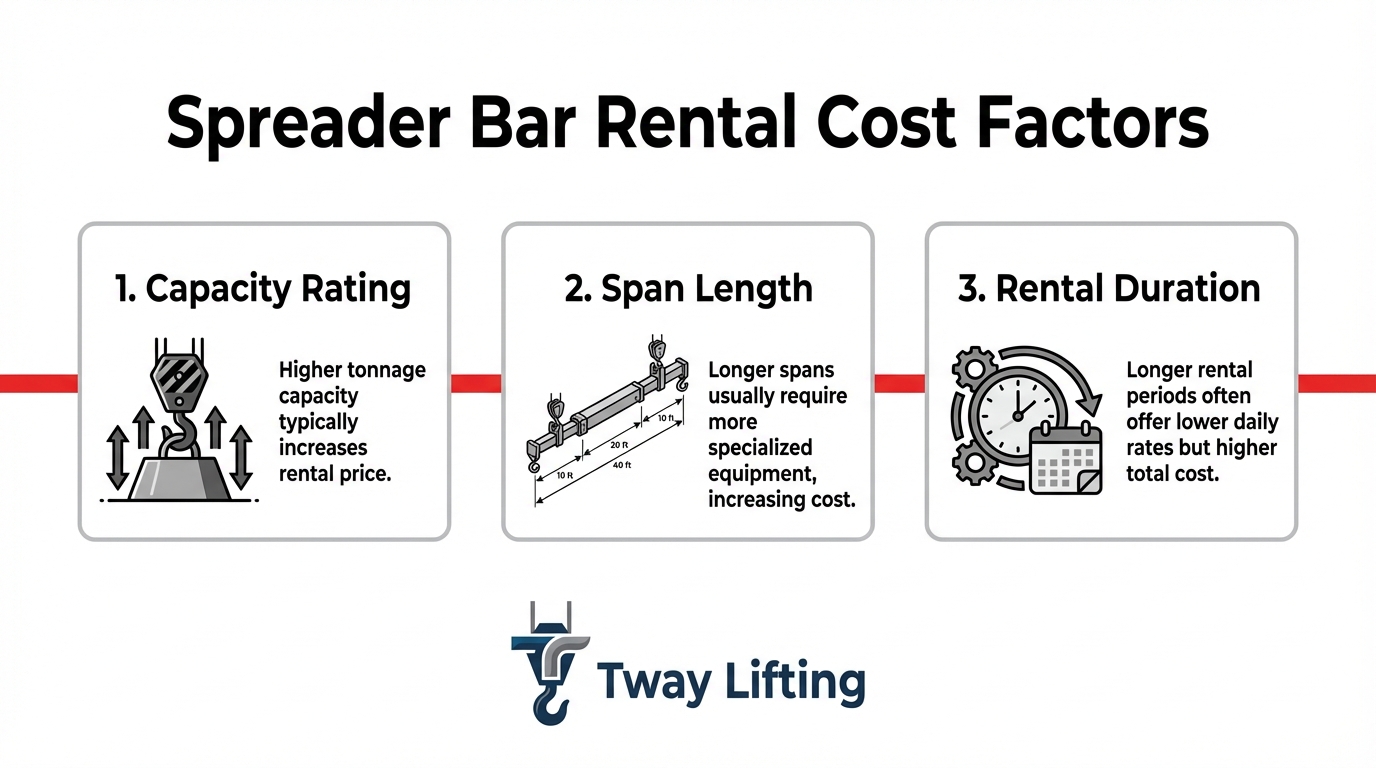
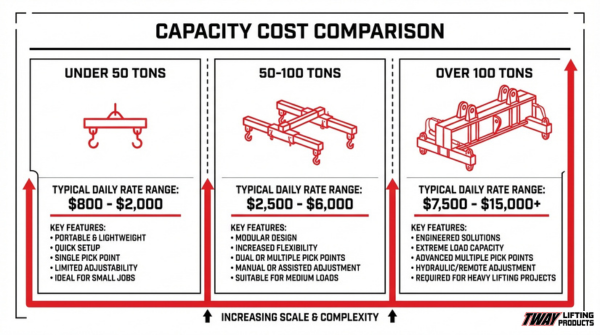
Capacity serves as the primary cost driver. Bars under 50 tons typically rent for $100 to $300 per day, while mid-range and heavy-capacity units above 50 or 100 tons cost significantly more due to heavier materials, specialized transport, and limited inventory availability.
Span length and bar type further refine pricing. Short fixed bars offer the lowest rates, adjustable models carry a moderate premium for their versatility across multiple load widths, and modular systems charge per component or assembled configuration. Rolling and basket designs push rates higher still at comparable tonnage due to specialized engineering.
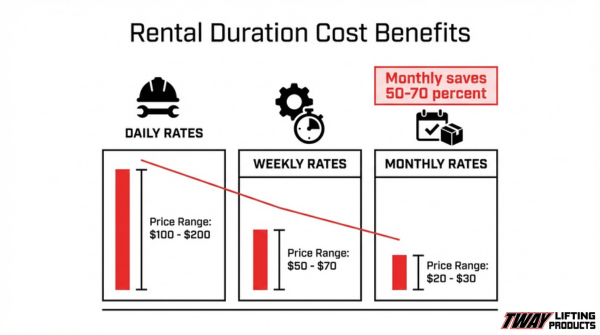
Rental duration directly controls the effective daily cost. Weekly rates typically equal two to four daily charges, and monthly terms can reduce per-day expense by 50% to 70%. Projects exceeding two to three weeks almost always benefit from longer commitments.
Each lift application carries distinct pricing factors. Construction, steel erection, utility, and entertainment rigging each demand different capacity, span, and compliance configurations that shape the final quote.
Location, delivery logistics, inspection fees, custom fabrication needs, and supplementary rigging accessories collectively add costs that can rival the base rental rate. Bundling these services through a single full-service provider like Tway Lifting compresses both expense and coordination overhead.
How Does Spreader Bar Capacity Affect Rental Cost?
Spreader bar capacity directly affects rental cost because higher tonnage ratings require heavier materials, stronger engineering, and specialized transport. Below, pricing breaks down across three capacity tiers: under 50 tons, 50 to 100 tons, and over 100 tons.
How Much Does It Cost to Rent a Spreader Bar Under 50 Tons?
Renting a spreader bar under 50 tons typically costs between $100 and $300 per day for standard configurations. Weekly rates generally range from $400 to $1,200, while monthly rentals fall between $1,500 and $4,500 depending on location and bar specifications. These lighter-capacity bars suit most routine construction and industrial lifts, keeping both rental fees and transport costs relatively low. According to Mazzella Companies, third-party rigging inspections in 2025 cost $480 to $600 for a half-day, an ancillary expense that should be factored into any sub-50-ton rental budget. For projects with predictable load requirements, this capacity tier offers the most accessible entry point into spreader bar rental.
How Much Does It Cost to Rent a 50 to 100 Ton Spreader Bar?
Renting a 50 to 100 ton spreader bar costs significantly more than lighter-capacity units, with daily rates typically starting above $300 and monthly rates often exceeding $4,500. Several factors drive this increase:
- Heavier structural steel and thicker wall sections raise manufacturing and replacement costs.
- Larger shackles, slings, and connection hardware are required for safe rigging.
- Transport requires flatbed trucks or specialized trailers, adding mobilization fees.
- Fewer rental providers stock mid-range capacity bars, which limits competitive pricing.
For most steel erection and industrial plant lifts, this capacity tier represents the balance point between cost efficiency and load-handling capability.
How Much Does It Cost to Rent a Spreader Bar Over 100 Tons?
Renting a spreader bar over 100 tons costs substantially more due to custom engineering, oversize transport permits, and specialized rigging crews. Daily rates for bars in this range can reach several thousand dollars, with monthly contracts often negotiated on a project-specific basis rather than standard rate cards. Availability is limited; many rentals at this capacity require advance scheduling and dedicated lift planning. According to the Institute for Building Research and Training, the average cost of a major rigging-related injury exceeds $200,000, while a fatality surpasses $4 million. These figures underscore why investing in properly rated, inspected high-capacity spreader bars is far less expensive than the consequences of underspecifying equipment.
Understanding how capacity shapes cost is essential, but span length introduces another pricing variable worth examining.
How Does Spreader Bar Length and Span Influence Rental Price?
Spreader bar length and span influence rental price by directly increasing material, engineering, and transport costs as the bar grows longer. Short fixed bars cost the least, adjustable bars carry a moderate premium, and long-span custom bars command the highest rates.
What Do Short-Span Fixed Spreader Bars Typically Cost to Rent?
Short-span fixed spreader bars typically cost between $89 and $300 per day, depending on capacity and location. According to Vandalia Rental’s 2024 rate sheet, high-capacity spreader bars in the 8 to 12 foot range rent for $89.00 per day, $180.00 per week, and $357.00 per month. Rates climb in higher-cost metro areas; 2026 estimates place daily rentals at $100 to $300 in Fort Worth and $150 to $300 in Los Angeles.
Beyond the bar itself, ancillary costs add up. Third-party rigging inspections run $480 to $600 for a half-day, while operator training costs $125 to $500 per learner. Fixed short-span bars remain the most budget-friendly option for straightforward, repetitive lifts where load width stays consistent.
What Do Adjustable-Length Spreader Bars Cost to Rent?
Adjustable-length spreader bars cost more than fixed models because telescoping or pin-adjustable mechanisms add engineering complexity and manufacturing expense. The ability to change span on site eliminates the need to rent multiple fixed bars for varying load widths, which can offset the higher per-unit rate on projects with mixed lift dimensions.
Rental pricing scales sharply with tonnage. A lighter adjustable bar may start near the weekly rate of a comparable fixed bar, while heavier configurations can cost several times more. For projects requiring frequent span changes, the flexibility of an adjustable bar often reduces total rental spend compared to sourcing separate fixed units for each width.
What Do Long-Span Custom Spreader Bars Cost to Rent?
Long-span custom spreader bars cost significantly more than standard inventory items due to specialized fabrication, engineered lift plans, and oversized transport requirements. Bars exceeding 40 feet often require permits, escort vehicles, and custom trailer configurations, all of which add to the total rental expense.
Because these bars are built or assembled for a specific lift, lead times are longer and availability is limited. Custom engineering documentation, proof-load testing, and third-party certification further increase costs before the bar reaches the job site. For projects demanding spans well beyond standard catalog sizes, early planning and coordination with the rental provider help control pricing and avoid rush charges.
With span requirements established, the type of spreader bar selected further refines the rental rate.
How Does Spreader Bar Type Change the Rental Rate?
Spreader bar type changes the rental rate based on design complexity, adjustability, and specialized components. Fixed, adjustable, modular, and rolling or basket spreader bars each carry distinct pricing structures.
How Are Fixed Spreader Bar Rental Rates Determined?
Fixed spreader bar rental rates are determined by the bar’s rated capacity, span length, and material construction. Because fixed bars use a single, non-adjustable design, they carry lower manufacturing and maintenance costs than adjustable or modular alternatives. This simplicity typically makes them the most affordable option for straightforward lifts where the load dimensions are known in advance. Rental providers price fixed bars primarily on tonnage rating and overall length, with heavier and longer units commanding higher weekly and monthly rates.
How Are Adjustable Spreader Bar Rental Rates Determined?
Adjustable spreader bar rental rates are determined by the bar’s capacity range, its minimum-to-maximum span adjustment, and the mechanical components that enable length changes. According to Certified Sales and Rentals’ 2024 rate book, a 2-ton adjustable 6 ft 6 in beam rents for $100.00 per week and $250.00 per month, while a 40-ton 10 ft beam costs $400.00 per week and $1,100.00 per month. The ability to accommodate multiple load widths with one piece of equipment adds engineering value, which is reflected in higher rental rates compared to fixed alternatives. For projects with variable load dimensions, the versatility often offsets the premium.
How Are Modular Spreader Bar Rental Rates Determined?
Modular spreader bar rental rates are determined by the number of individual components required, the total assembled length, and the rated capacity of the system. Modular systems consist of interchangeable end units, drop links, and bolt-together struts that can be configured for different lift requirements. This flexibility means rental providers often charge per component or per assembled configuration rather than a single flat rate. Additional costs may apply for engineering review of each unique assembly. While per-day pricing runs higher than fixed bars, modular systems eliminate the need to rent multiple dedicated spreader bars across a multi-phase project.
How Are Rolling or Basket Spreader Bar Rates Determined?
Rolling or basket spreader bar rates are determined by the bar’s specialized design features, load-handling geometry, and the additional rigging hardware integrated into the assembly. Rolling spreader bars allow controlled rotation of long or asymmetric loads during placement, while basket configurations use a cradle-style support system for irregularly shaped items. Both designs require more complex engineering and heavier-duty connection points than standard fixed or adjustable bars. These factors push rental rates above those of conventional spreader bars at comparable tonnage ratings. Availability also influences pricing, since fewer rental inventories stock specialty configurations.
With bar type established, rental duration further shapes the total cost of a spreader bar rental.
How Does Rental Duration Affect Spreader Bar Pricing?
Rental duration affects spreader bar pricing by reducing the effective daily cost as the commitment period increases. The sections below cover typical daily, weekly, and monthly rates, plus when long-term rentals become the more cost-effective choice.
What Are Typical Daily Spreader Bar Rental Rates?
Typical daily spreader bar rental rates range from approximately $89 to $300, depending on capacity and location. Smaller, high-capacity bars in the 8- to 12-foot range can start around $89 per day, while standard spreader bars for mobile crane applications in major U.S. metros often fall between $100 and $300 per day. Daily rates carry the highest per-day cost, so they work best for single-day picks or short-duration lifts where mobilization time is minimal. For projects extending beyond two or three days, switching to a weekly rate almost always saves money.
What Are Typical Weekly Spreader Bar Rental Rates?
Typical weekly spreader bar rental rates range from $180 to $1,200. A high-capacity 8- to 12-foot bar rents for roughly $180 per week, while standard mobile crane spreader bars in markets like Fort Worth and Los Angeles fall between $400 and $1,200 per week. Weekly pricing typically equals the cost of two to four daily rates, which means any project lasting three or more days benefits from the weekly tier. This structure rewards slightly longer commitments without locking renters into a full month.
What Are Typical Monthly Spreader Bar Rental Rates?
Typical monthly spreader bar rental rates range from $357 to $4,500. Compact high-capacity bars start near $357 per month, while standard spreader bars for mobile crane work run between $1,500 and $4,500 per month across U.S. markets. According to Countbricks, Fort Worth monthly spreader bar rentals in 2026 range from $1,500 to $4,500, and Los Angeles monthly rentals range from $2,000 to $4,000. Monthly rates generally reduce the effective daily cost by 50% to 70% compared to daily pricing. For multi-week steel erection or utility projects, this tier delivers the strongest per-day value.
When Does a Long-Term Rental Become More Cost-Effective?
A long-term rental becomes more cost-effective when the project timeline exceeds roughly two to three weeks. At that threshold, the cumulative daily or weekly charges surpass the monthly rate, making the longer commitment the better financial choice. Key factors that push projects toward long-term agreements include:
- Multi-phase construction schedules requiring repeated lifts over several weeks.
- Remote job sites where repeated mobilization and demobilization fees add up quickly.
- Ongoing maintenance or utility projects with unpredictable completion dates.
For projects spanning multiple months, negotiating a custom long-term rate often yields additional savings beyond the standard monthly price. Understanding your project timeline upfront is one of the simplest ways to control total rental cost.
How Does the Lift Application Affect Spreader Bar Rental Cost?
The lift application affects spreader bar rental cost by determining the capacity, span, and engineering requirements each project demands. Construction, steel erection, utility, and entertainment rigging each carry distinct pricing factors.
What Does Spreader Bar Rental Cost for Construction Lifts?
Spreader bar rental cost for construction lifts depends on load weight, beam length, and project duration. Construction sites typically require mid-to-high capacity spreader beams for placing concrete panels, structural steel, and mechanical equipment. According to a 2024 Yahoo Finance industry report, the global construction equipment rental market is projected to grow from USD 161.34 billion in 2024 to USD 228.30 billion by 2030 at a 6.0% CAGR. That growth reflects rising demand for rental rigging, including spreader bars, across commercial and infrastructure projects. Because construction lifts often involve wide, asymmetric loads, spreader beams that convert lifting forces into compressive loads along the bar offer both safety and cost advantages over lifting beams subjected to bending.
What Does Spreader Bar Rental Cost for Steel Erection?
Spreader bar rental cost for steel erection typically runs higher than general construction due to heavier pick weights and longer required spans. Erecting structural columns, girders, and trusses demands spreader bars rated at 50 tons or more, often with custom lengths exceeding 20 feet. The precision required for setting steel also increases rigging planning time, which some providers factor into project quotes. Multi-pick days are common in steel erection, making weekly or monthly rental terms more cost-effective than daily rates. For most steel contractors, selecting a spreader beam over a lifting beam reduces material weight aloft, which keeps crane load charts more favorable and can lower overall lift costs.
What Does Spreader Bar Rental Cost for Utility and Energy Projects?
Spreader bar rental cost for utility and energy projects varies widely based on component size and site accessibility. Transformer sets, transmission poles, turbine nacelles, and solar array structures each require different capacity and span configurations. Remote job sites common in energy work often add mobilization and transport surcharges that increase the total rental expense beyond the base equipment rate. Utility lifts frequently involve sensitive electrical components, so engineered lift plans and certified rigging gear may be required, adding compliance costs. Spreader beams suited for these applications typically fall in the 20-to-75-ton range, with longer rental durations reflecting extended project timelines.
What Does Spreader Bar Rental Cost for Entertainment Rigging?
Spreader bar rental cost for entertainment rigging is generally lower per unit than heavy industrial applications, but total project costs accumulate through volume and frequency. Venues like stadiums, arenas, and concert stages use lighter-capacity spreader bars, often under 10 tons, to distribute loads across multiple rigging points for lighting trusses, LED screens, and speaker arrays. The critical cost driver in entertainment is turnaround speed; tight load-in and load-out schedules mean daily rates apply more often than weekly terms. Certified inspection documentation is non-negotiable in this sector, as venue safety protocols and insurance requirements demand current proof of compliance for every piece of rigging hardware.
Understanding how each application shapes pricing helps contractors request accurate quotes before committing to a rental provider.
How Does Location and Delivery Affect Spreader Bar Rental Pricing?
Location and delivery affect spreader bar rental pricing through regional market variations, transport distance, and mobilization logistics. Key factors include geographic rate differences, freight costs for oversized equipment, and site accessibility requirements.
Spreader bar rental rates vary significantly by region. According to Countbricks, renting a spreader bar for mobile cranes in Fort Worth in 2026 typically costs $100 to $300 per day, while the same rental in Los Angeles ranges from $150 to $300 per day. Weekly rates reflect a similar gap: $400 to $1,200 in Fort Worth compared to $600 to $1,200 in Los Angeles. Monthly pricing in Los Angeles starts at $2,000, versus $1,500 in Fort Worth. These differences stem from local demand, labor costs, and the concentration of available rental inventory in each metro area.
Delivery and mobilization fees often represent a hidden cost that catches planners off guard. Oversized spreader bars, particularly long-span or heavy-capacity units, require specialized flatbed transport, permits for wide loads, and sometimes escort vehicles. Per Acquisition.gov guidance, mobilization and demobilization payments are often structured as a percentage of the lump sum price, with portions paid upon completion of mobilization at the work site. Remote job sites or locations far from rental hubs increase freight charges substantially.
Site accessibility adds another pricing layer. Projects in congested urban centers, elevated terrain, or restricted-access facilities may require:
- Specialized transport vehicles rated for narrow roadways or weight-limited bridges.
- Additional labor for on-site assembly of modular spreader bar systems.
- Extended staging time if delivery windows are restricted by local ordinances or site schedules.
For projects spanning multiple U.S. regions, consolidating rentals through a single national provider typically reduces per-unit delivery costs compared to sourcing from separate local vendors. In my experience, the delivery line item surprises more project managers than the rental rate itself, especially on remote energy or utility sites where the transport bill can rival the equipment cost.
Understanding inspection and certification requirements adds another layer to total rental cost beyond delivery logistics.
How Do Inspection and Certification Requirements Affect Cost?
Inspection and certification requirements affect spreader bar rental cost by adding compliance-related fees for third-party evaluations, documentation, and operator qualification. These costs vary based on inspection scope, certification standards, and project-specific safety mandates.
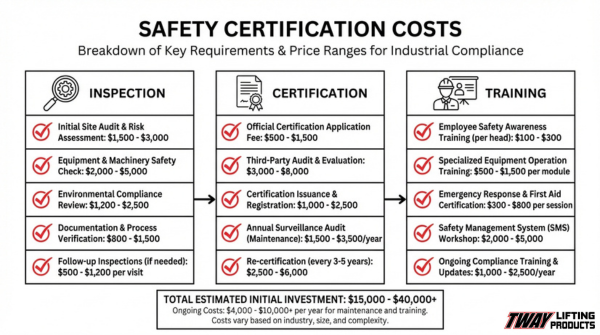
Third-party rigging inspections represent one of the most significant compliance costs in spreader bar rental. According to Mazzella Companies (2025), third-party rigging inspections for equipment like spreader beams are priced on a port-to-port basis, typically costing $480–$600 for a half-day and $960–$1,200 for a full-day. These fees apply on top of the base rental rate, and complex lifts requiring multiple inspection points can push costs higher.
OSHA-mandated annual inspections require certified specialists to evaluate sling connections, structural integrity, and load-bearing components. Rental providers that maintain current inspection records on their fleet reduce the compliance burden for renters, while providers without valid certifications shift that cost and scheduling responsibility to the customer.
Operator training and qualification add another layer. Lifting and rigging training costs between $125 and $500 per learner as of 2025. Projects requiring proof of certified riggers on-site may need this investment before the rental period begins.
Key certification-related costs that influence total rental pricing include:
- Third-party inspection fees, which range from $480 to $1,200 depending on duration.
- OSHA-compliant annual inspection documentation and reporting.
- Operator training and certification at $125–$500 per person.
- Load testing and proof-load certificates for critical or high-capacity lifts.
- Re-certification costs if equipment modifications occur during the rental term.
Skipping these requirements is not a viable cost-saving strategy. The average cost of a major rigging-related injury exceeds $200,000, and fatality costs surpass $4 million, according to the Institute for Building Research and Training. Investing in proper inspection and certification is far less expensive than the liability exposure of non-compliance. Rental providers with in-house inspection capabilities, such as those employing certified, factory-trained specialists, often bundle compliance into the rental agreement, simplifying both cost and logistics.
With compliance costs accounted for, custom fabrication needs can further adjust the final rental price.
Does Custom Fabrication or Modification Change Rental Pricing?
Custom fabrication or modification significantly changes rental pricing by adding engineering, material, and lead-time costs beyond standard rental rates. The extent depends on whether the project requires a fully custom-built spreader bar or a modification to existing modular equipment.
Custom-fabricated spreader bars require dedicated engineering design, raw material procurement, and welding or machining labor before the equipment ever reaches the job site. These upfront costs are typically passed through to the renter as a fabrication surcharge or built into a higher daily, weekly, or monthly rate. The more specialized the load geometry or attachment configuration, the steeper the premium. Projects involving non-standard pick points, unusual span-to-capacity ratios, or corrosion-resistant coatings can push rental pricing well above catalog rates for comparable capacity.
Modifications to existing rental inventory, such as adding custom end fittings or extending a modular spreader bar beyond standard strut configurations, carry a lower cost impact than full fabrication. However, each modification still requires engineering review and recertification to confirm the bar meets rated capacity under the new configuration. That recertification step alone adds cost and lead time.
For most lifts, choosing a modular spreader bar system eliminates the need for full custom fabrication. Modular spreader bars consist of interchangeable struts and end units that can be assembled to match specific span requirements without permanent modification. This flexibility reduces fabrication surcharges while still accommodating non-standard lift geometries.
From a practical standpoint, custom fabrication makes financial sense only when no standard or modular configuration can safely execute the lift. Requesting custom work for a lift that a properly sized modular bar could handle is one of the most common ways project teams overspend on spreader bar rentals. Always confirm with the rental provider whether an existing inventory solution fits before committing to custom fabrication costs.
How Do Additional Rigging Accessories Impact Total Rental Cost?
Additional rigging accessories impact total rental cost by adding incremental fees for each supplementary component required beyond the spreader bar itself. Shackles, slings, load cells, and specialized hardware each carry separate rental charges that compound quickly across multi-day projects.
Most spreader bar lifts require supporting rigging components to function safely and effectively. Wire rope slings connect the spreader bar to the crane hook and load, while shackles secure attachment points at rated capacities. Load cells may be needed for weight verification on critical picks. Synthetic slings, turnbuckles, and swivels add further line items depending on lift complexity. Each accessory typically carries its own daily, weekly, or monthly rental rate, so a project requiring five or six supplementary items can see accessory costs rival the spreader bar rental itself.
Skipping necessary accessories to reduce costs is a false economy. According to the National Safety Council, the total cost of work injuries in the U.S. in 2023 was $176.5 billion, encompassing wage losses, productivity losses, and medical expenses. A single rigging failure caused by missing or inadequate hardware can generate costs that dwarf any rental savings. Properly budgeting for the full accessory package from the outset protects both crews and project timelines.
For the most accurate estimate, request an itemized quote that lists every accessory alongside the primary spreader bar rental. Understanding accessory pricing upfront helps prevent budget overruns once the lift is underway.
How Should You Evaluate Spreader Bar Rental With Full-Service Rigging Support?
You should evaluate spreader bar rental with full-service rigging support by comparing bundled equipment, fabrication, inspection, and delivery against piecemeal vendor costs. The sections below cover how Tway Lifting’s integrated services reduce total project expense and the key pricing takeaways from this guide.
Can Tway Lifting’s Equipment Rentals and Custom Fabrication Help Reduce Spreader Bar Rental Costs?
Yes, Tway Lifting’s equipment rentals and custom fabrication can help reduce spreader bar rental costs by consolidating multiple service needs under one provider. Tway Lifting rents spreader beams from 2 to 100 tons and up to 40 feet in length, with daily, weekly, and monthly rate structures. Free local delivery and pickup from Tway Lifting’s Indianapolis and Fort Wayne superstores eliminate mobilization fees that other vendors charge separately. According to Certified Sales and Rentals, a 2-ton adjustable spreader beam rents for $100 per week, while a 40-ton beam costs $400 per week, illustrating how capacity directly scales pricing. Tway Lifting’s in-house custom fabrication for wire rope slings and special lifting assemblies removes the need for third-party fabricators, cutting lead times and markup costs. Bundling OSHA-compliant inspections with the rental further avoids standalone inspection fees that typically run $480 to $1,200 per session. For projects requiring certified riggers, same-day sling fabrication, or emergency service, a single-source provider like Tway Lifting compresses both cost and coordination overhead.
What Are the Key Takeaways About Spreader Bar Rental Pricing?
The key takeaways about spreader bar rental pricing are that total cost depends on the interaction of capacity, length, type, duration, application, location, compliance, and accessories. The most actionable insights from this guide include:
- Capacity is the primary cost driver; rates increase sharply above 50 tons and again above 100 tons.
- Longer rental durations reduce the effective daily rate, making weekly and monthly terms more cost-effective for extended projects.
- Modular and adjustable spreader bars carry higher base rates but offer flexibility that can eliminate multiple fixed-bar rentals.
- Inspection and certification fees add $480 to $1,200 per session, so bundling these with a rental provider saves significantly.
- Delivery distance and mobilization logistics influence total project cost as much as the bar itself.
- Matching the spreader bar type to the specific lift application prevents overspending on unnecessary capacity or features.
Selecting a full-service rigging partner that manufactures, rents, inspects, and fabricates under one roof is the most reliable way to control spreader bar rental costs across every variable this guide has covered.