







If you’re planning a complex lifting operation and wondering whether your load needs a spreader bar, you’ve come to the right place. We understand that selecting the proper rigging equipment can feel overwhelming, especially when safety and efficiency are paramount. Whether you’re lifting delicate aerospace components or heavy construction materials, we’ll help you determine exactly when a rental spreader bar becomes essential for your project.
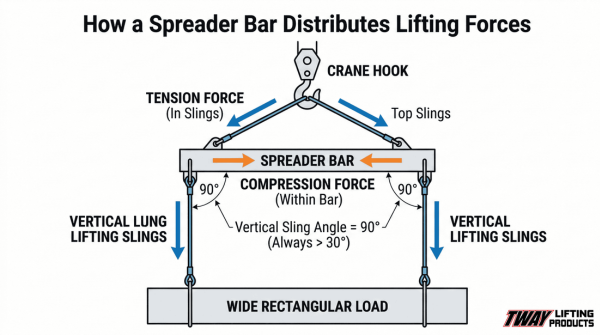
A spreader bar is a below-the-hook lifting device that works as a compression member, converting vertical lifting forces into compressive forces within the bar and tensile forces in the slings to distribute load weight evenly and prevent damage. These engineered solutions are available in fixed, adjustable, telescopic, and modular designs with capacities reaching up to 3,000 tons and spans extending to 100 meters, making them indispensable for industries handling everything from fragile glass panels to massive offshore platform components.
TL;DR Summary: Spreader bars function as compression members that convert vertical lifting forces to protect loads from damage while maintaining geometric stability. Certain load characteristics—including long flexible materials, fragile components, wide dimensions, and multiple lifting points—make spreader bars necessary instead of other equipment. Common applications span manufacturing facilities lifting heavy machinery, construction sites handling precast concrete panels, aerospace operations moving delicate fuselages, and energy sectors transporting turbine blades. Safety regulations from OSHA and ASME B30.20 govern spreader bar operations, with rigging failures contributing to 60% of crane-related deaths between 2011-2017. Choosing the right rental spreader bar requires evaluating load weight, center of gravity, required capacity, and project duration, with daily rates ranging from $150-$300 in major US cities. Tway Lifting offers comprehensive rental solutions with over 70 years of industry expertise, providing capacities from 2-100 tons with nationwide delivery and full compliance certification.
Quick Tip: Always verify your sling angles stay above 30 degrees when using a spreader bar—angles below this threshold dramatically increase forces on both the bar and rigging, potentially leading to catastrophic failure.
As we explore the specific types of loads requiring rental spreader bars, you’ll discover how proper equipment selection directly impacts both project safety and operational efficiency. Understanding these requirements will position you to make informed decisions that protect your workforce, preserve load integrity, and ensure regulatory compliance throughout your lifting operations.
What Is a Spreader Bar and How Does It Work for Lifting Loads?
A spreader bar is a compression member that converts vertical lifting force into compressive forces within the bar and tensile forces in the slings. These critical below-the-hook lifting devices distribute loads across multiple attachment points, preventing damage to fragile materials and maintaining safe sling geometry during lifting operations.
Spreader bars are available in fixed, adjustable, telescopic, and modular designs with capacities up to 3,000 tons and spans up to 100 meters. The global spreader bar market was valued at USD 765 million in 2024, reflecting widespread adoption across industries. Proper sling angle maintenance is critical—angles below 30 degrees dramatically increase forces on rigging and are not recommended for safe operations.
The following sections detail the main functions of spreader bars and how they differ from other lifting devices.
What Are the Main Functions of a Spreader Bar in Material Handling?
The main functions of a spreader bar include distributing load weight evenly to prevent damage from compressive forces. Spreader bars maintain geometric stability by converting vertical lifting forces into controlled compression and tension forces throughout the rigging system.
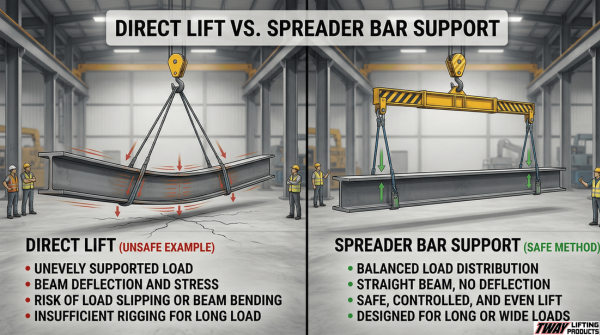
These devices reduce stress on any single point of the load and rigging, preventing catastrophic failure during lifting operations. Spreader bars are essential for lifting long, flexible, or fragile loads that could be damaged by direct sling attachment, such as glass panels, precast concrete sections, and structural steel beams.
How Do Spreader Bars Differ From Other Lifting Devices?
Spreader bars differ from other lifting devices by working primarily through compression forces, while lifting beams work through bending moments. Spreader bars require higher headroom compared to lifting beams due to their rigging configuration and attachment geometry.
Key operational differences include load distribution methods—spreader bars distribute loads to slings at multiple points, while lifting beams support loads directly through their structure. Spreader bars are best suited for long, wide, or fragile loads, whereas lifting beams excel at single-point lifts and compact lifting scenarios.
This foundation in spreader bar mechanics and functions prepares for examining why certain loads specifically require spreader bars instead of alternative lifting equipment.
Why Might Certain Loads Need a Spreader Bar Instead of Other Equipment?
Certain loads need a spreader bar instead of other equipment when their physical characteristics, dimensions, or handling requirements exceed the safe capabilities of standard lifting methods. Spreader bars provide multiple attachment points, distribute compressive forces, and maintain proper sling geometry for loads that would be damaged or unsafe to lift with conventional rigging.
What Load Characteristics Make a Spreader Bar Necessary?
Load characteristics that make a spreader bar necessary include flexibility, fragility, width, and multi-point design requirements. Long flexible loads such as steel pipes, structural beams, and roof trusses require multiple support points to prevent bending or buckling during the lift. Fragile materials including glass panels, precast concrete sections, and delicate machinery need protection from the concentrated compressive forces that slings would otherwise apply directly to the load surface.
Wide loads create sling angle problems that spreader bars solve by extending the attachment points outward. Loads designed with multiple lifting points—such as prefabricated building sections or heavy equipment—require even load distribution among all attachment points to prevent structural damage.
How Do Load Dimensions and Weight Influence Spreader Bar Use?
Load dimensions and weight influence spreader bar use by determining the required capacity, span, and configuration needed for safe lifting operations. Load capacity depends on the spreader bar design, materials, and lift geometry, with sling angle serving as the critical determining factor for force calculations.
As sling angle decreases below the recommended 45-60 degrees, compressive force on the spreader bar increases dramatically according to basic trigonometry principles. A 2019 Crane Institute study found that reducing sling angles from 60 to 30 degrees nearly doubles the force on rigging components.
Modular systems like Modulift can handle extraordinary loads up to 3,000 tons with spans reaching 100 meters for massive industrial components. Telescopic designs allow operators to make quick length adjustments for varying load widths without requiring tools or reconfiguration time, improving efficiency on projects with multiple load sizes.
The selection process balances load weight against available crane capacity while maintaining safe working load limits and proper sling angles for both equipment protection and worker safety.
What Are Common Types of Loads That Require a Rental Spreader Bar?
Common types of loads that require a rental spreader bar include heavy equipment, industrial components, and irregular loads that need multiple lifting points for safe handling. Manufacturing facilities, aerospace operations, construction sites, and energy projects regularly rely on spreader bars to distribute lifting forces and protect valuable cargo during material handling operations.
When Are Spreader Bars Essential for Large or Heavy Equipment?
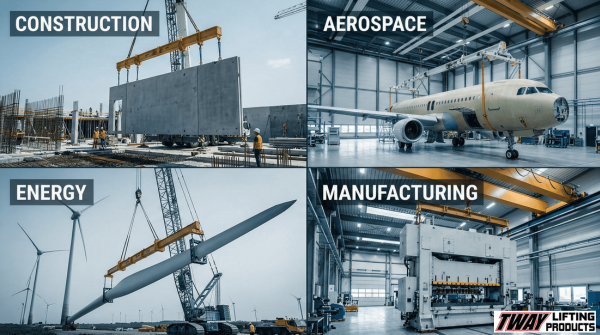
Spreader bars are essential for large or heavy equipment when loads exceed single-point lifting capabilities or require protection from compressive forces. Manufacturing facilities use spreader bars for lifting heavy machinery such as:
- Assembly line components weighing multiple tons
- Industrial presses and stamping equipment
- Large CNC machines and production equipment
- Automated manufacturing systems
The aerospace industry requires spreader bars for delicate components like aircraft fuselages, wings, and satellite equipment where point loads could cause structural damage. Oil and gas operations depend on spreader bars for pipe sections, pressure vessels, and offshore platform components that demand precise load distribution.
What Industrial Applications Commonly Use Rental Spreader Bars?
Industrial applications commonly using rental spreader bars span construction, shipping, entertainment, and energy sectors where load geometry demands multiple attachment points. Construction projects lift precast concrete panels, structural steel beams, and bridge girders that require even weight distribution to prevent cracking or deformation.
Shipping operations handle containers and assemble large vessel components using spreader bars to maintain cargo integrity. The entertainment industry lifts stage trusses and lighting rigs for concerts and events where load stability prevents equipment damage and ensures performer safety. Energy projects handle specialized equipment in both traditional and renewable applications, including transformer installations and solar panel arrays.
How Are Spreader Bars Used for Irregular or Unbalanced Loads?
Spreader bars are used for irregular or unbalanced loads by providing adjustable attachment points that accommodate varying load geometries and center of gravity locations. Adjustable spreader bars accommodate loads of varying widths from 10 to 40 feet, common on construction sites handling different beam lengths and panel sizes.
Modular systems like Modulift can be configured for extremely heavy and irregular loads up to 3,000 tons with custom attachment point spacing. Center of gravity calculations determine correct attachment points for unbalanced loads, ensuring load stability throughout the lift cycle. Multiple lifting point loads require spreader bars to distribute weight evenly across attachment points, preventing localized stress concentrations that could cause load failure.
This section establishes the foundation for understanding specific load types, preparing readers for the critical safety and regulatory considerations that govern spreader bar operations.
What Are the Safety and Regulatory Considerations for Lifting With a Spreader Bar?
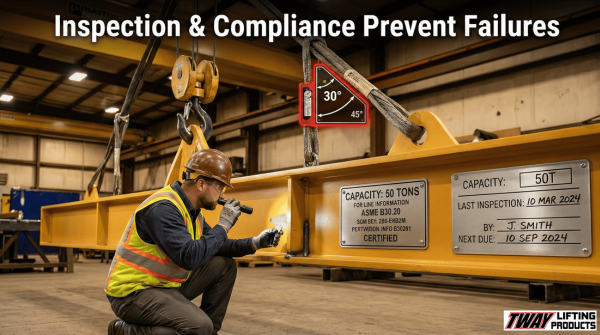
Safety and regulatory considerations for lifting with spreader bars involve strict compliance with OSHA standards, proper inspection protocols, and understanding critical failure modes. According to the U.S. Bureau of Labor Statistics, rigging failures contributed to 60% of crane-related deaths between 2011 and 2017. All spreader bars must be clearly marked with the manufacturer’s name, rated load, serial number, and weight, while custom-designed lifting accessories require proof-testing to 125% of rated capacity before initial use.
Common failure modes include:
- Overloading beyond rated capacity
- Fatigue cracks in welds
- Improper rigging configurations
- Corrosion of structural components
This section examines OSHA compliance requirements and how rental spreader bars enhance workplace safety through proper engineering and maintenance standards.
What OSHA Standards Apply to Spreader Bar Operations?
OSHA standards for spreader bar operations center on equipment inspection requirements and operator certification under 29 CFR 1926.251 and 29 CFR 1926.1427. OSHA 29 CFR 1926.251 mandates rigging equipment inspection prior to each shift and as necessary during use, ensuring equipment integrity before every lifting operation. Additionally, 29 CFR 1926.1427 requires crane operators to be trained, certified, and evaluated for safe operation.
Rigging equipment for material handling must meet specific safety requirements for construction activities. Employers must ensure proper training and qualification of all personnel involved in lifting operations, including riggers, signal persons, and crane operators.
How Do Rental Spreader Bars Improve Workplace Safety?
Rental spreader bars improve workplace safety by maintaining safe sling angles that prevent overloading of slings and the spreader bar itself. They distribute loads evenly, reducing the risk of load instability and tipping during lifting operations. This even distribution protects loads from damage that could lead to catastrophic failure.
ASME B30.20 requires three inspection levels for rental spreader bars: initial inspection before first use, frequent inspection (daily to monthly based on usage), and periodic inspection (1-12 months depending on service conditions). These comprehensive inspection protocols ensure equipment reliability and operator safety throughout the rental period.
How Do You Choose the Right Rental Spreader Bar for Your Load?
Choosing the right rental spreader bar requires evaluating load characteristics, project duration, and safety requirements to match equipment capabilities with lifting demands. Proper selection ensures safe operations while optimizing costs for your specific application.
What Factors Should Be Considered Before Renting a Spreader Bar?
The factors for renting a spreader bar include project duration, budget constraints, equipment availability, and maintenance requirements. Daily rental rates in major US cities range from $150-$300, weekly $600-$1,200, and monthly $2,000-$4,500 in 2026, making short-term projects more cost-effective than purchasing.
Key rental considerations include:
- Access to wide capacity ranges without upfront investment
- Elimination of storage, maintenance, and inspection costs
- Flexibility to upgrade or change equipment mid-project
- Professional support and certification services
Renting provides immediate access to specialized equipment for occasional use while avoiding the ongoing costs of ownership, including storage facilities and certified inspection programs.
How Does Load Type Determine Spreader Bar Size and Configuration?
Load type determines spreader bar selection through weight calculations, center of gravity analysis, and dimensional requirements that match equipment capacity to lifting demands. Load weight and center of gravity calculations determine the required capacity, while load geometry influences the optimal spreader bar configuration.
Load-specific configurations include:
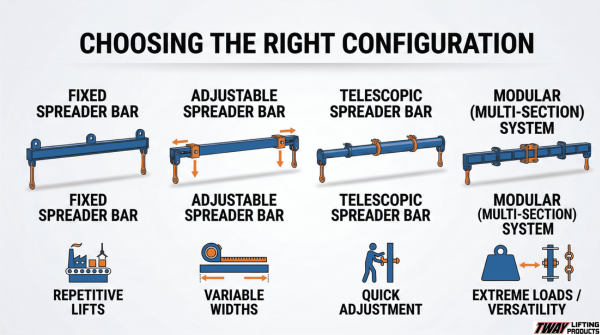
- Fixed spreader bars for repetitive lifts of uniform loads in manufacturing
- Adjustable bars for varying load widths in construction applications
- Modular systems for frequently changing load sizes
- Telescopic designs for quick length adjustments without tools
Load dimensions directly impact sling angle requirements, with wider loads necessitating longer spreader bars to maintain safe angles above 30 degrees and prevent excessive forces on rigging components.
The selection process involves calculating total load weight, identifying attachment points, determining required span length, and verifying that the chosen equipment capacity exceeds calculated loads with appropriate safety factors for your specific lifting scenario.
How Can Tway Lifting Help You Select the Best Spreader Bar Rental for Your Needs?
Tway Lifting provides comprehensive spreader bar rental solutions backed by over 70 years of lifting and rigging expertise. The company offers expert consultation to match your specific load requirements with the optimal spreader bar configuration, ensuring safe and efficient lifting operations across all industries.
What Rental Options and Expert Support Does Tway Lifting Offer for Spreader Bars?
Tway Lifting offers spreader bar rentals with capacities from 2 to 100 tons and spans up to 40 feet. The rental fleet includes fixed, adjustable, telescopic models, and Modulift modular systems to accommodate diverse lifting requirements. All equipment meets or exceeds ASME B30.20 and OSHA standards with current certifications.
The company provides:
- Free nationwide delivery and pickup service
- Daily, weekly, and monthly rental terms
- Proof-load testing and certification services
- Technical support for lift planning and equipment selection
Expert engineers assist with load calculations, sling angle optimization, and proper equipment selection to ensure compliance with safety regulations. This comprehensive support reduces project risks and ensures optimal lifting performance.
What Are the Key Takeaways About What Types of Loads Require a Rental Spreader Bar?
Spreader bars are essential below-the-hook lifting devices for heavy, bulky, or irregularly shaped loads across multiple industries. According to Peter Hansen, CEO of Tway Lifting Products in 2024, proper equipment selection requires thorough pre-lift planning including load calculations, sling angles, and equipment specifications.
Critical safety factors include:
- Maintaining safe sling angles above 30 degrees
- Proper training and inspection protocols
- Adherence to ASME B30.20 and OSHA standards
- Regular equipment certification and testing
Emerging trends in spreader bar technology include modular designs, advanced materials, and smart technology integration for enhanced safety monitoring. These developments provide greater versatility and improved load monitoring capabilities for complex lifting operations.
For specialized spreader bar rental consultation and nationwide delivery, contact Tway Lifting’s experienced team to ensure your lifting operations meet all safety and performance requirements.