



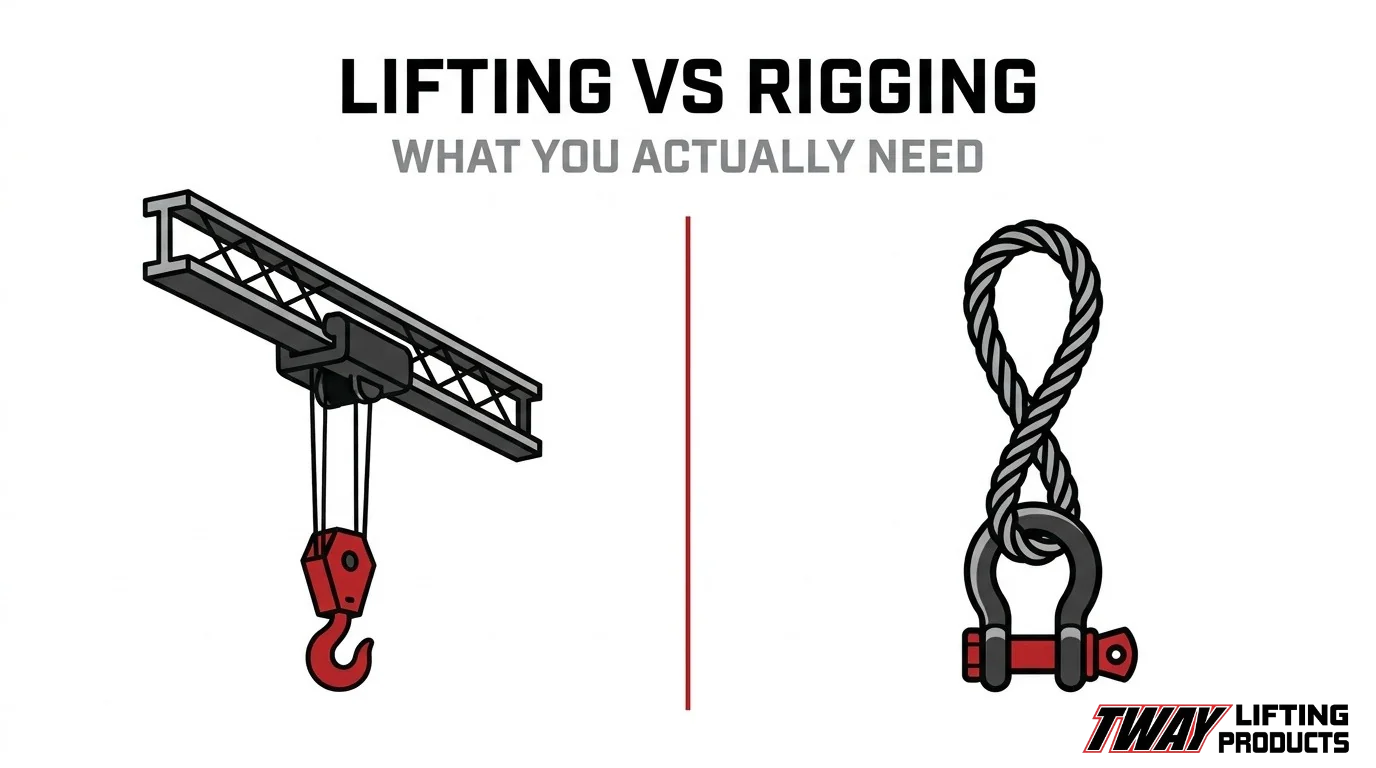

Lifting equipment is work equipment designed to raise and lower loads, including the accessories that anchor and support it. Rigging equipment is the hardware that attaches, secures, and controls a load before and during that lift. These two categories work together on most jobs, but they serve distinct functions and carry separate selection, inspection, and compliance requirements.
This guide covers what each category actually means, the main equipment types within each, the pros and cons of both, how to choose the right gear for your job, and the safety and compliance standards that govern all of it.
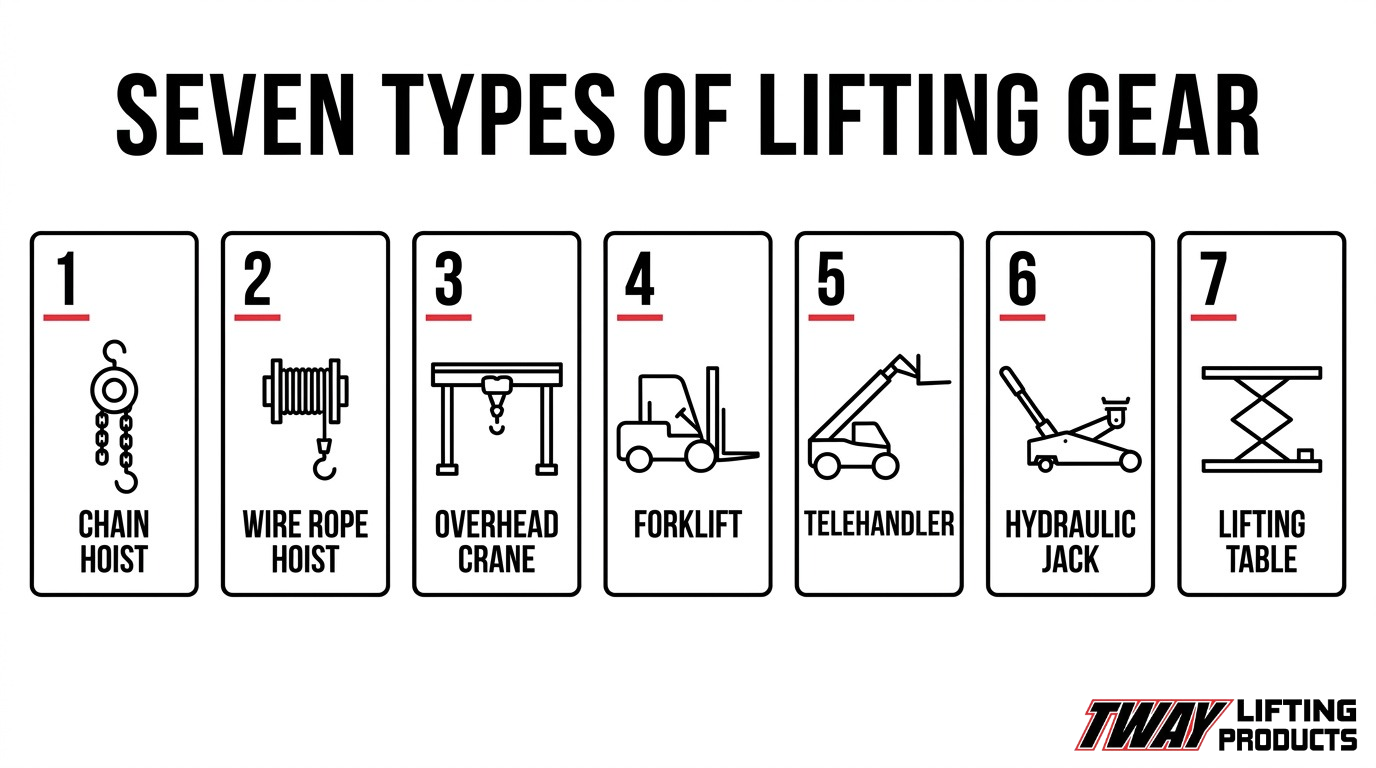
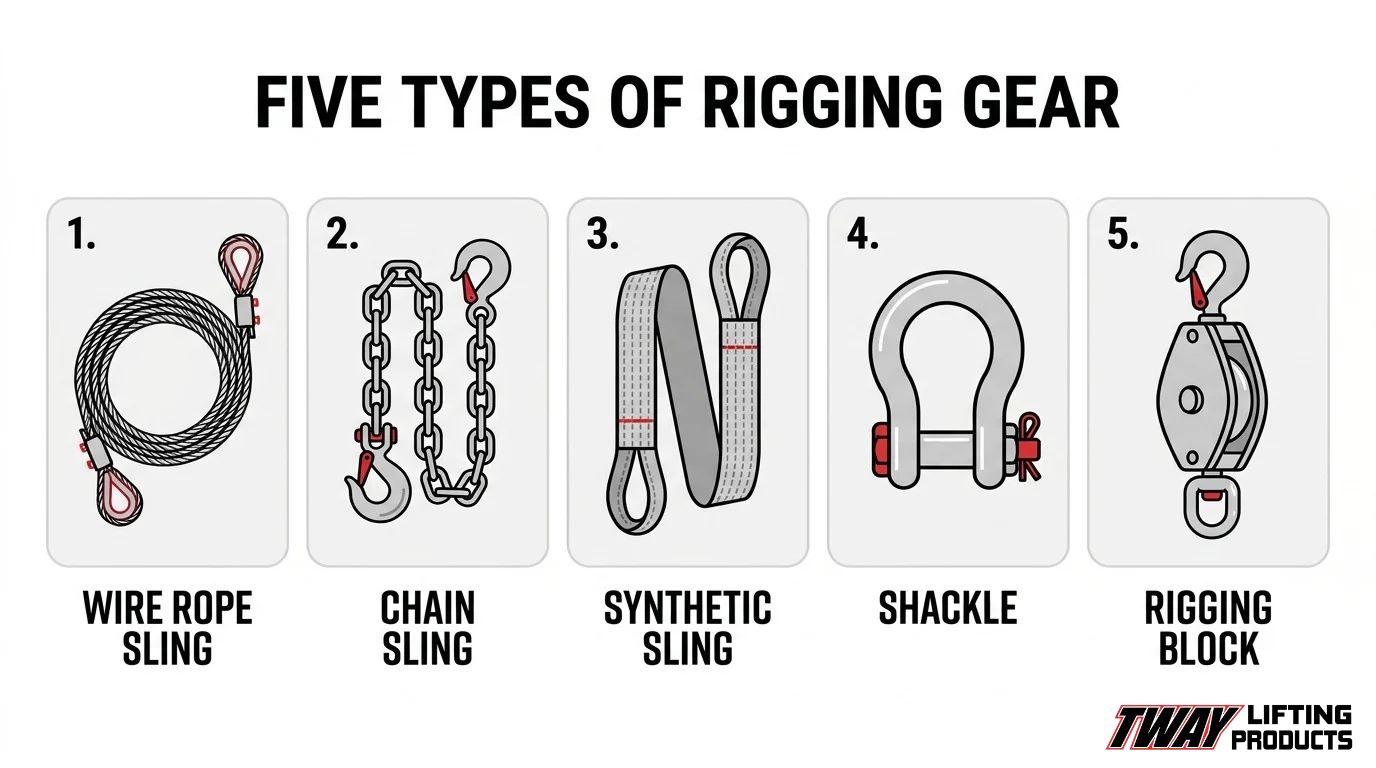
Lifting and rigging each encompass several distinct gear types. Chain hoists, wire rope hoists, overhead cranes, forklifts, telehandlers, hydraulic jacks, and lifting tables each suit different capacities and environments. On the rigging side, wire rope slings, chain slings, synthetic slings, shackles, and rigging blocks each serve a specific function in connecting and stabilizing a load.
Both categories offer real advantages and real limitations. Lifting equipment increases capacity and reduces manual injury risk, but it demands capital investment, certified operators, and site-specific planning. Rigging equipment is highly adaptable across load shapes and configurations, but it degrades over time and relies heavily on the competence of the rigger.
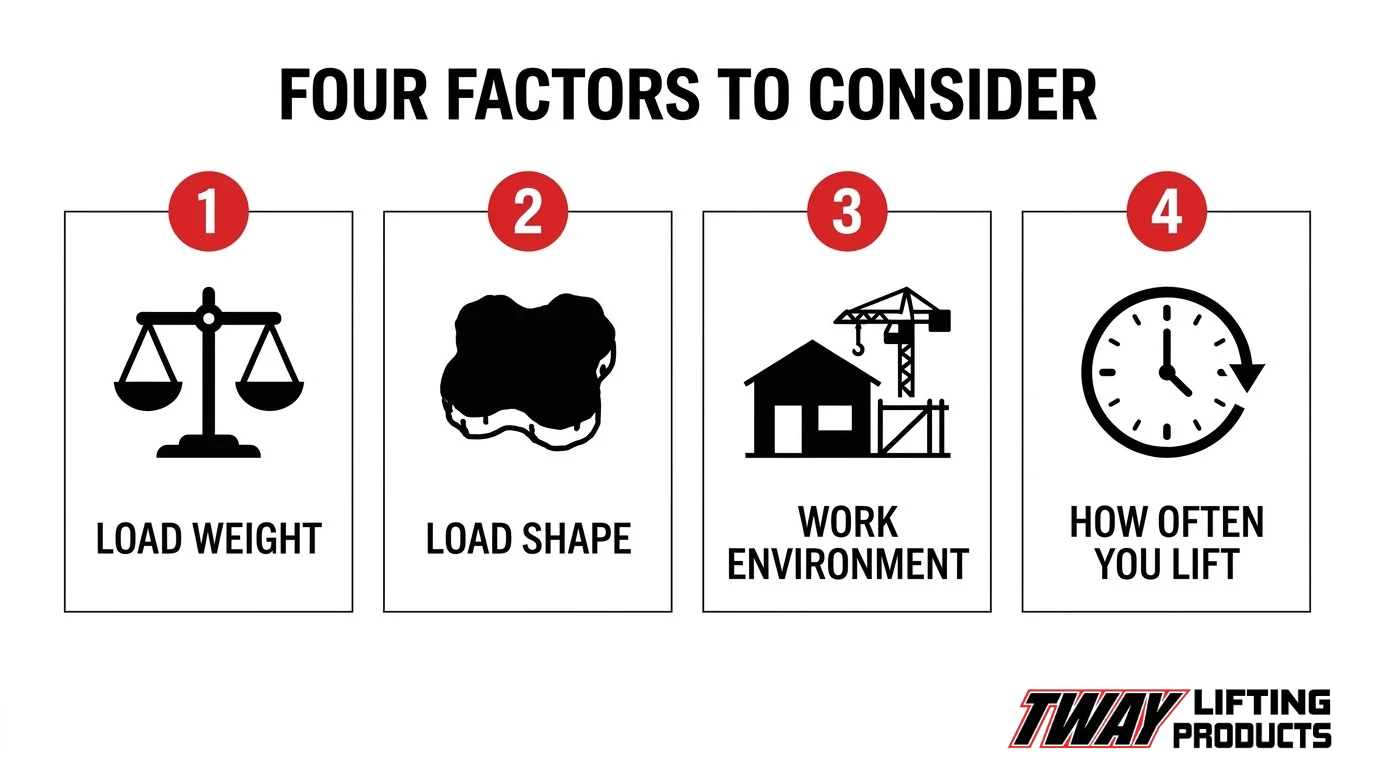
Equipment selection comes down to four variables: load weight, load shape, work environment, and how often you lift. We also cover the OSHA and ASME B30 standards that govern both categories, mandatory inspection schedules, and how Tway Lifting supports these needs with slings, hoists, and certified inspections.
What Does “Lifting Equipment” Actually Mean?
Lifting equipment is work equipment designed to lift and lower loads, including the accessories and attachments that anchor, fix, or support it. The section below covers which devices qualify, how they move loads, and which industries use them most.
What Types of Equipment Are Classified as Lifting Devices?
The types of equipment classified as lifting devices include cranes, hoists, forklifts, telehandlers, hydraulic jacks, and lifting tables. Each device shares one defining function: it applies mechanical force to raise or lower a load, rather than simply securing or connecting one. Accessories such as eye bolts, lifting beams, and load hooks are also classified as lifting equipment when used to anchor or support the lift.
How Does Lifting Equipment Move a Load?
Lifting equipment moves a load by applying mechanical force through a drive mechanism connected to the load. According to the U.S. Department of Energy, a hoist mechanism uses a drum with wire ropes threaded through a load block to raise and lower loads. Telehandlers use a telescopic boom to extend and reposition loads horizontally as well as vertically, making them versatile but also exposing workers to rollover, load failure, and struck-by risks. Understanding the drive mechanism behind each device is essential for matching equipment to task requirements safely.
What Industries Rely Most on Lifting Equipment?
The industries that rely most on lifting equipment include construction, manufacturing, warehousing, transportation, and facilities maintenance. A study published via the National Library of Medicine found that work-directed activity such as pushing, lifting, and repetitive motion accounted for 36% of injuries in California’s facilities maintenance and property services industry, the single largest injury category. Construction, ports, and energy production also depend heavily on lifting equipment for daily material movement. Any sector that moves heavy loads at height or over distance has lifting equipment at the center of its operations.
What Does “Rigging Equipment” Actually Mean?
Rigging equipment is the hardware used to attach, secure, and control a load before and during a lift. The following section covers the gear types that qualify as rigging, the role rigging plays in pre-lift planning, and which industries rely on it every day.
What Types of Equipment Are Classified as Rigging Gear?
The types of equipment classified as rigging gear include slings, shackles, hooks, wire rope assemblies, synthetic webbing, chains, and rigging blocks. These components connect a load to the lifting device without performing the vertical movement themselves. Each item has a defined working load limit (WLL) that reflects the manufacturer’s recommended maximum force for that configuration, according to the U.S. Department of Agriculture Forest Service. Rigging gear is selected based on load shape, weight, and surface sensitivity, with synthetic web slings favored for delicate or finished surfaces because the material molds to the load and absorbs shock more effectively than chain or wire rope.
What Role Does Rigging Play Before the Lift Happens?
Rigging plays a critical role in pre-lift planning by establishing how the load is attached, balanced, and controlled before any vertical movement begins. A poorly rigged load can shift mid-air regardless of how capable the lifting device is. OSHA requires that rigging equipment for material handling be inspected prior to use on each shift, and defective rigging must be removed from service immediately. This pre-use inspection step is where most preventable incidents are caught. In practice, rigging determines the safety of every lift, making it the foundation rather than an afterthought.
What Industries Depend on Rigging Equipment Daily?
The industries that depend on rigging equipment daily include construction, steel production, maritime shipping, utilities, mining, and entertainment rigging. According to the U.S. Bureau of Labor Statistics, 43 percent of fatal work injuries involving cranes between 2011 and 2017 occurred in private construction, where rigging failures are a leading contributing factor. Port operations also rely heavily on rigging, with the top 25 U.S. container ports operating 583 ship-to-shore gantry cranes in 2025. Entertainment venues, motor speedways, and large-scale industrial facilities all use rigging daily to position equipment, scenery, and structural components safely.
Are Lifting and Rigging Equipment the Same Thing?
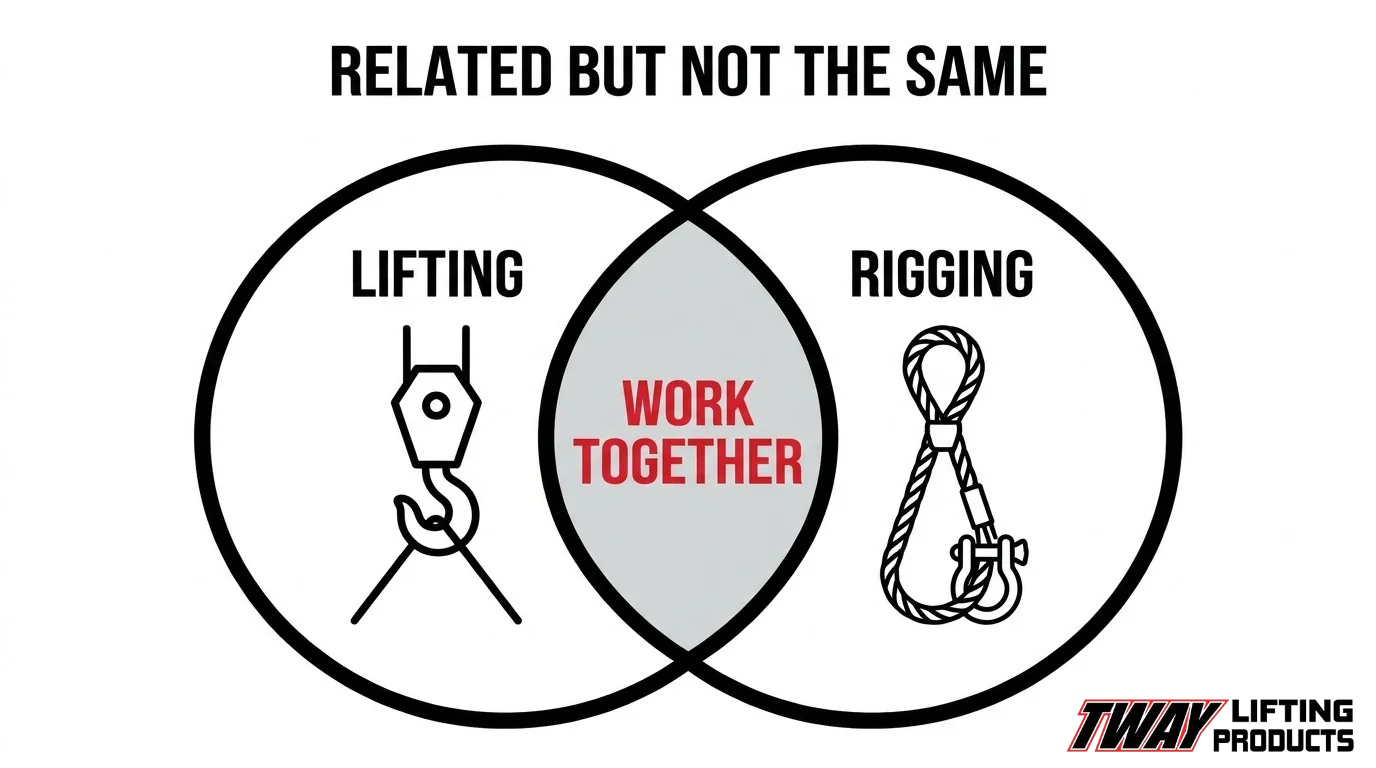
Lifting and rigging equipment are related but not interchangeable. The sections below clarify where these two categories overlap and where their functions diverge.
Where Do Lifting and Rigging Equipment Overlap?
Lifting and rigging equipment overlap when both are required to complete a single lift safely. A crane (lifting equipment) cannot safely move an irregularly shaped load without slings, shackles, or hooks (rigging equipment) connecting the load to the hook. In this sense, rigging components are classified as lifting accessories under broader regulatory definitions. Neither category operates independently on a complex lift; together, they form one complete load-handling system.
Where Does Lifting Equipment End and Rigging Equipment Begin?
Lifting equipment ends where the mechanical drive system stops, and rigging equipment begins at the connection point between the hook and the load. The crane, hoist, or jack generates and controls vertical movement. Rigging hardware, including slings, shackles, and blocks, positions and secures the load before movement starts.
According to OSHA, rigging equipment for material handling must be inspected prior to use on each shift, and defective rigging equipment must be removed from service immediately. The Canadian Centre for Occupational Health and Safety notes that synthetic web slings grip and cushion delicate loads in ways wire rope cannot, illustrating how rigging choice directly affects load integrity. The Lifting Equipment Engineers Association (LEEA) reinforces that inspection and ethical best practice remain critical across both categories.
Treating rigging as an afterthought to lifting is one of the most common and costly mistakes on a job site.
What Are the Main Types of Lifting Equipment?
The main types of lifting equipment include chain hoists, wire rope hoists, overhead cranes, forklifts, telescopic handlers, hydraulic jacks, and lifting tables. Each type suits different load capacities, environments, and operational demands.
Chain Hoists
Chain hoists are mechanical or electric devices that lift loads using a looped chain threaded through a pulley or gear mechanism. They are widely used in manufacturing, construction, and maintenance applications where vertical lifting in confined spaces is required. Available in manual, pneumatic, and electric configurations, chain hoists suit capacities ranging from light assembly work to heavy industrial loads. Their durability and straightforward design make them one of the most reliable short-range lifting tools on a job site.
Wire Rope Hoists
Wire rope hoists are lifting devices that raise and lower loads using a steel wire rope wound around a drum. They handle higher capacities and faster lift speeds than most chain hoists, making them common in overhead crane systems and industrial facilities. According to the Mine Safety and Health Administration (MSHA), wire ropes deteriorate and will break if left in service long enough, with causes including wear, corrosion, kinking, crushing, overloading, and heat damage. Regular inspection is therefore not optional but operationally critical.
Overhead Cranes
Overhead cranes are fixed lifting systems that travel along elevated runways to move loads horizontally and vertically across a defined workspace. Under OSHA Standard 29 CFR 1910.179, only designated personnel are permitted to operate overhead and gantry cranes, which include semigantry, cantilever gantry, wall cranes, and storage bridge cranes. This operator restriction reflects the complexity and risk of these systems, particularly in high-throughput industrial environments like steel plants and warehouses.
Forklifts and Telescopic Handlers
Forklifts are wheeled industrial vehicles that lift and transport palletized or platform-mounted loads using front-mounted forks. Telescopic handlers (telehandlers) extend this capability further: according to Purdue University’s Agricultural Safety and Health Program, the defining characteristic of a telehandler is its single telescopic boom, which extends or retracts to position attachments and materials at greater reach and height than a standard forklift allows. Both machines are mobile, making them suited for warehouses, construction sites, and logistics operations where loads must move across distances, not just vertically.
Hydraulic Jacks and Lifting Tables
Hydraulic jacks and lifting tables are low-profile devices that use pressurized fluid to generate vertical lift force. Jacks typically provide concentrated upward force beneath a load point, while lifting tables offer a stable platform that raises and lowers an entire surface. Both types serve positioning and maintenance tasks where precision matters more than height or range. They are common in automotive service, manufacturing assembly lines, and equipment installation, where controlled, gradual lift prevents load damage and improves worker ergonomics.
What Are the Main Types of Rigging Equipment?
The main types of rigging equipment are wire rope slings, chain slings, synthetic slings, shackles and hardware, and rigging blocks and pulleys. Each type serves a distinct function in securing, positioning, and directing loads before and during a lift.
Wire Rope Slings
Wire rope slings are flexible steel assemblies used to connect loads to lifting devices. They handle heavy, abrasive loads well and perform reliably in high-heat environments. According to the Mine Safety and Health Administration, wire ropes deteriorate from causes including wear, corrosion, kinking, crushing, overloading, and heat damage, making regular inspection essential before every use.
Chain Slings
Chain slings are load-bearing assemblies made from alloy steel links, valued for durability and resistance to cuts, abrasion, and elevated temperatures. They suit rough industrial environments such as steel production and foundries. Chain slings accommodate adjustable length configurations, making them practical for irregular or awkward load shapes.
Synthetic Slings
Synthetic slings are flexible rigging assemblies made from nylon or polyester webbing. According to the Canadian Centre for Occupational Health and Safety, synthetic web slings are the preferred choice where finished parts or delicate equipment must be protected, because the material stretches and molds to the load while cushioning shock better than wire rope or chain.
Shackles and Hardware
Shackles are load-rated connectors that link slings, hooks, and rigging components into a complete assembly. Common hardware types include bow shackles, dee shackles, hooks, and master links. Each component carries a working load limit (WLL), which represents the manufacturer’s maximum recommended force for safe use in any given configuration.
Rigging Blocks and Pulleys
Rigging blocks are single- or multi-sheave devices used to redirect the line of pull or multiply mechanical advantage in a rigging system. According to the Infrastructure Health and Safety Association, a snatch block opens on one side so rope can be slipped over the sheave without threading, making it especially useful when changing the direction of pull on a line.
What Are the Pros and Cons of Lifting Equipment?
Lifting equipment offers significant productivity and safety advantages, but it also carries real limitations and risks. The sections below cover the biggest advantages, common limitations, and conditions that turn lifting equipment into a safety hazard.
What Are the Biggest Advantages of Using Lifting Equipment?
The biggest advantages of using lifting equipment are increased load capacity, reduced manual injury risk, and operational efficiency. Mechanical lifting devices allow workers to move loads far beyond human physical limits, from individual chain hoists handling several tons to overhead cranes spanning entire production floors. By removing the need for manual lifting, these tools directly reduce musculoskeletal strain, one of the leading causes of workplace injury in industrial settings. Equipment like telescopic handlers and hydraulic lifting tables also improve positioning precision, letting crews place heavy loads accurately without repeated repositioning attempts. For high-volume operations, that combination of capacity, speed, and worker protection is difficult to replicate with any other method.
What Are the Common Limitations of Lifting Equipment?
The common limitations of lifting equipment include high acquisition costs, site-specific constraints, and operator training requirements. Large cranes and telehandlers require substantial capital investment, ongoing maintenance budgets, and certified operators, which creates barriers for smaller operations or short-term projects. Fixed overhead cranes are permanently tied to their runway structure, limiting flexibility when load paths change. Even mobile equipment like forklifts faces floor-load, aisle-width, and terrain restrictions that reduce their usability in confined or uneven environments. Matching the right equipment to the job is critical; oversizing or undersizing a lift creates both economic waste and safety exposure. In practice, operational constraints are often underestimated during the planning phase.
When Does Lifting Equipment Become a Safety Risk?
Lifting equipment becomes a safety risk when it is improperly selected, poorly maintained, or operated without adequate training. Telehandlers, for example, can expose workers to rollovers, load failure, and struck-by incidents according to WorkSafeBC guidance on managing telehandler risks. However, industry-wide improvement is measurable: according to a 2023 Center for Offshore Safety annual report, mechanical lifting and lowering incidents (SPI 2C) fell to their lowest level in five years, representing a 78% decrease per 200,000 work hours compared to 2020. That trend reflects what consistent training, inspection, and procedure compliance can achieve. Risks escalate quickly when any of those controls are missing, particularly with high-capacity equipment operating near personnel.
What Are the Pros and Cons of Rigging Equipment?
Rigging equipment offers precise load control and versatility across configurations, but it also carries real limitations and safety risks. The sections below cover the key advantages, common limitations, and conditions that turn rigging equipment into a hazard.
What Are the Biggest Advantages of Using Rigging Equipment?
The biggest advantages of using rigging equipment are its adaptability, load protection, and ability to work across virtually any lift configuration. Slings, shackles, and hardware can be combined to match irregular load shapes, distribute weight evenly, and protect delicate surfaces. According to the Canadian Centre for Occupational Health and Safety, synthetic web slings mould to the shape of a load, gripping securely while cushioning and absorbing shock better than wire rope or chain, making them ideal for finished or fragile materials. Rigging hardware also scales well: the same shackles and blocks used on a small lift can be reconfigured for much heavier applications, giving teams flexibility without requiring entirely new equipment.
What Are the Common Limitations of Rigging Equipment?
The common limitations of rigging equipment include wear degradation, working load limits, and the skill required for safe use. Wire ropes, chain slings, and synthetic slings all degrade over time through abrasion, corrosion, bending fatigue, and overloading. OSHA Standard 1926.251 requires rigging equipment to be inspected before every shift and immediately removed from service when defective. That inspection burden is not trivial: a team running multiple sling configurations daily must track wear across dozens of components. Rigging also depends heavily on the competence of the rigger; an improperly configured sling hitch or an incorrect working load limit (WLL) calculation can compromise the entire lift before the crane even moves.
When Does Rigging Equipment Become a Safety Risk?
Rigging equipment becomes a safety risk when it is degraded, mismatched to the load, or operated without proper training. Wire ropes deteriorate through wear, corrosion, kinking, and heat damage, and according to the Mine Safety and Health Administration, they will break if left in service long enough without removal. Using a sling beyond its rated WLL, selecting the wrong sling type for a load surface, or rigging a load with an incorrect angle all multiply the risk of sudden failure. The U.S. Department of Agriculture’s Forest Service notes that the WLL reflects the manufacturer’s maximum safe working force, and the safety design factor exists precisely because field conditions create stresses that static ratings cannot fully predict. Proper training, pre-shift inspection, and strict WLL compliance are non-negotiable, not best practices.
How Do You Choose Between Lifting and Rigging Equipment?
Choosing between lifting and rigging equipment depends on four key variables: load weight, load shape, work environment, and frequency of use. Each factor narrows your options differently, and the sections below address each one directly.
How Does Load Weight Determine Which Equipment You Need?
Load weight determines which equipment you need by establishing the minimum working load limit (WLL) required for safe operation. According to the U.S. Department of Agriculture Forest Service, the WLL reflects the manufacturer’s recommendation for the maximum weight or force you should apply in any given situation, with the safety design factor representing the ratio between the minimum breaking strength and the WLL.
Heavier loads generally require mechanical lifting equipment such as overhead cranes, hoists, or hydraulic systems with rated capacities that exceed the load. Rigging components like slings, shackles, and hardware must also be matched to that same WLL. Never select equipment based on estimated weight alone; always verify actual load weight before specifying any gear.
How Does Load Shape Affect Your Rigging or Lifting Choice?
Load shape affects your rigging or lifting choice by determining which attachment method can safely contact, grip, and stabilize the load during movement. Irregular, awkwardly balanced, or fragile loads typically require rigging solutions rather than a straight mechanical lift.
The Canadian Centre for Occupational Health and Safety notes that synthetic web slings are a good choice where highly finished parts or delicate equipment must be protected from damage, because the synthetic material stretches and flexes to mould to the shape of the load while cushioning shock better than wire rope or chain. For uniform, rigid loads with defined lift points, standard lifting equipment with fixed hooks or attachments is often sufficient. Load shape is an underappreciated selection factor; the wrong attachment method can shift the center of gravity mid-lift and create serious instability.
How Does Your Work Environment Influence Equipment Selection?
Your work environment influences equipment selection by limiting which equipment can physically fit, safely operate, or remain structurally supported within the available space. Indoor facilities with fixed overhead structures favor overhead cranes or hoists mounted to existing beams, while outdoor or jobsite environments may require mobile lifting equipment such as telehandlers or forklifts.
Confined spaces restrict swing radius and height, making compact chain hoists or manual rigging systems more practical. Corrosive, wet, or high-temperature environments affect material compatibility, particularly for wire rope slings and synthetic slings, which degrade under specific chemical or heat exposure. Matching equipment to environmental conditions is not optional; it directly determines both equipment longevity and worker safety.
How Does Frequency of Use Factor Into the Decision?
Frequency of use factors into the decision by determining whether the investment in permanent lifting infrastructure is justified or whether rental and portable rigging solutions are more cost-effective. High-frequency, repetitive lifts in a fixed location typically warrant dedicated lifting equipment such as an overhead crane or electric hoist, which offers speed, consistency, and reduced operator fatigue over time.
Occasional or project-specific lifts favor modular rigging setups using slings, shackles, and portable hoists that can be configured per job and stored between uses. OSHA requires that rigging equipment be inspected prior to use on each shift, so higher-frequency operations also increase inspection demands regardless of equipment type. Matching equipment permanence to actual use frequency keeps both costs and compliance burdens manageable.
What Are the Key Safety and Compliance Requirements?
Safety and compliance requirements for lifting and rigging equipment are governed by OSHA standards, ASME codes, and mandatory inspection schedules. The following sections cover OSHA rules for lifting equipment, OSHA rules for rigging equipment, and required inspection frequencies.
What OSHA Standards Apply to Lifting Equipment?
The OSHA standards that apply to lifting equipment include 29 CFR 1910.179, which governs overhead and gantry cranes, and broader General Industry and Construction standards covering forklifts, hoists, and hydraulic lifting devices. OSHA 29 CFR 1910.179 requires that only designated personnel operate covered cranes, and that load-rating test reports remain readily available for modified cranes and repaired hooks. Compliance with these standards is not optional. A NIOSH alert documented seven forklift-related worker fatalities, concluding that each death could have been prevented if OSHA standard provisions had been followed and appropriate safety equipment had been used.
What OSHA Standards Apply to Rigging Equipment?
The OSHA standards that apply to rigging equipment are primarily found in 29 CFR 1926.251, which covers rigging equipment for material handling in construction. This standard requires rigging equipment to be inspected before use on each shift and as necessary throughout use. Defective rigging equipment must be removed from service immediately. The American Society of Mechanical Engineers (ASME) B30 series complements OSHA by establishing safety standards for cableways, cranes, derricks, hoists, hooks, jacks, and slings. Together, OSHA and ASME B30 form the two-pillar compliance framework most U.S. operations must follow.
How Often Must Lifting and Rigging Equipment Be Inspected?
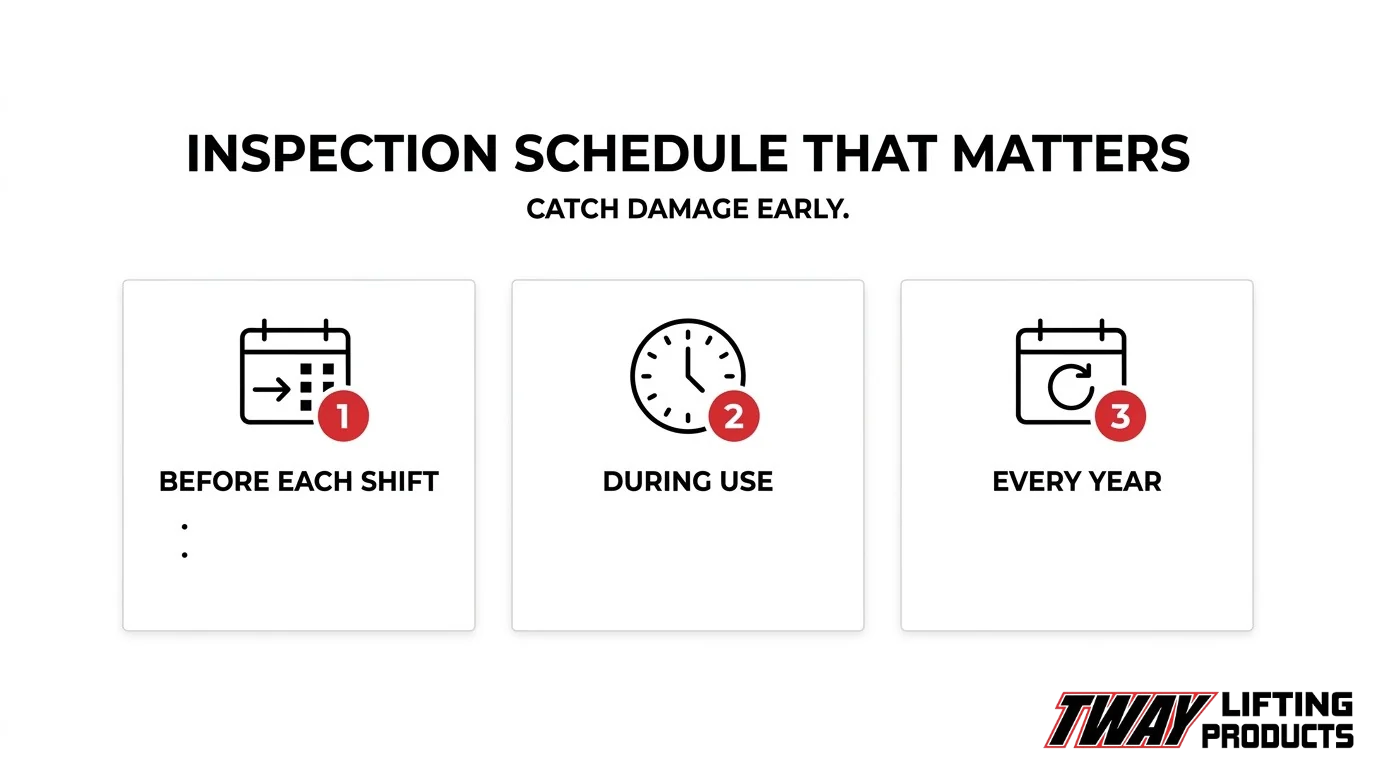
Lifting and rigging equipment must be inspected at three distinct intervals: before each shift, periodically during use, and annually as required by OSHA and industry best practice. Per OSHA 29 CFR 1926.251, rigging equipment requires a pre-shift inspection every time it is put into service. Lifting equipment such as overhead cranes requires documented frequent and periodic inspections under 29 CFR 1910.179, with periodic inspections typically conducted at 1-to-12-month intervals depending on service conditions. The Mine Safety and Health Administration notes that wire ropes deteriorate from wear, corrosion, kinking, and overloading, making regular inspection critical to catching damage before failure. Skipping scheduled inspections is one of the most preventable contributors to serious lifting incidents.
How Does Tway Lifting Support Your Rigging and Lifting Needs?
Tway Lifting supports rigging and lifting needs as a full-service manufacturer, distributor, and inspection provider headquartered in Indianapolis, Indiana. The sections below cover Tway Lifting’s product and service offerings and key takeaways from this article.
Does Tway Lifting Offer Slings, Hoists, and OSHA-Compliant Inspections?
Yes, Tway Lifting offers slings, hoists, and OSHA-compliant inspections across its full product and service portfolio. The company supplies wire rope slings, chain slings, synthetic slings, hoists, shackles, spreader beams, fall protection equipment, fittings, load securements, cables, and hand tools. Inspection services are performed by certified specialists and align with ASME B30 Safety Standards, which govern cableways, cranes, derricks, hoists, hooks, jacks, and slings. Tway Lifting also provides same-day wire rope sling fabrication, chain sling reconditioning, custom lifting assemblies, and rigging equipment rental with free local delivery and pickup. Founded in 1945 and ISO9001-2008 certified, Tway Lifting brings over 75 years of industry expertise to every compliance requirement.
What Are the Key Takeaways About Lifting vs. Rigging Equipment We Covered?
The key takeaways about lifting vs. rigging equipment center on understanding each category’s role, selecting the right equipment for the job, and maintaining strict compliance. The consequences of getting it wrong are severe: the National Transportation Safety Board documented a 2022 incident in which a crawler crane toppled off the construction barge Carolyn Skaves in Norfolk, Virginia, and was declared a total constructive loss. Practical lessons from this article include:
- Lifting equipment raises and lowers loads; rigging equipment connects and secures loads before the lift.
- Equipment selection depends on load weight, shape, environment, and frequency of use.
- OSHA and ASME B30 standards require pre-shift inspection and removal of defective equipment.
- Working load limits (WLL) must never be exceeded; safety design factors are non-negotiable.
- Regular inspection by certified specialists is the single most effective way to prevent catastrophic failure.
Partnering with an experienced, certified supplier like Tway Lifting is the most reliable way to ensure every lift meets safety and compliance standards.