







A spreader bar is a rigid structural member that holds lifting slings apart at a set distance, converting vertical lifting loads into compressive forces in the bar and tensile forces in the slings. Choosing between a fixed and adjustable model for your rental determines how accurately you can control load geometry, how many lift configurations one unit can serve, and what the total cost of that rental looks like.
This guide covers how each bar type works mechanically, how their performance compares across key lift variables, when each configuration is the right call, what safety and inspection requirements apply to rented units, and how to evaluate rental against purchase.
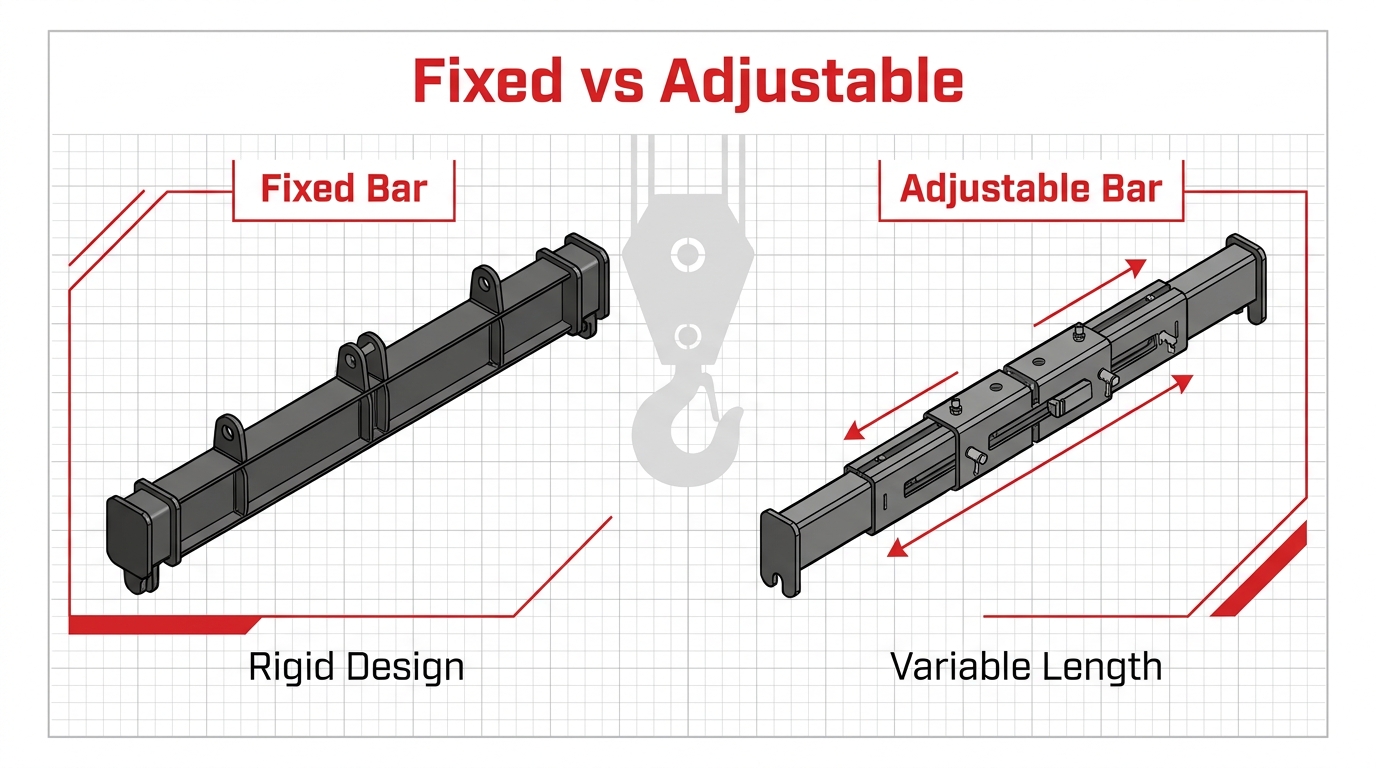
Fixed and adjustable spreader bars distribute load forces through the same compressive-tensile force path, but their structural differences make each better suited to specific conditions. Fixed bars hold slings at one unchanging spread, which delivers maximum rigidity, simpler setup, and higher tonnage capacity for precision lifts where load geometry never varies. Adjustable bars allow crews to reposition attachment points to match each load’s pick point spacing, making one rental unit practical across multiple lift widths and project sites.
Safety and inspection requirements apply to both bar types without exception. OSHA 1926.251, ASME B30.20, and LEEA 055 govern proof-testing, markings, and pre-use inspection for every spreader bar that enters service, regardless of whether it is owned or rented.
Deciding between fixed and adjustable ultimately comes down to load weight, attachment point spacing, lift height, and how often those variables change across your jobs.
What Is a Spreader Bar and How Does It Work in Rigging?
A spreader bar is a rigid structural member used in rigging to hold lifting slings apart at a set distance, keeping load control safe and stable during overhead lifts. It works by converting the vertical lifting load into compressive forces within the bar itself and tensile forces in the attached slings, distributing weight across multiple pick points rather than concentrating stress at a single connection.
This section covers how spreader bars function mechanically, what forces they manage, and why rigging engineers rely on them for precision load control.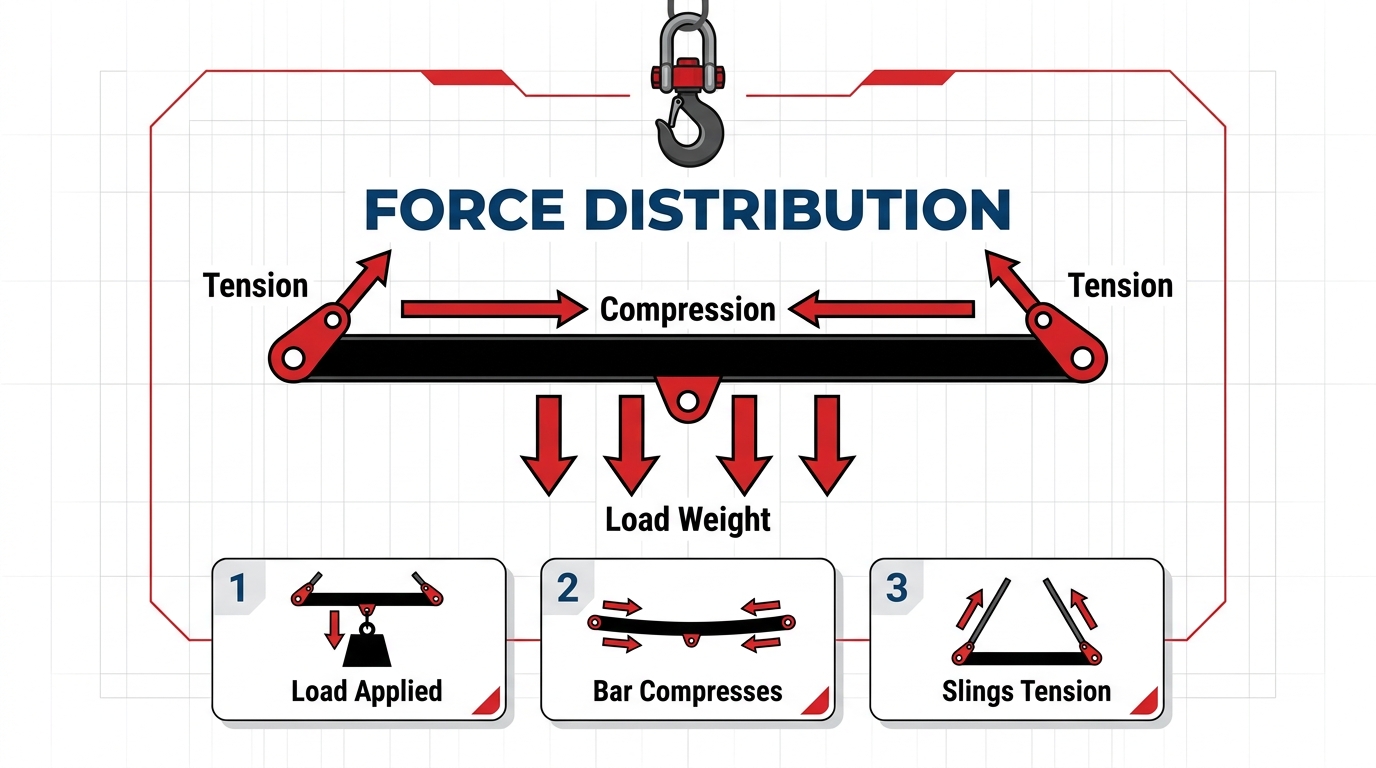
How a Spreader Bar Distributes Load Forces
A spreader bar distributes load forces by separating sling attachment points horizontally, which eliminates steep sling angles that would otherwise generate inward crushing forces on the load. According to Mazzella Companies, spreader beams convert lifting loads into compressive forces in the bar and tensile forces in the slings, making them highly efficient in material use compared to lifting beams. This force-splitting behavior protects fragile or oversized loads from lateral compression while maintaining vertical stability throughout the lift.
What Mechanical Role Does a Spreader Bar Play in a Rigging System?
The mechanical role of a spreader bar in a rigging system is to act as the horizontal control point between the crane hook above and the sling legs below, managing both load geometry and sling angle simultaneously. Rigging engineers emphasize that spreader bars eliminate the need for large sling angles, which directly reduces inward crushing forces on the load being lifted. By fixing the horizontal distance between pick points, the bar also prevents swaying and enables accurate load placement, two factors that are critical in confined or precision lift environments. This makes the spreader bar one of the most functionally important components in any multi-point rigging assembly.
What Are the Types of Spreader Bars Available for Rent?
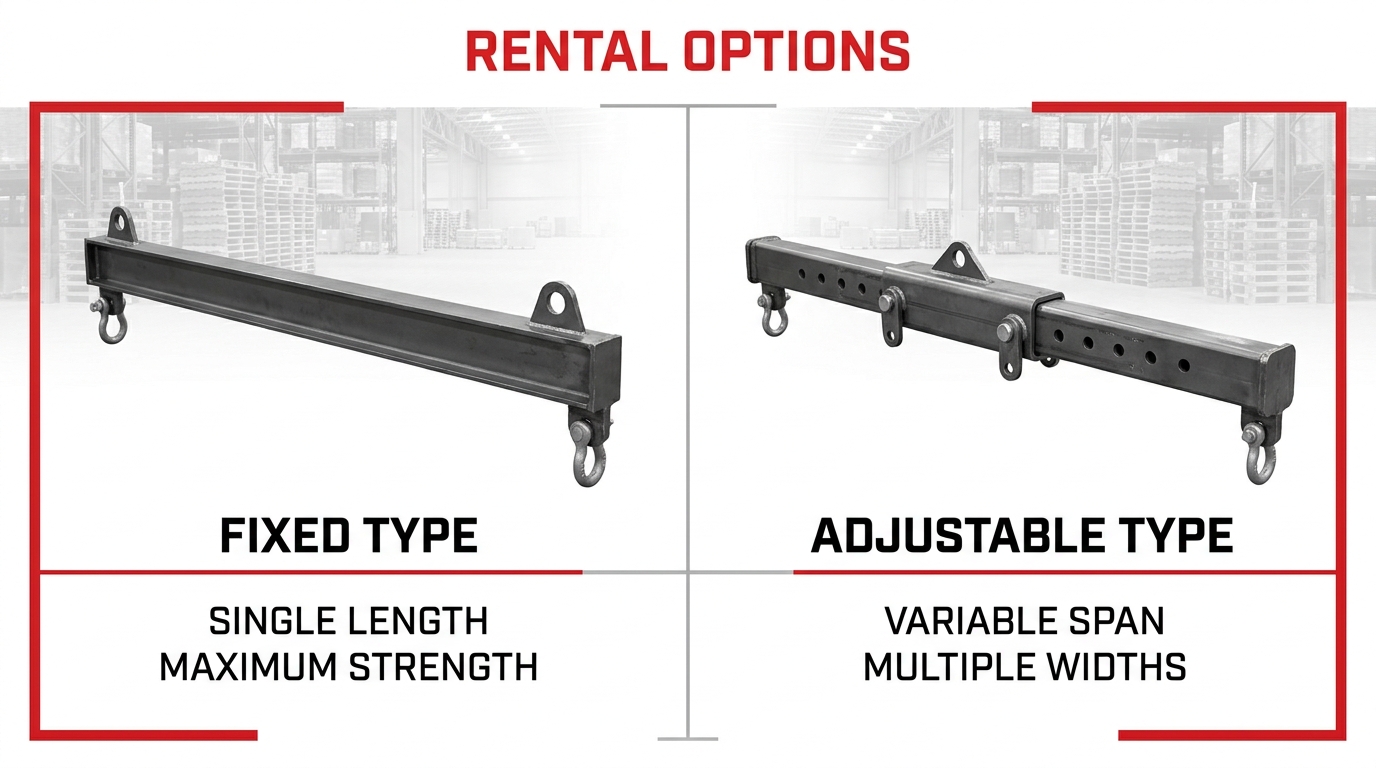
The types of spreader bars available for rent are fixed and adjustable models, each designed for different load geometries and lift configurations. The sections below cover how each bar type performs and which rental scenarios each best serves.
Fixed Spreader Bar
A fixed spreader bar is a rigid, single-length rigging device that holds lifting slings apart at one set distance. According to Hercules SLR, fixed spreader bars are ideal for straightforward lifting operations where the load is stable and uniform. Construction materials include high-strength, low-alloy (HSLA) steel and, in some configurations, composite materials that are lightweight, non-conductive, and non-corrosive. Fixed bars deliver maximum structural rigidity, which makes them the preferred choice for precision lifts where load geometry does not change between picks.
Adjustable Spreader Bar
An adjustable spreader bar allows crews to change the bar’s working length to match the spacing between pick points on different loads. Adjustable spreader bars control how lifting forces are distributed by allowing crews to match pick point spacing to the load, as noted by Machining & Welding. Aluminum adjustable models are available in capacities ranging from 1/2 ton to 3 tons for lighter applications, while modular systems scale considerably higher. Because one unit can serve multiple span requirements, adjustable bars reduce the need for a large owned inventory, making rental the practical choice for variable-width lifts.
How Does a Fixed Spreader Bar Perform Under Load?
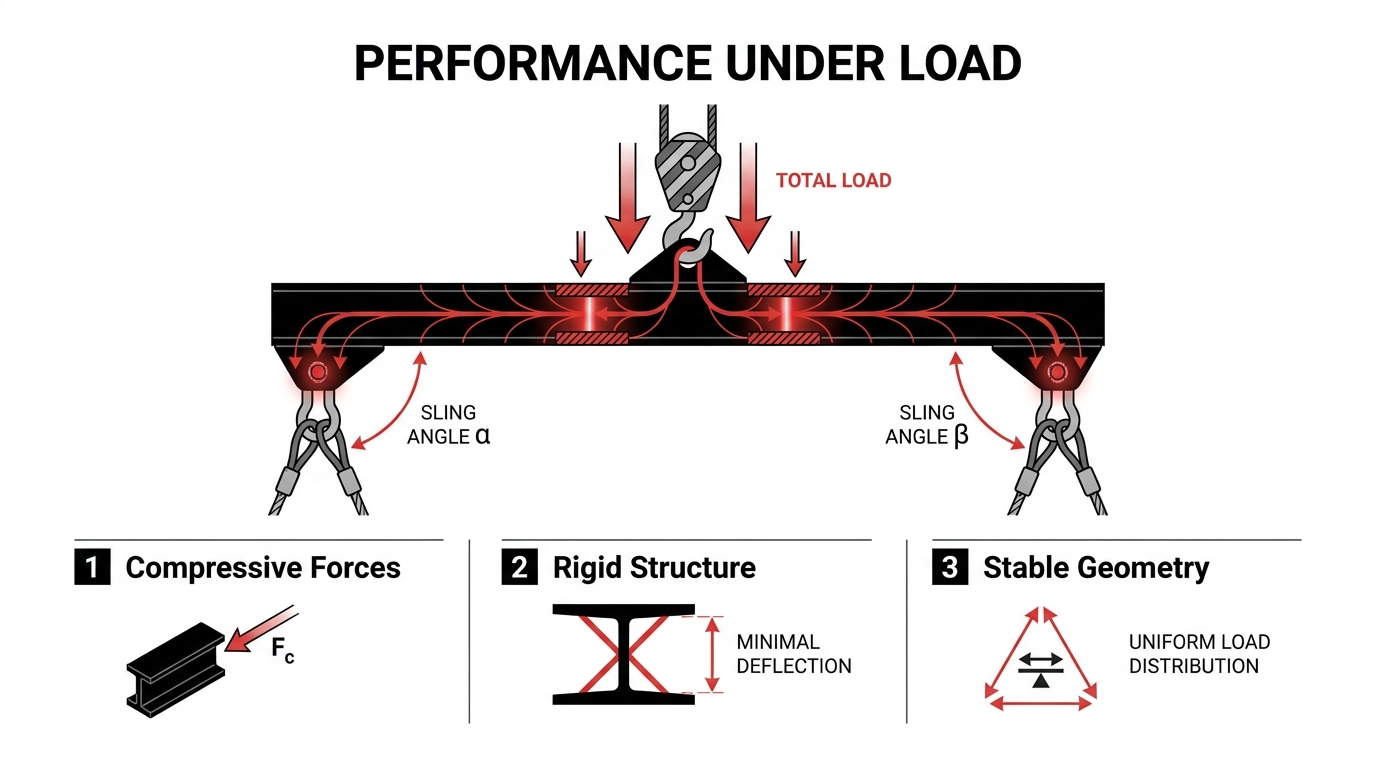
A fixed spreader bar performs under load by converting lifting forces into compressive stress along the bar’s length while transferring tensile forces into the attached slings. This force-path geometry keeps the bar structurally efficient and the suspended load stable throughout the lift.
Load Force Distribution in a Fixed Bar
Fixed spreader bar load distribution works by channeling downward weight into two primary force types: compression in the bar and tension in the slings. According to Mazzella Companies, spreader beams convert lifting loads into compressive forces in the bar and tensile forces in the slings, making them highly efficient in material use. Because the bar length never changes, the compressive load path remains consistent and predictable across every lift, which simplifies engineering verification and load planning significantly.
Structural Behavior Under Compressive Stress
A fixed spreader bar resists compressive stress through its fixed cross-section and rigid construction, typically using high-strength, low-alloy (HSLA) steel as the primary material. The bar’s unchanging geometry prevents buckling under load as long as the working load limit is respected. This rigidity is an underrated advantage: rigging teams do not need to recheck structural integrity across different span configurations because there are no moving components to shift under load.
How Sling Angles Affect Fixed Bar Performance
Sling angles directly affect fixed bar performance by determining how much inward crushing force acts on the suspended load. Rigging engineers note that spreader bars eliminate the need for large sling angles, which reduces inward crushing forces on the load being lifted. A fixed bar maintains a set pick-point distance, so sling angles remain consistent when lifting the same load geometry, delivering repeatable force distribution that adjustable bars cannot guarantee across varying spans.
How Does an Adjustable Spreader Bar Handle Variable Load Widths?
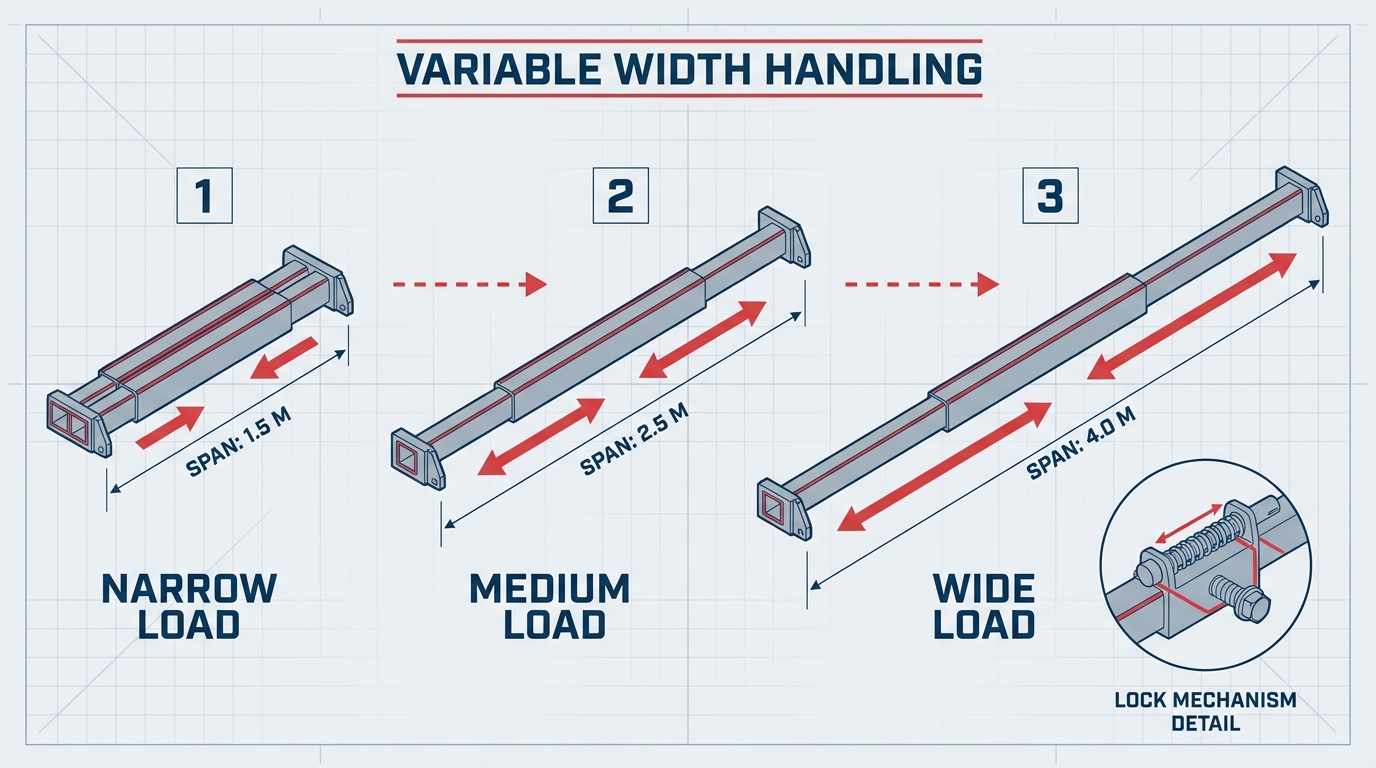
An adjustable spreader bar handles variable load widths by allowing crews to reposition attachment points along the bar’s length to match the exact pick point spacing of each load. This section covers how span adjustment works mechanically, which load types benefit most, and how span changes affect the working load limit.
How Does the Span Adjustment Mechanism Work?
The span adjustment mechanism works by sliding or telescoping the bar’s end fittings to new positions, then locking them in place before the lift begins. According to Machining & Welding, adjustable spreader bars control how lifting forces are distributed by allowing crews to match pick point spacing to the load. Most designs use a pinned or bolted locking system that secures the extended position under compressive load. This mechanical flexibility is what makes adjustable bars practical across job sites where no two loads share identical attachment geometry.
What Load Types Benefit Most from an Adjustable Bar?
The load types that benefit most from an adjustable bar include irregular cargo, equipment with variable lifting lugs, and long structural components where pick point spacing differs between units. Loads with inconsistent width, offset centers of gravity, or custom fabricated lifting lugs require a bar that can reposition rather than one locked to a fixed span. Expert lift planners note that load geometry, center of gravity, and lifting height all determine which spreader bar configuration is appropriate for a given operation.
How Does Changing the Span Affect the Working Load Limit?
Changing the span affects the working load limit because extending a bar beyond its rated span increases the bending moment and compressive stress within the section. Rated capacities on adjustable bars are typically published at specific span intervals, meaning a crew must verify the WLL at the actual set span before each lift. Using an adjustable bar at an unverified intermediate span is one of the most common field errors in rigging, and selecting a bar with published capacity tables for every increment is a practical safeguard that prevents dangerous over-loading.
What Are the Key Differences Between Fixed and Adjustable Spreader Bars?
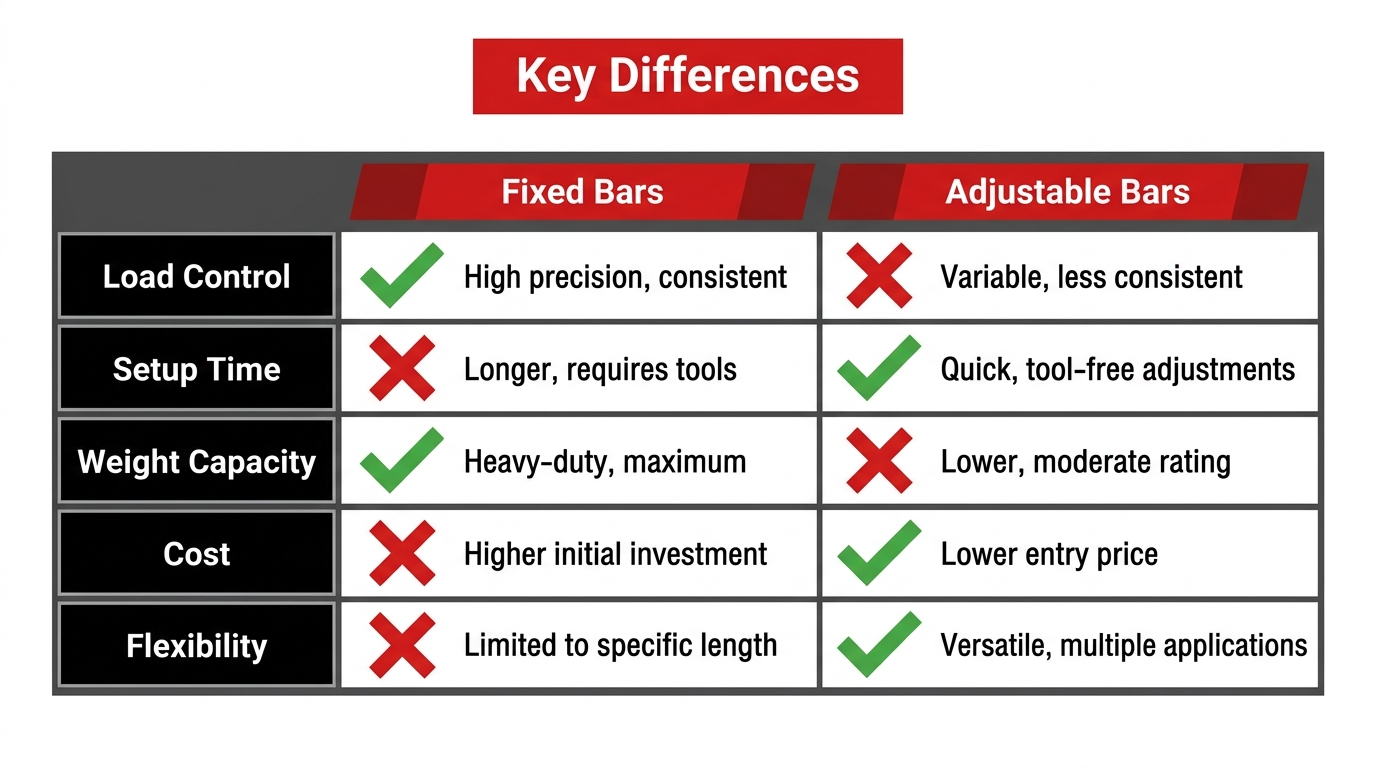
The key differences between fixed and adjustable spreader bars involve load control accuracy, configuration flexibility, setup complexity, weight capacity, and rental cost. Each factor points to a different bar type depending on your lift requirements.
Which Is More Accurate for Load Control — Fixed or Adjustable?
Fixed spreader bars are more accurate for load control when the load geometry is known and consistent. Because a fixed bar holds slings at a predetermined, unchanging spread, it eliminates any variability introduced by span adjustments. Adjustable bars allow crews to match pick point spacing to the load, which improves control on irregular lifts, but each adjustment requires verification that the new span is correctly set and load-rated. For precision lifts where center of gravity and pick point placement are engineered in advance, a fixed bar removes one variable from the equation entirely.
Which Handles a Wider Range of Lift Configurations?
Adjustable spreader bars handle a wider range of lift configurations. According to Hercules SLR, modular systems allow re-use at different spans by bolting interchangeable struts, making them suited for projects where load widths change between lifts. Fixed bars, by contrast, are ideal for straightforward operations with stable, uniform loads. Across a rental period covering multiple lifts with varying widths, an adjustable bar reduces the need to swap equipment entirely.
Which Is Easier to Set Up and Rig on a Job Site?
Fixed spreader bars are easier to set up and rig on a job site. There are no span adjustments, locking mechanisms, or span verification steps required before rigging begins. The bar connects to slings at fixed attachment points, and the crew proceeds directly to the lift. Adjustable bars require additional steps, including selecting and securing the correct span setting and confirming that the configuration falls within the bar’s rated capacity at that span. On time-sensitive jobs, the simplicity of a fixed bar reduces pre-lift preparation time.
Which Carries a Higher Weight Capacity Per Rental Unit?
Fixed spreader bars generally carry higher weight capacity per rental unit. Modular and adjustable aluminum spreader beams are available in capacities ranging from 1/2 ton to 3 tons for lightweight applications, while fixed bars built from high-strength, low-alloy (HSLA) steel are engineered for significantly heavier loads. Modular spreader beams extend to capacities up to 2,000 tonnes in fixed-span configurations. Adjustable bars trade upper capacity for span versatility, which makes them practical for lighter or mid-range lifts but less suitable for high-tonnage precision work.
Which Costs Less to Rent for a Short-Term Lift?
Fixed spreader bars cost less to rent for a short-term lift. Spreader bar rentals typically range from $100 to $300 per day depending on location and capacity, with fixed units generally sitting at the lower end due to their simpler construction. Adjustable and modular systems command higher rates because of their span versatility and the engineering complexity built into the design. For a single-day or single-lift rental where the load width is already known, choosing a fixed bar keeps costs down without sacrificing performance.
When Should You Choose a Fixed Spreader Bar for Your Lift?
A fixed spreader bar is the right choice when load dimensions are consistent, tonnage is high, and precise load control matters most. The following H3s cover three scenarios where a fixed bar outperforms adjustable alternatives: repetitive same-width lifts, high-tonnage precision lifts, and structural steel erection.
Is a Fixed Bar Better for Repetitive Same-Width Lifts?
A fixed bar is better for repetitive same-width lifts because it eliminates the setup time and variability that adjustable bars introduce between cycles. When the pick point spacing never changes, a fixed bar locks in that dimension permanently, giving riggers a consistent, predictable rig every time. According to Hercules SLR, fixed spreader bars are ideal for straightforward lifting operations where the load is stable and uniform. For high-volume operations, that consistency is not just convenient; it directly reduces rigging error and speeds throughput on the job site.
Is a Fixed Bar the Right Choice for High-Tonnage Precision Lifts?
A fixed bar is the right choice for high-tonnage precision lifts because its rigid, single-span design carries compressive load without the mechanical variables that adjustable collars and pins introduce at extreme weights. Expert lift planners note that selecting the right spreader bar configuration depends on load geometry, center of gravity, lifting height, and environmental factors, according to ENSER — all conditions where a fixed bar’s structural simplicity is a clear advantage. LGH experts also confirm that high-capacity lifts benefit from equipment that reduces rigging weight without sacrificing load distribution accuracy.
Does a Fixed Bar Make More Sense for Structural Steel Erection?
A fixed bar makes more sense for structural steel erection when beam dimensions and pick points are engineered to a known, unchanging specification. Structural steel members are fabricated to precise tolerances, so the lift geometry is determined before the first piece leaves the shop. Rigging engineers emphasize that spreader bars eliminate the need for large sling angles, which reduces the inward crushing forces on the load being lifted, according to ELT Lift — a critical advantage when handling steel sections that cannot tolerate lateral compression. For these engineered lifts, a fixed bar matches the precision that structural erection demands.
When Should You Choose an Adjustable Spreader Bar Instead?
An adjustable spreader bar is the right choice when load widths, pick point spacing, or cargo shapes vary between lifts. The sections below cover three specific scenarios where adjustable bars outperform fixed configurations: changing load widths, multi-project rentals, and oddly shaped or varied cargo.
Is an Adjustable Bar Better When Load Widths Change Between Lifts?
An adjustable bar is better when load widths change between lifts because crews can match pick point spacing to each load without swapping equipment. Adjustable spreader bars control how lifting forces are distributed by allowing crews to dial in the correct span per lift. A fixed bar locks you into one spread, which creates rigging inefficiencies or unsafe sling angles whenever load dimensions shift. For operations handling multiple load sizes in a single shift, the flexibility of an adjustable bar is not just convenient — it is the operationally correct choice.
Is an Adjustable Bar Suited for Multi-Project Rental Scenarios?
An adjustable bar is well suited for multi-project rental scenarios because one unit can serve different span requirements across separate job sites. According to Holloway Houston Inc., modular spreader systems favor rental over purchase precisely because they are adaptable for various project spans and reduce the need for a large owned inventory. Renting a single adjustable unit instead of multiple fixed-length bars simplifies logistics, lowers total rental cost, and keeps compliance documentation consolidated to one piece of equipment.
Does an Adjustable Bar Work Better for Oddly Shaped or Varied Cargo?
An adjustable bar works better for oddly shaped or varied cargo because it lets riggers position attachment points to match each load’s actual pick geometry. Expert lift planners note that selecting the right spreader bar configuration depends on load geometry, center of gravity, lifting height, and environmental factors. Odd or irregular loads often have asymmetric pick points that no single fixed span can reliably serve, making span adjustability essential for maintaining load stability and safe sling angles throughout the lift.
What Safety Standards Apply to Spreader Bar Rentals?
The safety standards that apply to spreader bar rentals include OSHA regulation 1926.251, ASME B30.20, and LEEA 055 guidance. Together, these frameworks govern design proof-testing, marking requirements, daily inspection, and below-the-hook device compliance.
OSHA 1926.251 Requirements for Lifting Accessories
OSHA Standard 1926.251 requires that custom-designed lifting accessories be marked to indicate safe working loads and proof-tested to 125 percent of their rated load before use. The same standard mandates that rigging equipment be inspected by a competent person each day before use, with damaged equipment removed from service immediately. Renting through a compliant supplier reduces the burden on crews, since pre-inspected units arrive ready to meet these requirements.
ASME B30.20 and Below-the-Hook Standards
ASME B30.20 is the primary consensus safety standard covering construction, marking, inspection, and testing protocols for below-the-hook lifting devices, including spreader bars. Compliance with B30.20 ensures rental units meet uniform design and documentation requirements across job sites. Any spreader bar that cannot be traced to a documented inspection record should not enter service, regardless of its apparent physical condition.
LEEA 055 Verification Guidance
LEEA 055 provides guidance on the verification of spreader beams, lifting beams, and lifting frames to confirm compliance with applicable safety regulations. While LEEA is a UK-originated standard, it is widely referenced by rigging professionals in the US as a best-practice framework for pre-use verification documentation and periodic examination schedules.
What Should You Inspect Before Using a Rented Spreader Bar?
Before using a rented spreader bar, you should inspect the bar’s structural condition, load markings, attachment hardware, and proof-test documentation. OSHA Standard 1926.251 requires a competent person to inspect rigging equipment each day before use, and any damaged equipment must be removed from service immediately.
Structural Inspection: Bar Body and Welds
The bar body and welds require a close visual check for cracks, deformation, corrosion, and signs of impact damage. Pay particular attention to weld seams along the bar’s length and at lifting lugs, where stress concentrations are highest. Any visible crack or deformation is cause for immediate removal from service.
Markings and WLL Verification
The markings and WLL verification step confirms that the bar displays a legible safe working load rating matched to your planned lift. OSHA requires that special lifting accessories be marked to indicate safe working loads and proof-tested to 125 percent of their rated load prior to use. A bar with missing or illegible markings should never enter service.
Pin, Shackle, and Connection Point Checks
The pin, shackle, and connection point checks confirm that all attachment hardware is correctly sized, undamaged, and properly secured. Inspect shackle threads, cotter pins, and lifting lug bores for wear, elongation, or corrosion. Loose or mismatched hardware is a primary failure point in spreader bar rigging.
Adjustability Mechanism Inspection (Adjustable Bars Only)
The adjustability mechanism inspection applies specifically to adjustable spreader bars and verifies that locking pins, telescoping tubes, and span adjustment features engage fully and hold position under load. A locking pin that does not seat completely will allow the bar to shift span during the lift, creating an uncontrolled load condition. This check is one of the most commonly skipped steps and one of the most consequential.
What Information Do You Need Before Renting a Spreader Bar?
The information you need before renting a spreader bar covers three core variables: load weight, lift height, and attachment point spacing. Each factor directly determines which bar type and size fits your lift safely.
How Does Load Weight Affect Which Spreader Bar You Should Rent?
Load weight affects which spreader bar you should rent by establishing the minimum working load limit (WLL) the rental unit must meet or exceed. Every spreader bar carries a rated capacity, and operating above it creates a failure risk. According to ENSER lift planning experts, selecting the right spreader bar configuration depends on load geometry, center of gravity, lifting height, and environmental factors. For lighter lifts, adjustable aluminum spreader beams handle capacities from 1/2 ton to 3 tons. Heavier industrial loads require steel or modular systems rated well beyond that threshold. Never select a bar based on approximate weight; always confirm the verified load weight before contacting a rental provider.
How Does Lift Height Factor Into Your Spreader Bar Selection?
Lift height factors into your spreader bar selection by determining the available headroom between the crane hook and the load’s attachment points. Greater bar length and sling length consume vertical clearance, so taller lifts with limited hook height may require a shorter bar or a different rigging geometry. Rigging engineers note that spreader bars eliminate the need for large sling angles, which reduces inward crushing forces on the load. When headroom is restricted, a compact fixed bar often performs better than a longer adjustable configuration because it minimizes the total rigging stack height while keeping sling angles within safe limits.
How Does Attachment Point Spacing Determine Bar Length?
Attachment point spacing determines bar length by setting the minimum distance the spreader bar must span between its end fittings. Adjustable spreader bars allow crews to match pick point spacing to the load precisely, making them the practical choice when attachment points vary between jobs. For loads with fixed, manufacturer-designated lift points, a fixed bar cut to that exact span delivers repeatable, accurate positioning. Measuring the center-to-center distance between all pick points before you call your rental provider prevents mismatches that delay rigging setup on site.
How Does Renting a Spreader Bar Compare to Buying One?
Renting a spreader bar compares to buying one favorably for short-term, variable, or infrequent lifts, while purchasing makes more sense for high-frequency, same-configuration work. The key decision factors are cost, frequency of use, and equipment variety needs.
Rental daily rates typically range from $100 to $300 depending on capacity and location, while purchasing a basic 2-ton unit starts at $400. For a single project or occasional lift, rental eliminates capital outlay, storage costs, and maintenance obligations entirely.
Modular spreader systems particularly favor rental over purchase because they are adaptable for various project spans and reduce the need for a large owned inventory, according to Holloway Houston Inc. Owning a fixed-length bar only makes financial sense if your operations consistently use the same span and tonnage.
From a practical standpoint, renting also shifts the compliance burden: reputable rental providers deliver equipment that has already been inspected, proof-tested, and marked with safe working loads per OSHA requirements. That pre-verified compliance is often underestimated as a cost-saving factor by teams focused only on the daily rate.
The comparison comes down to this: rent when lift configurations vary, projects are short-term, or storage is limited. Buy when daily utilization is predictable, the configuration never changes, and the payback period on purchase cost is short.
How Do Tway Lifting’s Rigging Rental and Inspection Services Support Spreader Bar Lifts?
Tway Lifting supports spreader bar lifts through certified inspection services and a rental inventory of spreader beams ranging from 2 to 100 tons, up to 40 feet in length. The sections below cover pre-use verification and key article takeaways.
Can Tway Lifting’s Certified Inspection Services Verify a Rented Spreader Bar Before Use?
Yes, Tway Lifting’s certified inspection services can verify a rented spreader bar before use. Tway Lifting’s inspection specialists are certified and factory-trained, performing OSHA-required pre-use evaluations that confirm structural integrity, load markings, and working load limit compliance. ASME B30.20 requires that below-the-hook lifting devices meet specific construction, marking, and testing protocols before deployment, and OSHA Standard 1926.251 mandates that rigging equipment be inspected by a competent person each day before use, with damaged equipment removed from service immediately. Tway Lifting’s inspection services are offered as complimentary to clients, making compliance accessible alongside every rental. For complex spreader bar lifts, pairing a pre-verified rental unit with a certified inspection is the most practical way to reduce liability and protect your crew.
What Are the Key Takeaways About Fixed vs Adjustable Spreader Bar Rental Options We Covered?
The key takeaways about fixed vs adjustable spreader bar rental options are centered on matching bar type to lift requirements, budget, and frequency. The most actionable conclusions from this article are:
- Fixed spreader bars deliver precision and maximum load capacity for repetitive, same-width, high-tonnage lifts such as structural steel erection.
- Adjustable spreader bars offer span flexibility, making them the practical choice when load widths vary between lifts or across multiple projects.
- Rental is preferred over purchase when lift configurations change, since modular systems reduce the need for a large owned inventory.
- Pre-use inspection is non-negotiable: every rented unit must be verified by a competent person before each use under OSHA 1926.251.
- Tway Lifting provides spreader beam rentals from 2 to 100 tons with free local delivery and certified inspection support from its Indianapolis and Fort Wayne locations.
Choosing between fixed and adjustable ultimately depends on load geometry, pick point spacing, and how often lift configurations change across your jobs.