








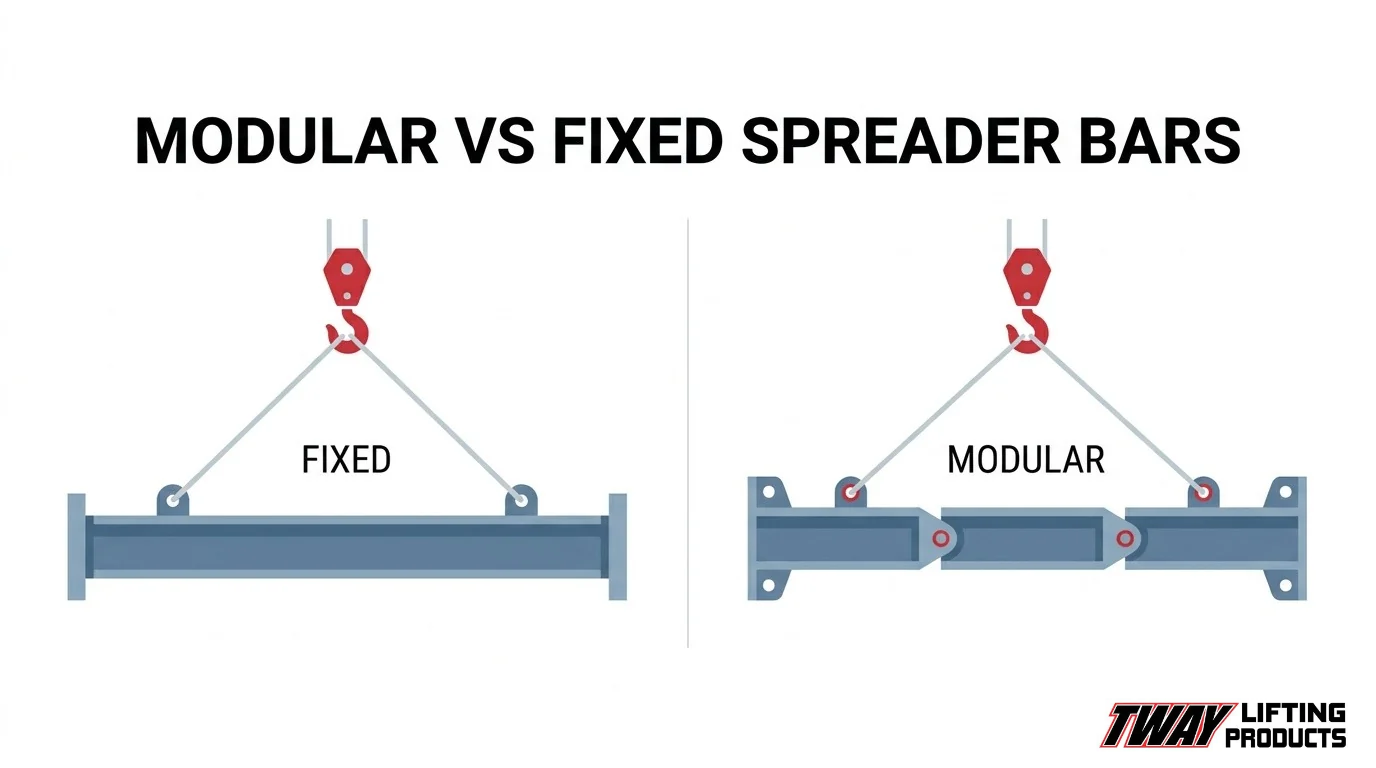

A spreader bar is a rigid structural member used in rigging to horizontally separate sling attachment points, keeping sling angles wide, reducing tension on each leg, and preventing inward forces from crushing, tipping, or sliding the load. The two primary configurations are fixed bars, built to a single permanent length, and modular bars, assembled from interchangeable sections that adjust to different span requirements.
This guide covers what each bar type is and how it works, how they compare across load capacity, adjustability, setup time, cost, and storage, the pros and cons of each design, when to choose one over the other, safety and inspection requirements, and how to match the right bar to your application.
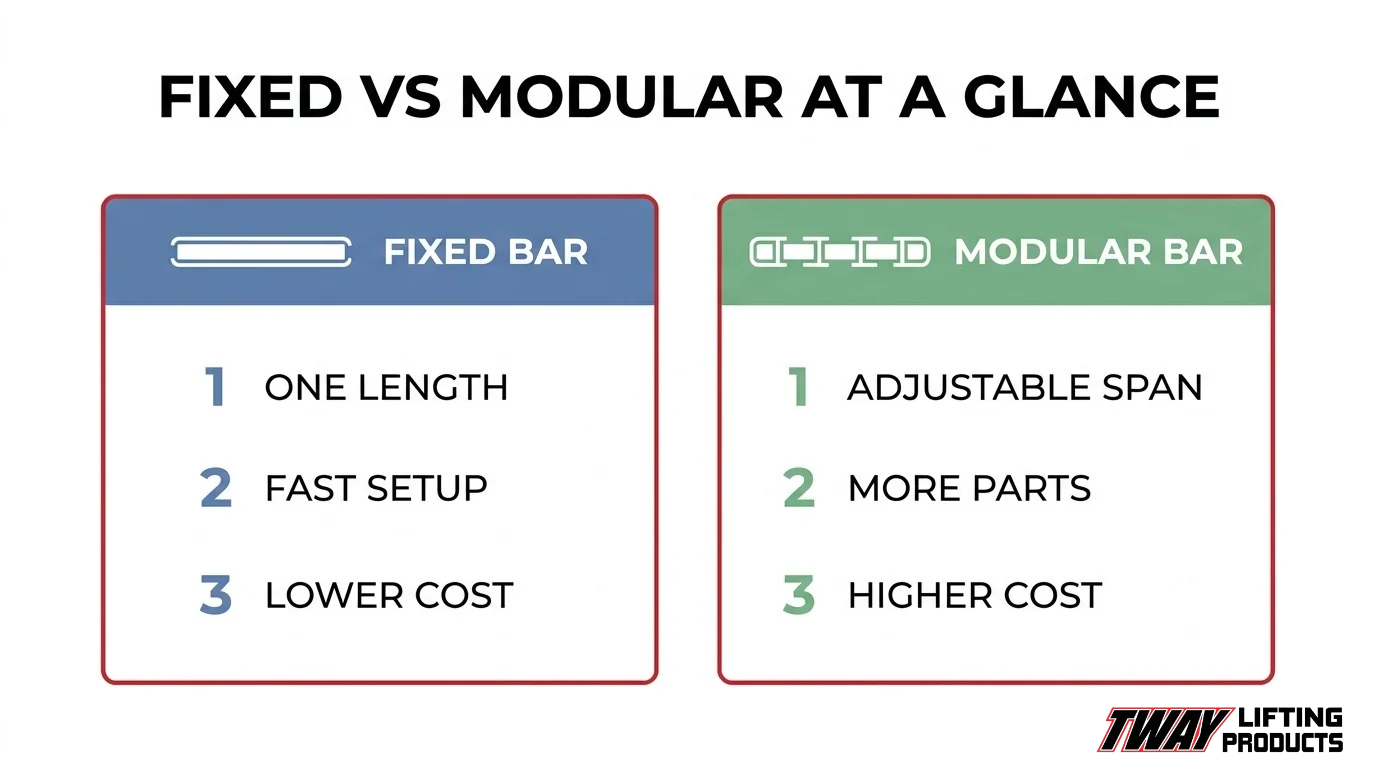
Fixed and modular bars differ most sharply in structural simplicity versus operational flexibility. Fixed bars have no adjustable joints, which makes them easier to inspect, faster to rig, and better suited to high-frequency lifts with consistent load geometry. Modular bars consist of pin-connected sections that reconfigure across a range of lengths; a peer-reviewed study in Machines confirmed that optimization algorithms can automatically determine the minimum section count needed for any target assembly length.
Choosing between them depends on how often your lift geometry changes, what load capacity your application demands, and what your project duration and budget allow. OSHA and ASME B30.20 establish minimum compliance requirements for both types, covering safe working load markings, proof testing, and pre-use visual inspection before every lift.
What Is a Spreader Bar and What Does It Do in Rigging?
A spreader bar is a rigid structural member used in rigging to horizontally separate sling attachment points during a lift. This section covers what spreader bars do mechanically, the safety problems they solve, and the industries that rely on them.
What Does a Spreader Bar Do During a Lift?
A spreader bar maintains lateral distance between sling legs, preventing inward compression forces from acting on the load. By holding attachment points apart, it keeps sling angles wide and vertical, reducing sling tension and protecting the load from crushing, tipping, or sliding. According to the U.S. Department of Energy’s Hoisting and Rigging Fundamentals (TR244C Rev. 5, 2002), spreader bars “eliminate the hazard of the load tipping, sliding or bending as well as the possibility of low sling angles and the tendency of the sling to crush the load.” For loads sensitive to lateral pressure, such as prefabricated panels, pipes, or structural sections, this mechanical separation is essential to lift integrity.
What Are the Core Components of a Spreader Bar?
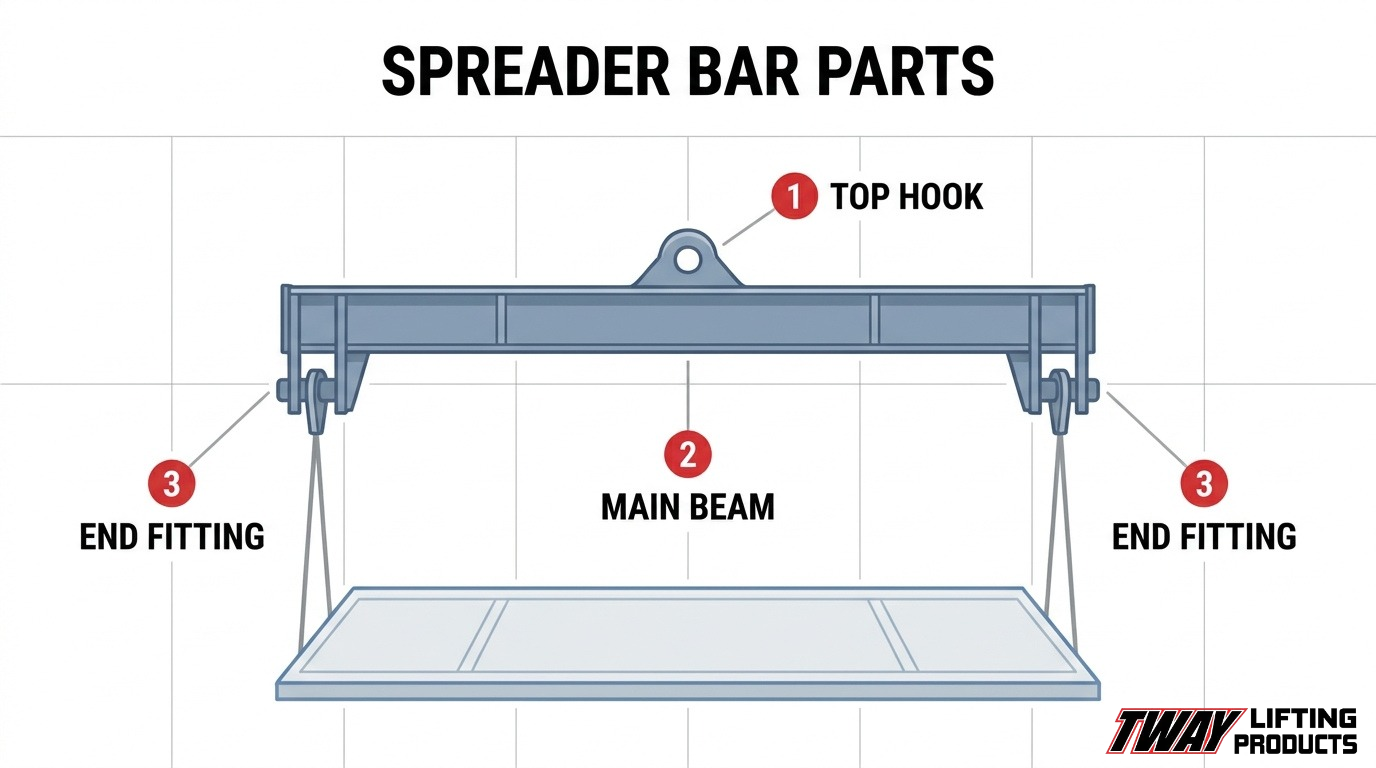
The core components of a spreader bar are the main beam body, end fittings, and connection hardware such as shackles or lifting eyes. The beam body carries compressive load along its length. End fittings anchor the sling legs at a fixed spread distance, while the top connection point attaches to the crane hook above. This three-point geometry, one upper connection and two lower sling points, defines spreader bar function and distinguishes it from a lifting beam, which is subject to bending moment rather than pure compression.
What Industries Use Spreader Bars in Lifting Operations?
The industries that use spreader bars include construction, oil and gas, shipbuilding, aerospace, wind energy, and manufacturing. Construction crews use them to reduce crane lifting forces when placing precast concrete bridge slabs. Offshore operators rely on them for heavy module installations on production platforms. In shipbuilding, multi-point spreader beam arrangements distribute lift forces across lightly framed hull panels without causing structural distortion. NASA has used H-frame spreader bars to position spacecraft assemblies above thermal vacuum test chambers. Wind energy labs position spreader bars between load introduction stations during blade structural testing.
What Is a Fixed Spreader Bar?
A fixed spreader bar is a rigid, single-length structural beam used in rigging to horizontally separate sling attachment points during a lift. It operates in compression, pushing attachment points outward to maintain sling angle and prevent inward forces from crushing, tipping, or sliding the load.
How Does a Fixed Spreader Bar Work in a Lift?
A fixed spreader bar works by transmitting compressive forces horizontally between two lifting points while slings above and below carry the vertical load. The bar holds attachment points at a predetermined spread, which controls sling geometry. According to the U.S. Department of Energy’s Hoisting and Rigging Fundamentals (TR244C Rev. 5, 2002), spreader bars eliminate hazards including load tipping, sliding, bending, low sling angles, and sling-to-load crushing. Because the spread is permanently set, the rigging geometry is fixed at whatever length the bar was manufactured to.
What Are the Main Components of a Fixed Spreader Bar?
The main components of a fixed spreader bar are the main structural tube or beam, end fittings, and lifting attachment hardware such as shackle holes or hooks. These components work together as a single, non-adjustable assembly. The end fittings define the attachment points and determine maximum load distribution. Because the bar is one-piece, there are no pins, locking collars, or intermediate connection points that require field assembly before each lift.
What Materials and Configurations Are Fixed Spreader Bars Built In?
Fixed spreader bars are built primarily from steel, using either round tube, square tube, or wide-flange beam profiles. Configuration depends on rated capacity and application span. Heavier-capacity bars use thicker-walled structural sections, while lighter-duty versions use standard round or square tube. The one-length, non-adjustable nature of fixed bars makes them straightforward to certify and inspect, since structural integrity does not depend on correctly assembled field connections.
What Is a Modular Spreader Bar?
A modular spreader bar is an adjustable lifting beam assembled from multiple interchangeable sections that can be configured to different lengths for varying lift geometries. Unlike a fixed bar, its pin-connected or bolted segments allow riggers to change the span between lifting attachment points without fabricating a new piece of equipment.
According to a peer-reviewed study published in Machines by Tom Wheatley et al., a custom optimization algorithm can determine which configuration of sections produces an assembly of a desired total length using the fewest possible components, automating what would otherwise be a manual selection process across a wide range of lengths.
This configurability makes modular spreader bars especially practical when lift geometry changes between jobs or when a single piece of equipment must serve multiple applications.
What Are the Key Differences Between Modular and Fixed Spreader Bars?
The key differences between modular and fixed spreader bars involve load capacity, adjustability, setup time, cost, and storage footprint. The sections below examine each dimension so you can match the right bar type to your specific lift requirements.
How Do Modular and Fixed Spreader Bars Compare in Load Capacity?
Modular and fixed spreader bars compare in load capacity based on their design intent: fixed bars are engineered to a single, certified safe working load (SWL), while modular bars carry a rated capacity that may vary with configuration length and connection points. Both types must display legible SWL markings under 29 CFR 1910.184(f)(1), which requires identification markings indicating the recommended safe working load, hitch type, and angle. Under 29 CFR 1926.251(a)(4), custom lifting accessories must also be proof-tested to 125% of rated load before use. Because a modular bar’s capacity can shift as sections are added or removed, verifying the rated load at each configuration is especially critical before every lift.
How Do Modular and Fixed Spreader Bars Compare in Adjustability?
Modular and fixed spreader bars compare in adjustability most sharply: modular bars can be reconfigured across a range of lengths by adding or removing pin-connected sections, while fixed bars maintain one permanent span. The American Institute of Steel Construction’s Engineering Journal documents one lifting-beam design that uses holes at 1-foot centers along a continuous bottom plate specifically to provide versatility across variable panel sizes, illustrating the practical value of adjustable attachment points. Fixed bars eliminate that flexibility entirely, but that rigidity is an asset when lift geometry never changes between jobs. For operations handling a single, repeating load, the simplicity of a fixed bar is often the more reliable and inspection-friendly choice.
How Do Modular and Fixed Spreader Bars Compare in Setup Time?
Modular and fixed spreader bars compare in setup time based on configuration complexity. A fixed bar requires no field assembly; riggers attach slings and lift. A modular bar requires section selection, pin insertion, torque verification, and load-marking confirmation before each use. No published comparative time study was located benchmarking changeover time between the two systems directly. In practice, however, the additional assembly steps in modular systems introduce more pre-lift checkpoints, which means setup time is longer whenever the configuration changes between lifts. For high-frequency repetitive lifts, that accumulated setup time represents a real operational cost that favors fixed bars.
How Do Modular and Fixed Spreader Bars Compare in Cost?
Modular and fixed spreader bars compare in cost across purchase price, utilization, and storage. Fixed bars are simpler to fabricate and typically carry a lower unit cost, but each bar serves only one lift geometry, so operations with varied loads may need multiple fixed bars. Modular systems carry a higher initial cost but consolidate that investment across multiple configurations. The Kentucky Transportation Cabinet has documented a spreader bar and coil hook project cost estimate of $24,500, illustrating that even a single fixed-bar procurement can be a substantial capital line item. For short-duration or infrequent projects, renting either type often delivers better cost efficiency than purchasing.
How Do Modular and Fixed Spreader Bars Compare in Storage and Transport?
Modular and fixed spreader bars compare in storage and transport based on physical size and disassembly capability. Fixed bars must be stored and transported at their full manufactured length, which can present real constraints in confined yards, shared storage facilities, or multi-site operations. Modular bars can be broken down into sections, reducing the footprint for both racking and vehicle loading. The Transport for NSW Dogging and Rigging Guide addresses storage requirements for lifting and spreader beams, reinforcing that proper storage conditions and labeling are ongoing compliance obligations regardless of bar type. For contractors working across multiple sites, the ability to pack a modular bar into a standard work vehicle rather than requiring dedicated transport is a meaningful logistical advantage.
What Are the Pros and Cons of Fixed Spreader Bars?
The pros and cons of fixed spreader bars center on structural reliability versus operational inflexibility. The advantages cover load distribution and simplicity; the disadvantage is a single fixed working length that limits versatility across varied lift geometries.
What Are the Advantages of Using a Fixed Spreader Bar?
The advantages of using a fixed spreader bar include reliable load distribution, structural simplicity, and suitability for repetitive lifts involving uniform loads. Because a fixed bar has no adjustable joints or pin connections, it introduces fewer mechanical variables into the lift, which simplifies pre-lift inspection and reduces the number of potential failure points.
Fixed bars are especially effective for wide or lightly framed loads. According to the Indian Register of Shipping, multi-point spreader beam arrangements distribute lift force to multiple points along a panel’s primary structural members, preventing distortion during the lift. An OSHA incident report similarly documents an overhead crane using a spreader beam to lift a large piece of sheet steel, illustrating the bar’s routine application in industrial material handling.
What Are the Disadvantages of Using a Fixed Spreader Bar?
The disadvantages of using a fixed spreader bar stem primarily from its single, unchangeable working length. A fixed bar cannot be reconfigured between jobs with different load widths or attachment-point spacing, which means a facility handling varied lift geometries must own or rent multiple bars sized to each application.
This inflexibility also increases storage and transport demands. A long fixed beam requires dedicated floor space and specialized transport rigging, adding logistical cost. For operations where lift dimensions change frequently, the fixed bar’s structural simplicity becomes a limitation rather than an asset, making a modular system the more practical choice.
What Are the Pros and Cons of Modular Spreader Bars?
The pros and cons of modular spreader bars center on their adjustability versus their added complexity. The sections below cover the key advantages and disadvantages rigging teams should weigh before selecting a modular system.
What Are the Advantages of Using a Modular Spreader Bar?
The advantages of using a modular spreader bar are its flexibility, storage efficiency, and cost-effectiveness across varied lifting applications. Because modular bars consist of interchangeable sections, a single system can be reconfigured to match different lift point spacings without purchasing multiple fixed bars. A peer-reviewed study published in Machines by Wheatley et al. confirmed that a custom optimization algorithm can automatically determine the minimum number of sections needed to achieve any desired beam length, reducing setup error and configuration time across a wide range of assembly targets. This versatility makes modular bars particularly practical for operations that handle loads of varying geometry, such as construction, oil and gas, and shipbuilding. For rental or temporary projects, one modular system often replaces several single-length bars, lowering both equipment costs and storage requirements between jobs.
What Are the Disadvantages of Using a Modular Spreader Bar?
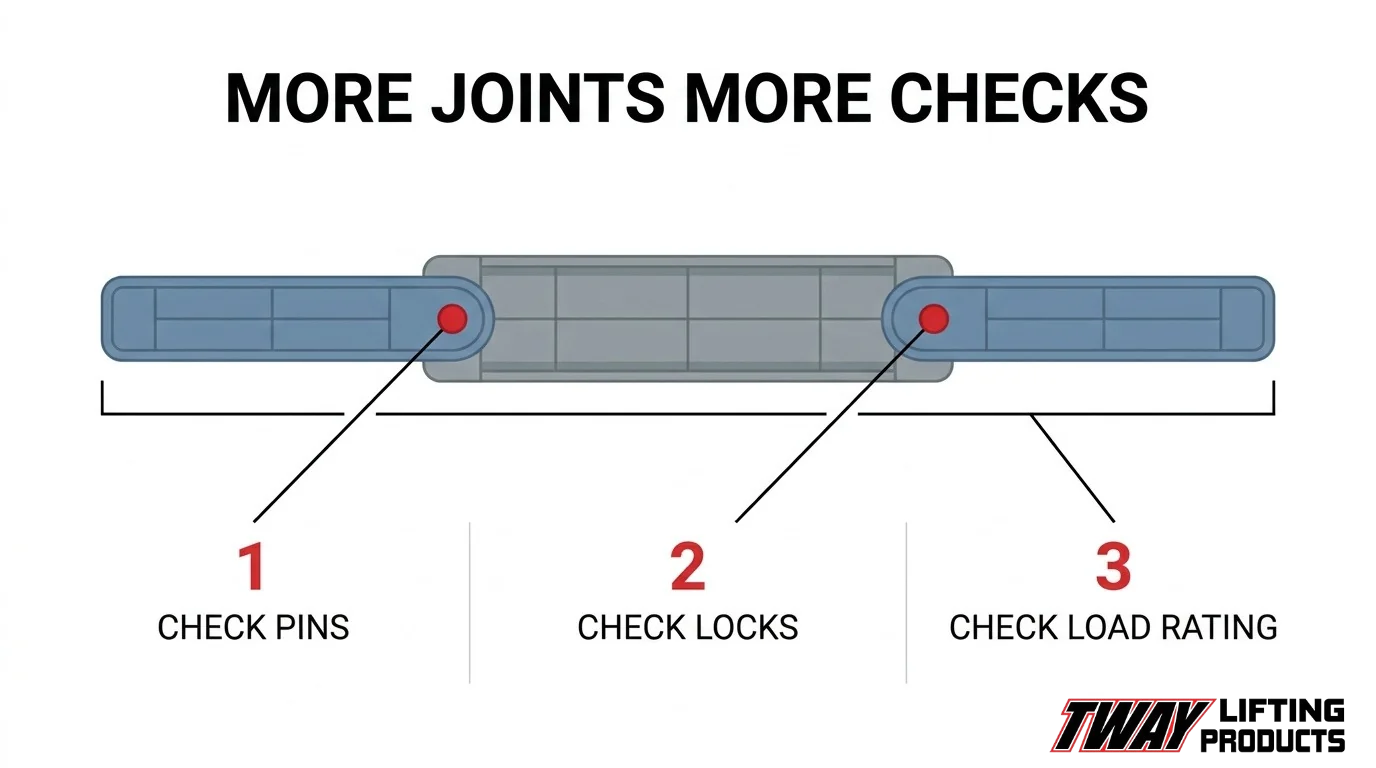
The disadvantages of using a modular spreader bar include increased connection points, greater inspection demands, and higher initial complexity compared to fixed designs. Each pin connection, locking mechanism, and section joint is a potential failure point that requires verification before every lift. Under 29 CFR 1926.251(a)(4), custom lifting accessories must be marked with safe working loads and proof-tested to 125 percent of rated load prior to use, meaning each reconfigured assembly may require documented load verification. Assembly errors are also more likely when multiple sections are involved, particularly in time-pressured field environments. In practice, modular bars demand more rigger training and pre-lift discipline than fixed bars, and that overhead is easy to underestimate until an incident occurs.
When Should You Use a Fixed Spreader Bar Instead of a Modular One?
You should use a fixed spreader bar when lift conditions are predictable and repeatable: consistent load geometry, maximum capacity demands, or restricted overhead space. The section below covers three primary decision scenarios.
Are Fixed Spreader Bars Better for High-Frequency Repetitive Lifts?
Fixed spreader bars are better for high-frequency repetitive lifts when the load dimensions and rigging points never change between cycles. Because a fixed bar requires no reconfiguration, there is nothing to adjust, re-pin, or recheck between lifts. This eliminates the incremental setup time that accumulates across dozens or hundreds of daily cycles.
The tradeoff is real: a fixed bar locks you into one geometry. For operations running the same load on the same crane repeatedly, that constraint is an advantage, not a limitation. Consistency also reduces the chance of configuration error, which is where repetitive-lift incidents often originate.
Are Fixed Spreader Bars the Right Choice for Maximum Load Capacity Needs?
Fixed spreader bars are the right choice for maximum load capacity needs when a single-piece, engineered structure provides a higher, more predictable rated load than a comparable modular assembly of equivalent span. A fixed bar has no pin connections, interlocking joints, or adjustment mechanisms that can introduce tolerance variation or concentrated stress at connection points under extreme loads.
For lifts at or near the upper limit of a crane’s capacity, eliminating mechanical joints in the below-the-hook hardware reduces variables in the load path. This makes a fixed bar the lower-risk choice when load weight is the dominant design constraint.
When Are Fixed Spreader Bars Preferred in Confined or Restricted Lift Zones?
Fixed spreader bars are preferred in confined or restricted lift zones when precise, pre-engineered geometry must be maintained within tight spatial constraints. A NASA Goddard Space Flight Center procedure recorded in the NASA Lessons Learned Information System describes an H-frame spreader bar suspending a spacecraft assembly on four vertical cables, then positioning it precisely above a thermal-vacuum chamber, where clearances left no room for geometric variation. Virginia Highway and Transportation Research Council documentation similarly notes that two spreader bars were used in a gantry crane rig to reduce lifting forces during a constrained bridge slab installation. In both cases, a fixed configuration provided the dimensional certainty the confined zone demanded.
When Should You Use a Modular Spreader Bar Instead of a Fixed One?
Modular spreader bars are the right choice when lift geometry changes between jobs, when operations span multiple industries, or when a project is temporary. The section below covers each scenario.
Are Modular Spreader Bars Better When Lift Geometry Varies Between Jobs?
Modular spreader bars are better when lift geometry varies between jobs because they can be reconfigured to match different load widths, attachment point spacings, and sling angles without requiring a separate bar for each setup. A peer-reviewed study published in Machines by Tom Wheatley et al. describes an optimization algorithm that automatically determines which combination of modular sections produces the correct total assembly length for any desired configuration, running calculations repeatedly across a wide range of target lengths. That capability makes modular systems particularly valuable when load dimensions are unpredictable or change frequently. A fixed bar, by contrast, is built for one geometry and cannot adapt without replacement.
Are Modular Spreader Bars the Right Choice for Multi-Industry Operations?
Modular spreader bars are the right choice for multi-industry operations because a single configurable system can serve construction, oil and gas, shipbuilding, aerospace, and manufacturing lifts without maintaining separate fixed bars for each application. Each industry imposes its own load widths, attachment spacings, and weight distributions. A modular system reconfigures to meet those varying demands, reducing inventory and storage requirements across a fleet that must perform in more than one sector. For rigging operations supporting diverse client industries, a modular bar delivers flexibility that no fixed bar can match.
When Are Modular Spreader Bars Preferred for Rental or Temporary Projects?
Modular spreader bars are preferred for rental or temporary projects when the cost and storage burden of a purpose-built fixed bar cannot be justified for a short engagement. Rental fleets benefit directly from modularity: a single adjustable system covers a broader range of customer lift requirements than multiple fixed bars of different lengths, improving utilization and simplifying inventory. For project owners, renting a modular bar eliminates capital outlay and long-term storage obligations after the job is complete. This makes modular the practical default for one-off lifts, short-term contracts, and situations where the next job’s geometry is still unknown.
What Safety Considerations Apply to Spreader Bar Lifting Operations?
Safety considerations for spreader bar lifting operations cover three core areas: regulatory compliance, rigging geometry, and pre-lift inspection. The sections below address each in sequence.
How Do OSHA Regulations Apply to Spreader Bar Use?
OSHA regulations apply to spreader bar use through requirements covering sling marking, proof testing, and safe working load identification. Under 29 CFR 1910.184(f)(1), employers must use only wire-rope slings with permanently affixed, legible markings indicating the recommended safe working load, hitch type, and angle basis. For custom lifting accessories, 29 CFR 1926.251(a)(4) requires that special grabs, hooks, clamps, and similar devices be marked with safe working loads and proof-tested to 125 percent of rated load before use. ASME B30.20 extends these requirements to below-the-hook lifting devices, governing their marking, construction, inspection, testing, and operation. Together, these standards form the minimum compliance baseline for any spreader bar program.
How Does Proper Rigging Angle Affect Spreader Bar Safety?
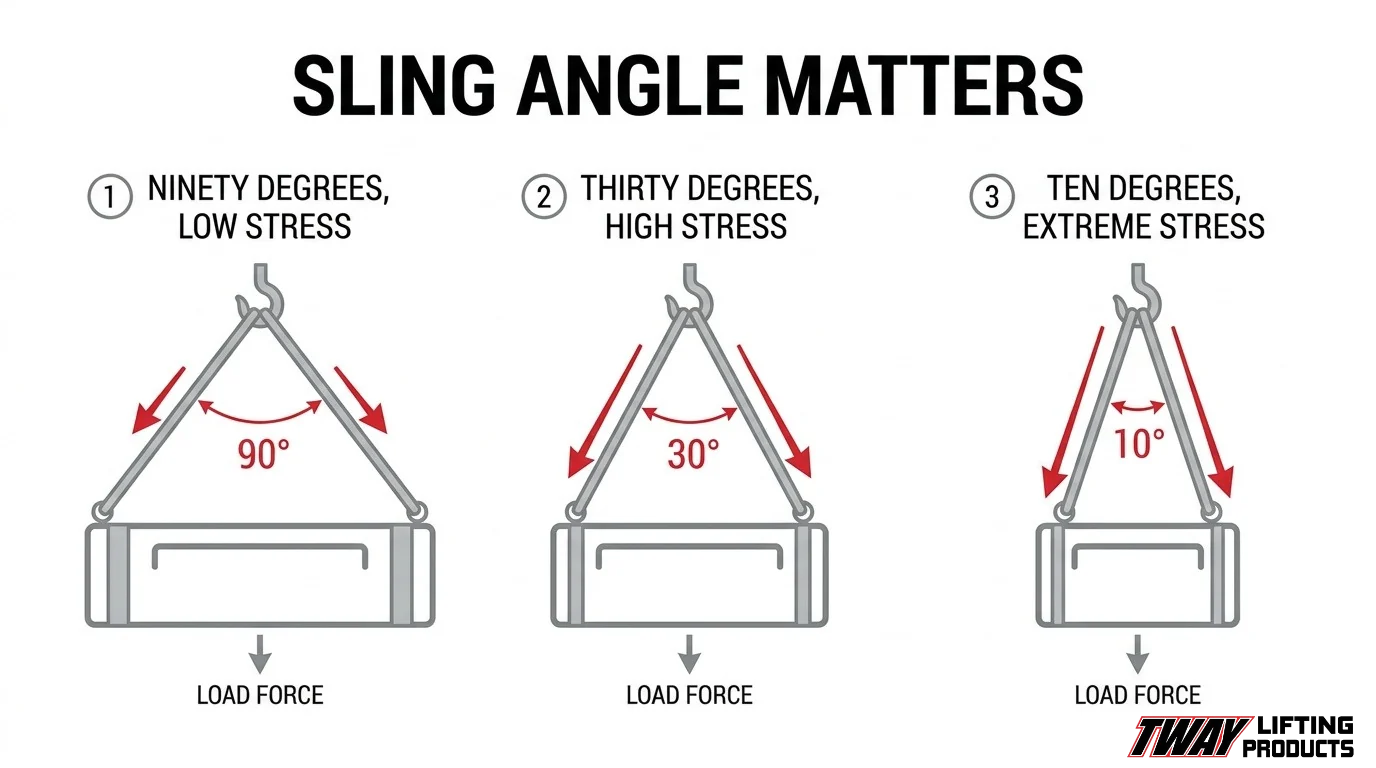
Proper rigging angle affects spreader bar safety by directly altering the tension force each sling leg must carry. As the sling angle decreases, the load angle factor increases sharply; a sling at 30 degrees carries twice the stress of one at 90 degrees, and at 10 degrees the factor rises to nearly 5.75, according to load-angle factor data from Virginia’s Division of Mineral Mining materials handling training. Shallower angles also increase compressive force transferred into the spreader bar itself. No universally mandated minimum sling angle applies to every spreader bar design, so rigging engineers must evaluate each configuration individually. Getting the angle right is one of the highest-leverage decisions in any lift plan.
What Inspection Requirements Apply to Spreader Bars Before Each Lift?
Inspection requirements for spreader bars before each lift include a mandatory visual check covering rated load markings, condition, and serial number, as required under ASME frequent inspection criteria and confirmed by the Navy Crane Center’s NAVFAC P-307 program, which also specifies that equipment must withstand load testing for a minimum of two minutes with no permanent deformation. Beyond pre-use checks, periodic formal inspections are required at set intervals. According to U.S. Army TB 43-0142, Safety Inspection and Testing of Lifting Devices, periodic inspections must occur at least every 12 months and before using any device that has been idle for six months or more, with all results documented in the maintenance record. Inspection methods include visual examination, wear measurements, and in some cases non-destructive testing.
How Do You Choose the Right Spreader Bar for Your Lifting Application?
Choosing the right spreader bar depends on your headroom constraints, load geometry, lift frequency, and industry requirements. The sections below cover how industry type, load shape, and job volume each shape that decision.
According to the Transport for NSW Dogging and Rigging Guide, lifting beams are used in lower headroom applications where the multi-leg sling angle is greater than 120 degrees and are subject to a bending moment at the centre of the beam—a key engineering constraint that influences bar selection before any other factor is weighed.
Does the Industry You Work In Affect Which Spreader Bar You Should Choose?
Yes, the industry you work in does affect which spreader bar you should choose, because each sector carries distinct load types, regulatory environments, and rigging configurations. Industries such as oil and gas, shipbuilding, aerospace, construction, and manufacturing each impose different demands on lifting equipment.
A NIOSH FACE program evaluation of 73 fatal crane investigations found 11 rigging failures among the contributing causes, underscoring that improper equipment selection carries real consequence across all sectors.
Regulated environments like aerospace and offshore energy often require equipment that meets traceable load ratings and documented inspection records. Matching your spreader bar to your industry’s compliance framework is not optional—it is the foundation of a safe lift plan.
Does Load Shape and Size Determine Whether You Need Modular or Fixed?
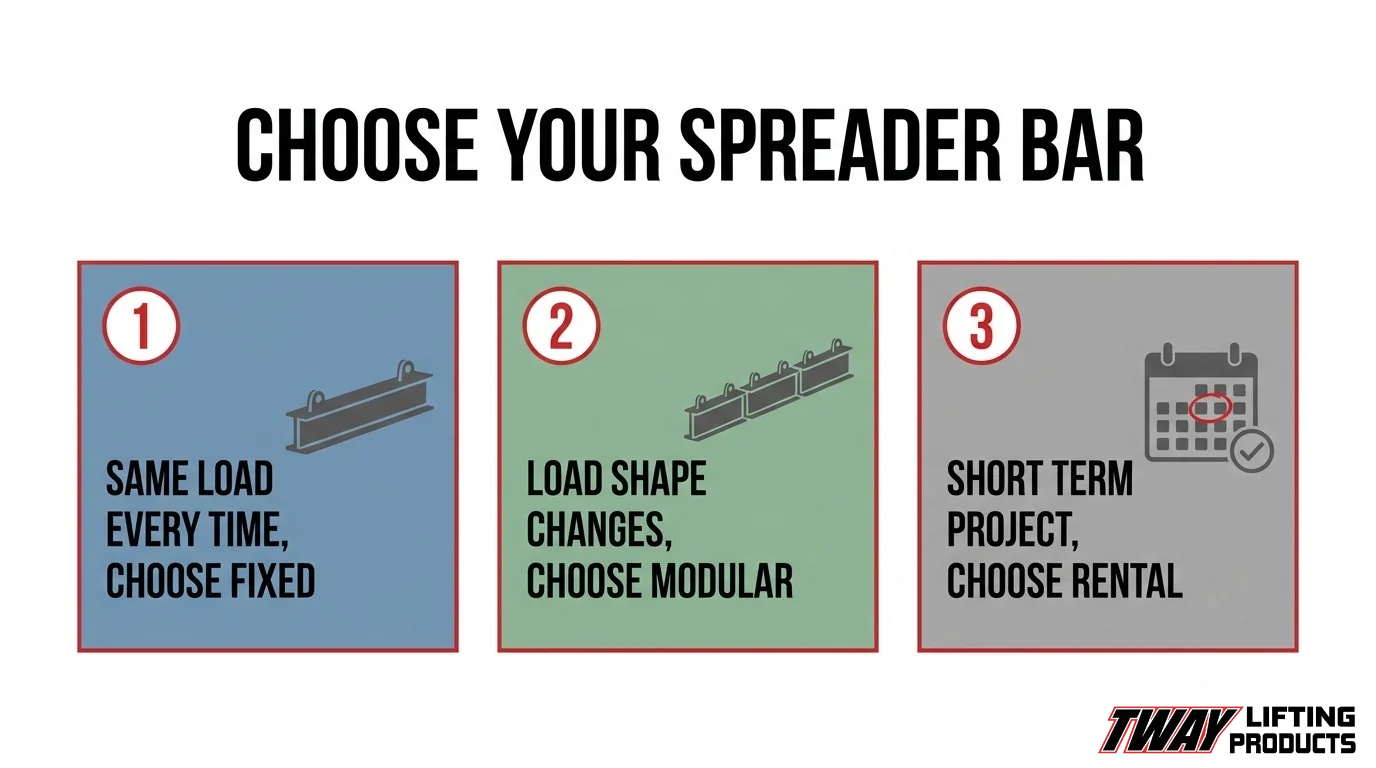
Yes, load shape and size determine whether you need a modular or fixed spreader bar. Long, narrow loads such as structural beams or pipe sections benefit from a fixed bar sized precisely to the lift point spacing. Wide, irregular, or variably sized loads, such as prefabricated panels or modular assemblies, benefit from adjustable configurations that can be repositioned between lifts.
A fixed bar delivers structural simplicity for uniform, repeating loads. For operations handling loads that differ in width or attachment geometry from job to job, a modular bar removes the need for multiple purpose-built bars and reduces the hardware inventory required on site.
Does Lift Frequency and Job Volume Influence Your Spreader Bar Decision?
Yes, lift frequency and job volume influence your spreader bar decision significantly. High-frequency, repetitive lifts involving the same load geometry favor a fixed bar: it is ready to use, requires no reconfiguration, and introduces fewer adjustment points that could be misset under production pressure.
Lower-volume operations, project-based work, or multi-site contractors handling varied loads are strong candidates for modular bars or rental equipment, since the cost of purchasing and storing multiple fixed bars is difficult to justify when lift requirements change with each contract.
Honestly, volume is one of the most underweighted selection factors in rigging planning. A single modular bar covering several lift configurations can outperform a fleet of fixed bars in total cost and logistics, provided the bar is correctly rated for each intended use.
How Do Tway Lifting’s Custom Fabrication and Rentals Support Spreader Bar Decisions?
Tway Lifting supports spreader bar decisions through custom fabrication, equipment rentals, and more than 75 years of rigging manufacturing experience. The following sections cover how Tway Lifting can guide your selection and recap the key article takeaways.
Can Tway Lifting’s Custom Fabrication and Equipment Rentals Help You Choose the Right Spreader Bar?
Yes, Tway Lifting’s custom fabrication and equipment rentals can help you choose the right spreader bar for your application. Founded in 1945 and ISO9001-2008 certified, Tway Lifting manufactures, sells, and rents rigging equipment, giving teams flexibility across project types and budgets
For teams uncertain whether a fixed or modular bar fits their needs, Tway Lifting’s rental inventory includes spreader beams rated from 2 to 100 tons, up to 40 feet, as well as telescopic adjustable-length bars, available on daily, weekly, or monthly terms with free local delivery and pickup. Custom fabrication covers purpose-built wire rope slings and special lifting assemblies where standard equipment does not match the load geometry or capacity requirement.
This combination of manufacturing capability, rental access, and certified, factory-trained qualified riggers makes Tway Lifting a practical single-source partner for both fixed and modular spreader bar decisions.
What Are the Key Takeaways About Modular vs. Fixed Spreader Bars We Covered?
The key takeaways about modular vs. fixed spreader bars center on matching bar type to lift frequency, load geometry, and project duration. Here are the essential decision points this article covered:
- Fixed spreader bars suit repetitive, high-capacity lifts with consistent load dimensions, offering structural simplicity and minimal setup.
- Modular spreader bars suit variable-geometry lifts and multi-industry operations, using adjustable sections to match changing attachment-point spacing.
- Sling angle directly affects load on the bar and rigging components; steeper angles reduce stress on the system.
- OSHA and ASME B30.20 govern marking, proof testing, and inspection for both bar types, with pre-use visual inspection required before every lift.
- Rental is a practical path when lift geometry varies by project or ownership cannot be justified by frequency.
Connecting the right bar type to your specific load, frequency, and compliance requirements is the clearest path to a safe, cost-effective lift.