


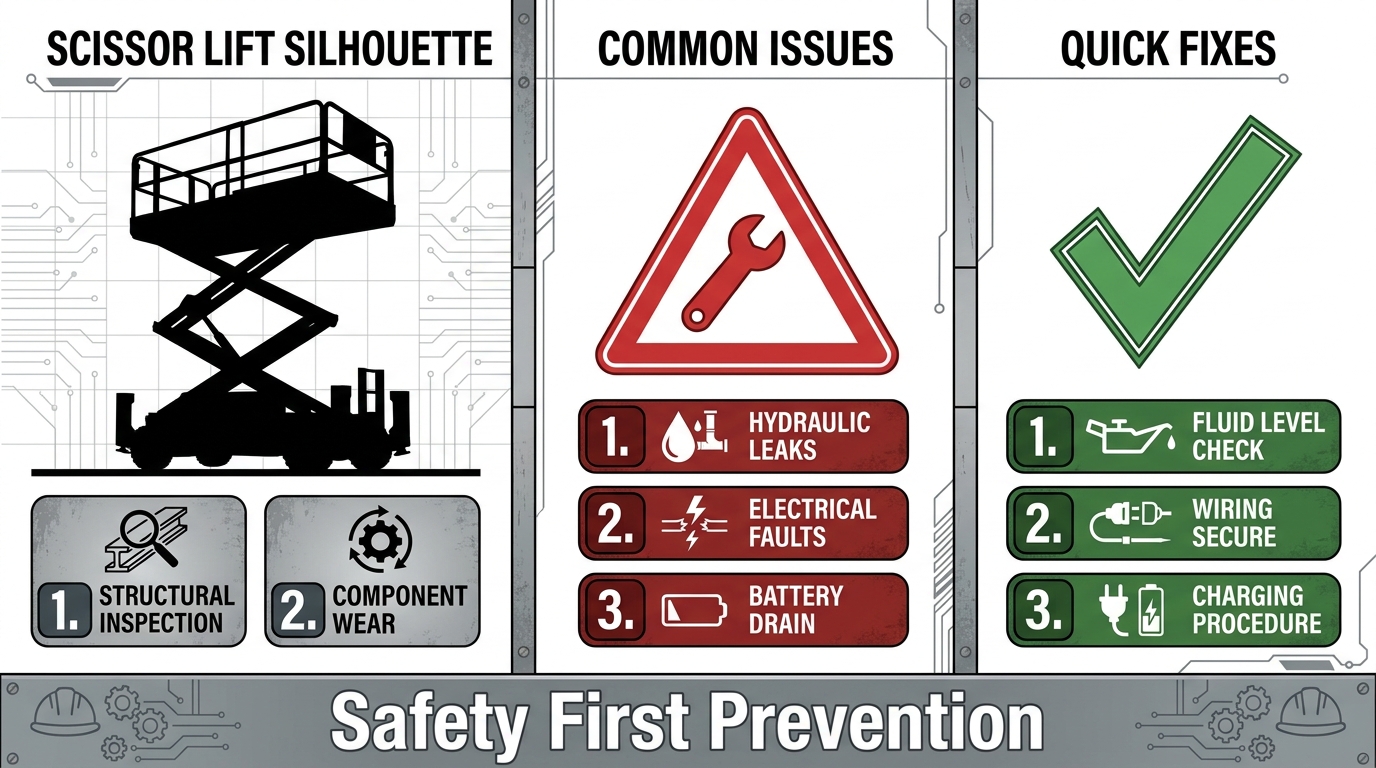

A rental lift malfunction is any condition that prevents the machine from operating safely or within its designed parameters, ranging from a dead battery that stops the unit from powering on to a hydraulic leak that causes an elevated platform to drift. Understanding these failures, and knowing how to respond to each one, is essential for keeping crews safe and job sites compliant.
This guide covers pre-operation inspection requirements, power and electrical failures, hydraulic and control system faults, error code interpretation, stability problems, scissor and boom lift-specific issues, safety and compliance risks, and the boundaries of renter repair responsibility.
Pre-shift inspections form the foundation of reliable lift operation. OSHA mandates that operators check fluid levels, batteries, tires, steering, controls, and guardrail systems before every shift, and skipping any single category increases both breakdown risk and compliance exposure.
Power failures trace back to a short list of root causes: drained or faulty batteries, blown fuses, failed ignition switches, and damaged wiring. Knowing which symptom points to which cause allows operators to act quickly rather than guess.
Hydraulic and control system faults produce the clearest visible symptoms. Slow, jerky, or uneven platform movement signals damaged seals, contaminated fluid, or worn cylinders, while unresponsive controls often indicate a triggered safety interlock or a loss of power to the control box.
Error codes, stability warnings, and equipment-specific failure patterns for scissor and boom lifts each carry distinct diagnostic paths. Addressing these correctly, rather than clearing codes without resolving the underlying fault, is what separates a controlled response from a safety incident.
Finally, ignoring any malfunction carries legal and financial consequences. OSHA penalties, fall hazard exposure, and rental liability distinctions all depend on how quickly and correctly operators and site managers respond when something goes wrong.
What Should You Inspect Before Operating a Rental Lift?
Before operating a rental lift, you must complete a structured pre-start inspection covering the machine’s vehicle systems, structural components, controls, and fluid levels. The following sections detail each inspection category.
What Pre-Operation Checks Are Required for Rental Lifts?
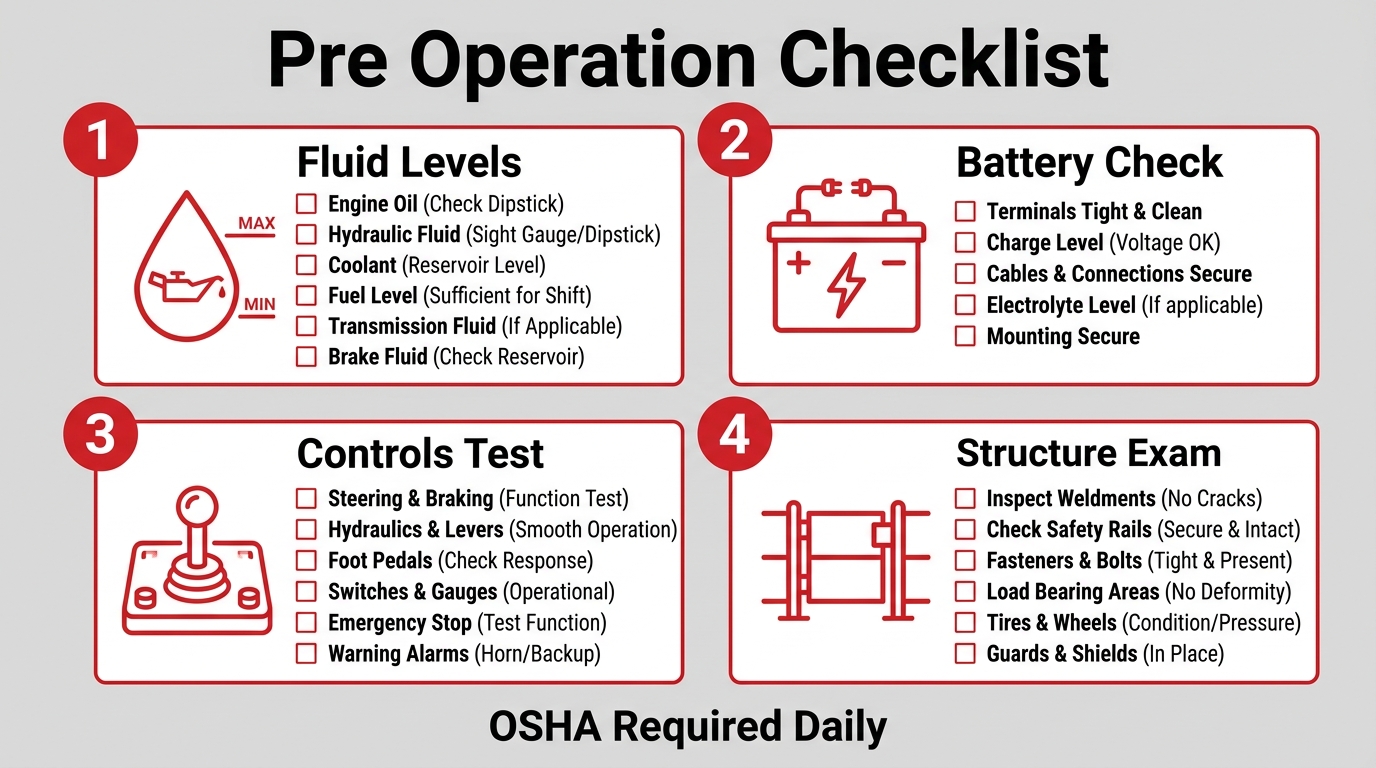
The pre-operation checks required for rental lifts include inspections of fluid levels, wheels and tires, batteries, steering systems, operating and emergency controls, and guardrail systems. According to OSHA, operators must conduct this full inspection prior to each work shift without exception. Skipping any single category creates compliance exposure and increases breakdown risk during operation. A consistent pre-shift routine is the single most effective habit for preventing avoidable downtime on rental equipment.
What Should You Look for When Inspecting the Lift Structure?
When inspecting the lift structure, look for physical damage to the guardrails, platform flooring, boom arms or scissor linkages, outrigger pads, and frame welds. Check that guardrails are securely fastened with no missing pins or bent sections. Examine the platform for cracks, debris, or loose grating that could create a slip hazard. Any visible structural deformation should be treated as a disqualifying condition, and the unit should be taken out of service before a shift begins.
How Do You Verify That Rental Lift Controls Are Functioning Correctly?
Verifying that rental lift controls are functioning correctly requires testing both ground-level and platform controls before ascending. Cycle each function, including lift, lower, drive, and emergency stop, at ground level first. Confirm that the emergency lowering system responds independently of the primary controls. If any control is unresponsive, sticky, or produces unexpected machine behavior, do not operate the lift until the issue is diagnosed and resolved by a qualified technician.
How Do You Verify That Rental Lift Controls Are Functioning Correctly?
The fluid and battery checks you should complete before use include inspecting hydraulic fluid, engine oil, coolant levels, and fuel, along with a battery terminal inspection for corrosion or loose connections. Low hydraulic fluid directly impairs lift and drive functions. Corroded or poorly connected battery terminals can cause electrical components to behave unpredictably. Check battery charge state and fluid reservoirs against manufacturer-specified minimum levels, and top off or flag deficiencies before the machine enters service.
Why Won’t the Rental Lift Power On?
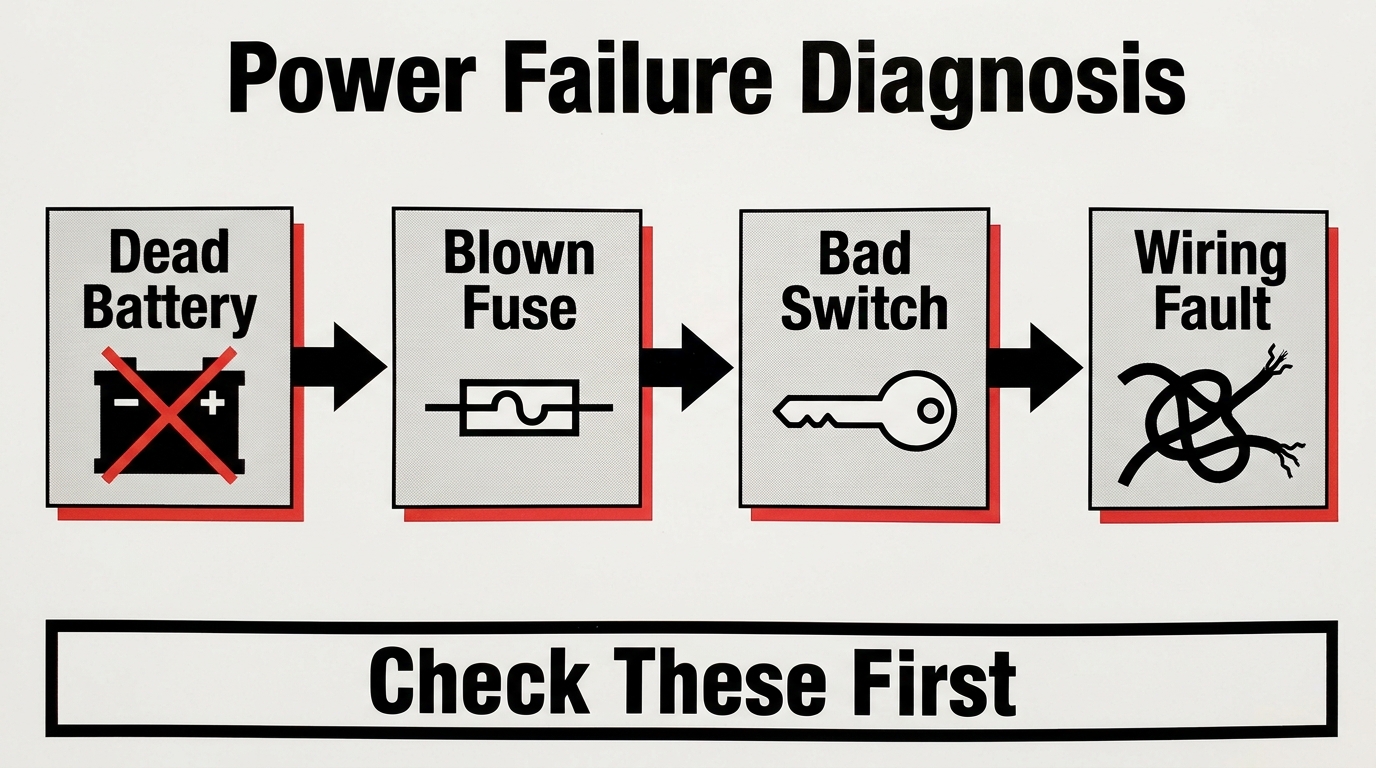
A rental lift that won’t power on typically has one of four root causes: a dead or draining battery, a blown fuse or tripped breaker, a faulty ignition switch, or a wiring fault. The sections below walk through each cause and how to identify it.
What Should You Check If the Battery Is Dead or Draining Fast?
The things to check if the battery is dead or draining fast are terminal connections, charge level, and battery age. A weak or failing battery causes electrical components to operate unpredictably or not at all, often made worse by corroded terminals or loose connections. Start by visually inspecting terminals for corrosion, then test voltage with a multimeter. If voltage reads below the manufacturer’s minimum, the battery needs charging or replacement before operating the lift.
What Could Cause a Blown Fuse or Tripped Breaker on a Rental Lift?
A blown fuse or tripped breaker on a rental lift is caused by an electrical overload, a short circuit, or a component drawing excessive current. Common triggers include a seized motor, damaged wiring contacting the frame, or an accessory pulling too much amperage. Locate the fuse panel using the operator’s manual, inspect each fuse visually for a broken filament, and replace only with the rated amperage specified. If the breaker trips again immediately after reset, a deeper fault exists and the unit should be taken out of service.
How Do You Diagnose a Faulty Ignition Switch on a Rental Lift?
You diagnose a faulty ignition switch on a rental lift by testing for voltage at the switch output when the key is turned. If battery voltage is present at the input but absent at the output with the key in the “on” position, the switch has failed internally. Check for loose connector pins at the switch harness first, as a poor connection mimics switch failure. A confirmed bad ignition switch requires component replacement by a qualified technician, not a field workaround.
What Wiring Issues Prevent a Rental Lift From Starting?
The wiring issues that prevent a rental lift from starting include frayed conductors, corroded connectors, broken ground straps, and damaged harness sections caused by pinching or abrasion. Inspect visible wiring runs for insulation damage, paying particular attention to areas where cables pass through metal frames or pivot points. According to industry liability standards, repairs resulting from equipment failure are the responsibility of the rental company, while repairs caused by misuse fall on the renter. Document any wiring damage thoroughly before contacting the rental provider, as this distinction directly affects who bears repair costs.
Why Is the Rental Lift Not Lifting or Raising Properly?
A rental lift that fails to raise properly typically has one of four root causes: low hydraulic pressure, fluid leaks, slow or uneven extension, or an overloaded platform. The H3 sections below address each cause with specific diagnostic steps.
What Causes Low Hydraulic Pressure on a Rental Lift?
Low hydraulic pressure on a rental lift is caused by a failing pump, worn internal seals, a blocked hydraulic filter, or a pressure relief valve set below operating thresholds. The relief valve is a critical component: according to Genie Industries, the Genie Z-34/22 hydraulic pump uses a pressure relief valve set at 3,200 psi (221 bar) to prevent over-pressurization. If pressure drops below the system’s minimum operating threshold, the lift will refuse to raise or will stall mid-cycle. In practice, a clogged filter is often the first culprit operators overlook, and clearing it frequently restores normal pressure before any component replacement is needed.
How Do Hydraulic Fluid Leaks Affect Lift Performance?
Hydraulic fluid leaks reduce the system’s operating pressure, causing erratic, slow, or incomplete lift movement. Leaks originate from cracked hoses, degraded cylinder seals, or loose fittings. As fluid volume drops, the pump struggles to maintain consistent pressure across all functions, so the boom or platform may raise partway and stop. Operators should visually inspect hydraulic lines and cylinder rods for wetness or staining before and after each shift.
What Should You Do If the Lift Raises Slowly or Unevenly?
If the lift raises slowly or unevenly, first check fluid level, filter condition, and all hydraulic line connections. Slow or jerky movement typically indicates contaminated fluid, air trapped in the system, or a partially obstructed control valve. Uneven raising, where one side extends faster than the other, often points to a damaged cylinder or a flow-control valve out of calibration. Do not continue operating a lift that raises unevenly, as asymmetric load distribution increases tip-over risk.
Could an Overloaded Platform Prevent the Lift From Raising?
Yes, an overloaded platform can prevent the lift from raising. Most aerial work platforms include a load-sensing system that locks out lift functions when the rated capacity is exceeded, protecting both the operator and the structural components. Exceeding the platform’s rated capacity stresses hydraulic cylinders and can trigger automatic shutdowns. Remove excess tools, materials, or personnel until the load falls within the manufacturer’s rated limit, then attempt to raise again.
What Causes Rental Lift Controls to Stop Responding?
Rental lift controls stop responding due to several interconnected electrical, mechanical, and safety-system failures. The sections below cover ground control failures, mid-operation platform control loss, and the emergency descent procedures to use when controls fail entirely.
Why Would the Ground Controls Fail to Respond?
Ground controls fail to respond primarily because of electrical faults, such as corroded battery terminals, blown fuses, or a damaged control harness connecting the ground panel to the machine’s main system. A weak or failing battery can cause electrical components to operate unpredictably or not at all, with corroded terminals being a frequent aggravating factor. Additionally, an active emergency stop button at the platform level will override and disable ground control input entirely. Before assuming a deeper fault, check that the key switch is in the correct position, the emergency stop is fully released, and all cable connections at the ground panel are secure.
Why Would the Platform Controls Stop Working Mid-Operation?
Platform controls stop working mid-operation most often because of a triggered safety interlock, a loss of power to the platform control box, or a damaged joystick or wiring harness. Safety interlocks, such as tilt sensors detecting an unlevel machine or a load exceeding rated capacity, cut control response as a protective measure. A loose or pinched cable running up the boom can also interrupt the signal mid-lift, and physical wear on joystick contacts causes intermittent or total loss of input. According to JLG Industries, Diagnostic Trouble Codes stored in machine memory can be retrieved through ground displays or telematics portals to identify the specific malfunction causing the control loss.
What Emergency Descent Features Should You Use If Controls Fail?
The emergency descent features to use when controls fail are the manual lowering valve, the ground-level emergency controls, and the platform-level emergency stop/descent function, depending on the machine model. All modern aerial lifts are required by OSHA to have operating and emergency controls that are inspected before each work shift, ensuring these features are operational before the machine enters service. The manual lowering valve, typically located at the base of the machine, allows a ground worker to slowly lower the platform by releasing hydraulic pressure without electrical input. If the platform controls are unresponsive, always attempt ground control override first before engaging the manual valve, and follow the specific descent procedure in the operator’s manual for that unit.
Why Is the Rental Lift Showing Error Codes or Warning Lights?
Error codes and warning lights indicate that the lift’s onboard diagnostic system has detected a fault, ranging from minor sensor alerts to critical safety failures. The following sections cover how to read those codes, what stability warnings mean, and when to stop work immediately.
How Do You Interpret Common Error Codes on Rental Lifts?
Common error codes on rental lifts are alphanumeric fault signals stored in the machine’s onboard diagnostic memory, pointing to specific system malfunctions such as electrical faults, hydraulic pressure loss, or sensor failures. According to JLG Industries, Diagnostic Trouble Codes (DTCs) can be retrieved using machine analyzers, ground displays, or telematics portals to identify the exact malfunction. Each manufacturer uses a proprietary code library, so always consult the operator manual specific to the rental unit’s make and model. Attempting to clear codes without addressing the underlying fault can mask a recurring problem and create safety risk.
What Does a Tilt or Stability Warning Indicate on a Rental Lift?
A tilt or stability warning indicates that the lift has detected an unsafe lean angle, an overloaded platform, or a compromised ground condition that threatens overturn risk. According to the 2025 IPAF Global Safety Report, overturns were the top cause of fatal and major powered access accidents in 2024. Common triggers include uneven ground, load exceeding rated capacity, and faulty or miscalibrated tilt sensors. When this warning activates, lower the platform, redistribute the load, and verify ground levelness before resuming.
When Should an Error Code Trigger an Immediate Work Stoppage?
An error code should trigger an immediate work stoppage when it signals a safety-critical system failure, such as a stability fault, loss of emergency controls, or a hydraulic pressure alarm. Any code that restricts platform movement, disables emergency descent, or appears during elevated operation requires workers to descend safely and remove the unit from service. Non-critical codes covering minor sensor glitches may allow continued operation with caution, but that determination must be made by a qualified technician, not the operator.
What Causes Unstable or Shaky Movement on a Rental Lift?
Unstable or shaky movement on a rental lift stems from several distinct mechanical and site conditions. The following sections cover ground conditions, outrigger failures, and worn drive components as the primary culprits.
How Does Uneven Ground Affect Rental Lift Stability?
Uneven ground affects rental lift stability by creating an unlevel base that shifts the machine’s center of gravity beyond safe operating margins. According to FieldEx, common causes of platform instability include uneven ground conditions, overloading beyond rated capacity, and faulty or miscalibrated tilt sensors. Any one of these conditions can trigger unpredictable platform movement or activate stability lockouts mid-operation. Operators should inspect the work surface before positioning the lift and use ground pads to distribute weight evenly across soft or irregular terrain.
What Outrigger or Stabilizer Problems Lead to Shaking?
Outrigger and stabilizer problems that lead to shaking include improper deployment, uneven extension, hydraulic leaks within the stabilizer cylinders, and pad contact with soft or sloped ground. When outriggers are not fully extended or are deployed on inconsistent surfaces, the machine lacks a symmetric load path, producing visible rocking under platform movement. Stabilizer cylinders with worn seals can bleed pressure slowly, causing gradual lean during extended operations. Always verify that all outrigger pads are in firm, level contact before elevating the platform.
Could Worn Tires or Drive Components Cause Instability?
Yes, worn tires or drive components can cause instability during ground-level travel and at elevation. Tires with uneven wear, low pressure, or structural damage create an irregular rolling surface that amplifies vibration through the machine frame. Worn drive motors, damaged axles, or failing wheel bearings introduce mechanical play that produces shaking, particularly on rough or sloped terrain. Inspecting tires for tread depth, sidewall integrity, and correct inflation before each shift is a straightforward step that directly reduces drive-related instability.
Understanding these three root causes helps operators respond quickly and stop unsafe conditions before they escalate.
What Are the Most Common Scissor Lift Problems on Rental Units?
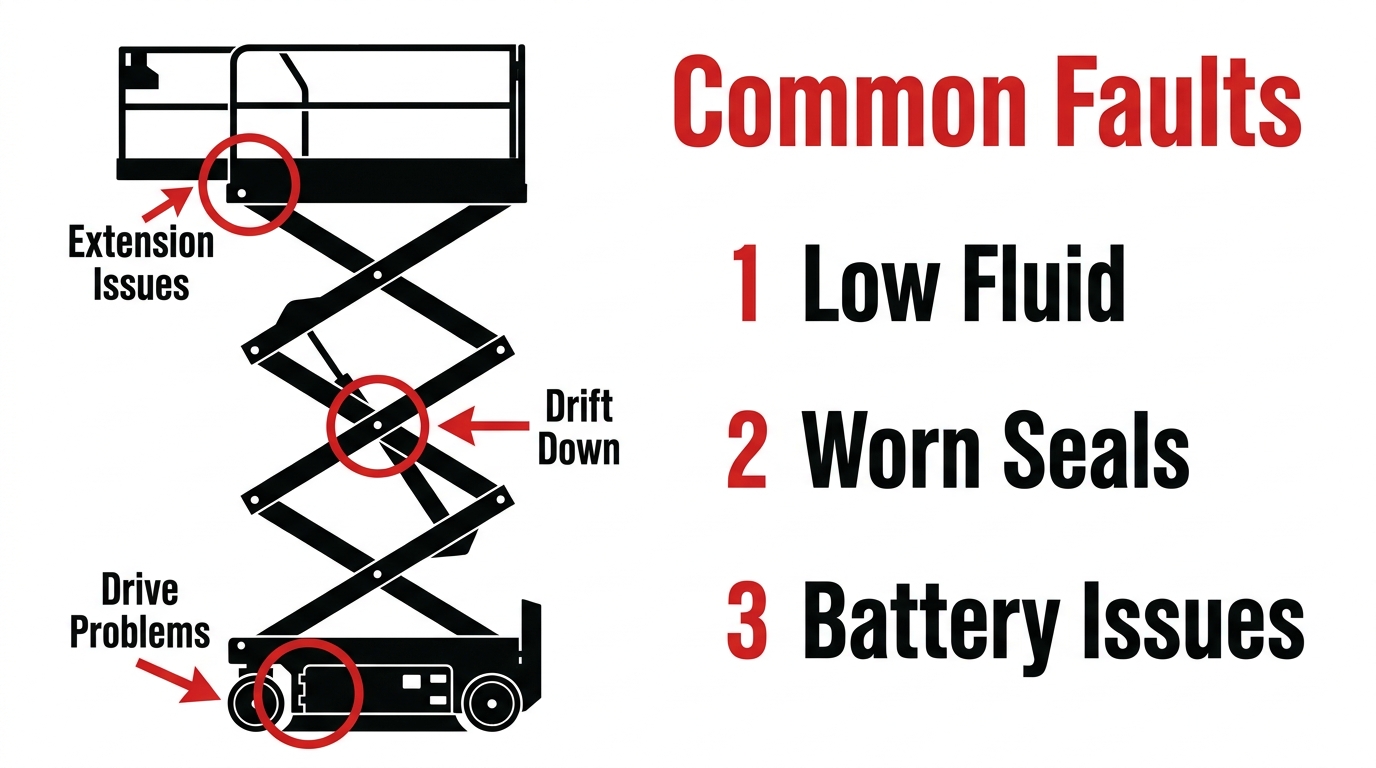
The most common scissor lift problems on rental units include incomplete platform extension, platform drift while elevated, and drive system failure. Each issue has distinct causes rooted in hydraulics, seals, or electrical systems.
Why Do Scissor Lift Scissors Fail to Extend Fully?
Scissor lift scissors fail to extend fully due to low hydraulic fluid levels, a worn hydraulic pump, or a faulty lift cylinder. When fluid volume drops below the operating threshold, the cylinder lacks the force needed to push the scissors to full height. Blocked hydraulic lines and contaminated fluid compound the problem, causing sluggish or incomplete extension. Checking fluid levels first eliminates the most common cause before escalating to pump or cylinder diagnosis.
What Causes a Scissor Lift to Drift Down While Elevated?
A scissor lift drifts down while elevated because of internal hydraulic cylinder leakage or a failing holding valve. Worn piston seals allow pressurized fluid to bypass the cylinder, causing the platform to slowly descend under load. On rental units, deteriorated seals from accumulated hours are a frequent culprit. Any platform drift while elevated is a serious hazard and should trigger immediate removal from service pending inspection.
How Do You Troubleshoot a Scissor Lift That Won’t Drive?
Troubleshooting a scissor lift that won’t drive starts with verifying the battery charge, drive enable switch, and any active fault codes. Weak or drained batteries are among the most common reasons aerial equipment refuses to respond to drive commands. If battery voltage is adequate, inspect the drive controller for error codes and check whether the platform is fully lowered, since most scissor lifts disable drive when the deck is raised beyond a set threshold. Confirm all emergency stop buttons are released before deeper electrical diagnosis.
What Are the Most Common Boom Lift Problems on Rental Units?
The most common boom lift problems on rental units involve articulation failures, hydraulic system faults, and rotation malfunctions. The H3 sections below cover each failure mode, its root causes, and how to diagnose it in the field.
Why Does a Boom Lift Arm Fail to Articulate Properly?
A boom lift arm fails to articulate properly due to electrical or hydraulic faults that interrupt command signals or fluid delivery to the joints. A weak or failing battery is a frequent culprit, causing electrical components to operate unpredictably or not at all, and corroded terminals or poor connections make this worse. On hydraulic articulating models, the Genie Z-34/22 service documentation identifies the pump’s pressure relief valve, set at 3,200 psi (221 bar), as a key checkpoint when the arm responds sluggishly or stops mid-movement. Inspecting the battery charge, terminal condition, and hydraulic pressure simultaneously narrows the diagnosis quickly.
What Causes Jerky or Slow Boom Movement During Operation?
Jerky or slow boom movement is caused by hydraulic system failures, specifically damaged lines or seals, contaminated fluid, or worn-out hydraulic cylinders. According to FieldEx, these conditions disrupt consistent fluid flow, creating uneven pressure that produces the stuttering or lagging motion operators notice at the controls. Contaminated fluid is particularly damaging because particulates accelerate cylinder wear and clog control valves, compounding the problem over time. On rental units, which may have inconsistent maintenance histories, checking fluid condition and inspecting hose integrity should be the first diagnostic steps.
How Do You Diagnose Rotation or Swing Malfunctions on a Boom Lift?
Rotation or swing malfunctions on a boom lift are diagnosed by systematically checking the slew ring, swing motor, and associated hydraulic or electrical circuits. Begin by observing whether the turntable moves at all, moves in only one direction, or moves inconsistently under load, since each symptom points to a different failure. A stuck or grinding slew ring typically indicates lubrication failure or physical damage, while erratic swing often points to a faulty swing motor or a pressure imbalance in the hydraulic circuit. Checking for active fault codes on the machine’s control panel can confirm which subsystem is at fault before any component is removed.
With rotation, articulation, and movement faults identified, the next priority is understanding what safety risks these unaddressed problems create on the job site.
What Safety Risks Come With Ignoring Rental Lift Malfunctions?
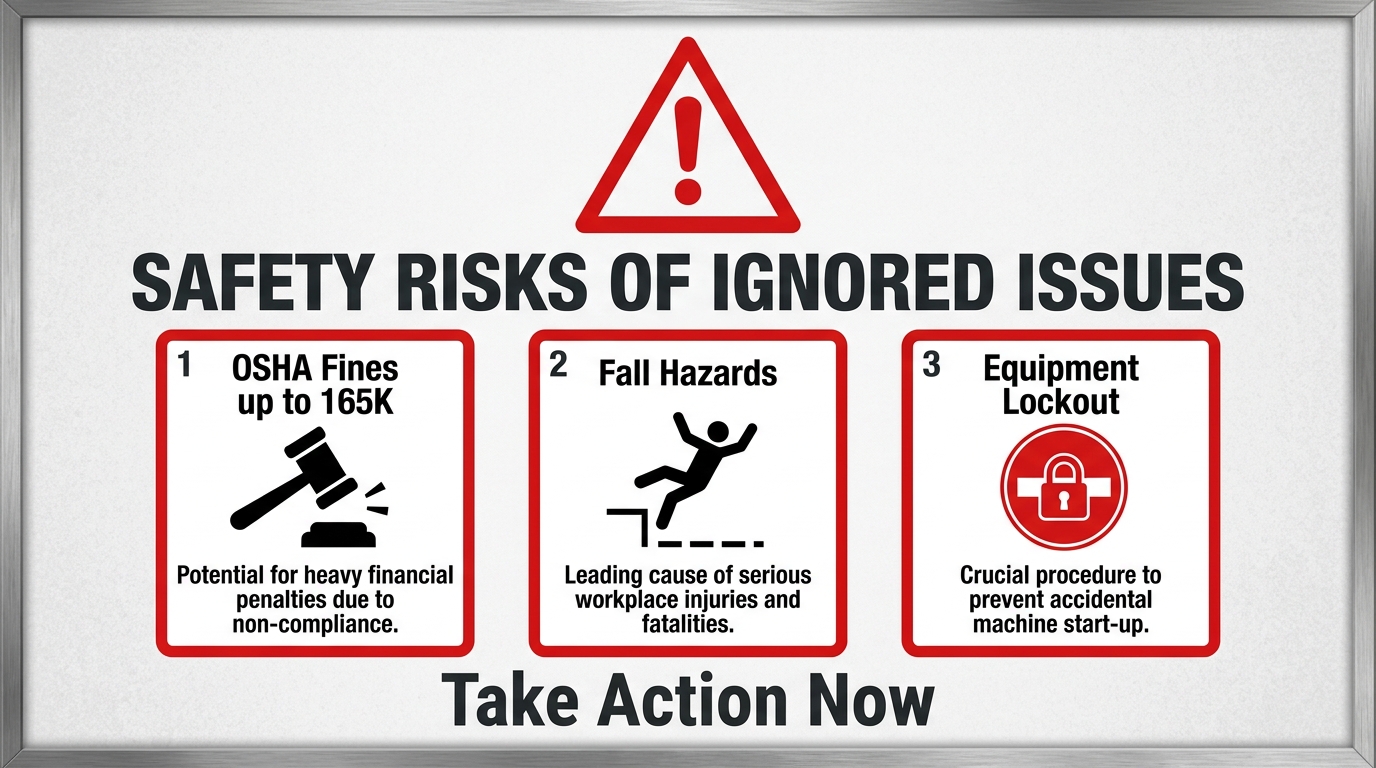
Ignoring rental lift malfunctions exposes workers and employers to OSHA violations, fall hazards, and mandatory equipment removal from service. The following H3s detail each risk category.
How Can an Unaddressed Lift Issue Lead to an OSHA Violation?
An unaddressed lift issue can lead to an OSHA violation when the equipment’s condition fails to meet federal aerial lift standards under 29 CFR 1926.453. Federal OSHA issued 541 citations for aerial lift violations (Standard 1926.453) in the construction industry between October 2024 and September 2025, resulting in over $1.9 million in penalties. Beginning January 15, 2025, the maximum penalty for a willful or repeated violation increased to $165,514 per violation. Operating a malfunctioning lift without correction is precisely the kind of willful negligence that draws the highest-tier penalties. Staying proactive about known defects is not optional; it is the only compliance-safe position.
What Are the Fall Hazards Associated With Malfunctioning Lift Equipment?
The fall hazards associated with malfunctioning lift equipment include sudden platform drops, guardrail failure, uncontrolled boom movement, and loss of operator support while elevated. The ANSI/SAIA A92.20-2020 standard specifically defines safeguarding requirements for persons and objects during mobile elevating work platform (MEWP) operations, recognizing that equipment failure is a primary fall trigger. According to CDC/NIOSH data, slips, trips, and falls remained a leading cause of construction worker death in 2022, killing more than 400 U.S. workers across all construction activities. Equipment in compromised condition dramatically increases that risk.
When Does a Rental Lift Malfunction Require Immediate Removal From Service?
A rental lift malfunction requires immediate removal from service whenever a defect compromises structural integrity, control function, fall protection, or stability. Section 1926.453(b)(2)(v) of the OSHA construction standards requires that a body belt and lanyard be attached to the boom or basket during aerial lift operation; if the platform cannot support that configuration safely, continued use violates federal law. Conditions warranting immediate removal include failed controls, hydraulic leaks causing drift, inoperative emergency descent systems, and compromised guardrails. When any of these are present, tagging out and contacting the rental provider is the only legally and operationally defensible action.
When Should You Repair vs. Return a Malfunctioning Rental Lift?
The decision to repair or return a malfunctioning rental lift depends on who caused the problem and what your rental agreement permits. The sections below clarify allowed repairs, required disclosures, and how liability is assigned under typical rental contracts.
What Repairs Are You Allowed to Make on a Rental Lift?
The repairs you are allowed to make on a rental lift are limited to minor, non-invasive corrections, such as clearing debris from sensors, resetting tripped breakers, or reconnecting a loose power cable. Most rental agreements prohibit renters from opening hydraulic lines, replacing mechanical components, or modifying controls. Attempting unauthorized repairs can void damage waivers and shift full financial liability to your crew. When in doubt, stop work and contact the rental provider before touching anything beyond basic operational resets.
What Damage Must Be Reported Directly to the Rental Provider?
The damage that must be reported directly to the rental provider includes any structural damage, hydraulic leaks, electrical failures, broken guardrails, damaged tires, or control malfunctions that occurred during your rental period. Prompt reporting protects you legally and ensures the provider can dispatch a technician or swap the unit before further damage occurs. Failing to report known damage at return can result in disputed liability claims and unexpected charges. Document all issues with photos and timestamps the moment they are discovered.
How Do Rental Agreements Affect Your Liability for Lift Malfunctions?
Rental agreements affect your liability by distinguishing between equipment failure and renter misuse. According to industry practice, repairs resulting from equipment failure are the responsibility of the rental company, while repairs necessitated by misuse are the responsibility of the renter. Most contracts also include damage waivers, daily inspection acknowledgments, and clauses specifying approved operators. Reading these terms before signing is one of the most practical steps a site manager can take to avoid unexpected costs if a malfunction occurs.
How Do Tway Lifting’s Rental and Inspection Services Help You Avoid Lift Issues?
Tway Lifting’s rental and inspection services help you avoid lift issues by combining OSHA-compliant inspections, certified repair expertise, and rigging equipment rentals backed by over 75 years of industry experience. The sections below cover how Tway Lifting prevents common failures and summarize the key troubleshooting lessons from this guide.
Can Tway Lifting’s OSHA-Compliant Inspection and Repair Services Prevent Common Rental Lift Failures?
Yes, Tway Lifting’s OSHA-compliant inspection and repair services can prevent common rental lift failures by identifying electrical, hydraulic, and structural problems before they escalate. Tway Lifting performs rigging inspections using certified, factory-trained specialists who follow OSHA standards and deliver detailed reporting on equipment condition. Rental equipment from Tway Lifting includes wire rope slings, spreader beams, hoists, shackles, and load cells, all maintained to compliance standards. Same-day repair and reconditioning services reduce downtime when issues do occur. For job sites across the U.S., this level of pre-vetted, inspection-backed rental equipment is one of the most reliable ways to reduce unplanned lift failures before work begins.
What Are the Key Takeaways About Troubleshooting Common Rental Lift Issues We Covered?
The key takeaways about troubleshooting common rental lift issues covered in this guide are:
- Pre-shift inspections are mandatory. Check fluid levels, batteries, tires, controls, and guardrails before every shift.
- Power failures trace to a few root causes. Drained batteries, faulty starters, and clogged fuel filters are the most common starting-point failures.
- Hydraulic problems produce visible symptoms. Slow, jerky, or uneven lift movement signals damaged seals, contaminated fluid, or worn cylinders.
- Error codes require interpretation, not guessing. JLG Diagnostic Trouble Codes stored in machine memory identify specific malfunctions retrievable via analyzer or telematics portal.
- Instability has three primary triggers: uneven ground, overloading, and miscalibrated tilt sensors.
- OSHA penalties are real and increasing. Willful violations now carry penalties up to $165,514 per incident.
- Rental liability follows use. Equipment failure is the rental provider’s responsibility; damage from misuse falls on the renter.
- When in doubt, remove the lift from service and contact your rental provider immediately.
With these principles in hand, partnering with an experienced provider like Tway Lifting keeps your operations compliant, efficient, and safe.