




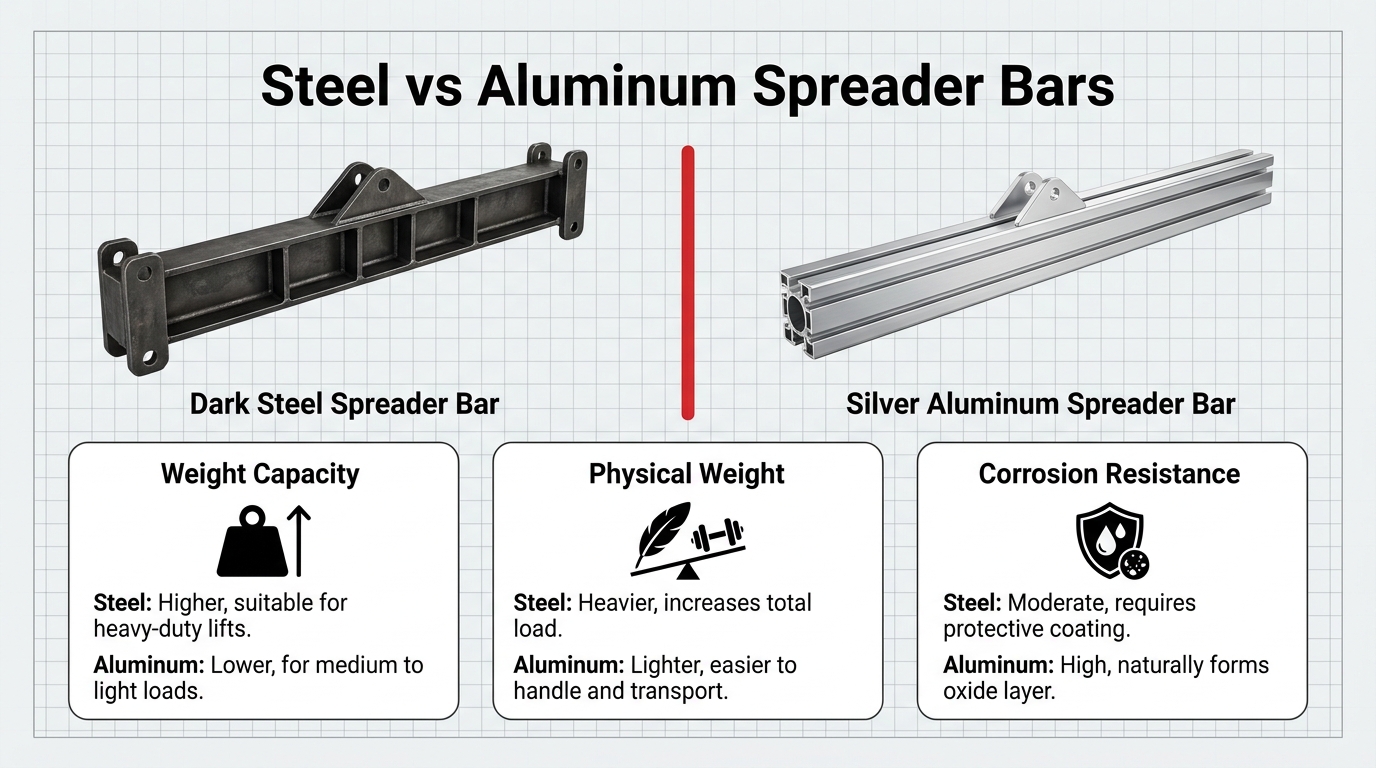

A spreader bar is an industrial lifting device that keeps sling legs apart during a lift, carrying the load through axial compression to resist inward forces on the rigging. Choosing between steel and aluminum for a rental comes down to the specific demands of your lift: load weight, site conditions, handling frequency, and compliance requirements.
This guide covers the mechanical differences between the two materials, the conditions that favor each one, available sizes and configurations, safety and compliance standards, and how to evaluate rental providers alongside the rent-versus-buy decision.
Steel and aluminum spreader bars differ most sharply in weight capacity, physical weight, and corrosion resistance. Steel handles heavier rated loads and resists deformation under cyclic stress, while aluminum weighs roughly one-third as much per cubic foot and resists corrosion without surface treatments.
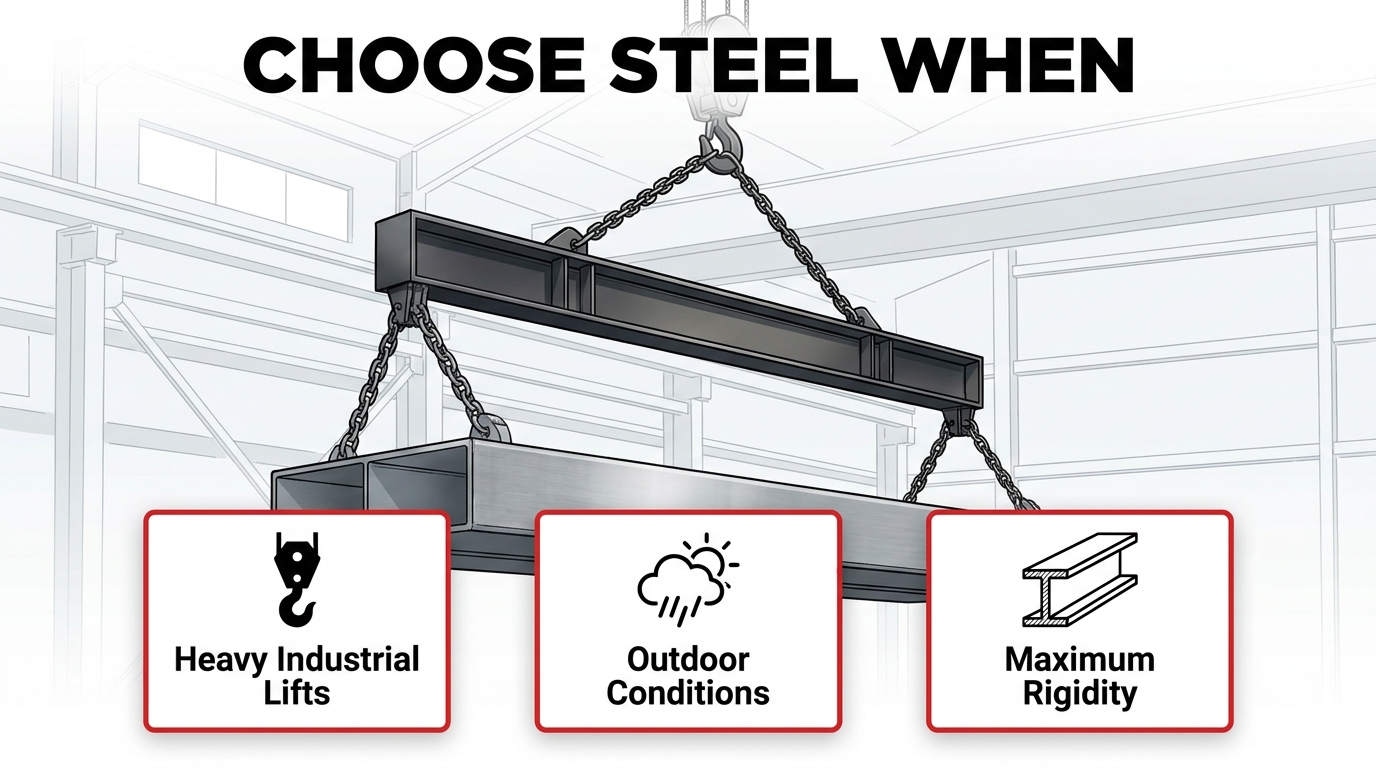
The conditions that favor each material are equally distinct. Steel is the right call for heavy industrial lifts, outdoor exposure, and applications where bar rigidity is non-negotiable. Aluminum suits weight-restricted lifts, repetitive overhead applications, and entertainment or film rigging where crews reconfigure loads frequently.
Rental spreader bars are available in fixed, telescopic, and modular configurations, with capacities ranging from 2 to 100 tons, covering routine construction lifts through large-scale industrial projects. Safety requirements apply regardless of material: OSHA 29 CFR 1926.251(a)(4) mandates proof-testing to 125% of rated capacity, and ASME B30.20-2025 governs design, marking, and inspection for all below-the-hook lifting devices.
Renting typically costs $100 to $300 per day and becomes less cost-effective than ownership only beyond 60 days of annual use.
What Is a Spreader Bar and What Does It Do?
A spreader bar is an industrial lifting device designed to spread the top rigging and keep sling legs apart during a lift, carrying the load through axial compression to resist inward forces. This mechanical function makes it fundamentally different from a lifting beam, which handles bending forces instead. According to Mazzella Companies, spreader bars convert lifting loads into compressive forces in the bar and tensile forces in the slings, making them highly efficient in material use.
In rigging terminology, spreader bars are also called lifting spreaders, beam spreaders, load bars, and spread bars. Knowing what a spreader bar does is the foundation for choosing the right material, size, and configuration for your lift.
What Are the Main Differences Between Steel and Aluminum Spreader Bars?
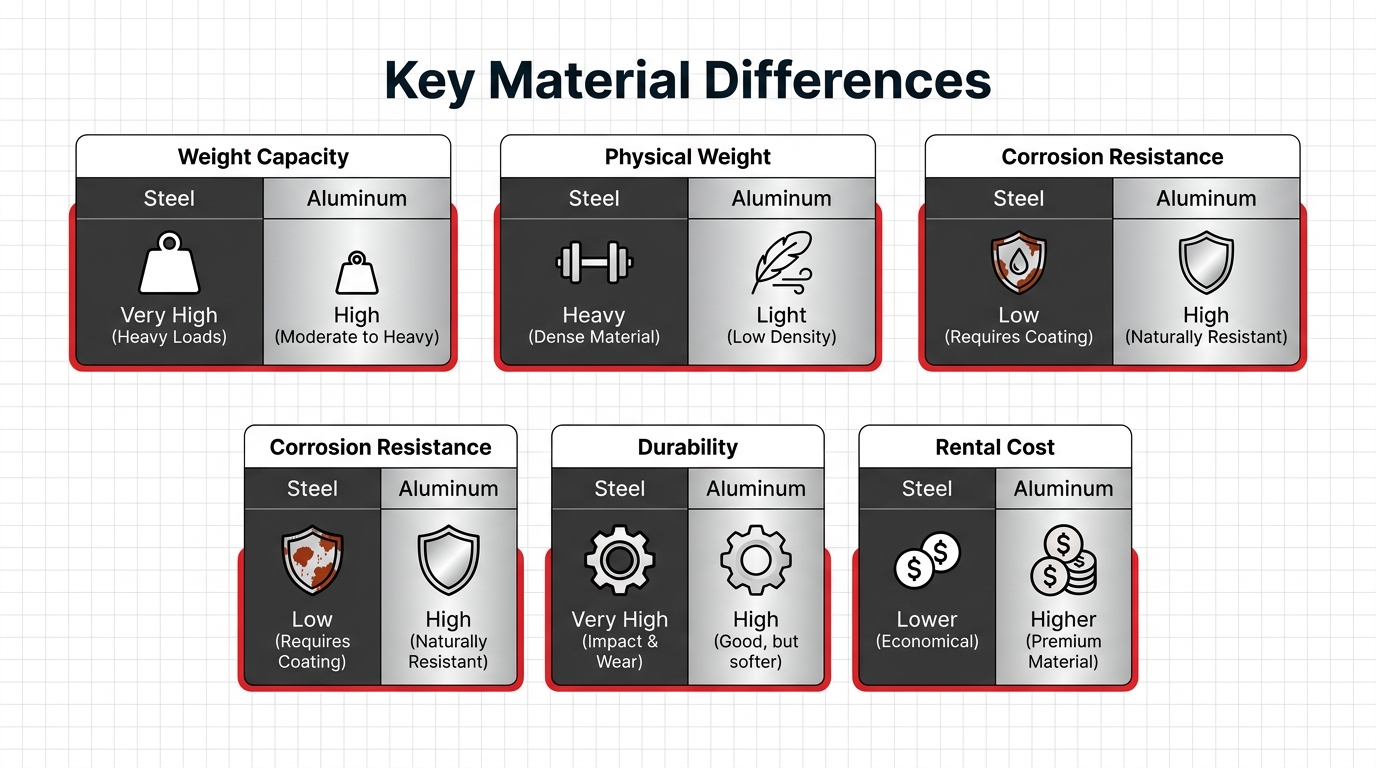
The main differences between steel and aluminum spreader bars involve weight capacity, physical weight, corrosion resistance, durability, and rental cost. Each factor affects which material suits your specific lift.
How Do Steel and Aluminum Spreader Bars Compare in Weight Capacity?
Steel and aluminum spreader bars compare in weight capacity with steel holding a clear advantage for heavy-duty lifts. High-strength, low-alloy steels like API 5L X52 deliver superior tensile strength, supporting lifts where load demands exceed what aluminum can safely handle. Aluminum spreader bars work well for light-to-medium loads, but their lower density limits their structural ceiling. For critical heavy lifts, steel remains the more dependable material choice.
How Do Steel and Aluminum Spreader Bars Compare in Physical Weight?
Steel and aluminum spreader bars compare in physical weight with aluminum being substantially lighter. According to Wiley Metal, aluminum weighs approximately 169 lbs per cubic foot versus steel at approximately 490 lbs per cubic foot. That nearly 3x weight difference means aluminum bars are far easier to transport, reposition, and handle on site. For jobs where crane hook load budgets are tight, aluminum’s lighter footprint directly preserves usable lifting capacity.
How Do Steel and Aluminum Spreader Bars Compare in Corrosion Resistance?
Steel and aluminum spreader bars compare in corrosion resistance with aluminum performing significantly better in most environments. All aluminum types inherently resist corrosion because their surfaces oxidize into a stable protective layer, unlike steel, which requires coatings or surface treatments to prevent rust. For marine and offshore applications specifically, aluminum alloys with protective coatings are recommended. Steel bars used outdoors require consistent maintenance to sustain their rated integrity.
How Do Steel and Aluminum Spreader Bars Compare in Durability?
Steel and aluminum spreader bars compare in durability with steel outperforming aluminum under high-stress, cyclic loading conditions. Steel’s greater density and toughness allow it to absorb repeated heavy loads without the fatigue degradation that aluminum can exhibit over time. Aluminum, while corrosion-resistant, is more susceptible to surface damage and deformation under sustained heavy use. For long-term, high-frequency industrial lifting, steel typically delivers a longer functional service life.
How Do Steel and Aluminum Spreader Bars Compare in Cost to Rent?
Steel and aluminum spreader bars compare in cost to rent with both materials falling within a similar daily rate range of $100 to $300 per day, depending on capacity and location. Aluminum bars may carry a slight premium due to material cost, but the difference is rarely a deciding factor. The more practical cost consideration is total lift cost: choosing aluminum can reduce crane size requirements, indirectly lowering overall project expense. Matching material to lift requirements, rather than minimizing the bar rental cost alone, produces the best financial outcome.
When Does Renting a Steel Spreader Bar Make More Sense?
Renting a steel spreader bar makes more sense when a lift demands maximum rated capacity, harsh environmental exposure, or zero tolerance for flex under load. The H3s below cover heavy industrial lifts, outdoor conditions, and rigidity requirements.
Is a Steel Spreader Bar Better for Heavy Industrial Lifts?
A steel spreader bar is better for heavy industrial lifts where rated capacity and structural integrity cannot be compromised. High-strength, low-alloy steels like API 5L X52 and ST43 deliver the optimal balance of strength, toughness, and weldability required for demanding applications. Modular steel spreader beams are built to handle capacities ranging from 24 to 1,000 tons in high-capacity industrial projects, according to LGH. Steel also performs reliably when lifting prefabricated construction elements such as large concrete panels and structural steel, where load shifting must be eliminated. For any lift where payload mass approaches the upper range of crane capacity, steel is the safer and more defensible material choice.
Is a Steel Spreader Bar the Right Choice for Outdoor or Harsh Environments?
A steel spreader bar is the right choice for outdoor or harsh environments when the bar is properly surface-treated and the priority is mechanical strength over corrosion resistance. Unlike aluminum, steel requires protective coatings to resist oxidation, but treated steel maintains structural integrity under high mechanical stress, UV exposure, and variable loads. Steel spreader bars are widely used in outdoor construction and heavy infrastructure projects where load mass, not weight savings, governs the equipment selection. In persistently wet or marine environments, protective coating maintenance becomes critical to service life.
Should You Rent Steel When You Need Maximum Rigidity Under Load?
You should rent steel when maximum rigidity under load is a non-negotiable requirement. Steel’s density, approximately 490 lbs per cubic foot compared to aluminum’s 169 lbs per cubic foot, directly contributes to its superior resistance to flexion and deformation during lifts. When a bar deflects under load, sling angles shift and rated capacity calculations become unreliable. Steel eliminates that variable, making it the preferred material for precision lifts, tight tolerance placements, and high-cycle industrial operations where consistent geometry matters. Rigidity is an underrated selection criterion. Choosing steel specifically for its stiffness, rather than just its capacity rating, reflects the kind of disciplined rigging planning that protects both the load and the crew.
When Does Renting an Aluminum Spreader Bar Make More Sense?
Renting an aluminum spreader bar makes more sense when weight restrictions, lift frequency, or industry-specific requirements make a lighter material the safer and more practical choice. The following H3s cover three scenarios: crane capacity limits, repetitive overhead lifting, and entertainment or film rigging.
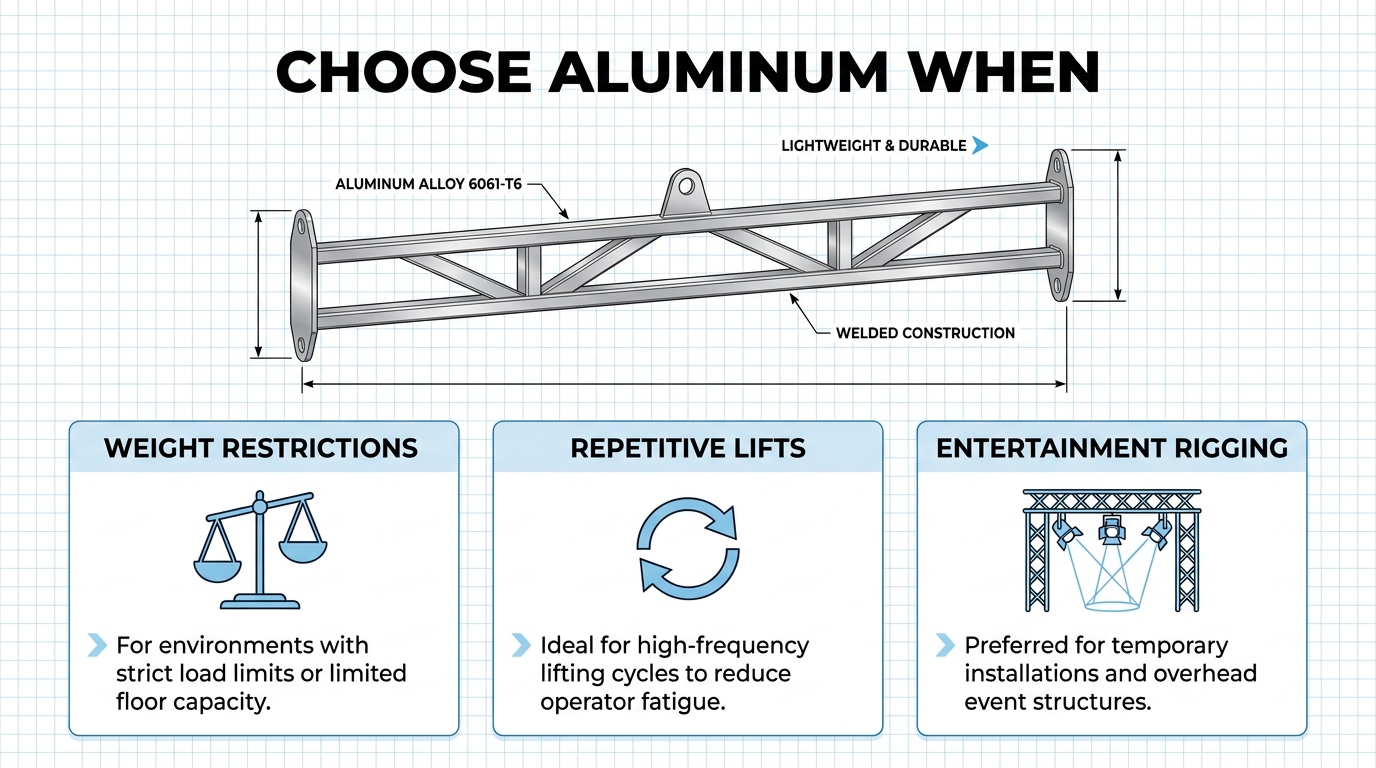
Is an Aluminum Spreader Bar Better When Weight Restrictions Apply?
An aluminum spreader bar is better when weight restrictions apply because its lower mass preserves more of the crane’s rated hook capacity for the actual load. Aluminum weighs approximately 169 lbs per cubic foot compared to steel’s 490 lbs per cubic foot, according to Wiley Metal. On jobsites where crane capacity is fixed and every pound of rigging gear competes with payload, that difference is operationally significant. Aluminum’s weight advantage is especially critical in confined indoor lifts, mezzanine work, and facilities with structural floor-load limits where bringing in a heavier crane is not an option.
Is Aluminum the Right Choice for Repetitive Overhead Lifts?
Aluminum is the right choice for repetitive overhead lifts when riggers must reposition, carry, or reconfigure the bar multiple times during a shift. A significantly lighter bar reduces cumulative physical strain on the crew and speeds setup between lifts. Competitor content gaps frequently include analysis of aluminum versus steel fatigue behavior under cyclic loading, which matters in high-frequency lift environments. For moderate-capacity repetitive applications, aluminum delivers a practical efficiency gain that steel cannot match without adding handling complexity.
Should You Rent Aluminum for Entertainment or Film Industry Rigging?
Yes, you should rent aluminum for entertainment or film industry rigging when loads consist of lighting rigs, staging, or set pieces that change configuration frequently. According to Hercules Crane and Lifting Supplies, adjustable spreader bars are frequently used in the entertainment industry to lift stage equipment and lighting rigs featuring varying shapes and sizes. Aluminum’s lighter weight makes reconfiguring rigging between scenes or performances faster and safer for elevated crew working at height. For short-term production schedules, renting eliminates the cost of owning specialized aluminum rigging that sits idle between projects.
What Industries Typically Rent Spreader Bars?
The industries that typically rent spreader bars include construction, energy, manufacturing, shipping, and entertainment. Each sector relies on spreader bars for different load types, environments, and rigging configurations, which also shapes the choice between steel and aluminum.
Construction
Construction is one of the most active industries for spreader bar rentals. Spreader bars are essential for lifting prefabricated elements such as large concrete panels and steel structures, minimizing the risk of load shifting during placement. Steel spreader bars dominate this sector given the heavy, irregular loads involved.
Energy and Industrial Manufacturing
Energy and industrial manufacturing operations routinely require spreader bars for high-capacity lifts. Modular spreader beams with capacities ranging from 24 to 1,000 tons are used for heavy lifts in industrial projects, according to LGH (Lifting Gear Hire). These sectors favor steel for maximum rigidity under sustained loads.
Shipping and Marine
Shipping and marine operations rent spreader bars to manage oversized cargo and subsea equipment. Weight management is a real concern in this environment, as a steel spreader bar can represent 40 to 60% of the total hook load in subsea structures, per the Offshore Technology Conference.
Entertainment and Event Production
The entertainment industry uses adjustable spreader bars to lift stage equipment and lighting rigs that vary in shape and size. Aluminum is the preferred material here, keeping rigging lightweight and manageable for crews working overhead in theaters, arenas, and film sets.
What Sizes and Configurations Are Available When Renting a Spreader Bar?
Rental spreader bars are available in a wide range of sizes and configurations to match specific lift requirements. The sub-sections below cover adjustable length options and lifting attachment configurations renters can access.
What Adjustable Length Options Are Available for Rental Spreader Bars?
The adjustable length options available for rental spreader bars include fixed-length bars, telescopic adjustable bars, and modular systems that can be configured to project-specific spans. Telescopic bars allow on-site length adjustment without requiring a different unit, making them practical for jobs where load geometry varies. Modular spreader beams, according to LGH (Lifting Gear Hire), reach capacities from 24 to 1,000 tons, covering everything from routine construction lifts to large-scale industrial projects. Tway Lifting’s rental fleet includes spreader beams up to 40 feet in length and capacities from 2 to 100 tons, with adjustable and modular options readily available. For most project planners, modular systems offer the best flexibility across changing lift requirements without committing to a purchase.
What Lifting Attachment Configurations Can You Rent?
The lifting attachment configurations available for rental spreader bars include single-point top rigging, dual pick-point arrangements, and multi-leg sling setups that distribute load across wider spans. Common end fittings include shackle connections, hook eyes, and pin-and-clevis attachments, each suited to different rigging arrangements. In the entertainment industry, adjustable spreader bars are frequently configured with multiple attachment points to accommodate lighting rigs and stage equipment of varying shapes. Steel bars typically support heavier fixed-point configurations, while aluminum bars suit lighter, repositionable multi-leg arrangements where frequent reconfiguration is needed. Matching the attachment configuration to the load geometry and material is one of the most consequential decisions in spreader bar selection.
What Safety and Compliance Standards Apply to Rented Spreader Bars?
Safety and compliance standards for rented spreader bars include OSHA regulations, ASME B30.20 certification requirements, and pre-use load testing protocols. The following sections cover OSHA applicability, required certifications, and inspection responsibilities.
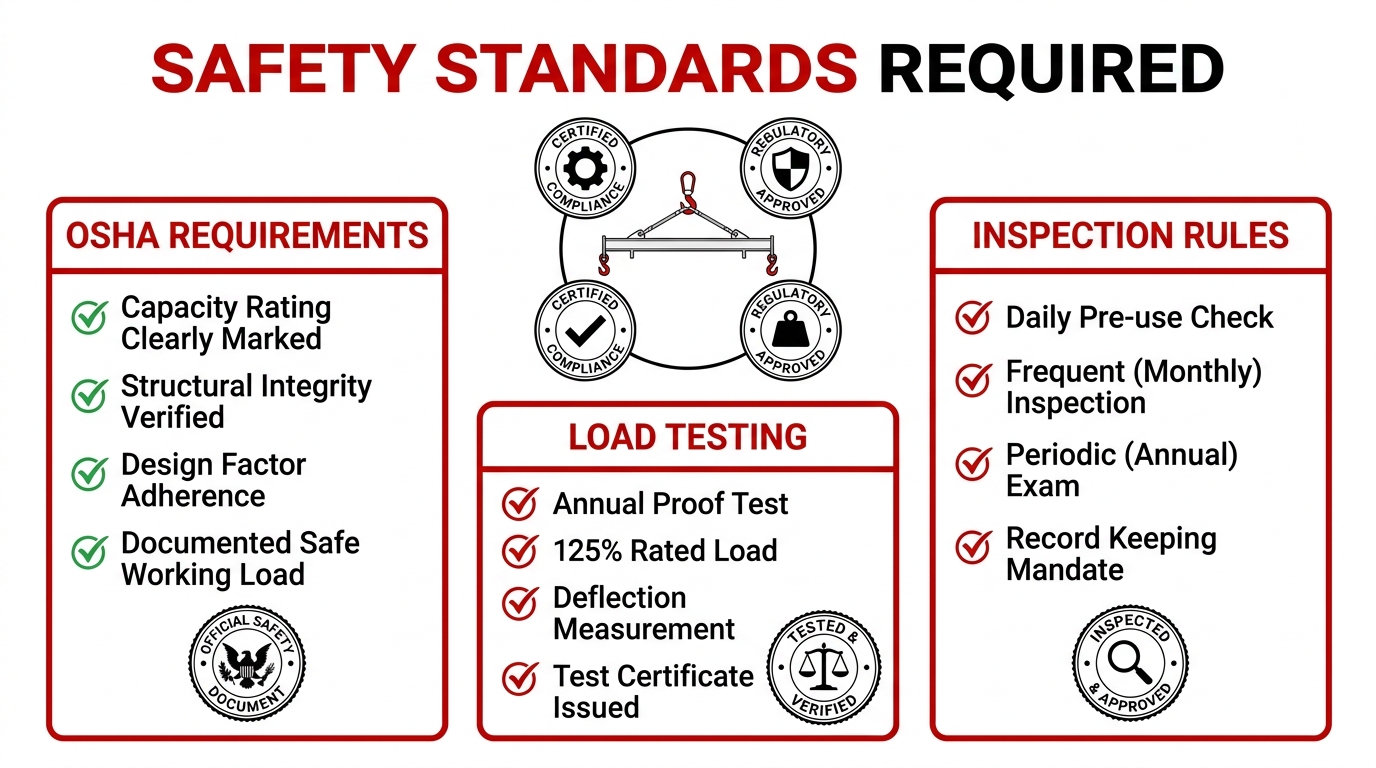
Do Rented Spreader Bars Need to Meet OSHA Requirements?
Rented spreader bars do need to meet OSHA requirements, regardless of whether the equipment is owned or rented. OSHA 29 CFR 1926.251(a)(4) mandates that custom-designed lifting accessories, including spreader bars, must be marked with their safe working loads and proof-tested to 125% of their rated capacity before initial use. ASME B30.20-2025 further governs below-the-hook lifting devices, covering design, marking, installation, and inspection standards. Compliance is not optional: as the ASME Safety Standards Committee states, adherence “is a legal requirement that protects workers, prevents equipment damage, and ensures operational efficiency.”
What Load Testing or Certification Should a Rental Spreader Bar Have?
A rental spreader bar should carry proof-test documentation confirming it has been tested to at least 125% of its rated safe working load, per OSHA 29 CFR 1926.251(a)(4). Reputable rental equipment should also conform to ASME B30.20-2025 and, for internationally sourced equipment, EN 13155, which covers structural integrity and load-bearing capacity requirements for non-fixed lifting attachments. Visible SWL markings and a current inspection record are the minimum documentation to verify before accepting any rental unit.
Who Is Responsible for Inspection When You Rent a Spreader Bar?
Responsibility for inspection when you rent a spreader bar is shared between the rental provider and the end user. The rental provider is responsible for supplying equipment that is pre-certified, load-tested, and in serviceable condition before dispatch. The renter, however, bears responsibility for a pre-use visual inspection on-site, confirming SWL markings are legible, no structural damage is present, and the bar matches the lift plan requirements. In practice, the safest approach is to rent only from providers who supply full certification documentation, so both parties can verify compliance before any lift begins.
What Should You Look for When Choosing a Spreader Bar Rental Provider?
The right spreader bar rental provider delivers certified equipment, reliable logistics, and configuration flexibility. The H3s below cover three core evaluation criteria: load-rated certification, delivery speed, and custom configuration support.
Does the Rental Provider Offer Load-Rated and Certified Equipment?
A rental provider should offer load-rated and certified equipment that meets OSHA 29 CFR 1926.251(a)(4), which requires spreader bars to be marked with their safe working load and proof-tested to 125% of rated capacity before first use. ASME B30.20-2025 adds design, marking, and inspection standards for below-the-hook lifting devices. Accepting uncertified rental equipment shifts liability to the jobsite, a risk no responsible operator should accept.
Can the Rental Provider Supply Same-Day or Short-Notice Delivery?
The rental provider should supply same-day or short-notice delivery backed by active inventory and regional logistics capability. Lift schedules rarely accommodate long lead times, and a delayed spreader bar can stall an entire crane crew. Providers with free U.S. delivery and available stock across multiple capacity ranges are best positioned to meet urgent project timelines without premium surcharges.
Does the Provider Offer Custom Configurations for Specialized Lifts?
The provider should offer custom configurations for specialized lifts, including adjustable-length bars, modular assemblies, and matched attachment hardware for non-standard load geometries. Tway Lifting provides spreader bar rentals with capacities from 2 to 100 tons, including modular and adjustable options carrying ASME/ISO certifications with free U.S. delivery. For complex lifts, configuration flexibility is just as critical as rated capacity.
How Does Renting a Spreader Bar Compare to Buying One?
Renting a spreader bar costs between $100 and $300 per day, while purchasing ranges from $400 for basic models to over $2,000 for adjustable units. The right choice depends on usage frequency, storage capacity, and whether compliance maintenance falls within your operational scope.
What Are the Key Takeaways About Renting Steel vs Aluminum Spreader Bars?
The key takeaways about renting steel vs aluminum spreader bars center on matching material to job conditions, then evaluating cost against frequency of use. Steel suits heavy industrial lifts, outdoor exposure, and maximum rigidity. Aluminum suits weight-restricted lifts, repetitive overhead applications, and entertainment rigging. According to a cost-benefit analysis by Holloway Houston, rigging equipment ownership becomes more cost-effective than renting only when used more than 60 days per year. For projects below that threshold, renting eliminates purchase price, storage, and ongoing certification costs entirely. The most overlooked factor is compliance: rented bars from certified providers arrive pre-tested and documented, removing the inspection burden from your team and reducing liability on the lift.
How Do Tway Lifting’s Rental and Rigging Services Apply to Spreader Bar Needs?
Tway Lifting’s rental and rigging services apply directly to spreader bar needs through a certified fleet covering 2 to 100 tons, with both steel and aluminum options. The following H3s detail the equipment supply and key decision takeaways.
Can Tway Lifting’s Rental Services Supply Certified Steel or Aluminum Spreader Bars?
Yes, Tway Lifting’s rental services can supply certified steel and aluminum spreader bars with capacities ranging from 2 to 100 tons, including modular and adjustable configurations with ASME/ISO certifications and free U.S. delivery. Both material options are available to match the specific demands of each lift, whether the priority is maximum structural rigidity for heavy industrial loads or reduced hook weight for weight-restricted applications. HSLA steel grades like API 5L X52 deliver the strength and weldability required for heavy-duty lifts, while aluminum options suit marine, entertainment, and overhead repetitive applications. In practice, having access to both material types from a single certified rental source eliminates the guesswork of material selection and reduces procurement time on short-notice projects.
What Are the Key Takeaways About Renting Steel vs Aluminum Spreader Bars?
The key takeaways about renting steel vs aluminum spreader bars center on matching material to application, budget, and compliance requirements. Use this checklist to guide your rental decision:
- Load capacity: Steel bars handle heavier rated loads and provide superior rigidity under high compressive force.
- Weight on the hook: Aluminum weighs roughly 169 lbs per cubic foot versus 490 lbs for steel, reducing hook load in weight-sensitive lifts.
- Corrosion environment: Aluminum’s natural oxide layer makes it the preferred choice for marine, offshore, or wet conditions.
- Rental cost: Spreader bar rentals typically run $100 to $300 per day; renting avoids capital outlay for infrequent lifts.
- Compliance: All rented bars must carry proof-testing to 125% of rated capacity per OSHA 29 CFR 1926.251(a)(4) and meet ASME B30.20-2025 standards.
- Long-term use: Ownership becomes more cost-effective than renting beyond 60 days of annual use, according to Holloway Houston’s cost-benefit analysis.
Tway Lifting combines over 75 years of rigging expertise with a certified rental fleet to help teams make the right material choice for every lift.