






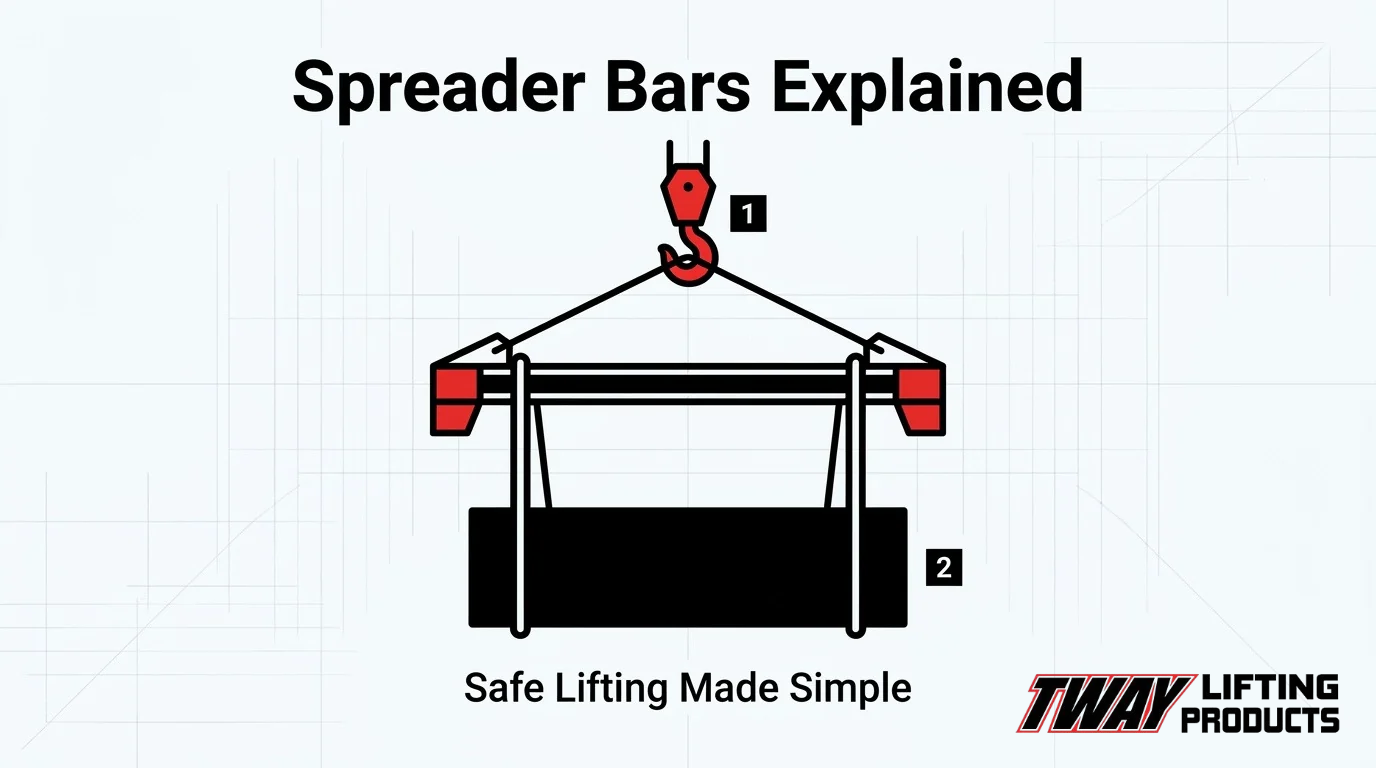

A spreader bar is a horizontal structural member that separates sling attachment points outward from the load, keeping the rigging in compression rather than allowing inward sling forces to crush, tip, or destabilize what is being lifted. Unlike a lifting beam, which connects directly to the crane hook and carries bending forces at its center, a spreader bar acts as a pure compression strut, a distinction that produces dramatic differences in rated capacity.
This guide covers what spreader bars are and the problems they solve, their main applications across industries, the types available, how load capacity is calculated and rated, the safety guidelines that govern every lift, the standards and regulations that apply, common mistakes that cause failures, and how to select the right bar for a specific lift.
Spreader bars appear across construction, marine, industrial, and entertainment work, each sector applying them differently based on load geometry, weight, and site constraints. For long, heavy girders, they are the standard rigging method; in marine cargo operations, bars spanning over 18 feet are routinely used on bridge cranes; on stage, they distribute suspended rigging loads over performer and audience areas.
Rated capacity ties directly to working load limit, sling angle, and bar length together, not to any single variable in isolation. A sling angle as shallow as 30 degrees cuts effective capacity in half, and longer bars carry lower published WLL values as buckling resistance decreases.
Safe operation depends on pre-use inspection, correct sling attachment, angle management, formal lift planning, and knowing exactly when to remove a bar from service. ASME B30.20 and OSHA 29 CFR §1926.251 define the minimum compliance requirements for every lift.
What Is a Spreader Bar?
A spreader bar is a horizontal structural member used in lifting operations to separate and stabilize sling attachment points, keeping them positioned outward from the load. The two heading below cover how it differs from a lifting beam and what specific rigging problem it solves.
How Does a Spreader Bar Differ From a Lifting Beam?
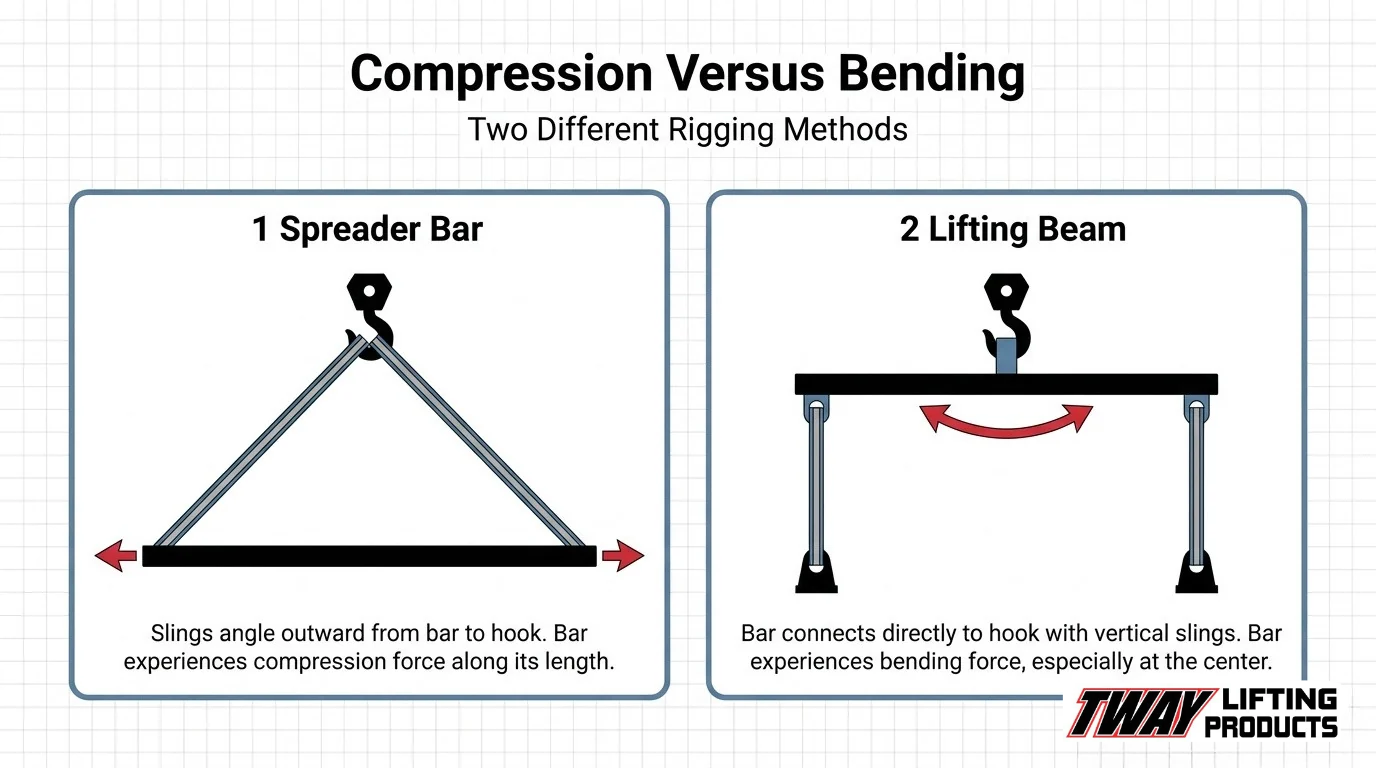
A spreader bar differs from a lifting beam primarily in how each device handles load forces. A spreader bar acts as a compression strut: slings attach below both ends and angle upward to a single crane hook, pushing the bar’s ends outward under load. A lifting beam, by contrast, connects directly to the crane hook at its top and carries slings below, making it subject to a bending moment at the beam’s center.
The practical consequence is significant for capacity. According to the Federal Highway Administration, spreader beams are designed as compression members, while lifting beams are primarily bending members that attach at their center to the crane hook. Because bending governs, the same beam can carry a much lower load when rigged as a lifting beam, so always use the rating marked for the configuration in use.
What Problem Does a Spreader Bar Solve in Rigging?
A spreader bar solves the problem of inward sling compression and low sling angles on wide or fragile loads. When slings run at a steep inward angle without a spreader, horizontal compressive forces bear against the sides of the load, risking crushing, tipping, or sliding. The U.S. Department of Energy notes that spreader bars eliminate the hazard of load tipping, sliding, or bending, as well as low sling angles and sling-induced crushing.
This is especially valuable on longer, heavier pieces. Per Federal Highway Administration guidance, spreader beams are specifically selected for longer, heavier girder segments where a single clamp and direct sling connection would be insufficient to maintain load stability throughout the pick.
What Are the Main Uses of a Spreader Bar?
Spreader bars are used across construction, industrial, marine, and entertainment sectors to distribute load forces and protect both the load and rigging components. Each industry applies them differently depending on load geometry, weight, and site constraints.
How Are Spreader Bars Used in Construction Lifting?
Spreader bars are used in construction lifting to safely hoist long, heavy structural members such as girders, beams, and precast panels. On longer, heavier pieces, a spreader beam paired with beam clamps is the standard rigging method, according to the Federal Highway Administration. A University of Texas at Austin study for TxDOT surveyed steel erectors and found that a single crane with two lift points and a spreader bar was the most widely used method for lifting curved steel girders.
Any defect identified during inspection must be remedied before the equipment is returned to service, as confirmed by the Health and Safety Executive. This makes pre-lift inspection non-negotiable on active construction sites.
How Are Spreader Bars Used in Industrial and Manufacturing Settings?
Spreader bars are used in industrial and manufacturing settings to move oversized machinery, heavy fabricated components, and bulk materials that cannot be safely lifted with single-point rigging. They distribute the load across multiple attachment points, reducing stress concentrations on the lifted object. This is especially valuable when handling fragile or asymmetrical components where a single sling would cause bending or tipping.
How Are Spreader Bars Used in Marine and Offshore Operations?
Spreader bars are used in marine and offshore operations to load and unload bulk cargo, transfer heavy equipment between vessels, and position offshore structures during installation. According to an OSHA Longshoring Fatal Facts report, a 15-ton bridge crane equipped with a 2,500-pound I-beam spreader bar measuring 18.5 feet long was used to transfer grain bags from dock to barge. Offshore lifting environments add dynamic load variables, making engineered spreader bars with rated safety factors essential.
How Are Spreader Bars Used in the Entertainment and Stage Industry?
Spreader bars are used in the entertainment and stage industry to hang lighting rigs, speaker arrays, video walls, and scenic elements from truss systems above performance areas. According to the PLASA/ESTA International Code of Practice for Entertainment Rigging, all temporary rigging installations must be preplanned by a competent person, with complete rigging drawings submitted and approved before any site work begins. Precision load distribution is critical here, as unevenly suspended overhead equipment poses direct safety risks to performers and audiences below.
What Are the Types of Spreader Bars?
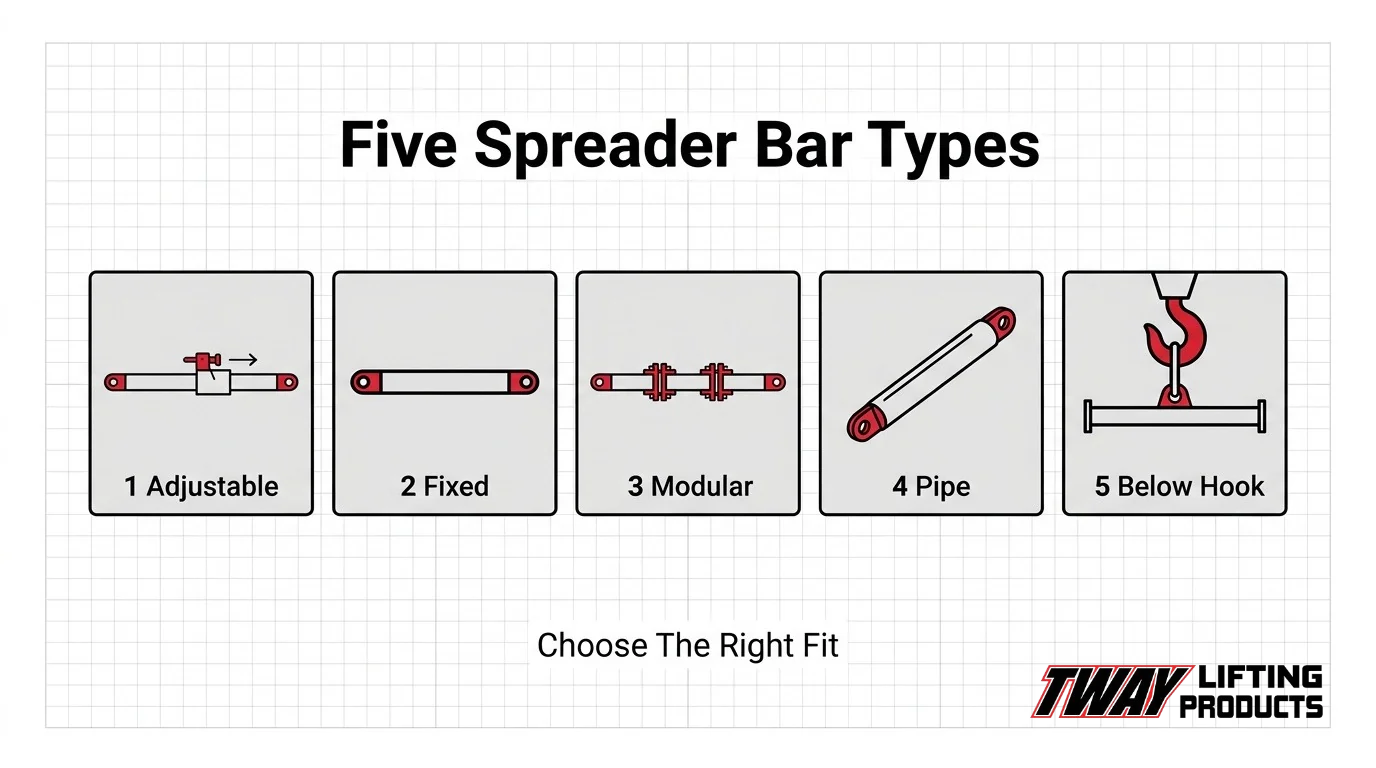
The types of spreader bars include adjustable, fixed, modular, pipe, and below-the-hook designs. Each configuration suits different load weights, job site conditions, and rigging requirements. The sections below break down how each type works and when to use it.
Adjustable Spreader Bar
An adjustable spreader bar is a telescoping device that allows the attachment points to be repositioned along its length without changing the bar itself. Riggers use this type when load widths vary between lifts, making it the most versatile option for multi-job sites. The adjustable design eliminates the need to stock several fixed-length bars for different load configurations. This flexibility makes it a practical choice for rental fleets and operations handling a rotating variety of loads.
Fixed Spreader Bar
A fixed spreader bar is a rigid, single-length device with permanently set attachment points at both ends. It suits applications where the same load geometry is lifted repeatedly, such as production line equipment or identically sized structural members. Because there are no moving parts, fixed bars are straightforward to inspect and certify. For high-cycle, identical lifts, a fixed bar is often the most reliable and cost-effective option available.
Modular Spreader Bar
A modular spreader bar uses interchangeable sections that riggers assemble to create different lengths from a standardized component set. This design reduces storage footprint while still accommodating varied load widths. Individual sections can be replaced if damaged, lowering long-term maintenance costs compared to replacing an entire fixed unit. Modular bars are particularly well-suited for facilities that need adaptability without the full cost of multiple dedicated bars.
Pipe Spreader Bar
A pipe spreader bar uses a structural pipe as its main compression member, with welded or pinned lugs at each end for sling attachment. According to a study published in Scientific Reports, one engineered design used an 8-inch ASTM A106 Grade B pipe main beam to reach a safe working load of 30 metric tons (about 33 U.S. tons), using a design factor of 2 per ASME BTH-1 for Design Category A lifters. The pipe’s circular cross-section distributes compressive forces evenly, making it efficient for heavy single-pick lifts.
Below-the-Hook Spreader Bar
A below-the-hook spreader bar is a lifting device that connects between a crane hook and the load, governed by ASME B30.20, which covers the marking, construction, inspection, and operation of below-the-hook lifting devices used for attaching loads to a hoist. Any device in this category must carry traceable documentation, a current inspection date, and manufacturer markings showing rated capacity. Selecting the correct type for each lift directly determines whether the rigging system stays within safe load limits throughout the operation.
How Is a Spreader Bar Rated for Load Capacity?
A spreader bar’s load capacity rating depends on three interconnected factors: its marked working load limit, the sling angle used during the lift, and the bar’s physical length. The sections below explain how each factor is calculated and applied.
What Does the Working Load Limit Mean on a Spreader Bar?
The working load limit (WLL) on a spreader bar is the maximum load the equipment is approved to lift under specified rigging conditions. It is not a single universal number; the WLL applies only when the hitch method, sling types, sling angles, and load weight all fall within the parameters defined in the lift plan. According to the Canadian Centre for Occupational Health and Safety, lift plans must account for the WLL alongside hitch method, sling types and angles, and other factors that could impact the lift. Exceeding the marked WLL for any single variable invalidates the rating entirely, making pre-lift planning essential rather than optional.
How Does Sling Angle Affect a Spreader Bar’s Load Capacity?
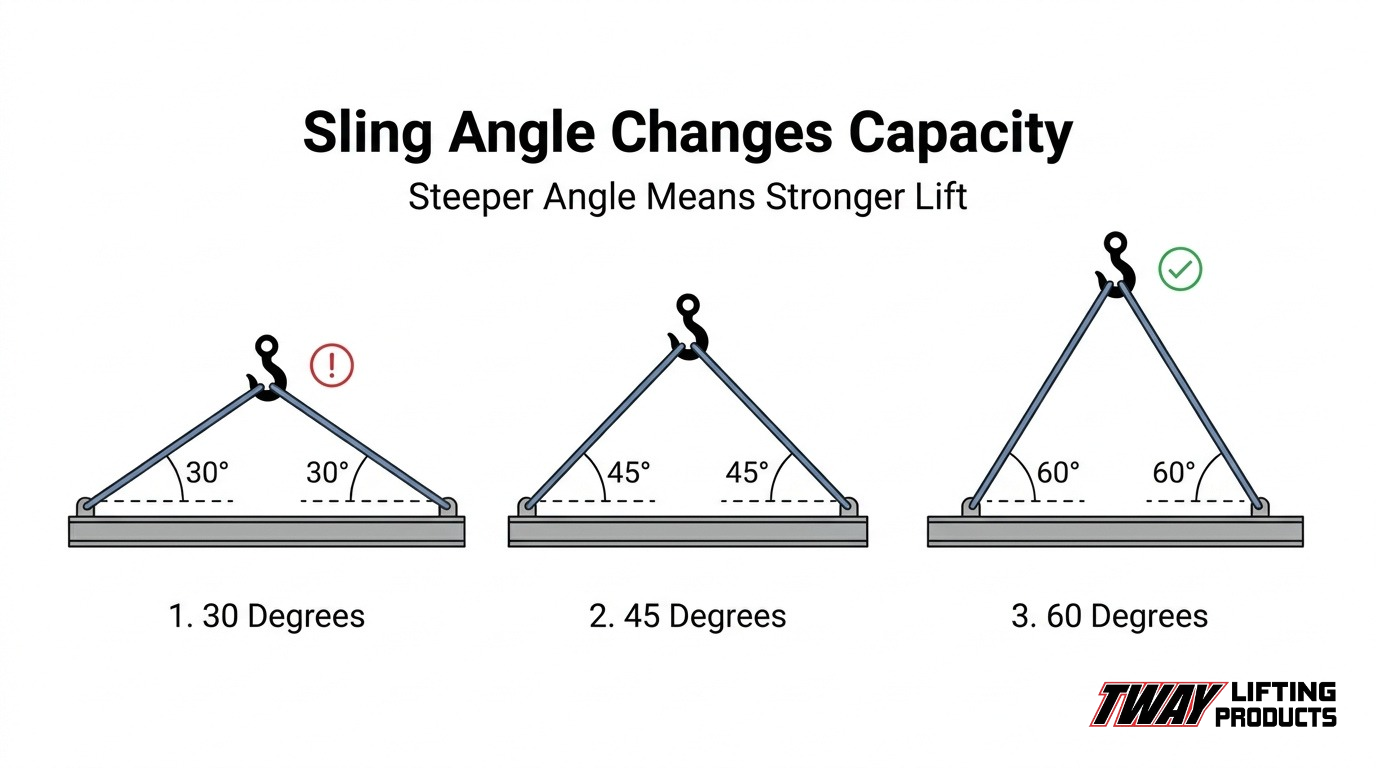
Sling angle directly determines the effective rated load a spreader bar can safely carry. A spreader bar acts as a strut in pure compression, according to the Lifting Equipment Engineers Association, meaning the top sling angle governs how much of the crane’s vertical lift force reaches the load. The Pacific Northwest National Laboratory’s Hoisting and Rigging Manual states the formula clearly: rated load equals vertical capacity multiplied by the sine of the minimum horizontal angle. At 30 degrees, that multiplier is only 0.500; at 60 degrees, it rises to 0.866. Steeper sling angles preserve more rated capacity. Working at shallow angles without recalculating the sling angle and reduced WLL is a common and consequential rigging error.
How Does Spreader Bar Length Affect Its Safe Working Load?
Spreader bar length directly reduces safe working load because longer bars experience greater compressive stress along the beam axis. A published engineering case study in Scientific Reports documents a 30-metric-ton SWL design that required a 2:1 safety factor per ASME BTH-1 guidelines for category A lifters. Under 29 CFR §1926.251, custom lifting accessories must be marked with their safe working loads and proof-tested to 125 percent of rated load before use. As length increases, the beam’s buckling resistance decreases, which manufacturers reflect in lower published WLL values for longer configurations. Always verify the SWL stamped on the bar matches the actual span being used on that specific lift.
What Are the Safety Guidelines for Using a Spreader Bar?
The safety guidelines for using a spreader bar cover pre-use inspection, correct sling attachment, load angle limits, operator duties during the lift, and removal-from-service criteria. Each step below addresses a specific phase of safe spreader bar operation.
What Pre-Use Inspections Should Be Performed on a Spreader Bar?
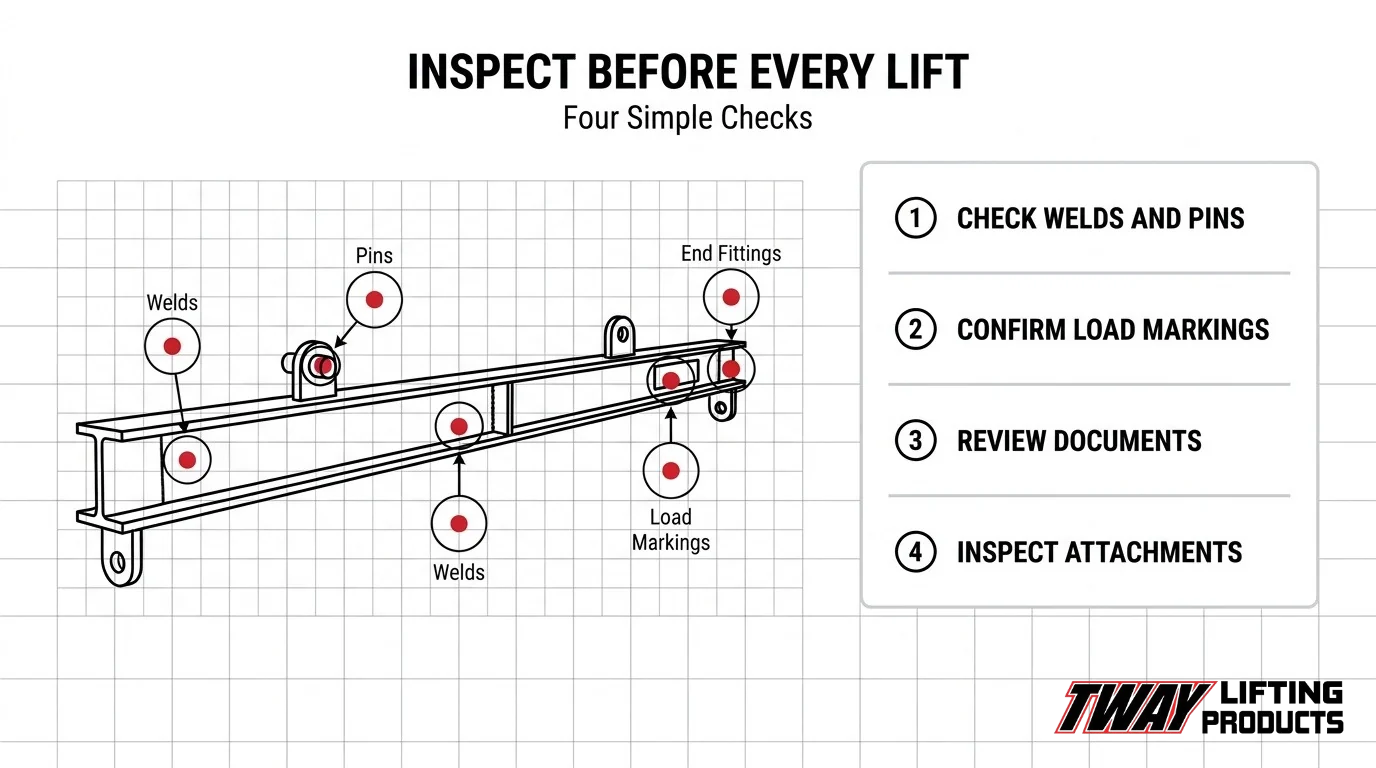
Pre-use inspections on a spreader bar should include verifying structural integrity, checking all attachment points, confirming WLL markings, and reviewing documentation. According to the SLAC National Accelerator Laboratory Environment, Safety & Health Division, operators and riggers are responsible for conducting pre-use inspections, while equipment custodians are responsible for ensuring equipment is marked and fabricated correctly.
Before each use, inspect the following:
- Welds, pins, and end fittings for cracks, deformation, or corrosion
- WLL and manufacturer markings are legible and match the lift plan
- Traceable documentation, including the current inspection and load test date
- Sling attachment hardware for wear or damage
What Are the Rigging Rules for Attaching Slings to a Spreader Bar?
The rigging rules for attaching slings to a spreader bar require that slings are securely fastened, properly rated, and protected against load edges. Per 29 CFR §1910.184(c)(6)-(7), slings shall be securely attached to their loads and padded or protected from sharp edges.
Key attachment rules include:
- Match each sling’s WLL to the load share it will carry
- Use shackles or hooks rated for the applied load angle
- Pad slings where they contact sharp load edges or corners
- Never allow slings to twist, knot, or run across each other at the spreader end fittings
What Are the Load Angle Restrictions When Using a Spreader Bar?
The load angle restrictions when using a spreader bar require that the rated load be calculated using the formula: rated load equals vertical capacity multiplied by the sine of the minimum horizontal angle. The Pacific Northwest National Laboratory Hoisting and Rigging Manual specifies sine values of 0.500 at 30°, 0.707 at 45°, and 0.866 at 60°.
In practice, this means:
- Sling angles below 30° from horizontal reduce rated capacity by 50% or more
- Always use the manufacturer’s angle-derated WLL, not the vertical-only rating
- Confirm the final rigging geometry before the lift begins, since field adjustments change the effective angle
Angle management is often where rigging errors go undetected, making it one of the highest-risk variables in any spreader bar lift.
What Are the Operator Responsibilities During a Spreader Bar Lift?
The operator responsibilities during a spreader bar lift include verifying the lift plan, communicating with the rigging crew, monitoring load stability, and stopping the lift if hazards arise. The Canadian Centre for Occupational Health and Safety (CCOHS) states that lift plans must outline how the load will be rigged and must be developed and approved before the lift begins.
Specific operator duties include:
- Confirm load weight and center of gravity before attaching rigging
- Ensure all personnel are clear of the lift zone before hoisting
- Monitor the load for tipping, swinging, or unexpected movement during the lift
- Call for an immediate stop if any rigging component shows signs of distress
When Should a Spreader Bar Be Taken Out of Service?
A spreader bar should be taken out of service immediately when any inspection reveals a defect that is, or could become, a danger to personnel. The Health and Safety Executive (HSE) states that when a defect is identified during examination, the equipment must not be used until the defect is remedied.
Remove a spreader bar from service if any of the following conditions are present:
- Visible cracks, bends, or deformation in the beam or end fittings
- Missing, illegible, or incorrect WLL markings
- Corrosion or pitting that reduces structural cross-section
- Damaged or missing pins, shackle holes, or attachment hardware
- Expired or missing inspection documentation
With these guidelines in place, using a certified rigging partner adds an additional verification layer before every critical lift.
What Standards and Regulations Govern Spreader Bar Use?
Spreader bar use in the United States falls under two primary regulatory frameworks: ASME standards for device design and marking, and OSHA regulations for rigging operations. The section below covers each framework separately.
What ASME Standards Apply to Below-the-Hook Lifting Devices?
ASME standard B30.20 applies to below-the-hook lifting devices, covering marking, construction, installation, inspection, testing, maintenance, and operation of devices used to attach loads to a hoist. Spreader bars fall within this scope. According to ASME B30.20-2025, below-the-hook lifting devices must be in good condition, carry traceable documentation with a current inspection and load test date, and be marked by the manufacturer with the name or trademark, rated capacity, weight if over 100 pounds, and applicable drawing and serial numbers. These marking requirements make compliance straightforward to verify during pre-use inspection, which is why treating documentation as a first-check habit rather than a formality is worth the effort.
What OSHA Regulations Cover Spreader Bar Rigging Operations?
The OSHA regulations covering spreader bar rigging operations are found primarily in 29 CFR §1926.251 and 29 CFR §1910.184. Under 29 CFR §1926.251(a)(1), rigging equipment for material handling must be inspected prior to use on each shift and as necessary during use to confirm it is safe. Custom lifting accessories must be marked with safe working loads and proof-tested to 125 percent of rated load before use. Under 29 CFR §1910.184(c)(6)-(7), slings must be securely attached to their loads and padded or protected from sharp edges.
What Are Common Mistakes Made When Using a Spreader Bar?
Common mistakes made when using a spreader bar include exceeding the rated working load limit, rigging at incorrect sling angles, skipping pre-use inspections, and failing to develop a formal lift plan. The section below details each error and its consequences.
Overloading Beyond the Working Load Limit
Overloading a spreader bar is one of the most direct causes of catastrophic lift failure. Each bar carries a stamped WLL that reflects its safe capacity under defined conditions; exceeding it, even briefly, risks structural collapse of the bar or its connecting hardware.
According to the U.S. Department of Energy’s Hoisting and Rigging Fundamentals, spreader bars eliminate the hazard of load tipping and sling crushing only when used within their rated parameters. Ignoring those parameters removes every safety advantage the tool provides. In practice, riggers often underestimate load weight or fail to account for dynamic forces during pick-up, both of which push real loads beyond the rated limit without warning.
Using Incorrect Sling Angles
Incorrect sling angles are a critical rigging error because angle directly reduces usable load capacity. According to FEMA’s National Urban Search and Rescue guidance, the angle of a rigging attachment in relation to the lifting point greatly affects vertical and horizontal forces on both the anchor and the strap itself.
The Pacific Northwest National Laboratory Hoisting and Rigging Manual states the formula clearly: rated load equals vertical capacity multiplied by the sine of the minimum horizontal angle. At 30 degrees, that sine value is only 0.500, cutting effective capacity in half compared to a 90-degree vertical configuration. Riggers who do not calculate or verify sling angles before the lift routinely underutilize rated capacity or, worse, overstress components without realizing it.
Skipping Pre-Use Inspections
Skipping pre-use inspections is a regulatory violation and a preventable cause of equipment failure. Under 29 CFR §1926.251(a)(1), rigging equipment for material handling must be inspected prior to use on each shift and as necessary during use to ensure it is safe.
Inspections should check for cracks, deformation, corrosion, and legible WLL markings. The Health and Safety Executive states that when a defect is identified that is or could become a danger, the equipment must not be used until remedied. A spreader bar lifted into service with an undetected crack or missing load marking creates an invisible hazard for everyone on the job site.
Failing to Create a Formal Lift Plan
Failing to create a formal lift plan leaves rigging decisions to chance rather than engineering. According to the Canadian Centre for Occupational Health and Safety, lift plans outline how the load will be rigged and must confirm that lifting equipment, slings, and rigging hardware are appropriate for the type and weight of the load, considering hitch method, sling types, angles, working load limit, and other contributing factors.
Without a written plan reviewed by a competent person, teams frequently select the wrong bar length, miscalculate the center of gravity, or use mismatched hardware. These errors compound quickly once the load is in the air, when corrections become dangerous and costly. A written lift plan is not paperwork for its own sake; it is the single document that aligns every decision before the hook is ever engaged.
How Do You Choose the Right Spreader Bar for a Lift?
Choosing the right spreader bar depends on three interconnected factors: load weight, load geometry and fragility, and available lifting height. The following sections address each factor with specific selection guidance.
How Does Load Weight Determine Which Spreader Bar to Use?
Load weight determines which spreader bar to use by establishing the minimum required Working Load Limit (WLL) for the entire rigging assembly. Every spreader bar carries a marked rated capacity, and the selected bar must meet or exceed the total lifted weight under the planned rigging configuration.
According to the Canadian Centre for Occupational Health and Safety, lift plans must confirm that lifting equipment, slings, and rigging hardware are appropriate for the type and weight of the load, considering hitch method, sling types and angles, and other factors that could impact the lift. Because sling angle reduces effective capacity, the bar’s rated WLL must account for the worst-case angle geometry, not just the gross load weight. Selecting a bar rated exactly at the load weight leaves no margin for rigging geometry losses.
How Does Load Shape or Fragility Influence Spreader Bar Selection?
Load shape or fragility influences spreader bar selection by determining the number of attachment points needed, the required span between lift points, and whether the bar must prevent compressive crushing forces on the load.
Key selection considerations based on load characteristics include:
- Wide or long loads require sufficient bar length to position lift points directly above the load’s structural members or engineered pick points.
- Fragile or surface-sensitive loads benefit from spreader bars because, as noted by the U.S. Department of Energy, they eliminate the tendency of slings to crush the load.
- Loads with multiple attachment points may require a modular or adjustable spreader bar to match variable pick-point spacing.
- Asymmetric loads may need an adjustable bar or a custom assembly to keep the hook centered over the center of gravity.
Overlooking load geometry is one of the most common selection errors in practice. Even a correctly rated bar will perform unsafely if its span does not align with the load’s actual structural pick points.
How Does Lifting Height and Headroom Factor Into Spreader Bar Choice?
Lifting height and headroom factor into spreader bar choice by controlling the total vertical space consumed by the crane hook, top slings, the bar itself, and the bottom slings combined. Where overhead clearance is limited, a compact bar with shorter sling legs may be required, but shorter slings increase the sling angle, which directly reduces the rated load capacity of the assembly.
The practical tradeoff is straightforward: tighter headroom forces steeper sling angles, and steeper angles demand a higher-rated bar to handle the same load. Sites with generous headroom allow flatter angles and more efficient use of the bar’s rated capacity. Before finalizing bar selection, riggers should calculate the total hook-to-load distance and confirm it fits within the available lift height, then verify the resulting sling angles fall within the bar manufacturer’s rated angle limits.
How Can Tway Lifting Support Your Spreader Bar and Rigging Needs?
Tway Lifting supports spreader bar and rigging needs through custom fabrication, equipment rental, and expert consultation. The sections below cover Tway’s specific offerings and a summary of key article takeaways.
Does Tway Lifting Offer Custom Fabrication or Rental of Spreader Bars?
Tway Lifting offers both custom fabrication and rental of spreader bars, serving customers nationally from its Indianapolis and Fort Wayne, Indiana locations. The rental inventory includes spreader beams rated from 2 to 100 tons, in lengths up to 40 feet, available for daily, weekly, or monthly terms, with free nationwide delivery and pickup available.For non-standard lifts, Tway Lifting fabricates custom wire rope slings and special lifting assemblies to meet specific load requirements. According to FEMA’s National Urban Search and Rescue guidance, strap and cable attachment angles directly affect vertical and horizontal forces on anchor points, making properly spec’d rigging hardware essential. With over 75 years of experience, Tway Lifting provides the technical knowledge to match the right equipment to every lift configuration.
What Are the Key Takeaways About Spreader Bar Uses, Types, and Safety Guidelines We Covered?
The key takeaways about spreader bar uses, types, and safety guidelines are centered on three priorities: selecting the right equipment, rigging it correctly, and inspecting it before every use. Spreader bars control sling angles, protect fragile loads, and prevent tipping or crushing. Equipment selection depends on load weight, shape, headroom, and required WLL. Types range from fixed and adjustable to modular and pipe designs, each suited to different applications. ASME B30.20, OSHA 29 CFR §1926.251, and proper lift planning govern compliant operations. Sling angle management is non-negotiable: shallow angles multiply sling tension and reduce effective capacity. Pre-use inspection, documentation, and operator accountability form the foundation of every safe lift.