








A lifting configuration is the specific arrangement of slings, hardware, and attachment points used to connect a load to a crane or hoist for a controlled lift. The two most common configurations are 2-point and 4-point setups, each suited to different load types, weight distributions, and jobsite conditions.
This guide covers how each configuration works mechanically, how to compare and choose between them, what OSHA and safety requirements govern each setup, which industries rely on them, and how to select the right rental provider and hardware for your application.
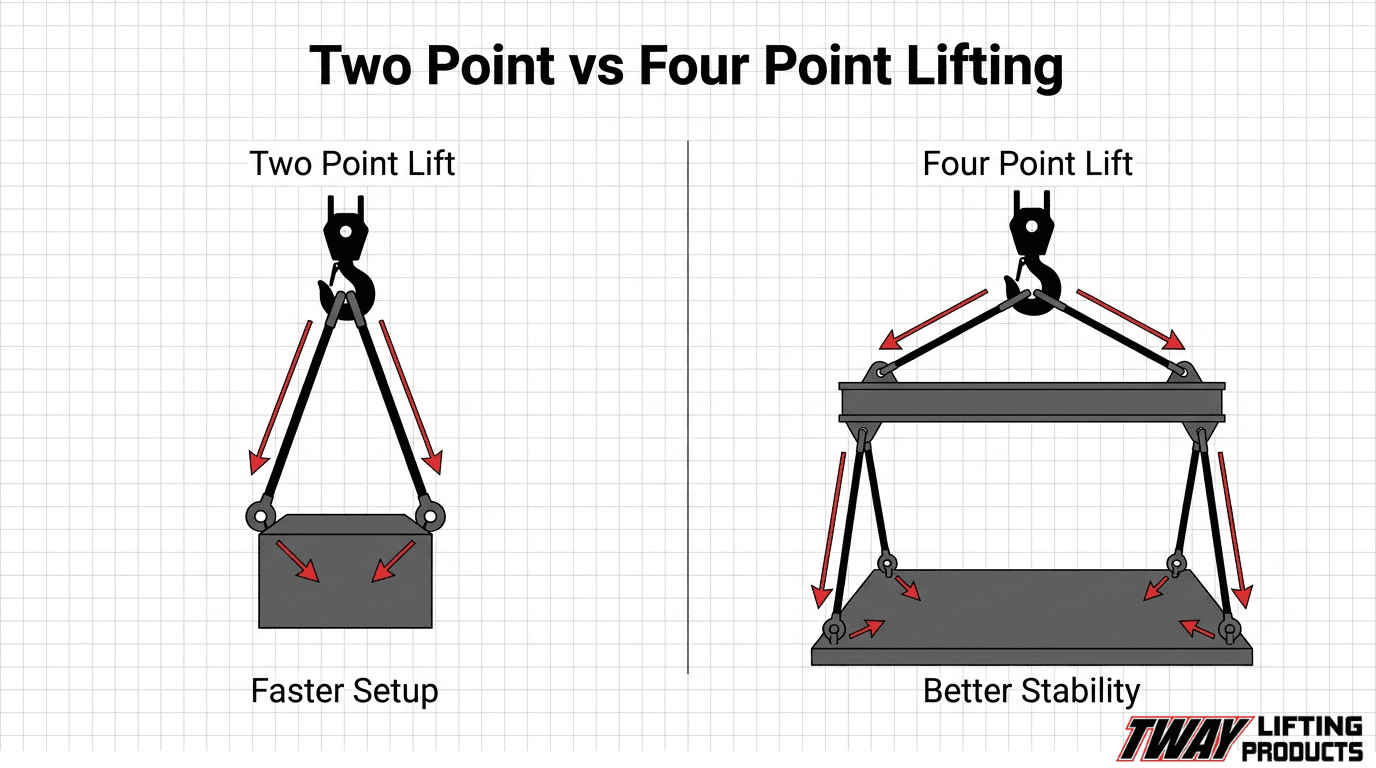
A 2-point lift divides the total load across two sling legs, making it faster to rig and well-suited for compact, balanced loads. Sling angle is the most critical variable; shallow angles increase tension on each leg significantly, which directly reduces the system’s usable capacity.
A 4-point lift distributes weight across four attachment points, providing the stability that long, wide, or irregularly shaped loads require. Spreader bars and lifting frames are central to controlling sling geometry and preventing inward compression forces across all four legs.
Both configurations are governed by OSHA 29 CFR 1926.251 and ASME B30.20, which require pre-lift inspection before every shift, removal of defective equipment from service, and compliance with rated sling capacities at actual working angles.
Industries including construction, mining, automotive manufacturing, and utilities each use these configurations for distinct load types, from structural steel panels to stamping dies and transformer tanks. Tway Lifting, a rigging manufacturer and distributor headquartered in Indianapolis, Indiana, has supplied lifting equipment to industrial sectors across all of these industries since 1945, including major construction projects such as Lucas Oil Stadium. Selecting a rental provider with inspection-certified equipment, custom fabrication capability, and a full hardware inventory is essential to maintaining compliance and lift safety on any application.
What Is a Lifting Configuration in Rigging?
A lifting configuration in rigging is the specific arrangement of slings, hardware, and attachment points used to connect a load to a crane or hoist for a controlled lift. The configuration determines how load forces are distributed across the rigging system, directly affecting lift stability, sling tension, and safety. Common configurations include 2-point and 4-point setups, each suited to different load types and jobsite conditions.
What Is a 2-Point Lifting Configuration?
A 2-point lifting configuration uses two attachment points to suspend a load from a crane or hoist. The sections below cover how load distribution works, what equipment is required, and what weight capacity limits apply.
How Does a 2-Point Lift Distribute Load?
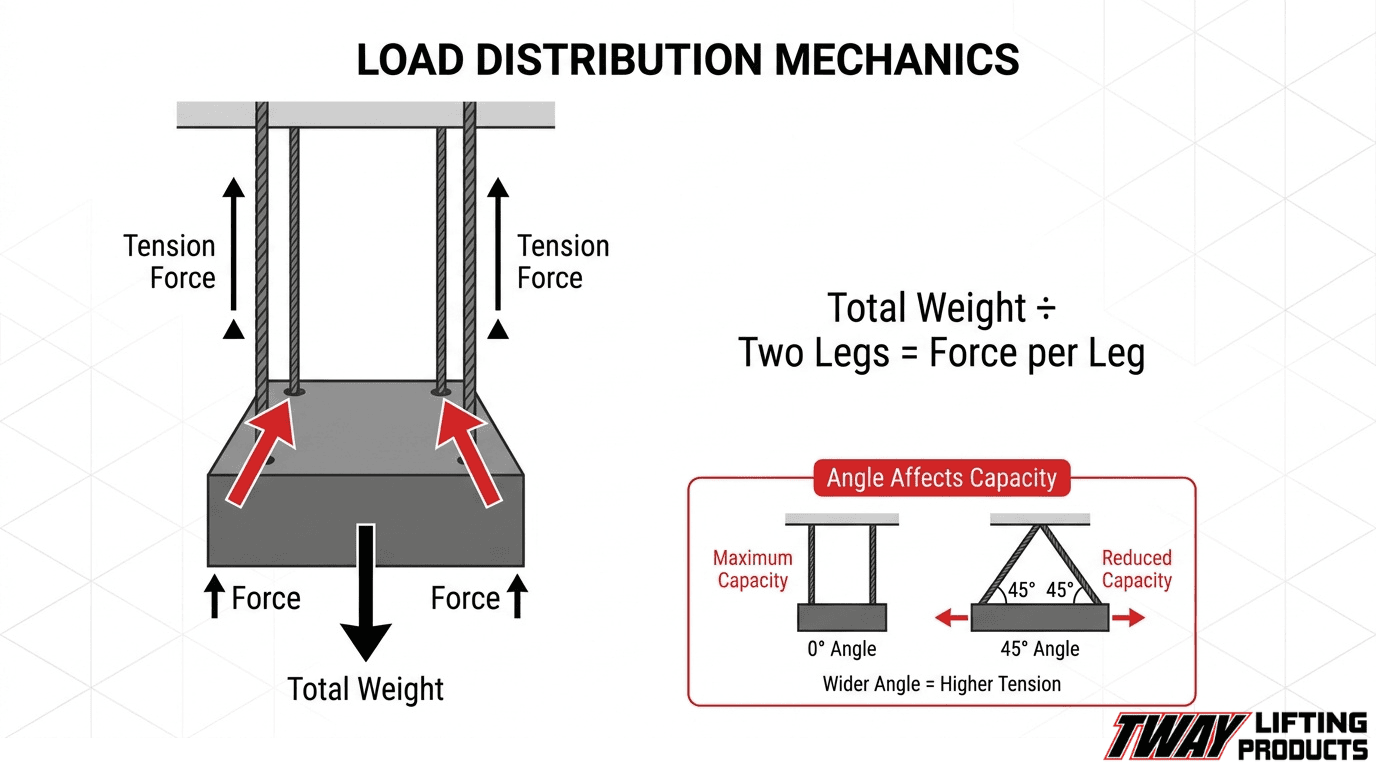
A 2-point lift distributes load by dividing the total weight between two sling legs or attachment points connected to a single lift point above. Each leg carries roughly half the load under ideal conditions, but this balance depends on the load’s center of gravity staying centered between both attachment points. According to Industrial Training International (ITI), the load must remain controlled, secure, and stable throughout the lift, as uncontrolled movement can cause loss of the load or collateral damage. Load monitoring hardware, such as load cells, helps verify real-time tension across both legs during critical lifts.
What Equipment Makes Up a 2-Point Lifting Setup?
A 2-point lifting setup consists of two slings, two shackles, a crane hook or master link, and the load attachment hardware at each pickup point. Common sling types include wire rope slings, chain slings, and synthetic slings. A spreader bar is frequently added to keep sling legs vertical and prevent inward compression forces on the load. Shackles connect each sling leg to the load’s lifting lugs or pad eyes, while the master link or hook gathers both legs at the top.
What Are the Weight Capacity Limits of a 2-Point Lift?
The weight capacity limits of a 2-point lift depend heavily on sling angle, rated sling capacity, and hardware working load limits. Sling angle is the most critical variable. According to Ashley Sling, a horizontal sling angle of 30 degrees increases sling tension by a factor of 2, effectively doubling the load felt by each sling compared to a vertical 90-degree lift. This means a sling rated for 10,000 lbs vertically can only safely carry 5,000 lbs at 30 degrees. Always select slings and hardware rated above the calculated sling tension, not just the total load weight.
What Is a 4-Point Lifting Configuration?
A 4-point lifting configuration uses four attachment points distributed across a load to divide weight evenly and maintain stability during a lift. The following sections cover how load is distributed across the four legs, what equipment makes up the setup, and applicable weight capacity limits.
How Does a 4-Point Lift Distribute Load?
A 4-point lift distributes load by dividing the total weight across four sling legs, each connected to a dedicated attachment point on the load. This spread reduces the force carried by any single leg and minimizes lateral stress on the load’s structure. Loads with length, width, or off-center weight benefit most from this arrangement, as the four contact points resist rotation and tipping throughout the lift. According to Industrial Training International, the load must remain controlled, secure, and stable throughout the entire duration of any lift, as uncontrolled movement can cause loss of the load or collateral damage. Four-point configurations achieve this stability through symmetric load distribution that two-point setups simply cannot match for large or wide loads.
What Equipment Makes Up a 4-Point Lifting Setup?
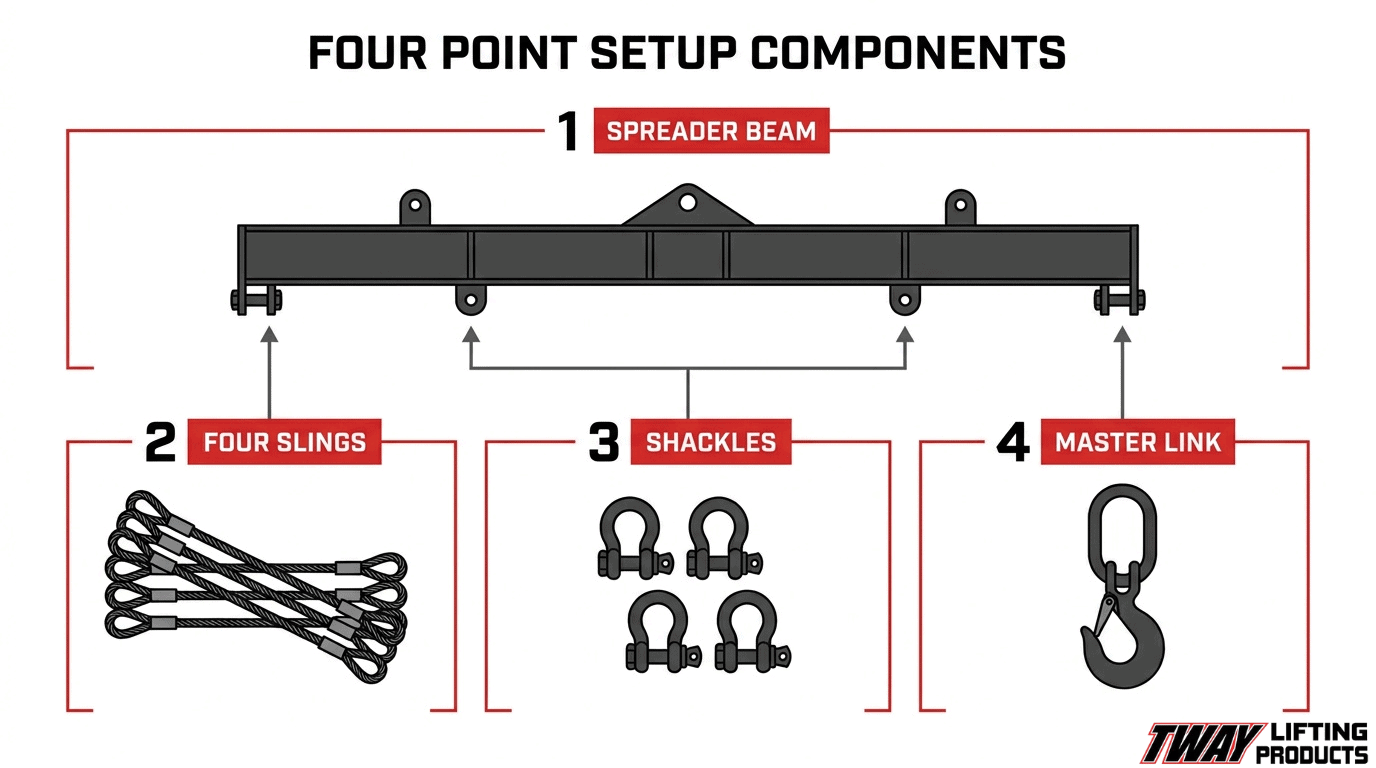
The equipment in a 4-point lifting setup includes four slings, a spreader bar or lifting frame, shackles, and a crane hook or hoist. A spreader bar is a horizontal beam with attachment points at each end that prevents inward sling compression and maintains correct sling geometry across all four legs. According to Hercules Lifting, a spreader bar is specifically designed to evenly distribute the load of a lifted object and create a stable, controlled lifting environment. Each sling leg connects from the spreader bar or lifting frame down to a dedicated pick point on the load. When selecting rigging equipment, the rated capacity of each component must exceed the calculated load share for that leg.
What Are the Weight Capacity Limits of a 4-Point Lift?
The weight capacity limits of a 4-point lift depend on the rated capacity of each individual sling leg, the shackles, the spreader bar, and the crane or hoist above. Because all four legs share the total load, each component only needs to carry a fraction of the gross weight, which allows 4-point configurations to handle heavier or more awkward loads than equivalent 2-point setups. However, sling angle directly affects the force each leg experiences. A sling angle of 30 degrees from horizontal doubles the tension on that leg compared to a vertical lift, according to Ashley Sling, meaning shallower angles effectively reduce the system’s usable capacity. Riggers must calculate leg tension at actual working angles, not rated vertical capacity alone, to confirm the configuration stays within safe limits.
How Do 2-Point and 4-Point Lifts Compare?
The two configurations differ primarily in how they distribute load, how safely they handle large or awkward shapes, and how quickly a crew can rig them. The H3s below address each comparison directly.
Which Configuration Handles Uneven Load Distribution Better?
The configuration that handles uneven load distribution better is the 4-point lift. Four attachment points spread force across a wider footprint, reducing the concentration of tension at any single connection. With a 2-point setup, off-center loads create unequal sling tension, raising the risk of tipping or slippage. According to OSHA’s sling use guidance, the horizontal angle between an inclined leg and the horizontal plane directly impacts rated sling capacity, so shallower angles in an uneven 2-point rig compound the problem. In practice, any load whose center of gravity cannot be confirmed directly between two lift points should default to a 4-point configuration.
Which Configuration Is Safer for Long or Wide Loads?
The configuration that is safer for long or wide loads is the 4-point lift. Four attachment points create a stable, rectangular rigging pattern that resists rotation and bending stress along the load’s length. A 2-point setup concentrates all force on two locations, which can induce structural flex or torsion in beams, panels, or tanks. Spreader bars paired with a 4-point arrangement provide additional lateral control, keeping sling angles favorable and preventing inward load compression during the lift.
Which Configuration Requires Less Setup Time?
The configuration that requires less setup time is the 2-point lift. Two slings, two shackles, and a single lift point mean fewer connections to inspect, adjust, and verify before the hook goes up. A 4-point setup requires attaching and equalizing four legs, confirming balanced tension across all connections, and often adding hardware such as a spreader beam or lifting frame. For compact, symmetrical loads where a 2-point rig is geometrically appropriate, the reduced component count translates directly into faster mobilization on the jobsite.
When Should You Use a 2-Point vs 4-Point Lifting Configuration?
The right lifting configuration depends on load weight, load shape, rigging geometry, and jobsite constraints. The sections below cover when each configuration fits best, how load shape drives the decision, and how environmental factors at the jobsite affect your choice.
When Is a 2-Point Lift the Right Choice?
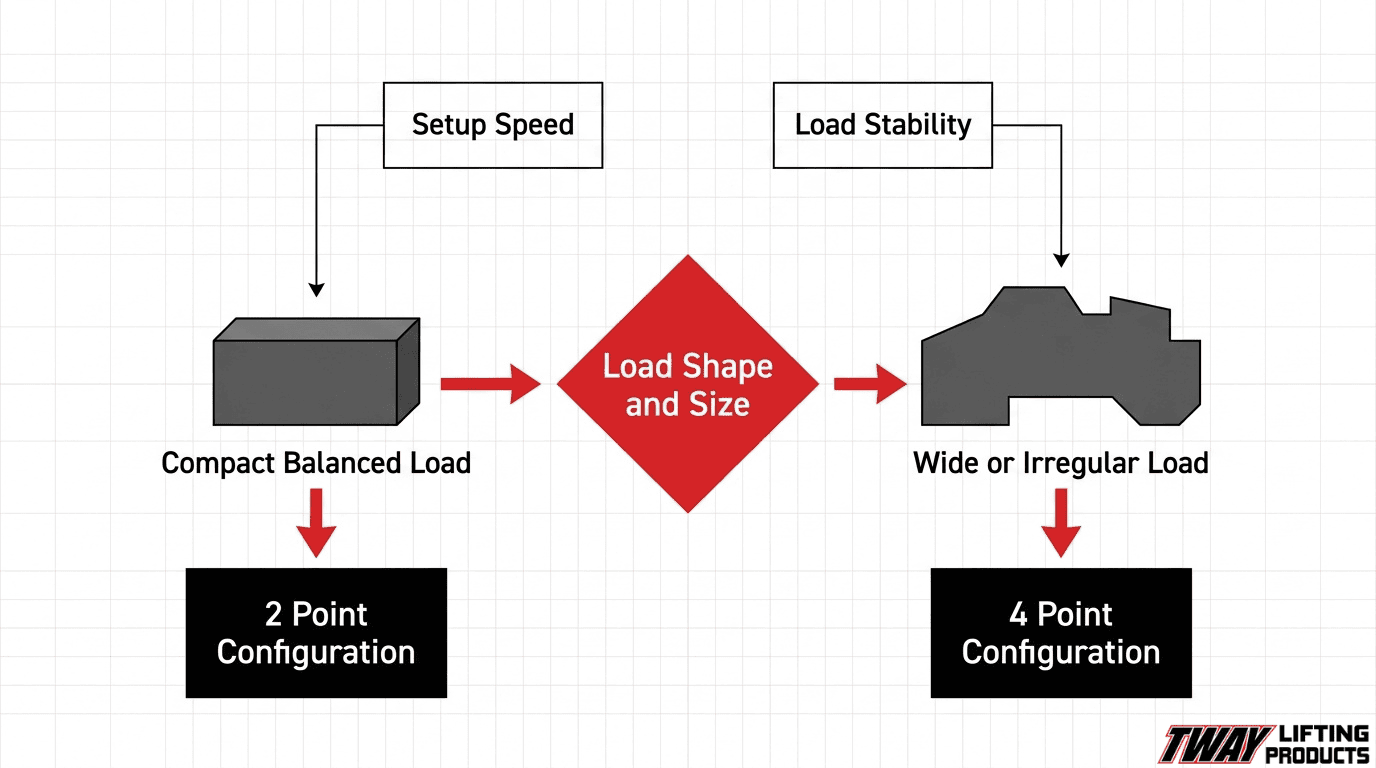
A 2-point lift is the right choice when the load is compact, symmetrically shaped, and has a clearly centered center of gravity. It requires less rigging hardware, sets up faster, and suits straightforward overhead picks where both attachment points align directly above the load’s balance point.
Loads such as structural beams, machinery frames, or prefabricated panels with balanced weight distribution lift cleanly on two legs. When rigging equipment is selected, it is usually better to use gear with a rated capacity higher than the total weight of the load, making correct sling selection critical even on simple two-point picks.
When Is a 4-Point Lift the Right Choice?
A 4-point lift is the right choice when the load is large, flat, wide, or irregularly distributed across its footprint. Four attachment points spread rigging forces across a broader area, reducing the load per leg and improving horizontal stability during the pick.
Large equipment skids, steel tanks, modular panels, and wide structural sections are strong candidates for four-point configurations. The added stability that four legs provide is especially valuable when the load is sensitive to tipping or tilting during the lift. In my experience, teams that underestimate load width frequently discover mid-lift instability that a 4-point setup would have prevented entirely.
When Does Load Shape Determine the Configuration?
Load shape determines the configuration when the object’s geometry creates uneven rigging attachment geometry or requires sling legs to spread at wide angles. A spreader bar is a horizontal device designed to evenly distribute the load of a lifted object, with attachment points at each end that create a stable and controlled lifting environment, according to Hercules Lifting.
Long, narrow loads such as pipes or structural members benefit from a 2-point spreader bar arrangement. Wide, rectangular loads with four defined lift points, such as large machinery bases, require a 4-point configuration to prevent lateral swing and sling convergence forces from concentrating stress.
When Does the Jobsite Environment Drive the Decision?
The jobsite environment drives the configuration decision when overhead clearance, crane radius, or ground obstructions restrict how sling legs can be positioned or how far apart attachment points can spread. Tight indoor bays, low ceilings, and congested work areas often favor a 2-point configuration with a spreader bar to keep sling angles vertical and maintain rated capacity.
Outdoor lifts with ample vertical clearance and wider crane reach allow 4-point setups where load stability outweighs the added rigging time. According to ITI, uncontrolled movements during a lift can result in loss of the load or collateral damage, making environment-driven configuration choices a safety imperative, not just a convenience decision.
What Are the OSHA and Safety Requirements for Each Configuration?
OSHA and safety requirements for each configuration center on rigging inspection, load control standards, and compliance with established industry codes. The sections below cover applicable standards for 2-point setups, 4-point setups, and pre-lift inspection procedures.
What OSHA Standards Apply to 2-Point Lifting Setups?
The OSHA standards that apply to 2-point lifting setups include rigging inspection requirements under 29 CFR 1926.251 and equipment guidelines governed by ASME B30.20. According to ANSI, ASME B30.20-2025 covers below-the-hook lifting devices, including structural and mechanical lifting devices, vacuum lifters, magnets, grapples, and clamps, with provisions for marking, construction, installation, inspection, testing, maintenance, and operation. In a 2-point configuration, every component in the load path, including slings, shackles, and hooks, must meet rated capacity requirements before the lift begins. Given that 2-point setups concentrate force across two attachment points, compliance with sling angle load factors is especially critical for maintaining safe working loads.
What OSHA Standards Apply to 4-Point Lifting Setups?
The OSHA standards that apply to 4-point lifting setups are the same foundational regulations governing all rigging operations, primarily 29 CFR 1926.251, with additional engineering controls required due to the increased number of attachment points. Four-point configurations introduce load sharing variables, meaning each leg must be individually rated, inspected, and matched to the load’s weight distribution. Hardware such as master links, equalizer plates, and shackles must be certified for the intended capacity. Rigging personnel must verify that no single leg exceeds its working load limit due to unequal load distribution across the four attachment points.
What Are the Inspection Requirements Before Each Lift?
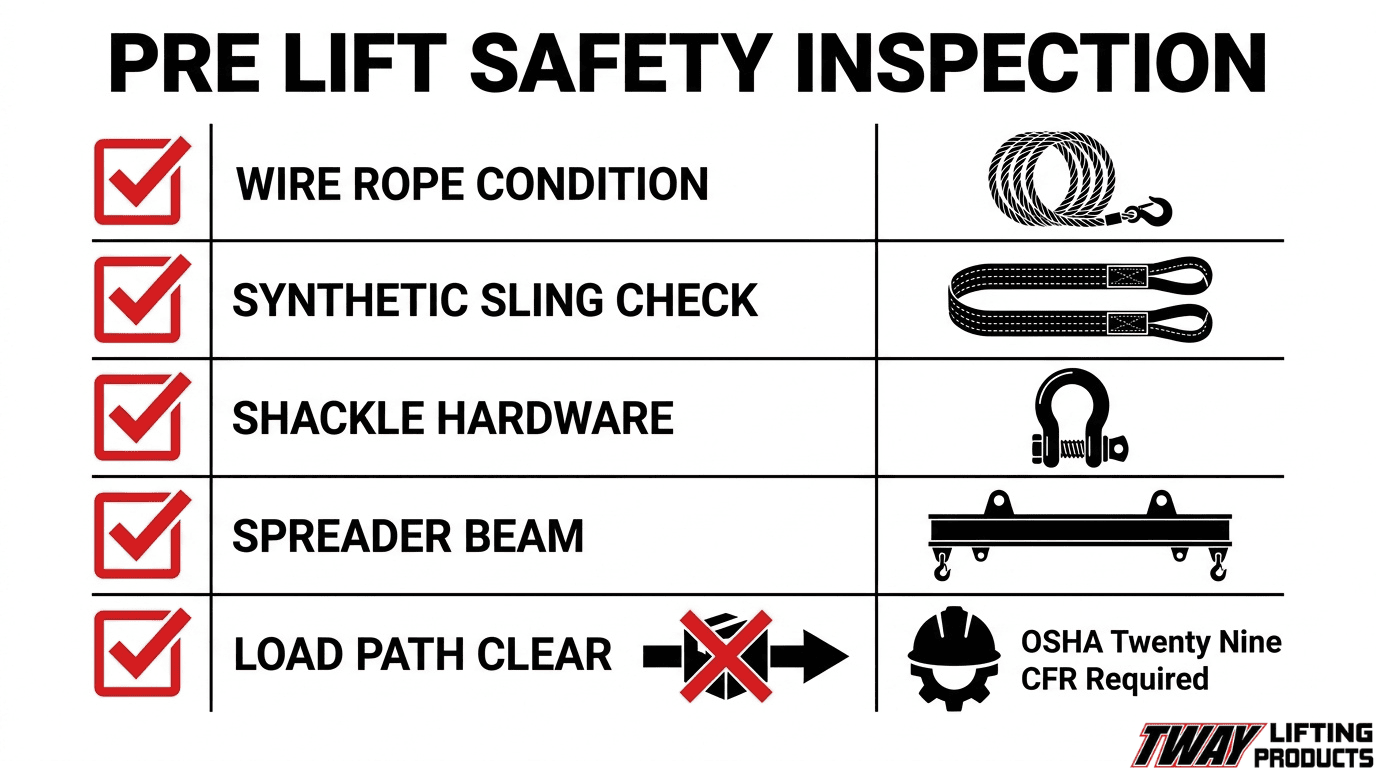
The inspection requirements before each lift are defined under OSHA 29 CFR 1926.251, which mandates that rigging equipment be inspected prior to use on each shift and as necessary during use, with defective equipment removed from service immediately. A thorough pre-lift inspection covers the following items:
- Wire rope slings: Remove from service if there are 10 or more broken wires in one lay length, five or more broken wires in one strand, or any kinking, bird caging, or severe corrosion, per Certified Safety Experts’ rigging inspection checklist.
- Synthetic slings: Inspect for cuts, abrasion, heat damage, chemical degradation, and distorted fittings.
- Shackles and hardware: Confirm pins are properly secured, threads are undamaged, and rated capacities are legible.
- Spreader beams and lifting frames: Check for cracks, deformation, and secure connection points.
- Load path: Verify that all components are aligned, seated correctly, and free from obstructions before the hoist takes tension.
Consistent pre-lift inspection is the single most controllable safety variable on any jobsite, regardless of whether a 2-point or 4-point configuration is used. Tway Lifting provides professional rigging inspection services performed by certified specialists, covering OSHA-required annual inspections, job site safety inspections, and detailed reporting for both rental and customer-owned equipment.
What Industries Commonly Rent 2-Point or 4-Point Lifting Configurations?
Industries that commonly rent 2-point or 4-point lifting configurations include construction, mining, automotive manufacturing, and utilities. Each sector presents distinct load types and jobsite conditions that drive configuration selection.
How Are Lifting Configurations Used in Construction?
Lifting configurations are used in construction to position structural steel, precast concrete panels, and mechanical equipment during building assembly. Two-point setups handle symmetrical beam lifts efficiently, while 4-point configurations stabilize wide or irregularly shaped panels where tipping risk is high. Projects like stadiums and large commercial builds depend on precise, controlled rigging to keep crews and structures safe.
How Are Lifting Configurations Used in Mining?
Lifting configurations are used in mining to install, reposition, and recover heavy machinery such as crushers, conveyors, and pump assemblies in confined or remote environments. Four-point setups are common when lowering bulky equipment into shafts or pits, distributing load across multiple attachment points to prevent shifting during descent.
How Are Lifting Configurations Used in Automotive Manufacturing?
Lifting configurations are used in automotive manufacturing to transfer large dies, engine blocks, and assembly fixtures between production stations. Four-point configurations are preferred for oversized stamping dies because they prevent flex and twisting that could damage precision tooling. Consistent load control at every attachment point is essential in high-throughput facilities where downtime is costly.
How Are Lifting Configurations Used in Utilities?
Lifting configurations are used in utilities to install transformers, generators, and transmission equipment on substations and tower sites. Two-point lifts suit cylindrical transformer tanks with balanced weight distribution, while 4-point setups accommodate rectangular switchgear cabinets or multiple-component assemblies that require stable, level positioning throughout the lift.
What Rigging Hardware Is Needed for Each Rental Configuration?
The rigging hardware needed for each rental configuration depends on the number of lift points, load geometry, and sling angle requirements. The sections below cover sling selection for 2-point and 4-point setups, plus the shackles and connecting hardware that complete each assembly.
What Slings Are Required for a 2-Point Lift Rental?
The slings required for a 2-point lift rental are typically wire rope slings or synthetic slings rated for the full load weight at the planned rigging angle. A 2-point configuration concentrates the entire load across two attachment points, so each sling must be rated well above half the gross load to account for sling angle tension. Selecting rigging equipment with a rated capacity higher than the total load weight is a recognized best practice, according to Holloway Houston Lifting. Wire rope slings and polyester or nylon synthetic slings are both common choices, with synthetic slings preferred where load surface protection matters.
What Slings Are Required for a 4-Point Lift Rental?
The slings required for a 4-point lift rental are four matched-length slings, commonly wire rope or chain slings, selected to maintain balanced tension across all attachment points. Because load distribution across four legs depends on consistent sling length and equal angles, mismatched slings can cause uneven loading. A spreader bar, which is a horizontal beam with attachment points at each end designed to distribute load evenly, is often paired with 4-point configurations to control leg angles and stabilize the lift.
What Shackles and Hardware Complete Each Configuration?
The shackles and hardware that complete each configuration include bow shackles, dee shackles, master links, and connecting rings sized to the working load limit of the sling assembly. Shackles serve as the primary connection between sling eyes and crane hooks or lifting beams, and every component in the assembly must match or exceed the rated capacity of the weakest link. Tway Lifting rents shackles, spreader beams ranging from 2 to 100 tons, load cells, and telescopic adjustable-length bars to support both 2-point and 4-point rental setups.
What Should You Ask a Lifting Equipment Rental Provider?
Choosing the right rental provider requires asking targeted questions about compliance, inspection services, and configuration flexibility. The key areas to evaluate cover OSHA-compliant inspection practices and the provider’s ability to supply application-specific rigging setups.
Does the Rental Provider Offer OSHA-Compliant Inspection Services?
A rental provider offering OSHA-compliant inspection services ensures that every piece of equipment meets federal safety requirements before and after use. Under OSHA 29 CFR 1926.251, rigging equipment for material handling must be inspected prior to use on each shift, and defective equipment must be removed from service immediately.
Providers who maintain certified inspection specialists, deliver detailed inspection reports, and perform on-site job safety reviews remove a significant compliance burden from the renter. Tway Lifting offers professional rigging inspection services performed by certified specialists, including OSHA-required annual inspections, job site safety inspections, and detailed reporting.
Can the Provider Supply Custom or Application-Specific Configurations?
A provider that can supply custom or application-specific configurations gives renters access to rigging setups precisely matched to their load geometry, weight class, and job site conditions. Standard catalog options rarely account for irregular load shapes, restricted overhead clearance, or multi-point balance requirements. Tway Lifting offers custom fabrication of wire rope slings and special lifting assemblies alongside a rental inventory that includes spreader beams from 2 to 100 tons and telescopic adjustable-length bars, covering both standard and non-standard configuration needs.
Tway Lifting offers custom fabrication of wire rope slings and special lifting assemblies, alongside a rental inventory that includes spreader beams ranging from 2 to 100 tons and up to 40 feet in length, as well as telescopic adjustable-length bars. This combination of manufacturing capability and rental flexibility makes Tway Lifting one of the most practical partners for projects requiring precise, application-specific 2-point or 4-point configurations.
How Do You Rent the Right Lifting Configuration for Your Application?
Renting the right lifting configuration starts with matching equipment specifications to your load, environment, and compliance requirements. The following H3s cover how manufacturer-distributors improve rental safety and the key takeaways for choosing between 2-point and 4-point configurations.
Can Renting Lifting Configurations From a Manufacturer-Distributor Improve Safety?
Yes, renting lifting configurations from a manufacturer-distributor can improve safety by providing inspection-ready, compliant equipment sourced from personnel who understand both manufacturing standards and field conditions. Manufacturer-distributors like Tway Lifting maintain rental inventories that are regularly evaluated against OSHA removal-from-service criteria. According to Certified Safety Experts, wire rope slings must be removed from service when there are 10 or more broken wires in one lay length, five or more broken wires in one strand, or any kinking, bird caging, or severe corrosion. A distributor that also manufactures has direct knowledge of these failure modes, making their rental fleet considerably more reliable than a general equipment supplier’s stock.
What Are the Key Takeaways About 2-Point vs 4-Point Lifting Configurations for Rent?
The key takeaways about 2-point vs 4-point lifting configurations for rent are that load geometry, weight distribution, and jobsite constraints determine which configuration protects personnel and equipment. Practical conclusions from this article include:
- 2-point configurations suit compact, balanced loads where minimal setup time matters.
- 4-point configurations are necessary for long, wide, or unbalanced loads requiring stable control at all four attachment points.
- Sling angle directly affects rated capacity; shallow angles increase sling tension significantly.
- Pre-lift inspection is mandatory before every shift under OSHA 1926.251.
- Renting from a manufacturer-distributor like Tway Lifting gives access to certified equipment, compliant spreader beams, shackles, and slings, with same-day wire rope sling fabrication available.
Tway Lifting rents wire rope slings, synthetic slings, spreader beams from 2 to 100 tons, shackles, hoists, and load cells for daily, weekly, or monthly terms, with free local delivery and pickup.