






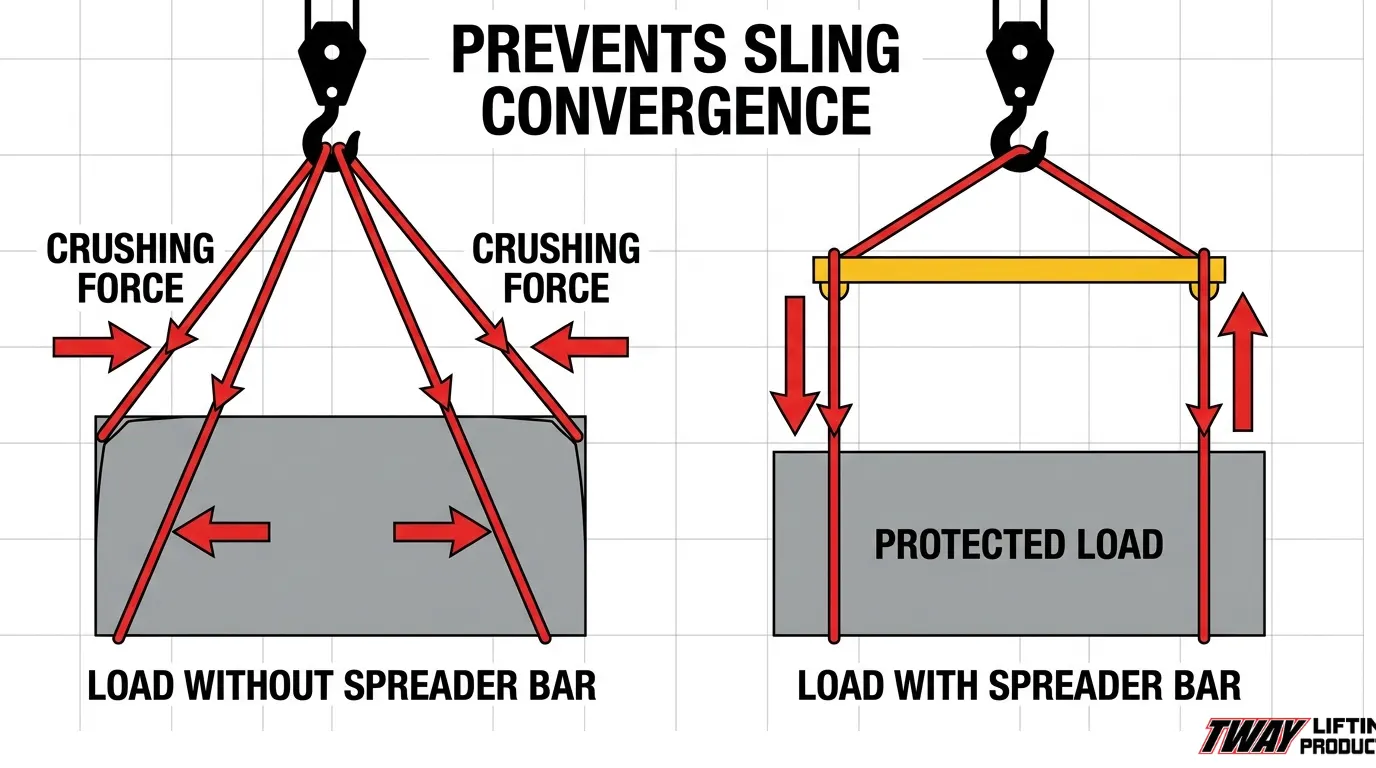
A spreader bar is a beam or bar used to hold apart two or more lifting slings that suspend a load with multiple attachment points, preventing the sling convergence that would otherwise crush or deform sensitive cargo. Because the bar carries the full applied load in compression, how it is stored between lifts directly affects its structural integrity and your compliance standing as the renter.
This guide covers what spreader bars do and why improper storage creates both damage and liability, where and how to position one on site, the environmental conditions that degrade steel and hardware, end fitting protection and daily inspection requirements, safe handling between storage and use, documentation obligations, and how Tway Lifting’s rental program supports compliant on-site use.
Spreader bars are the structural intermediary between a hoist and its load, so storage conditions that introduce corrosion, bending, or hardware loss compromise that function before the next lift begins. Improper storage can result in repair charges, regulatory violations under OSHA 29 CFR 1926.251, and disputed liability at return.
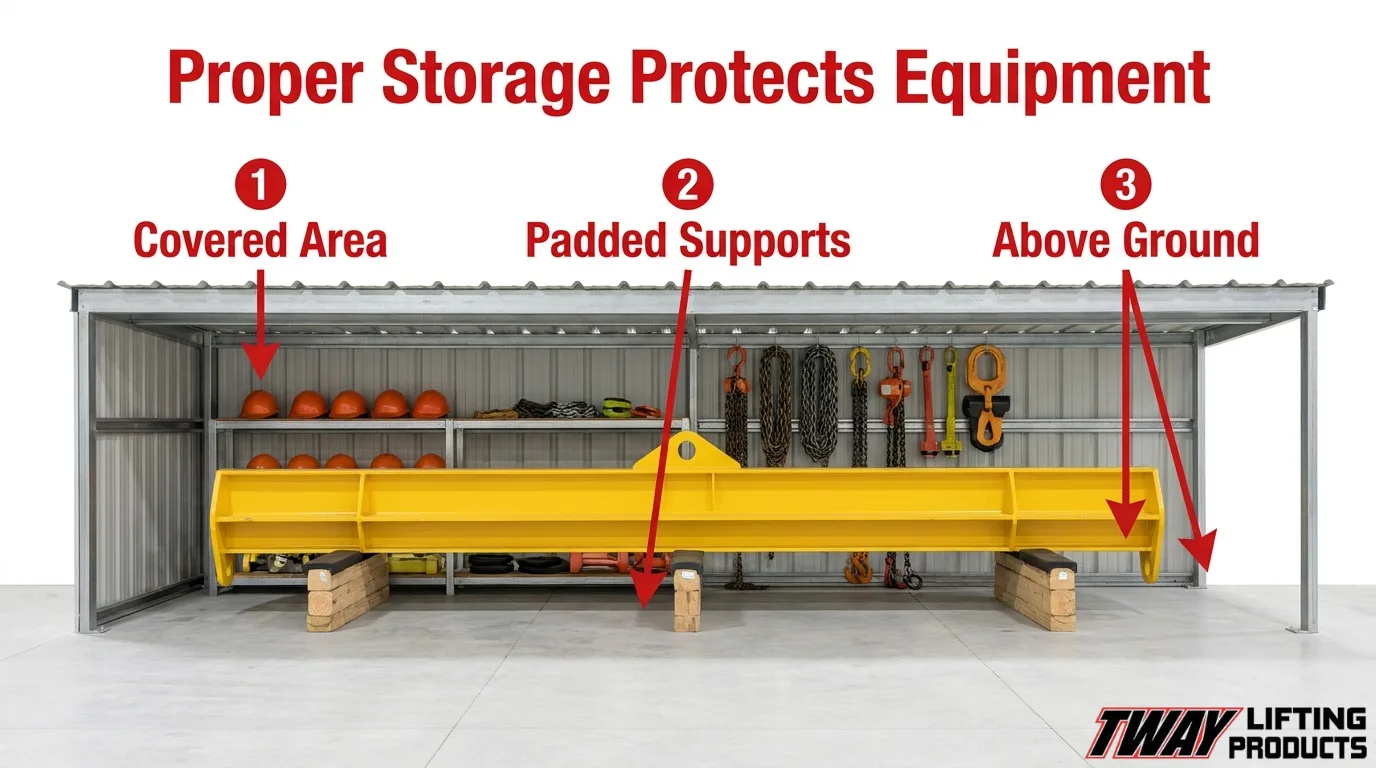
Dry, covered storage on padded supports above ground level is the baseline standard. The Electronic Code of Federal Regulations requires stored materials to be secured against sliding or collapse, and the Lifting Equipment Engineers Association specifies that storage areas must be free from contamination, temperature extremes, and moisture.
End fittings, threaded surfaces, shackle pins, and connection lugs require daily pre- and post-lift inspection, capping when not in use, and written shift logs that satisfy OSHA’s documented inspection requirements for below-the-hook lifting devices.
What Is a Spreader Bar and Why Does Proper Storage Matter?
A spreader bar is a load-distribution device used across rigging operations to protect both the load and the lifting slings. Understanding what it does, how damage occurs during storage, and what liability you carry as a renter shapes every handling decision on site.
What Is a Spreader Bar Used for in Rigging Operations?
A spreader bar is a beam or bar used for holding apart two or more lifting slings that suspend a load having two or more lifting attachments. It prevents sling convergence above the load, which would otherwise create inward compressive forces that can crush or deform sensitive cargo. According to the Naval Postgraduate School’s rigging definitions, a spreader may be suspended from a crane or hoist using one or more lifting attachments, making it a structural intermediary between the hoist and the load. Because the bar carries the full applied load in compression, its structural integrity is non-negotiable before every lift.
Why Can Improper Storage Damage a Rented Spreader Bar?
Improper storage damages a rented spreader bar by exposing its load-bearing components to conditions that degrade structural integrity before the next lift. The main load-bearing element in most spreader bars is seamless carbon steel pipe, which corrodes when stored in wet or chemically contaminated environments. End fittings, connection lugs, and threaded surfaces are especially vulnerable: impact from unsupported storage can deform attachment points, and moisture accelerates corrosion on machined surfaces. A bar stored flat on bare ground or leaned unsupported against a wall is also at risk of bending under its own weight over time. Damage that develops during storage is often invisible to an untrained eye but measurable under load.
What Are Your Liability Risks If a Rented Bar Is Damaged On Site?
Your liability risks if a rented bar is damaged on site include responsibility for repair costs, replacement charges, and potential regulatory exposure if the damage contributed to an unsafe condition. Rental agreements typically assign the renter full responsibility for the equipment’s condition from delivery through return. Beyond the financial exposure, OSHA regulations under 29 CFR 1926.251 require that defective rigging equipment be removed from service, meaning an inspector who finds a damaged rental bar on your site can flag a violation regardless of whether you own the equipment. Documenting the bar’s condition at delivery and at return is the most practical protection against disputed damage claims. Tway Lifting’s rental program includes free local delivery and pickup, giving site teams a clear handoff process at both ends of the rental period that supports accurate condition documentation.
Where Should You Store a Rented Spreader Bar On Site?
Storing a rented spreader bar correctly protects both the equipment and your crew. The following covers three key decisions: indoor vs. outdoor storage, ground contact safety, and active job site protocols.
Should a Spreader Bar Be Stored Indoors or Under Cover?
A spreader bar should be stored indoors or under covered shelter whenever possible. The Lifting Equipment Engineers Association specifies that storage areas should be dry, free from contamination and pollution, and not subjected to temperature extremes. Exposed threads and machined surfaces, such as those on eyebolts, require protection because these features are critical to operational integrity. On sites where a dedicated indoor space is unavailable, a weatherproof tarp or canopy shelter is the minimum acceptable cover.
Is It Safe to Store a Spreader Bar on the Ground?
Storing a spreader bar directly on the ground is not safe without proper support controls in place. Per 29 CFR 1926.250, all materials stored in tiers shall be stacked, racked, blocked, interlocked, or otherwise secured to prevent sliding, falling, or collapse, and aisles and passageways must remain clear for safe equipment movement. Lay the bar on timber cribbing or padded blocks to keep it off bare ground, prevent contact with standing water, and eliminate rolling or shift hazards.
How Should You Store a Spreader Bar on an Active Job Site?
On an active job site, a spreader bar should be stored in a designated, marked area away from high-traffic zones and overhead lift paths. Keep the bar off walking surfaces to avoid trip hazards, and position it where mobile equipment operators have clear sightlines to prevent accidental contact. Tag the bar clearly with its working load limit and rental status so crews do not confuse it with other equipment.
With a proper storage location identified, the next priority is how to physically position and support the bar to prevent structural damage.
How Should You Position and Support a Spreader Bar During Storage?
A spreader bar should be positioned and supported to prevent structural stress, rolling, and contact damage. The subsections below cover horizontal versus vertical orientation, appropriate support surfaces, and clearance requirements.
Should a Spreader Bar Be Stored Horizontally or Vertically?
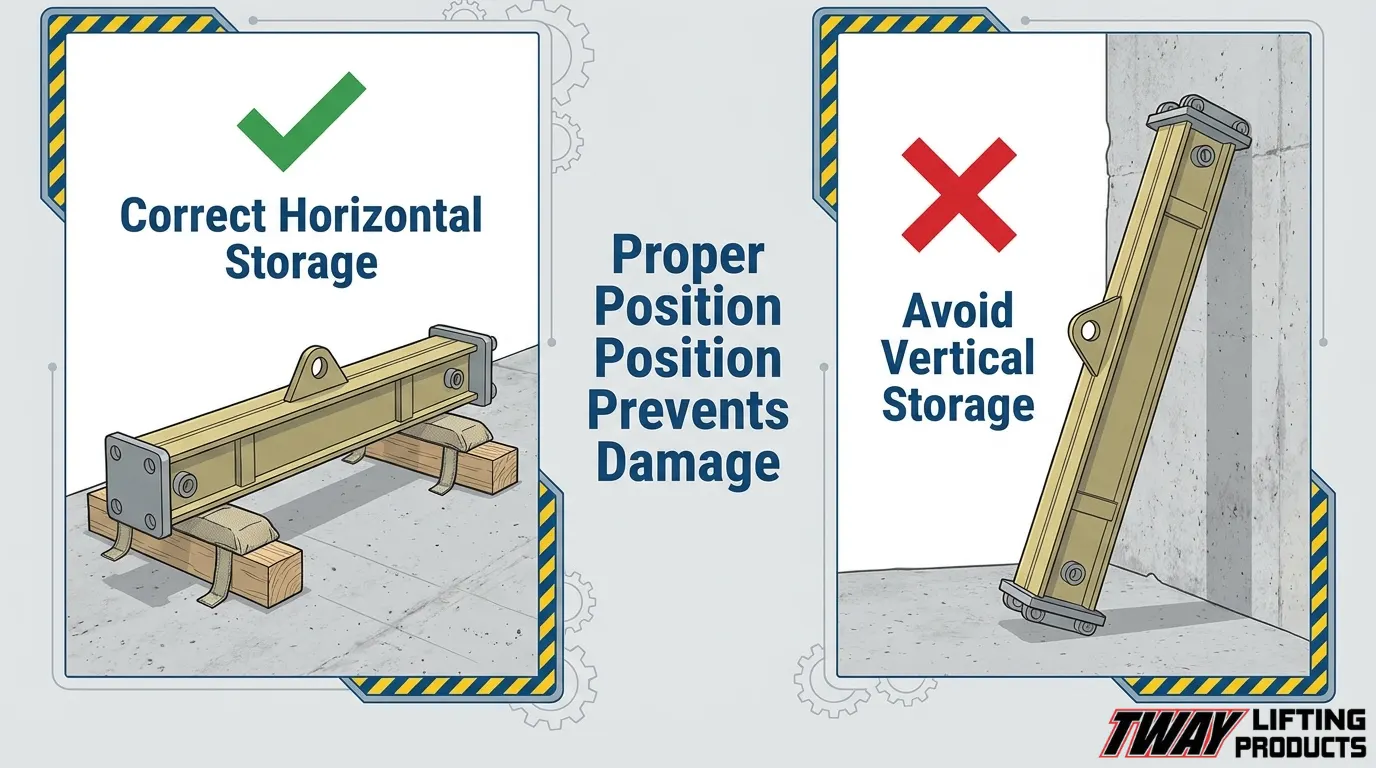
A spreader bar should be stored horizontally whenever possible. Vertical storage places concentrated point loads on the end fittings and connection lugs, risking deformation over time. Horizontal orientation distributes the bar’s weight evenly across multiple support points, preserving the structural integrity of the main load-bearing tube. Storing it upright against a wall without proper bracing also creates a tipping hazard for personnel nearby.
What Surface or Support Should a Spreader Bar Rest On?
The surface or support a spreader bar should rest on includes padded wooden cradles, rubber-lined racks, or blocked timber dunnage. Hard, uneven concrete floors create localized bearing stress on the bar’s outer surface. According to the Lifting Equipment Engineers Association, any exposed threads and machined surfaces, such as eyebolts, must be protected and stored carefully because these characteristics are critical to operational integrity. Soft or non-abrasive contact points prevent surface damage to those critical components.
How Much Clearance Does a Stored Spreader Bar Need?
A stored spreader bar needs enough clearance to allow safe visual inspection on all sides and unobstructed retrieval. The Electronic Code of Federal Regulations (29 CFR 1926.250) requires that aisles and passageways remain clear for the free and safe movement of material handling equipment and employees. In practice, maintain at least 18 to 24 inches of working space around the bar so personnel can inspect welds, fittings, and markings without repositioning other equipment first.
What Environmental Conditions Can Damage a Rented Spreader Bar?
Environmental conditions such as moisture, heat, and chemical exposure can each compromise a spreader bar’s structural integrity and hardware. The sections below cover the specific risks each condition creates.
How Does Moisture and Rain Exposure Affect a Spreader Bar?
Moisture and rain exposure affect a spreader bar by accelerating corrosion on carbon steel components, including connection lugs, stiffening plates, and threaded end fittings. Surface rust weakens load-bearing interfaces and can seize shackle pins, making safe disassembly difficult before the next lift. According to the Lifting Equipment Engineers Association, storage areas should be dry, free from contamination, and protected from temperature extremes, with exposed threads and machined surfaces carefully shielded to preserve operational integrity. Even brief pooling water beneath a bar stored on the ground speeds up pitting on uncoated steel. Covering the bar and elevating it off wet surfaces is the most practical defense against moisture damage on an active job site.
Can Direct Sunlight or Heat Warp or Weaken a Spreader Bar?
Direct sunlight or sustained heat can warp or weaken a spreader bar, particularly its synthetic sling attachment points and any load-rated plastic or rubber components integrated into the rigging assembly. Prolonged UV exposure degrades synthetic materials faster than most crews anticipate, reducing their rated strength before visible signs appear. The steel tube itself, typically seamless carbon steel per ASTM A106 Grade B, resists heat warping under normal site temperatures, but repeated thermal cycling expands and contracts connection hardware, gradually loosening fasteners. Storing the bar in shaded or covered areas whenever it is not in active use prevents both UV degradation of synthetic components and unnecessary stress on threaded fittings.
How Does Mud or Chemical Exposure Affect the Bar’s Hardware?
Mud or chemical exposure affects the bar’s hardware by clogging threaded surfaces, trapping corrosive agents against metal, and obscuring visual inspection points that a rigger needs to assess before each lift. Construction site chemicals, including concrete curing compounds, hydraulic fluids, and deicing salts, are particularly aggressive on carbon steel hardware and can degrade load-rated components faster than plain water corrosion alone. Mud packed into shackle bores or pin threads prevents proper seating during rigging, which creates an undetected load path error. The Lifting Equipment Engineers Association identifies contamination as a primary reason to remove lifting equipment from service. Wiping down hardware and flushing threaded points after muddy or chemical-exposed use protects both the equipment and the rental agreement.
How Should You Protect the End Fittings and Rigging Points?
End fittings and rigging points are the most mechanically vulnerable parts of a spreader bar. The sections below cover capping open fittings, controlling loose hardware, and responding to corrosion found during rental.
Should You Cap or Cover the End Fittings When Not in Use?
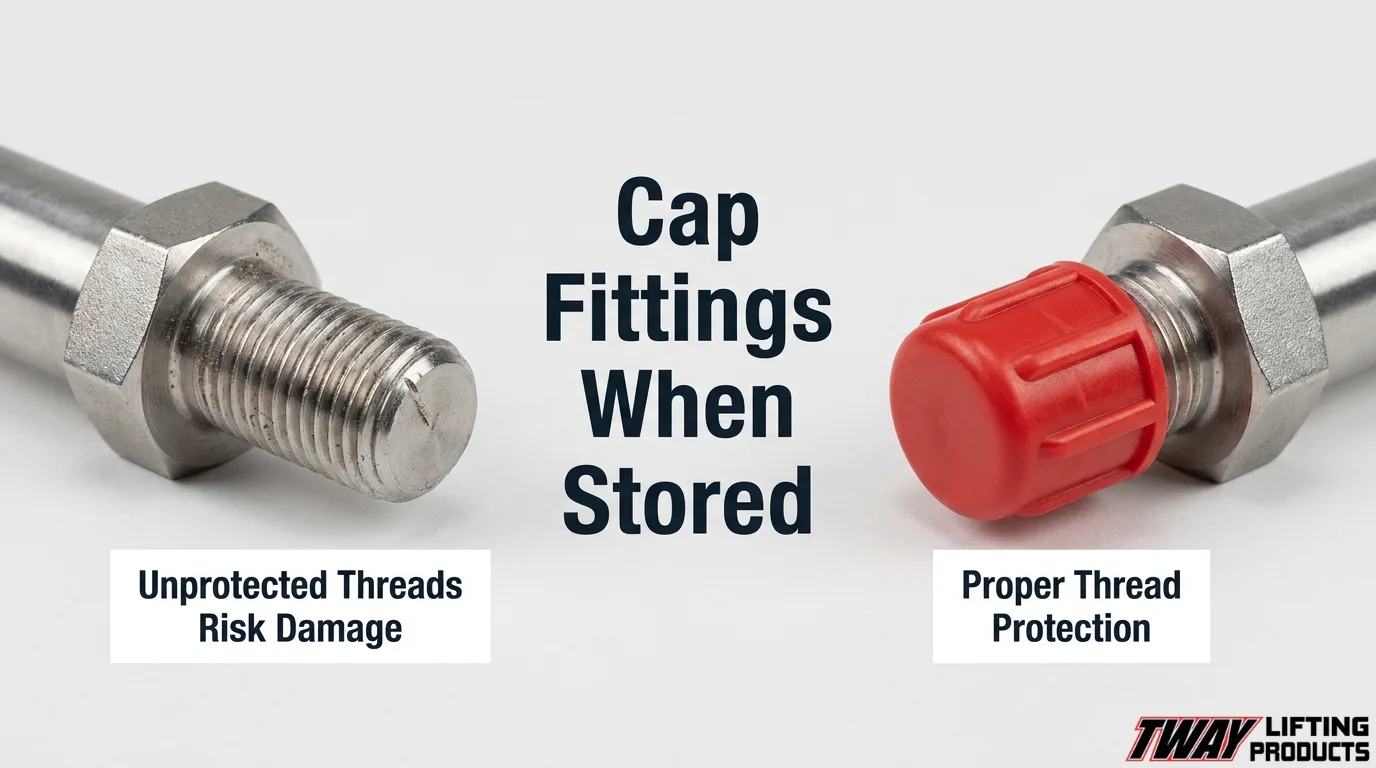
Yes, you should cap or cover the end fittings when not in use. Exposed threads and machined surfaces on components such as eyebolts are critical to operational integrity and must be protected during storage. According to the Lifting Equipment Engineers Association, any exposed threads and machined surfaces should be protected and stored carefully, as these characteristics are critical to the operational integrity of the equipment. Threaded caps, plastic thread protectors, or wrapped cloth secured with tape all serve this purpose effectively. Leaving fittings uncovered invites thread damage, debris intrusion, and corrosion that can compromise load-bearing performance on the next lift.
How Do You Prevent Shackle Pins and Hardware from Getting Lost?
Shackle pins and loose hardware are prevented from getting lost by keeping them attached, bagged, or contained at all times when the bar is not rigged. When removing shackles from the bar between lifts, mouse the pin back through the bow and hand-tighten it, then store the shackle on the fitting lug or in a labeled zip-lock bag secured to the bar. Never leave pins loose on the ground or in a tool bucket. Small hardware losses seem minor on a job site, but a missing shackle pin can ground an entire lift until a replacement is sourced and verified for the correct Working Load Limit.
What Should You Do If a Fitting Shows Corrosion During Rental?
If a fitting shows corrosion during rental, you should stop using that connection point, tag it out, and notify the rental provider immediately. Surface rust on non-load-bearing areas may be wiped clean and monitored, but corrosion on threaded sections, pin bores, or weld zones requires professional assessment before further use. OSHA regulation 29 CFR 1926.251 states that defective rigging equipment shall be removed from service. Attempting to clean or treat significant corrosion yourself does not restore rated capacity and does not satisfy compliance requirements. Document the finding with photographs and report it to Tway Lifting so the fitting can be inspected, recertified, or replaced before the next deployment.
What Daily Inspection Steps Should You Follow Before and After Use?
Daily inspection steps for a rented spreader bar cover checks before each lift, a post-lift review before storage, and clear criteria for when to stop using the bar entirely.
What Should You Check on a Spreader Bar Before Each Lift?
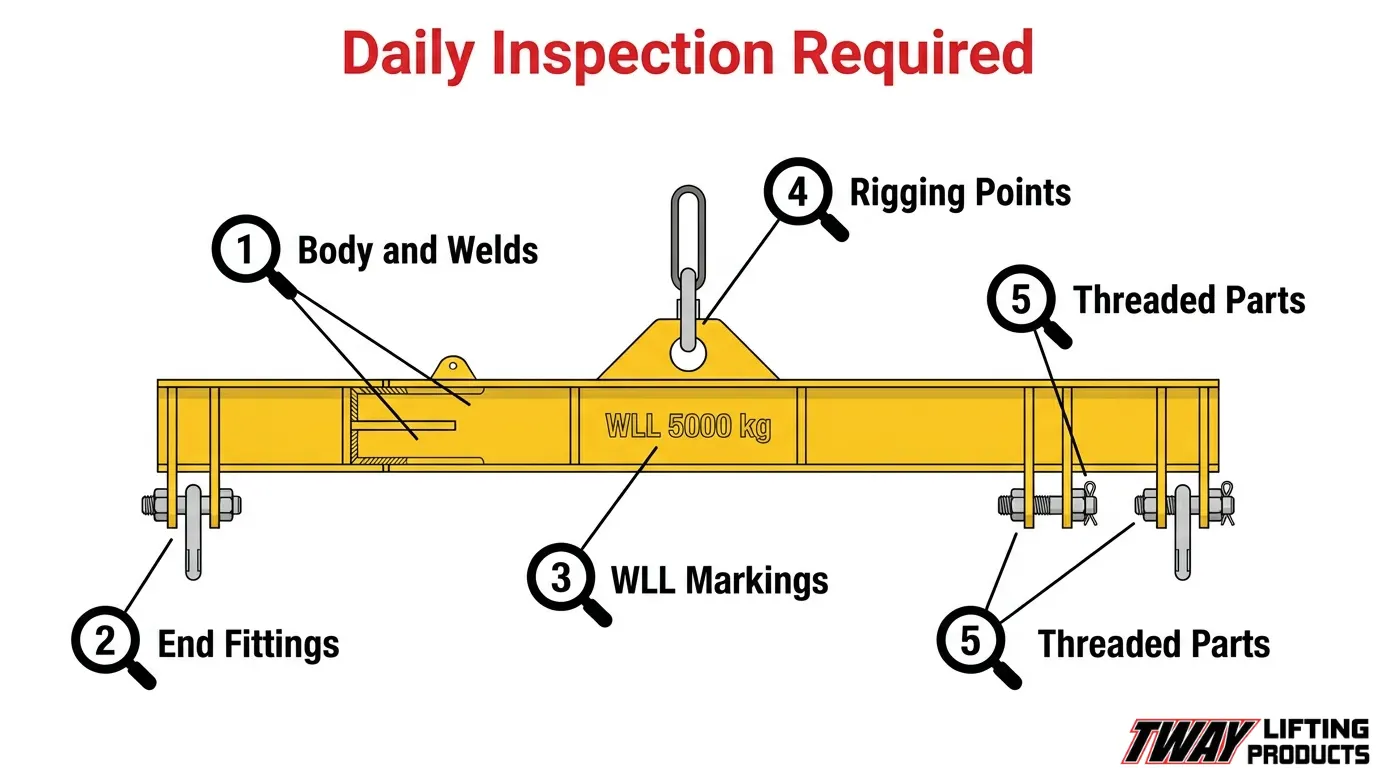
The steps to check on a spreader bar before each lift include reviewing the structural body, end fittings, and the working load limit (WLL) marking. OSHA 29 CFR 1926.251 requires rigging equipment to be inspected prior to use on each shift, with defective equipment removed from service immediately.
Before each lift, verify the following:
- Body and welds: Look for visible cracks, bends, dents, or weld separations along the full length of the bar.
- End fittings and shackles: Confirm all pins are fully seated, moused or secured, and show no deformation.
- WLL tag or markings: Verify the rated capacity label is legible and matches your lift plan.
- Rigging attachment points: Check that sling connection lugs are undamaged and free of corrosion or cracking.
- Threaded components: Inspect eyebolts and any threaded hardware for cross-threading, wear, or stripping.
A pre-lift checklist completed at each shift is the most reliable way to catch developing damage before it becomes a life-safety event.
What Should You Inspect After a Lift Before Returning It to Storage?
The steps to inspect after a lift before returning it to storage focus on identifying load-induced damage, contamination, and hardware condition while details are still fresh. ASME B30.20 governs inspection, maintenance, and operation standards for below-the-hook lifting devices such as spreader bars.
Conduct the following post-lift checks:
- Structural deformation: Look for any new bending, buckling, or cracking that was not present before the lift.
- Surface contamination: Remove mud, concrete splatter, or chemical residue before storage, since prolonged contact degrades metal and hardware.
- Threads and machined surfaces: The Lifting Equipment Engineers Association specifies that exposed threads and machined surfaces, such as those on eyebolts, must be protected before storage because these features are critical to operational integrity.
- Hardware completeness: Confirm all shackle pins, cotter pins, and any rigging accessories are accounted for and secured.
- Inspection records: The U.S. Department of Energy’s below-the-hook checklist asks whether an established program with records exists for periodic inspection. Log each post-lift check in writing.
When Should You Stop Using the Bar and Notify the Rental Provider?
You should stop using the bar and notify the rental provider immediately when any inspection reveals damage, missing certification markings, or hardware loss that compromises safe operation. Continuing to use suspect equipment shifts liability squarely onto the site operator.
Stop use and contact Tway Lifting if any of the following conditions are found:
- Visible cracks, bends, or buckles anywhere on the bar body or welds.
- A missing, illegible, or altered WLL marking.
- Deformed, cracked, or missing end fittings, shackle pins, or connection lugs.
- Corrosion, pitting, or chemical damage to threads or machined surfaces.
- Any load drop, shock load, or uncontrolled swing event during the prior lift.
- Evidence of impact damage from contact with a load, structure, or ground.
Tway Lifting’s rental team can assess whether the equipment requires inspection, repair, or replacement before the next lift.
How Should You Handle and Move a Spreader Bar Between Storage and Use?
Handling a spreader bar correctly between storage and the lift zone prevents structural damage, protects end fittings, and keeps workers safe. The sub-sections below cover proper carrying technique, mechanical transport options, and how to avoid bending or impact damage during repositioning.
What Is the Correct Way to Carry a Long Spreader Bar on Site?
The correct way to carry a long spreader bar on site is horizontally, with at least two lift points spaced evenly along its length to prevent mid-span flexing. A single person carrying one end while dragging the other is the fastest way to introduce bending stress to the main tube. For bars beyond 10 feet, use a team carry or a sling-supported lift from a crane or hoist, keeping the bar level throughout. Never grab the bar by its end fittings or shackle pins to bear its full weight, as this concentrates load on components designed for vertical tension, not horizontal handling forces.
Can a Forklift or Telehandler Be Used to Move a Stored Spreader Bar?
Yes, a forklift or telehandler can be used to move a stored spreader bar, provided the forks are spaced to support the bar at two balanced points without creating a cantilever overhang that induces bending. The forks must be wide enough apart to distribute the bar’s weight evenly across its span. Secure the bar against rolling or sliding before moving, since spreader bar tube geometry makes it prone to shifting on flat fork tines. Travel slowly over uneven ground. Never use a single fork tine as a pivot point, and never stack another load on top of the bar during transport.
How Do You Avoid Bending or Impact Damage During Repositioning?
Bending and impact damage during repositioning are avoided by controlling how the bar is supported, set down, and protected from contact with hard surfaces. The main load-bearing element of a spreader bar is typically seamless carbon steel pipe, according to a structural analysis published in Scientific Reports, meaning any concentrated impact or unsupported mid-span drop can permanently deform it. When setting the bar down, lower it onto padded or timber supports placed at two points; never let it drop onto concrete or steel plate. Keep the bar away from vehicle traffic lanes during temporary staging. If the bar must be repositioned across uneven terrain, use a sling-supported crane carry rather than ground-dragging or rolling.
What Documentation Should You Keep While Renting a Spreader Bar?
Documentation you should keep while renting a spreader bar includes photographic condition records, pre-use inspection logs, and any certifications provided at delivery. These records protect you from liability disputes and support OSHA compliance throughout the rental period.
Should You Photograph the Bar’s Condition at Delivery and Return?
Yes, you should photograph the bar’s condition at both delivery and return. Capture all surfaces, end fittings, shackle pins, and any existing scratches or deformations before the equipment leaves the delivery vehicle. Repeat this process immediately after the final lift, before return pickup. Date-stamped photos create an indisputable visual record that separates pre-existing damage from damage incurred on your site, protecting you from unfair repair charges. Store these images alongside the rental agreement for the full rental period.
What Records Does OSHA Require for Rental Rigging Equipment On Site?
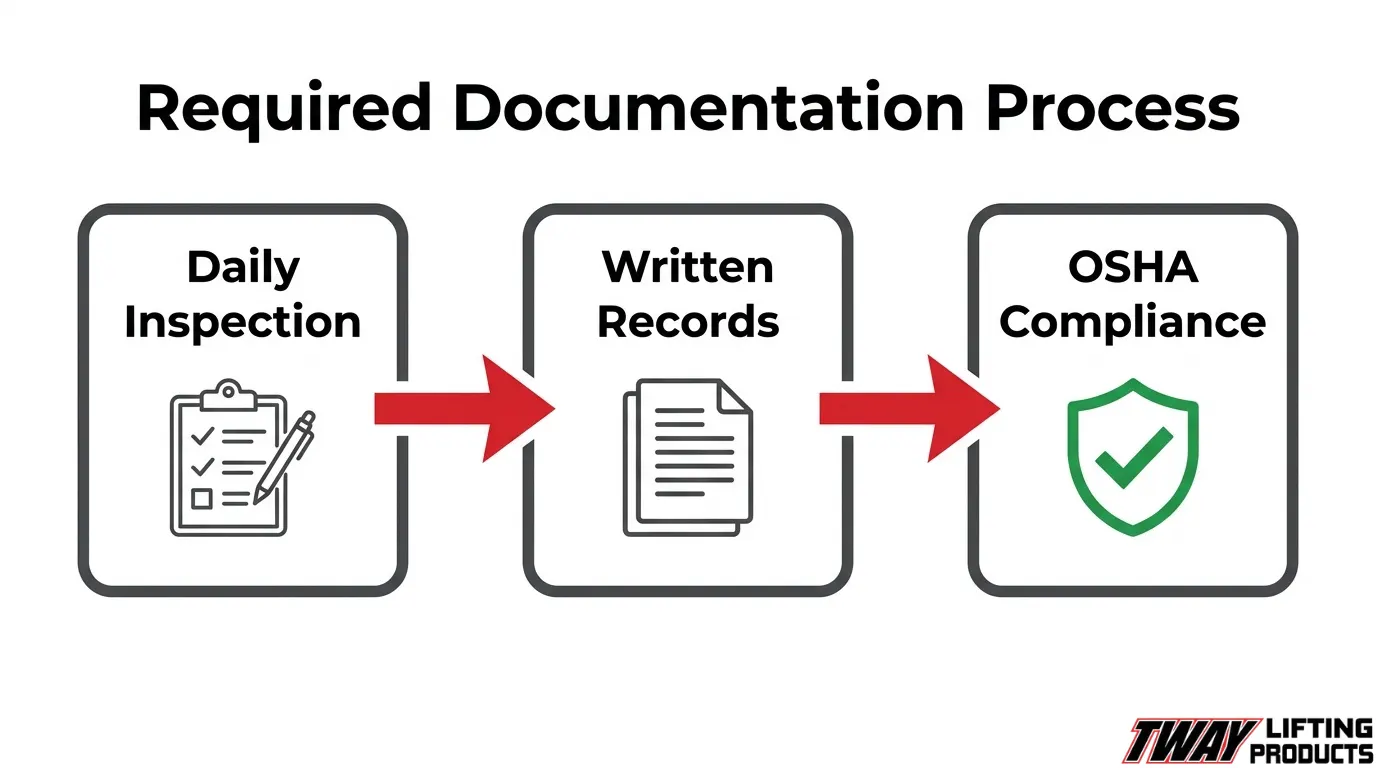
OSHA requires that rigging equipment for material handling be inspected prior to use on each shift and as necessary during use to ensure it is safe, and that defective rigging equipment be removed from service (OSHA 29 CFR 1926.251). In practice, this means site supervisors must maintain written or digital shift-inspection logs for every rental spreader bar used on site. Each log entry should record the date, the inspector’s name, the equipment identifier, and the inspection outcome. If the bar is removed from service, document the reason and notify the rental provider immediately. Tway Lifting provides certified rigging inspection services, including job site safety inspections and detailed reporting, which can supplement a site’s own shift-log program for rental equipment. Keeping these records on site and accessible during inspections is not optional; it is a direct regulatory requirement.
How Does Tway Lifting’s Equipment Rental Support Safe On-Site Use?
Tway Lifting’s equipment rental supports safe on-site use by providing inspected, certified spreader bars backed by over 75 years of rigging expertise. The sections below cover OSHA-compliant inspection practices and key storage takeaways.
Does Tway Lifting Offer OSHA-Compliant Inspections for Rented Rigging Equipment?
Tway Lifting offers OSHA-compliant inspections for rented rigging equipment, performed by certified specialists drawing on over 75 years of company experience. Compliance extends to any business that uses lifting equipment, regardless of ownership. According to the Health and Safety Executive’s LOLER overview, lifting equipment regulations place duties on all people and companies who own, operate, or have control over lifting equipment, including those whose employees use equipment they do not own. Tway Lifting’s inspection services address this responsibility directly, providing detailed reporting and job site safety assessments for rented spreader bars and rigging assemblies.
What Are the Key Takeaways About Storing a Rented Spreader Bar On Site?
The key takeaways about storing a rented spreader bar on site are that proper storage protects both the equipment and your liability as the renter. Store the bar in a dry, covered area on padded supports above ground level. Inspect it before and after every shift, protect end fittings from corrosion, and document any damage immediately. Keep aisles clear and secure the bar against movement. Tway Lifting’s rental program, backed by certified inspection services and free local delivery and pickup, makes it straightforward to return equipment in compliant, undamaged condition.