



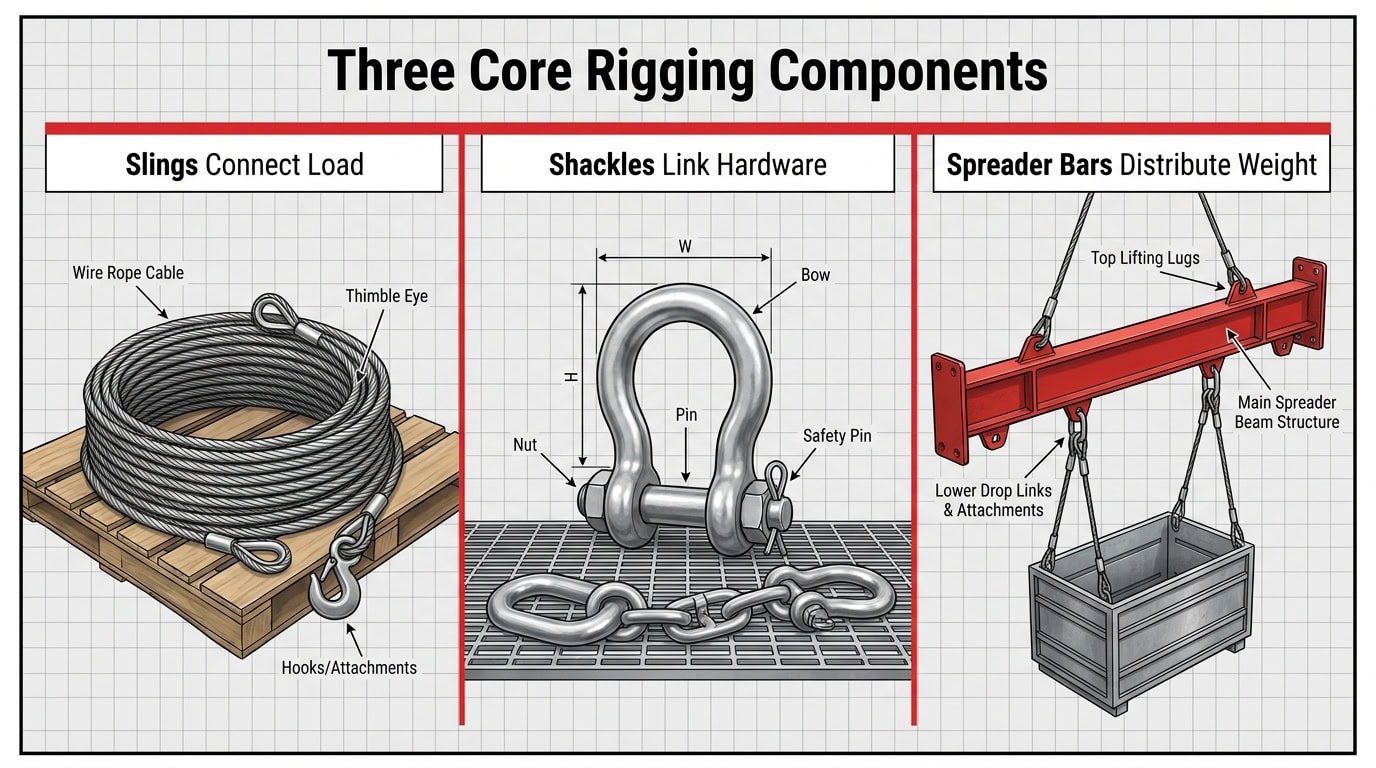

Renting slings, shackles, and spreader bars means accessing the three core components of a rigging system on a project-aligned basis, without the capital cost, maintenance burden, or depreciation risk of ownership.
This guide covers equipment identification, rental decision-making, sling and shackle types, spreader bar selection, load rating rules, OSHA compliance, rental costs, pre-use inspection, and how Tway Lifting supports the full rental process.
Slings, shackles, and spreader bars each serve a distinct mechanical role, and understanding how they function together is the starting point for any rental decision. The case for renting over buying comes down to cost flexibility, access to current equipment, and eliminating storage and maintenance overhead. Choosing the right sling, shackle, or spreader bar requires matching equipment type and rated capacity to load weight, geometry, edge conditions, and environment. Load rating rules govern every piece of rented gear, with Working Load Limit, hitch configuration, and sling angle all directly affecting safe usable capacity. OSHA 29 CFR 1926.251, ASME B30.9, and ASME B30.26 set the compliance baseline for rented rigging equipment, and the end user carries the legal responsibility to verify that every item meets those standards before a lift begins. Rental costs vary by equipment type, capacity, and term, with daily, weekly, and monthly options available to match project timelines without ownership overhead. Tway Lifting backs its rental program with certified, factory-trained inspection specialists, supporting compliant, ready-to-use rental equipment.
What Are Slings, Shackles, and Spreader Bars in Rigging?
Slings, shackles, and spreader bars are the three core components of a rigging system, each serving a distinct mechanical role in lifting and load control. The sections below define each component and explain how they function together.
What Is a Rigging Sling and What Does It Do?
A rigging sling is a flexible load-bearing assembly that connects a crane hook to the load being lifted. Wire rope slings, synthetic web slings, synthetic roundslings, and alloy chain slings are the four major types used in rigging operations, each suited to different load weights, environments, and edge conditions. Slings carry the full tension of the lift, so material selection directly affects safety and load capacity.
What Is a Shackle Used for in a Lifting System?
A shackle is a U-shaped connector that links slings, hooks, and lifting hardware at critical attachment points within a rigging assembly. Without shackles, slings cannot be reliably secured to crane hooks, spreader bars, or load lifting points. They are fast to inspect and widely adaptable, making them one of the most frequently used components across offshore wind, heavy engineering, marine operations, and construction lifting systems.
What Is a Spreader Bar and How Does It Work?
A spreader bar is a below-the-hook lifting device designed to distribute loads safely between multiple lifting points during crane operations. According to Multisec’s 2026 guide on spreader beams, it works by positioning the crane hook above the beam through angled slings, while the load hangs from attachment points below, preventing excessive force concentration at any single lift point. Modular spreader beams use interchangeable struts and end units, allowing engineers to adjust lifting spans across multiple projects.
How Do Slings, Shackles, and Spreader Bars Work Together?
Slings, shackles, and spreader bars work together as an integrated lifting system where each component handles a specific mechanical function. The crane hook connects to the spreader bar via upper slings and shackles; lower slings and shackles then secure the load to the bar’s end points. This arrangement maintains load stability and prevents excessive loading at individual lifting points. Understanding how these three components interact is the foundation for selecting the right rental configuration for any lift.
Why Would You Rent Rigging Equipment Instead of Buying It?
Renting rigging equipment makes financial and operational sense for companies that need specialized gear for specific projects without the long-term burden of ownership. The key advantages cover cost flexibility, equipment access, and depreciation avoidance.
Why Does Renting Rigging Equipment Save Money Compared to Buying?
Renting rigging equipment saves money by eliminating the large upfront capital expenditure that purchasing requires, while also removing ongoing costs for maintenance and storage. Buying heavy rigging gear represents a significant financial burden, particularly for companies that don’t lift continuously. Renting converts that fixed cost into a variable, project-aligned expense, so you pay only for what you actually use. For businesses managing tight project budgets, this flexibility is difficult to replicate through ownership.
Does Renting Give You Access to Better or Newer Equipment?
Yes, renting gives you access to the latest rigging equipment without the depreciation risk that comes with owning assets. According to Versabar, renting allows companies to obtain the exact machinery required for a specific task or project phase, matched to current equipment standards rather than aging owned inventory. As rental fleets are regularly updated, renters benefit from newer gear without bearing the cost of replacement cycles.
Is Demand for Rigging Equipment Rentals Growing?
Yes, demand for rigging equipment rentals is growing across the U.S. industrial sector. According to Market Research Future, the U.S. tower crane rental market is forecasted to grow at 5.64% annually from 2025 to 2035, reflecting sustained market confidence in rental as a preferred access model. This growth signals that more companies are choosing rentals over ownership as project scopes diversify and equipment requirements become more specialized.
What Types of Slings Are Available to Rent?
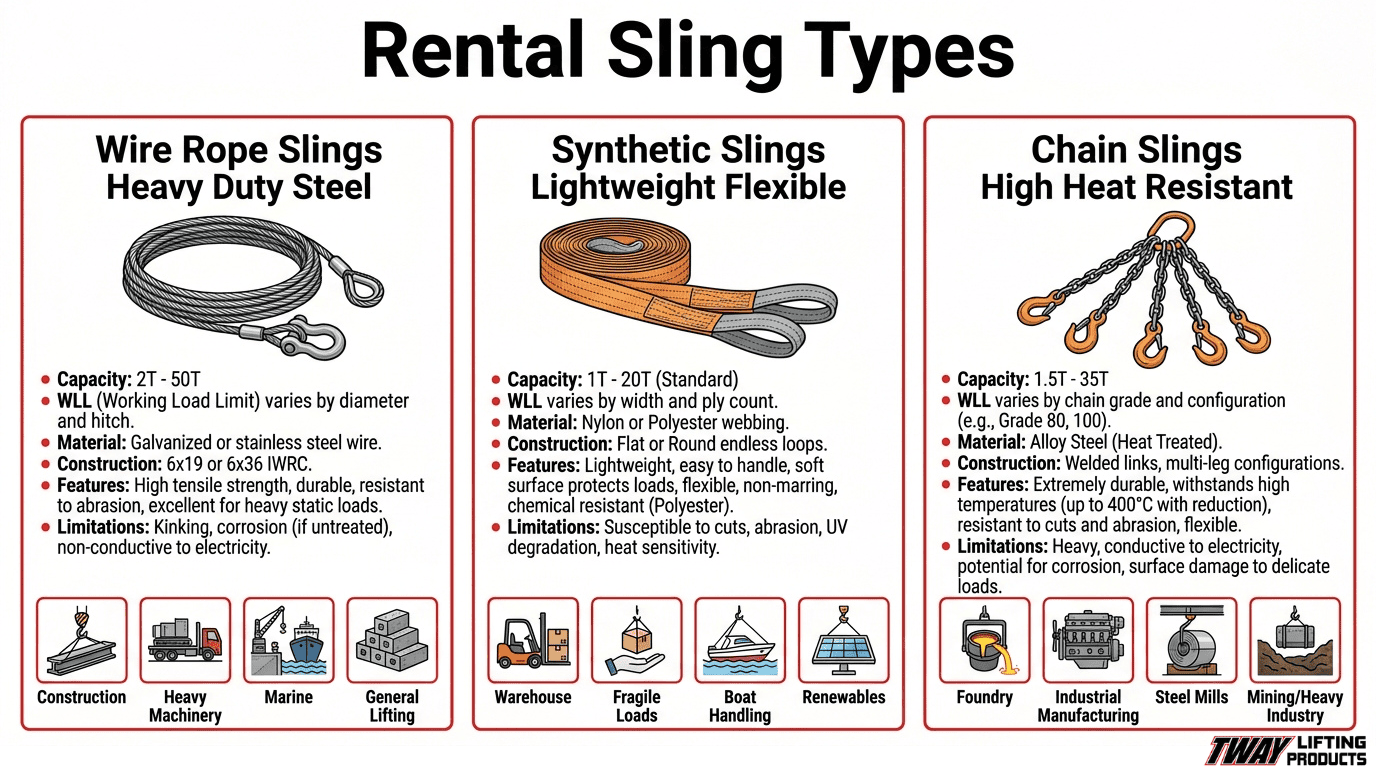
The types of slings available to rent fall into three main categories: wire rope slings, chain slings, and synthetic slings. According to Mazzella Companies, wire rope slings, synthetic web slings, synthetic roundslings, and alloy chain slings are the four major lifting slings used in rigging operations. Each type suits different load conditions, environments, and rigging configurations.
Wire Rope Slings
Wire rope slings are flexible steel cable assemblies used to lift heavy, abrasive, or high-temperature loads where synthetic materials would degrade. They handle demanding industrial environments well, including steel production and construction applications. Tway Lifting manufactures and rents wire rope slings with same-day fabrication available, making them a practical option when a project requires a custom-length assembly quickly.
Chain Slings
Chain slings are alloy steel assemblies rated for extreme loads and harsh conditions, including high heat, sharp edges, and chemically aggressive environments. Unlike synthetic options, chain slings tolerate direct contact with rough or jagged surfaces without damage to the sling body. Their durability makes them a preferred rental choice for foundry, forge, and heavy manufacturing lifts.
Synthetic Slings
Synthetic slings include polyester web slings, nylon slings, and high-performance roundslings made from aramid fibers. They are lightweight, non-marring, and flexible, protecting finished or delicate load surfaces during lifting. Tway Lifting rents synthetic slings across all three material types, covering a wide range of capacity and environmental requirements for construction, automotive, and utility projects.
What Types of Shackles Can You Rent for Rigging Jobs?
The types of shackles available to rent for rigging jobs include screw pin anchor shackles, round pin anchor shackles, and bolt-type safety shackles. Each suits different load configurations, connection requirements, and job site conditions.
Screw Pin Anchor Shackles
Screw pin anchor shackles are the most common rental shackle, designed for general rigging applications where the pin can be manually tightened and removed between lifts. The bow-shaped body accepts slings, hooks, or rings, making them versatile across construction, steel erection, and industrial lifting. Because the screw pin can back out under rotation or vibration, they are best suited for temporary, non-rotating connections where the load direction stays consistent.
Round Pin Anchor Shackles
Round pin anchor shackles use a smooth, straight pin secured by a cotter pin rather than a threaded screw, providing a more permanent connection than screw pin designs. They are well suited for in-line, straight-pull applications where the pin is not frequently removed. However, round pin shackles are not recommended for sling connections where side-loading or angular forces are present, as the smooth pin lacks the mechanical resistance of a threaded or bolted closure.
Bolt-Type Safety Shackles
Bolt-type safety shackles are the most secure shackle option available for rental, featuring a bolt, nut, and cotter pin closure that resists accidental disassembly under dynamic, rotating, or shock loads. ASME B30.26-2015 (R2020) governs the construction, installation, and inspection of detachable rigging hardware including shackles, making bolt-type designs the preferred choice for overhead and critical lifts where load security is non-negotiable. For high-consequence applications, bolt-type shackles are the only defensible choice.
What Types of Spreader Bars Are Available for Rent?
The types of spreader bars available for rent include fixed-length, adjustable, and modular systems. Each design suits different lift configurations, load widths, and project durations.
Fixed-Length Spreader Bars
Fixed-length spreader bars are rigid, single-span beams manufactured to a set dimension with no field adjustment. They suit repetitive lifts where the load geometry and lifting point spacing remain consistent across multiple picks. Because their geometry never changes, they are simple to inspect, certify, and deploy quickly on jobsites with standardized loads. For projects where load dimensions are known in advance and do not vary, fixed-length bars are often the most cost-effective rental choice.
Adjustable Spreader Bars
Adjustable spreader bars use a telescoping or sliding mechanism to change the beam’s working length without swapping equipment. This versatility makes them well suited for projects that involve lifts of varying widths or load geometries across different phases. Tway Lifting’s rental inventory includes telescopic adjustable length bars, allowing crews to modify lifting point spacing on-site rather than ordering multiple fixed-length units.
Modular Spreader Bar Systems
Modular spreader bar systems use interchangeable struts and end units to create different lifting spans and lifting configurations, giving engineers a flexible lifting system that can be adapted across multiple projects. According to Multisec’s research on spreader beam applications, this interchangeability makes modular systems particularly valuable in offshore wind, heavy infrastructure, and marine operations where load dimensions change frequently between lifts.
How Do You Choose the Right Sling for Your Rental Lift?
Choosing the right sling depends on four key load variables: length and flexibility, weight and rigidity, surface sharpness, and operating environment. Each H3 below addresses one of these selection scenarios specifically.
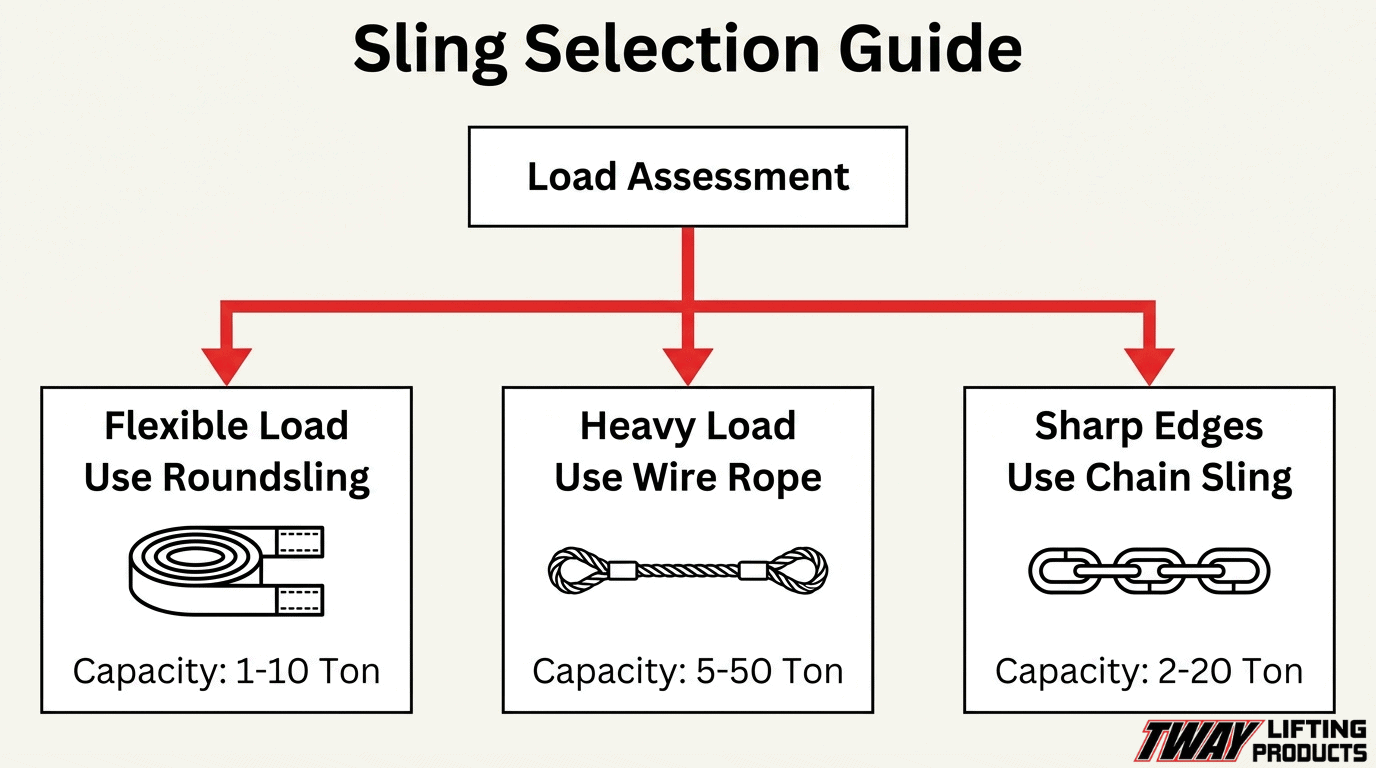
How Do You Select a Sling When Lifting a Long, Flexible Load?
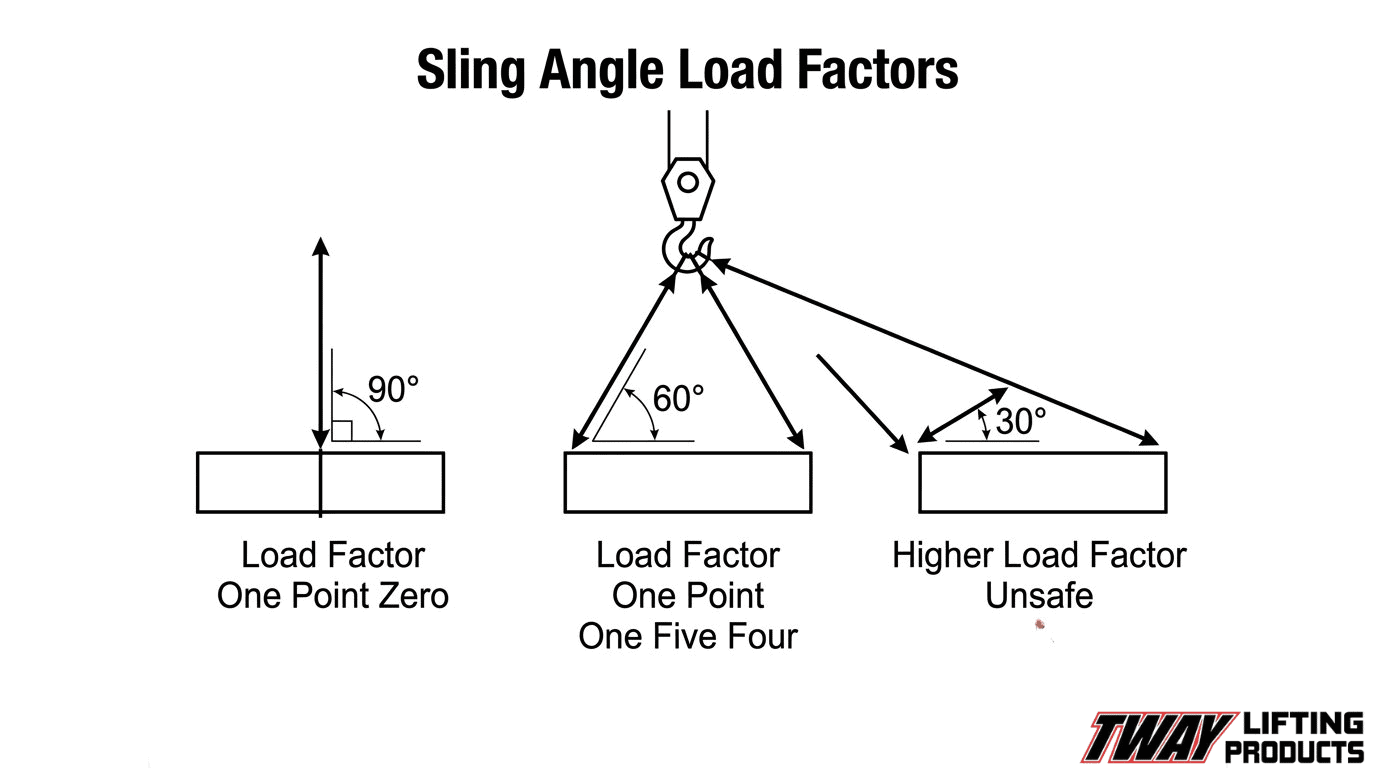
Selecting a sling for a long, flexible load requires careful attention to sling angle, because that angle directly controls how much tension each sling leg carries. According to a 2024 guide by US Cargo Control on calculating sling angles, a single-leg sling at 90° to the load carries a load factor of 1.0, but dropping that angle to 60° raises the load factor to 1.154, meaning the sling experiences more tension than the load’s actual weight. For long, flexible loads, a synthetic roundsling or web sling in a basket hitch configuration distributes tension across a broader contact surface, reducing both concentrated stress and the risk of load deformation.
How Do You Select a Sling When Lifting a Heavy, Rigid Load?
Selecting a sling for a heavy, rigid load often requires pairing the sling with a spreader beam. A spreader beam is a below-the-hook lifting device that distributes load weight across multiple lifting points, preventing concentrated stress on any single attachment. This setup maintains load stability and protects the integrity of rigid structures during the lift. Wire rope slings or alloy chain slings are the preferred companion slings in this configuration, given their high tensile strength and resistance to deformation under heavy loads.
How Do You Select a Sling When Lifting a Load with Sharp Edges?
Selecting a sling for a load with sharp edges requires both the right sling material and a protected contact zone. Synthetic web slings and roundslings are highly vulnerable to cuts from sharp edges and must be used with corner protectors or edge guards when contact is unavoidable. A 2024 US Cargo Control guide on sling angles notes that minimum recommended sling angles of 30 degrees must also be maintained, since shallow angles compound stress at the very contact points where sharp edges cause the most damage. Wire rope slings or chain slings offer greater resistance to edge cuts without relying on protectors.
How Do You Select a Sling for an Outdoor or High-Temperature Environment?
Selecting a sling for an outdoor or high-temperature environment requires matching sling material to the specific environmental hazard. The main considerations are:
- Heat exposure: Alloy chain slings tolerate elevated temperatures better than synthetic slings, which lose rated capacity rapidly above 200°F.
- UV and moisture exposure: Wire rope slings resist outdoor weathering well; synthetic slings degrade faster under prolonged UV exposure.
- Corrosive environments: Slings with corrosion-resistant coatings or stainless steel hardware are better suited for marine, offshore, or chemical-exposure conditions.
- Temperature extremes: Always verify the manufacturer’s temperature rating before deploying any synthetic sling outdoors in heat or cold.
Chain slings remain the most versatile choice across high-temperature and harsh outdoor conditions. Tway Lifting rents chain slings alongside wire rope and synthetic options, allowing project teams to select the right material for each specific environment from a single rental source.
How Do You Size a Spreader Bar for Your Lift?
Sizing a spreader bar correctly depends on three factors: load width, lifting angle, and load weight. Each H3 below covers one sizing dimension to help you select the right bar before your rental.
How Do You Size a Spreader Bar Based on Load Width?
Sizing a spreader bar based on load width means selecting a bar long enough to position the lift points directly above the load’s attachment points. The bar must span at least the full distance between those attachment points so the rigging pulls vertically downward, not inward. Inward pull forces the load to compress or flex, which can damage the structure and destabilize the lift. As a general rule, the spreader bar should match or slightly exceed the horizontal distance between the load’s lift lugs or connection points.
How Do You Size a Spreader Bar Based on Lifting Angle?
Sizing a spreader bar based on lifting angle means selecting a bar length that keeps the sling angle at or above 60 degrees from horizontal. According to US Cargo Control’s guide on calculating sling angles, a sling at 60 degrees produces a load factor of 1.154, meaning the tension in each sling leg already exceeds the actual load weight. Below 30 degrees, tension increases dramatically and exceeds safe working limits. A longer spreader bar increases the sling angle for a given hook height, directly reducing compressive stress on the bar and tension in the slings.
How Do You Size a Spreader Bar Based on Load Weight?
Sizing a spreader bar based on load weight means confirming the bar’s rated capacity meets or exceeds the total gross load, including rigging hardware weight. Every spreader bar carries a Working Load Limit (WLL) stamped or tagged on the equipment. The combined weight of the load and all attached slings, shackles, and hardware must stay below that WLL. For heavier loads, a higher-capacity bar is required, not a longer one. Tway Lifting’s rental fleet includes spreader beams rated from 2 to 100 tons, covering most industrial lift requirements without custom fabrication.
What Are the Weight Capacity and Load Rating Rules for Rented Rigging Gear?
The weight capacity and load rating rules for rented rigging gear require every piece of equipment to be used within its marked Working Load Limit, with load ratings adjusted for hitch configuration, sling angle, and environmental conditions. The following sections cover WLL rules for slings, shackles, and the critical effect of sling angle.
What Does Working Load Limit Mean for Rented Slings?
The Working Load Limit for rented slings is the maximum load a sling is rated to lift under a specific hitch configuration in normal conditions. WLL is stamped or tagged on every compliant sling and varies by hitch type:
- Vertical hitch: 100% of the rated WLL.
- Choker hitch: Approximately 75% of the rated WLL.
- Basket hitch (0° basket): Up to 200% of the rated WLL, depending on leg angle.
Never exceed the tagged WLL for the applicable hitch. A study by the Konecranes Training Institute, examining 249 industrial overhead crane incidents over ten years, found that 27% of load drops were directly tied to poor rigging practices, making WLL compliance a frontline safety obligation.
What Does Working Load Limit Mean for Rented Shackles?
The Working Load Limit for rented shackles is the maximum allowable load the shackle is rated to carry in a straight inline pull. Shackle WLL is stamped directly on the bow or body and must match or exceed the load being applied. Key rules include:
- Never side-load a shackle beyond the manufacturer’s rated side-load capacity.
- Never use a shackle with a bent pin, worn crown, or missing identification markings.
- Always match shackle WLL to the weakest component in the rigging assembly.
Industry demand for high-strength materials capable of handling loads above 10 tons reflects how seriously load rating requirements are applied across professional rigging operations.
How Does Sling Angle Affect the Working Load Limit?
Sling angle affects the Working Load Limit by increasing the tension in each sling leg as the angle from vertical decreases, which effectively reduces the sling’s usable capacity. Two calculations govern this relationship:
- Load factor: A multiplier applied to actual load weight to determine real tension per leg. At 90° (vertical), the load factor equals 1.0. At 60°, it rises to 1.154, meaning each leg carries more tension than the load’s actual weight.
- Reduction factor: Applied to the sling’s rated WLL to determine effective capacity at a given angle. As the angle decreases, the reduction factor lowers the safe working capacity.
According to US Cargo Control’s guide on calculating sling angles, the load factor increases tension in each sling leg as the angle decreases from vertical, while the reduction factor shows how much the rated capacity must be reduced to compensate. Sling angle is one of the most underestimated variables in lift planning; even a modest angular deviation can drop effective capacity well below what the tag indicates, creating an invisible overload condition.
What OSHA and Safety Standards Apply When Renting Rigging Equipment?
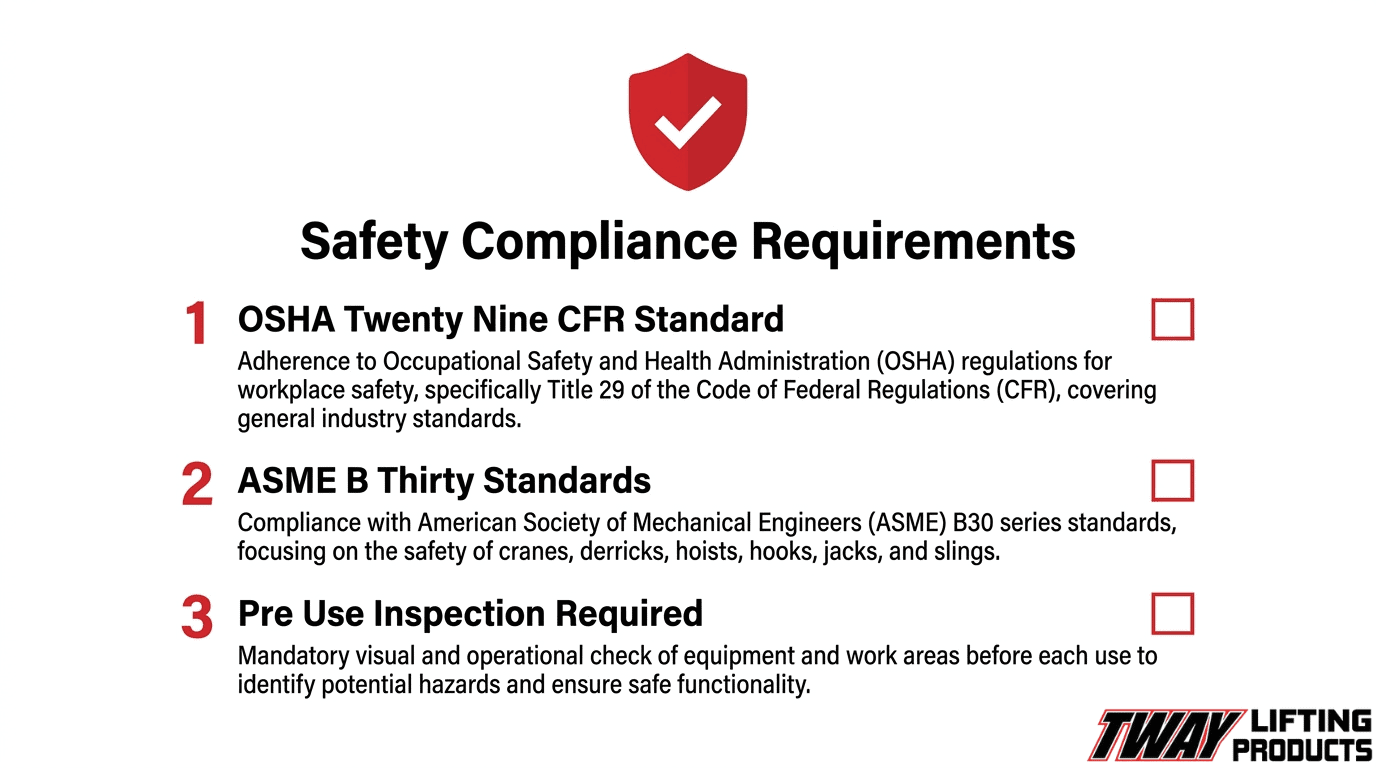
OSHA and safety standards that apply when renting rigging equipment include 29 CFR 1926.251, ASME B30.9, ASME B30.20, and ASME B30.26. These standards govern sling use, below-the-hook devices, and detachable rigging hardware across construction and industrial operations.
What OSHA Standards Govern the Use of Rigging Slings?
The OSHA standards that govern rigging slings are found in 29 CFR 1926.251, which establishes rigging equipment requirements for construction operations. Specifically, it mandates compliance with ASME B30.9 for slings and ASME B30.20 for below-the-hook lifting devices such as spreader bars. These two ASME standards define rated capacities, inspection intervals, and safe operating conditions that apply regardless of whether equipment is owned or rented.
What Inspection Requirements Apply to Rented Rigging Gear Before Each Use?
Inspection requirements for rented rigging gear before each use are defined by ASME B30.26-2015 (R2020), which sets construction, installation, operation, inspection, and maintenance requirements for detachable rigging hardware used in load-handling operations. This standard covers shackles, links, rings, swivels, turnbuckles, eyebolts, hoist rings, wire rope clips, wedge sockets, rigging blocks, and load indication devices. Before each use, operators must visually inspect rented hardware for deformation, cracks, corrosion, missing markings, and load rating labels. Any item failing inspection must be removed from service immediately, regardless of rental status.
Who Is Responsible for Safety Compliance on Rented Rigging Equipment?
The person responsible for safety compliance on rented rigging equipment is the end user, not the rental provider. OSHA places the duty of compliance on the employer whose workers use the equipment on a job site. The rental company is responsible for supplying gear that meets applicable ASME and OSHA standards, but the renting employer must verify condition, confirm load ratings, and ensure qualified personnel perform pre-use inspections. Relying on a rental provider’s prior inspection does not satisfy the employer’s independent compliance obligation under 29 CFR 1926.251.
How Much Does It Cost to Rent Slings, Shackles, and Spreader Bars?
Rental costs for slings, shackles, and spreader bars vary by equipment type, size, and rental duration. The sections below cover typical cost considerations for spreader bars, rigging slings, and shackles.
How Much Does It Cost to Rent a Spreader Bar?
The cost to rent a spreader bar depends on capacity, span, and rental term. Tway Lifting offers spreader beams ranging from 2 to 100 tons and up to 40 feet in length, available on daily, weekly, or monthly rental agreements. Renting eliminates the substantial upfront purchase cost, ongoing maintenance expenses, and storage requirements that come with ownership. For most project-based operations, renting a spreader bar is a more practical financial decision than purchasing equipment that sits idle between jobs. Tway Lifting’s rental inventory includes spreader beams from 2 to 100 tons and up to 40 feet in length, available on daily, weekly, or monthly terms with free local delivery and pickup.
How Much Does It Cost to Rent Rigging Slings?
The cost to rent rigging slings varies based on sling type, rated capacity, length, and rental duration. Wire rope slings, synthetic slings, and chain slings each carry different price points reflecting their materials and load ratings. According to Versabar, purchasing heavy rigging equipment requires a substantial upfront investment, whereas renting provides access to the same equipment without high initial costs, maintenance obligations, or storage burden. Tway Lifting offers daily, weekly, and monthly rental terms with free local delivery and pickup included.
How Much Does It Cost to Rent Shackles?
The cost to rent shackles depends on shackle type, working load limit, and rental period. Smaller screw pin anchor shackles for light-to-medium lifts carry lower rental rates, while larger bolt-type safety shackles rated for heavy industrial loads cost more per day or week. Tway Lifting includes shackles as part of its broader rigging rental inventory, making it straightforward to bundle shackles with slings and spreader bars for a complete lift package.
What Should You Check Before Accepting Rented Rigging Equipment?
Before accepting rented rigging equipment, you should check for physical damage, legible load markings, current inspection tags, and proper documentation confirming the gear meets OSHA and ASME standards. These checks protect your crew and keep your lift compliant from the first connection point.
Inspecting rented gear at delivery is not optional. According to a study by the Konecranes Training Institute examining 249 industrial overhead crane incidents over a ten-year period, 27% of load drops were directly tied to poor rigging practices, many of which begin with undetected equipment defects. Tway Lifting’s rental equipment is inspected by certified, factory-trained specialists before leaving the facility, providing renters with a documented starting point for their own required pre-use inspection.
The specific items to verify before accepting each equipment type are:
- Slings: Check for cuts, abrasions, heat damage, chemical burns, knots, and missing or unreadable capacity tags.
- Shackles: Inspect the pin for straightness, thread integrity, and correct seating; confirm the WLL stamp is legible and the body shows no cracks or distortion.
- Spreader bars: Verify structural welds, connection points, load rating plates, and confirming the serial number matches any rental documentation provided.
- Documentation: Request the most recent inspection record, confirming the inspection date and inspector credentials align with ASME B30.26 requirements.
Reject any component with worn markings, deformation, missing tags, or inspection records older than required intervals. Returning damaged equipment before a lift costs nothing; using it can cost everything.
How Long Can You Rent Rigging Equipment?
You can rent rigging equipment for a single day, a full week, or an entire month, depending on your project timeline. Tway Lifting offers daily, weekly, and monthly rental terms to match both short-duration lifts and extended project phases.
What Industries Commonly Rent Slings, Shackles, and Spreader Bars?
The industries that commonly rent slings, shackles, and spreader bars include offshore wind, heavy engineering, infrastructure construction, marine operations, and manufacturing. Each sector relies on this equipment to handle loads that exceed standard lifting capacity or require precise load distribution across multiple attachment points.
According to Multisec’s analysis of spreader beam applications, these industries routinely lift heavy fabricated steel structures, bridge sections, marine and port equipment, large machinery and industrial assemblies, and modular structures and plant equipment. Modular spreader beam systems, which use interchangeable struts and end units, give engineers the flexibility to adapt a single rental unit across multiple project types and lifting spans.
This breadth of application explains why rental demand for rigging equipment is consistent across diverse project types, from stadium construction and utility installations to shipyard lifts and offshore platform work. For project managers operating across these sectors, renting rather than owning spreader bars and rigging gear is the most practical way to access the right configuration for each unique lift.
How Does Tway Lifting’s Rigging Rental Program Support Your Lift Planning?
Tway Lifting’s rigging rental program supports your lift planning by providing OSHA-compliant equipment, certified inspection services, and flexible rental terms across slings, shackles, and spreader beams. The sections below cover Tway Lifting’s inspection credentials and key rental takeaways.
Does Tway Lifting Offer OSHA-Compliant Inspections on Rental Rigging Gear?
Yes, Tway Lifting offers OSHA-compliant inspections on rental rigging gear, performed by certified, factory-trained inspection specialists. Every rental item, including wire rope slings, chain slings, shackles, and spreader beams, is subject to inspection against OSHA and ASME standards before leaving the facility.
The rigging gear market now spans 55+ maritime and industrial economies, with 69% of demand concentrated in marine, construction, and offshore lifting operations, making verified compliance increasingly critical. For context on industry inspection pricing, Mazzella prices half-day rigging inspections at $480–$600 and full-day inspections at $960–$1,200, bundling travel and inspection time into a single rate.
Tway Lifting’s in-house inspection capability can reduce the need for third-party inspection costs on rental rigging gear.
What Are the Key Takeaways About Renting Slings, Shackles, and Spreader Bars?
The key takeaways about renting slings, shackles, and spreader bars are that equipment selection, compliance verification, and load rating accuracy are the three factors that determine lift safety and project success.
- Match equipment to load type: Use synthetic slings for delicate surfaces, chain slings for high-temperature environments, and spreader beams for wide or unstable loads.
- Verify working load limits: Always confirm WLL against actual load weight and apply load factor adjustments for sling angle.
- Confirm OSHA compliance: Rental gear must meet ASME B30.9 for slings and ASME B30.26 for detachable rigging hardware before every lift.
- Choose flexible rental terms: Daily, weekly, or monthly rentals let you right-size costs to your project timeline without ownership overhead.
Tway Lifting, a full-service rigging manufacturer and distributor since 1945, provides the gear, inspection, and expertise needed to execute compliant, confident lifts.