
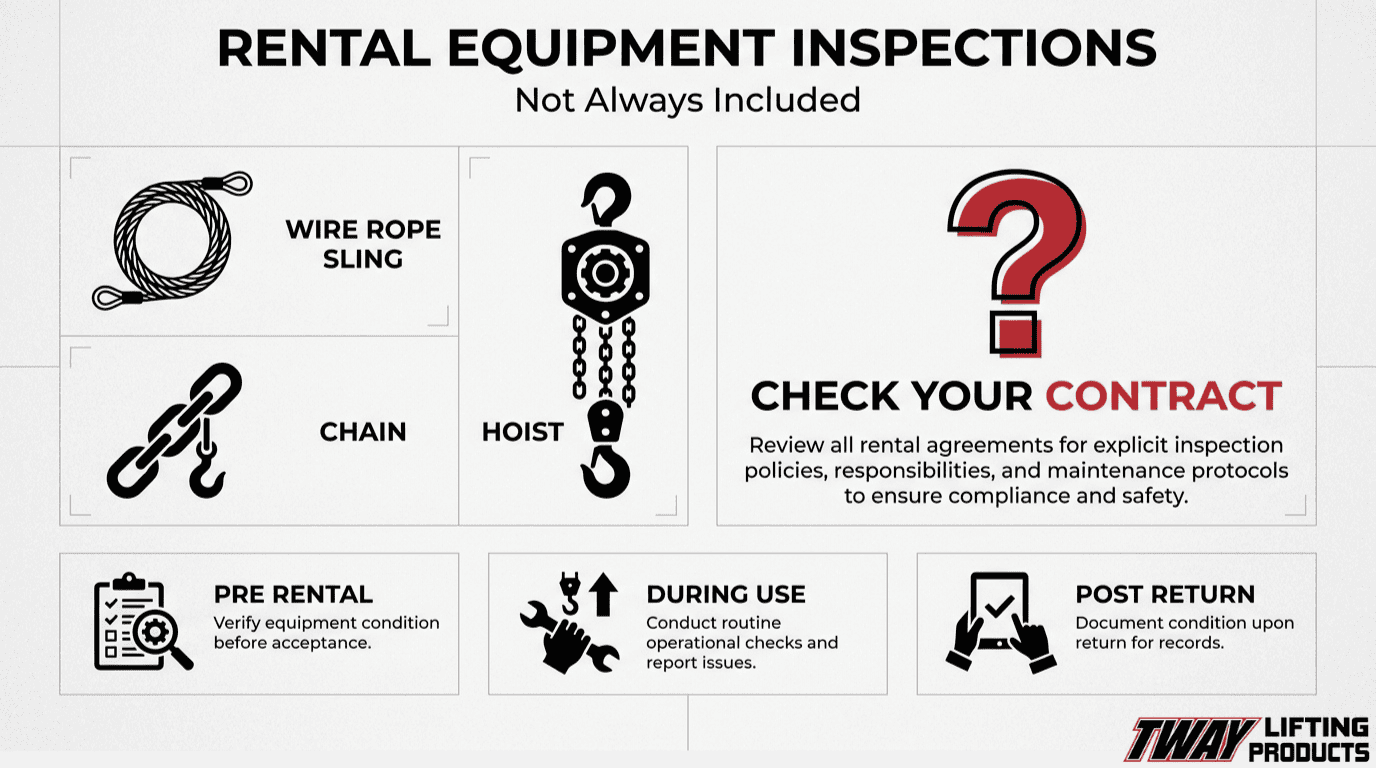

Rental equipment inspections are not automatically included with every agreement. Coverage depends on the rental company, contract terms, and equipment type, meaning renters often assume protections that do not exist.
This guide covers what rental agreements actually provide, how inspection responsibility is assigned under federal regulations, what specific defects to look for across different equipment types, how inspection requirements vary by industry, and how a qualified third-party inspection service closes the compliance gaps renters most commonly miss.
Rental agreements typically include access to equipment such as wire rope slings, chain slings, synthetic slings, hoists, and spreader beams, but not a guarantee that each item has been inspected before delivery. Rental companies may perform pre-rental checks as standard practice, though inspection depth varies considerably, and post-return inspections serve the rental company’s asset protection, not the renter’s safety.
Federal regulations assign the pre-use inspection burden to the employer operating the equipment, not the owner or rental provider. OSHA requires rigging equipment to be inspected prior to use on each shift, and MSHA places pre-operation inspection responsibility directly on the equipment operator. These obligations apply regardless of whether the equipment is rented or owned.
Inspection requirements also differ across construction, mining, and entertainment, each governed by distinct standards and responsible parties. Using rental equipment without a proper inspection exposes employers to equipment failure, worker injury, and significant regulatory liability. OSHA-compliant inspection services from a qualified third-party provider extend to rented lifting and rigging gear and provide the documented compliance record job sites require.
What Does Rental Equipment Typically Include?
Rental equipment from a full-service rigging supplier typically includes wire rope slings, chain slings, synthetic slings, spreader beams, shackles, hoists, and load cells. The sections below cover what renters can expect from standard rental inventories and how delivery and availability are structured.
Are Inspections Automatically Included with Rental Equipment?
Inspections are not automatically included with every rental equipment agreement. Coverage varies by company, contract terms, and equipment type. The following H3s cover pre-rental inspections, post-return inspections, and the renter’s own pre-use obligations.
Do Rental Companies Inspect Equipment Before Each Rental?
Rental companies do not universally inspect equipment before each rental, though many reputable providers perform pre-rental checks as standard practice. According to the U.S. General Services Administration, GSA-approved rental companies are staffed with professionals who provide advice and training on rented tools and equipment, suggesting a baseline of pre-rental diligence at qualified suppliers. However, inspection depth varies considerably across providers. Renters should always request documentation confirming that equipment was inspected before accepting delivery, rather than assuming it was done.
Do Rental Companies Inspect Equipment After It Is Returned?
Rental companies typically inspect equipment after it is returned to assess damage, document condition, and determine liability. This post-return inspection primarily protects the rental company’s asset rather than the renter’s safety. It does not substitute for the pre-use and during-use inspections required while the equipment is in the renter’s control. Relying on the rental company’s return inspection as a safety measure is a common and costly misunderstanding.
Is a Pre-Use Inspection by the Renter Required?
A pre-use inspection by the renter is required under federal regulations for most categories of lifting and rigging equipment. OSHA mandates that rigging equipment for material handling be inspected prior to use on each shift and as necessary during use to ensure it is safe, and that defective rigging equipment be removed from service (OSHA 29 CFR 1926.251). Additionally, MSHA requires operators to perform a pre-operation safety inspection, with defects affecting safety corrected in a timely manner. These obligations fall on the employer operating the equipment, regardless of whether it was rented or owned.
What Types of Inspections Apply to Rental Equipment?
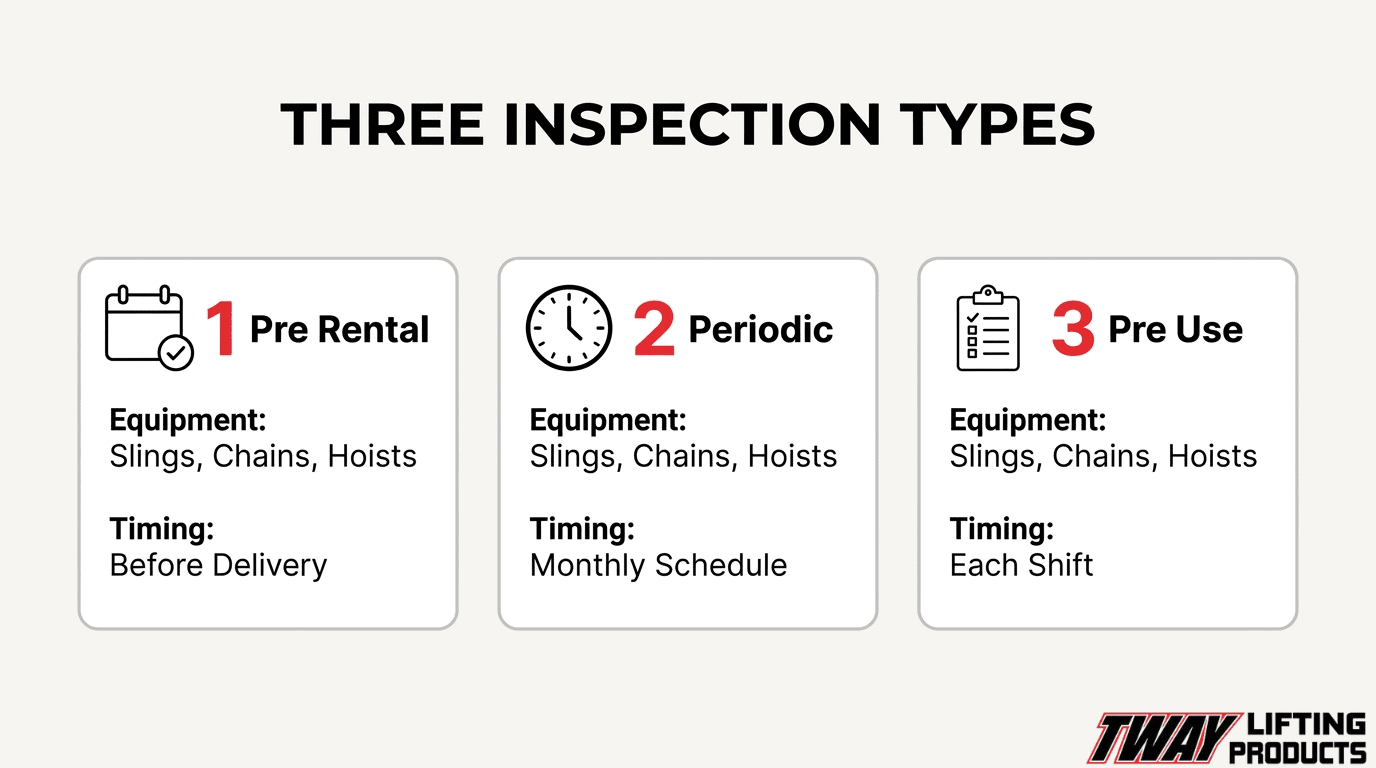
Three inspection types apply to rental equipment: pre-rental, periodic, and pre-use. Each occurs at a different stage of the rental lifecycle and carries distinct responsibilities for the rental company and the renter.
What Is a Pre-Rental Inspection?
A pre-rental inspection is an assessment performed by the rental company before equipment is released to a customer. The rental company examines the equipment for visible damage, wear, and functional defects to confirm it is safe and operational before the rental period begins. This inspection protects both parties: the rental company documents the equipment’s condition at handoff, and the renter receives gear that has been reviewed by a qualified party. For rigging equipment, this step is especially critical because defects in slings, hoists, or chains may not be obvious to an untrained eye.
What Is a Periodic Inspection?
A periodic inspection is a scheduled, recurring evaluation of rental equipment conducted at defined intervals, such as monthly, quarterly, or annually. These inspections go beyond surface-level checks and typically require a qualified inspector to assess structural integrity, load-bearing components, and wear indicators. For lifting and rigging equipment, periodic inspections are the standard mechanism for catching progressive damage that develops through repeated use across multiple rental cycles. Skipping periodic inspections is one of the most common compliance gaps in rental fleets. Tway Lifting offers professional rigging inspection services, including OSHA-required annual inspections and job site safety inspections performed by certified specialists, which can be applied to both owned and rented equipment.
What Is a Pre-Use Inspection?
A pre-use inspection is a check performed by the equipment operator immediately before each use. According to OSHA standard 1926.251, rigging equipment for material handling shall be inspected prior to use on each shift and removed from service if found defective. This obligation falls on the renter’s side of the relationship, not the rental company’s. The operator reviews for visible damage, deformation, corrosion, and missing components before any lift or operation begins.
Who Is Responsible for Inspecting Rental Equipment?
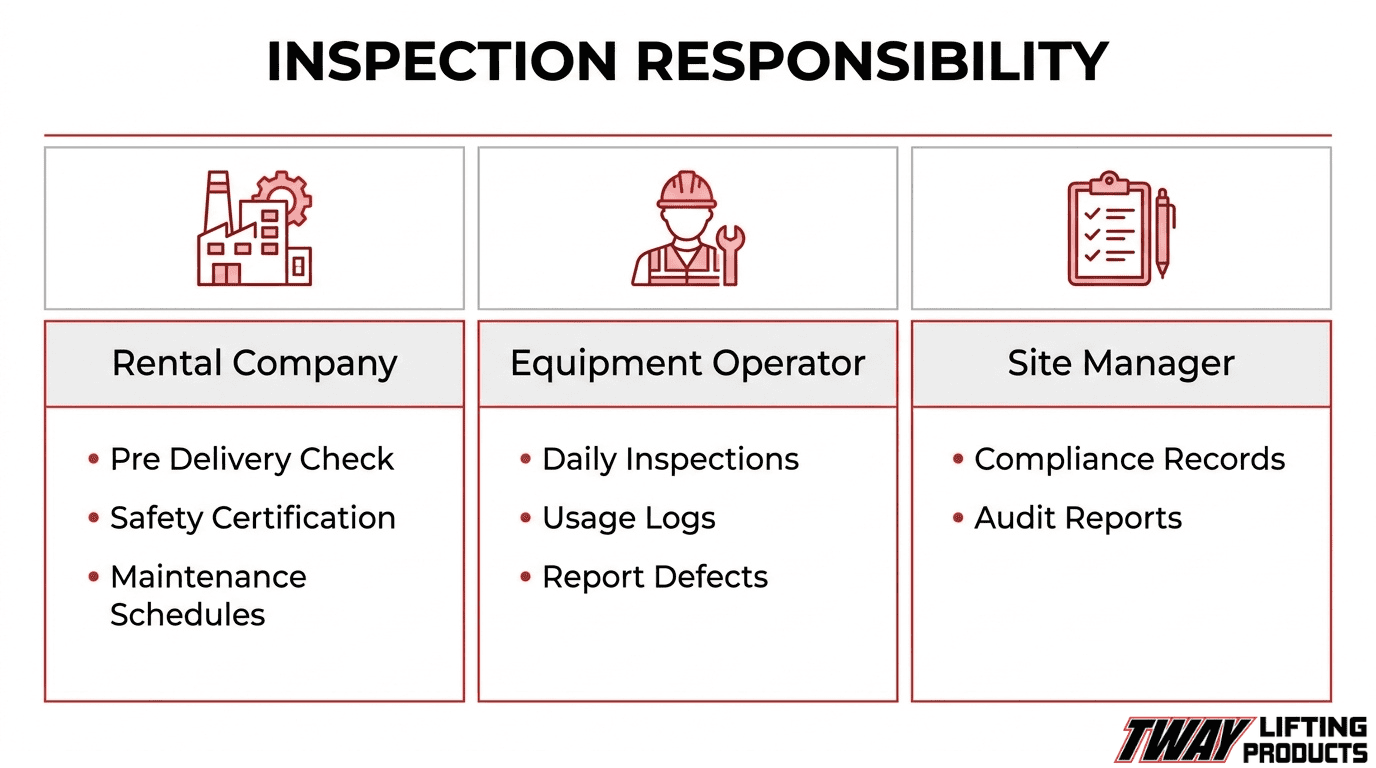
Inspection responsibility for rental equipment is shared across multiple parties, depending on who provides, operates, or manages the equipment. The sections below cover rental company obligations, renter duties, and third-party contractor accountability.
Who Is Responsible When the Rental Company Provides the Equipment?
The rental company is responsible for ensuring equipment is mechanically sound, properly maintained, and inspected before it leaves their facility. This typically covers pre-rental inspection, documentation of equipment condition, and removal of defective units from the available inventory. According to the U.S. General Services Administration, GSA-approved rental companies are staffed with professionals who provide advice and training on rented tools and equipment. That said, a rental company’s pre-delivery inspection does not transfer full liability to the renter, but it does not eliminate the renter’s own inspection duties either. Rental company responsibility ends at delivery; what happens on the job site shifts to the operator.
Who Is Responsible When the Renter Operates the Equipment?
The renter is responsible for conducting pre-use inspections once the equipment is on-site and in operation. Operating without verifying equipment condition places legal and safety liability squarely on the employer directing that work. OSHA mandates that rigging equipment be inspected prior to use on each shift and removed from service if found defective. This means the renter’s designated competent person, not the rental company, owns the pre-shift inspection duty during active use. Treating the rental company’s pre-delivery check as a substitute for on-site inspection is a dangerous and non-compliant assumption.
Who Is Responsible When a Third-Party Contractor Is Involved?
When a third-party contractor is involved, inspection responsibility belongs to the employer directing the contractor’s work with the equipment. OSHA assigns inspection obligations to the employer controlling the work environment, regardless of who owns the equipment. The contractor’s employer must designate a competent person to conduct daily sling and attachment inspections, as required under OSHA 29 CFR 1910.184. Ownership of the equipment does not determine inspection duty; control over its use does. In multi-party job sites, written agreements should clearly define which party holds inspection responsibility to avoid dangerous gaps in compliance.
What Do OSHA Regulations Say About Rental Equipment Inspections?
OSHA regulations establish clear, mandatory inspection requirements for rigging equipment, regardless of whether that equipment is owned or rented. The following H3s cover what OSHA requires, who bears responsibility, and the consequences of non-compliance.
Does OSHA Require Inspections on Rental Rigging Equipment?
Yes, OSHA requires inspections on rental rigging equipment. According to OSHA standard 29 CFR 1926.251, rigging equipment for material handling shall be inspected prior to use on each shift and as necessary during its use to ensure it is safe, and defective rigging equipment shall be removed from service. A separate standard, 29 CFR 1910.184, further specifies that slings and all fastenings and attachments must be inspected daily by a competent person designated by the employer. These requirements apply to the equipment in use, not to its ownership status. Whether a sling is rented or owned, the inspection obligation is identical.
Does OSHA Assign Inspection Responsibility to the Renter or the Owner?
OSHA assigns inspection responsibility to the employer directing the work, which is typically the renter on an active job site. OSHA standards reference the “employer” and the “competent person designated by the employer” as the responsible parties for pre-use and shift inspections. The rental company’s pre-rental check does not satisfy this obligation. Once equipment is in operation, the employer controlling that work environment holds the compliance burden. This is an often-misunderstood distinction that can expose renters to significant liability.
What Happens If Rental Equipment Fails an OSHA Inspection?
Rental equipment that fails an OSHA inspection must be removed from service immediately. OSHA standard 29 CFR 1926.251 states explicitly that defective rigging equipment shall be taken out of operation without delay. Continuing to use failed equipment exposes employers to OSHA citations, fines, and potential liability for injuries. The rental company must be notified so the defective item can be repaired, reconditioned, or replaced before returning to service.
What Should You Look for When Inspecting Rental Equipment?
Inspecting rental lifting equipment requires checking specific defect indicators on each equipment type. The following H3s cover wire rope slings, chain slings, hoists, and synthetic slings.
What Should You Inspect on Rental Wire Rope Slings?
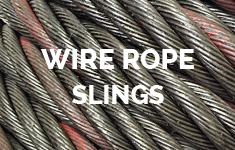
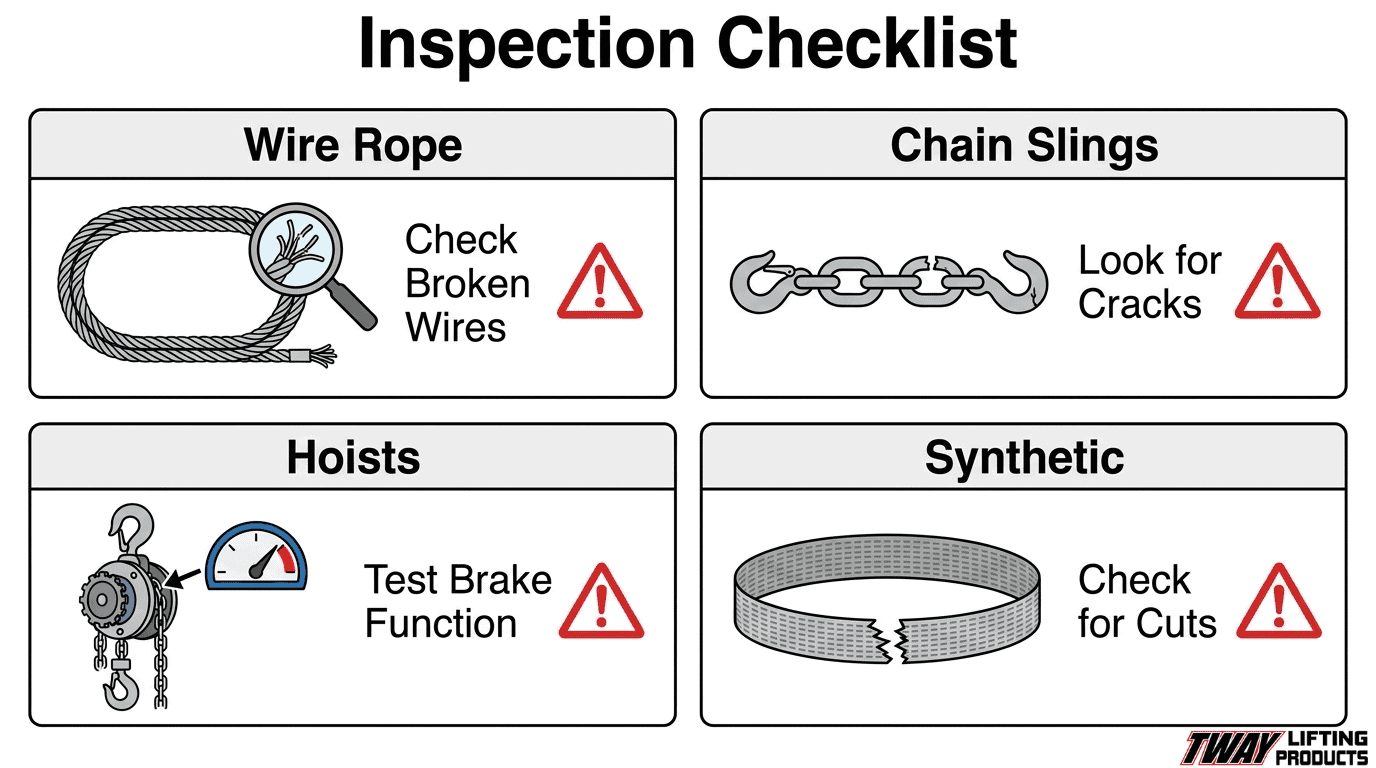
Rental wire rope slings should be inspected for broken wires, corrosion, kinking, crushing, bird-caging, and core damage. According to OSHA, wire rope should not be used when it exceeds six wire breaks in multiple strands in any lay length, or three breaks in any single strand in any lay length. Check end fittings, hooks, and thimbles for deformation or cracks. Any sling showing these defects must be removed from service immediately before a lift begins.
What Should You Inspect on Rental Chain Slings?
Rental chain slings should be inspected for stretched links, cracks, gouges, nicks, corrosion, and weld defects. Examine each link individually, since a single damaged link compromises the entire sling’s rated capacity. Also verify that hooks, master links, and coupling links are properly seated and show no deformation. Chain that has been shock-loaded or overstressed may show no visible distortion yet still be unsafe.
What Should You Inspect on Rental Hoists?
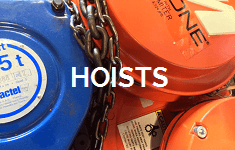
Rental hoists should be inspected for proper brake function, hook condition, chain or wire rope wear, and load-limiting device operation. Check that the hook latch closes fully and that the hook throat has not widened beyond its rated tolerance. Inspect the chain drive, motor housing, and suspension attachment point for cracks or corrosion. Hoists with inoperative brakes or damaged load chains must never be placed into service.
What Should You Inspect on Rental Synthetic Slings?
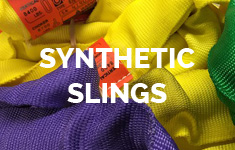
Rental synthetic slings should be inspected for cuts, tears, abrasion, chemical burns, heat damage, and missing or illegible load tags. Webbing that shows exposed core yarns or significant surface wear has lost structural integrity and must be taken out of service. Unlike wire rope or chain, synthetic sling damage is not always obvious, so inspectors should flex the sling and examine both faces along its full length before use.
How Do Rental Equipment Inspections Vary by Industry?
Rental equipment inspections vary by industry based on the governing regulatory body, equipment type, and site-specific hazards. The sections below cover inspection requirements in construction, mining, and entertainment.
How Are Rental Equipment Inspections Handled in Construction?
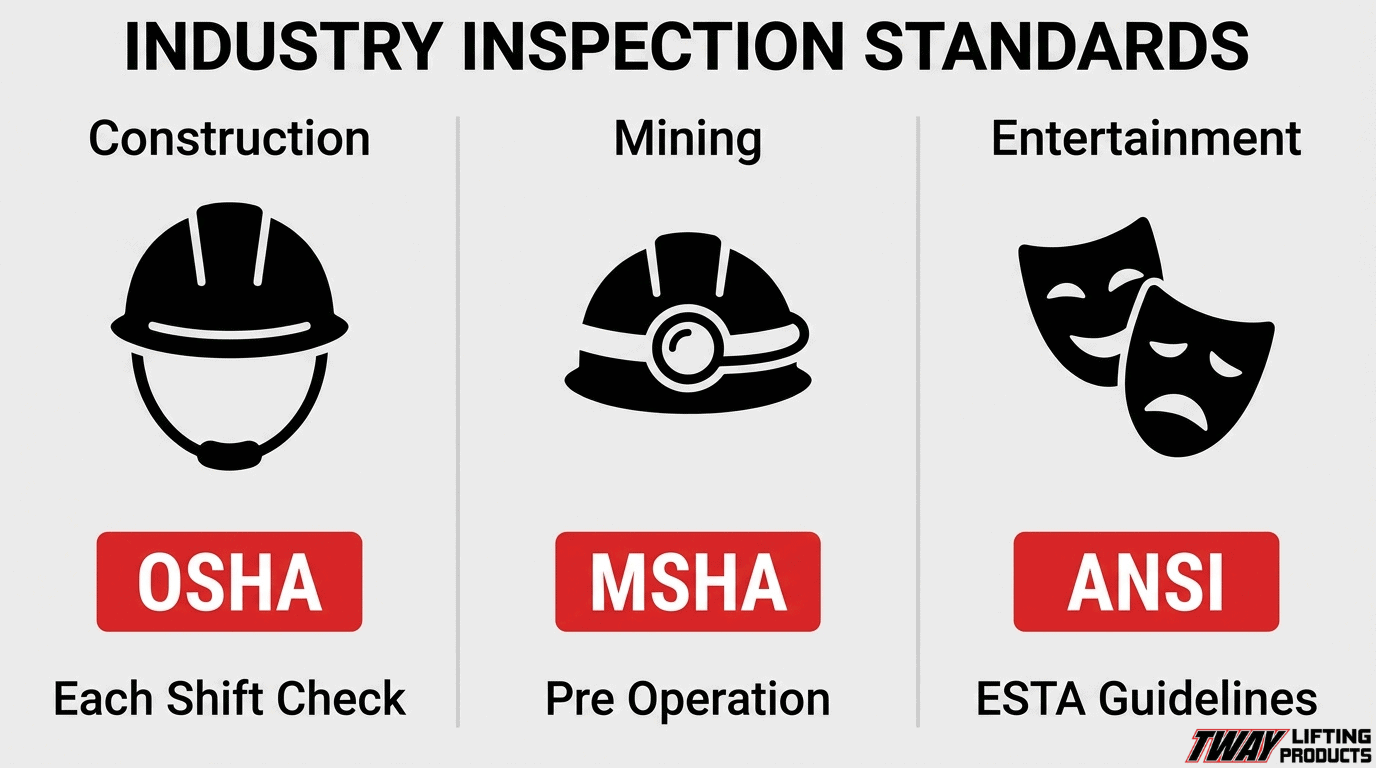
Rental equipment inspections in construction are handled under OSHA standards, which mandate pre-shift inspection of all rigging equipment used for material handling. According to OSHA 29 CFR 1926.251, rigging equipment shall be inspected prior to use on each shift, and defective equipment must be removed from service immediately. Slings, wire rope, and hoisting assemblies all fall under this requirement. Construction sites involve heavy loads, unpredictable conditions, and multiple contractors, making consistent inspection discipline especially critical. Tway Lifting serves construction companies across Indiana and beyond, providing rigging rentals and OSHA-compliant inspection services designed to support job site compliance from delivery through active use. Renters operating on job sites bear primary responsibility for pre-use checks, regardless of whether the equipment was delivered in good condition.
How Are Rental Equipment Inspections Handled in Mining?
Rental equipment inspections in mining are handled under Mine Safety and Health Administration (MSHA) regulations, which impose operator-level accountability. MSHA requires that operators perform a pre-operation safety inspection before using self-propelled mobile equipment, and defects affecting safety must be corrected in a timely manner. Mining environments expose equipment to extreme wear, dust, and grade changes, which makes pre-operation checks especially consequential. Unlike OSHA construction standards, MSHA places inspection responsibility directly on the equipment operator, not a designated competent person, reinforcing individual accountability on site.
How Are Rental Equipment Inspections Handled in the Entertainment Industry?
Rental equipment inspections in the entertainment industry are handled through ANSI standards developed by the Entertainment Services and Technology Association (ESTA). ANSI E1.6-2 2020 governs the design, inspection, and maintenance of electric chain hoists used in entertainment rigging. Additionally, ANSI E1.4-2 2021 establishes minimum performance criteria for statically suspended rigging systems in performance spaces. These standards apply to venues such as stadiums and theaters where suspended loads pose direct risks to audiences. Because entertainment rigging often involves temporary installations with rented hoists and truss systems, inspection compliance depends heavily on the rigging contractor managing the event. Tway Lifting supplies entertainment rigging equipment, including hoists and related hardware, and offers inspection services applicable to temporary rigging installations at venues such as stadiums and performance spaces.
What Are the Risks of Using Rental Equipment Without a Proper Inspection?
The risks of using rental equipment without a proper inspection include equipment failure, worker injury, fatalities, and regulatory violations that expose employers to serious legal liability. Uninspected lifting and rigging equipment can fail under load without warning, with consequences that are often irreversible.
Skipping inspections puts workers directly in harm’s way. OSHA mandates that rigging equipment for material handling be inspected prior to use on each shift, and defective equipment be removed from service immediately. Ignoring this requirement means undetected defects, such as wire rope strand breaks, worn chain links, or compromised sling attachments, remain in active use.
Beyond physical danger, operating uninspected rental equipment exposes employers to OSHA citations, work stoppages, and civil liability. According to the Centers for Disease Control and Prevention, 125 traumatic injuries from commercial fishing winches alone were identified between January 2000 and November 2020, underscoring how mechanical equipment failures cause real, preventable harm.
From an expert standpoint, the assumption that a rental company’s pre-rental check satisfies all inspection obligations is one of the most common and costly mistakes site supervisors make. The renter’s duty to inspect before each use is independent of whatever the rental company performed before delivery.
How Should You Approach Rental Equipment Inspections with OSHA-Compliant Inspection Services?
Approaching rental equipment inspections with OSHA-compliant inspection services means engaging a qualified third-party specialist before each use. The sections below cover whether Tway Lifting’s services extend to rental equipment and the core takeaways renters need to act on.
Can OSHA-Compliant Inspection Services From Tway Lifting Cover Rental Equipment?
Yes, OSHA-compliant inspection services from Tway Lifting can cover rental equipment across a wide range of lifting and rigging gear, including wire rope slings, chain slings, synthetic slings, hoists, and spreader beams. Tway Lifting’s certified inspection specialists perform inspections against applicable OSHA standards and ANSI guidelines. According to the Entertainment Services and Technology Association, ANSI E1.6-2 2020 governs the design, inspection, and maintenance of electric link chain hoists used in entertainment rigging, one category within Tway Lifting’s inspection scope. Rental equipment does not arrive with a compliance guarantee attached, making third-party inspection an essential step before any shift begins.
What Are the Key Takeaways About Whether Inspections Are Included with Rental Equipment?
The key takeaways about whether inspections are included with rental equipment are straightforward: inspections are rarely automatic, and the renter carries the compliance burden once equipment leaves the rental yard. The most actionable conclusions from this article are:
- Rental companies typically inspect equipment between rentals, but this does not satisfy OSHA’s shift-by-shift inspection requirements.
- OSHA places pre-use inspection responsibility on the employer operating the equipment, not the owner or rental provider.
- Defective rental equipment must be removed from service immediately, regardless of the rental agreement terms.
- A qualified third-party provider, such as Tway Lifting, can perform OSHA-required periodic and job site inspections on rented gear.
- Documenting inspections creates a defensible compliance record if a regulatory review or incident occurs.
Partnering with Tway Lifting’s inspection specialists before deploying rental equipment is the most reliable way to close the compliance gap renters often overlook.