






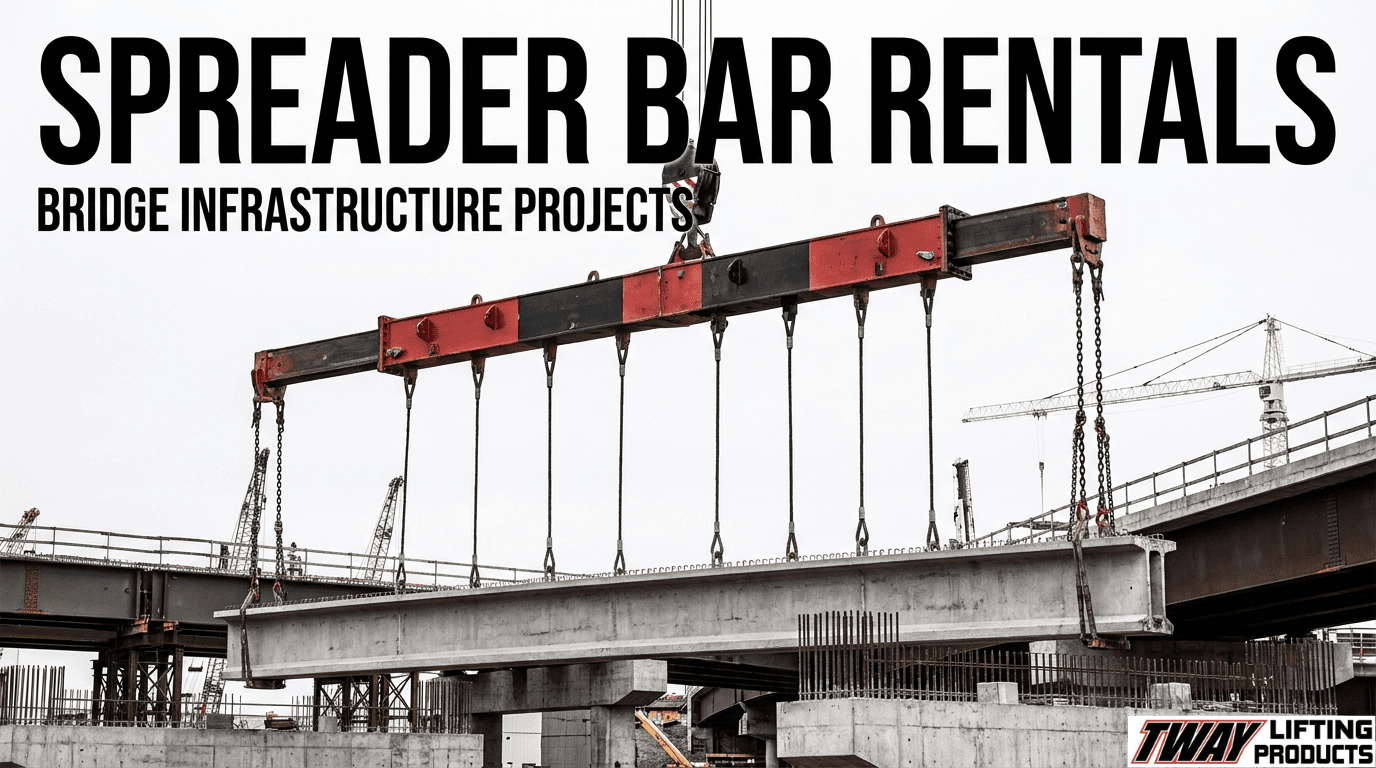

Spreader bar rental for bridge and infrastructure projects is the short-term lease of below-the-hook lifting devices that convert crane hook loads into pure compression, distributing force evenly across multiple lift points to protect structural components during placement.
This guide covers what spreader bars are and how they work, the types available to rent, why they are essential for infrastructure lifts, their key project applications, how to select the right bar for a bridge job, compliance requirements, pre-use inspection procedures, rental costs, and the rent-versus-buy decision.
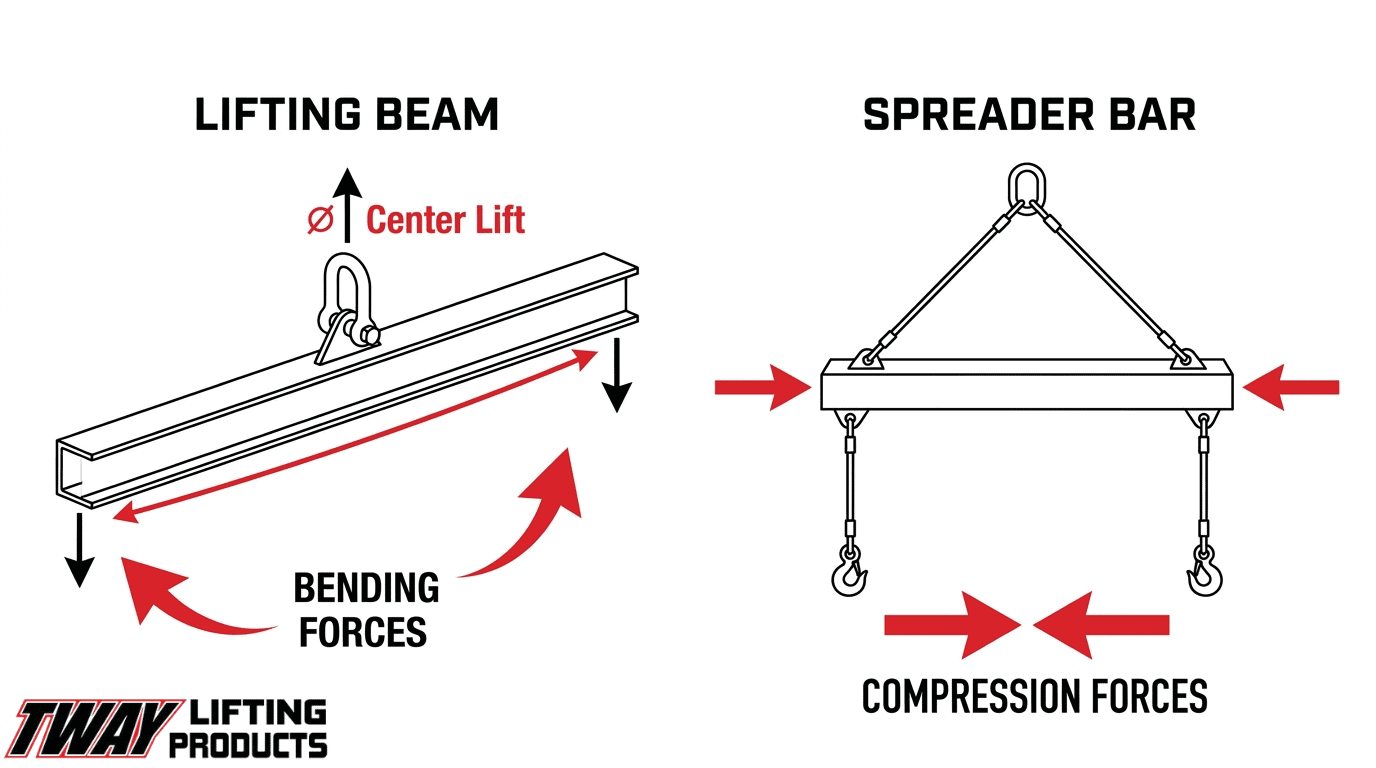
Spreader bars function by holding slings apart at a controlled horizontal distance, keeping lifting forces vertical and eliminating the inward side loads that steep sling angles place on structural members. They differ from lifting beams in a fundamental way: lifting beams carry load through bending at a single center point, while spreader bars transfer load entirely through compression across the full span.
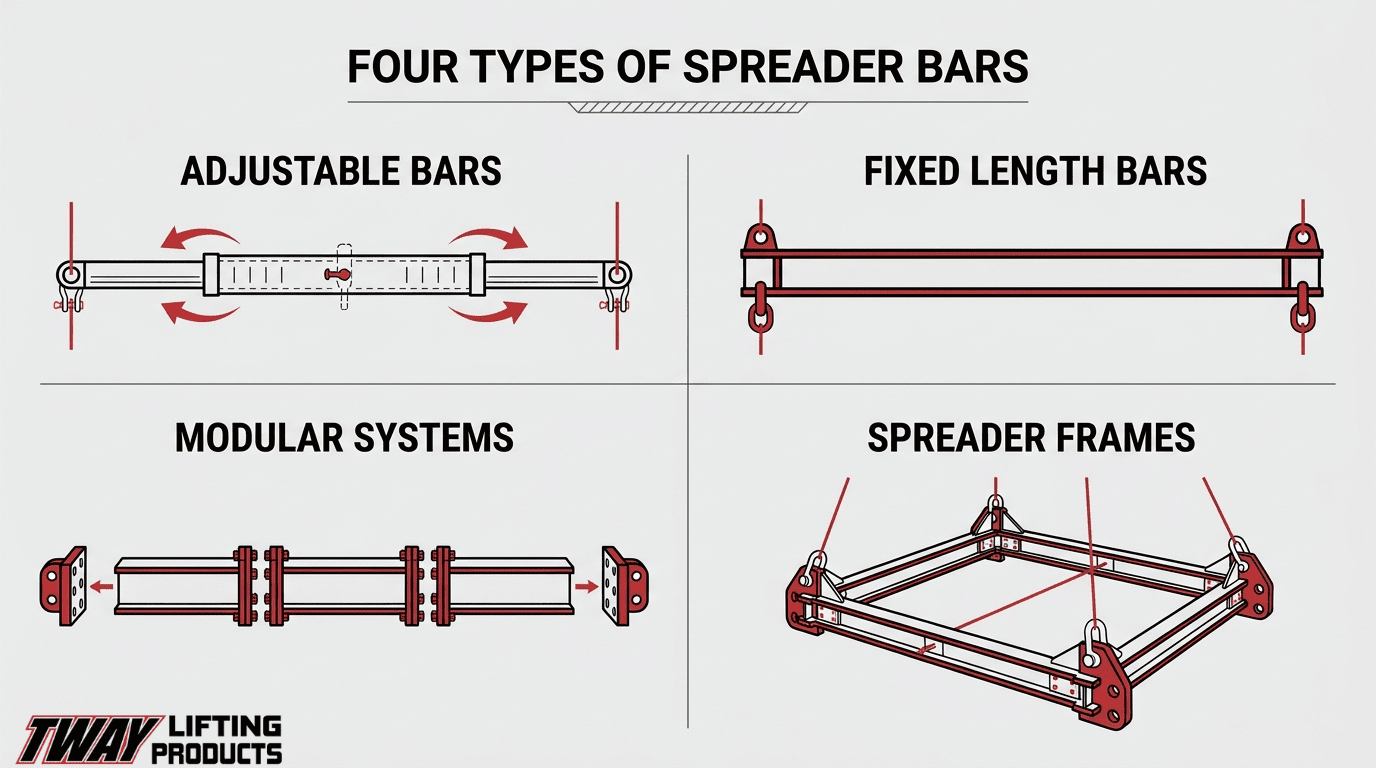
The types available to rent include adjustable telescoping bars, fixed-length bars, modular bolt-together systems, and below-the-hook spreader frames. Each configuration suits different span requirements, load geometries, and site conditions.
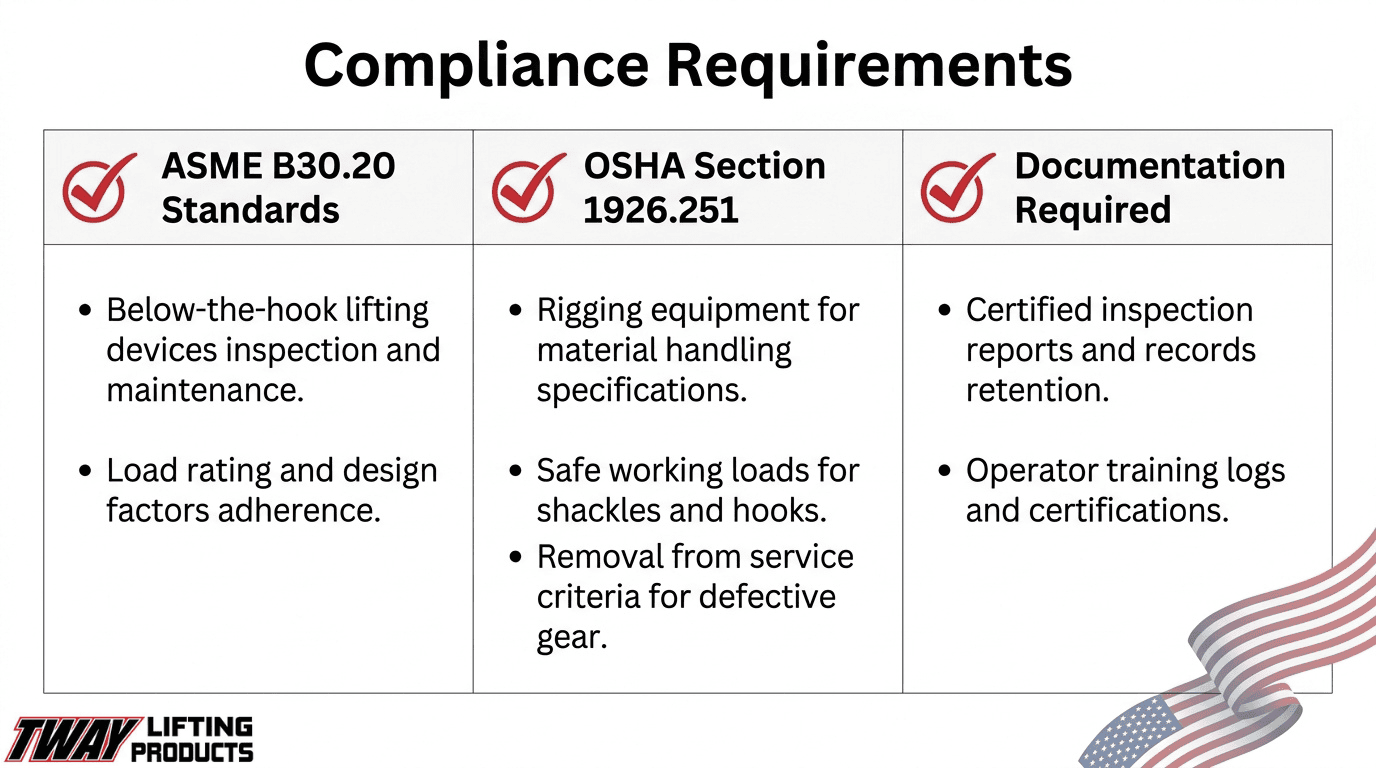
Compliance governs every rental decision. ASME B30.20-2025 now explicitly addresses adjustable and modular spreader bars, covering marking, construction, inspection, and operation. OSHA Section 1926.251 requires that lifting accessories for prefabricated structures be marked with safe working loads and proof-tested to 125 percent of rated capacity before use.
Rental costs range from approximately $180 to $1,200 per week depending on span length and capacity, with the rent-versus-buy threshold for specialty rigging falling around 30 days of annual use.
What Is a Spreader Bar and How Does It Work in Lifting?
A spreader bar is a below-the-hook lifting device that converts lifting loads into pure compression, protecting slings and cargo during crane operations. The following sections cover what a spreader bar does during a lift, how it differs from a lifting beam, and what load capacities these devices handle.
What Does a Spreader Bar Do During a Lift?
A spreader bar works by holding slings apart at a controlled horizontal distance, keeping lifting forces vertical and preventing inward compression on the load. Without a spreader bar, short slings create steep angles that multiply side loads on lifting rings dangerously. According to a Texas Department of Transportation Center for Transportation Research study on Accelerated Bridge Construction, a 60-foot extendable spreader bar with two lift clamps was used to lift and support bridge girders during erection. When headroom is restricted, slings must be shortened, which increases side loads; a spreader bar eliminates this problem by maintaining vertical force alignment on the lifting rings.
How Does a Spreader Bar Differ From a Lifting Beam?
A spreader bar differs from a lifting beam primarily in how each handles load forces. Lifting beams use a single center top attachment point and carry load through bending; spreader bars transfer load entirely through compression. According to the National Precast Concrete Association, a 4-point pick suspended from a single point loads only two of the four slings and anchors at any time, whereas a spreader beam ensures all four anchors and slings share the load equally. This load distribution advantage makes spreader bars the preferred choice for long, fragile, or irregularly shaped infrastructure components where balanced multi-point lifting is critical.
What Load Capacities Do Spreader Bars Handle?
Spreader bars handle load capacities ranging from light-duty lifts under 1 ton to heavy infrastructure lifts exceeding 100 tons, depending on design, material, and configuration. Tway Lifting’s rental inventory covers spreader beams rated from 2 to 100 tons, with lengths up to 40 feet, along with telescopic adjustable-length bars for variable span requirements. For any application, the working load limit must be clearly marked on the device, and the bar must be matched to both the total load weight and the lift point geometry before use. Tway Lifting’s rigging rental inventory includes spreader beams from 2 to 100 tons and up to 40 feet in length, along with telescopic adjustable-length bars, giving infrastructure teams the capacity range to match equipment precisely to their lift requirements.
What Types of Spreader Bars Are Available to Rent?
The types of spreader bars available to rent include adjustable bars, fixed-length bars, modular systems, and below-the-hook spreader frames. Each type suits different load geometries, span requirements, and project conditions.
Adjustable Spreader Bars
Adjustable spreader bars are telescoping bars that allow operators to change the lift span without swapping equipment. Attachment points slide or lock at variable positions along the bar’s length, accommodating loads with non-standard or shifting pick-point spacing. This flexibility makes them well-suited for bridge girder erection and precast panel placement, where lift point locations often vary between elements. ASME B30.20-2025 now explicitly addresses adjustable spreader bars, covering their marking, construction, inspection, and operation requirements.
Fixed-Length Spreader Bars
Fixed-length spreader bars are single-span bars manufactured to one set dimension, optimized for repeated lifts of identical loads. Because their geometry does not change, they are simpler to inspect and certify, and they typically offer higher load ratings relative to their weight. These bars work best on production-oriented infrastructure jobs where element dimensions are consistent throughout the project, such as standardized deck panel installations.
Modular Spreader Bar Systems
Modular spreader bar systems consist of interchangeable sections that bolt or pin together to form bars of varying lengths. Crews can assemble the required span on-site using standardized components, then reconfigure the system for the next phase without renting a separate unit. ASME B30.20-2025 also specifically addresses modular spreader bars, recognizing their unique assembly and inspection considerations. For large infrastructure projects with evolving span requirements, modular systems offer the most practical combination of adaptability and compliance.
Below-the-Hook Spreader Frames
Below-the-hook spreader frames are rigid, often rectangular or H-shaped lifting frames that distribute a load across four or more attachment points simultaneously. Unlike linear bars, these frames handle loads with two-axis spread requirements, such as wide bridge deck segments or large precast slabs. Because they attach below the crane hook and interface directly with the load, they fall under ASME B30.20-2025 below-the-hook device standards for marking, construction, and pre-use testing. Selecting the right frame geometry at the outset is critical; an undersized or incorrectly configured frame can introduce uneven load distribution that compromises both the lift and the structure.
Why Are Spreader Bars Essential for Bridge & Infrastructure Lifts?
Spreader bars are essential for bridge and infrastructure lifts because they distribute load forces across multiple points, preventing structural damage to long, flexible, or heavy components during crane operations. The sections below cover load protection, multi-point lifting requirements, and sling angle stress reduction.
How Do Spreader Bars Protect Long or Flexible Bridge Loads?
Spreader bars protect long or flexible bridge loads by maintaining controlled horizontal separation between lift points, preventing inward compression forces that can buckle or crack structural members. Bridge girders, precast deck panels, and steel trusses are especially vulnerable when slings converge at steep angles, concentrating stress at the lift attachments. By keeping lift points spread apart, the bar eliminates inward sling forces entirely, allowing the load to travel horizontally stable without flex or twist. For components with low lateral rigidity, this is not a precaution but a structural necessity. Any rigging plan that skips a spreader on a long bridge element is accepting risk that the geometry of the lift itself simply cannot tolerate.
Why Do Infrastructure Projects Require Multi-Point Lifting?
Infrastructure projects require multi-point lifting because prefabricated structures, modular panels, and bridge components are too large and heavy for a single-point pick to distribute load safely across all attachment anchors. A four-point pick suspended from a single crane hook loads only two of the four anchors at any given time, leaving the other two unloaded and creating uneven stress concentration. Using a spreader bar ensures all four anchors and slings share the load equally. Per OSHA Section 1926.251(a)(4), custom lifting accessories for modular panels and prefabricated structures must be marked with safe working loads and proof-tested to 125 percent of rated load prior to use.
How Do Spreader Bars Reduce Sling Angle Stress on Structural Members?
Spreader bars reduce sling angle stress by widening the horizontal distance between lift points, which increases the sling angle relative to vertical and reduces the compressive side load transferred into the structure. According to the National Precast Concrete Association, a sling angle below 60 degrees is not recommended for concrete structures because a 30-degree angle generates twice the force of a 90-degree angle, capable of overloading both anchors and slings and causing structural failure. By maintaining wider lift point separation, a spreader bar keeps sling angles above the safe threshold without requiring excessively long slings. For infrastructure crews working under bridge decks or in restricted clearance zones, this force geometry control is what separates a safe lift from a catastrophic one.
What Are the Key Applications of Spreader Bar Rentals in Infrastructure?
The key applications of spreader bar rentals in infrastructure include bridge beam installation, precast concrete panel placement, bridge deck segment lifts, utility tower and transmission line work, and tunnel and underground construction. Each application demands multi-point load control that only spreader bars reliably provide.
How Are Spreader Bars Used in Bridge Beam Installation?
Spreader bars are used in bridge beam installation to distribute crane hook loads across multiple lift points, keeping long girders level and preventing bending stress during placement. According to a study by the Texas Advanced Computing Center at the University of Texas, spreader bars convert lifting loads into pure compression, unlike lifting beams that rely on bending forces through a single center point. For bridge girders, this compression-based load path is critical: a girder swinging under uneven sling tension can crack, shift, or overturn before it ever reaches its bearing seat. Specifying the right bar length to match the girder’s lift points is the single most important selection decision on these jobs.
How Are Spreader Bars Used in Precast Concrete Panel Placement?
Spreader bars are used in precast concrete panel placement to equalize tension across all lift anchors simultaneously, preventing anchor overload and panel cracking. A single-hook pick without a spreader bar loads only two of four anchors at a time, concentrating stress unpredictably. By spreading attachment points to match the panel’s embedded hardware layout, a spreader bar keeps every anchor in vertical tension, which is the loading condition those anchors are engineered to handle.
How Are Spreader Bars Used in Bridge Deck Segment Lifts?
Spreader bars are used in bridge deck segment lifts to stabilize wide, heavy deck sections that would otherwise rotate or tip under an off-center crane hook. Deck segments often have asymmetric mass distribution, and a fixed or adjustable spreader bar provides the horizontal separation between sling attachment points needed to counteract that imbalance. This keeps the segment level as it travels from the transport barge or truck into its final position on the piers.
How Are Spreader Bars Used in Utility Tower and Transmission Line Work?
Spreader bars are used in utility tower and transmission line work to lift assembled tower sections and conductor reels without damaging sensitive components or distorting structural geometry. Tower sections are typically tall and slender, making them prone to racking if slings converge at a steep angle. A spreader bar widens the pick geometry, reduces horizontal compression on the tower’s chord members, and keeps the assembly plumb during crane travel to the foundation.
How Are Spreader Bars Used in Tunnel and Underground Infrastructure Projects?
Spreader bars are used in tunnel and underground infrastructure projects to lower precast tunnel lining segments, mechanical equipment, and prefabricated utility modules through restricted shaft openings. Headroom inside shafts is severely limited, so slings alone would create extreme inward side loads on any lift hardware. A spreader bar maintains vertical sling geometry within the confined space, protecting both the lifted component and the shaft lining from damaging lateral forces during descent.
How Do You Choose the Right Spreader Bar for a Bridge Project?
Choosing the right spreader bar for a bridge project depends on five factors: span length, load weight, lift point locations, headroom clearance, and environmental conditions. Each variable directly influences bar size, configuration, and material requirements.
How Does Span Length Determine the Right Spreader Bar Size?
Span length determines spreader bar size by setting the minimum horizontal distance the bar must bridge between attachment points on the load. Longer bridge components, such as precast girders or deck segments, require longer bars to maintain the correct sling geometry and prevent inward load compression. Matching bar length to actual lift point spacing is the most critical dimension in equipment selection. An undersized bar forces sling angles inward, dramatically increasing compressive forces on the bar and tension loads on rigging hardware.
How Does Load Weight Affect Spreader Bar Selection?
Load weight affects spreader bar selection by determining the minimum safe working load (SWL) rating the bar must carry. The selected bar’s rated capacity must exceed the total lifted weight, including the load, rigging hardware, and any dynamic factors from crane movement. According to OSHA, any method that yields sufficiently accurate and reliable data may be used to establish the weight of the load for proof-testing purposes, meaning teams must verify weight independently before selecting equipment. Underestimating load weight is one of the most common and preventable rigging errors on infrastructure projects.
How Do Lift Point Locations Influence Spreader Bar Configuration?
Lift point locations influence spreader bar configuration by dictating attachment point spacing, the number of pick points required, and whether a single bar or a spreader frame is appropriate. According to the U.S. Department of Defense, a spreader is defined as a device specially designed to permit lifting and handling by spreading the lifting points, confirming that matching bar geometry to lift point layout is fundamental to safe rigging. Asymmetrical lift points require adjustable bars or custom rigging to equalize load distribution across all anchors.
How Does Headroom Clearance at the Job Site Affect Bar Choice?
Headroom clearance at the job site affects bar choice by controlling the usable sling length between the crane hook and the load. Restricted overhead space forces shorter slings, which steepen sling angles and generate higher lateral forces on lifting rings. A spreader bar counteracts this by keeping those forces vertical and manageable, regardless of available headroom. Sites with low clearance, such as bridge underpasses or enclosed staging areas, almost always require a spreader bar rather than a standard two-leg bridle sling configuration.
How Do Environmental Conditions on Bridge Sites Affect Equipment Selection?
Environmental conditions on bridge sites affect equipment selection by introducing wind load, corrosion exposure, temperature variation, and unstable ground conditions that all influence rigging performance. Marine and waterway bridge sites expose steel bars to moisture and salt, accelerating corrosion and reducing the effective service life of unprotected equipment. According to Bureau of Safety and Environmental Enforcement (BSEE) data, crane incidents totaled 1,158 across categories between CY 2007 and CY 2013, underscoring the real operational risk that adverse site conditions create. Equipment rated for the load alone is not sufficient; the bar and rigging system must be matched to the full environmental profile of the site.
What Are OSHA and ASME Compliance Requirements for Spreader Bar Rentals?
OSHA and ASME compliance requirements for spreader bar rentals cover equipment marking, proof-testing, documentation, and operational standards. The sections below address ASME B30.20 standards, OSHA construction regulations, and pre-use documentation requirements.
What ASME B30.20 Standards Apply to Below-the-Hook Lifting Devices?
ASME B30.20 standards apply to below-the-hook lifting devices by governing their marking, construction, installation, inspection, testing, maintenance, and operation. According to the American National Standards Institute, the 2025 revision now explicitly addresses adjustable and modular spreader bars and clamps, making it directly applicable to the configurations most common on bridge and infrastructure projects. Any rented spreader bar used on a job site must conform to these standards regardless of who owns the equipment.
What OSHA Regulations Govern Spreader Bar Use on Infrastructure Sites?
The OSHA regulations that govern spreader bar use on infrastructure sites are found primarily in 29 CFR 1926.251. Section 1926.251(a)(4) requires that special custom-design grabs, hooks, clamps, or other lifting accessories for modular panels and prefabricated structures be marked with their safe working loads and proof-tested to 125 percent of their rated load prior to use. Spreader bars used with rigging hardware on bridge sites fall within this requirement, and non-compliance can result in citation, project stoppage, or liability exposure.
What Documentation Is Required Before Using a Rented Spreader Bar?
The documentation required before using a rented spreader bar includes the equipment’s load rating certification, proof-test records, inspection history, and manufacturer markings confirming safe working load. OSHA’s proof-testing standard allows any reliable method to establish load weight, giving contractors flexibility in how they document compliance. Practically, the most defensible approach is to obtain written certification from the rental provider confirming the bar has been inspected and proof-tested per ASME B30.20 and OSHA 1926.251 before the equipment leaves the yard. Tway Lifting provides professional rigging inspection services performed by certified specialists, including OSHA-required annual inspections, job site safety reviews, and detailed reporting, helping contractors meet documentation requirements before equipment is deployed.
With compliance documentation confirmed, the next step is a thorough pre-use physical inspection of the rented equipment.
What Should You Inspect Before Using a Rented Spreader Bar?
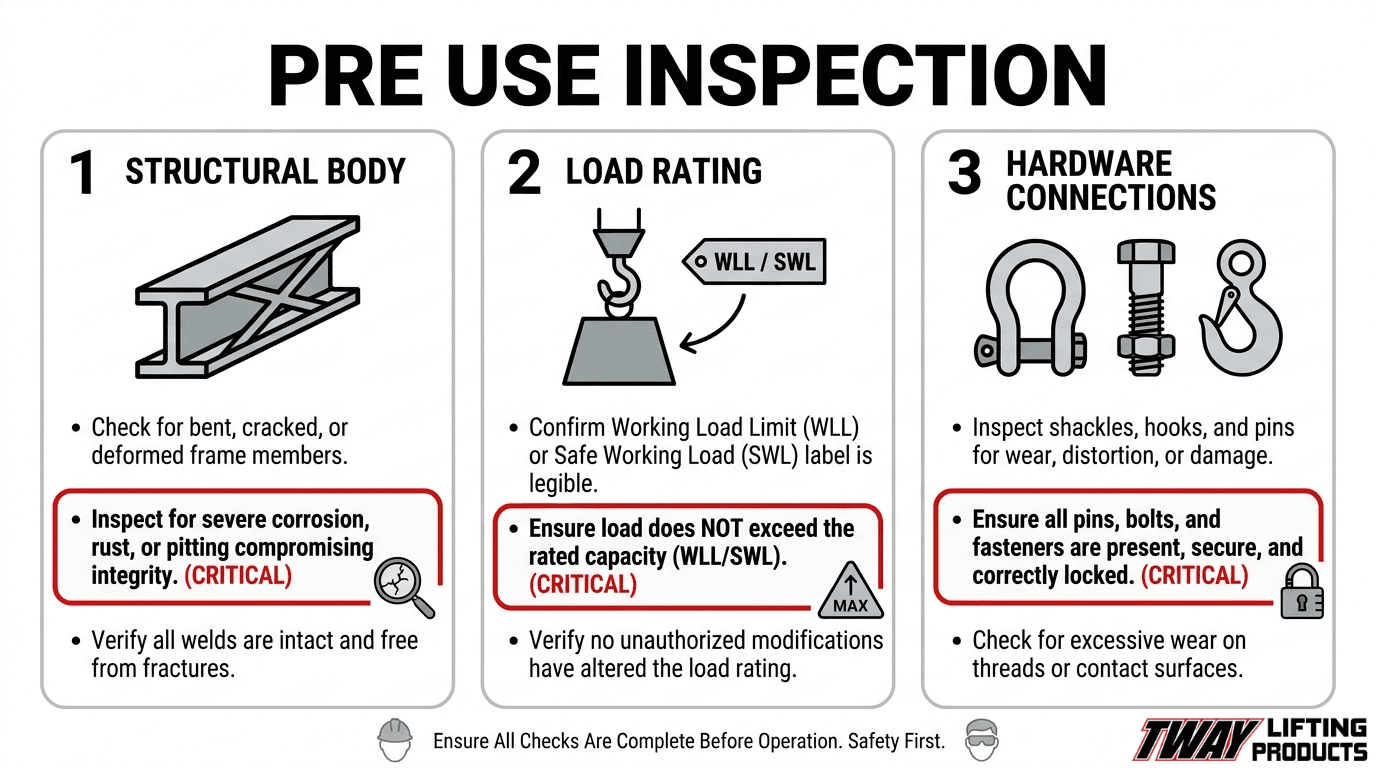
Before using a rented spreader bar, inspect the structural body, verify the load rating, and examine all rigging hardware connections. Each check targets a specific failure point that could compromise the lift.
What Structural Defects Should You Look for on a Spreader Bar?
The structural defects to look for on a spreader bar include cracks, bends, corrosion, deformation, and weld fractures along the main beam. Inspect the full length of the bar visually, paying close attention to end fittings and attachment points where stress concentrates during compression loading. Any visible crack or permanent bend is an automatic disqualifier. Surface rust alone may be cosmetic, but pitting corrosion that reduces wall thickness compromises the bar’s compression capacity and must be assessed by a qualified rigger before the equipment is used.
How Do You Verify the Load Rating of a Rented Spreader Bar?
The load rating of a rented spreader bar is verified by locating the permanent markings on the device that indicate its safe working load (SWL). OSHA Section 1926.251(a)(4) requires that lifting accessories be marked to indicate safe working loads and proof-tested to 125 percent of their rated load prior to use. Confirm the marked SWL matches or exceeds the planned lift weight, and request documentation from the rental provider confirming the bar has been proof-tested. Never rely on verbal assurances; the SWL marking must be legible and the test records current.
What Rigging Hardware Connections Must Be Inspected Before a Lift?
The rigging hardware connections that must be inspected before a lift include shackle pins, end fittings, attachment holes, and any connecting links between the spreader bar and the slings. Check that shackle pins are fully seated, moused, and show no thread damage. Verify that end attachment holes are round with no elongation, which would indicate prior overloading. Confirm sling eyes seat squarely in the fittings without being pinched or twisted. ASME B30.20-2025 governs inspection requirements for below-the-hook lifting devices, including spreader bars and their connecting hardware, so all components must meet this standard before each use.
How Much Does It Cost to Rent a Spreader Bar for Infrastructure Work?
Spreader bar rental costs vary by span length, rental duration, and accessory requirements. The sections below cover how each pricing factor affects your total rental budget.
How Does Spreader Bar Span Length Affect Rental Pricing?
Spreader bar span length directly affects rental pricing, with longer and higher-capacity bars commanding significantly higher rates. According to Count Bricks, typical weekly rental rates range from $180 to $1,200. A high-capacity 8- to 12-foot bar rents for roughly $180 per week, while daily rates run $100 to $300 and monthly rates reach $1,500 to $3,500 depending on length and capacity.
For infrastructure work involving long bridge girders or precast deck segments, expect to budget toward the upper end of these ranges. Longer span requirements pull rental costs sharply higher, so confirming your required bar length before contacting a rental provider helps avoid pricing surprises.
How Does Rental Duration Affect the Total Cost?
Rental duration affects total cost through tiered daily, weekly, and monthly rate structures, where longer commitments lower the effective per-day rate. A bar renting at $200 per day costs far more over a two-week bridge installation than a monthly flat rate of $1,500 to $3,500. The American Rental Association projects equipment rental industry revenue will grow 2.3 percent in 2026 to nearly $82.3 billion, reflecting sustained pricing pressure across all equipment categories.
For multi-phase infrastructure projects, locking in a monthly rate almost always outperforms day-by-day billing.
What Additional Costs Come With Spreader Bar Rentals?
Additional costs that come with spreader bar rentals include delivery and pickup fees, rigging hardware, and inspection or compliance documentation charges. Common add-on expenses to budget for are:
- Delivery and return freight, which varies by distance and equipment size.
- Rigging accessories, such as shackles, slings, and hooks, which are typically rented separately.
- Pre-use inspection fees, required before deploying below-the-hook lifting devices on regulated job sites.
- Damage waivers or liability deposits, which some rental providers require for high-capacity equipment.
Understanding the full cost picture before signing a rental agreement prevents budget overruns on infrastructure projects.
What Are the Advantages of Renting vs. Buying a Spreader Bar?
The advantages of renting vs. buying a spreader bar depend primarily on how frequently the equipment will be used and how much overhead a contractor is willing to carry. The two sections below break down when each approach delivers better financial outcomes.
When Does Renting a Spreader Bar Make More Financial Sense?
Renting a spreader bar makes more financial sense when project use is infrequent or short-term. Ownership carries indirect costs that many contractors underestimate, including component replacement, storage upgrades, compliance tracking, administrative time, and removal from service for repairs. According to Holloway Houston Inc., a general guideline suggests that specialty items used fewer than roughly 30 days per year often favor renting over buying, since break-even points depend heavily on utilization frequency, storage capability, and access to qualified inspectors. For bridge and infrastructure contractors working on discrete project timelines, renting also eliminates capital expenditure and keeps equipment obligations off the balance sheet entirely. Tway Lifting offers daily, weekly, and monthly rental options for spreader beams and rigging accessories, with free local delivery and pickup, making short-term equipment access straightforward for project-based contractors.
When Does Owning a Spreader Bar Offer Better Long-Term Value?
Owning a spreader bar offers better long-term value when utilization exceeds the break-even threshold consistently across multiple years. The same Holloway Houston Inc. guideline places standard rigging hardware at roughly 60 days of annual use before ownership becomes cost-competitive. Companies with dedicated storage facilities, in-house inspection staff, and a steady pipeline of infrastructure lifts can absorb the overhead costs that make ownership unprofitable for occasional users. For most bridge project contractors without those infrastructure advantages, renting remains the sharper choice.
How Do Tway Lifting’s Rigging Rentals and Inspection Services Support Bridge & Infrastructure Lifts?
Tway Lifting supports bridge and infrastructure lifts through certified rigging specialists, a rental fleet of spreader beams rated from 2 to 100 tons, and complimentary inspection services. The following sections cover specialist-guided equipment selection and key project takeaways.
Can Tway Lifting’s Certified Rigging Specialists Help You Select and Inspect Rented Spreader Bar Equipment?
Yes, Tway Lifting’s certified rigging specialists can help you select and inspect rented spreader bar equipment for bridge and infrastructure projects. With over 75 years of experience, Tway Lifting pairs clients with certified, factory-trained qualified riggers who assess load weight, span requirements, lift point geometry, and site headroom before recommending the right spreader beam from a rental inventory spanning 2 to 100 tons and up to 40 feet. Inspection services include OSHA-required annual checks, job site safety reviews, and detailed reporting, all performed by certified specialists, with free local delivery and pickup available for rental equipment.This combination of expert selection guidance and pre-use inspection eliminates the compliance gap that often delays infrastructure lifts.
What Are the Key Takeaways About Spreader Bar Rental for Bridge & Infrastructure Projects?
The key takeaways about spreader bar rental for bridge and infrastructure projects center on safety, compliance, and cost discipline. Projects should prioritize the following:
- Match equipment to load: Select spreader bars based on verified load weight, span length, and lift point configuration before mobilization.
- Comply with ASME B30.20-2025 and OSHA standards: Rented below-the-hook devices require documented inspections, proper load markings, and proof-testing records.
- Inspect before every lift: Check structural integrity, load ratings, and all rigging hardware connections on rented equipment regardless of prior use.
- Evaluate rent versus buy honestly: Use frequency thresholds and total cost of ownership, including storage, compliance tracking, and component replacement, to guide the decision.
- Partner with certified specialists: Expert guidance during selection and inspection reduces incident risk and keeps lifts on schedule.
Tway Lifting’s rental fleet, certified inspectors, and 75-year manufacturing background make it a strong operational partner for bridge and infrastructure teams across the U.S.