





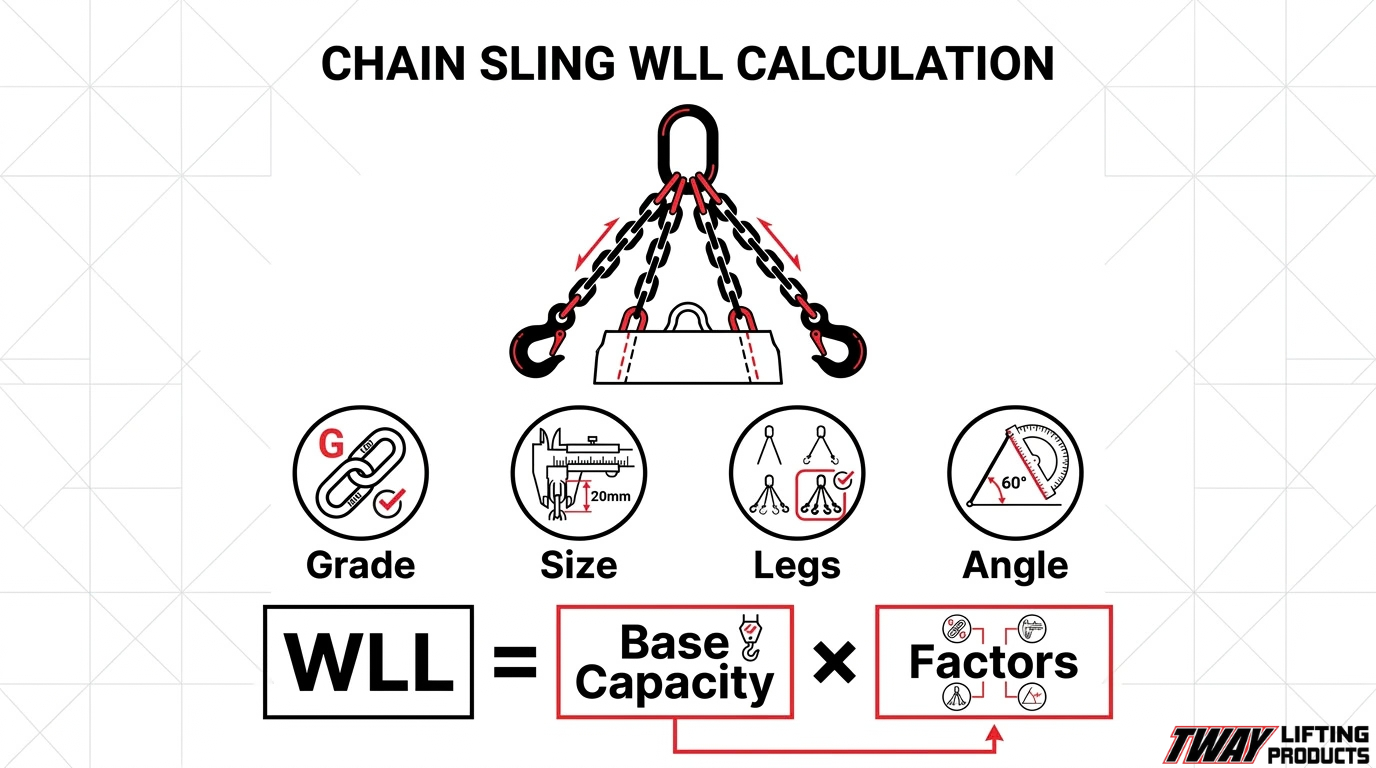

Chain sling working load limit (WLL) is the maximum load a sling may carry in a straight, direct-pull configuration. It must never be exceeded under any operating condition.
This guide covers chain sling fundamentals, the step-by-step WLL calculation process for single- and multi-leg configurations, sling angle factors, chain grades, hitch types, governing standards, and common field mistakes that silently reduce capacity.
WLL starts with four variables: chain grade, chain diameter, number of legs, and sling angle. Grade 80 and Grade 100 are the only grades approved for overhead lifting; lower grades are transport chains. Together, grade and diameter set the baseline capacity before any configuration adjustments.
Calculating WLL requires applying a load angle factor (LAF) to account for sling geometry, then adjusting for hitch type. A vertical hitch delivers full rated capacity; a choker hitch reduces it; a basket hitch nearly doubles it when the load is balanced. Multi-leg slings follow a two-leg equivalent model regardless of whether three or four legs are present.
OSHA 29 CFR 1910.184, 29 CFR 1926.251, and ASME B30.9 define binding requirements for sling marking, use, and inspection. A sling assembly’s WLL is governed by its lowest-rated component, not the chain itself.
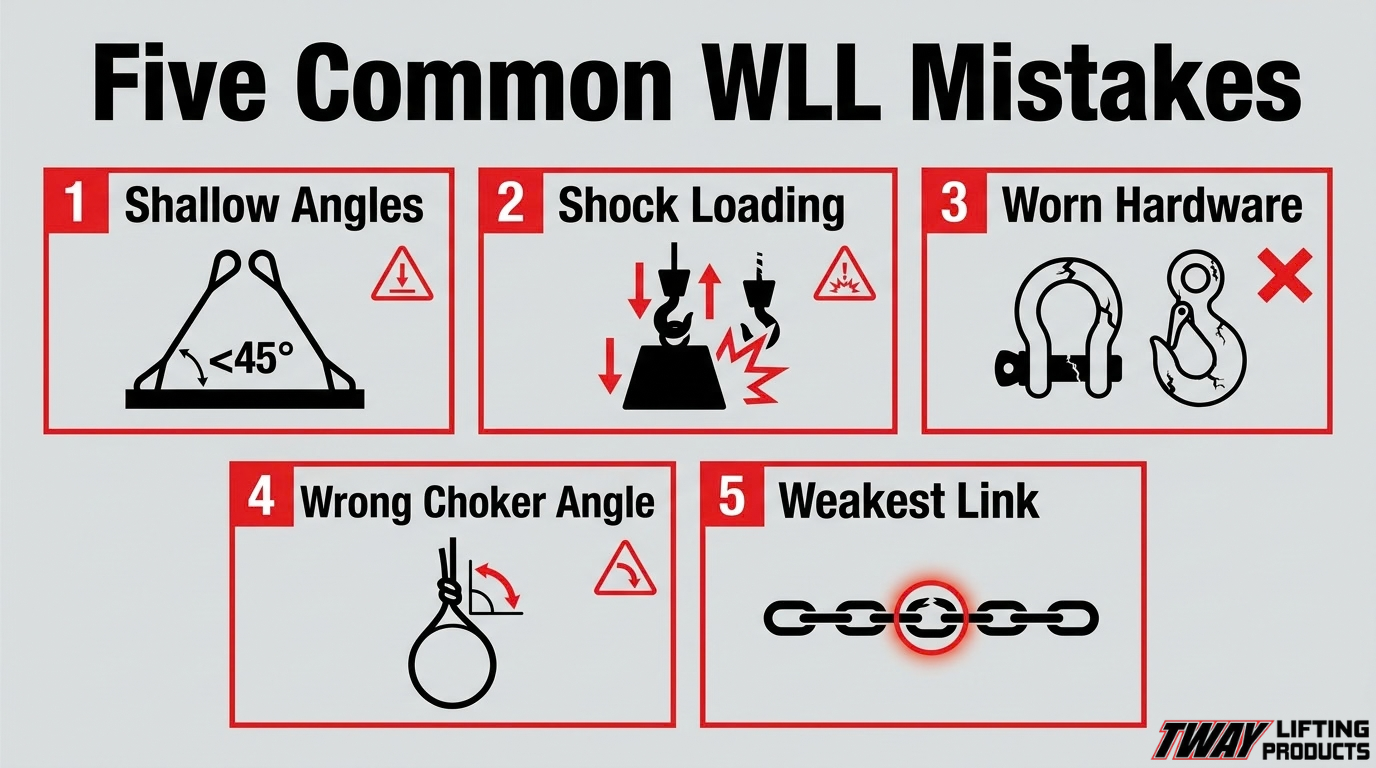
Field errors including shallow sling angles, shock loading, improper choke angles, and using worn hardware all reduce effective capacity below what the sling tag shows. Knowing where those losses occur is as important as the calculation itself.
What Is Working Load Limit (WLL) in Chain Slings?
Working load limit (WLL) in chain slings is the maximum load permitted in a straight, direct-pull configuration. It must never be exceeded under any operating condition.
OSHA requires that alloy steel chain slings carry permanently affixed, legible identification markings showing rated capacities, and employers must not use any sling with loads exceeding those marked WLL values. The term “working load limit” is used interchangeably with “rated capacity” across regulatory frameworks.
WLL relates directly to the minimum breaking load through the factor of safety. According to WorkSafe New Zealand’s Approved Code of Practice for Load-Lifting Rigging, the factor of safety for chain and associated hardware must not be less than 4:1, meaning the chain must withstand at least four times its rated WLL before failure.
For choke configurations, rated loads at angles less than 120 degrees must be determined by the manufacturer or a qualified person, not estimated in the field. Understanding WLL is the foundation for every capacity calculation covered in the sections below.
What Determines the Rated Capacity of a Chain Sling?
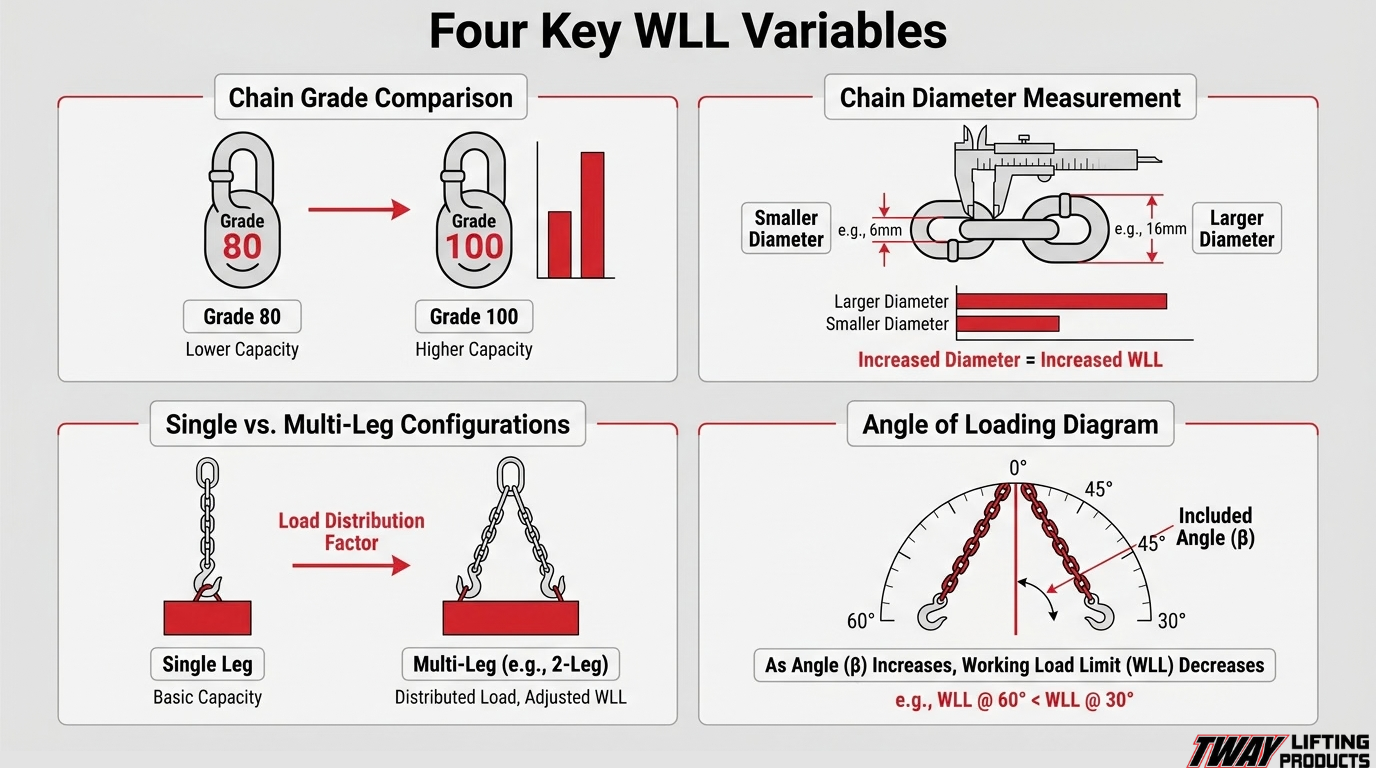
The rated capacity of a chain sling is determined by four variables: chain grade, chain diameter, number of legs, and sling angle. Each factor independently affects the working load limit (WLL), and together they define how much a sling can safely lift.
How Does Chain Grade Affect WLL?
Chain grade directly affects WLL by establishing the baseline tensile strength of the chain material. Higher grades are manufactured from stronger alloy steel, producing significantly higher load limits at the same diameter. According to the Federal Department of Transportation Federal Motor Carrier Safety Administration (via Ohio State University Extension), WLL increases substantially across grades at identical chain sizes:
| Chain Size (in.) | Grade 30 | Grade 43 | Grade 70 | Grade 80 | Grade 100 |
| 1/4 | 1,300 lb | 2,600 lb | 3,150 lb | 3,500 lb | 4,300 lb |
| 5/16 | 1,900 lb | 3,900 lb | 4,700 lb | 4,500 lb | 5,700 lb |
| 3/8 | 2,650 lb | 5,400 lb | 6,600 lb | 7,100 lb | 8,800 lb |
| 1/2 | 4,500 lb | 9,200 lb | 11,300 lb | 12,000 lb | 15,000 lb |
| 5/8 | 6,900 lb | 13,000 lb | 15,800 lb | 18,100 lb | 22,600 lb |
For lifting applications, only Grade 80 and Grade 100 alloy chains are considered appropriate. Grades 30, 43, and 70 are transport and load-securement chains, not rated for overhead lifting.
How Does Chain Size (Diameter) Affect WLL?
Chain size (diameter) affects WLL because a larger cross-sectional area of alloy steel carries greater tensile load before failure. As the table above shows, even within the same grade, moving from 1/4 in. to 1/2 in. more than triples the WLL. Selecting the correct diameter for the intended load is as important as selecting the correct grade — both variables must match the lift requirements.
How Does the Number of Legs Affect Rated Capacity?
The number of legs affects rated capacity by distributing the total load across multiple chain paths, increasing the sling’s overall lifting capability. A two-leg sling has a higher combined WLL than a single-leg sling of the same grade and size, provided the sling angle is favorable. However, load distribution is never perfectly equal across all legs in practice, so rated capacity tables for multi-leg slings already account for realistic load-sharing assumptions. Rated capacity is always governed by the lowest-rated component in the assembly.
How Does Sling Angle Affect Chain Sling Capacity?
Sling angle affects chain sling capacity because shallower angles increase the tension each leg must carry to support the same vertical load. According to the U.S. Bureau of Reclamation, “angle of loading” is the inclination of a leg measured from the horizontal or vertical plane, and rated capacity is the maximum working load permitted at that angle.
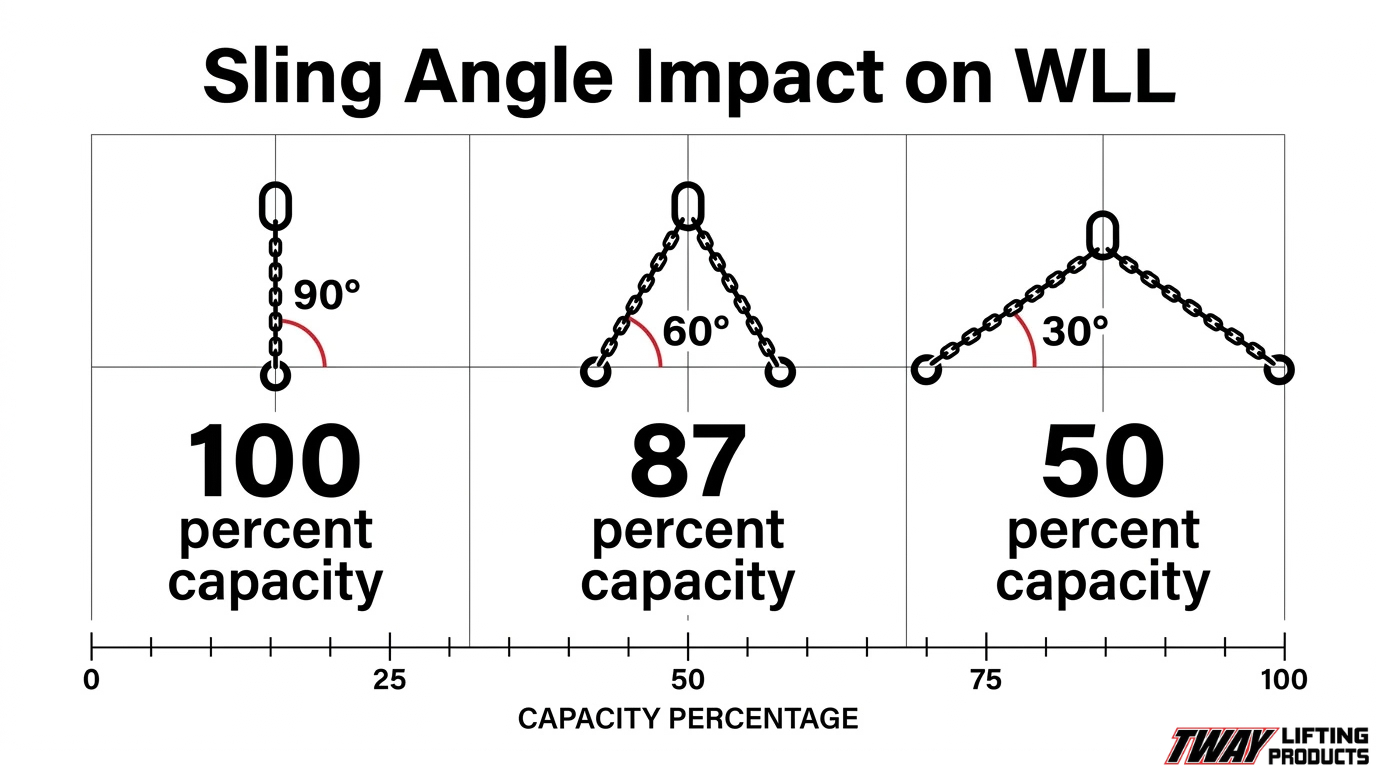
To apply the angle reduction, divide the sling length by the vertical height to calculate the Load Angle Factor (LAF), per the U.S. Department of Energy. The NCCCO Rigger Reference Manual provides capacity data showing the magnitude of this effect for alloy chain slings:
| Chain Size | Grade 80 Vertical | Grade 80 at 60° | Grade 80 at 45° | Grade 80 at 30° |
| 9/32 in. | 4,300 lb | 3,500 lb | 7,400 lb* | 6,100 lb* |
| 3/8 in. | 8,800 lb | 7,100 lb | 15,200 lb* | 12,400 lb* |
| 1/2 in. | 15,000 lb | 12,000 lb | 26,000 lb* | 21,200 lb* |
*Two-leg configurations. At 30 degrees, capacity loss is severe; rigging below 30 degrees from horizontal is widely considered unsafe practice.
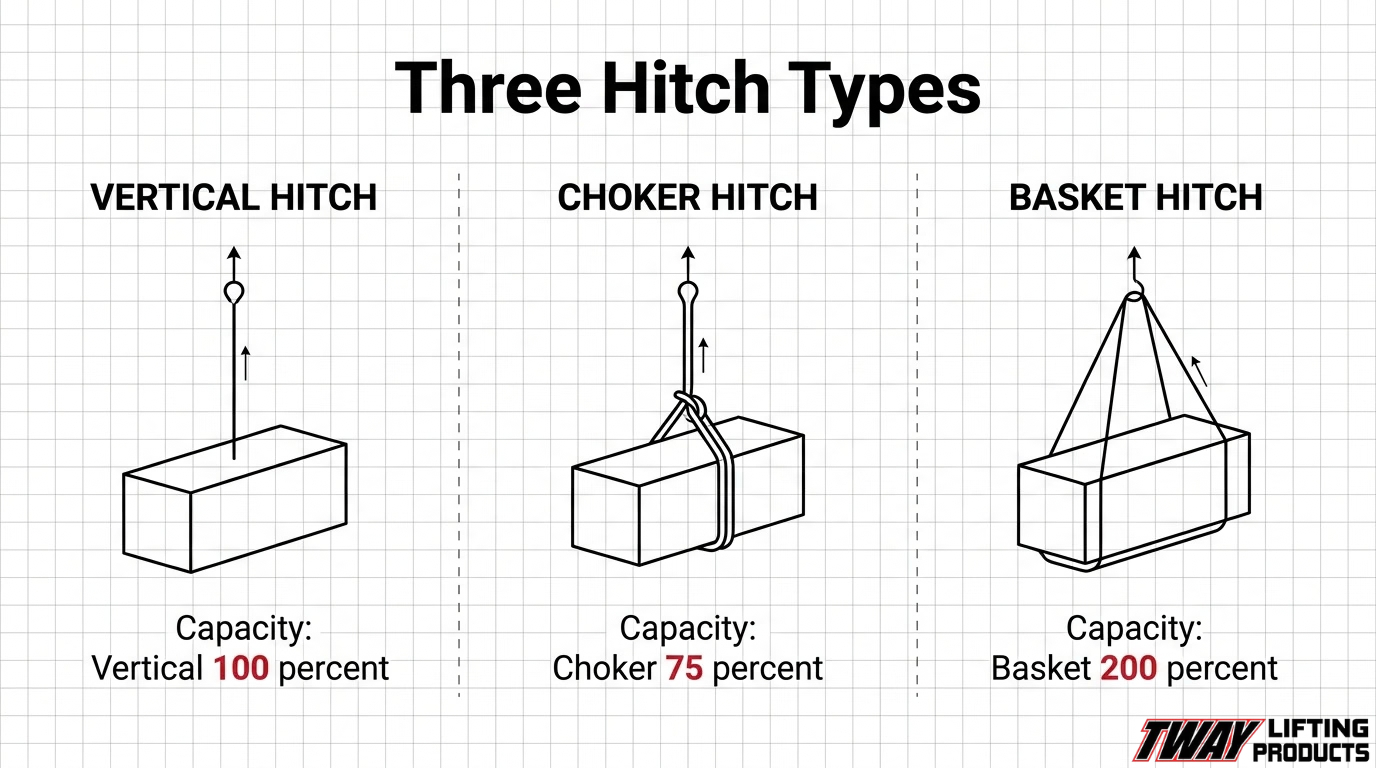
Hitch configuration also affects capacity. Purdue University’s rigging guidance notes that the same sling is rated at 1.4 tons vertical, 1.1 tons in a choker hitch, and 2.9 tons in a basket configuration. As the Naval Postgraduate School defines it, choke angle — the angle between the vertical and choked portion of the sling — reduces rated capacity as it decreases.
Understanding how these four variables interact is the foundation for every WLL calculation in the sections that follow.
How Do You Calculate WLL for a Single-Leg Chain Sling?
To calculate WLL for a single-leg chain sling, start with the manufacturer’s rated WLL for the chain grade and diameter, then apply the appropriate hitch configuration factor and load angle factor for your lift geometry. The sections below cover each calculation variable in sequence.
Step 1: Identify the Chain Grade and Diameter
The WLL for a single-leg chain sling is determined first by its chain grade and diameter. Higher grades carry greater loads at the same diameter. According to Ohio State University Extension, a 3/8-inch Grade 80 chain carries a WLL of 7,100 lb, while the same diameter in Grade 100 reaches 8,800 lb. Always verify your chain’s grade marking before any lift.
Step 2: Look Up the Baseline WLL from the Manufacturer’s Table
The baseline WLL for a single-leg chain sling is found in the manufacturer’s rated capacity table for the chain’s specific grade and diameter. These values assume a vertical, straight-pull configuration with no sling angle deviation. The manufacturer’s table is the only reliable starting point; never estimate or substitute values from a different grade or diameter.
Step 3: Apply the Hitch Configuration Factor
A single-leg chain sling WLL changes based on how it is hitched to the load. The three standard hitch types and their relative capacity effects are:
- Vertical hitch: Full rated WLL applies with no deduction.
- Choker hitch: Capacity reduces; according to the Naval Postgraduate School, as the choke angle decreases, the rated capacity of the sling is reduced.
- Basket hitch: Capacity increases relative to vertical when the load is balanced symmetrically.
Step 4: Apply the Load Angle Factor (LAF)
The Load Angle Factor (LAF) is calculated by dividing the sling length by the vertical height of the lift. Per the U.S. Department of Energy, this ratio produces the LAF, which is then multiplied against the baseline WLL to yield the adjusted working capacity. As the sling angle decreases from vertical, the LAF increases tension in each leg, reducing effective capacity significantly.
How Do You Calculate WLL for Multi-Leg Chain Slings?
WLL for multi-leg chain slings depends on the number of legs, the single-leg WLL, and the sling angle. The following sections cover two-leg, three-leg, and four-leg configurations.
How Do You Calculate WLL for a Two-Leg Chain Sling?
WLL for a two-leg chain sling is calculated by multiplying the single-leg WLL by the load angle factor (LAF) and then by 2. The LAF accounts for the angle each leg makes with the vertical: as the angle increases from vertical, each leg carries a greater share of tension than the load weight alone would suggest.
According to the U.S. Department of Energy, the LAF equals sling length divided by the vertical height. At 60 degrees from horizontal, the LAF is approximately 0.866; at 45 degrees, it drops to 0.707. Applying these factors before multiplying by leg count prevents dangerous overloading. Skipping the angle correction is one of the most common and consequential mistakes in multi-leg sling calculations.
How Do You Calculate WLL for a Three-Leg Chain Sling?
WLL for a three-leg chain sling uses only two legs in the calculation, not three. Industry practice and rated capacity tables treat a three-leg sling as a two-leg equivalent because load distribution across three attachment points is rarely uniform, and the third leg may carry little or no load depending on load geometry.
The standard formula is: WLL = single-leg WLL × LAF × 2. Ratings published by the National Commission for the Certification of Crane Operators confirm that three- and four-leg sling assemblies are rated identically in capacity tables for this reason. Assuming three active legs inflates the calculated capacity and creates a serious safety hazard.
How Do You Calculate WLL for a Four-Leg Chain Sling?
WLL for a four-leg chain sling is calculated using the same two-leg equivalent method: WLL = single-leg WLL × LAF × 2. Like the three-leg configuration, a four-leg sling cannot guarantee that all legs share the load equally, so only two legs are credited in the rated capacity.
This approach is consistent with how NCCCO-published alloy chain sling capacity tables present multi-leg ratings. Despite having four physical legs, the additional legs function as redundancy rather than multiplying usable capacity. For critical lifts, this conservative calculation is the correct and compliant approach under recognized rigging standards.
What Is the Sling Angle Factor and How Do You Apply It?
The sling angle factor is a multiplier that adjusts a chain sling’s WLL based on the angle its legs form with the horizontal plane. As that angle decreases from vertical, each leg carries more force, reducing safe capacity. The H3 sections below cover exact WLL values at 90, 60, 45, and 30 degrees.
What Is the WLL at a 90-Degree Sling Angle?
The WLL at a 90-degree sling angle is the full single-leg rated capacity, with an angle factor of 1.0. At this angle, each sling leg lifts in pure vertical tension, so no additional horizontal force component is introduced. According to the U.S. Department of Energy, the load angle factor (LAF) is calculated by dividing sling length by vertical height; at 90 degrees, those values are equal, producing an LAF of 1.0 and zero capacity penalty. This is the most efficient sling geometry for maximizing WLL.
What Is the WLL at a 60-Degree Sling Angle?
The WLL at a 60-degree sling angle applies an angle factor of approximately 0.866, reducing each leg’s effective capacity to about 86.6% of its vertical rating. For a two-leg Grade 80 chain sling using 3/8-inch chain (single-leg WLL: 7,100 lb), each leg carries roughly 6,149 lb of effective load at this angle. The NCCCO Rigger Reference Manual confirms that a 60-degree angle noticeably reduces alloy chain sling capacities compared to vertical lifts. In practice, 60 degrees is the minimum recommended working angle for most rigging operations.
What Is the WLL at a 45-Degree Sling Angle?
The WLL at a 45-degree sling angle applies an angle factor of approximately 0.707, reducing each leg’s capacity to about 70.7% of its vertical WLL. This represents a meaningful 29% capacity reduction from a vertical lift. Using the NCCCO Rigger Reference Manual capacity data as a reference point, a Grade 80 1/2-inch two-leg sling drops from 26,000 lb (at 60 degrees) to approximately 21,200 lb at 45 degrees. Riggers should treat 45 degrees as a firm operational threshold; going below it causes capacity losses that most slings cannot safely absorb without upsizing the chain grade or diameter.
What Is the WLL at a 30-Degree Sling Angle?
The WLL at a 30-degree sling angle applies an angle factor of 0.5, cutting each leg’s effective capacity to exactly half its vertical WLL. This is the steepest capacity penalty in standard rigging practice. The NCCCO Rigger Reference Manual documents this directly: a Grade 80 3/8-inch two-leg sling rated at 15,200 lb at 60 degrees drops to just 8,800 lb at 30 degrees. Operating at 30 degrees is widely considered the absolute minimum safe sling angle and should only be used when geometry leaves no alternative.
What Chain Grades Are Used in Rated Capacity Calculations?
Chain grades used in rated capacity calculations are Grade 80, Grade 100, and Grade 120, each carrying progressively higher working load limits for the same chain diameter. The following H3s break down the WLL benchmarks and key characteristics for each grade.
What Is Grade 80 Chain and What Is Its WLL?
Grade 80 chain is heat-treated alloy steel chain with a minimum tensile strength designation of 800 N/mm², widely used as the industry baseline for lifting slings. According to ASTM A391/A391M, this specification covers Grade 80 heat-treated alloy steel chain for slings, lifting assemblies, and load binding.
Common single-leg vertical WLL values for Grade 80 chain include:
- 9/32 in.: 4,300 lb
- 3/8 in.: 8,800 lb
- 1/2 in.: 15,000 lb
Grade 80 remains the most widely stocked grade in the field, making it a practical default for general industrial lifts where Grade 100 capacity is not required.
What Is Grade 100 Chain and What Is Its WLL?
Grade 100 chain is alloy steel chain with a tensile grade designation of 1,000 N/mm², delivering approximately 25% higher WLL than Grade 80 at the same diameter. According to the NCCCO Rigger Reference Manual, single-leg vertical WLL values for Grade 100 chain are:
- 9/32 in.: 5,700 lb
- 3/8 in.: 11,200 lb
- 1/2 in.: 15,000 lb at 30°; 39,000 lb in a two-leg basket at 60°
For operations with tight weight or space constraints, Grade 100 allows riggers to achieve higher capacity with a smaller, lighter chain.
What Is Grade 120 Chain and What Is Its WLL?
Grade 120 chain is the highest-grade alloy steel chain currently used in rated capacity calculations, with a tensile designation of 1,200 N/mm², delivering roughly 50% greater WLL than Grade 80 at equivalent diameter. Because Grade 120 hardware and master links must match the chain’s elevated rating, the entire sling assembly must be Grade 120 rated to realize the full capacity gain.
Selecting the correct grade for your application is the single most impactful capacity decision made before a lift begins. Tway Lifting stocks chain slings across multiple grades and diameters, and its certified rigging specialists can help match the right grade to your specific load requirements. The company has served industrial lifting operations from its Indianapolis and Fort Wayne, Indiana locations since 1945.
How Do Hitch Configurations Change the Calculated Capacity?
Hitch configuration directly changes a chain sling’s calculated WLL by altering how load is distributed across the sling body. The three standard configurations are vertical, choker, and basket hitches, each producing a different effective capacity.
How Does a Vertical Hitch Affect Chain Sling WLL?
A vertical hitch represents the baseline WLL for a chain sling, with the full single-leg rated capacity applied to the load. The sling runs straight from the hook to the load with no wrapping or doubling, so no reduction factor is applied. According to Purdue University Physics Department rigging data, a sling rated at 1.4 tons in a vertical configuration drops to 1.1 tons in a choker and rises to 2.9 tons in a basket, confirming that vertical WLL is the reference point from which all other configurations are calculated.
How Does a Choker Hitch Affect Chain Sling WLL?
A choker hitch reduces chain sling WLL to approximately 75–80% of the vertical rating. The sling wraps around the load and chokes back on itself, creating a choke angle that places additional stress on the chain. As defined by the Naval Postgraduate School, the choke angle is the angle between the vertical and choked part of the sling; as this angle decreases below 120 degrees, rated capacity drops further. Washington Administrative Code (WAC 296-155-55800) requires that rated loads for choke angles below 120 degrees be determined by the manufacturer or a qualified person.
How Does a Basket Hitch Affect Chain Sling WLL?
A basket hitch increases chain sling WLL to approximately double the single-leg vertical rating, provided the load is balanced and the sling legs remain at or near vertical. The sling passes under the load with both ends attached to the hook, distributing the load across two supporting legs. This configuration delivers the highest capacity of the three standard hitches, as illustrated by the Purdue University example where a 1.4-ton vertical sling achieves 2.9 tons in a basket configuration. Basket capacity decreases if the legs splay outward at wider angles.
What OSHA and ASME Standards Govern Chain Sling WLL?
The OSHA and ASME standards that govern chain sling WLL are 29 CFR 1910.184, 29 CFR 1926.251, and ASME B30.9. Together, these regulations establish binding requirements for sling fabrication, load marking, use, inspection, and maintenance across general industry and construction.
OSHA 29 CFR 1910.184 and 1926.251
OSHA 29 CFR 1910.184 and 1926.251 prohibit employers from using alloy steel chain slings with loads exceeding the rated capacities indicated by permanently affixed, legible identification markings prescribed by the manufacturer. According to OSHA, thorough periodic inspections of alloy steel chain slings in use are required at intervals no greater than once every 12 months, with frequency determined by service conditions, lift severity, and sling use history. OSHA originally published Section 1910.184 on June 27, 1975, based on the ANSI B30.9-1971 consensus standard, and extended it to construction on February 9, 1979.
ASME B30.9, Inspection, and Tagging
ASME B30.9 covers fabrication, attachment, use, inspection, testing, and maintenance of slings used for load handling. Per ASME, chain slings must be rated at the load capacity of their lowest-rated component; if hardware fittings carry a lower rating than the chain itself, the sling’s marked WLL must reflect that lower value. This component-rating rule is often overlooked in the field, making it one of the most consequential compliance points a rigger can apply.
Understanding these standards is essential before selecting or deploying any chain sling for a critical lift.
What Common Mistakes Reduce Chain Sling Capacity in the Field?
Common mistakes that reduce chain sling capacity in the field include incorrect sling angles, shock loading, using damaged hardware, and ignoring the lowest-rated component in a multi-piece assembly.
- Shallow sling angles: Angles below 45 degrees from horizontal drastically increase leg tension and reduce effective WLL. Many riggers underestimate how sharply capacity drops as the angle flattens.
- Shock loading: Accelerating or decelerating a suspended load quickly generates dynamic forces far exceeding the rated WLL. According to North Carolina State University Environmental Health and Safety, loads must be eased up and down to prevent shock load on the crane.
- Ignoring the weakest component: A chain sling’s WLL is governed by its lowest-rated fitting or hardware, not the chain itself. Using a lower-rated hook or shackle silently reduces the entire assembly’s capacity.
- Improper choker angle: Tightening a choker below 120 degrees reduces rated capacity; the tighter the choke, the lower the load limit.
- Using worn or damaged chain: Stretched, gouged, or heat-affected links compromise structural integrity without obvious visual cues during a hurried pre-lift check.
Treating WLL as a fixed number regardless of configuration or hardware condition is one of the most dangerous assumptions a rigger can make. Tway Lifting offers professional rigging inspection services performed by certified specialists, helping operations identify worn hardware, damaged chain, and assembly mismatches before they affect safe working load in the field.
How Do Tway Lifting’s Chain Slings Support Accurate WLL Selection?
Tway Lifting’s chain slings support accurate WLL selection through custom fabrication and clear safe working load markings. The H3s below cover custom fabrication capabilities and a recap of the key WLL calculation steps covered in this article.
Does Tway Lifting Offer Custom-Fabricated Chain Slings for Specific Load Requirements?
Yes, Tway Lifting offers custom-fabricated chain slings for specific load requirements. With over 75 years of industry experience, Tway Lifting builds chain slings to match exact lift configurations, leg counts, and rated capacities. Chain slings fabricated to meet the requirements of ASTM A391/A391M cover slings, lifting assemblies, and load binding applications. According to the Health and Safety Executive, all lifting equipment must be clearly marked to indicate safe working loads, and every Tway Lifting sling is marked accordingly.For operations requiring non-standard configurations or specialized hardware, Tway Lifting’s custom fabrication capability removes the guesswork from WLL selection before a lift begins.
What Are the Key Steps to Calculating Chain Sling Capacity and WLL We Covered?
The key steps to calculating chain sling capacity and WLL are straightforward when applied in sequence. This article covered:
- Identify chain grade and size to establish the baseline single-leg WLL from published capacity tables.
- Determine hitch configuration (vertical, choker, or basket) and apply the appropriate capacity adjustment.
- Calculate the sling angle factor by dividing sling length by vertical height, then multiply the single-leg WLL by that factor.
- Account for leg count using the rated capacity of the lowest-rated component when building multi-leg slings.
- Verify markings and compliance to confirm the fabricated sling is permanently marked with its WLL before use.Matching a Tway Lifting sling to your specific load profile puts every one of these steps to practical use.