




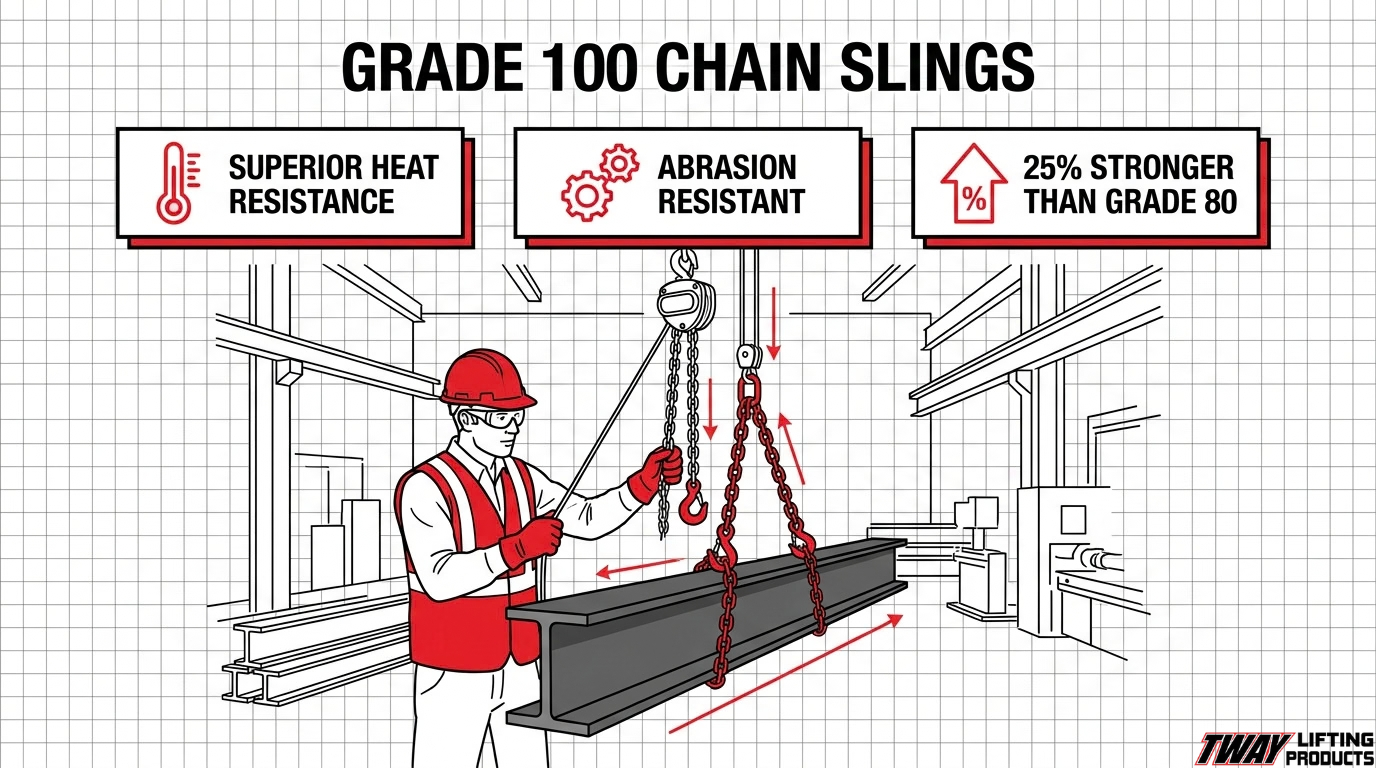

A lifting chain sling is a rigging assembly made from linked alloy steel chain that connects a load to a hoist or crane hook for controlled overhead lifting. Grades 80 and 100 alloy steel are the industry standard materials, with each sling marked to show size, grade, rated load, and length before it ever enters service.
This guide covers what chain slings are made from and how they work, the configurations and components that define each assembly, chain grades and working load limits, industry applications and performance advantages, inspection and safe use practices, sling selection and maintenance, and how Tway Lifting supports your rigging needs.
Chain sling construction, function, and distinctions from other sling types establish the technical foundation: how alloy steel grade determines proof-test requirements, how the Working Load Limit governs every lift, and why chain slings outlast synthetic and wire rope alternatives in abrasive, high-heat conditions.
Configurations and components shape how capacity is deployed in the field. Single, double, triple, and quad-leg slings each suit different load geometries, while master links, hooks, and shortening clutches govern how force transfers through the assembly.
Chain grades and working load limits translate material specifications into measurable capacity. A 1/2-inch Grade 100 chain carries 15,000 lb compared to 12,000 lb for the same diameter in Grade 80, making grade one of the most consequential decisions in sling selection.
Inspection, safe use, selection, and maintenance close the lifecycle: how to identify removal-from-service conditions, rig correct hitches, account for sling angle reductions, and keep slings compliant with OSHA 29 CFR 1910.184 and ASME B30.9.
What Is a Lifting Chain Sling?
A lifting chain sling is a rigging assembly made from linked alloy steel chain, used to connect a load to a hoist or crane hook for controlled lifting. The sections below cover what chain slings are made from, how they work, and what distinguishes them from other sling types.
What Materials Are Lifting Chain Slings Made From?
Lifting chain slings are made from alloy steel, with Grade 80 and Grade 100 being the most common grades in industrial use. According to OSHA’s guidance on alloy steel chain slings, rated loads depend on material strength, design factor, hitch type, loading angle, diameter of curvature, and fabrication efficiency. Each new sling is marked to show size, grade, rated load, and length.
The Associated Wire Rope Fabricators confirms that proof test loads for each sling depend on chain size, chain grade, and number of attached legs, with Grade 80 and Grade 100 governing standard sling assemblies.
How Does a Lifting Chain Sling Work to Lift a Load?
A lifting chain sling works by transferring a load’s weight through its chain legs to a master link, which connects to the hoist hook. The Working Load Limit (WLL) is the maximum load permitted in a straight vertical configuration and must never be exceeded. The design factor represents the ratio between minimum breaking strength and WLL.
For multi-leg configurations, two, three, or four single hitches form a bridle hitch. According to the U.S. Department of Energy’s Hoisting and Rigging Fundamentals, equal load distribution across legs may require adjustment using turnbuckles or chain lever hoists. Per California DIR Title 8, quadruple sling ratings equal triple sling ratings because standard practice cannot guarantee uniform load distribution across all four legs.
What Makes Chain Slings Different From Other Sling Types?
Chain slings differ from other sling types primarily in durability, temperature tolerance, and resistance to abrasion and cutting. The key distinctions by sling type are:
- Synthetic web slings are easily cut and offer poor abrasion resistance compared to chain slings, according to the Canadian Centre for Occupational Health and Safety.
- Wire rope slings are removed from service for broken wires, kinking, or crushing, per 29 CFR 1910.184, making them less forgiving in abrasive environments.
- Metal mesh slings resist abrasion and cutting but are limited to a temperature range of -20°F to 550°F.
- Chain slings remain adjustable, repairable, and serviceable across demanding industrial conditions where other sling types fail prematurely.
ASME B30.9 governs fabrication, use, inspection, and maintenance standards across all sling types, establishing chain slings as the benchmark for heavy-duty and high-heat applications.
What Are the Types of Lifting Chain Slings?
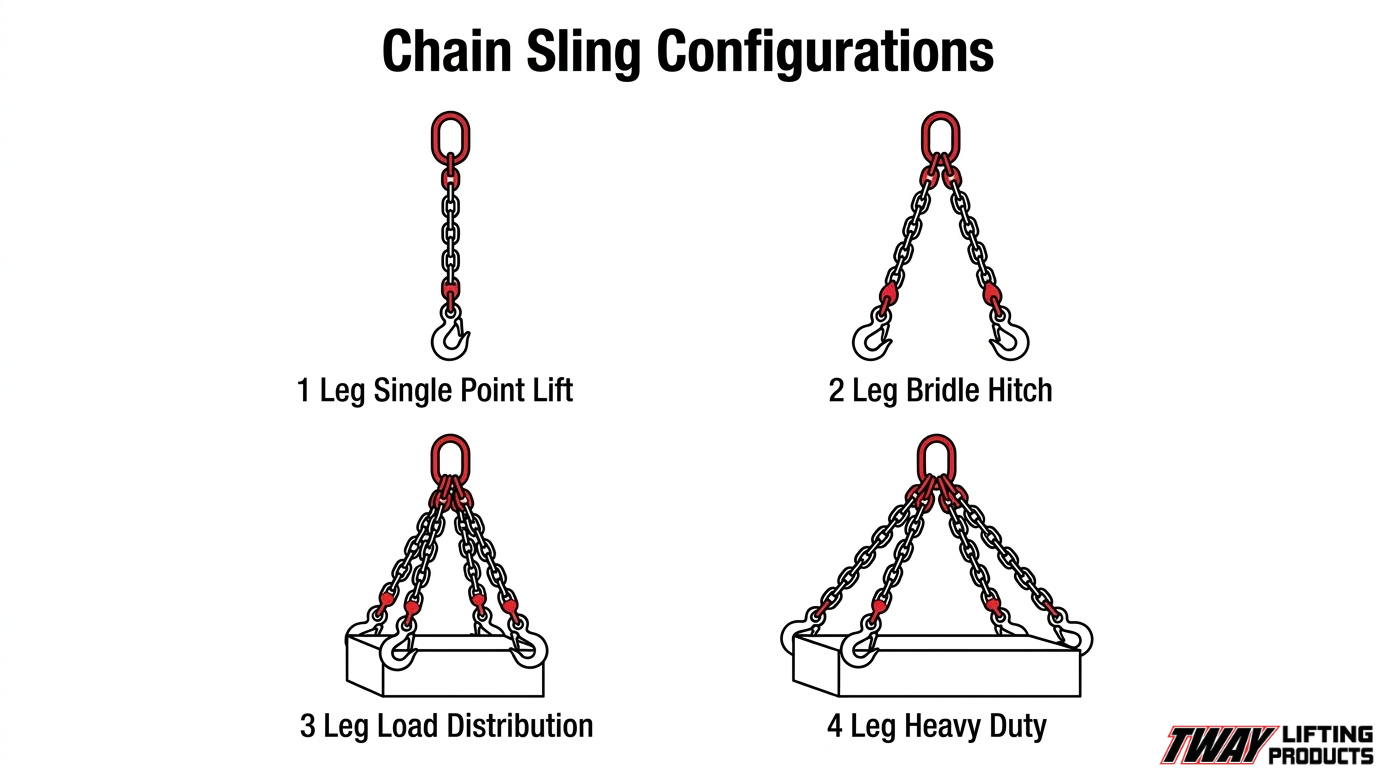
The types of lifting chain slings are single-leg, double-leg, triple-leg, and quad-leg configurations. Each type suits different load geometries, weight distributions, and attachment point requirements. The sections below cover when each configuration is the right choice.
Single-Leg Chain Sling
A single-leg chain sling uses one chain connected between a master link and a hook to lift a load from a single attachment point. It is the most straightforward configuration, suited for loads with a single, centered lifting lug where full vertical control is maintained. Because load angle is zero, the full rated WLL applies without reduction. Single-leg slings are common for symmetrical, compact loads in manufacturing and fabrication environments.
Double-Leg Chain Sling
A double-leg chain sling connects two chain legs to a single master link, spreading the lift across two attachment points for improved load stability. The U.S. Department of Energy’s Hoisting and Rigging Fundamentals guidance notes that two single hitches can form a bridle hitch for loads with the necessary lifting lugs, and that leg lengths may need adjustment to distribute load equally. Master links for double-leg slings must be proof-tested to at least four times the single-leg vertical hitch rated load, per Washington Administrative Code § 296-155-33800.
Triple-Leg Chain Sling
A triple-leg chain sling attaches three chain legs to one master link, distributing weight across three points for larger or irregularly shaped loads. According to Washington Administrative Code § 296-155-33800, master links for triple-leg bridle slings must be proof-tested to at least six times the single-leg vertical hitch rated load. This configuration provides excellent load control and is well-suited for heavy structural components, engine blocks, and large fabrications with three dedicated lifting points.
Quad-Leg Chain Sling
A quad-leg chain sling uses four legs attached to one master link to lift loads with four attachment points. Notably, California’s Title 8 Table S-1 rated capacity guidance states that the quadruple sling rating is the same as the triple sling rating because normal lifting practice may not distribute the load uniformly to all four legs. In practice, this makes proper leg angle and attachment point alignment critical to avoid overloading any individual leg.
What Are the Key Components of a Lifting Chain Sling?
The key components of a lifting chain sling are the master link, chain legs, hooks, and adjusters or shortening clutches. Each component serves a distinct structural role, and all must meet proof-test requirements before a sling enters service.
What Role Does the Master Link Play in a Chain Sling?
The master link is the uppermost load-bearing ring that connects all chain legs to the hoist hook. According to Washington Administrative Code § 296-155-33800, all new and repaired chain slings must be proof tested before initial use; master links for double-leg bridle slings must withstand at least 4 times the single-leg vertical hitch rated load, while master links for triple- and quadruple-leg bridle slings must withstand at least 6 times that rated load. Because the master link bears the combined force of every leg simultaneously, it is the most critically loaded single component in the assembly. Slings must be shortened or adjusted only through methods approved by the manufacturer or a qualified person.
What Types of Hooks Are Used on Chain Slings?
The types of hooks used on chain slings are grab hooks, sling hooks, and foundry hooks. Grab hooks attach directly to individual chain links and allow the leg length to be set at precise increments. Sling hooks feature a wider throat for attaching to lifting lugs or rings, while foundry hooks have a broad, deeply curved profile suited to handling ladles and other hot-process equipment. All hooks must match the rated capacity of the chain leg they terminate and carry a manufacturer’s load marking.
What Is the Purpose of Adjusters and Shortening Clutches?
Adjusters and shortening clutches allow a rigger to equalize leg lengths on multi-leg slings without unsafe field modifications. The U.S. Department of Energy’s Hoisting and Rigging Fundamentals states that equal load distribution across bridle hitch legs may require adjusting leg lengths using approved devices such as turnbuckles or chain lever hoists. Shortening clutches grip a chain link mechanically, effectively reducing the working length of that leg while keeping the full rated capacity intact. This is the correct way to balance a load; federal guidance explicitly prohibits shortening slings with knots, bolts, or other makeshift devices.
What Chain Grades Are Used in Lifting Chain Slings?
The chain grades used in lifting chain slings are Grade 80, Grade 100, and Grade 120 alloy steel. Each grade offers progressively higher tensile strength and working load limits. The sections below cover each grade’s properties, applications, and how grade selection directly affects load capacity.
What Is Grade 80 Chain and When Is It Used?
Grade 80 chain is a heat-treated alloy steel chain rated at a minimum breaking force corresponding to 80 kilograms per square millimeter of material cross-section. It is the industry’s long-established standard for overhead lifting and remains the most widely stocked chain grade in commercial rigging assemblies.
According to 49 CFR § 393.108, Grade 80 working load limits by chain diameter are:
| Chain Diameter | Grade 80 WLL |
| 1/4 in (7 mm) | 3,500 lb |
| 3/8 in (10 mm) | 7,100 lb |
| 1/2 in (13 mm) | 12,000 lb |
| 5/8 in (16 mm) | 18,100 lb |
Grade 80 suits most general industrial lifting where maximum weight savings are not critical.
What Is Grade 100 Chain and When Is It Used?
Grade 100 chain is a higher-strength alloy steel chain rated approximately 25% stronger than Grade 80 at the same diameter. It is used when engineers need greater load capacity without increasing chain size or overall sling weight. According to OSHA, Grades 80 and 100 are the two most common grades in active industrial use.
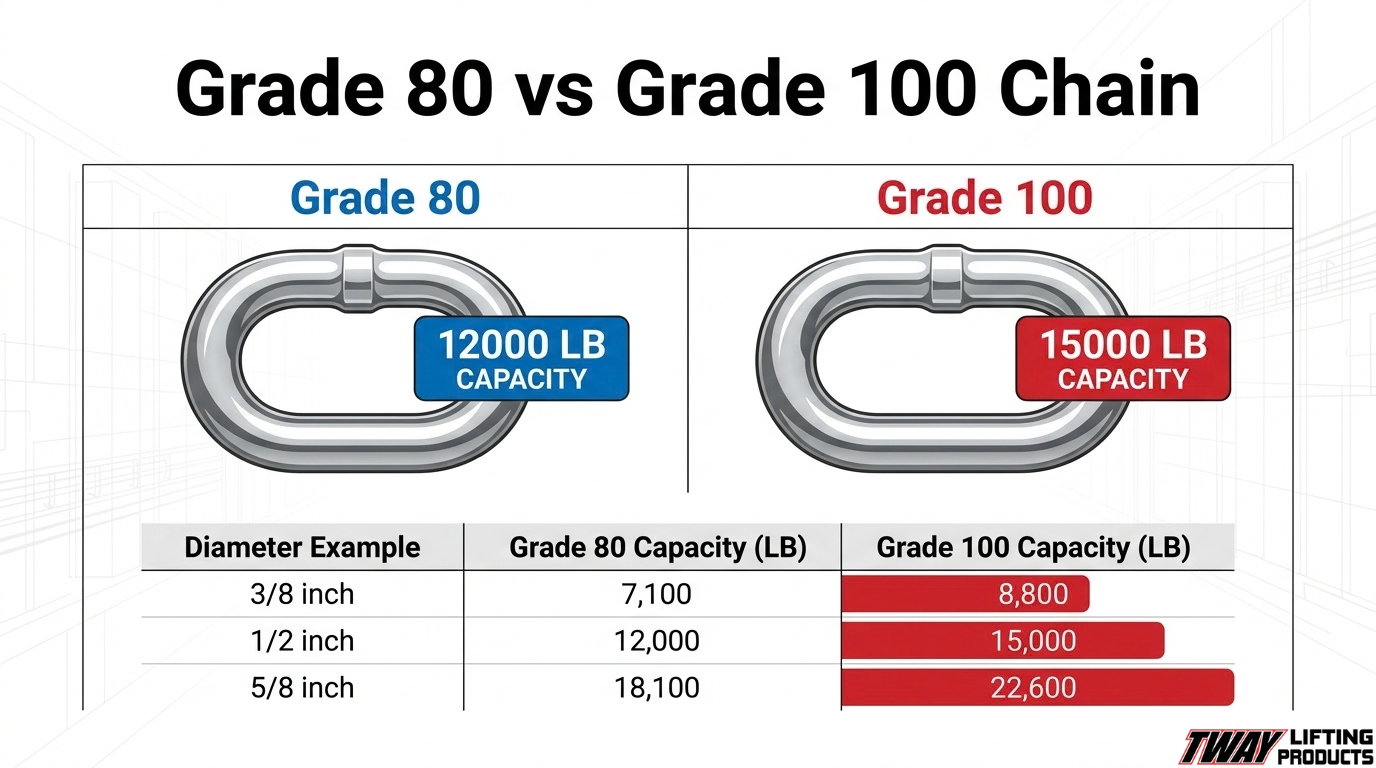
Comparing Grade 100 WLLs directly against Grade 80 at the same diameters illustrates the capacity gain:
| Chain Diameter | Grade 100 WLL |
| 1/4 in (7 mm) | 4,300 lb |
| 3/8 in (10 mm) | 8,800 lb |
| 1/2 in (13 mm) | 15,000 lb |
| 5/8 in (16 mm) | 22,600 lb |
Grade 100 is the better choice when load weights are close to the Grade 80 limit for a given chain size, since upsizing chain also increases sling weight and hardware cost.
What Is Grade 120 Chain and When Is It Used?
Grade 120 chain is a premium-strength alloy steel chain engineered to deliver the highest working load limits currently available in standard lifting chain. It is used in applications where maximum capacity in the smallest possible chain cross-section is required, such as high-cycle production lifting in automotive and steel manufacturing environments. No federal WLL table in the provided research covers Grade 120 chain specifically; consult the manufacturer’s rated load data and ASME B30.9 when specifying Grade 120 assemblies.
How Does Chain Grade Affect Working Load Limit?
Chain grade directly determines working load limit: higher grades use stronger alloy steel heat treatments that increase tensile strength, allowing the same chain diameter to carry a greater certified load. Comparing Grade 80 and Grade 100 at 1/2-inch diameter shows a 3,000 lb difference (12,000 lb versus 15,000 lb) on identical hardware. Selecting a higher grade is effectively a capacity upgrade without a size penalty, which makes grade selection one of the most consequential decisions in sling specification.
What Are the Working Load Limits of Lifting Chain Slings?
The working load limits of lifting chain slings depend on three core variables: chain grade, chain diameter, and the configuration used during the lift. The following sections cover how WLL is calculated for a single-leg sling, how sling angle reduces effective capacity, and how adding legs changes the overall load rating.
How Is Working Load Limit Calculated for a Single-Leg Sling?
The working load limit for a single-leg sling is the maximum load that sling can safely lift in a straight vertical configuration. According to the NSW Government Dogging and Rigging Guide, the WLL must never be exceeded, and the design factor represents the ratio between minimum breaking strength and the WLL.
For a vertical hitch, the full rated WLL applies. For example, per federal cargo-securement data, a 1/2-inch Grade 80 chain carries a WLL of 12,000 lb, while the equivalent Grade 100 chain reaches 15,000 lb. Choker and basket hitches reduce that rated capacity further, making configuration selection as critical as chain grade selection.
How Does Sling Angle Affect the Working Load Limit?
Sling angle directly reduces the effective working load limit of a chain sling. As the angle between the sling leg and the vertical increases, the tension in each leg must increase to support the same load, which reduces the rated capacity.
According to California Department of Industrial Relations Title 8, Table S-1, multi-leg sling ratings are adjusted based on the included angle between the inclined leg and the vertical. Steeper angles create significantly higher leg tension, and at 60 degrees from vertical the effective WLL can drop to roughly half of the vertical rating. Riggers often underestimate this reduction, making angle awareness one of the most important safety disciplines in rigging practice.
How Does the Number of Legs Change the Load Capacity?
The number of legs increases total load capacity, but only when the load is distributed evenly across all legs. A two-leg bridle sling rated at a given single-leg WLL can handle a greater combined load than a single-leg configuration, assuming an appropriate sling angle.
However, per California DIR Table S-1, a quadruple-leg sling carries the same rated capacity as a triple-leg sling, because normal lifting practice may not distribute the load uniformly to all four legs. In practice, the fourth leg functions as a backup rather than an equal load-bearer. Leg count should always be evaluated alongside sling angle to determine true lifting capacity.
What Industries Use Lifting Chain Slings?
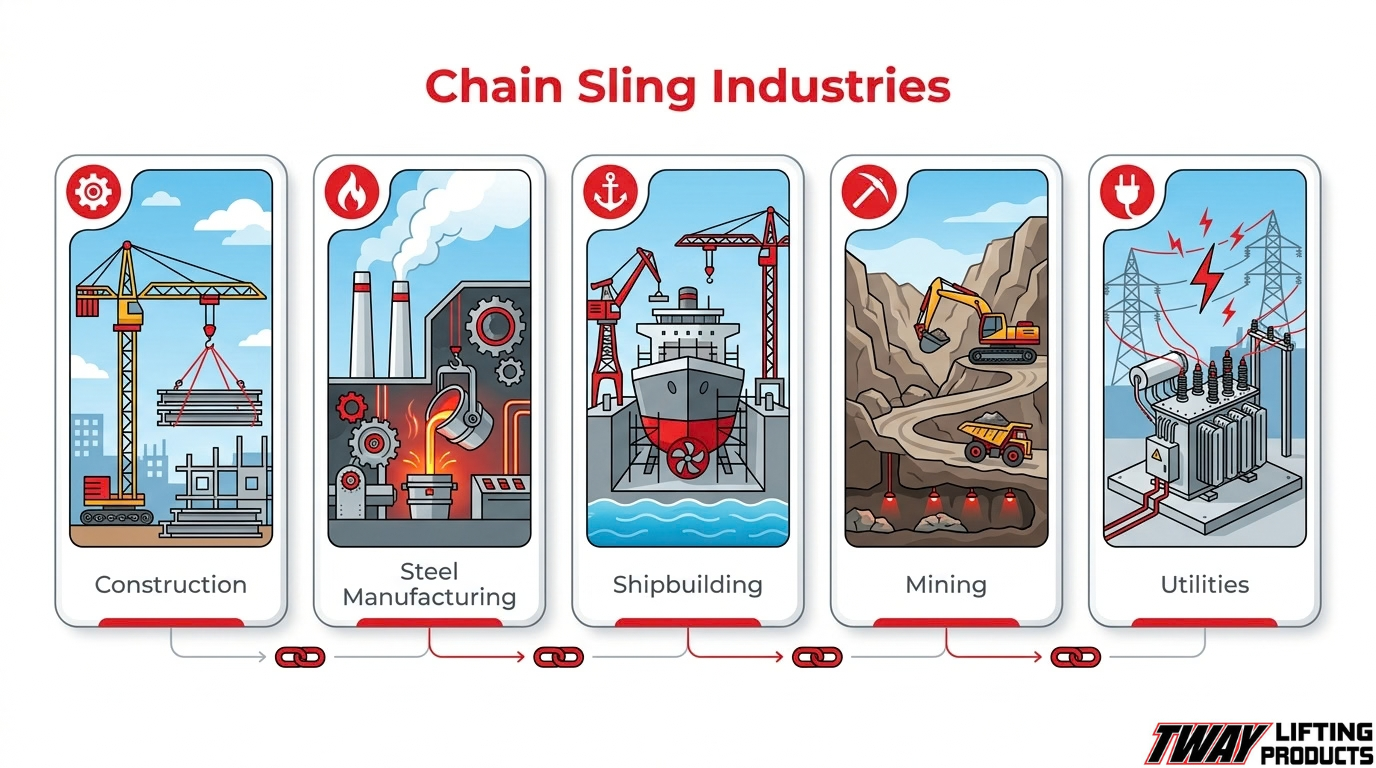
The industries that use lifting chain slings span heavy manufacturing, construction, marine, mining, and utility sectors. Each industry depends on chain slings for their ability to handle extreme loads, abrasive conditions, and high-temperature environments where synthetic alternatives fail.
Construction
The construction industry uses lifting chain slings to hoist steel beams, precast concrete panels, and heavy machinery. According to the U.S. Bureau of Labor Statistics, construction workers record 2.2 total recordable injury cases per 100 full-time equivalent workers, making rigging equipment reliability a direct safety factor on every job site.
Steel and Metal Manufacturing
Steel and metal manufacturing facilities use lifting chain slings to move molten metal equipment, billets, and raw stock through production lines. These environments routinely expose slings to extreme heat and abrasive surfaces, conditions under which synthetic web slings fail due to poor abrasion resistance, according to the Canadian Centre for Occupational Health and Safety.
Shipbuilding and Marine
Shipbuilding and repair facilities use lifting chain slings across drydocks, shipbuilding positions, piers, workshops, and warehouses, according to the U.S. Environmental Protection Agency’s Profile of the Shipbuilding and Repair Industry. The layout of these facilities requires versatile, durable rigging that can handle irregular load shapes in confined or wet environments.
Mining and Mineral Production
The mining sector uses lifting chain slings to move ore, heavy extraction equipment, and underground machinery. In 2024, the estimated total value of U.S. nonfuel mineral production reached $106 billion, according to the U.S. Geological Survey’s Mineral Commodity Summaries 2025, reflecting the scale of operations demanding reliable heavy-lift rigging.
Utilities and Infrastructure
Utility and infrastructure projects use lifting chain slings to position transformers, generators, and large pipe assemblies. The adjustability and high working load limits of chain slings make them particularly well suited for installations where load weight, access restrictions, and precise placement all converge.
With applications spread across every major heavy industry, understanding chain sling advantages clarifies why this rigging type remains the dominant choice in demanding environments.
What Are the Advantages of Using a Chain Sling Over Other Sling Types?
The advantages of using a chain sling over other sling types include superior heat resistance, the ability to handle sharp-edged and abrasive loads, and stronger resistance to chemicals and corrosive environments. The following H3s cover each of these performance advantages in detail.
How Do Chain Slings Perform in High-Temperature Environments?
Chain slings perform exceptionally well in high-temperature environments, making them the preferred choice for foundries, steel mills, and heat-treating operations. Alloy steel construction allows chain slings to withstand conditions that would quickly degrade synthetic web slings or damage wire rope. By contrast, Emory University EHS guidelines note that metal mesh slings (a comparable metal option) are only rated for use between -20°F and 550°F when not impregnated with elastomers. Alloy chain slings exceed this range in many industrial applications, offering a meaningful durability edge where heat is a constant factor.
Why Are Chain Slings Preferred for Sharp-Edged or Abrasive Loads?
Chain slings are preferred for sharp-edged or abrasive loads because their alloy steel links resist cutting and wear that would destroy softer sling materials. According to Emory University Environmental Health and Safety (EHS-327 Sling Safety Guidelines), synthetic web slings are easily cut and have poor abrasion resistance compared with chain and wire rope slings, and webbing must be protected from sharp corners, protrusions, and abrasive surfaces. Chain slings require no protective padding against sharp edges, reducing setup time and eliminating a common failure point on rough or irregular loads.
How Do Chain Slings Hold Up Against Chemicals and Corrosive Conditions?
Chain slings hold up against many chemicals and corrosive conditions better than synthetic slings, which can degrade rapidly on contact with oils, solvents, and industrial fluids. Alloy steel chain resists surface damage from many common industrial chemicals, and damaged links can be individually replaced rather than requiring full sling retirement. This repairability makes chain slings a cost-effective long-term solution in harsh chemical environments compared to synthetic alternatives that must be discarded once compromised.
How Do You Inspect a Lifting Chain Sling for Safety?
Inspecting a lifting chain sling for safety requires a systematic review of physical condition, inspection frequency, and regulatory compliance. The sections below cover removal-from-service criteria, formal inspection intervals, and the OSHA and ASME standards that govern the process.
What Visual Signs Indicate a Chain Sling Should Be Removed From Service?
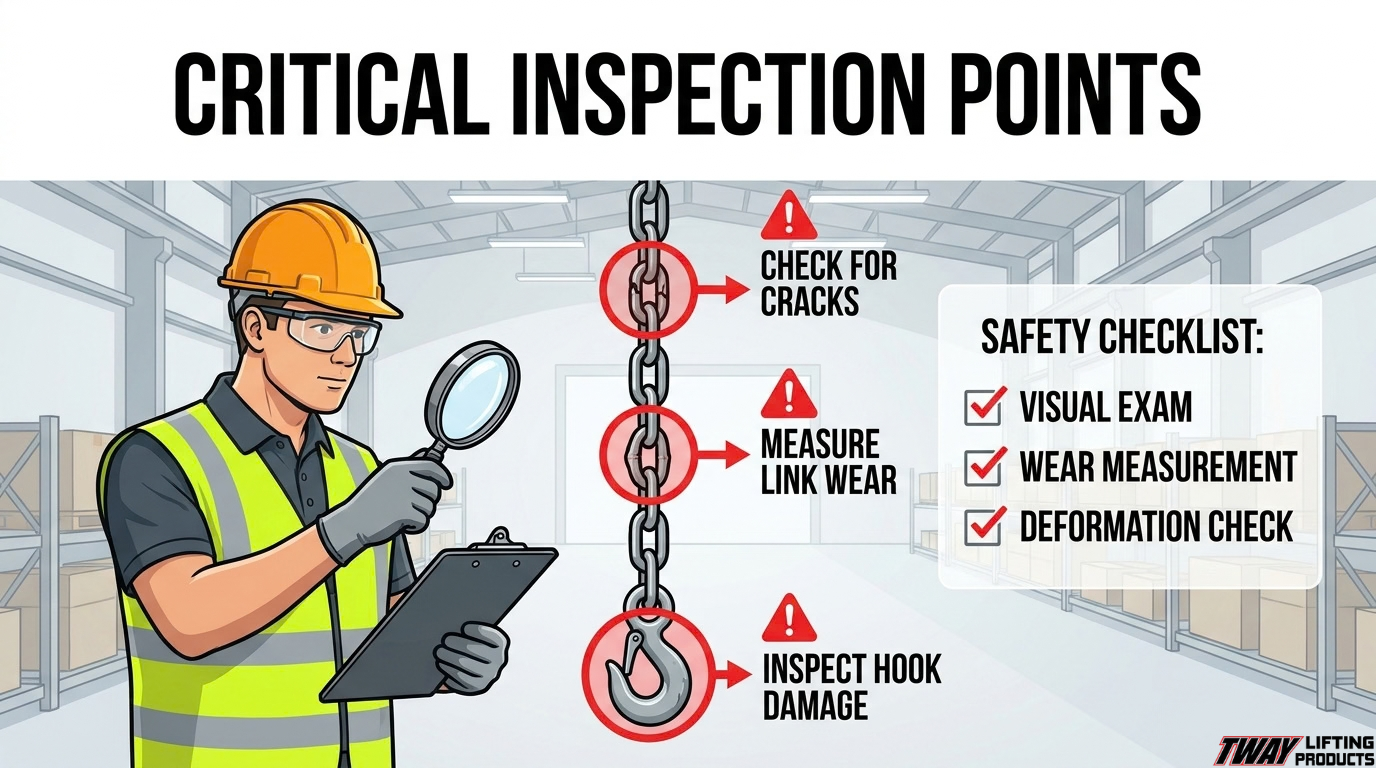
The visual signs that indicate a chain sling should be removed from service include stretched or elongated links, cracks, nicks, gouges, bent or twisted links, worn chain diameter, and damaged or deformed hooks, master links, or fittings. Any of these defects compromise the sling’s structural integrity under load.
The stakes are significant. According to the National Institute for Occupational Safety and Health (CDC), analysis of crane-related fatalities in construction found that 24 of 40 deaths from being struck by a load were caused by rigging failure. A pre-use visual inspection is one of the simplest and most effective defenses against that outcome.
How Often Should Lifting Chain Slings Be Formally Inspected?
Lifting chain slings should be formally inspected at three defined intervals:
- Before each use: A quick visual check by the operator for obvious damage, deformation, or missing identification tags.
- Periodically during service: A documented inspection based on frequency of use, severity of service conditions, and applicable site requirements.
- Annually at minimum: A thorough inspection by a qualified person, required under OSHA 29 CFR 1910.184 for general industry sling use.
High-frequency or harsh-environment applications may warrant more frequent formal inspections. From an operational standpoint, waiting for a scheduled annual inspection to catch developing damage is a risk that well-run facilities simply should not take.
What OSHA and ASME Standards Govern Chain Sling Inspection?
The OSHA and ASME standards that govern chain sling inspection are 29 CFR 1910.184 (OSHA’s general industry sling standard) and ASME B30.9 (the industry standard for sling fabrication, use, inspection, testing, and maintenance).
OSHA 29 CFR 1910.184 establishes mandatory removal-from-service criteria and inspection recordkeeping requirements for alloy steel chain slings used in general industry. ASME B30.9 provides detailed technical provisions covering fabrication, attachment, use, inspection, testing, and maintenance of slings used for load handling, complementing OSHA’s regulatory minimums with engineering-level guidance.
Together, these two frameworks define the compliance floor for any U.S. rigging operation using chain slings. Tway Lifting’s inspection specialists perform both OSHA-required annual inspections and job site safety inspections, delivering detailed compliance documentation — a practical resource for operations that need to meet these regulatory requirements without diverting internal staff.
How Do You Use a Lifting Chain Sling Safely?
Using a lifting chain sling safely requires correct hitch selection, awareness of sling angle effects on load capacity, and proper storage between uses. The sections below cover each practice in detail.
What Are the Correct Hitches for Rigging a Chain Sling?
The correct hitches for rigging a chain sling are the vertical hitch, choker hitch, and basket hitch, each suited to different load conditions. A vertical hitch attaches one leg directly to the load for straightforward lifts. A choker hitch wraps around the load and reduces rated capacity. A basket hitch supports the load from beneath and increases capacity when legs remain near vertical.
According to the U.S. Department of Energy Hoisting and Rigging Fundamentals, two, three, or four single hitches can be combined into a bridle hitch for loads with lifting lugs, and leg lengths should be adjusted with turnbuckles or chain lever hoists to distribute the load equally. Never shorten sling legs with knots, bolts, or makeshift devices.
What Sling Angle Mistakes Can Lead to Overloading?
Sling angle mistakes that lead to overloading include using excessively wide angles between legs, which dramatically increases the tension each leg must carry beyond the rated capacity. As the angle between an inclined leg and vertical increases past 45 degrees, the effective load per leg rises steeply. Many riggers underestimate this effect on multi-leg slings.
Per California Department of Industrial Relations Title 8, Table S-1, multi-leg sling ratings are adjusted based on the included angle between the inclined leg and the vertical. Critically, quadruple sling ratings match triple sling ratings because normal lifting practice may not distribute the load uniformly across all four legs. Always verify the rated capacity for your specific angle before any lift.
How Should Chain Slings Be Stored When Not in Use?
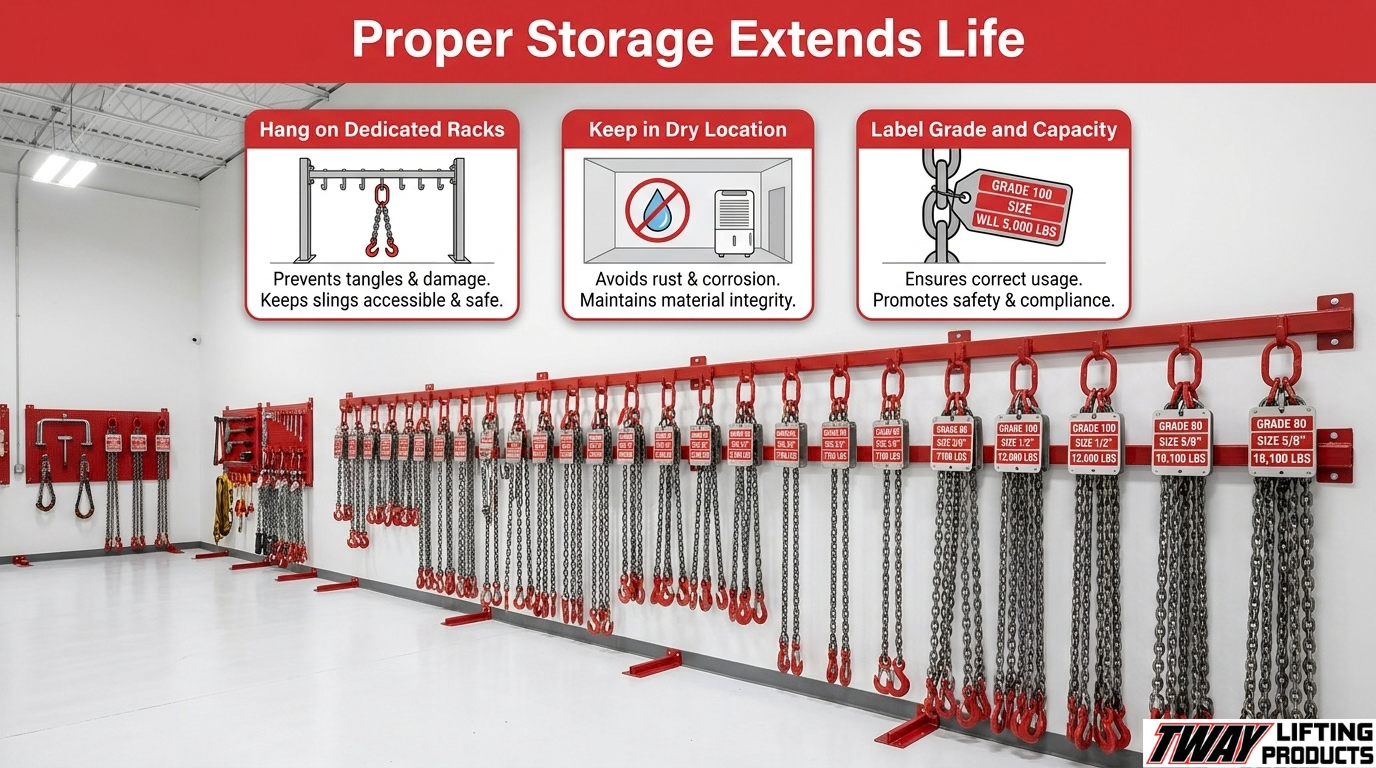
Chain slings should be stored hung on a dedicated rack in a dry, clean location away from corrosive chemicals, moisture, and extreme temperatures. Coiling slings loosely on the floor risks kinking, link damage, and contamination that may go undetected before the next use. Proper storage also makes pre-use inspection faster and more reliable.
Tag or label each sling with its grade, size, and rated load so the correct sling is selected quickly during the next job. Inspect slings for damage before hanging them, rather than deferring inspection to the next use cycle, since damage is easier to identify and document immediately after a lift.
With correct hitch selection, angle awareness, and disciplined storage, chain slings remain safe and ready for every subsequent lift.
How Do You Select the Right Lifting Chain Sling for a Job?
Selecting the right lifting chain sling requires evaluating load weight, load shape, center of gravity, and the work environment. The following sub-sections address each factor in detail.
How Does Load Weight Determine Which Chain Sling to Choose?
Load weight determines which chain sling to choose by establishing the minimum Working Load Limit (WLL) the sling must meet. The sling’s rated capacity must exceed the total load weight with an appropriate safety margin. Chain grade and leg count both directly affect the WLL available. According to Princeton University Environmental Health and Safety, the hoist hook must sit directly above the load’s center of gravity; if offset, dangerous tilting results, causing unequal stress across sling legs. Undersizing a sling for the actual load weight is one of the most preventable rigging errors in the field.
How Does Load Shape or Center of Gravity Affect Sling Selection?
Load shape and center of gravity affect sling selection by dictating how many legs are needed and where attachment points must be placed. Irregular or asymmetric loads shift the center of gravity off-center, requiring multi-leg configurations or adjustable leg lengths to balance the lift. Long or wide loads may require spreader bars in combination with chain slings to prevent load rotation or uneven leg loading.
How Does the Work Environment Influence Chain Sling Selection?
The work environment influences chain sling selection by determining whether a sling must resist heat, chemicals, abrasion, or moisture. Emory University Environmental Health and Safety guidelines note that metal mesh slings resist abrasion and cutting, making environmental resistance a key sling-type differentiator. Outdoor or marine environments favor alloy steel chain over synthetic slings, which degrade under UV exposure and abrasion. High-temperature environments require verified temperature ratings before any sling is deployed. Tway Lifting stocks chain slings, synthetic slings, and wire rope slings, making it straightforward to source the right sling type for a given environment from a single supplier.
How Are Lifting Chain Slings Maintained and Repaired?
Lifting chain slings require routine maintenance and proper repair protocols to remain safe and compliant. The two subsections below cover field repair limitations and the maintenance steps that maximize sling service life.
Can a Damaged Chain Sling Link Be Replaced in the Field?
No, a damaged chain sling link cannot be replaced in the field. Washington Administrative Code § 296-155-33800 requires that adjustments and repairs use only methods approved by the manufacturer or a qualified person, and that all new and repaired chain slings are proof tested before returning to service. Field link replacement bypasses both requirements, making the sling non-compliant and unsafe. Any chain sling with a damaged link must be taken out of service immediately and sent to a certified repair facility for inspection, component replacement, and proof testing. As a certified Peerless/Acco Welded Sling Repair Center, Tway Lifting provides the manufacturer-approved reconditioning and proof testing that regulations require before a repaired sling can return to service.
What Maintenance Steps Extend the Life of a Chain Sling?
The maintenance steps that extend chain sling life are cleaning, lubrication, proper storage, and periodic formal inspection. Follow this routine:
- Clean after each use: Remove dirt, weld spatter, and chemical residue that accelerate wear.
- Lubricate regularly: Apply a light chain lubricant to all links and hardware to reduce friction and prevent corrosion.
- Inspect before every lift: Check each link for stretching, twisting, nicks, cracks, and wear, and verify hooks and master links are undamaged.
- Store correctly: Hang slings on a rack in a dry, covered area; never leave them coiled on the floor where they can be driven over or exposed to moisture.
- Log formal inspections: Maintain documented records for every periodic inspection to support ASME B30.9 compliance.
Consistent lubrication is often the most overlooked step, yet it directly reduces link wear and extends service intervals between formal inspections.
How Does Tway Lifting Support Your Chain Sling Rigging Needs?
Tway Lifting supports chain sling rigging needs through inspection, repair, reconditioning, and custom fabrication services, with roots going back to 1945. The sections below cover Tway Lifting’s service capabilities and a summary of key chain sling takeaways.
Does Tway Lifting Offer Chain Sling Inspection and Repair Services?
Yes, Tway Lifting offers chain sling inspection and repair services as a certified Peerless/Acco Welded Sling Repair Center. Tway Lifting’s inspection specialists perform OSHA-required annual inspections and job site safety inspections, delivering detailed reports for compliance documentation. Chain sling reconditioning is also available, and Tway Lifting offers same-day wire rope sling fabrication. Tway Lifting’s certified, factory-trained inspection specialists bring the expertise needed to identify wear, deformation, or damage that would require a sling to be removed from service. For operations where downtime is costly, this combination of inspection and repair under one roof is a practical advantage that most facilities cannot replicate in-house.
What Are the Key Takeaways About Lifting Chain Slings We Covered?
The key takeaways about lifting chain slings are centered on grade selection, load limits, inspection frequency, and proper rigging practice. The most actionable conclusions from this guide include:
- Grade determines capacity: Grade 80 and Grade 100 alloy steel are the industry standard grades; higher grades carry significantly greater working load limits at the same chain diameter.
- Sling angle reduces WLL: As the sling angle decreases from vertical, effective load capacity drops; always calculate the reduced WLL before rigging.
- Multi-leg configurations increase capacity: Double, triple, and quad-leg slings distribute load across legs, but leg angles must be accounted for in every lift.
- Regular inspection is non-negotiable: Chain slings require pre-use visual checks and formal periodic inspections by qualified personnel to meet OSHA and ASME B30.9 requirements.
- Damage means immediate removal: Stretched links, cracks, gouges, or distorted hooks require the sling to be pulled from service without exception.
- Repair requires a qualified source: Field repairs are not a substitute for manufacturer-certified reconditioning.
Tway Lifting can help you apply every one of these principles across your operation.