







A 3-leg chain sling is a multi-point lifting assembly that connects three independent alloy steel chain legs to a single master link, distributing a lifted load across three attachment points simultaneously. It is classified as a bridle hitch configuration and is governed by standards including OSHA 29 CFR 1910.184 and ASME B30.9.
This guide covers what a 3-leg chain sling is and how it works, the advantages and load ratings that define its performance, the common configurations and end fittings available, inspection and safe use requirements, how it compares to other multi-leg sling types, and how to select the right sling for your application.
Each leg in a triple leg assembly contributes to load distribution, with equal sharing assumed when legs are spaced 120° apart. Because rigid or irregular loads can shift that balance, engineering standards conservatively calculate working load limit using only two active legs.
Load ratings depend on three interacting variables: chain grade and diameter, sling angle, and the WLL calculation method applied. A 7 mm Grade 80 chain sling rates 3,500 lb in a single vertical hitch and reaches 9,100 lb in a triple leg bridle configuration at a 60-degree horizontal angle.
Inspection, safe rigging technique, and end fitting selection each carry equal weight in keeping a triple leg sling performing within its rated limits. OSHA requires daily pre-use checks and thorough periodic inspections at intervals no greater than 12 months.
For operations requiring custom fabrication, certified inspection, or reconditioning, Tway Lifting provides full-service support built on over 75 years of rigging expertise.
What Is a 3-Leg Chain Sling?
A 3-leg chain sling is a multi-point lifting assembly that connects three independent chain legs to a single master link, distributing a load across three attachment points simultaneously. The sections below cover how it differs from single and dual-leg slings, what components it contains, and what chain grade powers it.
How Is a 3-Leg Chain Sling Different From a 1-Leg or 2-Leg Sling?
A 3-leg chain sling differs from a 1-leg or 2-leg sling by adding a third attachment point, which distributes the lifted load across three contact positions instead of one or two. According to the Canadian Centre for Occupational Health and Safety (CCOHS), bridle hitches are made of 2, 3, or 4 single-leg hitches, with the hook positioned over the center of gravity of the load. A single-leg sling concentrates the entire load on one chain, while a 2-leg sling splits it between two. Three legs add lateral stability and reduce the force each individual leg must carry, making the configuration better suited for heavy, wide, or awkward loads where a single attachment point would be unsafe.
What Components Make Up a 3-Leg Chain Sling?
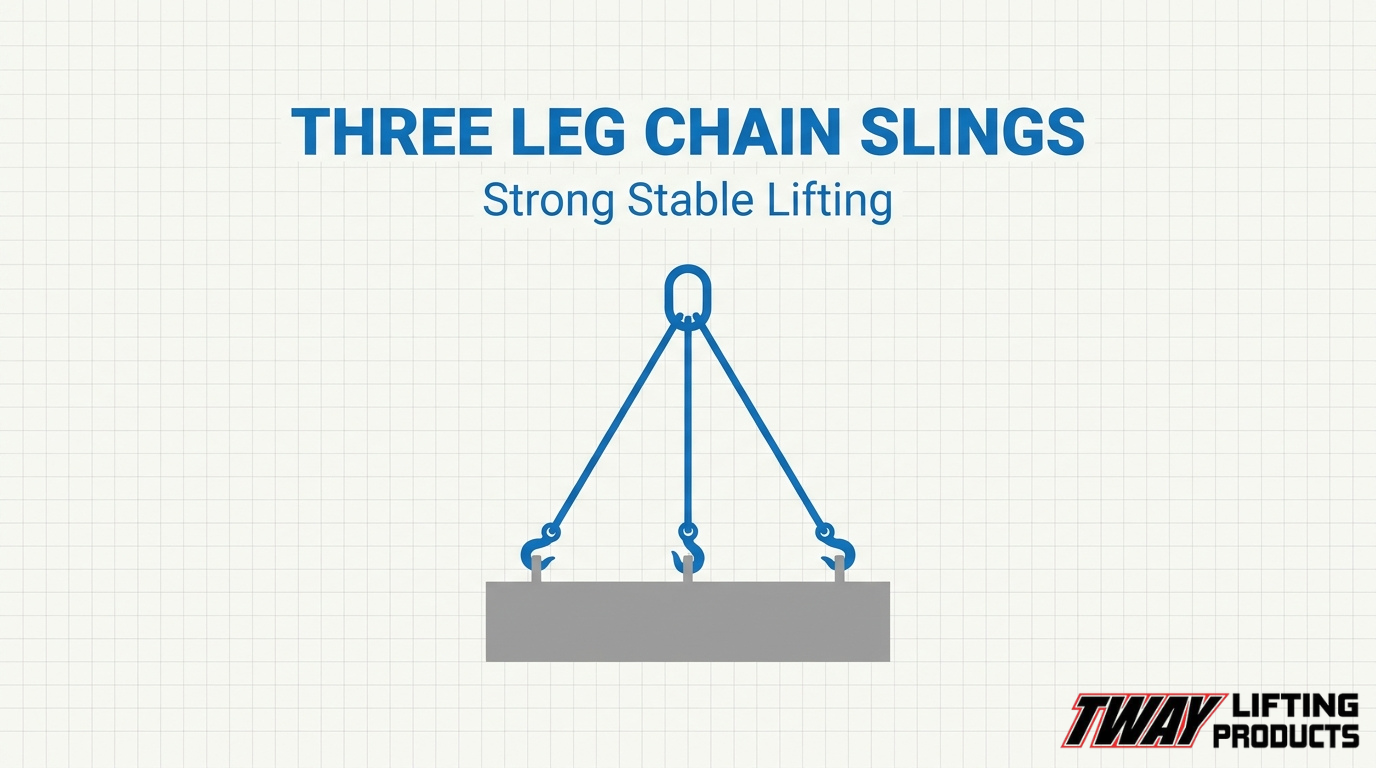
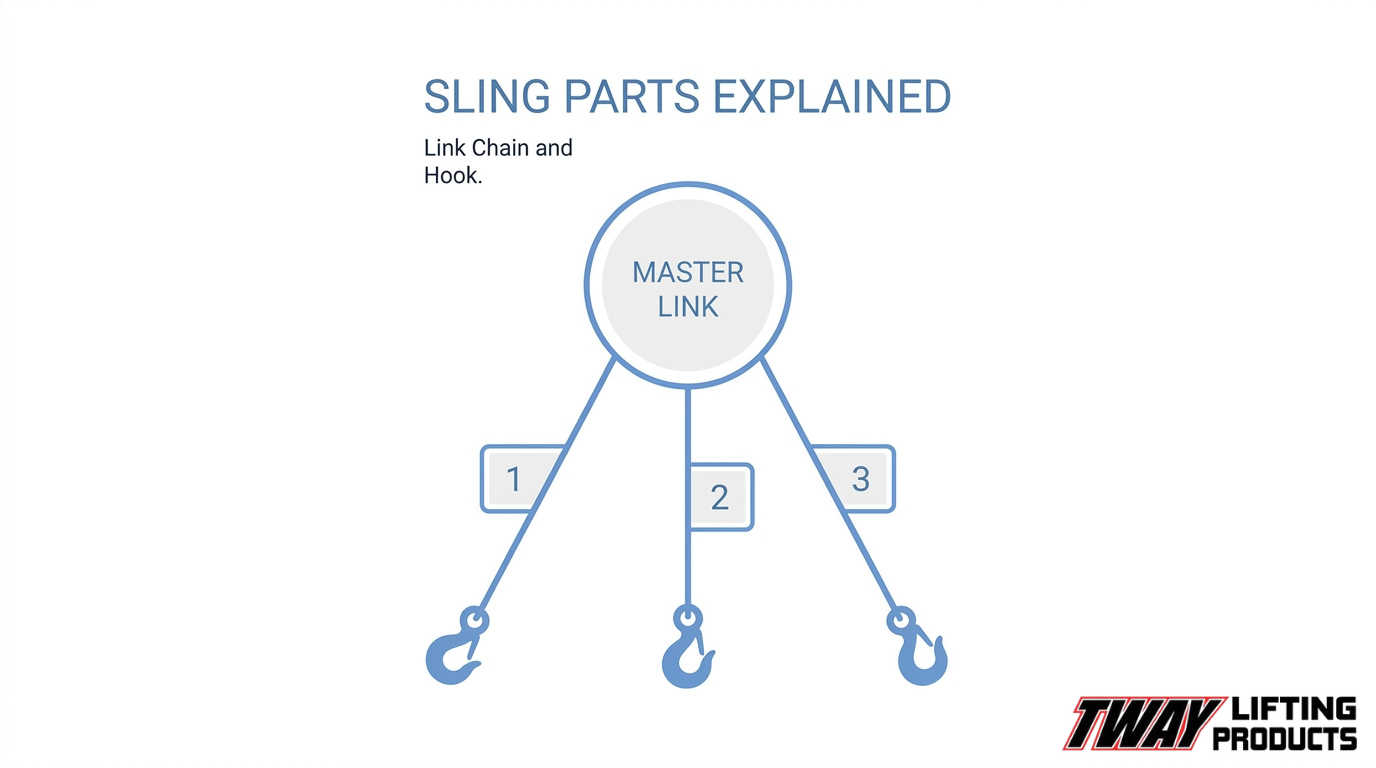
The components of a 3-leg chain sling are a master link (also called a master ring), three alloy chain legs, and a lower-end attachment on each leg, such as a hook, shackle, or grab hook. The master link gathers all three legs at the top and connects to the crane hook or hoist. Each chain leg transfers load force downward to its attachment point on the load. According to the New Zealand Civil Aviation Authority’s March 2022 guidance on chain slings, common defects that can render chain components unsafe or unfit for use include nicks, gouges, stretch, bent or distorted links, and corrosion, particularly in the load-bearing sections. Selecting high-quality components across every connection point is essential, since the weakest component determines the assembly’s practical capacity.
What Grade of Chain Is Used in a 3-Leg Chain Sling?
The grade of chain used in a 3-leg chain sling is Grade 80 alloy steel, which is the industry-standard minimum for overhead lifting applications. According to OSHA’s Guidance on Safe Sling Use (Table 1), a 9/32-inch (7 mm) Grade 80 alloy steel chain sling has a single-leg vertical rated load of 3,500 lb, rising to 9,100 lb at a 60-degree horizontal angle when configured as a triple or quadruple leg bridle sling. Grade 100 chain is also used in higher-capacity assemblies, offering greater working load limits in the same chain diameter. Using a lower-grade chain, or rigging a chain beyond its rated capacity, carries documented consequences: a WorkSafe Victoria safety alert recorded a 4.5-tonne precast concrete pile falling from a piling rig after the lifting chain was stressed beyond its lifting capacity due to improper rigging. Chain grade should always be verified by reading the embossed markings on the links before any lift. Tway Lifting, a full-service rigging manufacturer headquartered in Indianapolis, Indiana, stocks Grade 80 and Grade 100 alloy chain slings and can assist with grade verification and specification for your application.
How Does a 3-Leg Chain Sling Work?
A 3-leg chain sling works by suspending a load from a central master link, with three chain legs spreading downward to individual attachment points on the load. The sections below cover how weight distributes across all three legs, what the master link does, and how the hooks connect at the load.
How Does Load Distribution Work Across Three Legs?
Load distribution across three legs works by spreading the total weight among each chain leg, with equal distribution assumed when the legs are spaced 120° apart in plan. According to the Lifting Equipment Engineers Association (LEEA), COPSULE Edition 10, if two legs are closer than 120°, the third leg receives a disproportionately greater share of the load.
Three-leg slings are less susceptible to unequal distribution than four-leg slings because the load can tilt slightly, allowing the legs to self-equalize. However, lifting a rigid, irregularly shaped load can still produce unequal leg loads. Per the U.S. Department of Energy’s Hoisting and Rigging Fundamentals, the conservative safe working load formula for a three-leg sling assumes only two legs bear the weight, calculated as: SWL = SWL (single vertical hitch) x H/L x 2.
What Role Does the Master Link Play in a Triple Leg Sling?
The master link is the central connecting point at the top of a triple leg sling, accepting the crane hook and transferring the entire lifted load into all three chain legs simultaneously. It must carry the full combined load of all three legs, making it the highest-stressed single component in the assembly. A properly rated master link keeps all three legs geometrically aligned beneath the hook, which directly controls leg angle and load distribution. Selecting a master link with adequate capacity for the total rigged load is one of the most consequential decisions in assembling a three-leg sling.
How Do the Hooks Attach to the Load on a 3-Leg Sling?
The hooks on a 3-leg sling attach to designated lifting points on the load, such as pad eyes, lifting lugs, or structural frames. Each hook must be seated fully and correctly, with the load bearing on the bowl of the hook rather than the tip. Per British Columbia’s Occupational Health and Safety Regulation (B.C. Reg. 296/97, §15.36), any new, repaired, or altered sling with welded load-bearing attachments must be proof tested by the manufacturer before being placed in service.
Hooks with safety latches help prevent accidental disengagement during lifts, particularly when leg angles shift as the load is raised.
What Are the Main Advantages of Using a 3-Leg Chain Sling?
The main advantages of using a 3-leg chain sling are improved load stability, better control over awkward or irregular loads, and a higher working load limit compared to single or dual leg slings. The sections below cover each benefit in detail.
How Does a 3-Leg Sling Improve Load Stability Over Single or Dual Leg Slings?
A 3-leg sling improves load stability by distributing the load across three contact points rather than one or two. According to the Canadian Centre for Occupational Health and Safety, bridle hitches are made of 2, 3, or 4 single leg hitches and require the hook to be positioned directly over the center of gravity of the load. Three attachment points create a wider, more balanced base beneath the master link, reducing the risk of the load tilting or shifting mid-lift. This triangulated support is especially valuable when lifting large, flat, or symmetrical loads where consistent contact at each lift point keeps the load level throughout the entire lift cycle.
Why Is a 3-Leg Chain Sling Preferred for Awkward or Irregular Loads?
A 3-leg chain sling is preferred for awkward or irregular loads because it allows the load to tilt slightly and self-equalize tension across all three legs. The Infrastructure Health and Safety Association notes that three-leg hitches are less susceptible to unequal distribution since the load can tilt to equalize leg loads, though rigid irregular loads may still develop unequal forces. Three fixed attachment points give riggers more control over load orientation than a single or double leg sling can provide. For loads with off-center mass or uneven geometry, this self-adjusting behavior significantly reduces the chance of a sudden shift.
How Does Triple Leg Configuration Increase Working Load Limit?
Triple leg configuration increases working load limit by engaging three load-bearing legs simultaneously, multiplying the effective capacity beyond a single leg rated value. OSHA’s capacity table shows that for 7 mm Grade 80 chain, a single leg sling carries 3,500 lb vertically, while a triple and quadruple leg bridle sling reaches 9,100 lb at a 60-degree horizontal angle. Adding a third leg distributes stress across more chain links and attachment hardware, keeping individual leg loads well below their rated limits. In practice, this makes a 3-leg sling one of the most efficient configurations for maximizing capacity without stepping up to a larger chain diameter.
What Are the Weight Capacity and Load Ratings for a 3-Leg Chain Sling?
The weight capacity and load ratings for a 3-leg chain sling depend on three interacting variables: the working load limit (WLL) calculation method, the sling angle during the lift, and the diameter of the chain. The following sections break down each factor.
How Is the Working Load Limit Calculated for a 3-Leg Chain Sling?
The working load limit for a 3-leg chain sling is calculated using the formula: WLL = single vertical hitch WLL × (H/L) × 2, where H is the vertical height and L is the leg length. This formula reflects a conservative safety assumption: because a rigid load may tilt during the lift, only two of the three legs are treated as load-bearing, while the third acts as a stabilizer. Rigging engineers should treat this formula as the safe baseline, not a theoretical maximum.
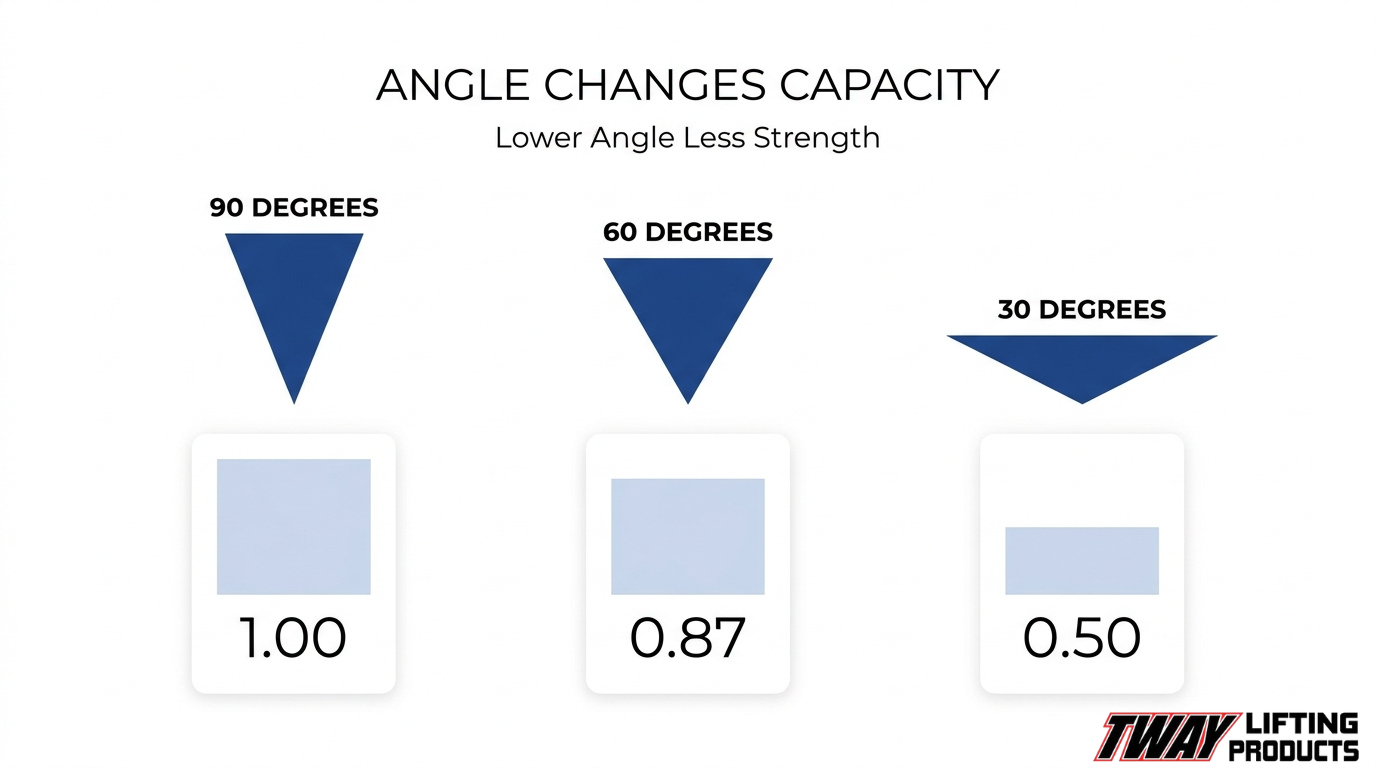
How Does Sling Angle Affect the Working Load Limit on a 3-Leg Sling?
Sling angle directly reduces the working load limit on a 3-leg sling as the legs move away from vertical. Shallower angles force each leg to carry a higher tension to support the same vertical load, which significantly cuts usable capacity. According to WorkSafeBC’s Occupational Health and Safety Regulation (Part 15, §15.33(2)), the WLL of a sling with more than three legs is still limited to the WLL of any three legs. Additionally, only slings tested and marked with their safe working load should be used, with thorough examination by a competent examiner within the preceding six months.
How Does Chain Size Affect the Load Rating of a 3-Leg Sling?
Chain size directly determines the baseline load rating of a 3-leg sling, with larger diameter chain producing substantially higher WLLs at every sling angle. According to OSHA’s Guidance on Safe Sling Use (Table 1), a 7 mm (9/32 in) Grade 80 alloy steel chain sling rates at 3,500 lb in a single vertical hitch, rising to 9,100 lb for triple and quadruple leg bridle configurations at a 60-degree horizontal angle. Selecting the correct chain size for the expected load weight and lift angle is one of the most consequential decisions in sling specification.
What Are the Common Configurations of a 3-Leg Chain Sling?
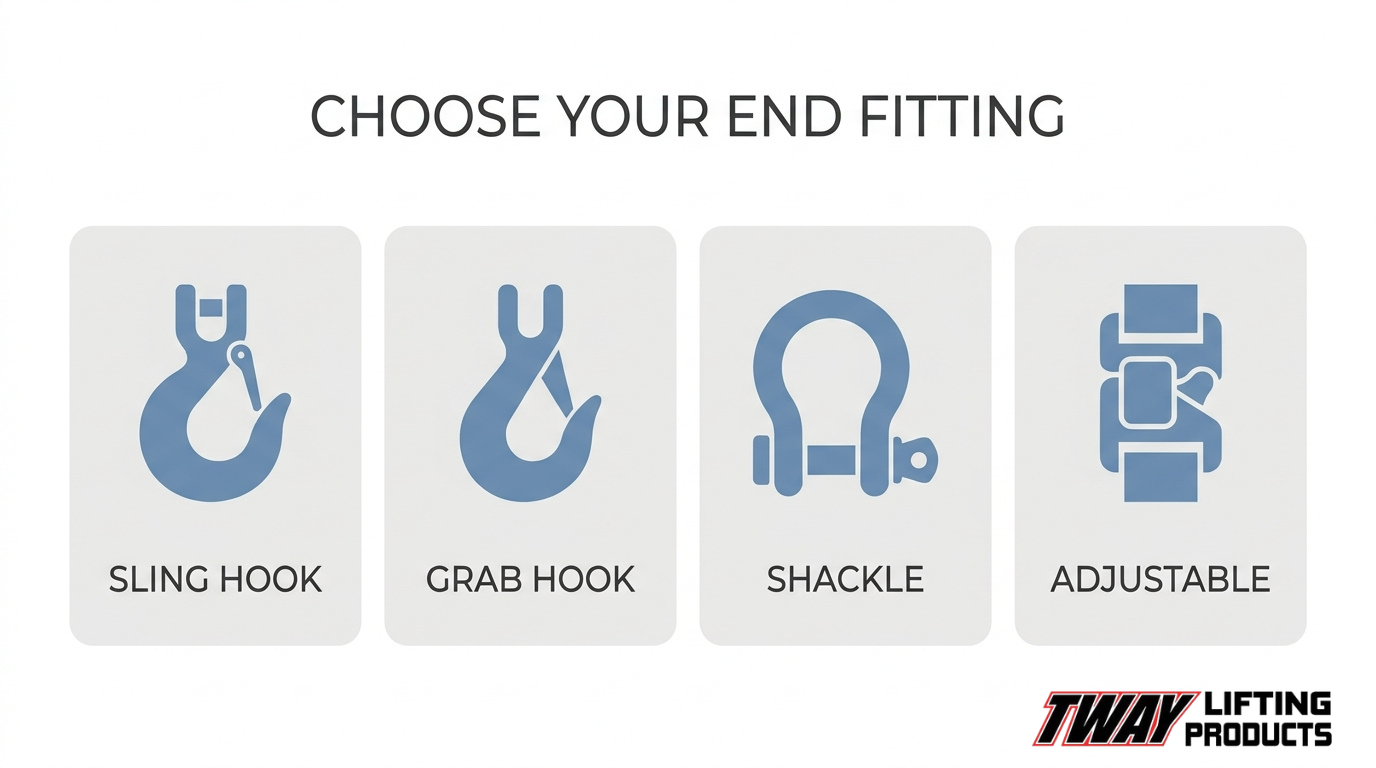
The common configurations of a 3-leg chain sling differ by the type of end fitting attached to each leg. End fitting selection affects connection security, adjustability, and the sling’s suitability for specific load points. The main configurations use sling hooks, grab hooks, shackles, or adjustable components.
What Is a 3-Leg Chain Sling With Sling Hooks?
A 3-leg chain sling with sling hooks is a configuration in which each leg terminates in a safety latch hook designed to seat onto lift points such as pad eyes, rings, or structural steel. Sling hooks provide fast attachment and release, making them practical for high-cycle lifting operations. Per California’s Title 8 §5044(b)(1), hooks and all other attachments must carry a rated capacity at least equal to the alloy steel chain used, or the sling must not exceed the capacity of its weakest component.
What Is a 3-Leg Chain Sling With Grab Hooks?
A 3-leg chain sling with grab hooks is a configuration in which each leg ends in a narrow-throated hook that engages directly into a chain link rather than over a lift point. Grab hooks allow leg length to be shortened by capturing a specific link, giving the rigger some length control without a separate adjustment mechanism. This makes them useful when a compact, fixed-position connection is needed.
What Is a 3-Leg Chain Sling With Shackles?
A 3-leg chain sling with shackles is a configuration in which each leg connects to the load via a bow or dee shackle secured with a screw pin or bolt. Shackles create a fully enclosed load path that cannot accidentally disengage, which is a meaningful safety advantage over open-throat hooks in applications with shock loading or confined rigging geometry. This configuration is common in heavy industrial lifts where connection integrity cannot be left to chance.
What Is an Adjustable 3-Leg Chain Sling?
An adjustable 3-leg chain sling is a configuration that incorporates grab hooks, shortening clutches, or sliding components on each leg, allowing leg length to be set independently before a lift. Adjustability lets riggers compensate for uneven lift points on asymmetric loads, helping each leg carry a more balanced share of the total weight. This configuration is particularly well-suited for loads where attachment points are not at equal heights.
What Industries and Applications Use 3-Leg Chain Slings?
3-leg chain slings are used across heavy industries where stable, multi-point lifting of large or irregular loads is required. The sections below cover their specific roles in construction, mining, and automotive manufacturing.
How Are 3-Leg Chain Slings Used in Construction?
3-leg chain slings are used in construction to lift structural elements such as precast concrete panels, steel beams, and machinery modules from multiple attachment points simultaneously. The three-leg configuration distributes load across three lift points, keeping heavy components level during placement. According to the Lawrence Berkeley National Laboratory EHS Manual, rigging must be evaluated before use in environments involving corrosives or temperature extremes between -20°F and +180°F, conditions commonly encountered on active construction sites.
How Are 3-Leg Chain Slings Used in Mining Operations?
3-leg chain slings are used in mining operations to lift heavy equipment components, such as crusher housings, pump assemblies, and conveyor sections, that require controlled, balanced lifts in confined or underground spaces. Alloy chain slings are preferred in mining environments because they resist abrasion and tolerate the high-impact, high-load demands of underground and surface extraction work.
How Are 3-Leg Chain Slings Used in Automotive Manufacturing?
3-leg chain slings are used in automotive manufacturing to position and install large powertrain components, body presses, and die sets that have multiple fixed lift points requiring simultaneous engagement. Precise load control matters on assembly lines where components must be lowered into tight tolerances without lateral swing, making the three-point stability of a triple leg sling particularly well suited to this application.
How Do You Inspect a 3-Leg Chain Sling for Safe Use?
Inspecting a 3-leg chain sling for safe use requires pre-use visual checks, compliance with OSHA and ASME standards, and clear criteria for removing damaged slings from service. The following section covers each step of that process.
What Pre-Use Visual Checks Should Be Performed on a 3-Leg Chain Sling?
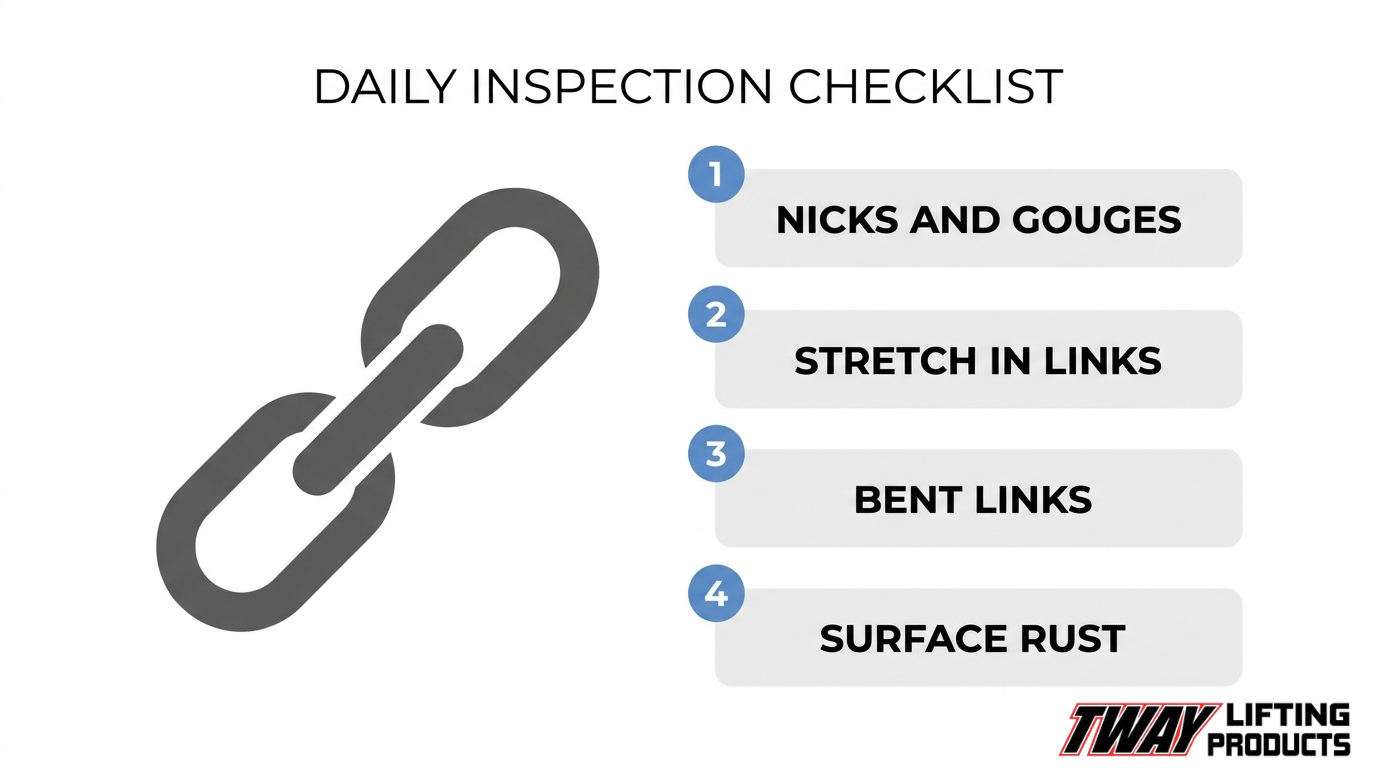
Pre-use visual checks on a 3-leg chain sling should cover every link, fitting, and attachment point across all three legs. According to the New Zealand Civil Aviation Authority’s 2022 report on lifting equipment inspections, common defects that render a chain sling unsafe include:
- Nicks and gouges on load-bearing link sections
- Stretch or elongation in any link
- Bent or distorted links
- Surface corrosion on chain or fittings
Inspect the master link, sub-links, and hooks for deformation, cracks, and missing identification tags. Each component must be free of visible damage before the sling is used. In practice, a quick but systematic pass through all three legs before every lift is one of the simplest habits that prevents catastrophic failure.
What Are the OSHA and ASME Standards for Chain Sling Inspection?
The OSHA and ASME standards for chain sling inspection establish both daily and periodic inspection requirements. Under OSHA 29 CFR 1910.184(d), each sling and all fastenings and attachments must be inspected for damage or defects by a competent person before each use, with thorough periodic inspections conducted at intervals not exceeding 12 months. ASME B30.9 covers fabrication, use, inspection, testing, and maintenance of alloy steel chain slings and applies alongside OSHA requirements for workplace compliance.
When Should a 3-Leg Chain Sling Be Removed From Service?
A 3-leg chain sling should be removed from service immediately when any inspection reveals a disqualifying defect. The University of Waterloo Safety Office identifies the following as definitive removal-from-service criteria:
- Wear on any portion of any link exceeding the manufacturer’s allowable wear specification
- Cracks in the weld area of any link
- Stretch, distortion, or bent links
- Nicks, gouges, or corrosion that compromises structural integrity
Never attempt to continue using a sling that meets any of these conditions; contact the chain manufacturer for wear tolerances specific to your sling’s grade and size. Maintaining a disciplined removal-from-service process is the single most effective safeguard against chain sling failures during live lifts. Tway Lifting’s certified, factory-trained inspection specialists perform OSHA-required annual inspections and provide detailed reporting, helping operations stay compliant and identify removal-from-service conditions before they become hazards.
How Do You Use a 3-Leg Chain Sling Safely?
Using a 3-leg chain sling safely requires correct setup before the lift, awareness of common rigging errors, and proper personal protective equipment. The following sections cover leg length and angle configuration, frequent mistakes to avoid, and site-level safety precautions.
How Should Leg Length and Sling Angle Be Set Before a Lift?
Leg length and sling angle should be set so that all three legs share load evenly and no single leg is overstressed. According to the CCOHS, the hook or master link must be positioned directly over the center of gravity of the load before lifting begins. The LEEA (COPSULE Edition 10) specifies that legs are assumed to be spaced at 120° to each other when viewed from above; if two legs are closer together, the third leg absorbs a disproportionately greater share of the load. Steeper angles (closer to vertical) preserve more working load limit, while shallow horizontal angles sharply reduce capacity. Setting leg length correctly before the lift is one of the most impactful decisions a rigger makes, and it is often underestimated in pre-lift planning.
What Are the Most Common Rigging Mistakes With 3-Leg Chain Slings?
The most common rigging mistakes with 3-leg chain slings include uneven leg spacing, incorrect hook placement, exceeding rated capacity, and using damaged components. The U.S. Department of Energy’s Hoisting and Rigging Fundamentals notes that on an irregularly shaped rigid load, a 3-leg hitch may effectively transfer load to only two legs, meaning the sling should be rated as if only two legs are active. Additional frequent errors include:
- Positioning the master link off-center from the load’s center of gravity.
- Shortening chain legs by tying knots, which concentrates stress and reduces capacity.
- Using any component whose rated capacity is lower than that of the chain itself.
- Failing to inspect all three legs and hardware before each use.
What PPE and Site Precautions Apply When Using a 3-Leg Chain Sling?
PPE and site precautions when using a 3-leg chain sling include hard hats, steel-toed boots, cut-resistant gloves, and exclusion zones beneath suspended loads. Chains should be protected from contact with sharp load edges using soft packing material, as the Hong Kong Labour Department’s Code of Practice for Safety at Work specifies. Additional site precautions include:
- Never stand under a suspended load during or after the lift.
- Verify that the lift environment does not involve corrosive chemicals or temperature extremes that could compromise chain strength.
- Confirm all three hooks are fully seated and latched before the crane takes tension.
- Keep all personnel clear until the load is fully landed and sling tension is released.
With safe rigging procedures established, comparing the 3-leg chain sling to other multi-leg sling types helps determine the best tool for each application.
How Does a 3-Leg Chain Sling Compare to Other Multi-Leg Sling Types?
A 3-leg chain sling sits between 2-leg and 4-leg configurations in terms of contact points and complexity. The following comparisons cover how it stacks up against 4-leg chain slings, wire rope slings, and synthetic slings.
How Does a 3-Leg Chain Sling Compare to a 4-Leg Chain Sling?
A 3-leg chain sling compares to a 4-leg chain sling in that both share the same rated load category: OSHA’s capacity table groups “Triple and Quadruple Leg Bridle Slings” together, meaning a 4-leg configuration carries no higher official WLL than a 3-leg sling of the same chain size. According to WorkSafeBC §15.33(2), the WLL of a sling with more than 3 legs is limited to the WLL of any 3 legs of the sling. In practice, the 4-leg design adds a fourth attachment point for load stability rather than raw capacity. The 3-leg sling is lighter, simpler to rig, and better suited to loads with three defined lift points, while the 4-leg version suits rectangular loads with four corners.
How Does a 3-Leg Chain Sling Compare to a 3-Leg Wire Rope Sling?
A 3-leg chain sling compares to a 3-leg wire rope sling primarily in durability, adjustability, and environmental resistance. Alloy chain tolerates abrasion and is adjustable via shortening hooks, while wire rope offers flexibility in tight rigging geometries. According to Princeton University EHS, wire rope with a fiber core is more flexible but less resistant to environmental damage, whereas a wire rope strand core provides greater strength and heat resistance. However, alloy chain outperforms both wire rope core types in high-heat environments. ASME B30.9 governs the fabrication, inspection, and use of both sling types under a single standard, so compliance requirements are parallel.
How Does a 3-Leg Chain Sling Compare to a 3-Leg Synthetic Sling?
A 3-leg chain sling compares to a 3-leg synthetic sling most sharply in inspection frequency and environmental durability. Synthetic slings require inspection at three-monthly intervals, per WorkSafe Western Australia’s Tower Cranes Code of Practice (April 2025, referencing AS 1353.2 and AS 4497.2), while alloy chain slings require daily pre-use checks and thorough periodic inspections no less than annually under OSHA 29 CFR 1910.184. Synthetic slings are lighter and gentler on finished surfaces but are vulnerable to heat, sharp edges, and chemical exposure. Chain slings carry higher WLLs for equivalent leg counts and are far more appropriate for rough industrial environments, hot materials, or outdoor heavy-lift applications.
How Do You Select the Right 3-Leg Chain Sling for Your Application?
Selecting the right 3-leg chain sling requires evaluating three key factors: load weight, lift point geometry, and work environment. The following sections address each factor in detail.
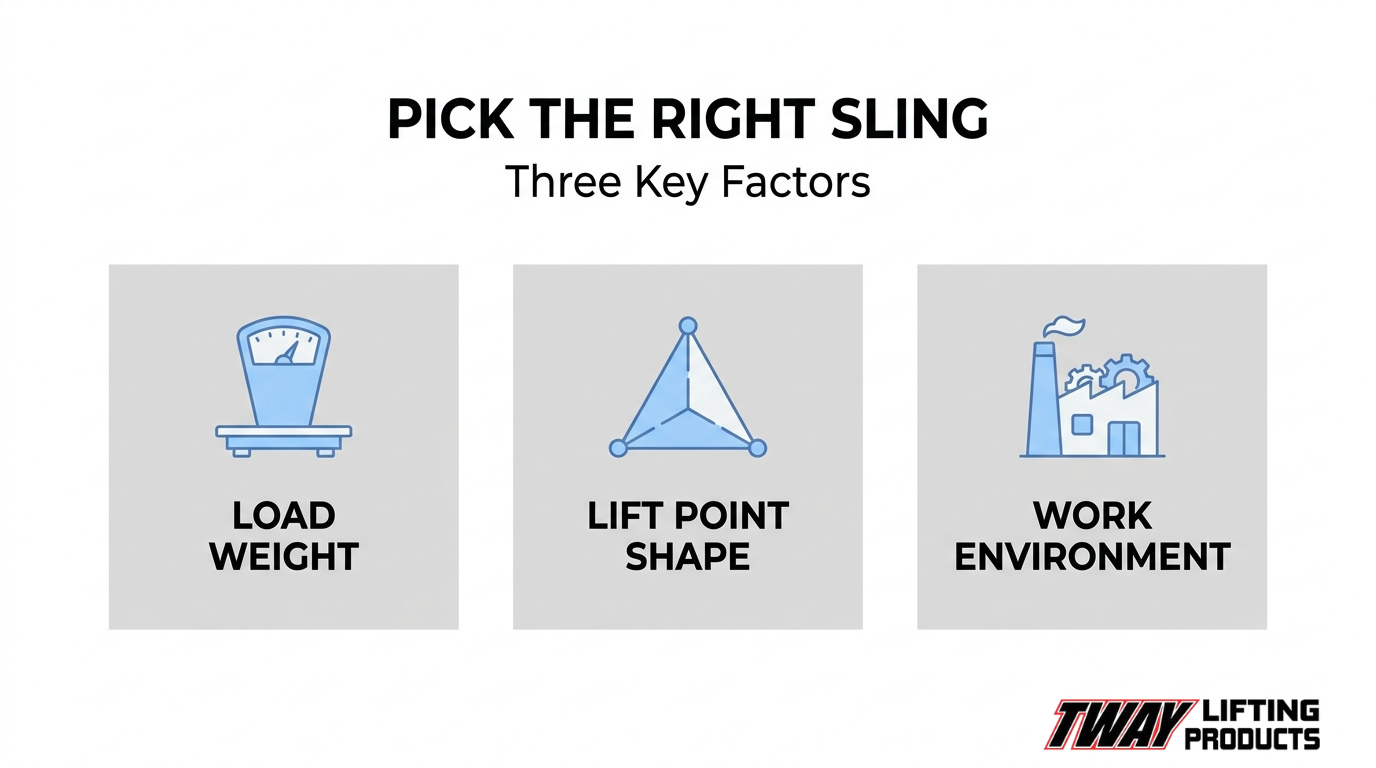
How Does Load Weight Determine Which 3-Leg Chain Sling You Need?
Load weight determines which 3-leg chain sling you need by establishing the minimum Working Load Limit the sling must meet. Start with the total load weight, then apply the appropriate sling angle factor to account for leg tension. Per OSHA’s capacity table, a 7 mm Grade 80 three-leg sling at a 60-degree horizontal angle rates 9,100 lb, dropping to 5,200 lb at 30 degrees. Always select a sling rated above your calculated working load, not equal to it. Never assume the vertical WLL applies once legs angle outward, as tension in each leg increases significantly as the angle decreases.
How Does Lift Point Geometry Affect 3-Leg Sling Selection?
Lift point geometry affects 3-leg sling selection by dictating required leg length and attachment spacing. According to the Lifting Equipment Engineers Association (LEEA), legs are assumed to be spaced at 120 degrees to each other in plan. If two attachment points are closer together, the third leg carries a disproportionately greater share of the load. Leg length must be sufficient to achieve a sling angle no less than 30 degrees from horizontal. Tighter attachment spacing requires longer legs or a spreader beam to maintain safe angles. Tway Lifting’s rental inventory includes spreader beams ranging from 2 to 100 tons and up to 40 feet in length, which can be a practical solution when lift geometry requires additional span between attachment points.
How Does the Work Environment Affect Which 3-Leg Chain Sling to Choose?
The work environment affects which 3-leg chain sling to choose by determining whether a standard alloy chain provides adequate durability or whether special precautions are required. According to the Lawrence Berkeley National Laboratory Environment, Safety & Health Manual, rigging used near corrosives, degrading chemicals, or in temperature extremes below -20°F or above +180°F requires expert review before use. Chain slings generally outperform synthetic alternatives in harsh environments, but extreme heat or chemical exposure still requires direct consultation with a rigging specialist. Matching sling material to site conditions is one of the most underestimated steps in the selection process.
How Can Tway Lifting Help You Source or Service a 3-Leg Chain Sling?
Tway Lifting helps you source or service a 3-leg chain sling through custom fabrication, reconditioning, and certified inspection services backed by over 75 years of rigging expertise. The sections below cover custom sling options and key takeaways for safe triple leg lifting.
Does Tway Lifting Offer Custom-Fabricated 3-Leg Chain Slings?
Tway Lifting offers custom-fabricated chain slings and special lifting assemblies built to meet specific application requirements. As a full-service rigging manufacturer and an authorized Peerless/Acco Welded Sling Repair Center, Tway Lifting manufactures, sells, rents, and reconditions chain slings, all under one roof in Indianapolis, Indiana. Wire rope sling fabrication is also available. For inspections, the LEEA’s COPSULE standard and the Hong Kong Electrical and Mechanical Services Department both require slings to be thoroughly examined by a competent person at defined intervals before use. Tway Lifting’s certified, factory-trained inspection specialists perform OSHA-required annual inspections and provide detailed reporting, so your slings remain compliant and ready for service.
What Are the Key Takeaways About 3-Leg Chain Slings and Triple Leg Lifting?
The key takeaways about 3-leg chain slings center on geometry, capacity, inspection, and sourcing. The most important conclusions from this article are:
- Leg spacing matters: Legs spaced evenly at 120° distribute load equally; uneven spacing forces one leg to carry a disproportionate share.
- Capacity planning: Because one leg may act primarily as a balance leg, rate the sling’s SWL using only two active legs when load evenness cannot be guaranteed.
- Angle reduces WLL: Shallower sling angles significantly reduce working load limit; always verify rated loads against the actual rigging angle before lifting.
- Inspection is non-negotiable: Pre-use visual checks for nicks, gouges, stretch, and distorted links must occur daily, with thorough periodic inspections at defined intervals.
- Component-matched hardware: Every hook, ring, and coupling link must carry a rated capacity at least equal to the chain itself.
- Work with a qualified supplier: Sourcing from an experienced manufacturer like Tway Lifting ensures fabrication quality, compliance documentation, and access to repair and reconditioning services when needed.