





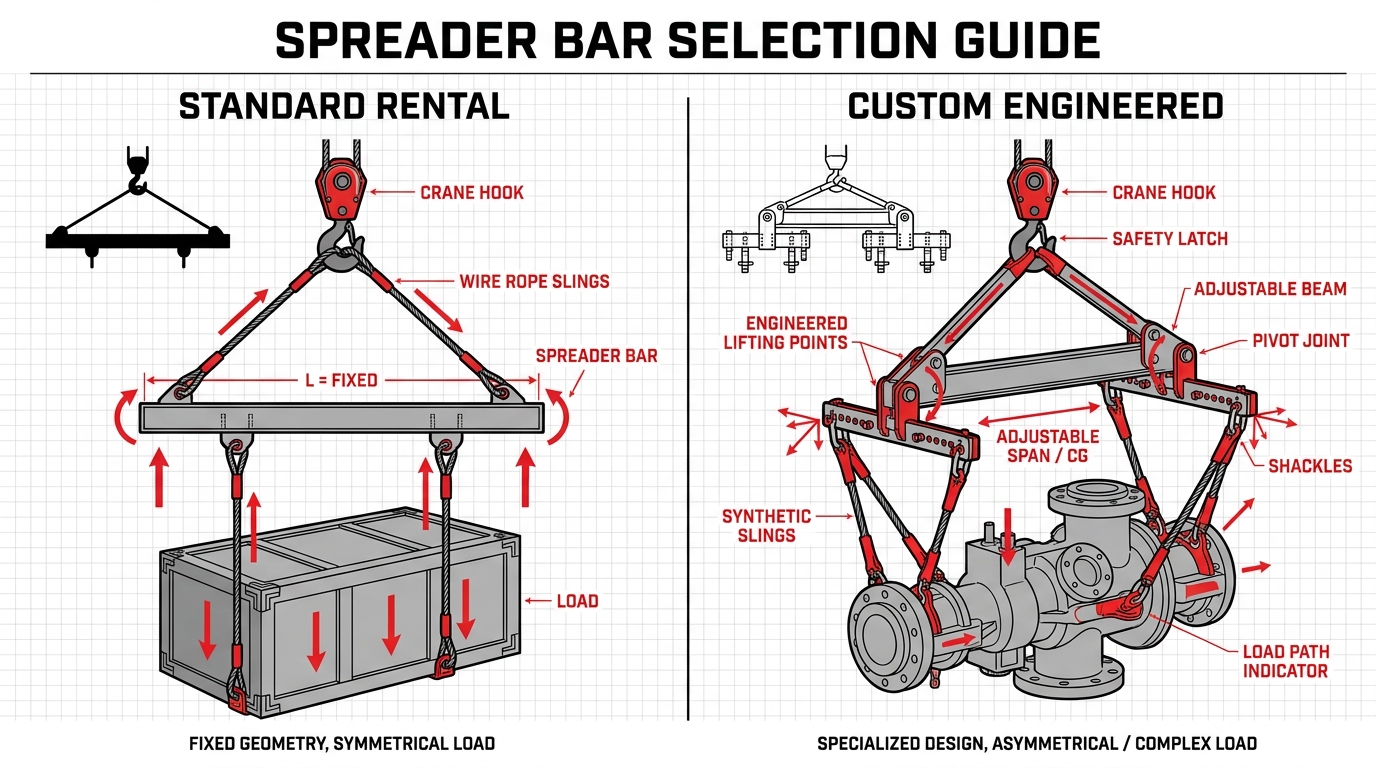

A spreader bar is a below-the-hook lifting device that keeps slings at a fixed distance apart, distributing load across multiple pick points while the bar absorbs compressive forces rather than bending forces. Choosing between a custom engineered bar and a standard rental unit is one of the most consequential decisions in lift planning, and the right answer depends on load geometry, rigging angles, project duration, compliance requirements, and risk tolerance.
This guide covers how spreader bars work, the rental options available, how custom engineering differs from off-the-shelf equipment, when each choice is appropriate, and how to specify the right bar for your application.
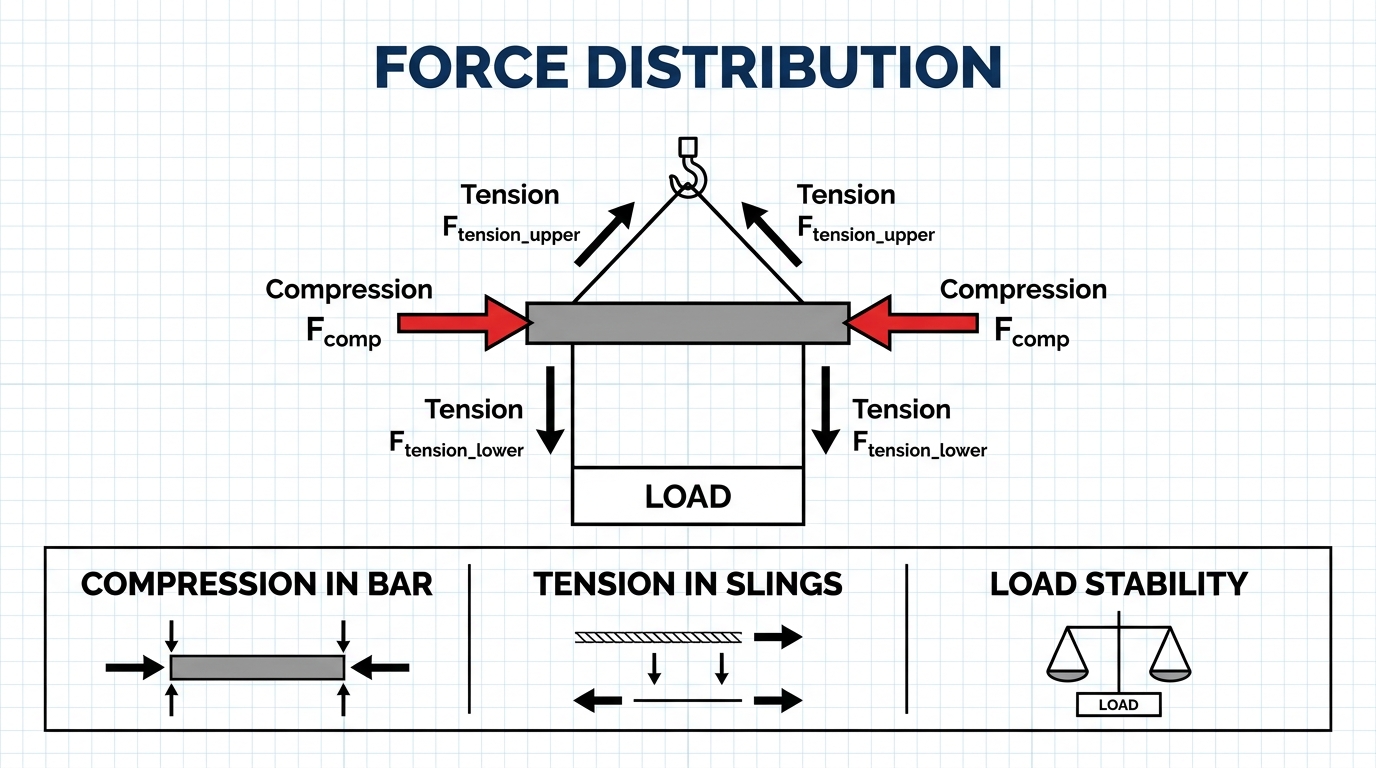
Spreader bars distribute load by converting lifting forces into pure compression in the bar and tension in the slings, a mechanical behavior that makes them predictable under high-capacity conditions and essential for wide, irregular, or multi-point loads.
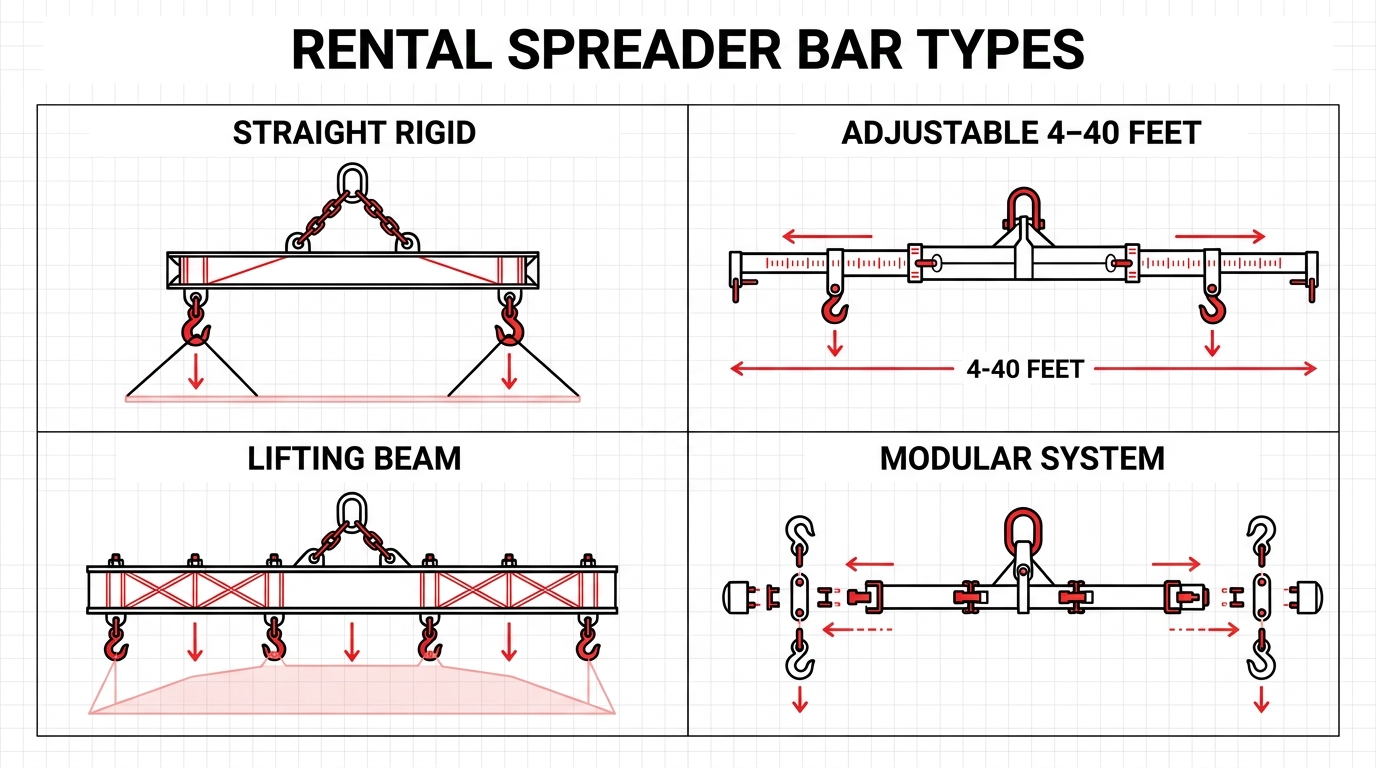
Standard rental inventory includes straight rigid bars, adjustable bars spanning 4 to 40 feet, below-the-hook lifting beams, and modular systems. Each type addresses a different range of load sizes, headroom conditions, and project durations.
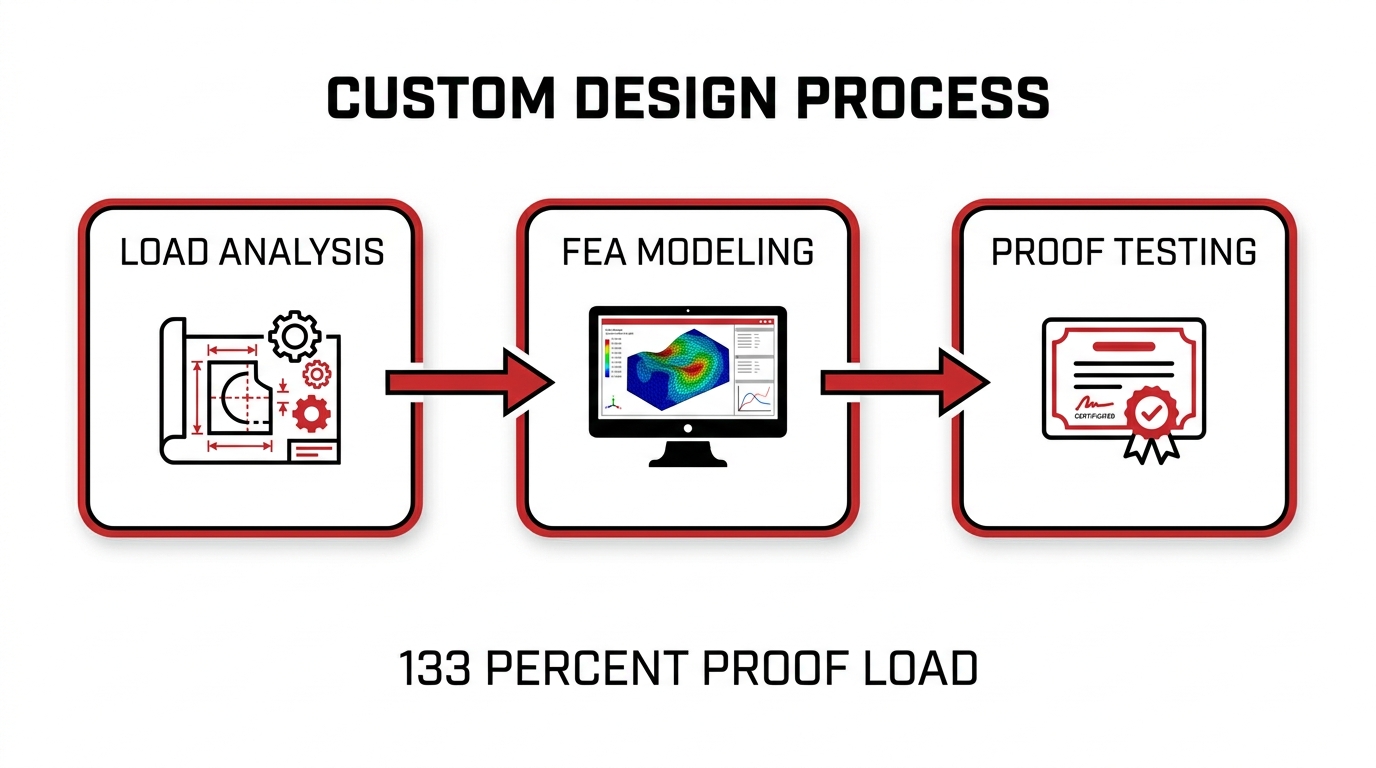
Custom engineered bars are designed from load data specific to one lift: weight, center of gravity, attachment point spacing, and sling angles. They are validated through Finite Element Analysis and proof load testing, and carry the engineering documentation that regulated jobsites require.
The risks of mismatching bar to load are substantial. Poor rigging is the leading cause of load-drop incidents, and non-engineered lifts on governed jobsites expose contractors to OSHA citations, civil liability, and project shutdowns.
Knowing when to rent, when to fabricate, and when to involve a rigging engineer is the difference between a compliant lift and a preventable failure.
What Is a Spreader Bar and What Does It Do in Rigging?
A spreader bar is a below-the-hook lifting device designed to keep slings at a fixed distance apart while distributing a load across multiple lifting points. The following sections cover how spreader bars distribute force during a lift and which lift types require them.
How Does a Spreader Bar Distribute Load During a Lift?
A spreader bar distributes load by converting lifting forces into pure compressive forces in the bar and tensile forces in the slings. It sits rigged between the crane hook and the load, with slings running from the crane hook down to each end of the bar and separate rigging connecting the bar ends to the load. This two-stage rigging geometry keeps sling angles controlled and prevents inward compression against the load. According to Mazzella Companies, this is the key mechanical distinction between spreader bars and lifting beams, which instead convert loads into bending forces. Properly applied, this compression-only load path makes spreader bars significantly more predictable under high-capacity conditions.
What Types of Lifts Typically Require a Spreader Bar?
The types of lifts that typically require a spreader bar include wide or heavy-duty loads, irregularly shaped structures, and loads vulnerable to tipping, sliding, or bending under direct sling tension. Common applications involve lifting long structural steel members, pressure vessels, prefabricated panels, and equipment with multiple pick points spread far apart. When slings attach directly to a wide load without a spreader bar, inward sling angles generate damaging horizontal compression against the load’s sides. A spreader bar eliminates that inward force by holding slings vertical or near-vertical, preserving both load integrity and rated capacity throughout the lift.
What Are the Types of Spreader Bars Available for Rental?
The types of spreader bars available for rental include straight rigid bars, adjustable bars, below-the-hook lifting beams, and modular systems. Each type suits different load geometries, headroom conditions, and project durations.
Straight Rigid Spreader Bars
Straight rigid spreader bars maintain a fixed length and are ideal for repetitive lifting of standardized loads where dimensions remain consistent. Because the bar length never changes, rigging setup is fast and predictable across identical lifts.
- Best for: Repetitive production lifts with uniform load dimensions
- Load behavior: Transfers compressive forces through the beam, tensile forces through slings
- Key limitation: Cannot accommodate varying load widths without swapping bars
For operations running the same lift repeatedly, rigid bars are often the most practical and cost-efficient rental choice.
Adjustable Spreader Bars
Adjustable spreader bars allow users to modify the spread length, typically ranging from 4 to 40 feet, making them versatile for multiple load sizes and configurations. A single rental unit can serve several different lifts on the same jobsite, reducing equipment costs and logistical complexity.
- Spread range: 4 to 40 feet (per Holloway Houston)
- Best for: Projects handling varied load widths or irregular dimensions
- Key advantage: One bar replaces multiple fixed-length units
Adjustable bars are among the most frequently rented options because they address the widest range of standard lift scenarios without requiring custom fabrication.
Below-the-Hook Lifting Beams
Below-the-hook lifting beams are supported from a single point at or near the center and are ideal for situations with limited headroom where direct hook-up is required. Unlike spreader bars rigged from both ends, a lifting beam converts the load into bending forces rather than compressive forces, which changes how the beam must be rated and inspected.
ASME B30.20-2025 governs below-the-hook lifting devices and requires each unit to be marked with the manufacturer’s name, rated load, and serial number. Renters should verify this marking is present and legible before any lift.
- Primary use case: Low-headroom environments requiring single-point crane hookup
- Force type: Bending forces (distinct from compression-dominant spreader bars)
- Compliance check: Confirm ASME B30.20 markings before use
Modular Spreader Bar Systems
Modular spreader bar systems can be assembled in various configurations for maximum versatility and are often used for extremely large or heavy loads. Sections bolt or pin together on-site, allowing the rigging crew to build the precise span and lifting geometry the load demands without waiting for custom fabrication.
- Best for: Extremely large or heavy lifts where fixed-length bars fall short
- Configuration flexibility: Multiple span lengths from one set of components
- Rental advantage: Access to large-capacity systems without ownership, storage, or transport costs
Modular systems represent the upper tier of standard rental inventory and bridge the gap between off-the-shelf bars and fully custom-engineered solutions.
What Is a Custom Engineered Spreader Bar?
A custom engineered spreader bar is a below-the-hook lifting device designed from the ground up for a specific load, geometry, and site condition rather than selected from a standard catalog. Unlike off-the-shelf rental bars, custom units are backed by engineering drawings, material certifications, and compliance documentation. The following H3s cover design methodology, materials and load ratings, and engineering certification.
How Is a Custom Spreader Bar Designed for a Specific Lift?
A custom spreader bar is designed by modeling the exact load weight, center of gravity, attachment point spacing, sling angles, and environmental conditions of the planned lift. Engineers use Finite Element Analysis (FEA) to predict stress distribution across the bar before fabrication begins. According to a validated workflow published in Scientific Reports (Nature), custom spreader beam design integrates FEA for stress prediction followed by a physical proof load test at 133% of the Safe Working Load. This approach eliminates the geometry compromises that come with standard bars and ensures the final assembly performs precisely as calculated for that lift.
What Materials and Load Ratings Are Used in Custom Fabrication?
Materials and load ratings in custom fabrication are selected based on the design category assigned under ASME BTH-1. The standard establishes three categories with distinct safety factors:
- Category A: 2:1 yield strength, 2.4:1 ultimate strength
- Category B: 3:1 yield strength, 3.6:1 ultimate strength
- Category C: 6:1 yield strength, 7.2:1 ultimate strength
Structural steel grades, weld specifications, and connection hardware are then matched to whichever category the application demands. Higher-duty-cycle or critical lifts require progressively larger safety margins, which directly drives material selection and rated capacity.
Who Engineers and Certifies a Custom Spreader Bar?
A custom spreader bar is engineered and certified by a qualified lifting engineer who produces stamped calculations and drawings, then validates the fabricated unit through proof load testing. OSHA 1926.251 mandates that custom-designed lifting accessories, including spreader bars, must undergo proof testing to 125% of their rated capacity before initial use. Under ASME B30.20-2025, the finished bar must also be permanently marked with the manufacturer’s name, rated load, and serial number. This certification chain creates a documented compliance record that protects the operator, the contractor, and the job site.
How Do Custom Engineered and Standard Rental Spreader Bars Differ?
Custom engineered and standard rental spreader bars differ across five key dimensions: load capacity, lift geometry, lead time, cost structure, and compliance documentation. Understanding each difference helps you match the right bar to your specific lift requirements.
How Do They Differ in Load Capacity and Configuration?
Load capacity and configuration differences between custom and standard rental bars center on design intent. Standard rental bars are built to fixed, catalog-defined capacities, typically serving common load weights and symmetrical lift geometries. Custom engineered bars are designed to a specific load weight, center of gravity, and attachment point layout, meaning capacity is calculated precisely for one lift scenario.
Selection requires evaluating load weight, dimensions, center of gravity, environmental conditions, and applicable safety standards. When those variables fall outside a standard bar’s fixed parameters, a custom design is the only compliant option.
How Do They Differ in Lift Geometry and Rigging Angle Flexibility?
Lift geometry and rigging angle flexibility differ significantly between the two options. Standard rental bars offer fixed or adjustable spread lengths, typically ranging from 4 to 40 feet, accommodating common sling angle configurations. Custom bars are engineered to specific attachment point spacings, hook heights, and sling geometries dictated by the load.
Proper sling angles of 30 degrees or greater are required to maintain safe load distribution and preserve rated capacity. When irregular load geometry forces sling angles below safe thresholds on a standard bar, a custom bar engineered to the correct spread resolves the problem at the design stage rather than at the rigging site.
How Do They Differ in Lead Time and Availability?
Lead time and availability differ sharply between custom and standard bars. Standard rental spreader bars are immediately available from rental fleets, making them suitable for time-sensitive or short-notice lifts. Custom engineered bars require design, fabrication, FEA stress analysis, and proof load testing before deployment, adding days or weeks to project timelines.
A validated custom design workflow integrates Finite Element Analysis for stress prediction and a physical proof load test at 133% of the Safe Working Load, according to a study published in Scientific Reports. For critical lifts, that lead time investment is justified, but projects with tight schedules should verify custom availability early.
How Do They Differ in Cost Over Short vs Long-Term Use?
Cost differences between custom and standard rental bars depend heavily on frequency and duration of use. Standard rental bars cost between $100 and $300 per day depending on location and capacity, making them cost-effective for short-duration or infrequent lifts. Custom engineered bars carry higher upfront fabrication costs but eliminate the cumulative rental expense for repeated or long-term applications.
A fabrication shop requiring a 30-foot, 40-ton bar for quarterly lifts must also factor in transport, storage, and maintenance costs when evaluating ownership. For one-time or sporadic lifts, rental wins on economics; for recurring specialized lifts, custom fabrication typically delivers a lower total cost of ownership.
How Do They Differ in OSHA and ASME Compliance Documentation?
OSHA and ASME compliance documentation requirements differ substantially between custom and standard bars. Standard rental bars carry manufacturer-issued load ratings and markings required under ASME B30.20-2025, including the manufacturer’s name, rated load, and serial number. Custom engineered bars must meet additional requirements: OSHA 1926.251 mandates proof testing to 125% of rated capacity before initial use, and engineered drawings with material certifications are typically required on regulated jobsites.
This documentation gap is often overlooked until an inspector or general contractor demands it. For any lift where a jobsite specification or regulatory authority requires an engineer of record, only a custom bar with a full documentation package satisfies that standard.
When Should You Choose a Standard Rental Spreader Bar?
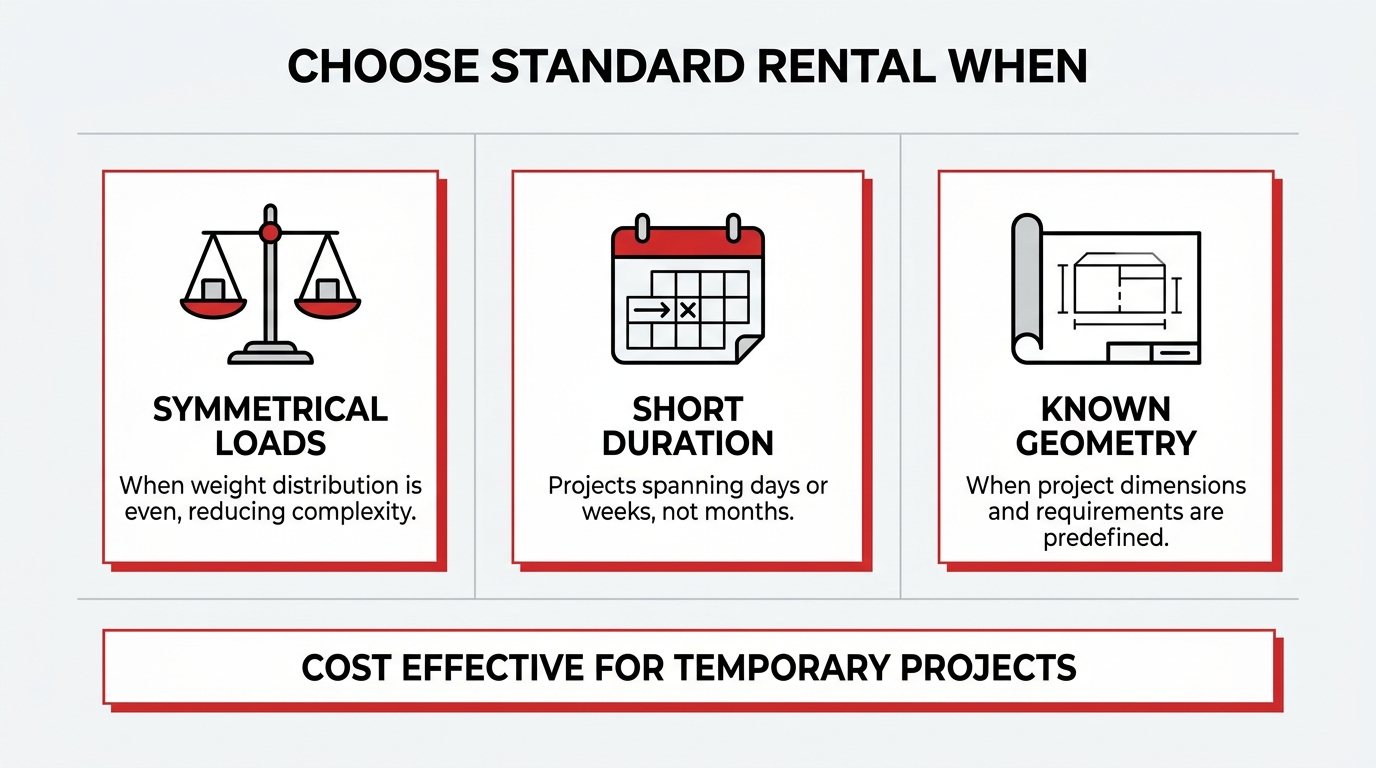
A standard rental spreader bar is the right choice when your load geometry is predictable, the project duration is short, and the lift falls within a catalogued capacity range. The following sections cover symmetrical load suitability, short-duration project economics, and the industries that most commonly rely on rental bars.
Is a Standard Bar Sufficient for Symmetrical Loads With Known Geometry?
A standard bar is sufficient for symmetrical loads with known geometry when the load’s weight, dimensions, and center of gravity are fully defined and fall within the bar’s rated capacity. Fixed spreader bars maintain a set length and are ideal for repetitive lifting of standardized loads where dimensions remain consistent. Adjustable rental bars extend that range, with spread lengths typically spanning 4 to 40 feet, accommodating multiple standard load sizes without custom fabrication. Selection still requires confirming load weight, dimensions, center of gravity, environmental conditions, and applicable safety standards before committing to a rental unit.
When Does a Rental Bar Make Sense for Short-Duration Projects?
A rental bar makes sense for short-duration projects when the total rental cost is lower than ownership costs including purchase price, transport, storage, and maintenance. Spreader bar rentals typically cost between $100 and $300 per day depending on location and capacity. For context, a fabrication shop needing a 30-foot, 40-ton bar for quarterly lifts would weigh those per-day rental rates against transport and storage overhead before purchasing. For a single-event or temporary project, rental avoids those fixed ownership burdens entirely.
What Industries Most Commonly Rely on Standard Rental Bars?
The industries that most commonly rely on standard rental bars are construction, steel production, automotive manufacturing, utilities, and mining. These sectors regularly encounter standardized, repeatable lifts where load geometry is known and project timelines are finite. As Peter Hansen notes, “Spreader bars are essential below-the-hook lifting devices used in a wide range of industries to safely and efficiently lift heavy, bulky, or irregularly shaped loads.” Standard rental inventory covers the majority of these routine applications efficiently and cost-effectively.
When Do You Need a Custom Engineered Spreader Bar Instead?
Custom engineered spreader bars are required when load geometry, rigging angles, regulatory demands, or lift criticality exceed what standard rental equipment can safely address. The following sections identify the four key conditions that trigger the need for custom design.
When Is Custom Engineering Required for Oversized or Irregular Loads?
Custom engineering is required for oversized or irregular loads when the load’s dimensions, weight distribution, or center of gravity cannot be safely accommodated by a standard bar’s fixed capacity and geometry. Irregular loads, such as pressure vessels, turbine assemblies, or structurally asymmetric fabrications, place uneven forces on attachment points that standard bars are not rated to handle.
Selection of a spreader bar requires evaluating load weight, dimensions, center of gravity, environmental conditions, and applicable safety standards. When any of those variables fall outside a standard bar’s design envelope, a custom solution is the only compliant path forward. In practice, irregular load geometry is the single most common trigger for custom fabrication requests.
When Does Lift Angle or Attachment Point Spacing Demand Custom Design?
Lift angle or attachment point spacing demands custom design when the required sling angle, hook height, or load connection spacing cannot be matched by an off-the-shelf bar configuration. Proper sling angles of 30 degrees or greater are required to maintain safe load distribution and preserve the rated capacity of a spreader bar system. When a load’s attachment points are spaced at non-standard intervals, or when headroom constraints compress the available sling angle below safe thresholds, a custom bar engineered to the exact geometry is necessary. No adjustable rental bar can compensate for a structurally dictated attachment spacing that falls outside its range.
When Do Regulatory or Jobsite Specifications Require Engineered Drawings?
Regulatory or jobsite specifications require engineered drawings when project owners, general contractors, or governing standards mandate documentation of design calculations, material certifications, and proof test results before a lift proceeds. OSHA 1926.251 mandates that custom-designed lifting accessories, including spreader bars, must undergo proof testing to 125% of their rated capacity before initial use. Additionally, ASME B30.20-2025 requires below-the-hook lifting devices to be marked with the manufacturer’s name, rated load, and serial number. Many regulated jobsites in petrochemical, nuclear, and heavy civil construction sectors require stamped engineering drawings as a condition of lift permit approval, making a rental bar without documentation non-permittable regardless of its capacity.
When Is a Custom Bar the Safer Choice for Critical or Tandem Lifts?
A custom bar is the safer choice for critical or tandem lifts when a single failure would result in catastrophic loss of life, catastrophic asset damage, or both. Rigging failures contribute to as many as 60% of crane-related deaths, according to industry data cited by Tway Lifting. Tandem lifts involving two cranes introduce dynamic load-sharing variables that require precise attachment geometry, matched capacity, and engineered rigging plans that standard bars cannot support. A validated custom design workflow integrates Finite Element Analysis for stress prediction and physical proof load testing at 133% of the Safe Working Load, per a 2025 study published in Scientific Reports. For any lift classified as critical under ASME or site-specific lift planning standards, relying on a standard rental bar represents an unacceptable and often non-compliant risk.
What Are the Risks of Using the Wrong Spreader Bar for Your Lift?
The risks of using the wrong spreader bar include structural overload, sling failure from improper angles, and significant legal liability. The following sections cover what happens when capacity is exceeded, how mismatched geometry creates dangerous force multiplication, and what regulatory exposure follows on governed jobsites.
https://drive.google.com/file/d/1RRe5digqS0fB7UisnaeOdoPWYeY4N6pY/view
What Happens When a Standard Bar Is Used on a Load It Was Not Rated For?
When a standard bar is used on a load it was not rated for, the bar absorbs compressive forces beyond its design limit, risking sudden structural collapse. Standard rental bars carry fixed rated capacities with no engineering margin for unverified load weights, off-center centers of gravity, or irregular load geometry. A bar subjected to loads above its rated capacity can buckle, fracture, or fail at connection points without warning. According to an Industry Business Roundtable crane safety study, poor rigging is the most common root cause of load drops, accounting for 27% of all load-drop incidents. Overloading a spreader bar is precisely the scenario that statistic describes, making rated-capacity verification the single most critical step before any lift.
How Can Improper Sling Angles From a Mismatched Bar Lead to Failure?
Improper sling angles from a mismatched bar lead to failure by multiplying the tension load in each sling far beyond the calculated lift weight. Proper sling angles of 30 degrees or greater are required to maintain safe load distribution and preserve the rated capacity of a spreader bar system. When a bar is too short or too long for the actual load width, sling angles fall outside this safe range. At shallow angles below 30 degrees, sling tension increases dramatically, exceeding the sling’s rated capacity even when the total load weight appears manageable. This force multiplication is invisible to an untrained eye on the rigging deck, which makes it one of the most underestimated failure modes in field lifts. A standard rental bar selected without verifying lift geometry against actual attachment point spacing routinely produces this exact condition.
What Liability Exposure Comes From Non-Engineered Lifts on Regulated Jobsites?
The liability exposure from non-engineered lifts on regulated jobsites includes OSHA citations, civil litigation, and project shutdowns. Rigging failures contribute to as many as 60% of crane-related deaths, and regulators treat non-engineered lift plans as willful violations when injury occurs. OSHA has issued fines as high as $210,000 against a single master rigger for four willful hoisting and rigging violations on a construction site. Beyond financial penalties, the Sims Crane legal precedent established that a spreader bar qualifies as a “suspended load” under MSHA compliance, making it a regulatory violation for any worker to stand beneath it. On OSHA- and MSHA-governed jobsites, using a standard rental bar without engineered drawings or proof-load certification shifts full liability to the contractor, not the equipment supplier.
How Do You Specify the Right Spreader Bar for Your Application?
Specifying the right spreader bar requires evaluating load weight, dimensions, center of gravity, lift geometry, and applicable safety standards before selecting any equipment. The following H3s cover the precise load data, attachment geometry, and engineering involvement needed to make that determination correctly.
What Load Data and Lift Geometry Do You Need Before Selecting a Bar?
The load data and lift geometry you need before selecting a bar include load weight, overall dimensions, center of gravity location, hook height, and environmental conditions.
Collect this information before any bar comparison:
- Gross load weight: Total weight including rigging hardware and any load attachments.
- Load dimensions: Length, width, and height to determine required bar span.
- Center of gravity: Eccentric CG locations demand attachment point offsets or custom geometry.
- Hook height: Available headroom above the load directly limits bar length and sling configuration.
- Environmental conditions: Temperature extremes, corrosive atmospheres, or outdoor exposure affect material and coating requirements.
Selection of a spreader bar requires evaluating load weight, dimensions, center of gravity, environmental conditions, and applicable safety standards. Missing any of these inputs typically forces a post-selection redesign, which costs more time than gathering the data upfront.
How Do Attachment Points, Hook Heights, and Sling Angles Factor Into Selection?
Attachment points, hook heights, and sling angles factor into selection by directly determining whether a given bar length produces safe load distribution or creates dangerous lateral forces on the load.
Proper sling angles of 30 degrees or greater are required to maintain safe load distribution and preserve the rated capacity of a spreader bar system. When hook height is limited, a longer bar is needed to maintain that minimum angle; a shorter bar in the same headroom pushes sling angles toward vertical, which increases compressive load on the bar but reduces horizontal force on attachment hardware.
Attachment point spacing on the load must also align with bar end fittings. Mismatched spacing forces slings to converge inward or splay outward, both of which alter the load path assumed in the bar’s rated capacity calculation. When attachment spacing is irregular or asymmetric, a standard rental bar rarely accommodates the geometry without compromising safety margins.
When Should You Involve a Rigging Engineer Before Finalizing Your Choice?
You should involve a rigging engineer before finalizing your choice when the lift involves irregular load geometry, asymmetric attachment points, limited headroom, tandem crane operations, or regulatory requirements for engineered drawings.
Engineers apply tools such as Finite Element Analysis for stress prediction and validate designs through proof load testing, as documented in published custom spreader beam design workflows. Standard rental bars carry fixed rated capacities based on assumed symmetric geometry; any deviation from those assumptions makes engineer review essential, not optional.
Involve a rigging engineer specifically when any of the following conditions apply:
- Load weight or dimensions exceed standard rental bar ratings.
- The center of gravity is off-center relative to the lift points.
- Jobsite specifications or contract documents require stamped engineering drawings.
- The lift qualifies as a critical or tandem lift under site safety plans.
- Sling angle constraints cannot be satisfied by available standard bar lengths.
Engineer involvement at the specification stage is the single most effective way to prevent mismatched equipment from reaching the jobsite.
How Does Tway Lifting’s Custom Fabrication and Rental Services Support Your Spreader Bar Needs?
Tway Lifting supports spreader bar needs through both custom fabrication for complex lifts and a rental inventory for standard applications. The sections below cover when custom engineering solves problems standard bars cannot, and how to choose between the two options.
Can Tway Lifting’s Custom Fabrication Services Solve Lifts Standard Bars Cannot Handle?
Yes, Tway Lifting’s custom fabrication services can solve lifts that standard bars cannot handle. Standard rental bars cover a wide range of routine lifts, but certain loads demand a purpose-built solution: irregular load geometry, asymmetric center of gravity, unusual attachment point spacing, or capacity requirements that fall outside standard inventory ranges.
Tway Lifting, founded in 1945 and now in its third generation of leadership under CEO Peter Hansen, manufactures custom wire rope slings and special lifting assemblies with the same compliance-focused approach applied to all below-the-hook equipment. Custom fabrication ensures the bar geometry, rated load, and rigging attachment points are engineered specifically for the lift at hand, not adapted from a general-purpose design.
For critical lifts where a mismatch between bar and load creates measurable failure risk, custom engineering is the professionally responsible choice.
What Should You Know About Choosing Between Engineered and Standard Spreader Bars?
The decision between engineered and standard spreader bars depends on load weight, geometry, center of gravity, environmental conditions, and applicable safety standards. Selection criteria are not purely about capacity: a standard adjustable bar ranging from 4 to 40 feet handles many symmetrical loads efficiently, while an irregular or oversized load with unique rigging geometry requires a custom-engineered solution.
Tway Lifting offers both paths: a rental fleet covering spreader beams from 2 to 100 tons at up to 40 feet, alongside custom fabrication for applications outside that envelope. Rental suits short-duration projects where daily costs between $100 and $300 are more economical than ownership. Custom fabrication suits recurring critical lifts where a properly rated, certified bar reduces liability and compliance exposure.
Matching the right bar to the right lift is where Tway Lifting’s 75-plus years of expertise adds the most value.