





An industrial lifting hook is a forged metal connector that transfers load between a rigging assembly and a crane, hoist, or chain sling. Hook selection determines whether a lift succeeds safely or results in equipment failure, dropped loads, or injury.
This guide covers the full range of hook types and their applications, safety latch classifications, materials and construction standards, hook selection by rigging method and environment, inspection criteria and retirement thresholds, rigging connections and failure causes, and how Tway Lifting supports compliant hook programs.
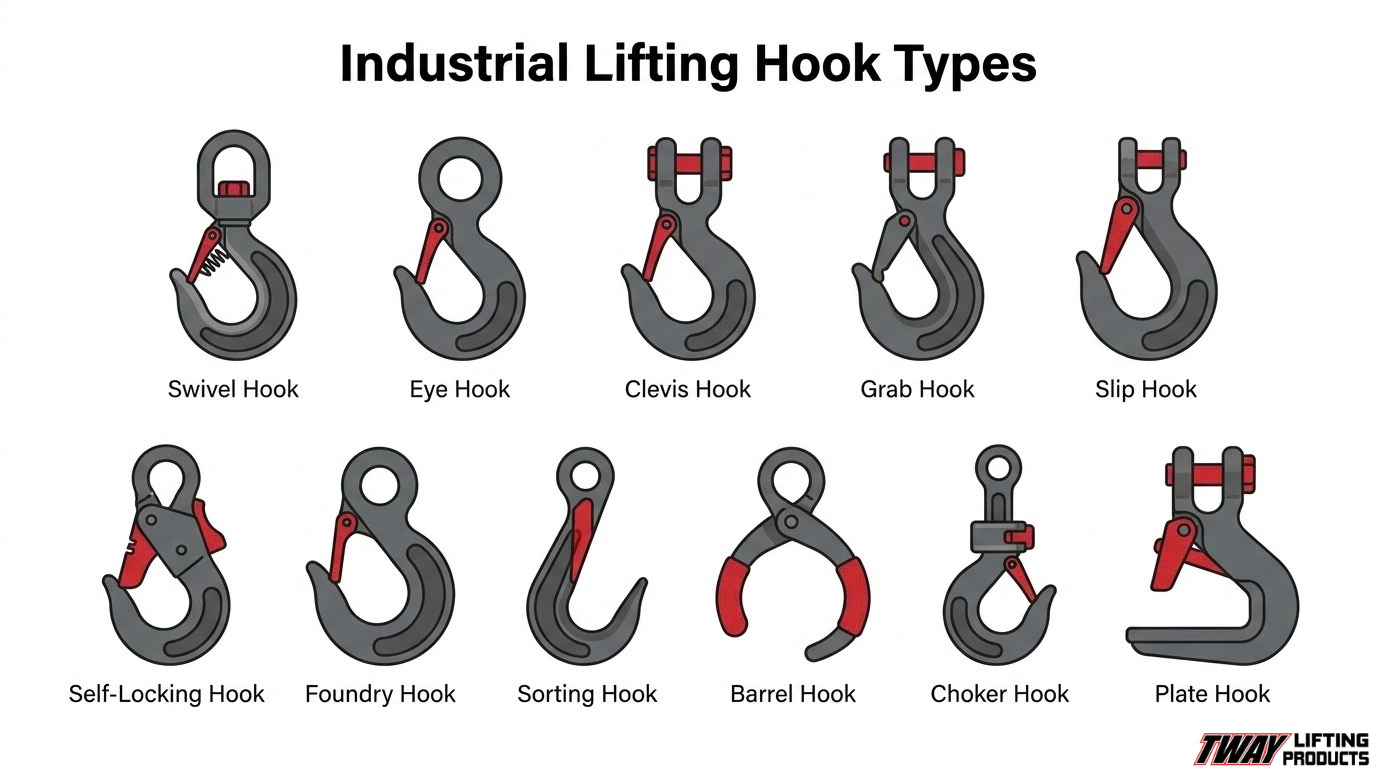
Industrial lifting hooks span eleven distinct types, including swivel hooks, grab hooks, slip hooks, clevis hooks, eye hooks, shank hooks, ramshorn hooks, foundry hooks, sorting hooks, pipe hooks, and self-locking hooks. Each serves a different connection method, load profile, or application environment, and using the wrong type introduces failure risk that cannot be corrected through inspection alone.
Safety latches range from basic spring-closing designs to positive lock mechanisms required for personnel lifts. Regulatory requirements under OSHA, ASME B30.10, and the American Bureau of Shipping specify which latch type applies to which operation.
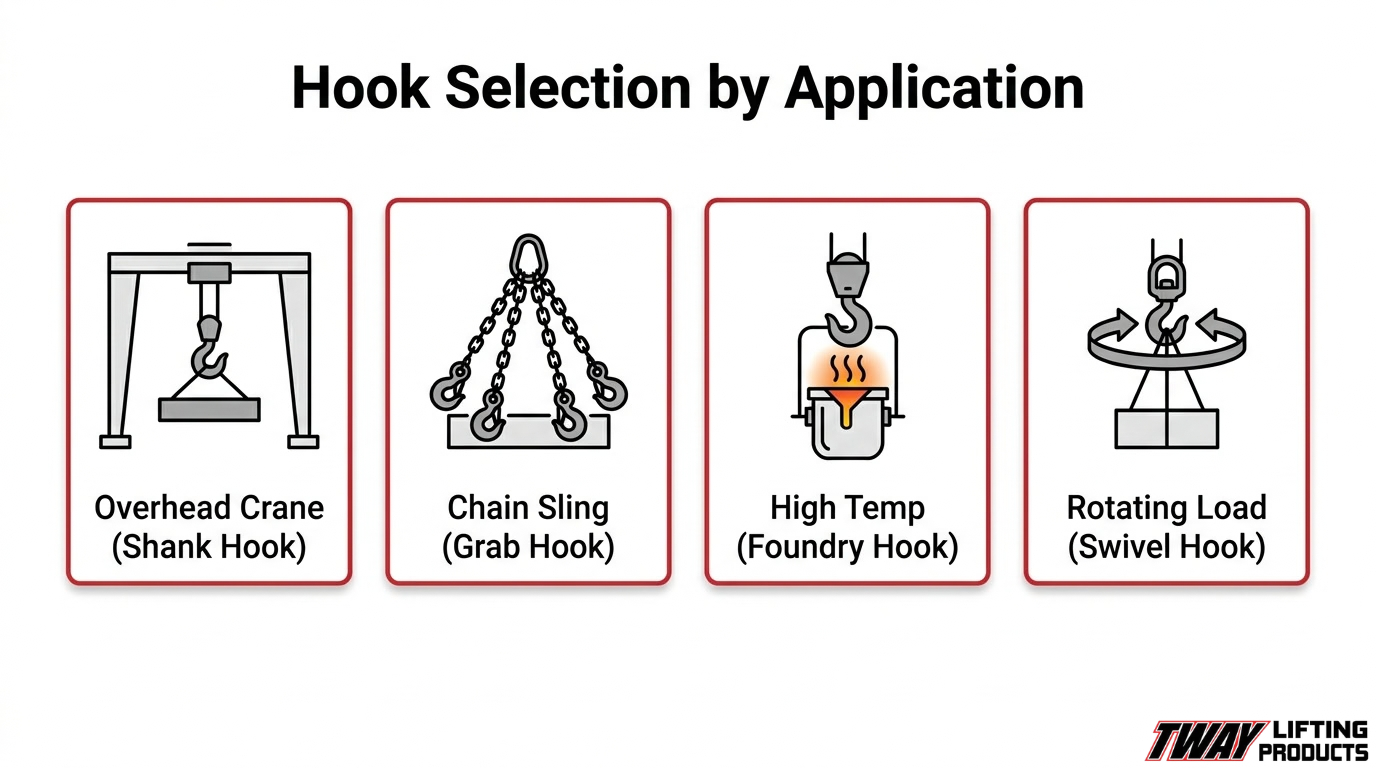
Hook selection depends on rigging method, load behavior, and working environment. Swivel hooks address rotating loads, grab hooks seat securely on chain sling links, and foundry hooks are built for high-temperature service where standard latches are physically impractical.
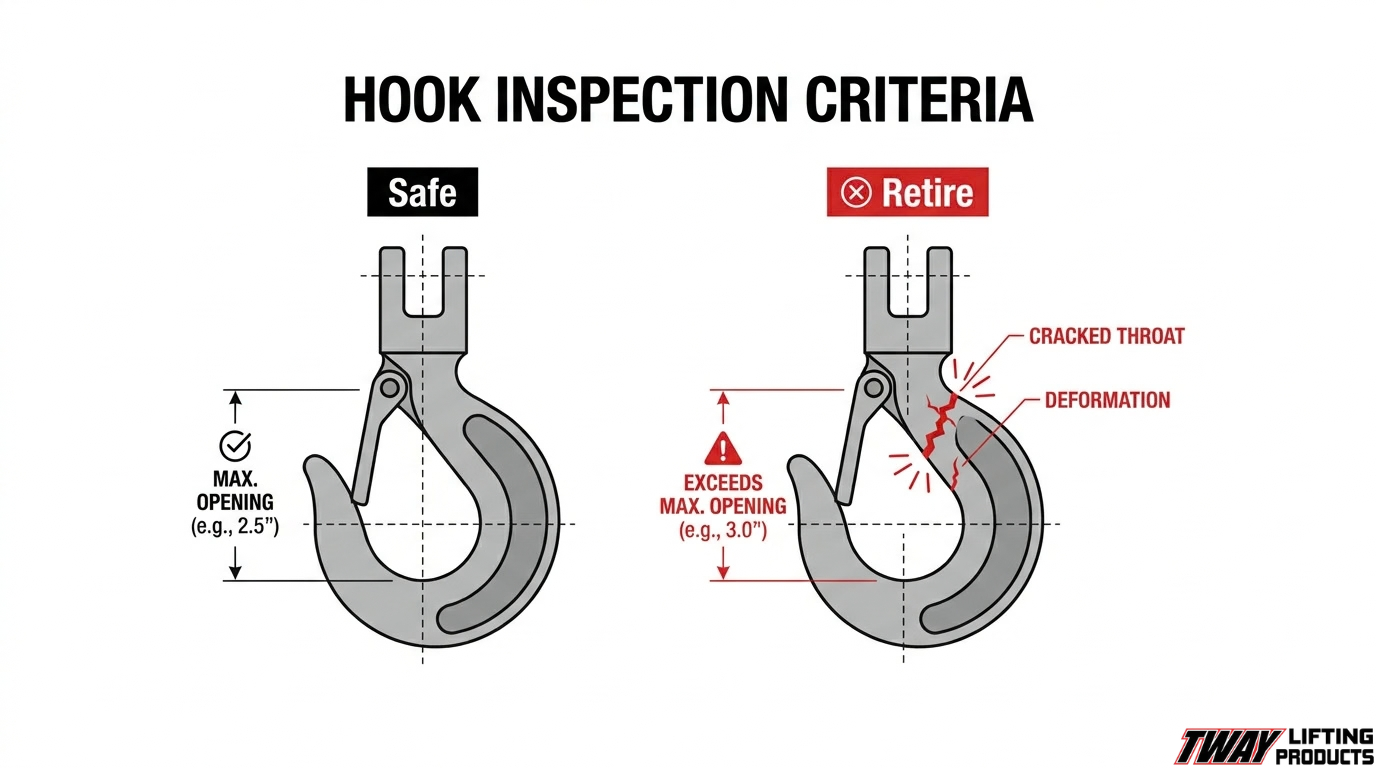
Inspection is governed by defined thresholds. Hooks must be removed from service at 5 percent throat opening, 10 degrees of twist, or any visible crack, with thorough examinations required at intervals no greater than every six months.
What Is an Industrial Lifting Hook?
An industrial lifting hook is a forged or fabricated metal device that connects a load to a crane, hoist, or rigging assembly for controlled vertical lifting. It serves as the critical load-transfer point between the lifting equipment and the object being moved. The sub-sections below cover how hooks are defined, what they do, and why hook selection directly affects safety.
How Is an Industrial Lifting Hook Defined?
An industrial lifting hook is defined as a mechanical connector, typically made from forged steel, designed to bear the full working load limit (WLL) of a rigging system. Hooks attach to cranes, chain slings, wire rope slings, and hoists to secure and transfer loads during lifting operations. ASME B30.10-2024 governs the specification, purchase, maintenance, and safe use of hooks across all B30 equipment categories, providing the authoritative standard manufacturers, employers, and users must follow.
What Does an Industrial Lifting Hook Do?
An industrial lifting hook transfers the suspended load from the rigging assembly to the crane or hoist above it. It maintains a secure connection under load, allows controlled attachment and detachment of rigging hardware such as slings and shackles, and retains that hardware under slack conditions through its latch or locking device. According to OSHA regulations under 29 CFR 1926.251, custom lifting accessories, including hooks, must be marked with their safe working loads and proof-tested to 125 percent of rated capacity before use, underscoring the hook’s role as a load-critical component.
Why Does Hook Selection Matter in Industrial Lifting?
Hook selection matters because the wrong hook type can fail under load, causing dropped loads, equipment damage, and fatal injuries. Different hook styles, such as grab hooks, slip hooks, eye hooks, clevis hooks, swivel hooks, shank hooks, ramshorn hooks, and foundry hooks, are each engineered for specific load types, rigging configurations, and environmental conditions. Matching hook design to application is not merely best practice; it is a direct determinant of whether a lift succeeds safely or results in catastrophic failure.
What Are the Types of Industrial Lifting Hooks?
The types of industrial lifting hooks include swivel hooks, eye hooks, clevis hooks, shank hooks, grab hooks, slip hooks, self-locking hooks, sorting hooks, foundry hooks, ramshorn hooks, and pipe hooks. Each type serves a distinct connection method, load profile, or application environment.
Swivel Hook
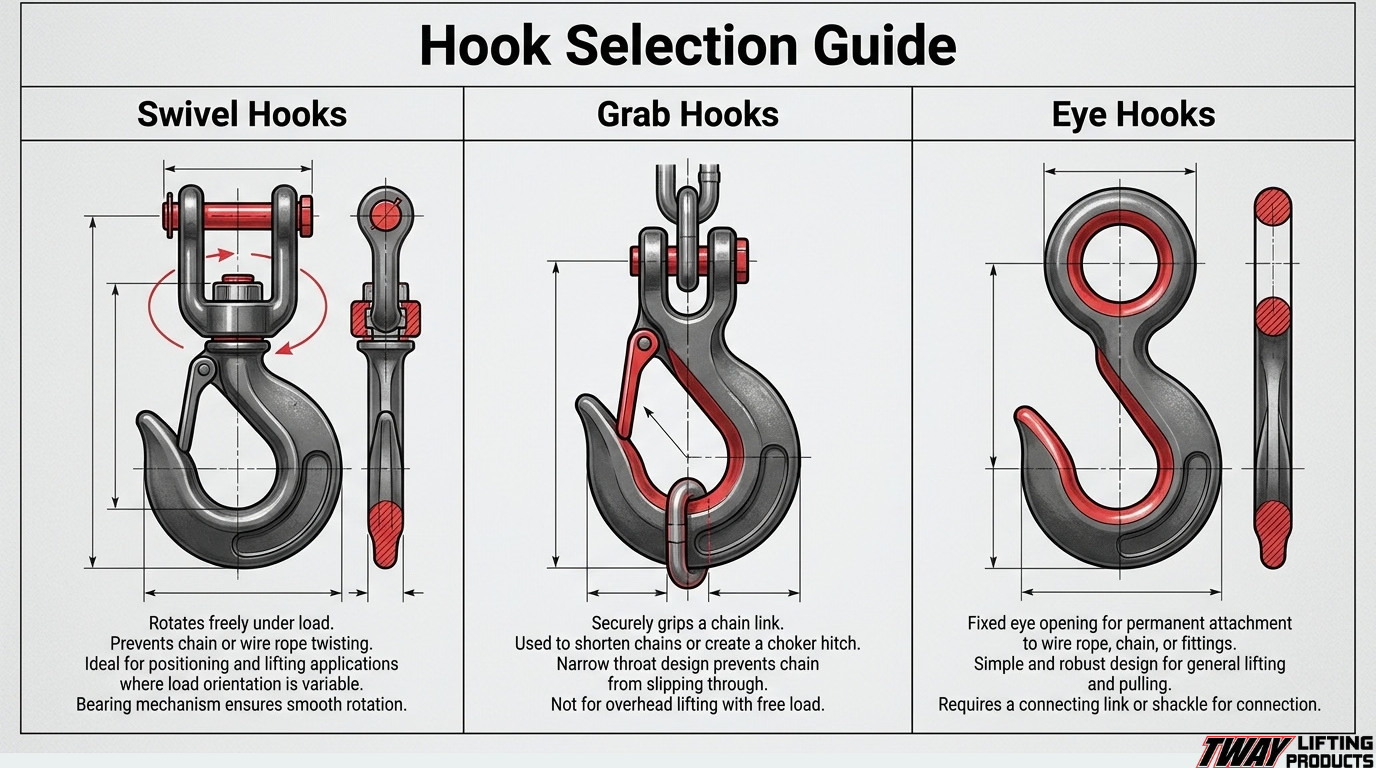
A swivel hook is a rotating lifting hook that prevents load-induced twist from transferring into the rigging above it. According to the National Wildfire Coordinating Group, a swivel must rotate freely by hand with no binding under no load; if it does not rotate freely, it must be removed from service immediately. Shank-style swivel hooks follow standardized dimensional limits: at 3,000 lb capacity, the shank measures 1.0 in. (A) and 1.33 in. (B) maximum; at 6,000 lb, those limits increase to 1.3 in. and 1.7 in. respectively.
Eye Hook
An eye hook is a lifting hook with a fixed circular eye at the top, designed to attach directly to a crane hook block, overhaul ball assembly, or shackle pin. The eye provides a permanent, non-rotating connection point suited for vertical lifts where load rotation is not a concern.
Clevis Hook
A clevis hook is a lifting hook that attaches via a U-shaped clevis body and pin, allowing quick connection to chain links, shackles, and rigging fittings. Per the National Association of Chain Manufacturers (NACM), clevis hooks are tested against Grade 30, Grade 43, and Grade 70 chain specifications in two configurations: Clevis Grab Hook and Clevis Slip Hook.
Shank Hook
A shank hook is a lifting hook with a threaded or plain shank that mounts directly into crane hook blocks, hoists, or load blocks. The rigid, non-rotating connection makes it standard on overhead cranes and hoists where the hook is a permanent, fixed component of the lifting machine.
Grab Hook
A grab hook is a narrow-throated hook designed to seat positively onto a specific chain link, preventing the chain from slipping through the throat. The reduced throat opening locks the hook at a chosen link, making it the correct choice for shortening chain sling legs or creating fixed attachment points.
Slip Hook
A slip hook is an open-throated hook that allows chain or sling material to pass freely through the hook body. It is used for choker hitches on chain slings and for load-end attachment where the chain must self-tighten around the load during the lift.
Self-Locking Hook
A self-locking hook is a hook fitted with a mechanically positive latch that requires deliberate two-action release before it can open. The Mine Safety and Health Administration requires hooks with self-closing latches or equivalent to be used in most overhead lifting applications, with J-hooks permitted only for setting wooden trusses as a named exception.
Sorting Hook
A sorting hook is a long-handled, open hook used to attach and release rigging from a safe distance without requiring the rigger to reach directly into the load zone. According to Oregon OSHA, using sorting hooks with tag lines reduces fall hazards during attachment and removal of rigging while increasing security and control of the load during handling.
Foundry Hook
A foundry hook is a heavy-duty lifting hook designed for high-temperature environments, specifically for handling molten metal ladles, castings, and furnace equipment. Its design omits safety latches where latch fitting is physically incompatible with hot-metal operations, an exemption recognized under several occupational safety standards.
Ramshorn Hook
A ramshorn hook is a double-saddle lifting hook with two curved bearing surfaces mounted on a single shank, distributing load across both saddles simultaneously. A study published in Materials Today: Proceedings identifies the forged trapezoidal ramshorn hook as widely used for grabbing and lifting heavy mechanical components, with the trapezoidal cross section providing structural load distribution advantages.
Pipe Hook
A pipe hook is a contour-shaped lifting hook engineered specifically for handling tubular goods and drill pipe. Per National Transportation Safety Board pipeline construction specifications, pipe hooks must contact one-third of the pipe circumference and extend one-fourth of the pipe diameter into the joint. Additionally, where pipe hooks are used above the derrick floor, each hook must be secured to the derrick to prevent it from falling, as required by Alaska Department of Labor regulations.
How Do Lifting Hook Safety Latches Differ by Type?
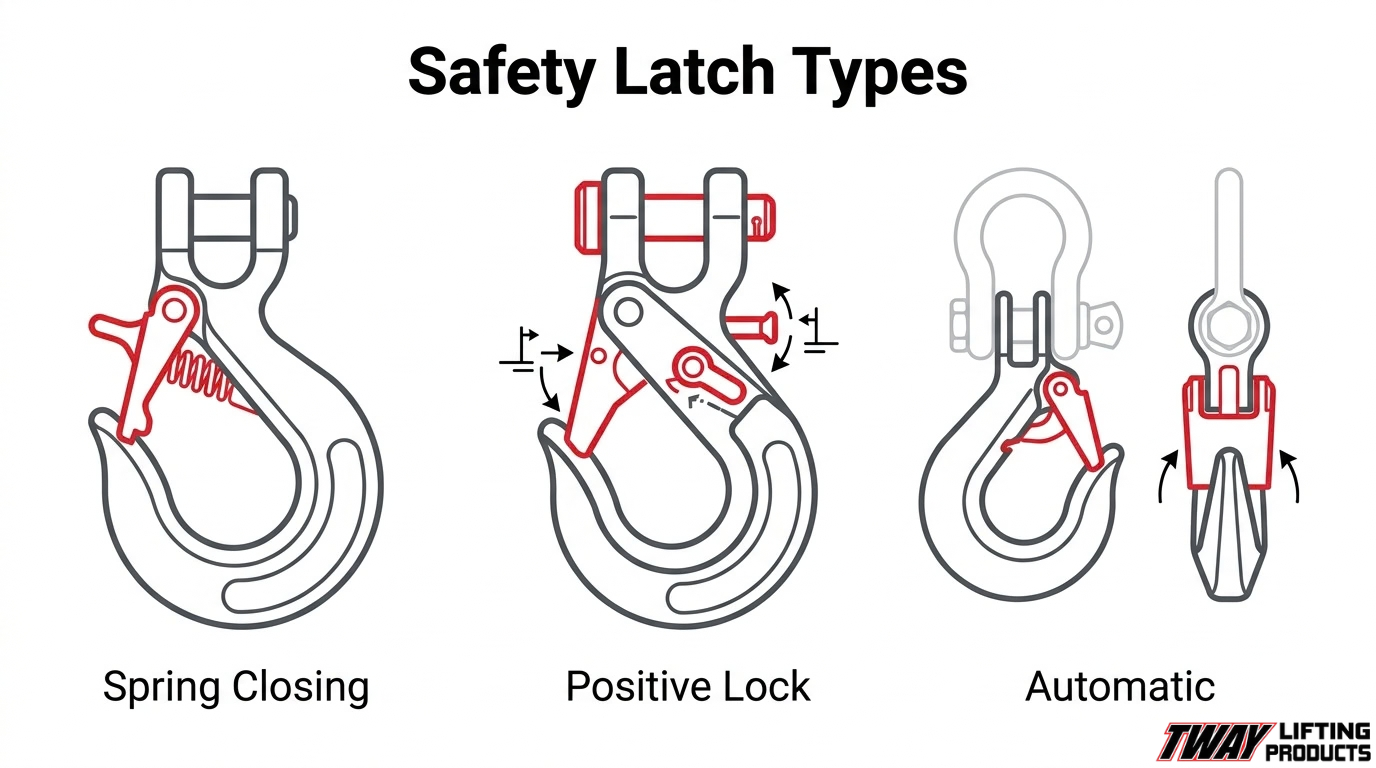
Lifting hook safety latches differ by type based on their locking mechanism: standard spring-closing, positive lock, and automatic self-closing designs. Each type addresses specific load control requirements, with more demanding applications, such as personnel lifting, requiring stronger locking means.
What Is a Standard Safety Latch on a Lifting Hook?
A standard safety latch on a lifting hook is a spring-loaded closure that automatically closes across the throat opening to retain slings or rigging under slack conditions. According to the Mine Safety and Health Administration (MSHA), hooks with self-closing latches or their equivalent must be used, with a narrow exception permitting “J” hooks only for setting wooden trusses.
Safety catches must be fitted to all hooks unless load geometry physically prevents attachment, such as a molten metal pouring ladle in a steelworks. Additionally, hook wear in the lifting area must not exceed 10% of the hook diameter at that position. Pre-use inspection protocols are also required: per Jefferson Lab’s hoisting and rigging standard, load hooks are inspected for acceptable condition prior to each use and at specific intervals in accordance with DOE Standard 1090-2007.
What Is a Positive Lock Latch on a Lifting Hook?
A positive lock latch on a lifting hook is a mechanism that requires a deliberate manual action to open, preventing inadvertent disengagement caused by vibration or spring failure. According to the American Bureau of Shipping (ABS) Guide for Certification of Lifting Appliances, hooks used for personnel lifting must be provided with latches fitted with positive locking means; a spring-retaining arrangement alone does not qualify, because vibration or spring failure can cause the latch to open unexpectedly.
This distinction matters most in overhead and marine lifting operations, where load movement and equipment dynamics create exactly the conditions that defeat spring-only latches. Washington Administrative Code further requires that crane hooks be equipped with latches or self-locking devices that bridge the throat opening, retaining slings even under slack conditions.
What Is an Automatic Safety Latch on a Lifting Hook?
An automatic safety latch on a lifting hook is a self-closing device that engages without manual input each time a load is attached, relying on the load’s own weight or a mechanical cam to keep the throat sealed during the lift. This design reduces the risk of operator error during repeated hook-and-release cycles common in high-volume rigging operations.
Where loads must pass directly over workers, occupied workspaces, or passageways, California’s Division of Industrial Relations requires safety-type hooks or equivalent load-retention means, with self-closing latches explicitly specified. Automatic latches satisfy this requirement by closing consistently regardless of whether the operator manually resets them between lifts, making them well-suited to crane work in congested industrial environments.
What Materials Are Industrial Lifting Hooks Made From?
Industrial lifting hooks are made from materials that meet strict requirements for construction quality, structural integrity, and load-bearing strength. Regulatory guidance establishes that lifting gear shall be of good construction, sound material, adequate strength, and free from patent defect.
The most common materials used in industrial lifting hooks include:
- Alloy steel: The dominant material for high-strength forged hooks, offering superior toughness and resistance to deformation under heavy loads.
- Carbon steel: Used in lower-grade hooks for lighter-duty applications where maximum strength is not required.
- Stainless steel: Selected for corrosive or washdown environments where standard steel would degrade.
- Heat-treated steel: Applied in foundry and high-temperature hooks where thermal resistance is essential.
Forged construction is the preferred manufacturing method across all material grades, as the forging process aligns the grain structure of the metal and significantly increases resistance to cracking and fatigue failure. Cast hooks, by contrast, are more brittle and far less reliable under dynamic or shock loads. For demanding industrial applications, forged alloy steel remains the safest and most performance-consistent material choice available. Tway Lifting, a manufacturer and distributor of lifting equipment since 1945, supplies forged steel hooks and associated rigging hardware that meet ASME B30.10 and OSHA standards for industrial use.
What Standards and Ratings Apply to Industrial Lifting Hooks?
Standards and ratings for industrial lifting hooks establish the safety baseline every operation must meet. The subsections below cover WLL definitions, ASME B30.10 requirements, and OSHA regulations.
What Does WLL Mean on an Industrial Lifting Hook?
WLL on an industrial lifting hook means Working Load Limit, the maximum load a hook is rated to carry under normal, straight-line conditions. Manufacturers stamp or engrave WLL directly onto the hook body, making it the primary field reference for riggers selecting hardware. Exceeding WLL does not provide an automatic safety margin; that margin is built into the design factor and should never be treated as usable capacity. Matching the hook’s WLL to the calculated load weight, sling angle, and rigging configuration is the most critical step in hook selection.
What ASME Standards Apply to Industrial Lifting Hooks?
ASME B30.10 is the primary standard that applies to industrial lifting hooks. Published by the American Society of Mechanical Engineers, ASME B30.10 covers the design, construction, installation, inspection, testing, maintenance, and operation of hooks used with cranes, hoists, and rigging equipment. Compliance with B30.10 is recognized by OSHA and the U.S. Department of Energy as the governing technical benchmark for hook safety programs.
What OSHA Regulations Govern Industrial Lifting Hook Use?
OSHA regulations governing industrial lifting hook use are found primarily in 29 CFR 1926.502 for construction and 29 CFR 1910.184 for general industry. According to ASME’s 2024 update, ASME B30.10-2024 is intended for manufacturers, owners, employers, users, and governing entities concerned with the specification, buying, maintenance, training, and safe use of hooks with B30 equipment. OSHA adopts B30.10 as the technical reference, meaning B30.10 compliance directly supports OSHA compliance. Custom lifting accessories must also be proof-tested to 125 percent of rated load before use under 29 CFR 1926.251.
How Do You Select the Right Hook for Your Lifting Application?
Selecting the right hook depends on your rigging method, load type, environment, and whether the load rotates. The sections below cover overhead crane lifting, chain sling rigging, wire rope sling rigging, high-temperature environments, and rotating or spinning loads.
Which Hook Type Is Best for Overhead Crane Lifting?
The best hook type for overhead crane lifting is a shank hook or ramshorn hook, chosen based on load weight and geometry. According to a study published in Materials Today: Proceedings, forged trapezoidal ramshorn hooks feature two curved saddles mounted on a single shank and are widely used for grabbing and lifting heavy mechanical components. For general overhead crane service, shank hooks provide a rigid, high-capacity connection to the hook block. Locking-type snaphooks are mandatory for overhead connections where contact with the keeper could cause disengagement. The U.S. Nuclear Regulatory Commission requires annual magnetic particle or liquid penetrant examination on all hooks associated with permanent fixed cranes, chain falls, and come-alongs.
Which Hook Type Is Best for Chain Sling Rigging?
The best hook type for chain sling rigging is a clevis grab hook or eye grab hook rated for alloy steel chain. Per the Code of Federal Regulations (29 CFR 1910.184), every new, repaired, or reconditioned alloy steel chain sling must be proof tested by the manufacturer before use, in accordance with ASTM Specification A391-65. Grab hooks seat securely in chain links and resist disengagement under load, making them the industry standard for chain sling assemblies. One important nuance: OSHA recognizes exemptions for hooks used to wrap around objects such as molds, and hooks used to lift hot metals — these exemptions do not apply universally across all industries, so verify applicability before specifying a hook type.
Which Hook Type Is Best for Wire Rope Sling Rigging?
The best hook type for wire rope sling rigging is a forged steel lifting hook with latch, rated to the sling’s working load limit. ISO 7597:2013 specifies requirements for grade 8 forged steel lifting hooks with eye or clevis and pin configurations up to 63 t WLL, explicitly covering use with steel wire rope slings per ISO 7531. All wire rope rigging hardware, including rigging hooks, must comply with OSHA standards, ASME B30.26, or ASME B30.10, whichever is most stringent, per DOE-STD-1090-2020. A NIOSH incident report documents an 880 lb load falling 30 feet after a nylon sling end slipped out of a hook, underscoring why properly rated, latched hooks are non-negotiable for wire rope sling connections.
Which Hook Type Is Best for High-Temperature Environments?
The best hook type for high-temperature environments is a foundry hook or a hook specifically manufactured from heat-resistant alloy steel, without a standard safety latch. Standard spring-loaded latches can fail, deform, or bind at elevated temperatures, making them unsuitable for molten metal or furnace applications. OSHA recognizes this limitation: exemptions exist for hooks used to lift hot metals, acknowledging that conventional latch designs are physically impractical in those conditions. For foundry and steel mill applications, hook geometry should provide full load retention through saddle contact rather than relying on a latch mechanism. Selecting a hook rated for the specific temperature range and verified by the manufacturer is the safest approach for sustained high-heat service.
Which Hook Type Is Best for Rotating or Spinning Loads?
The best hook type for rotating or spinning loads is a swivel hook, which allows the load to rotate freely without transmitting torsional stress to the rigging or hoist. A swivel hook must rotate freely by hand under no load; if binding is present, it must be removed from service immediately. Swivel hooks prevent rope twist buildup in wire rope slings and reduce shock loading caused by sudden load spin. For applications where uncontrolled rotation poses a hazard, a swivel hook paired with a tag line provides both freedom of movement and operator control. Choosing a swivel hook with a locking latch adds an additional layer of security when loads pass over personnel or occupied work areas.
How Do You Inspect an Industrial Lifting Hook for Safety?
Inspecting an industrial lifting hook for safety involves checking for physical deformation, measuring throat opening against baseline dimensions, and following a scheduled examination program. The headings below cover retirement criteria, measurement procedures, and required inspection intervals.
What Visual Signs Indicate a Lifting Hook Should Be Retired?
Visual signs that indicate a lifting hook should be retired include cracks, twisting, straightening, excessive throat opening, a bent safety latch, and a broken spring. Any hook showing these conditions must be removed from service immediately, regardless of when it was last inspected.
Custom-designed hooks, grabs, and clamps must also be marked with their safe working loads and proof-tested to 125 percent of rated load before use, per 29 CFR 1926.251 (Legal Information Institute, Cornell Law School). A hook missing this marking should be treated as unfit for service until verified.
From a practical standpoint, visual inspections are most effective when riggers know exactly what a healthy hook looks like. Maintaining a reference photo or dimensional record of a new hook at each site makes retirement decisions faster and more defensible.
How Do You Measure Throat Opening to Check Hook Wear?
Throat opening measurement works by establishing three reference points (A, B, and C) using a center punch, then measuring the distance at the narrowest point of the throat against the hook’s original baseline dimension.
The Electronic Code of Federal Regulations (29 CFR 1910.184) requires hooks to be removed from service if the throat has opened more than 15 percent of normal measurement at the narrowest point, or if the hook is twisted more than 10 degrees from the plane of the unbent hook.
University of Virginia Facilities Planning and Construction rigging guidance sets a stricter standard: hooks with more than 5 percent throat opening, not to exceed 1/4 inch, shall be replaced, with no cracks, linear indications, laps, or seams accepted. Setting measurement distances at even-inch intervals simplifies the process during field inspections.
The 5 percent threshold is the more conservative benchmark and should be applied wherever the manufacturer does not specify otherwise.
How Often Should Industrial Lifting Hooks Be Inspected?
Industrial lifting hooks should be inspected before each use at the operational level, with thorough periodic examinations conducted at defined intervals based on service frequency and conditions. Tway Lifting’s certified, factory-trained inspection specialists perform OSHA-required periodic inspections and provide detailed reporting, helping operations maintain documented compliance with B30.10 and applicable CFR requirements.
The key regulatory benchmarks are:
- Every 6 months: The Health and Safety Executive (HSE) requires thorough examinations for all lifting accessories unless a formal examination scheme specifies different intervals.
- Every 12 months (maximum): Per 29 CFR 1910.184, thorough periodic inspections of alloy steel chain slings and associated hooks must occur at least annually, factoring in use frequency, service severity, and lift nature.
- Annually (documented): The U.S. Nuclear Regulatory Commission mandates annual magnetic particle or liquid penetrant examination, documented, for all hooks on permanent fixed cranes, chain falls, and come-alongs.
High-frequency or severe-duty applications should push inspection intervals closer to the 6-month threshold rather than defaulting to the annual maximum. Waiting the full 12 months on hooks in demanding service environments is one of the most common and preventable compliance gaps in rigging programs.
How Do Lifting Hooks Connect to Rigging Hardware?
Lifting hooks connect to rigging hardware through standardized mechanical interfaces, including shackles, eyebolts, links, rings, swivels, and wire rope or chain sling terminations. The sub-sections below cover the specific hardware components in a rigging assembly and how load slip incidents demonstrate what happens when those connections fail.
What Rigging Hardware Components Attach to a Lifting Hook?
The rigging hardware components that attach to a lifting hook include shackles, eyebolts, eye nuts, links, rings, swivel hoist rings, swivels, turnbuckles, rigging hooks, compression hardware such as wire rope clips and wedge sockets, rigging blocks, load-indicating devices, and precision load positioners. According to the U.S. Department of Energy DOE-STD-1090-2020, the use, inspection, maintenance, and repair of all such hardware must comply with applicable OSHA standards, ASME B30.26 “Rigging Hardware,” or ASME B30.10 “Hooks,” whichever standard is more stringent. Each connection point in the assembly carries the full suspended load, so selecting hardware rated to match the hook’s working load limit is essential.
How Can an Improper Hook Connection Cause Load Failure?
An improper hook connection causes load failure when a sling end slips, twists, or disengages from the throat of the hook under tension. A NIOSH incident report documented a case where a two-leg wire rope bridle attached to two nylon slings choked around an 880 lb (400 kg) stack of forms allowed one sling end to slip or twist out of the hook, dropping the entire load approximately 30 feet to a work area below. This type of failure is preventable. Using a hook with a properly functioning safety latch, correctly sizing the hardware interface, and confirming the sling seat is fully engaged in the bowl of the hook before lifting are the most effective controls against connection-related drops. For operations that need rigging hardware and sling assemblies matched to verified hook specifications, Tway Lifting offers same-day wire rope sling fabrication and a full range of compatible rigging fittings from its Indianapolis and Fort Wayne locations.
What Are Common Causes of Industrial Lifting Hook Failure?
- Instructions: Cover the primary causes of hook failure in industrial lifting. Address overloading, side loading, worn throat openings, latch failure, improper rigging, material defects, and corrosion. Use data from the research on crack formation, throat opening limits, and fatigue. Tie back to why proper hook selection and inspection prevent these failures.
- Entities: industrial lifting hook failure, overloading, side loading, throat opening, latch failure, corrosion, brittle fracture, heat-affected zone
- Triples: overloading → causes → permanent deformation and crack initiation; side loading → distorts → hook geometry; worn throat opening → triggers → retirement criteria; latch failure → results in → load disengagement; brittle fracture → develops from → cracks in heat-affected zone
- Priority: depth
- Competitor Coverage: moderate
- Discourse: causal explanation — identify mechanisms of failure and connect each to inspection and selection decisions
- Research: Stat: Slings shall be removed from service if hooks are cracked, have been opened more than 15 percent of the normal throat opening measured at the narrowest point or twisted more than 10 degrees from the plane of the unbent hook.
- Research: Stat: The failure could be attributed to the development of cracks within the heat-affected zone due to liquification, leading to a brittle fracture.
- Research: Stat: The load was secured in a conventional fashion, with a two-leg wire rope bridle attached to two nylon slings, which were choked around the load. The stack of forms weighed about 880 lbs (400 kg); one sling end slipped or twisted out of the hook, and the entire load of forms fell about 30 feet (10 m) to a work area underneath.
- Research: Stat: From 2011 to 2017, the Census of Fatal Occupational Injuries (CFOI) reported 297 total crane-related deaths, an average of 42 per year over this 7-year period.
The common causes of industrial lifting hook failure include overloading, side loading, throat opening distortion, latch failure, improper rigging, and material defects such as brittle fracture. The following sub-sections examine each cause and its measurable threshold.
How Does Overloading Cause Hook Failure?
Overloading causes permanent deformation and crack initiation in a lifting hook by exceeding its rated working load limit. Forces beyond the WLL stretch the hook’s throat, permanently widening the opening and reducing the load-bearing cross-section. Per the Electronic Code of Federal Regulations (29 CFR 1910.184), hooks opened more than 15 percent of the normal throat opening measured at the narrowest point must be removed from service immediately. Overloading is often a silent failure mode: the hook may appear intact after one overload event, yet internal stress concentrations set the stage for sudden fracture under a subsequent routine lift. Treating WLL as a firm ceiling, not an approximation, is the single most effective way to prevent this failure path.
How Does Side Loading Distort Hook Geometry?
Side loading distorts hook geometry by applying force at an angle to the hook’s designed load plane, concentrating stress on one side of the shank or bowl rather than distributing it through the throat. Hooks are engineered for in-line, vertical loading; lateral or angular forces bend the shank, twist the hook body, or open the throat asymmetrically. Federal standards specify retirement when a hook is twisted more than 10 degrees from the plane of the unbent hook (29 CFR 1910.184). Side loading most commonly occurs when sling legs are positioned outside the saddle or when load shift during a pick creates an unplanned angle. Using swivel hooks and maintaining proper sling geometry largely eliminates this failure mode.
How Does a Worn Throat Opening Compromise Hook Safety?
A worn throat opening compromises hook safety by reducing the effective bearing area that supports the sling or rigging component. Abrasion from repeated sling contact gradually enlarges the throat, lowering the hook’s actual load capacity below its rated WLL. University of Virginia rigging guidance specifies that hooks with more than 5 percent of the normal throat opening, not to exceed 1/4 inch, shall be replaced. Because throat wear is gradual, it is frequently missed without dedicated measurement using center-punch reference marks. Regular dimensional checks are the only reliable method for catching this failure cause before it leads to load drop.
How Does Latch Failure Lead to Load Disengagement?
Latch failure leads to load disengagement by allowing the sling or rigging hardware to exit the hook throat under slack or dynamic conditions. A NIOSH accident investigation documented a case where one sling end slipped or twisted out of a hook, dropping an 880 lb (400 kg) stack of forms approximately 30 feet onto a work area below. Latches fail due to bent components, broken springs, or corrosion that prevents full closure. The latch must bridge the full throat opening to retain rigging under slack; any gap creates an ejection path. Inspecting latch spring tension and closure completeness before every lift prevents this category of failure.
How Do Material Defects and Corrosion Cause Hook Fracture?
Material defects and corrosion cause hook fracture by introducing stress concentrations that propagate under cyclic loading. Research published in PubMed Central identified brittle fracture in lifting hooks attributed to crack development within the heat-affected zone caused by liquification during welding or thermal processing. Corrosion compounds this risk by pitting the hook surface, creating additional initiation sites for fatigue cracks. Hooks manufactured outside recognized standards, without proof testing or proper metallurgical controls, carry elevated defect risk. Selecting hooks that comply with ASME B30.10 and conducting annual magnetic particle or liquid penetrant examinations on critical crane hooks are the most effective countermeasures against material-driven failure.
How Can Tway Lifting Help You Choose and Inspect Lifting Hooks?
Tway Lifting helps you choose and inspect lifting hooks through decades of certified expertise, OSHA-aligned inspection services, and access to quality American rigging equipment. The sections below cover Tway’s inspection capabilities and the key takeaways from this guide.
Does Tway Lifting Offer OSHA-Compliant Hook Inspection Services?
Yes, Tway Lifting offers OSHA-compliant hook inspection services performed by certified, factory-trained inspection specialists. Founded in 1945 and ISO9001-certified, Tway Lifting provides professional rigging inspections, detailed reporting, and job site safety evaluations for lifting equipment across construction, mining, automotive, steel production, utility, and entertainment rigging sectors. The Health and Safety Executive recommends thorough examinations of all lifting accessories at intervals no greater than every six months, and Tway Lifting’s inspection program aligns with this standard. Beyond inspections, Tway Lifting also offers repair and reconditioning services, custom fabrication, same-day wire rope sling fabrication, and rigging equipment rental, making it a single-source solution for compliance and operational readiness.
What Are the Key Takeaways About Types of Industrial Lifting Hooks?
The key takeaways about types of industrial lifting hooks are that hook selection, safety latch requirements, and inspection frequency are all interdependent decisions that directly affect worker safety and regulatory compliance. Choosing the wrong hook type for a load, connection, or environment introduces failure risk that inspections alone cannot correct.
The most actionable conclusions from this guide are:
- Match hook type to application: Swivel hooks suit rotating loads, grab hooks secure chain slings, and ramshorn hooks handle heavy overhead crane lifts.
- Latch requirements are non-negotiable: Personnel lifts require positive lock latches; standard operations require at minimum self-closing latches.
- Inspect on a defined schedule: Thorough examinations must occur at least every six months per HSE guidance, with throat opening checks conducted before each use.
- Retire hooks at defined thresholds: Remove any hook from service showing cracks, throat opening beyond 5% of nominal, or twisting beyond 10 degrees.
- Compliance spans multiple standards: ASME B30.10, OSHA regulations, and ABS certification requirements may all apply depending on your industry and application.
Tway Lifting’s combination of manufacturing, distribution, rental, and certified inspection expertise makes it a practical resource for teams that need compliant equipment and professional guidance in one place.