







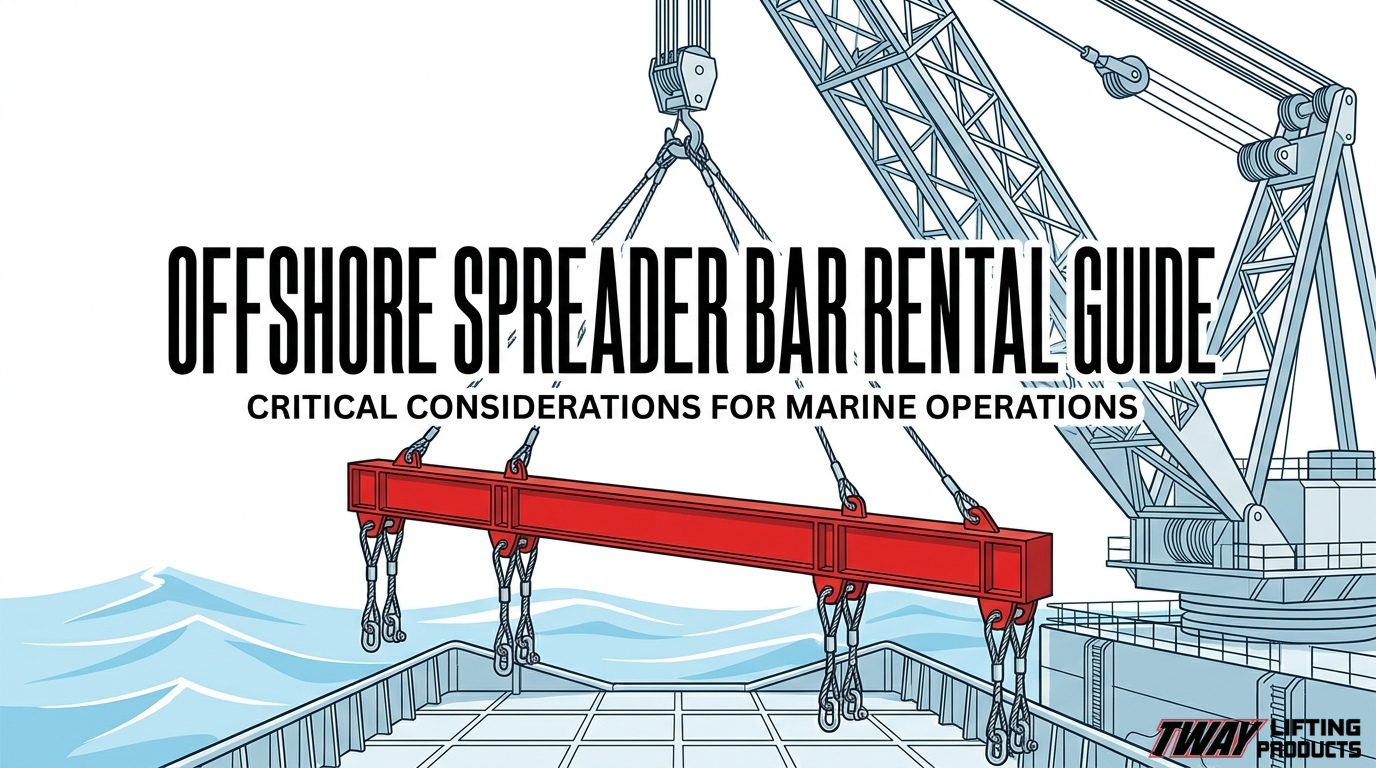

A spreader bar is a compressive rigging element that controls load attachment points and stabilizes loads during overhead lifts by holding sling legs apart at a fixed span. In offshore and marine environments, salt exposure, vessel motion across six degrees of movement, and dynamic wave loading make equipment selection, certification, and inspection far more consequential than in standard onshore work.
This guide covers spreader bar fundamentals, equipment types, load capacity factors, material and corrosion requirements, certification and compliance standards, inspection obligations, rental duration decisions, hardware compatibility, environmental conditions, and the rent-versus-buy comparison.
Spreader bars function as the geometric anchor of a rigging system, and understanding how fixed, adjustable, modular, pipe, and lifting frame designs differ prepares you to match the right unit to your offshore lift profile.
Load capacity evaluation goes beyond a nameplate working load limit. Sling angles, dynamic load factors from vessel motion, and multi-point load distribution each shift the true capacity requirement upward from the static baseline.
Saltwater and splash-zone exposure introduce corrosion rates that directly reduce structural cross-section over time, making material grade, galvanizing condition, and surface coating selection structural safety decisions rather than maintenance preferences.
Certification under DNV-ST-0378, ASME B30.20, and OSHA 1926.251 governs what documentation a rental spreader bar must carry before any offshore lift begins. Pre-lift inspection checklists, periodic examination intervals, and clear disqualification criteria keep rented equipment within safe service limits throughout a marine campaign.
Rental duration, hardware compatibility, environmental loading, and provider qualifications each shape the final equipment and agreement decisions that determine whether an offshore lift program stays on schedule and within budget.
What Is a Spreader Bar and How Does It Work in Offshore Lifting?
A spreader bar is a compressive rigging element that controls load attachment points and stabilizes loads during overhead lifts. The following sections explain its primary function, how it differs from a lifting beam, and why offshore environments demand specialized equipment.
What Is the Primary Function of a Spreader Bar in a Rigging System?
The primary function of a spreader bar in a rigging system is to manage lift geometry by collecting multiple lift points beneath a single hook. According to Corbin Collier, PE, spreader bars function as compressive elements that control load attachment points and stabilize the load during overhead lifts. By holding sling legs apart at a fixed span, the bar prevents inward sling forces from crushing or damaging the load. This geometry control is especially valuable when lifting large, fragile, or irregularly shaped loads where sling angle and attachment spacing are critical to safe, balanced lifts.
How Does a Spreader Bar Differ From a Lifting Beam?
A spreader bar differs from a lifting beam in how each handles stress within the rigging system. Spreader bars handle compressive stress through tension rigging, while lifting beams manage bending stress through their rigid structure. In practical terms, a spreader bar is suspended from its ends by slings connected to the crane hook above, placing the bar in compression. A lifting beam, by contrast, attaches to the hook at its midpoint and carries the load in bending. Selecting the wrong type for a given application directly affects structural performance and load safety.
Why Are Spreader Bars Especially Critical in Offshore and Marine Environments?
Spreader bars are especially critical in offshore and marine environments because these settings introduce severe weather, salt-laden air, and dynamic loads from waves and vessel movement that exceed the demands of standard onshore lifts. Marine and offshore environments require robust, modular equipment compliant with standards such as DNV-ST-N001. Vessel motion in six degrees, including heave, sway, surge, roll, pitch, and yaw, continuously shifts load forces during a lift, making precise geometry control non-negotiable. The combination of corrosive exposure and unpredictable dynamic loading means that only purpose-rated, properly certified spreader bars should be used offshore.
What Types of Spreader Bars Are Available for Offshore and Marine Rental?
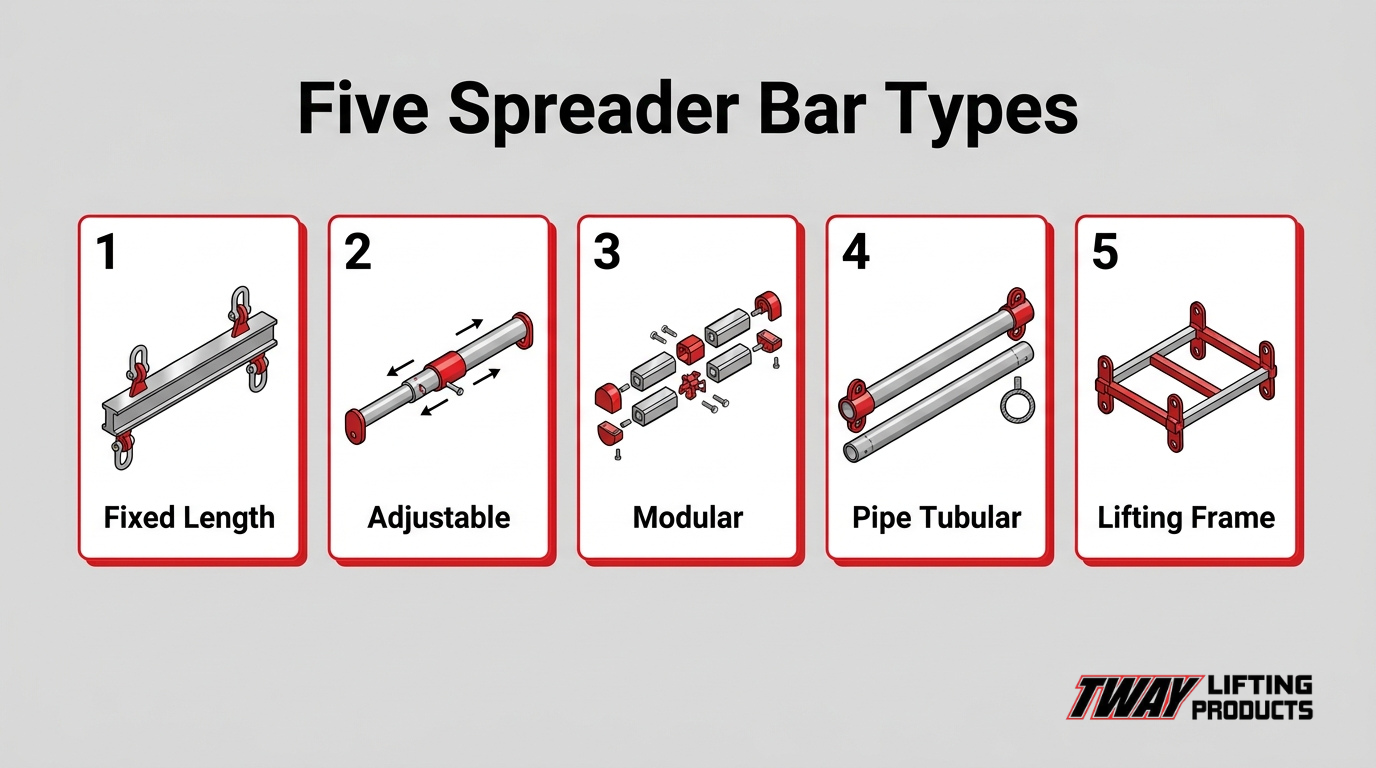
The types of spreader bars available for offshore and marine rental include fixed-length, adjustable, modular, pipe and tubular, and lifting frame designs. Each type suits different load profiles, span requirements, and marine operating conditions.
Fixed-Length Spreader Bars
Fixed-length spreader bars are designed for repetitive lifting tasks where load dimensions remain consistent across operations. Because the span does not change, these bars offer a straightforward, rigid solution with no moving parts to inspect or maintain between lifts. They work best on platforms or vessels where the same module or piece of equipment is lifted repeatedly with a known, stable geometry. According to Proline Global, fixed spreader bars are purpose-built for consistent load sizes, making them most efficient when span variability is not a project requirement.
Adjustable Spreader Bars
Adjustable spreader bars allow users to vary the span to accommodate different load sizes within a single rental unit. Telescopic or pin-adjusted designs cover multiple lift configurations without requiring separate equipment for each load width. This flexibility makes them practical for marine projects involving varied cargo, deck equipment, or structural components where dimensions change between lifts. For rental purposes, adjustable bars reduce the number of units needed on a vessel, which directly lowers mobilization complexity.
Modular Spreader Bars
Modular spreader bars are particularly well-suited to offshore heavy lift operations because of their configurable span and high capacity ratings. They can be delivered in sections and bolted together on-site, enabling efficient transport and flexible configuration for varying project scopes. According to Multisec, some DNV-ST-0378-compliant modular spreader beam models carry capacities up to 2,000 tons, meeting the demands of the most intensive marine lift programs. This sectionalized design also simplifies logistics when working on vessels or remote offshore platforms with limited deck space.
Pipe and Tubular Spreader Bars
Pipe and tubular spreader bars are widely used in heavy lifting for marine installations to avoid point loads on modules. Rather than concentrating force at a single contact, the tubular form distributes compressive loads evenly along its length. According to the Journal of Mechanical Engineering and Technology, these bars frequently use padeyes installed directly above a module’s lifting points, which aligns the load path cleanly and minimizes eccentric loading during the lift. Their cylindrical cross-section also resists torsional stress, which is a meaningful advantage in dynamic offshore environments.
Lifting Frame Spreader Bars
Lifting frames extend the spreader bar concept into a two-dimensional structure, providing attachment points in multiple directions rather than along a single axis. They are suited for unusually shaped, asymmetric, or structurally sensitive loads that require precise control of lift point geometry. In marine and offshore rental scenarios, lifting frames are selected when a single-bar configuration cannot safely balance the load or when the load requires protection from inward sling forces. Matching the right frame geometry to the load’s center of gravity is critical before any offshore deployment.
What Load Capacity Factors Must You Evaluate Before Renting a Spreader Bar Offshore?
The load capacity factors to evaluate before renting a spreader bar offshore include working load limit, rigging angle, dynamic load factor, and multi-point load distribution. Each variable directly affects which rental unit is safe for your specific lift.
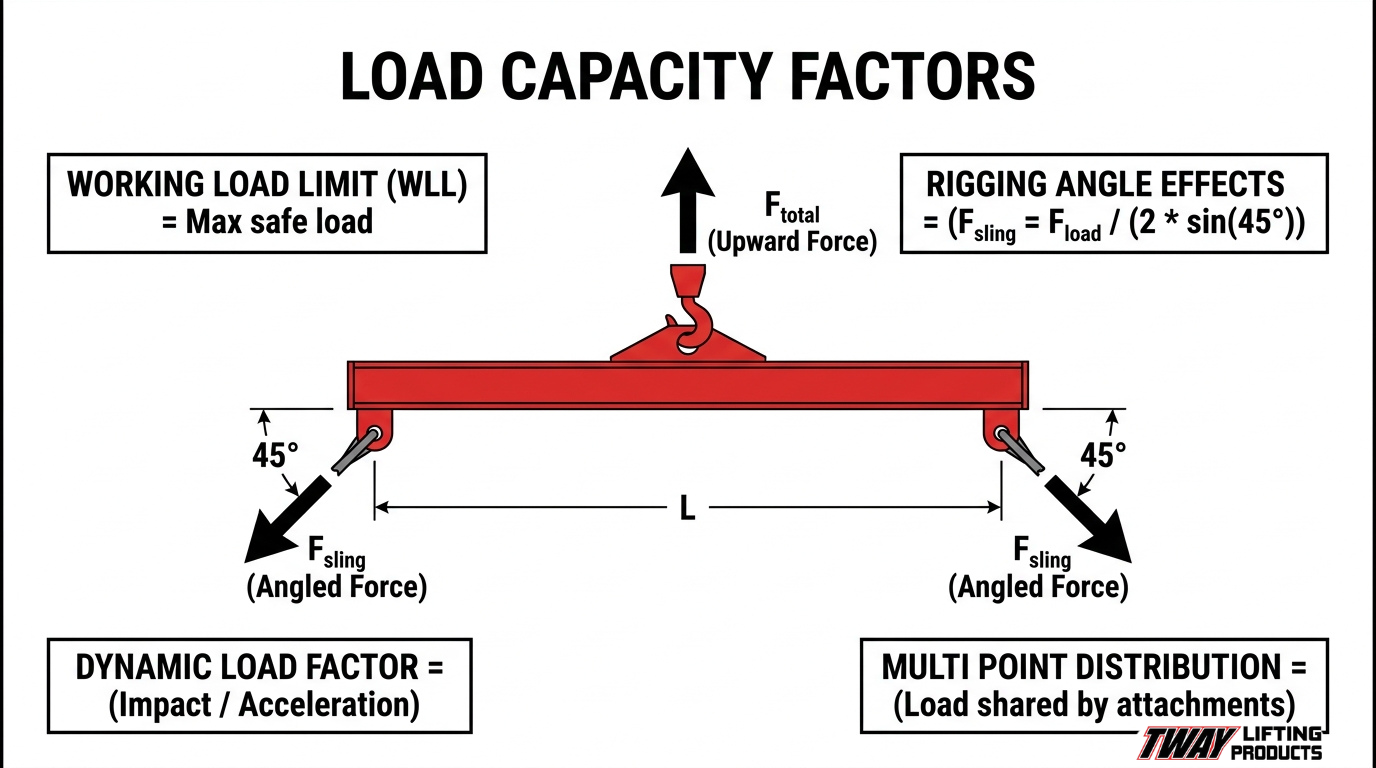
How Does the Working Load Limit Determine the Right Spreader Bar Rental?
The working load limit (WLL) determines the right spreader bar rental by establishing the maximum force the bar can safely carry under rated conditions. Spreader bar capacity is determined under ASME B30.20 and BTH-1, which establish design factors, account for sling angle effects, and define marking and rating requirements. Selecting a bar rated at or above the combined rigging load, including hardware weight, is the minimum starting point. In practice, offshore conditions rarely mirror the static land-based assumptions behind a nameplate WLL, making this baseline figure a floor rather than a final answer.
How Does Rigging Angle Affect the Rated Capacity of a Spreader Bar?
Rigging angle affects the rated capacity of a spreader bar by increasing tension in every sling and connecting component as the angle from horizontal decreases. A horizontal sling angle of 30 degrees increases the tension factor by 2 times, effectively doubling the load felt by the sling and all related rigging components. For offshore rentals, sling angles below 45 degrees should prompt an immediate upward revision of the required WLL. Overlooking this single factor is one of the most common sources of capacity under-specification on marine lift plans.
How Does Dynamic Load Factor Change Capacity Requirements on Marine Vessels?
The dynamic load factor (DLF) changes capacity requirements on marine vessels by applying a multiplier to the static load to account for vessel motion and environmental forces. DNV standards typically require a global safety factor of 1.5 for offshore lifts, reflecting the added stress from wave action, crane boom movement, and inertia. Vessel motions in six degrees, including heave, sway, surge, roll, pitch, and yaw, all contribute to peak dynamic loading. A spreader bar sized only for static weight will be undersized the moment the vessel moves under load.
How Do Multi-Point Lifts Affect Load Distribution Across a Spreader Bar?
Multi-point lifts affect load distribution across a spreader bar by dividing the total load among several attachment points, with each point carrying a share that changes based on load geometry and rigging symmetry. When attachment points are not symmetrically arranged or the center of gravity is offset, some lift points carry disproportionately higher forces than the static calculation suggests. Confirming that each individual connection point, shackle, and sling leg is rated for the maximum possible share rather than the average load is essential before finalizing a rental. With all four capacity variables resolved, the correct rental specification becomes far more defensible for lift plan approval.
What Material and Corrosion Considerations Apply to Offshore Spreader Bar Rentals?
Material and corrosion considerations for offshore spreader bar rentals center on selecting steel grades and surface treatments that withstand chloride exposure, salt spray, and splash-zone degradation. The sections below cover why saltwater demands specific material standards, how stainless steel compares to galvanized steel, and which coatings provide lasting protection.
Why Does Saltwater Exposure Demand Specific Material Standards in Marine Lifting?
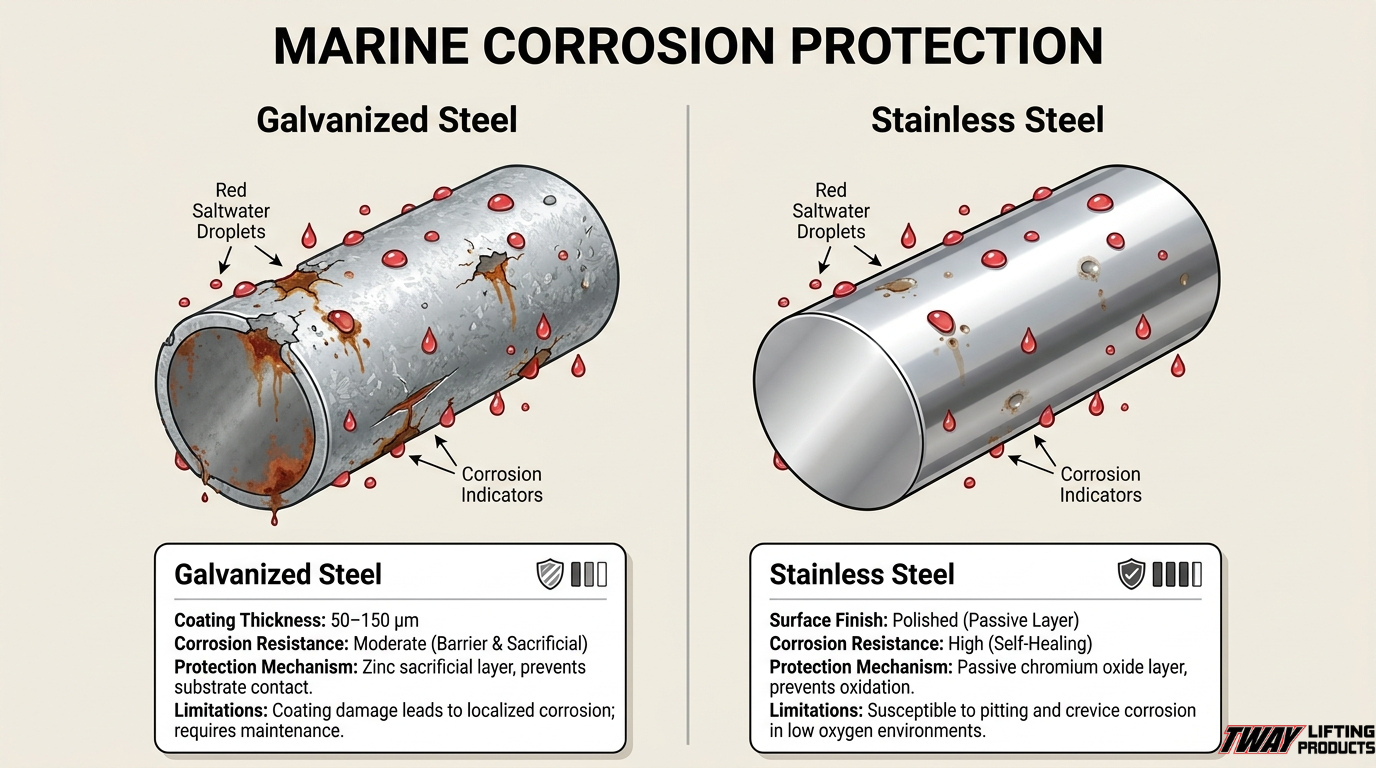
Saltwater exposure demands specific material standards in marine lifting because chloride ions and dissolved oxygen accelerate steel corrosion far beyond rates seen in dry industrial environments. According to Materials Performance (AMPP), corrosion rates in the offshore splash zone reach approximately 0.95 mm/year due to high oxygen and chloride content from recurrent splashing. Carbon steel without protection corrodes at 0.1 to 0.2 mm/year even with adequate oxygen access, but rates climb sharply where acidic iron chloride (FeCl2) forms in deteriorating rust pockets. For a spreader bar sustaining cyclic compressive loads, even moderate section loss measurably reduces rated capacity. This makes material selection a structural safety issue, not merely a maintenance concern.
How Does Stainless Steel Compare to Galvanized Steel for Offshore Spreader Bars?
Stainless steel and galvanized steel each address marine corrosion through different mechanisms. Stainless steel relies on a passive chromium oxide layer to resist chloride attack, while galvanized steel uses a sacrificial zinc coating that corrodes preferentially before the base steel is affected. Galvanized spreader bars are more common in rental fleets because they are cost-effective, weldable, and offer practical corrosion protection for most offshore durations. Stainless steel components are better suited to permanently submerged or high-chloride splash-zone exposures where zinc coatings deplete faster. For most rental applications, galvanized steel with a well-maintained coating provides adequate protection, but operators should confirm the rental bar’s coating condition and zinc thickness before deploying in aggressive splash-zone environments.
What Coatings or Surface Treatments Help Protect Rental Spreader Bars at Sea?
The coatings that help protect rental spreader bars at sea include Thermal Spray Aluminum (TSA) and liquid-applied epoxy systems. A paper presented at the ISOPE International Ocean and Polar Engineering Conference identifies TSA and epoxy coating systems as proven long-term corrosion protection methods for offshore steel structures. TSA bonds metallurgically to the steel surface and provides galvanic protection even when the coating is locally damaged. Epoxy systems, particularly multi-coat marine-grade formulations, create a dense barrier against chloride penetration. Pre-lift inspection routines for offshore spreader beams should confirm coating integrity as a primary checkpoint, since holidays or abrasion damage in the splash zone can initiate localized pitting that compromises structural cross-section faster than general corrosion rates suggest.
What Certifications and Compliance Standards Govern Offshore Spreader Bar Rentals?
The certifications and compliance standards that govern offshore spreader bar rentals include DNV-ST-0378, ASME B30.20, and OSHA 1926.251. The following sections cover what each standard requires and which documents a rental unit must carry before use.
What Does DNV GL Certification Require for Offshore Lifting Equipment?
DNV GL certification requires offshore lifting equipment to comply with DNV-ST-0378, the recognized standard governing the design, testing, and certification of spreader beams and heavy lift systems for marine projects. Equipment certified under this standard undergoes documented structural analysis, load testing, and material verification. According to Multisec, some DNV-certified modular spreader beams are approved for capacities up to 2,000 tons, confirming the standard’s applicability to the heaviest offshore lifts. DNV certification is, in practical terms, the baseline expectation for any spreader bar entering a marine or offshore work scope.
What Role Does ASME B30.20 Play in Spreader Bar Compliance?
ASME B30.20 plays the role of establishing design factors, marking requirements, and rating criteria for below-the-hook lifting devices, including spreader bars. Spreader bar capacity determination falls directly under ASME B30.20 and BTH-1, which account for sling angle effects and assign rated load limits. The standard also requires that all below-the-hook devices carry visible identification and rated capacity markings. Without compliant markings, a rental spreader bar fails inspection before the lift begins.
How Do OSHA Standards Apply to Marine and Offshore Lifting Operations?
OSHA standards apply to marine and offshore lifting operations through 29 CFR 1926.251, which governs rigging equipment used in construction, including marine environments under US jurisdiction. OSHA 1926.251(a)(4) specifically requires that custom-designed lifting accessories, such as spreader bars, be proof-tested to 125% of their rated capacity prior to use. This proof-load requirement is non-negotiable for any special-design or fabricated spreader bar brought onto a job site. Operators should verify that rental providers supply the accompanying proof-load test certificate before mobilization.
What Documentation Should a Rental Spreader Bar Include Before Use Offshore?
The documentation a rental spreader bar should include before offshore use consists of engineering design calculations, material certificates, proof load test certificates, and current inspection reports. According to DNV’s guidelines for marine operations under DNV-ST-N001, these records establish traceability from design through fabrication and testing. Incomplete documentation is a common cause of regulatory holds on offshore projects and can delay critical lift windows significantly.
What Inspection Requirements Apply to Rented Spreader Bars in Marine Environments?
Inspection requirements for rented spreader bars in marine environments include pre-lift visual checks, periodic examinations during the project, and clear disqualification criteria for damaged equipment. The sections below cover the pre-lift checklist, inspection frequency during extended offshore work, and specific damage signs that pull a bar from service.
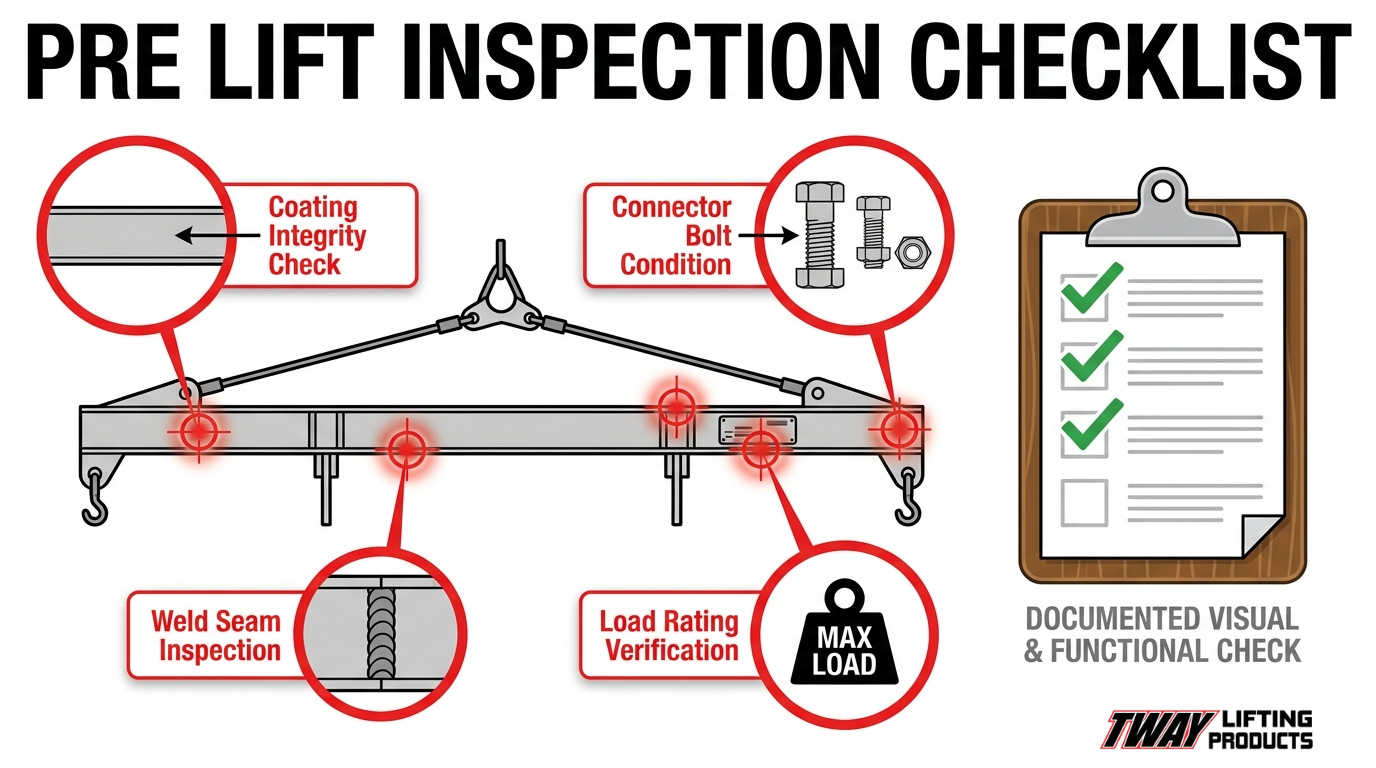
What Pre-Lift Inspection Checklist Should Be Followed for a Rental Spreader Bar?
The pre-lift inspection checklist for a rental spreader bar covers four core areas: coating integrity, connector and bolt condition, markings and traceability, and welding seam condition. According to Modulift, pre-lift routines for offshore spreader beams specifically target these four elements to catch salt-accelerated deterioration before a lift begins. ASME B30.20 further requires that all below-the-hook lifting devices carry visible ratings and identification, making legible markings a mandatory checklist item. Inspectors should also verify that all shackle pins are properly moused, safety latches on hooks are functional, and load-rated components match the lift plan specifications.
How Often Must a Rental Spreader Bar Be Inspected During Extended Offshore Projects?
A rental spreader bar must be inspected by a competent person at a minimum interval of every 6 months during extended offshore projects, per LOLER regulations as mandated by the Health and Safety Executive (HSE). In practice, the marine environment demands more frequent checks. Exposure to saltwater spray, dynamic vessel motion, and repeated loading cycles accelerates wear between formal examinations. For active offshore campaigns, many operators schedule documented visual inspections before every significant lift sequence, not only at the 6-month threshold.
What Damage Signs Disqualify a Rented Spreader Bar From Continued Use?
The damage signs that disqualify a rented spreader bar from continued use include visible corrosion penetrating the base metal, cracked or deformed welds, missing or illegible load ratings, bent or elongated padeyes, and loose or missing connector bolts. Any breach in the protective coating that exposes bare steel is a removal trigger in marine conditions, given that carbon steel corrosion rates in saltwater can reach 0.1 to 0.2 mm/year under normal oxygen exposure and climb significantly higher where rust concentrations form. Structural deformation from overload or impact, even if subtle, is also grounds for immediate removal from service. When in doubt, retire the bar.
How Does Rental Duration and Project Scope Affect Spreader Bar Selection Offshore?
Rental duration and project scope directly shape which spreader bar size, type, and configuration makes sense offshore. Short-term lifts favor standardized rentals for immediate fit; long-term projects introduce maintenance, replacement, and cost-efficiency decisions.
How Do Short-Term Marine Lifts Influence Which Spreader Bar Size to Rent?
Short-term marine lifts influence spreader bar size selection by prioritizing immediate load capacity, lift geometry, and logistical simplicity over long-term configurability. For a single-lift or brief campaign, a fixed-length or standard modular bar in the correct capacity range avoids unnecessary complexity. Renting a spreader bar for mobile crane applications in 2026 typically costs $150–$300 per day or $600–$1,200 per week, according to CountBricks, making short-term rental the most cost-effective path when utilization is limited. Modular spreader beams are especially practical here because they can be delivered in sections and bolted together on-site, enabling fast deployment without custom fabrication lead times.
How Do Long-Term Offshore Projects Change Maintenance and Replacement Decisions?
Long-term offshore projects change maintenance and replacement decisions by shifting focus from day-rate cost to total utilization cost, inspection cycles, and corrosion management. The break-even point between renting and purchasing specialized lifting equipment is estimated at 40–60 days of utilization per year, meaning extended campaigns may justify ownership rather than continued rental. For rental, providers must schedule periodic inspections, address coating degradation from saltwater exposure, and replace worn components before they affect rated capacity. Utilization rates and long-term maintenance obligations are key factors in calculating ROI for renting versus buying offshore lifting technology.
With project scope defined, evaluating rigging attachment compatibility ensures the selected spreader bar integrates safely with the full rigging system.
What Are the Rigging Attachment and Hardware Compatibility Requirements for Offshore Use?
The rigging attachment and hardware compatibility requirements for offshore use cover three interconnected areas: shackle-to-capacity matching, sling type selection, and pad eye design. Each component must be verified before any offshore lift proceeds.
How Do Shackle Ratings Need to Match the Spreader Bar Capacity?
Shackle ratings need to match the spreader bar capacity by ensuring the shackle’s working load limit equals or exceeds the maximum force transmitted through each attachment point under offshore load conditions. Undersized shackles create a weak link that bypasses the bar’s rated capacity entirely. Per Technik Design’s padeye guidelines, the clearance between the shackle pin and the hole should not exceed 6% of the shackle pin diameter. Exceeding this tolerance concentrates bearing stress on the pin and accelerates wear. In practice, rigging engineers should verify shackle ratings against the spreader bar’s rated capacity plus any dynamic load factor applied for offshore conditions.
What Sling Types Are Compatible With Offshore-Rated Spreader Bar Ends?
The sling types compatible with offshore-rated spreader bar ends are wire rope, synthetic, and chain slings. According to Bishop Lifting, synthetic slings are often preferred for their load protection properties and easier handling on marine job sites. Wire rope slings provide higher abrasion resistance in harsh offshore conditions, while chain slings offer durability for high-temperature or chemically aggressive environments. The correct choice depends on load surface sensitivity, environmental exposure, and the attachment hardware at each spreader bar end.
How Does Pad Eye Design Affect Safe Rigging on an Offshore Spreader Bar?
Pad eye design affects safe rigging on an offshore spreader bar by controlling how load forces transfer between the sling and the bar’s structure. According to Eng-Tips engineering forums, offshore pad eye design is typically sized for one specific shackle, matching both the shackle pin diameter and the shackle’s inside width to prevent lateral movement and uneven loading. Mismatched pad eyes allow the shackle to shift under dynamic offshore loads, introducing bending stress the bar was not designed to carry. Verifying pad eye-to-shackle compatibility before the lift is as critical as checking the bar’s rated capacity itself.
What Environmental Conditions Must Be Factored Into an Offshore Spreader Bar Rental?
The environmental conditions that must be factored into an offshore spreader bar rental include vessel motion, wind loading, and temperature extremes. Each of these forces directly affects equipment selection, load calculations, and structural performance at sea.
How Do Wave Motion and Vessel Pitch Affect Spreader Bar Performance at Sea?
Wave motion and vessel pitch affect spreader bar performance by introducing dynamic forces that exceed the static rated load. Vessel motions occur across six degrees: heave, sway, surge, roll, pitch, and yaw. Any combination of these movements can generate sudden load spikes that overwhelm rigging components sized only for static conditions.
DNV standards address this directly by requiring Dynamic Load Factors (DLF) in offshore lift calculations, with a global safety factor of 1.5 applied to account for vessel motion and environmental conditions. Selecting a spreader bar without factoring DLF into the working load limit is one of the most consequential errors a rigging team can make offshore.
How Does Wind Loading Change the Safe Working Parameters of a Spreader Bar?
Wind loading changes safe working parameters by adding lateral force to the rigging system that the spreader bar’s rated capacity does not inherently absorb. Wind load calculations for offshore lifting determine the forces exerted on both the suspended load and the rigging itself, and these forces must be incorporated into the lift plan before operations begin.
Suspended loads with large surface areas are most vulnerable, as wind pressure creates side loading across sling legs and can induce load swing. Rigging teams should confirm that the rental spreader bar’s end connections and sling arrangement can accommodate calculated lateral forces without approaching capacity limits.
How Do Extreme Temperature Ranges Offshore Affect Spreader Bar Structural Integrity?
Extreme temperature ranges offshore affect spreader bar structural integrity by altering the mechanical properties of the steel used in fabrication. Low temperatures reduce steel toughness and increase the risk of brittle fracture under impact loading, while elevated temperatures can reduce yield strength in standard carbon steel grades.
Marine and offshore environments subject lifting equipment to severe weather that compounds these thermal effects alongside salt-laden air and dynamic wave loads. Rental spreader bars intended for arctic or high-heat offshore environments should carry material certifications confirming the steel grade’s rated toughness across the expected temperature range. This is an often-overlooked specification during the rental selection process, but it directly determines whether equipment remains safe under the actual site conditions encountered.
How Does Renting vs. Buying a Spreader Bar Compare for Offshore Marine Projects?
Renting a spreader bar typically outperforms purchasing for infrequent or project-specific offshore work, while buying favors high-utilization fleets. The sections below cover when renting delivers stronger ROI and which hidden costs can erode those savings.
When Does Renting a Spreader Bar Make More Financial Sense Than Purchasing?
Renting a spreader bar makes more financial sense than purchasing when annual utilization stays below the break-even threshold. According to a utilization-based ROI analysis by Turchi, the break-even point between renting and purchasing specialized lifting equipment falls at approximately 40 to 60 days of use per year. Projects that fall below this threshold benefit from renting because capital is not tied up in equipment that sits idle between offshore campaigns.
Renting also makes sense in scenarios such as:
- Single-project deployments with a defined end date
- Projects requiring a specific capacity or span not matching owned inventory
- Operations where offshore certification maintenance (DNV-ST-0378, ASME B30.20) would fall on the buyer
For most offshore contractors running one or two major lift campaigns annually, renting is the more financially defensible choice. Outsourcing certification, inspection, and storage overhead to a rental provider removes significant indirect costs from the owner’s balance sheet.
What Hidden Costs Should You Watch for in an Offshore Spreader Bar Rental Agreement?
Hidden costs in an offshore spreader bar rental agreement include mobilization fees, permits, inspection fees, and damage liability charges. Mobilization costs cover organizing, assembling, and transporting the equipment to the jobsite before any lift begins, and these expenses are frequently quoted separately from the base rental rate. According to My-Crane, crane and rigging rentals commonly carry additional charges for oversized load permits and site-specific inspection requirements that project managers overlook during budgeting.
Key cost items to verify before signing include:
- Mobilization and demobilization transport fees
- Third-party inspection and certification surcharges
- Damage liability clauses and deductible amounts
- Overage charges for rental periods extended by weather delays
Utilization rates and long-term maintenance obligations also factor into the true cost of renting versus owning offshore lifting technology. Carefully reviewing each line item in the rental agreement before mobilization prevents budget overruns on offshore projects where schedule delays are expensive.
How Can a Rigging Rental and Inspection Provider Support Your Offshore Spreader Bar Needs?
A rigging rental and inspection provider supports your offshore spreader bar needs by supplying certified equipment, verified documentation, and expert guidance across every phase of a marine lift. The sections below cover how Tway Lifting’s services apply to offshore projects and the key rental considerations to carry forward.
How Does Tway Lifting’s Rental and Inspection Service Apply to Offshore Spreader Bar Projects?
Tway Lifting’s rental and inspection service applies to offshore spreader bar projects by providing spreader beams, slings, shackles, and below-the-hook equipment backed by certified inspection specialists and over 75 years of rigging expertise. Tway Lifting’s rental inventory includes spreader beams from 2 to 100 tons and up to 40 feet, alongside telescopic adjustable length bars, wire rope slings, synthetic slings, and chain slings. Inspection services are performed by certified specialists who verify ASME B30.20 compliance, confirm visible ratings and identification, and deliver detailed reporting. Qualified offshore rigging personnel must be API-U certified, and Tway Lifting’s factory-trained team is equipped to support those compliance requirements. For project teams managing tight offshore schedules, the combination of rental availability, same-day fabrication, and complimentary local delivery reduces mobilization delays significantly.
What Are the Most Important Offshore and Marine Spreader Bar Rental Considerations to Remember?
The most important offshore and marine spreader bar rental considerations cover equipment certification, capacity verification, corrosion protection, documentation, and provider competence. Keeping these priorities in view protects every lift from planning through execution:
- Certification compliance: Confirm the rental spreader bar meets DNV-ST-0378 and ASME B30.20 standards, and that OSHA 1926.251(a)(4) proof-testing to 125% of rated capacity has been completed.
- Capacity and load factors: Account for sling angles, Dynamic Load Factors from vessel motion, and DNV’s required global safety factor of 1.5 for offshore lifts.
- Corrosion protection: Verify coatings such as Thermal Spray Aluminum or epoxy systems are intact, particularly given offshore splash zone corrosion rates reaching 0.95 mm/year per Materials Performance (AMPP).
- Required documentation: Ensure the rental package includes engineering design calculations, material certificates, proof load test certificates, and current inspection reports.
- Hardware compatibility: Confirm shackle pin sizing, padeye fit, and sling type compatibility before committing to a rental configuration.
- Inspection cadence: Schedule pre-lift inspections covering coating integrity, bolt and connector condition, weld seams, and markings.
- Provider qualifications: Select a provider with API-U qualified personnel, a demonstrated inspection program, and equipment traceable to recognized offshore standards.
Tway Lifting’s decades of certified rigging experience make it a dependable partner when every one of these considerations must be met without compromise.