

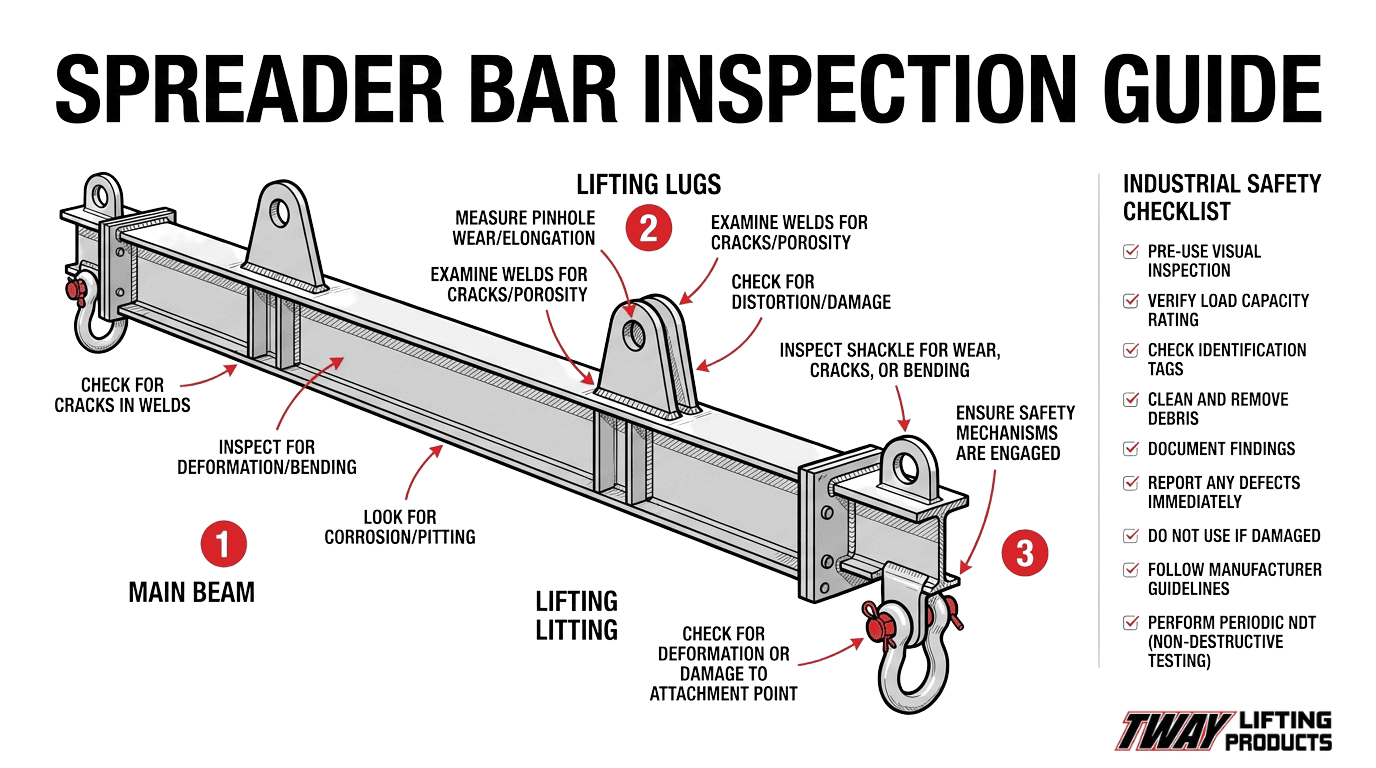

A spreader bar is a below-the-hook lifting device that holds rigging slings apart to distribute a load across multiple lifting points, converting the applied load into compression in the bar and tension in the attached slings. Renting one introduces a critical variable: you have no direct knowledge of that bar’s service history, inspection status, or how previous users treated it.
This guide covers what a spreader bar is and how its mechanics affect inspection priorities, the safety and legal risks of using unverified rental equipment, the documentation you must request before accepting any rented bar, how to inspect every structural component, how to verify load ratings against your lift plan, the visual checks required before every use, the OSHA and ASME standards that govern these inspections, and when to refuse or return equipment that fails your review.
A spreader bar’s force mechanics determine where failure begins. Smaller top sling angles amplify compression in the bar and tension in each sling, so structural defects that appear minor under a straight pull can trigger sudden failure in an angled configuration.
Documentation from the rental provider is a legal and safety requirement, not a courtesy. You need a current load test certificate, prior inspection records, and a visible capacity rating tag before the bar leaves the rental company’s possession.
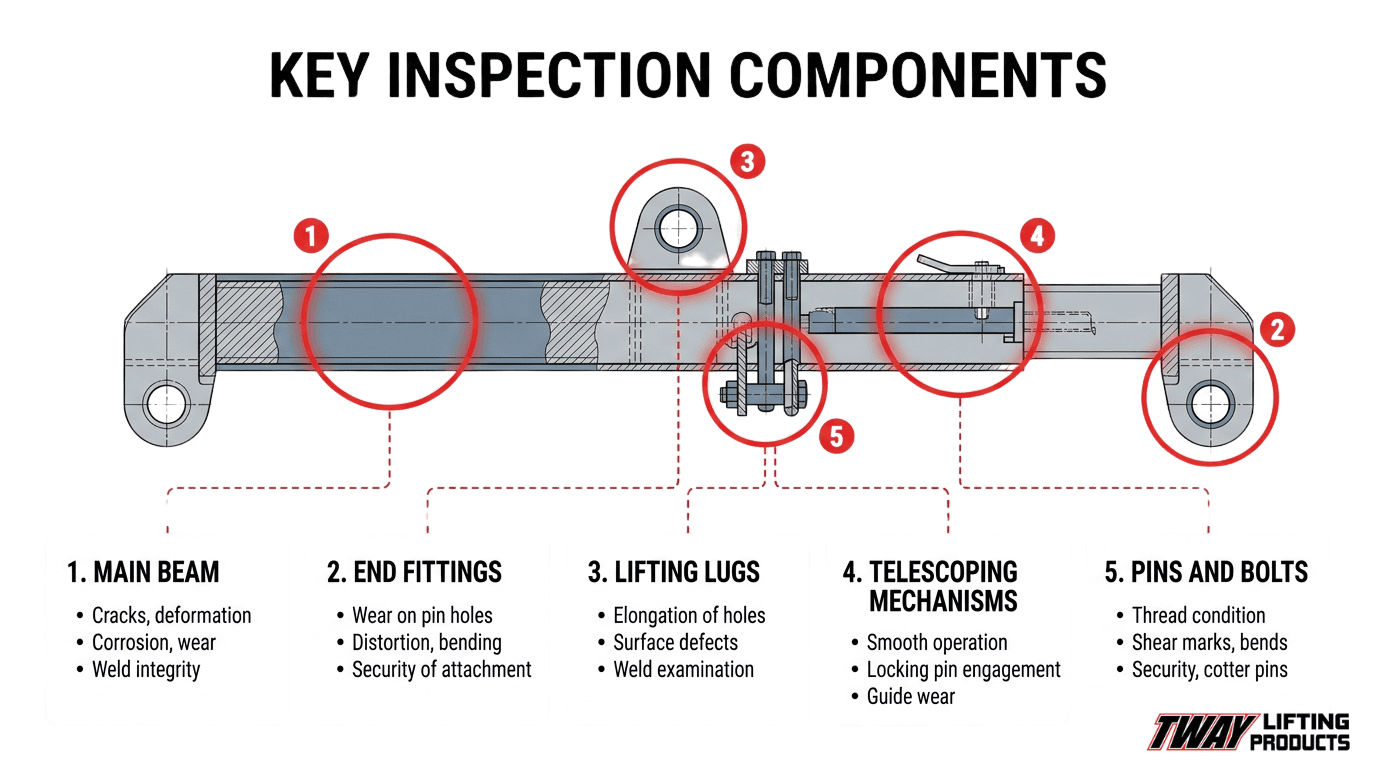
Component-level inspection covers the main beam, end fittings, lifting lugs, telescoping mechanisms, and all pins and locking devices, each of which carries load differently and can fail independently.
Load rating verification requires matching the bar’s marked Working Load Limit to your lift plan, calculating how your actual sling angle affects compressive force, and refusing any bar whose capacity is unmarked or unverifiable.
OSHA 29 CFR 1926.251 and ASME B30.20-2025 together establish what must be inspected, what constitutes a rejection condition, and what the legal consequences are when either standard is ignored.
What Is a Spreader Bar and How Does It Work in a Lift?
A spreader bar is a below-the-hook lifting device that holds two or more rigging slings apart to distribute a load’s weight evenly across multiple lifting points, increasing lift stability. It works by converting the applied lifting load into compression within the bar and tension in the attached slings, with top rigging supporting the entire load.
The following sections cover how the bar’s mechanics affect load forces, the common types available for rent, and the key role sling angle plays in safe operation.
How Does a Spreader Bar Convert Load Forces During a Lift?
A spreader bar converts load forces by generating axial compression along its length while placing the connecting slings under tension. According to Peerless Chain, this force conversion requires the top rigging to carry the full load, meaning the bar itself never bears the weight directly. Smaller top sling angles intensify this effect, increasing both the compressive force on the bar and the tension in each individual sling. Understanding this force relationship is essential before inspecting any rented bar, since hidden structural damage can cause sudden failure under compressive load.
What Are the Main Types of Spreader Bars Available for Rent?
The main types of spreader bars available for rent include fixed-length bars, telescopic bars, and modular spreader beams. A telescopic spreader bar uses sliding inner sections pinned at different lengths, providing on-site flexibility when load dimensions change between lifts. Modular spreader beams, also known as spreader bars, are designed specifically for lifting large, awkward, or heavy loads where stability is the priority. Each type presents distinct inspection requirements, particularly at pin locations and adjustable joints where wear concentrates.
How Do Sling Angles Affect Spreader Bar Performance?
Sling angles affect spreader bar performance by directly controlling the magnitude of compression and sling tension during the lift. As the top sling angle decreases from vertical, the multiplicative effect amplifies both forces beyond the rated load weight. Working Load Limit (WLL) represents the maximum load under ideal conditions, while Safe Working Load (SWL) applies a reduction based on actual operating conditions, including sling angle. Rigging teams should always confirm the sling geometry planned for their specific lift before accepting a rented bar, since a bar rated for one configuration may be dangerously underspecified for another.
What Are the Risks of Using a Damaged or Unverified Rented Spreader Bar?
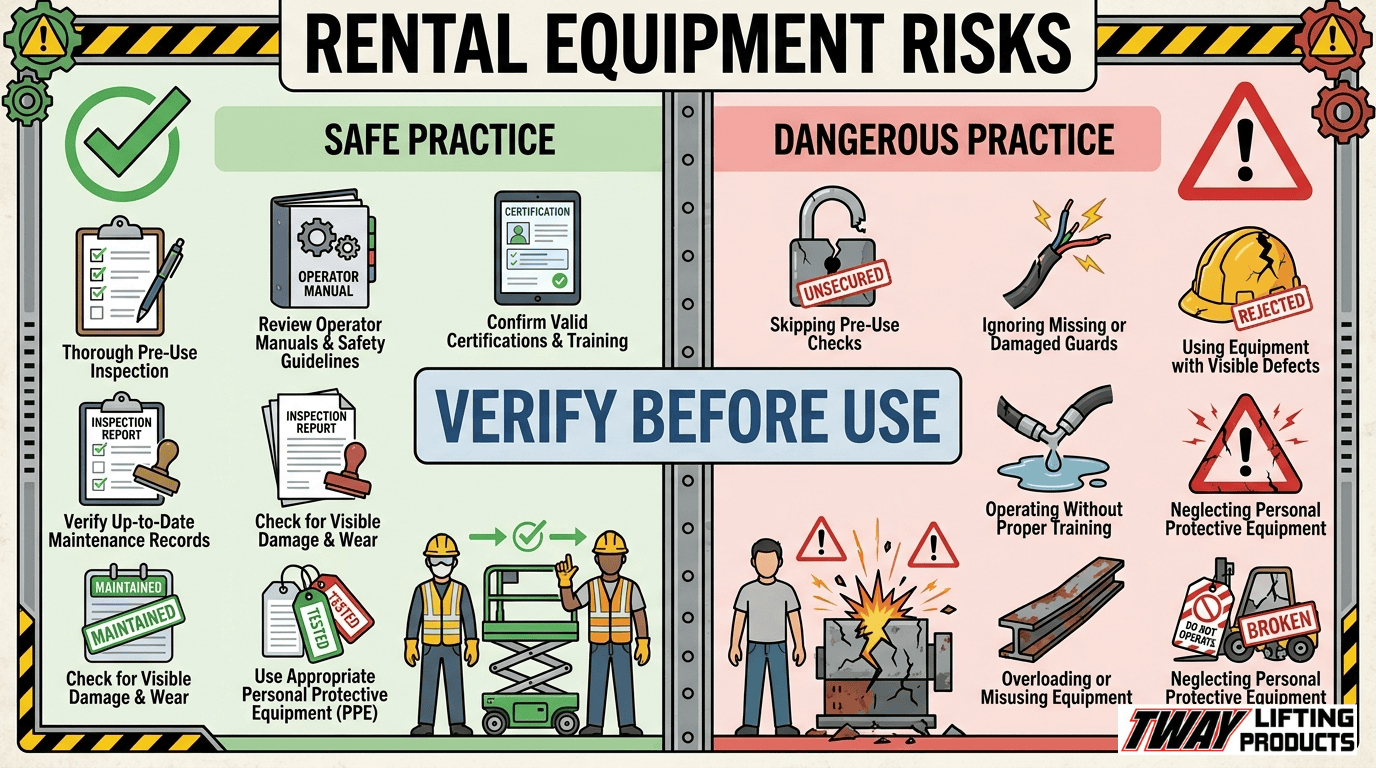
The risks of using a damaged or unverified rented spreader bar include load collapse, equipment failure, serious worker injury, and significant legal liability. Renting a spreader bar without confirming its inspection status, load rating, or structural condition introduces hazards that no lift plan can compensate for.
Physical and Safety Risks
The physical risks of using a damaged rented spreader bar range from partial load drop to complete lift failure. Structural defects such as cracks, bent end fittings, or corroded lifting lugs compromise the bar’s ability to sustain compressive forces during a lift. According to a 2025 report by the Health and Safety Executive (via Veriforce CHAS), handling, lifting, or carrying accidents accounted for 30% of non-fatal workplace injuries. Unverified equipment removes the only safeguard against these outcomes: a confirmed, current inspection record.
Legal and Liability Risks
The legal risks of using an unverified rented spreader bar extend to both the rental company and the job site operator. If an employee is injured while using rented equipment, both the subcontractor in charge of the job site and the rental agency can be held liable, according to the Pisanchyn Law Firm. This shared liability means that accepting a rented bar without documented inspection records is not just a safety failure; it is a direct legal exposure for every party involved in the lift.
What Documentation Should You Request When Renting a Spreader Bar?
When renting a spreader bar, you should request three core documents: a current load test certificate, a record of prior inspections, and a visible capacity rating tag. Each of these documents serves a distinct compliance and safety function, covered in the sub-sections below.
Does a Rented Spreader Bar Need a Current Load Test Certificate?
Yes, a rented spreader bar needs a current load test certificate before it can be safely deployed on any job site. OSHA’s 29 CFR 1926.251 requires rigging equipment to be inspected prior to use on each shift to confirm it is safe for material handling operations. A load test certificate provides documented proof that the bar has been physically verified to perform within its rated capacity. Without it, you have no traceable evidence the equipment can safely handle your planned lift, and both the rental agency and job site contractor may face shared liability if an incident occurs.
What Inspection Records Should the Rental Provider Supply?
The inspection records a rental provider should supply include prior periodic inspection reports, a maintenance log, and records of any repairs or reconditioning performed between rentals. According to a University of Surrey LOLER procedure document, documentation for any rented lifting equipment should be obtained from the rental company either before or on delivery to confirm compliance with strength and stability requirements. These records establish the equipment’s service history and reveal whether it has been subjected to conditions that might have degraded its structural integrity. Gaps in the inspection timeline are a practical red flag: missing records mean missing accountability, and that risk falls directly on whoever puts the bar into service.
Should the Rented Spreader Bar Have a Visible Capacity Rating Tag?
Yes, a rented spreader bar should have a visible capacity rating tag affixed before it leaves the rental provider’s possession. Washington State Legislature regulations require all structural and mechanical lifting devices to be marked with the manufacturer’s name and address, serial number, and lifter weight. Additionally, ASME B30.20-2025 specifically focuses removal criteria for below-the-hook lifting devices on structural integrity and the presence of visible ratings and identification. A tag that is missing, illegible, or damaged should be treated as a disqualifying condition. No rigger should attempt to determine capacity by memory or assumption when the rated tag is the primary on-site reference for safe lift planning.
What Are the Key Components to Inspect on a Rented Spreader Bar?
The key components to inspect on a rented spreader bar are the main beam, end fittings, lifting lugs, telescoping mechanisms, and all pins, bolts, and locking devices. Each element carries load in a distinct way and can fail independently, so every component requires its own focused check before the bar enters service.
How Do You Inspect the Main Beam or Tube for Structural Damage?
Inspecting the main beam for structural damage requires a thorough visual scan along the entire length of the tube or bar. Look for bends, dents, or visible deformation that indicate the beam absorbed an impact or was overloaded in a previous lift. Run a hand along the surface to detect warping not immediately visible to the eye.
Inspection points to cover include:
- Cracks or fractures along welds and heat-affected zones
- Pitting, corrosion, or surface rust that reduces wall thickness
- Unusual indentation or wear marks suggesting overloading
- Any deformation that affects the beam’s straight profile
According to a Northern Arizona University crane safety protocol, inspection of lifting equipment must include checking for corroded, cracked, bent, or worn components. A beam with any of these conditions must be removed from service immediately, regardless of how minor the damage appears.
How Do You Check the End Fittings and Shackle Attachment Points?
Checking the end fittings and shackle attachment points requires examining each connection for wear, distortion, and load capacity markings. The shackle properties most significant for inspection are load capacity, pin or bolt diameter, inside jaw width, and overall shackle length, according to the AISC Engineering Journal.
Key checks at each end fitting include:
- Visible deformation or spreading of the jaw
- Thread damage or cross-threading on the shackle pin
- Missing or illegible capacity markings
- Signs of weld cracking where the fitting meets the beam
Worn or unmarked shackles must not be used, as their actual capacity becomes unverifiable.
How Do You Evaluate the Condition of the Lifting Lugs or Pad Eyes?
Evaluating the condition of lifting lugs or pad eyes requires inspecting each lug for wear, elongation of the lifting hole, and cracks at the weld root. ProLift guidance states that lifting eyes, bows, and bolts should be inspected for obvious signs of wear, distortion, and physical damage before any lifting operation.
Focus on these indicators during evaluation:
- Elongated or out-of-round lifting holes caused by repeated loading
- Cracks or undercutting at the base weld
- Surface corrosion that compromises the lug’s cross-sectional area
- Any bend or twist in the lug plate itself
Elongation of the pin hole is an especially reliable indicator of cumulative overloading that may not be obvious from a distance.
How Do You Inspect Adjustable or Telescoping Spreader Bar Mechanisms?
Inspecting adjustable or telescoping spreader bar mechanisms requires checking all sliding sections, locking pins, and adjustment holes for wear and proper engagement. A telescopic spreader bar uses sliding inner sections pinned at different lengths, so the condition of both the outer tube and inner section directly affects the bar’s structural behavior under load.
Inspection steps for telescoping mechanisms include:
- Verify the inner tube slides without binding and seats fully at each pin position
- Check all pin holes for elongation or deformation
- Confirm the locking pins engage completely and cannot back out under load
- Inspect the outer tube for cracks at the sleeve ends where stress concentrates
A partially engaged or worn pin hole in a telescoping section is one of the most common failure points on adjustable rental equipment.
How Do You Verify the Condition of Any Pins, Bolts, or Locking Devices?
Verifying the condition of pins, bolts, and locking devices requires a hands-on check of each fastener for thread integrity, bends, and retention hardware. The U.S. Department of Energy Hoisting and Rigging program requires inspecting pins and bolts for cracks, thread damage, and bends, with any damaged member removed from service immediately.
Check each pin and bolt for:
- Bent or deformed shafts that prevent full seating
- Thread stripping or cross-threading that prevents secure torquing
- Missing cotter pins, clips, or safety wire on retention devices
- Corrosion or galling that prevents proper removal or seating
Without intact retention hardware, a pin can walk out under vibration and release the connection mid-lift.
How Do You Verify the Load Rating of a Rented Spreader Bar Is Correct for Your Lift?
Verifying the load rating of a rented spreader bar requires matching its marked capacity to your lift plan, adjusting for rigging angle, and confirming all identification tags are present. The sections below cover capacity matching, angle effects, and how to handle unmarked bars.
How Do You Match Spreader Bar Capacity to Your Lift Plan Requirements?
Matching spreader bar capacity to your lift plan requirements starts with comparing the bar’s marked Working Load Limit (WLL) against the total rigged load in your lift plan. Working Load Limit is the maximum load an item can lift under ideal conditions, while Safe Working Load (SWL) is a reduction of the WLL based on specific operating conditions. Because field conditions rarely match ideal assumptions, always work from the SWL when selecting rental equipment.
Your lift plan should specify:
- Total gross load weight, including rigging hardware
- Required lifting configuration and attachment points
- Any dynamic or side-load factors that reduce effective capacity
A common mistake is comparing only the load weight to the WLL without accounting for rigging hardware weight or dynamic factors. Never treat WLL as the operational ceiling without first calculating SWL for your specific conditions.
How Do You Account for Rigging Angle When Confirming Load Rating?
Rigging angle directly affects how much compressive force acts on the spreader bar and how much tension acts on individual slings. Smaller top sling angles create a multiplicative effect, increasing both the compressive force on the spreader bar and the tension in individual slings. This means a bar rated for a given load at vertical or near-vertical rigging may be inadequate at shallower angles using the same gross load.
Before confirming the rented bar’s rating is sufficient:
- Determine the actual top sling angle from your lift plan geometry
- Calculate the horizontal compression force the angle generates in the bar
- Confirm the bar’s rated capacity accounts for that compressive load, not just the vertical load component
Ignoring sling angle is one of the most consequential errors in load rating verification. The compressive load at shallow angles can multiply well beyond the gross load weight alone.
What Happens If the Rented Bar’s Capacity Is Unclear or Unmarked?
If the rented bar’s capacity is unclear or unmarked, the bar must be removed from service until proper identification is confirmed. ASME B30.20-2025 provides removal criteria for below-the-hook lifting devices, focusing on structural integrity and the presence of visible ratings and identification. An unmarked bar has no verifiable basis for a safe load decision.
The correct steps when facing an unmarked or unclear rating are:
- Contact the rental provider immediately and request original manufacturer documentation or a certified load test record
- Do not estimate capacity based on bar size, weight, or visual inspection alone
- If documentation cannot be produced before the lift, refuse the equipment and source a properly marked replacement
Operating an unmarked spreader bar exposes both the contractor and rental agency to liability should an incident occur. No lift schedule justifies proceeding without confirmed load identification on a below-the-hook lifting device.
What Visual Inspection Steps Should You Follow Before Every Use?
Visual inspection steps before every use include checking for cracks, bends, corrosion, weld integrity, and overloading indicators. The H3 sections below cover each check in sequence.
How Do You Check for Cracks, Bends, or Deformation in the Bar?
You check for cracks, bends, or deformation in the bar by systematically examining the full length of the main structural member under good lighting before each lift. Run your hand and eyes along every face of the bar, looking for visible fractures, kinks, or any section that appears bowed or twisted out of its original straight profile.
According to NAU’s crane safety inspection guidelines, lifting equipment inspection should include checking for cracked, bent, or worn components, as well as improperly applied end connections on the equipment nameplate. The DOE Hoisting and Rigging program similarly requires removal from service of any member showing cracks or bends.
Even a minor bend in a compression member is a serious rejection criterion; spreader bars carry axial compressive loads, so deformation directly reduces buckling resistance.
How Do You Identify Corrosion or Pitting That Affects Structural Integrity?
Corrosion or pitting that affects structural integrity is identified by examining all bar surfaces, joints, and end fittings for rust staining, scaling, or shallow cratered surface defects. Pay close attention to crevices around connection points where moisture collects.
The Washington Department of Labor and Industries inspection guidance states that structural member inspection should look for pitting and unusual indentation or wear marks. Surface pitting reduces the effective cross-sectional area of the bar, which lowers its load-carrying capacity below the rated Working Load Limit.
Light surface rust may be cosmetic, but any pitting that creates measurable material loss warrants rejection.
How Do You Inspect Welds on a Rented Spreader Bar?
Welds on a rented spreader bar are inspected visually by examining every weld bead at lug attachment points, end fittings, and any gussets for cracks, undercut edges, incomplete fusion lines, or porosity. On a rental bar, you have no knowledge of the weld history, so apply heightened scrutiny.
The U.S. Department of Transportation’s bridge welding reference manuals emphasize using multiple inspection techniques to ensure objectivity and integrity when evaluating welded structures. For any weld that looks suspicious but passes visual check, flag it for the rental provider and request documentation of the last qualified weld inspection.
How Do You Spot Signs of Prior Overloading or Impact Damage?
Signs of prior overloading or impact damage include unusual indentation or wear marks, deformed attachment holes, and stretched or cracked connection hardware. ASME B30.20 expressly forbids applying impact or shock loads to below-the-hook lifting devices, meaning any bar showing these indicators has likely been misused.
Additional indicators to look for are:
- Elongated pin holes or oval-shaped attachment bores
- Paint cracking or peeling in concentrated stress zones near lugs
- Bent or sprung end fittings that no longer sit flush
- Surface indentations inconsistent with normal handling contact
If any of these signs are present, remove the bar from service and return it to the rental provider immediately.
What Are the OSHA and ASME Standards That Apply to Spreader Bar Inspections?
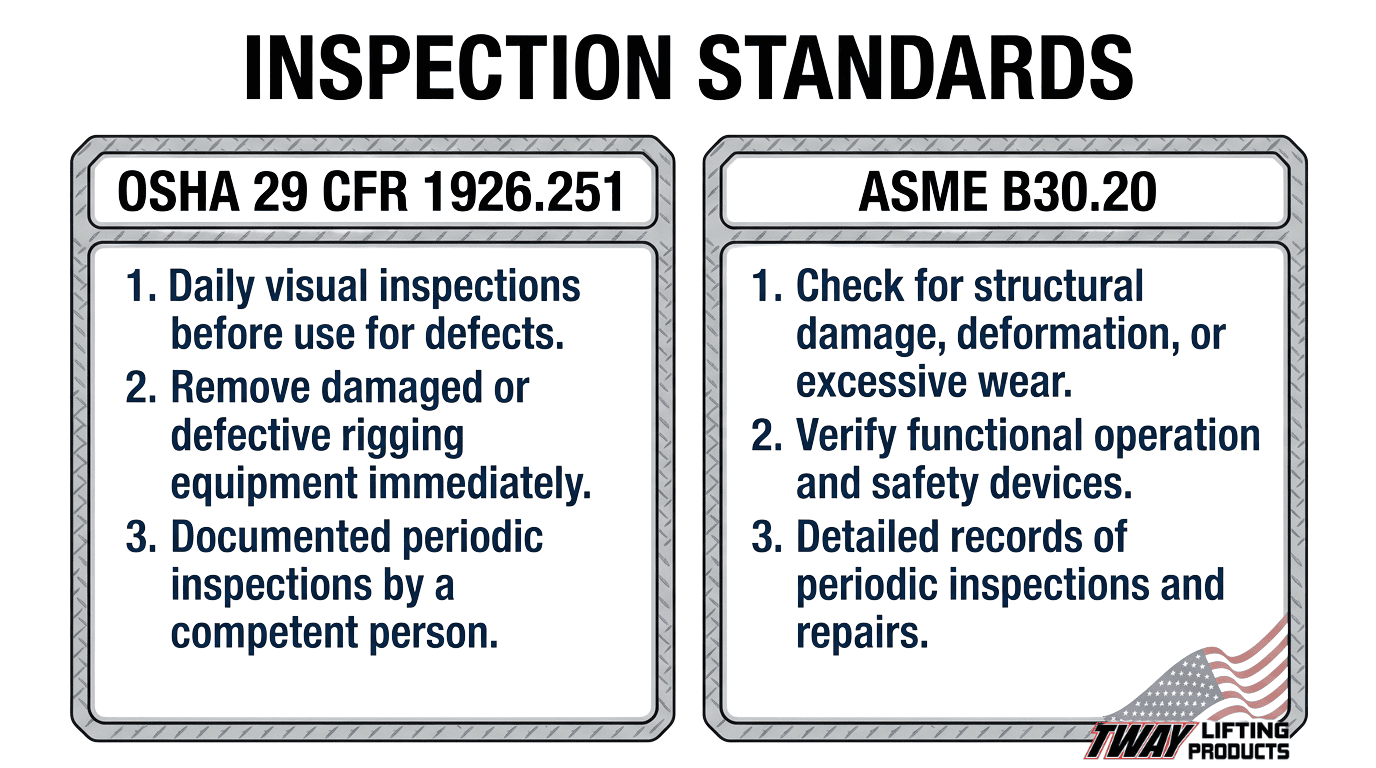
The OSHA and ASME standards that apply to spreader bar inspections are 29 CFR 1926.251 and ASME B30.20, which together establish the minimum legal and technical requirements for inspecting, operating, and removing below-the-hook lifting devices from service. These two frameworks address pre-use inspection frequency, structural integrity criteria, load rating visibility, and prohibited operating practices.
OSHA 29 CFR 1926.251: Pre-Use Inspection Requirements
OSHA 29 CFR 1926.251 requires that rigging equipment for material handling be inspected prior to use on each shift and as necessary during its use to confirm it is safe. This regulation applies directly to spreader bars used in construction and general industry. Under this standard, inspection is not optional or periodic; it is a mandatory condition of use on every shift. Failing to inspect before each lift places the operator, employer, and rental agency in direct violation of federal law.
ASME B30.20: Below-the-Hook Lifting Device Standard
ASME B30.20 is the primary technical standard governing below-the-hook lifting devices, including spreader bars and spreader beams. The 2025 revision provides updated removal-from-service criteria centered on structural integrity and the presence of visible load ratings and identification markings. The standard also expressly prohibits applying impact or shock loads to any lifting device certified under its specification. In practice, this means a spreader bar that has been dropped, swung into a structure, or shock-loaded during a previous rental must be removed from service regardless of its visual condition. ASME B30.20 is the standard most rigging engineers and inspectors reference when making go/no-go decisions on rented equipment.
How These Standards Interact for Rented Equipment
Together, OSHA 29 CFR 1926.251 and ASME B30.20 create a two-layer compliance obligation for rented spreader bars. OSHA establishes the legal duty to inspect; ASME B30.20 defines the technical criteria for what passes or fails. According to ASME B30.20-2025, any device missing visible ratings or identification markings must be removed from service immediately. Washington State regulations further require that all structural lifting devices be marked with the manufacturer’s name, address, serial number, and lifter weight, reinforcing these federal requirements at the state level. Understanding both standards is essential before accepting any rented lifting device on a job site.
When Should You Refuse or Return a Rented Spreader Bar After Inspection?
You should refuse or return a rented spreader bar when your pre-use inspection uncovers conditions that compromise structural integrity, load rating clarity, or regulatory compliance. The following H3s identify specific rejection criteria and the correct steps to take after a failed inspection.
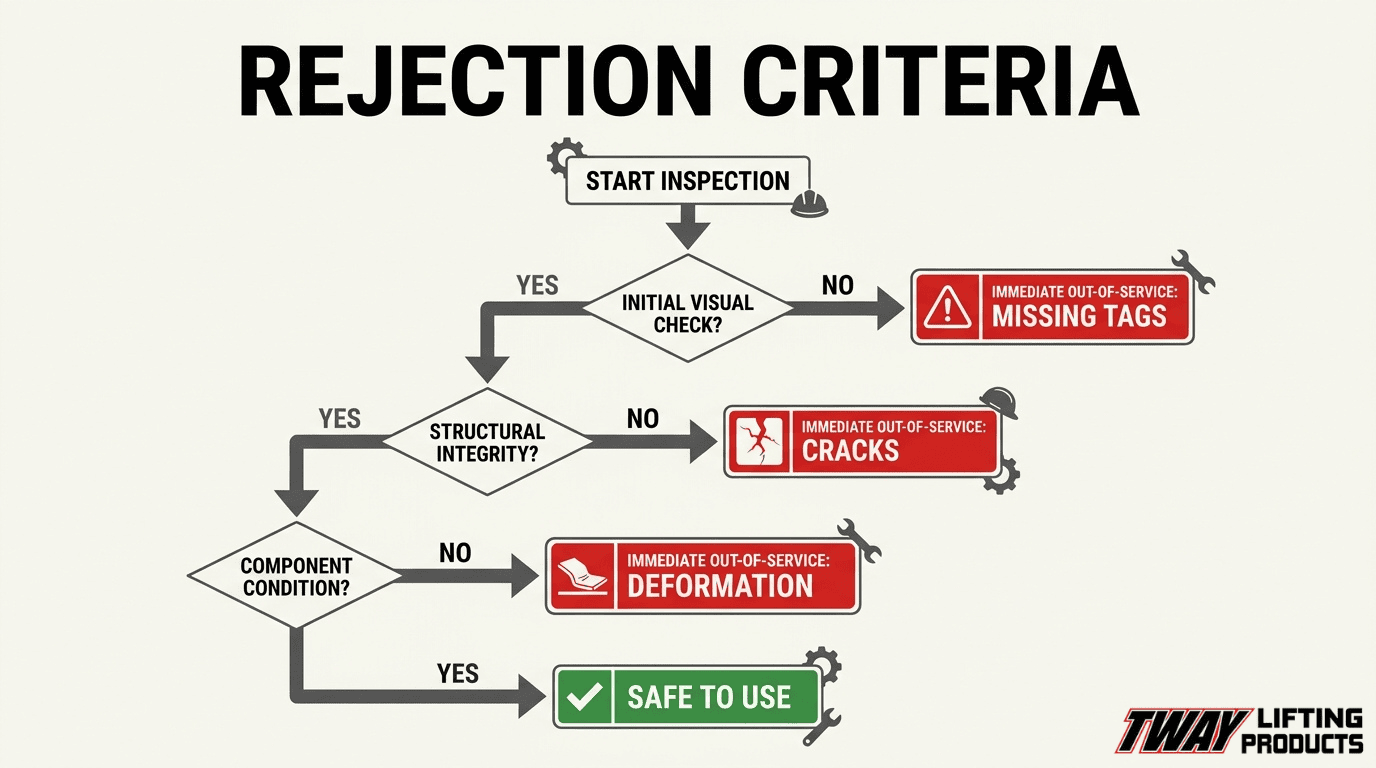
What Defects Make a Spreader Bar Immediately Out of Service?
The defects that make a spreader bar immediately out of service include visible cracks, bends, or deformation in the main beam; corroded or pitted structural members; damaged welds; missing or illegible capacity markings; and absent or expired inspection tags.
ASME B30.20-2025 provides removal criteria for below-the-hook lifting devices, focusing specifically on structural integrity and the presence of visible ratings and identification. Equipment missing its annual inspection tag must be removed from service until a proper inspection is conducted and a new tag is issued. Additional automatic rejection triggers include:
- Elongated or deformed lifting lugs and pad eyes.
- Cracked, bent, or thread-damaged shackle pins and attachment hardware.
- Pin locking devices that are missing, loose, or non-functional.
- Weld discontinuities, undercutting, or signs of repair welding not certified by a qualified engineer.
- Evidence of prior overloading, such as unusual indentation or wear marks on structural members.
Any single condition from this list is sufficient grounds to refuse the equipment before a lift begins.
What Should You Do If the Rental Bar Fails Your Pre-Use Inspection?
If the rental bar fails your pre-use inspection, you must immediately remove it from service, notify the rental provider in writing, and document all observed defects with photographs before returning the equipment.
According to the Pisanchyn Law Firm, if an employee is injured while using rented equipment, both the subcontractor in charge of the job site and the rental agency can be held liable. This shared liability makes a clear paper trail essential. The correct response sequence is:
- Tag the bar out of service and physically segregate it from usable equipment.
- Photograph every identified defect with date-stamped images.
- Notify the rental provider in writing, describing each defect and requesting a replacement or documented resolution.
- Record all findings in your site safety log before any lift proceeds.
- Do not accept a verbal assurance from the rental provider that the equipment is safe; require current inspection documentation with the replacement unit.
Returning a failed bar promptly protects your crew and establishes your due diligence should a liability dispute arise.
How Do Tway Lifting’s Rental and Inspection Services Support Safe Spreader Bar Use?
Tway Lifting supports safe spreader bar use by combining certified inspection expertise with a rental fleet maintained to OSHA and ASME standards. The H3s below cover specialist verification services and the article’s core takeaways.
Can Tway Lifting’s Certified Rigging Specialists Inspect or Verify Rental Lifting Gear?
Yes, Tway Lifting’s certified rigging specialists can inspect and verify rental lifting gear. Founded in 1945 and now in its third generation of leadership, Tway Lifting employs factory-trained, certified specialists who perform OSHA-required annual inspections, job site safety inspections, and detailed reporting for lifting equipment including spreader beams rated from 2 to 100 tons.
Tway Lifting’s rental fleet includes spreader beams, shackles, synthetic slings, and telescopic adjustable-length bars, all maintained under documented inspection protocols. According to the Pacific Northwest National Laboratory (PNNL), rigging components must carry tagging with the inspection due date and load test date, approved by a qualified engineer or rigging specialist. Tway Lifting’s inspection process satisfies exactly this requirement, giving renters documented confidence before the first lift.
What Are the Key Takeaways About Inspecting a Rented Spreader Bar Before Use?
The key takeaways about inspecting a rented spreader bar before use center on documentation, structural verification, and load rating confirmation. Before any lift, renters should:
- Confirm current load test certificates and inspection records are supplied by the rental provider.
- Verify the capacity rating tag is visible and matches the lift plan’s Working Load Limit requirements.
- Inspect the main beam, end fittings, lifting lugs, pins, and locking devices for cracks, corrosion, deformation, and weld defects.
- Check telescoping or adjustable mechanisms for proper pin engagement and locking function.
- Remove the bar from service immediately if any out-of-service condition exists under ASME B30.20-2025 criteria.
- Account for rigging sling angles, since smaller angles increase compressive force on the bar beyond face-value capacity ratings.
Partnering with a specialist like Tway Lifting removes ambiguity from this process. With over 75 years of rigging expertise, Tway Lifting can verify gear condition, confirm documentation, and supply pre-inspected rental equipment so your team lifts with full regulatory confidence.