





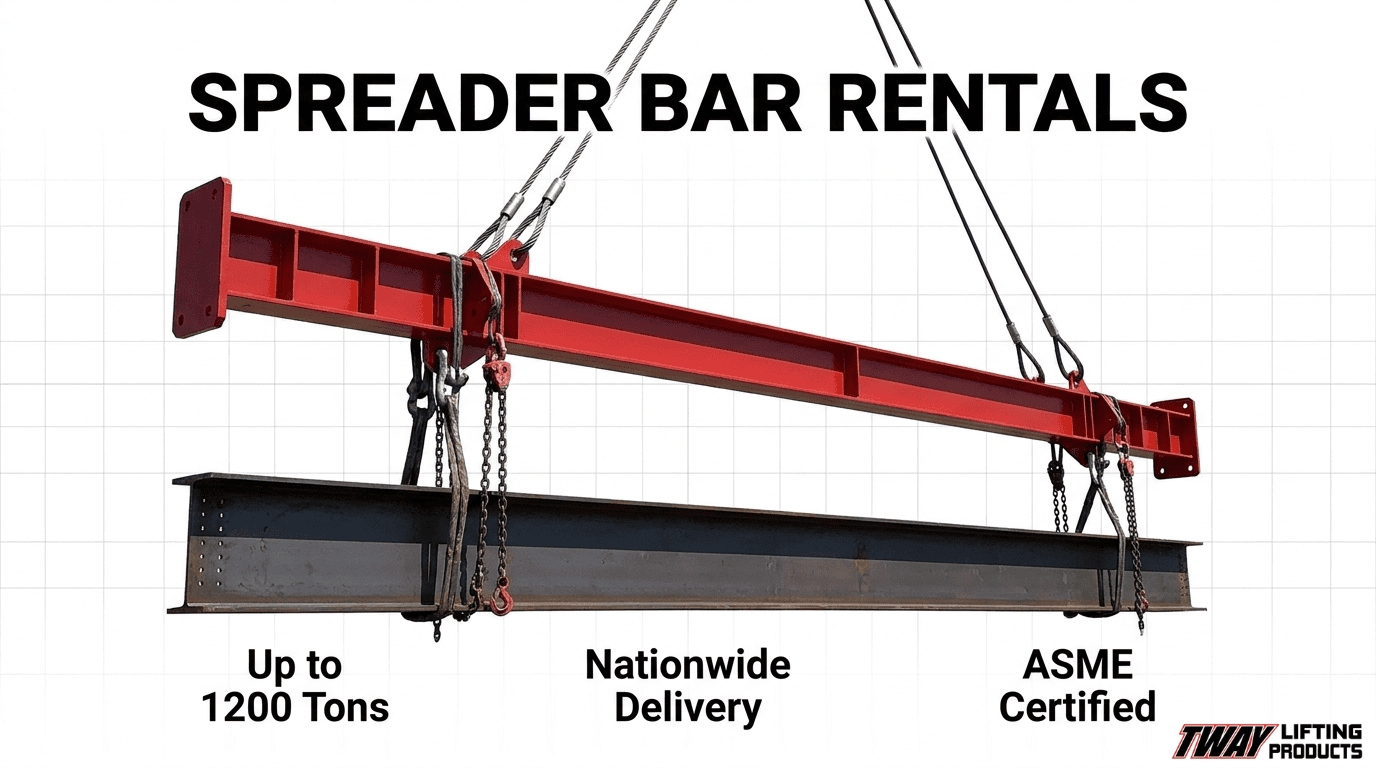

A spreader bar is a structural beam that converts lifting loads into compressive forces within the beam and tensile forces in the attached slings, distributing weight evenly across two lifting points rather than concentrating stress on one. Rental options span adjustable, fixed-length, below-the-hook, and pipe or structural models, with capacities reaching 1,200 tons and adjustable spreads from 3 to 100 feet.
This guide covers spreader bar fundamentals and equipment types, selection criteria for matching bars to your lift, industry applications and rental terms, cost and compliance considerations, regional availability across the United States, and how to evaluate providers before you commit.
Spreader bar mechanics and equipment types explain how force distributes through the system, how these bars differ from lifting beams, and what rental configurations are available, from versatile adjustable units to rigid pipe and structural models.
Selection, industry use, and rental terms walk through how to match capacity, length, and load geometry to your specific lift, which industries rely on spreader bar rentals most heavily, and what conditions govern minimum rental periods, insurance requirements, and damage liability.
Cost, safety compliance, and regional availability cover daily rental rates from $100 to $300 for light-duty bars, the ASME B30.20 and OSHA 1926.251 standards every rented bar must satisfy, and how availability, lead times, and fleet depth vary across the Midwest, Southeast, Northeast, and West.
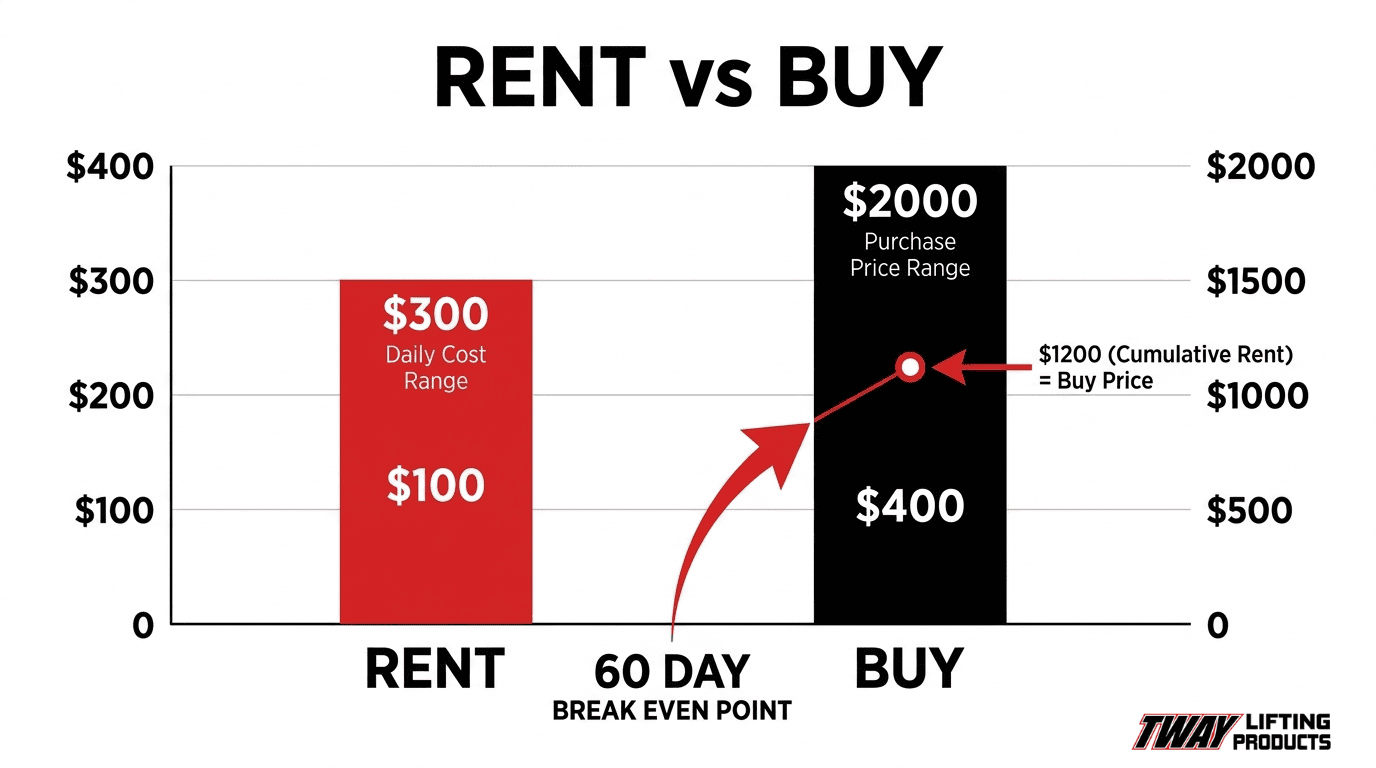
Provider evaluation and rent-versus-buy decisions address the questions to ask before signing a rental agreement, the 60-day annual usage threshold that determines when renting outperforms purchasing, and how Tway Lifting’s rental inventory, inspection services, and nationwide delivery support projects of any scale.
What Is a Spreader Bar and How Does It Work in Lifting?
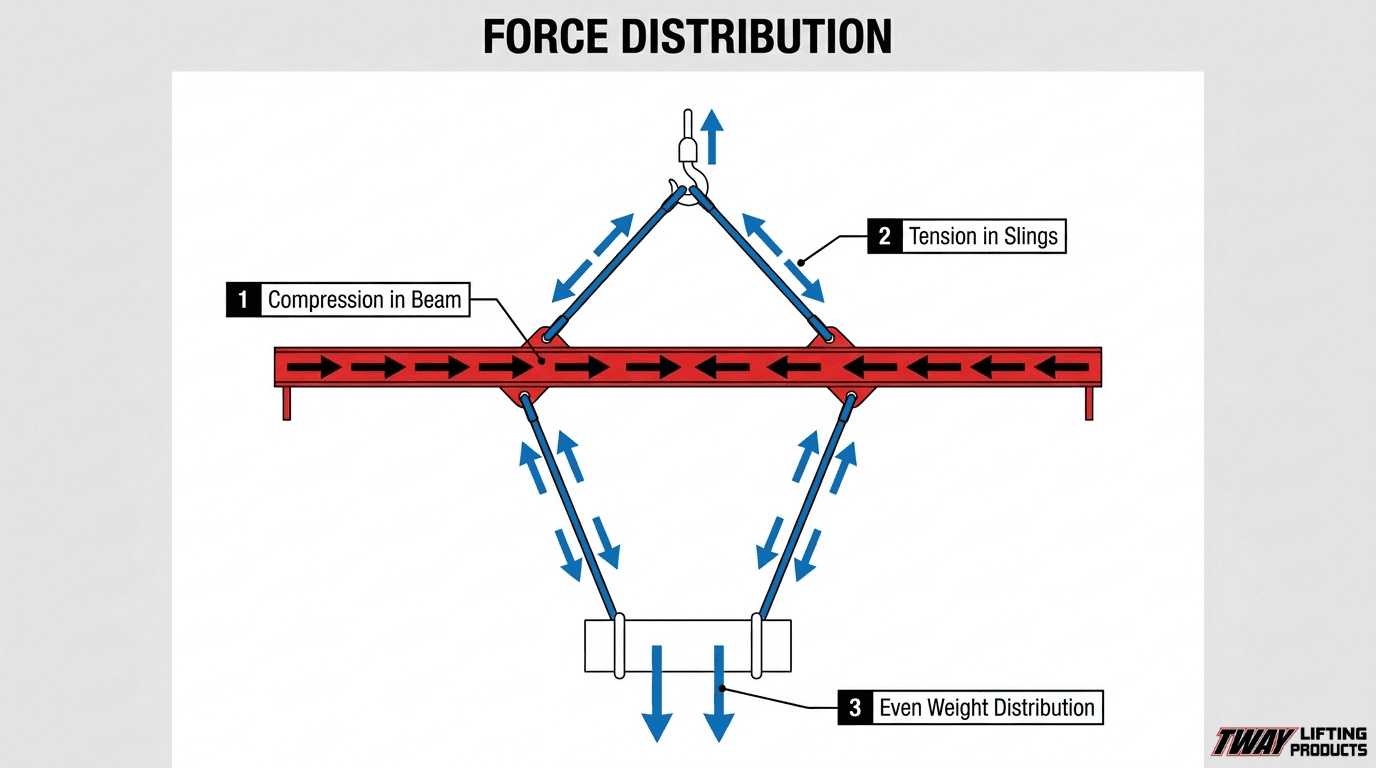
A spreader bar is a structural beam that converts lifting loads into compressive forces within the beam and tensile forces in the attached slings. It works by holding two slings apart, distributing a load’s weight evenly across both attachment points rather than concentrating stress on a single point.
How Does a Spreader Bar Distribute Load During a Lift?
A spreader bar distributes load by transferring the weight of a suspended object into compression along the beam’s length, while the overhead slings carry tension. According to Mazzella Companies, spreader beams are designed specifically to hold two slings apart, ensuring even weight distribution across both slings. This geometry reduces the risk of tipping, sliding, bending, or crushing during a lift, making spreader bars especially effective for wide, oversized, or unbalanced loads.
How Is a Spreader Bar Different from a Lifting Beam?
A spreader bar differs from a lifting beam primarily in how each handles stress. A spreader bar places the beam under compression, while a lifting beam places it under bending stress. Lifting beams use a single bail attachment on top, requiring less overhead clearance, whereas spreader bars need more headroom because the slings run above the beam. Spreader bars are lighter and more material-efficient; lifting beams are heavier and better suited for flexible or structurally weak loads requiring multi-point bottom support.
What Are the Key Components of a Spreader Bar System?
The key components of a spreader bar system are the beam itself, the overhead slings, the end fittings, and the connection hardware such as shackles. The beam body absorbs compressive force during the lift. Slings connect the beam’s end attachments to the crane hook above and to the load below, forming the load path. Proper sling angle calculation, using the formula θ = arcsin(H/L), is critical to preventing overloads on shackles, slings, and the beam itself.
What Loads and Capacities Can a Spreader Bar Handle?
Spreader bars can handle capacities ranging from light industrial loads up to 1,200 tons, with adjustable spreads from 3 to 100 feet in 1- to 2-foot increments. Modular designs allow for a wide range of configurations suited to diverse job site demands, including awkward or oversized loads that standard rigging cannot safely manage. For most rental applications, matching bar capacity to verified load weight before any lift is the single most important step a rigger can take.
What Types of Spreader Bars Are Available to Rent?
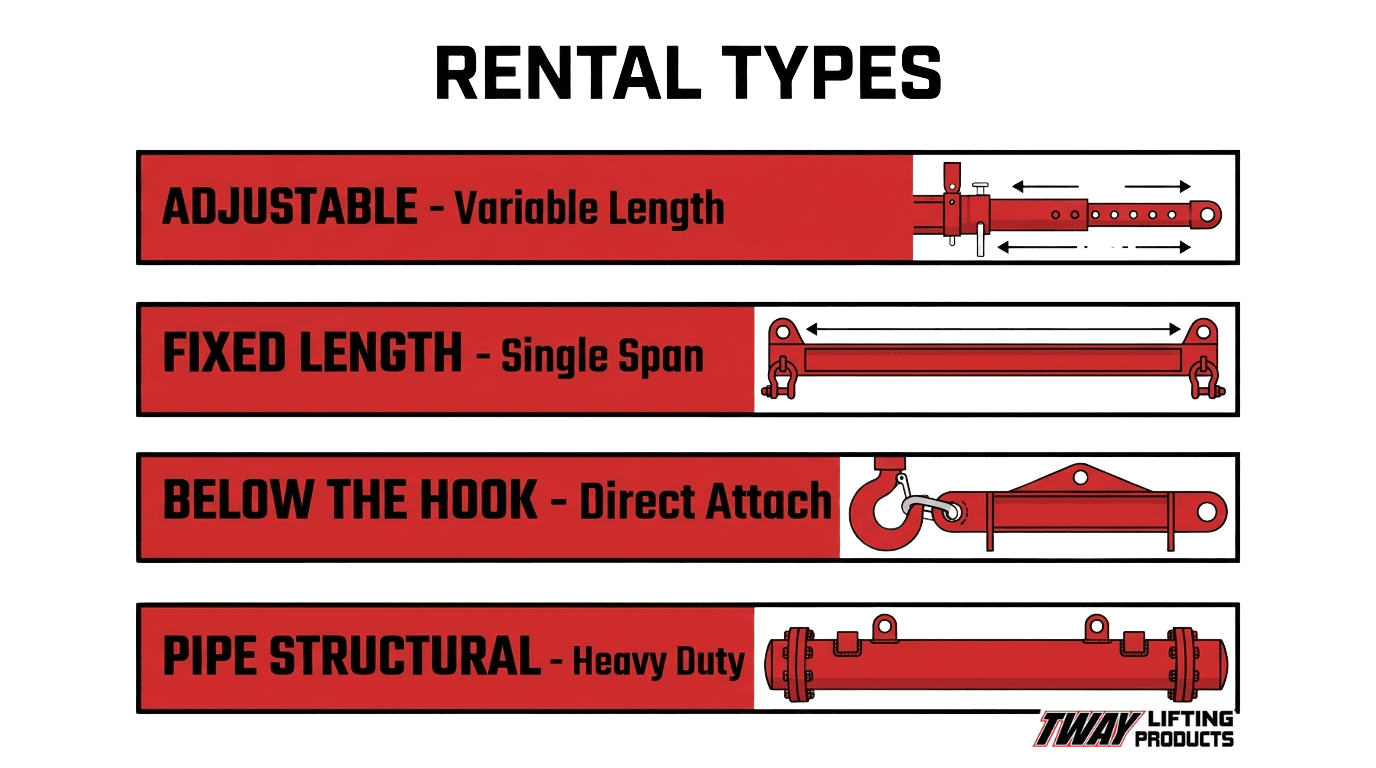
The types of spreader bars available to rent include adjustable, fixed-length, below-the-hook, and pipe or structural models. Each design addresses different load geometries, headroom constraints, and rigging configurations.
Adjustable Spreader Bars
Adjustable spreader bars are versatile lifting devices that allow riggers to change beam length and sling attachment points to match varying load widths on a single job site. They are especially valuable for awkward or oversized loads where a fixed geometry would require multiple bars. Capacities can reach well into the hundreds of tons, with spread increments as precise as one to two feet. Because adjustable units carry higher manufacturing costs, purchasing one can exceed $2,000, making rental the practical choice for most projects. ASME B30.20 governs marking, inspection, and maintenance requirements that all rental units must satisfy.
Fixed-Length Spreader Bars
Fixed-length spreader bars are rigid beams manufactured to a single, unchangeable span. They suit repetitive lifts where the load width and attachment points never vary, offering a simpler and typically lighter solution than adjustable alternatives. Rental availability spans a wide capacity range, and their straightforward design makes pre-use inspection faster and more consistent.
Below-the-Hook Spreader Bars
Below-the-hook spreader bars are lifting devices that attach directly beneath a crane hook to distribute load forces across multiple pick points. They are classified and regulated under ASME B30.20, which sets the inspection, testing, and marking requirements renters must verify before each use. This category covers both spreader and lifting beam configurations depending on whether the dominant stress is compressive or bending.
Pipe and Structural Spreader Bars
Pipe and structural spreader bars are heavy-duty units fabricated from pipe sections or structural steel profiles to handle high-compression loads across very wide spans. They are common in industrial plant work, bridge construction, and steel erection where load geometry is fixed and extreme capacity is required. Their rigid construction provides predictable load paths, simplifying the engineering review process before a critical lift.
How Do You Choose the Right Spreader Bar for Your Lift?
Choosing the right spreader bar requires matching three variables: load weight, bar length, and load geometry. The following sub-sections cover each selection factor in detail.
How Do You Match Spreader Bar Capacity to Your Load Weight?
Matching spreader bar capacity to your load weight starts with understanding how the bar handles force. A spreader beam is any beam where the load being lifted mainly puts a compressive stress in the beam, converting lifting loads into compressive forces in the beam and tensile forces in the slings. This force distribution spreads weight evenly across two lifting points rather than concentrating it on one.
The bar’s rated capacity must exceed your total load weight. For custom-designed lifting accessories, OSHA 1926.251(a)(4) requires proof-testing to 125% of rated load before use. Engineering calculations for spreader bar design must account for these fundamental load limits to ensure the selected bar operates safely within its design range.
Always confirm rated capacity markings on the bar before rigging begins.
How Do You Choose the Right Spreader Bar Length for Your Job?
Spreader bar length for your job depends on the distance between your load’s lifting attachment points. The bar must span those points without forcing slings into angles that generate dangerous compressive or side loads on rigging hardware.
Longer bars increase the horizontal spread between slings, which flattens sling angles and reduces vertical force efficiency. Shorter bars keep sling angles steeper and more efficient but require adequate headroom. Adjustable-length bars offer the most flexibility when attachment point spacing varies between jobs or is not precisely known in advance.
How Does Load Shape Affect Which Spreader Bar You Should Rent?
Load shape affects which spreader bar you should rent because irregular, asymmetric, or oversized loads create unequal force distribution across lifting points. A symmetrical rectangular load lifts predictably, but off-center or oddly shaped loads shift the center of gravity and apply unequal tension to slings.
For loads with unknown or variable weight characteristics, ASME BTH-1 prescribes design factors of Category A (Nd = 2.00) or Category B (Nd = 3.00), which must be marked on the device per ASME B30.20. More accurate knowledge of load characteristics allows for a lower design factor while maintaining safety. For irregular loads, renting an adjustable spreader bar with configurable sling attachment positions gives the rigger control over load balance that a fixed-geometry bar cannot provide.
How Does Your Rigging Configuration Influence Bar Selection?
Your rigging configuration influences bar selection through available headroom, crane hook height, and sling geometry. Spreader bars require overhead slings connecting the bar’s end fittings to the crane hook, which consumes vertical headroom above the load. If headroom is limited, a shorter bar or a lifting beam may be the more practical option.
The number of lifting points on the load, the crane’s hook block configuration, and whether a single crane or tandem cranes are used all determine which bar geometry fits the lift. Two-point lifts suit standard spreader bars, while multi-point loads may require modular systems with multiple attachment positions.
What Industries Commonly Rent Spreader Bars?
The industries that commonly rent spreader bars include construction, manufacturing, energy, transportation, and entertainment rigging. Each sector relies on spreader bars to safely handle oversized, heavy, or structurally sensitive loads that standard rigging cannot support alone.
Construction
The construction industry rents spreader bars to lift structural steel beams, precast concrete panels, and large HVAC units during building assembly. Wide, heavy loads require evenly distributed lift points to prevent bending, crushing, or tipping during placement. This is one of the highest-volume use cases for spreader bar rentals nationally.
Manufacturing and Steel Production
Manufacturing and steel production facilities rent spreader bars to move large machinery, fabricated assemblies, and raw material coils. These environments frequently handle loads too wide or rigid for single-point rigging, making spreader bars essential for both floor-level transfers and overhead crane operations.
Energy and Utilities
Energy and utility projects rent spreader bars to install transformers, generators, turbine components, and pipeline sections. These loads are often extremely heavy, irregularly shaped, and sensitive to uneven force distribution during placement, requiring precise load balancing across multiple lift points.
Transportation and Heavy Haul
Transportation and heavy haul operations use spreader bars when loading or offloading oversized cargo from flatbeds, rail cars, and barges. Controlled, balanced lifts reduce the risk of load shift during transfer, which is critical when working near vehicles or watercraft.
Entertainment Rigging
Entertainment rigging crews rent spreader bars to hang large stage structures, LED screens, speaker arrays, and scenic elements in arenas and stadiums. The modular configurations available support diverse rigging layouts in venues where headroom and load control are tightly managed.
What Are the Typical Rental Terms and Conditions for Spreader Bars?
Rental terms for spreader bars vary by provider but generally cover minimum rental periods, insurance requirements, and damage liability. The following sections break down each of these key conditions.
What Is the Minimum Rental Period for a Spreader Bar?
The minimum rental period for a spreader bar is typically one day, with most providers offering daily, weekly, or monthly terms. Tway Lifting provides spreader bars on a quote-by-quote basis with all three duration options, giving project managers flexibility to match rental length to actual job timelines. Weekly and monthly rates almost always reduce the effective daily cost, making longer commitments the smarter choice for extended projects.
What Insurance or Liability Requirements Apply to Rentals?
The insurance requirements that apply to spreader bar rentals include proof of general liability coverage, which most reputable providers require before releasing equipment. Tway Lifting specifically requires proof of insurance as a standard condition of every rental agreement. This protects both parties in the event of a worksite incident involving the rented equipment. Renters should verify their policy covers below-the-hook lifting devices and third-party property damage before finalizing any rental contract.
What Happens If a Rented Spreader Bar Is Damaged on the Job?
What happens when a rented spreader bar is damaged on the job depends on the rental agreement and the renter’s insurance coverage. Most rental providers hold the renter financially responsible for damage beyond normal wear, including repair costs or full replacement if the bar is rendered unusable. This is precisely why proof of insurance is a standard rental prerequisite. Reviewing damage liability clauses carefully before signing protects your project budget from unexpected costs.
How Much Does It Cost to Rent a Spreader Bar?
Spreader bar rental costs vary by capacity, duration, and location. The sections below break down pricing for light-duty and heavy-duty units and explain how rental terms and geography influence your total cost.
How Much Does It Cost to Rent a Light-Duty Spreader Bar?
Light-duty spreader bar rental costs typically range from $100 to $300 per day, depending on location and capacity. Renting is generally more cost-effective than purchasing for projects requiring the equipment fewer than 60 days per year. For occasional lifts, the daily rate keeps capital free for other job site needs, making rental the smarter financial choice for most short-term or infrequent applications.
How Much Does It Cost to Rent a Heavy-Duty Spreader Bar?
Heavy-duty spreader bar rental costs scale above the standard daily range as capacity and engineering requirements increase. Larger bars with higher tonnage ratings, specialized rigging configurations, or extended spreads command premium daily rates that reflect the equipment’s load-handling complexity. For heavy-lift projects, sourcing a quote-by-quote rental from a provider with verified compliance documentation is essential to control costs and avoid on-site delays.
How Do Rental Duration and Location Affect the Total Cost?
Rental duration and location directly affect the total cost of a spreader bar rental. Longer terms, such as weekly or monthly agreements, reduce the effective daily rate compared to single-day rentals. Geographic factors, including delivery distance, regional equipment availability, and local market demand, add variability to base pricing. Projects in remote or underserved areas typically incur higher logistics costs, making proximity to a national provider with delivery capabilities a meaningful cost advantage.
What Safety Standards Apply to Rented Spreader Bars?
The safety standards that apply to rented spreader bars come from two primary frameworks: OSHA regulations and ASME standards. The sections below cover governing standards, verification methods, and pre-use inspection requirements.
What ASME and OSHA Standards Govern Spreader Bar Use?
The ASME and OSHA standards that govern spreader bar use are ASME B30.20, ASME BTH-1, and OSHA 1926.251. ASME B30.20 specifies requirements for marking, inspection, testing, and maintenance of lifting beams and spreader bars. ASME BTH-1 addresses design considerations, including allowable stresses for shear, bending, compression, and connection design.
OSHA 1926.251 does not provide inspection criteria for below-the-hook lifting devices other than slings. However, according to an OSHA Standard Interpretation, following ASME B30.20 sections 20-1.3.1 through 20-1.3.7 and 20-1.3.9 satisfies OSHA’s General Duty Clause for these devices. Notably, manufactured lifting beams are exempt from the proof-testing and marking requirements of OSHA 1926.251(a)(4), while custom-designed accessories require proof-testing to 125% of rated load.
How Do You Verify a Rental Spreader Bar Meets Safety Requirements?
Verifying a rental spreader bar meets safety requirements starts with confirming the unit carries required ASME B30.20 markings, including rated capacity and design category. Request documentation showing the bar was manufactured to ASME BTH-1 standards, with the design factor category (Category A at Nd = 2.00 or Category B at Nd = 3.00) clearly marked on the device.
For custom-designed or modified bars, confirm proof-test records at 125% of rated load exist, as required by OSHA 1926.251(a)(4). A reputable rental provider should supply maintenance and inspection history without hesitation. Skipping this documentation step is one of the most common compliance oversights on rental equipment.
What Pre-Use Inspections Should You Perform on a Rented Bar?
The pre-use inspections you should perform on a rented bar follow the criteria in ASME B30.20, which sets the compliance benchmark recognized under OSHA’s General Duty Clause. Before each lift, check the following:
- Confirm capacity markings and design category are legible and match your lift plan.
- Inspect the beam body for cracks, deformation, corrosion, or weld defects.
- Check all attachment points, shackle holes, and lifting lugs for wear, elongation, or damage.
- Verify pins, bolts, and locking mechanisms are secure and undamaged.
- Confirm adjustable components (if applicable) lock positively at the required spread distance.
- Review rental documentation for any prior damage reports or repairs.
With governing standards and inspection protocols understood, selecting a rental provider who maintains compliance records is the logical next step.
How Do Regional Rental Options Differ Across the United States?
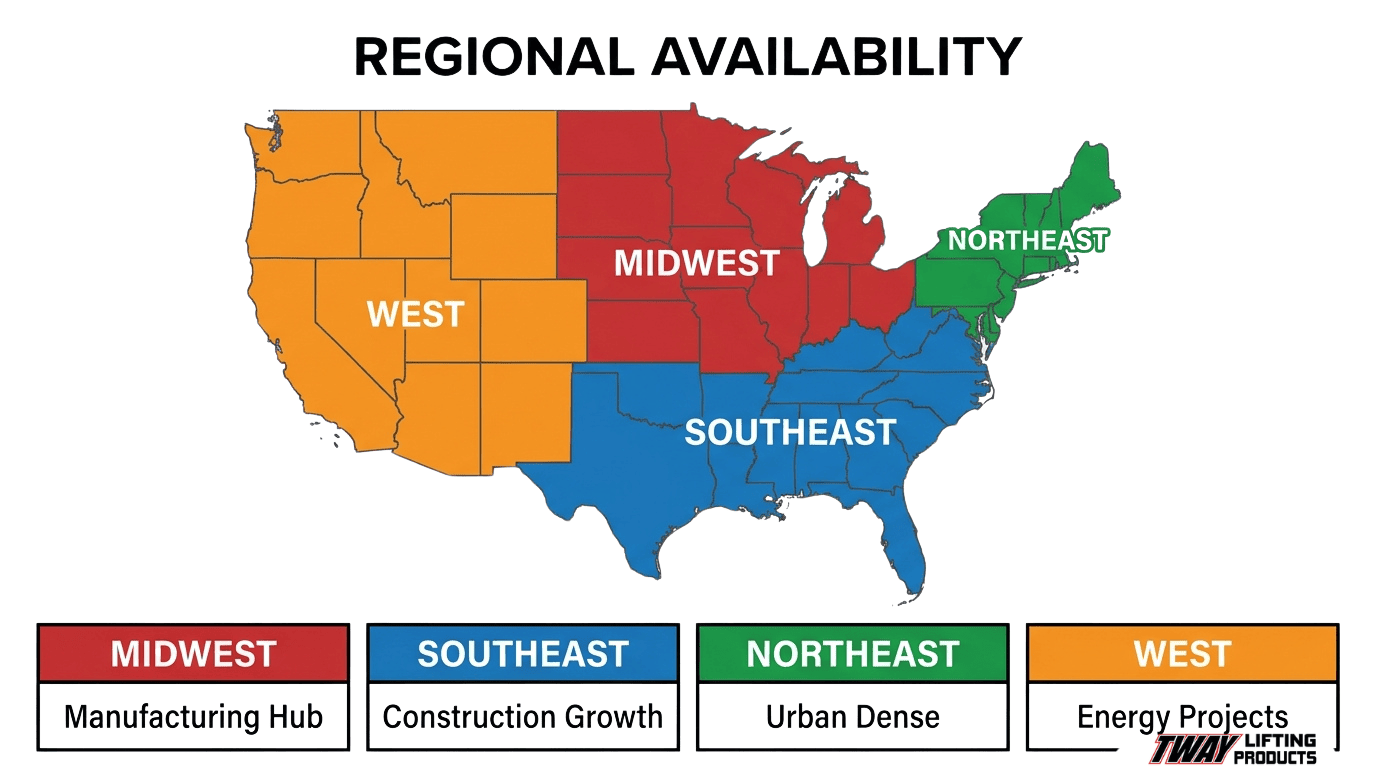
Regional spreader bar rental options differ based on local industry demand, fleet availability, and project density. The sections below cover how availability, lead times, and provider access vary across the Midwest, Southeast, Northeast, and West.
How Do Spreader Bar Rental Options Vary in the Midwest?
Spreader bar rental options in the Midwest are shaped by the region’s strong manufacturing, steel production, and automotive sectors. Cities like Indianapolis, Chicago, and Detroit generate consistent demand for below-the-hook lifting equipment, which supports a well-stocked regional rental fleet. Providers serving the Midwest typically carry a broad capacity range, with shorter lead times due to high inventory turnover. According to a 2025 Global Market Insights report, United Rentals led the U.S. construction equipment rental market with over 10% market share, reflecting the scale of national providers operating across Midwest industrial corridors.
How Do Spreader Bar Rental Options Vary in the Southeast?
Spreader bar rental options in the Southeast are driven by active construction, utility infrastructure, and port logistics projects. States like Florida, Georgia, and Texas border regions see elevated demand during hurricane recovery and energy sector buildouts. Rental fleets in this region often stock adjustable and heavy-capacity spreader bars suited for structural steel and large panel lifts. Availability is generally strong in metropolitan hubs, though rural job sites may require more lead time for delivery coordination.
How Do Spreader Bar Rental Options Vary in the Northeast?
Spreader bar rental options in the Northeast reflect the region’s dense urban construction environment and space-constrained job sites. Markets like New York City, Boston, and Philadelphia require compact rigging solutions and precise scheduling due to site access limitations. Rental providers here tend to prioritize shorter-span and lighter-capacity spreader bars for interior and high-rise applications. Availability can tighten during peak construction seasons, so early booking is advisable for projects in dense metro areas.
How Do Spreader Bar Rental Options Vary in the West?
Spreader bar rental options in the West are influenced by large-scale energy, mining, and infrastructure development across states like California, Nevada, and Colorado. Long-haul delivery distances in remote Western regions can affect lead times and logistics costs. Major metros such as Los Angeles and Denver support well-equipped rental inventories for industrial and commercial lifts. For projects in less-served areas, working with a national provider offering nationwide delivery, like Tway Lifting, ensures access without fleet gaps.
What Should You Ask a Spreader Bar Rental Provider Before You Rent?
The questions you should ask a spreader bar rental provider before you rent cover equipment specifications, compliance documentation, rental terms, and delivery logistics. Asking the right questions upfront prevents costly project delays, safety violations, and equipment mismatches.
The key questions to ask include:
- What is the rated capacity and ASME design category of this bar? Confirm the WLL matches your load weight and that the bar carries ASME BTH-1 Category A or B markings as required by ASME B30.20.
- Is current inspection documentation available? Request written inspection records showing the bar meets pre-use condition standards before it leaves the yard.
- What are the daily, weekly, and monthly rental rates? Clarify all pricing tiers, overage fees, and whether delivery is included or billed separately.
- Do you provide nationwide delivery? For multi-region projects, confirm the provider can ship to your job site and what lead times apply.
- What insurance or proof-of-insurance documentation is required? Most providers require certificate of insurance before releasing equipment.
- What is the damage liability policy? Understand who bears responsibility for field damage and whether a damage waiver is available.
- Can the bar be configured for adjustable spread or off-center loads? Verify whether the rental unit is fixed-length or adjustable, and whether accessories like shackles and slings are included.
- Is the provider aligned with current rental market practices? According to a 2025 Global Market Insights report, the construction equipment rental market reached USD 159.8 billion, with subscription-based and long-term rental models emerging as a growing opportunity. Providers offering flexible term structures and digital quote processes reflect this shift.
Asking these questions protects your crew, your schedule, and your budget before any lift begins.
How Does Renting Compare to Buying a Spreader Bar?
Renting compares to buying a spreader bar primarily on the basis of usage frequency, upfront cost, and project duration. Renting suits short-term or infrequent needs, while purchasing delivers better value for consistent, long-term use. The H3s below break down the cost thresholds and break-even points for each decision.
What Are the Cost Differences Between Renting and Buying a Spreader Bar?
The cost differences between renting and buying a spreader bar are significant at both entry and specialty levels. Spreader bar rental typically costs $100 to $300 per day, depending on location and capacity. Purchasing ranges from $400 for basic 2-ton models to over $2,000 for adjustable units. For most project budgets, renting eliminates large upfront capital expenditure while still providing access to the right capacity bar for the job.
When Is Renting a Spreader Bar More Cost-Effective Than Buying?
Renting a spreader bar is more cost-effective than buying when annual usage falls below 60 days per year. For specialty spreader bars with higher purchase prices, the rental-versus-purchase break-even point arrives sooner, around 30 days of annual use. Projects with unpredictable timelines or varying load requirements benefit most from renting, since different bar configurations can be selected per job without owning multiple units.
When Does Buying a Spreader Bar Make More Financial Sense?
Buying a spreader bar makes more financial sense for operations that use the equipment consistently throughout the year. When annual usage exceeds 60 days, cumulative daily rental fees surpass the purchase price, making ownership the more economical path. Companies with standardized lifting tasks, fixed load weights, and dedicated rigging teams are the strongest candidates for purchasing rather than renting.
With both cost thresholds and usage benchmarks in hand, the next step is finding a rental provider equipped to match your project requirements nationally.
How Do Tway Lifting’s Equipment Rentals Support Your Spreader Bar Needs?
Tway Lifting’s equipment rentals support spreader bar needs through flexible rental terms, certified inspection services, and nationwide delivery. The sections below cover what Tway Lifting offers and key takeaways from this guide.
Can Tway Lifting’s Rental and Inspection Services Cover Your Project?
Yes, Tway Lifting’s rental and inspection services can cover your project, whether it involves a short-term lift or an extended industrial operation. Tway Lifting offers spreader beams ranging from 2 to 100 tons and up to 40 feet in length, available on daily, weekly, or monthly terms with nationwide delivery. Proof of insurance is required, and quotes are provided on a per-project basis. Beyond hardware, Tway Lifting’s certified inspection specialists perform OSHA-required annual inspections, job site safety inspections, and detailed reporting, ensuring every rented bar meets compliance requirements before use. With over 75 years of rigging experience, Tway Lifting brings a depth of technical expertise that generic rental houses simply cannot match.
What Are the Key Takeaways About Regional Spreader Bar Rental Options We Covered?
The key takeaways about regional spreader bar rental options covered in this guide are organized around capacity, cost, compliance, and sourcing. Spreader bar capacities range from 24 to 1,200 tons, with adjustable spreads from 3 to 100 feet, making selection a precision decision tied directly to load weight, shape, and rigging configuration. Rental rates and availability vary by region, so engaging a national provider with local delivery capability simplifies logistics. Safety compliance under ASME B30.20 and OSHA standards is non-negotiable, regardless of rental source. For most projects under 60 days per year, renting outperforms purchasing on cost. Tway Lifting combines rental inventory, inspection services, and manufacturing expertise under one roof.