



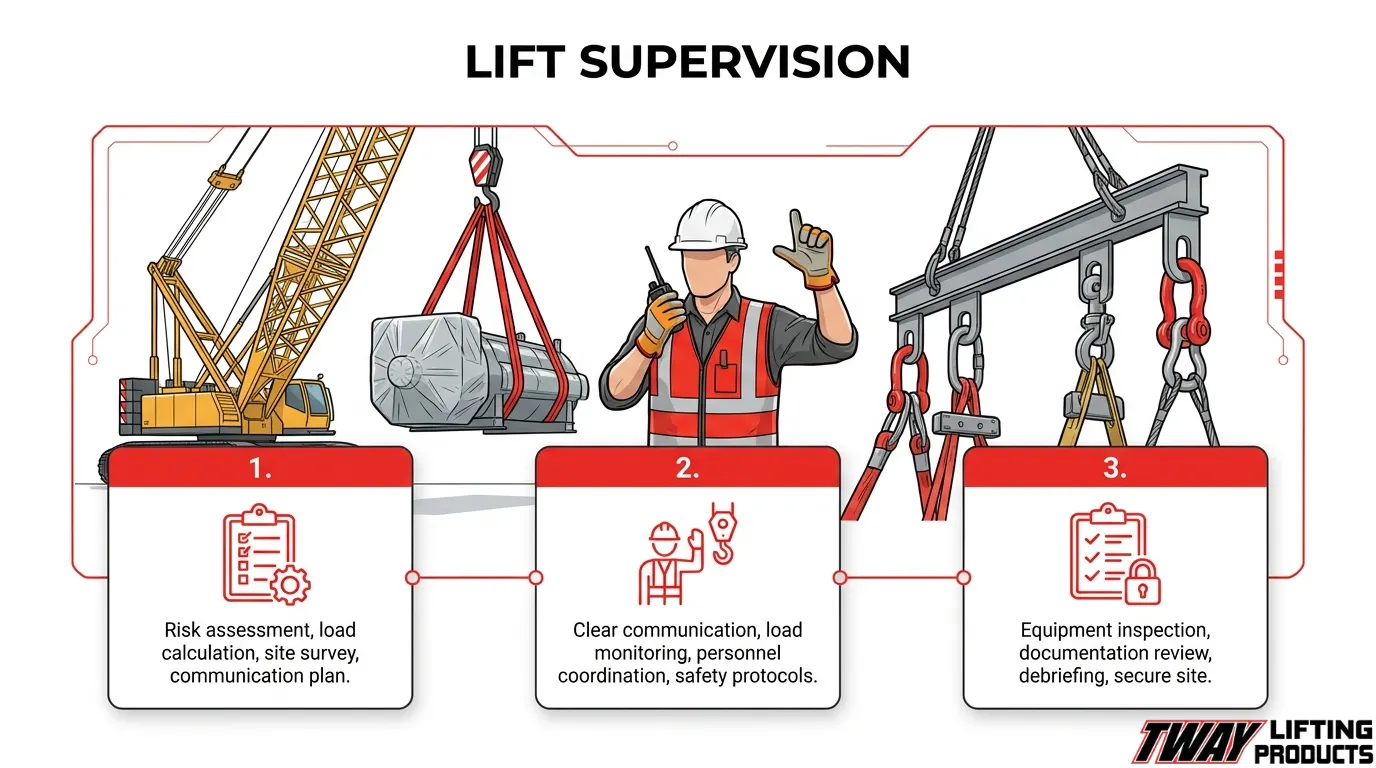

On-site lift supervision is a structured safety and compliance function where a qualified lift director manages all phases of a crane operation, from pre-lift planning through post-lift closeout, while maintaining physical presence and stop-work authority throughout.
This guide covers what lift supervision actually involves on site, who is legally required to have it, the federal and industry standards that govern it, supervisor qualifications, critical lift plan requirements, risk management, industry applications, and how to evaluate a qualified provider.
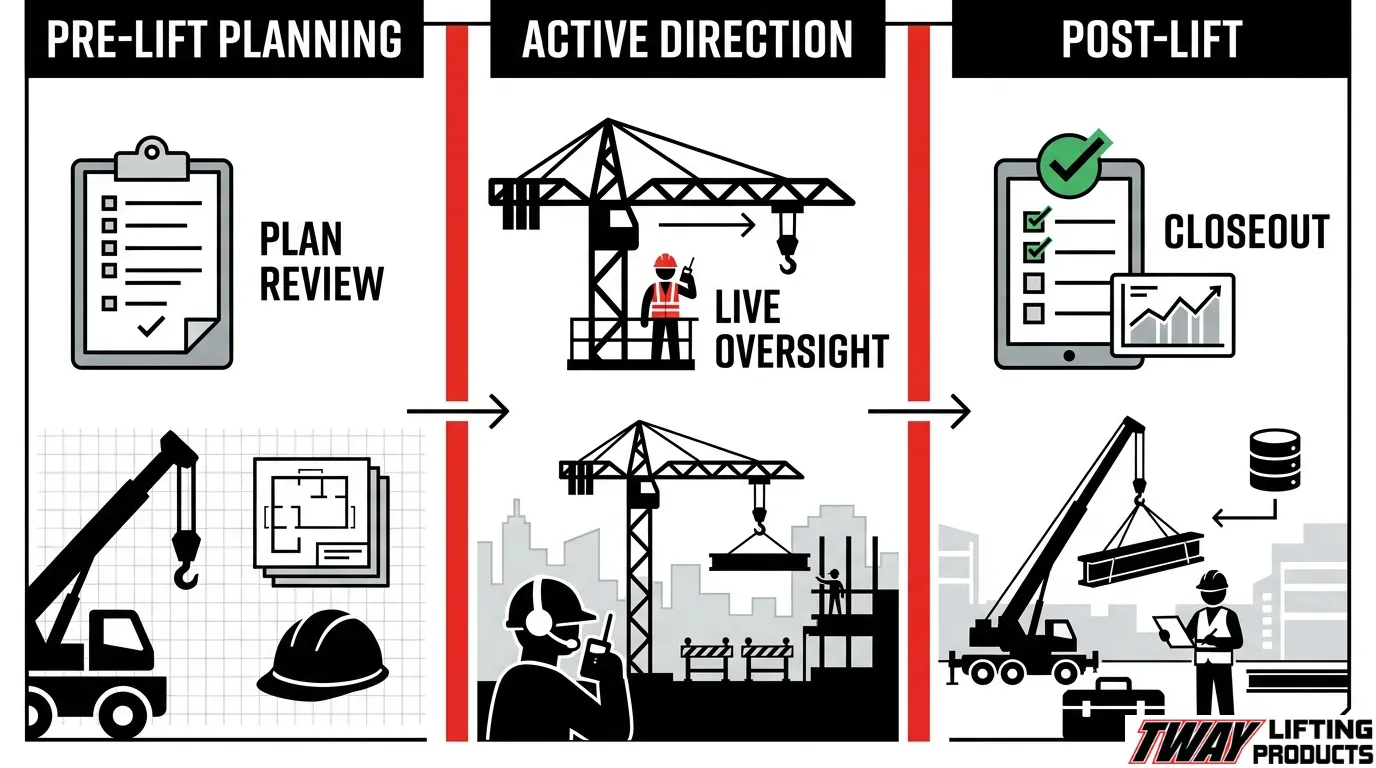
A lift supervisor’s duties span three distinct phases: pre-lift briefings, active direction during the pick, and post-lift equipment closeout. Each phase carries specific regulatory obligations under OSHA 29 CFR 1926 Subpart CC and DOE standards.
Supervision is mandatory for critical lifts, multi-crane operations, and picks approaching rated capacity thresholds. Federal regulations and state-level crane rules each define the conditions that trigger this requirement, and the consequences for non-compliance include documented fatalities and OSHA citations.
Regulatory frameworks from OSHA, ASME B30.5, and DOE-STD-1090-2020 establish overlapping obligations for supervisory presence, documentation, and personnel qualification. Supervisor credentials combine competent person designation, rigging knowledge, and lift plan interpretation skills, with NCCCO certification serving as a widely recognized benchmark.
Critical lift planning, risk control across the four dominant hazard categories, sector-specific applications in construction, industrial, and utilities work, and the integration of rigging inspection with supervisory oversight round out the full scope of what qualified lift supervision services cover.
What Does On-Site Lift Supervision Actually Involve?
On-site lift supervision involves three distinct phases: pre-lift planning, active direction during the lift operation, and post-lift closeout. Each phase carries specific duties that keep personnel safe and operations compliant.
What Happens During a Pre-Lift Planning Meeting?
A pre-lift planning meeting is a mandatory briefing where the lift supervisor reviews the lift plan with every worker involved before any equipment moves. The Federal Code of Federal Regulations (29 CFR 1926.1432) requires that for multi-crane lifts, the lift director must review the plan in a meeting with all workers who will be involved in the operation. Topics covered include load weight and rigging selection, hazard identification, equipment configuration, personnel roles, and emergency procedures. For lifts where the combined load and rigging exceed 85% of crane rated capacity, NASA’s safety manual requires a load cell to verify actual weight before the lift proceeds. Skipping or shortcutting this meeting is one of the most common contributors to preventable incidents on lift sites.
What Does a Lift Supervisor Do During the Lift Operation?
A lift supervisor’s duties during the lift operation include maintaining continuous physical presence, directing all crane movements, and holding authority to stop work immediately when unsafe conditions arise. According to DOE-STD-1090-2020, the lift director must be present at the lift site during the entire lifting operation, with responsibilities covering personnel qualification confirmation, hazard surveying, equipment and rigging verification, and emergency response direction. This stop-work authority is not advisory; it is a defined regulatory duty. A 2024 U.S. Department of Labor enforcement action against Adcock Cranes illustrates what happens when supervisory oversight fails: an outrigger gave way and tipped a 110-ton Liebherr crane into a worker because ground conditions were never verified as adequate before the lift began. Active, attentive supervision is the primary control between a normal lift and a fatal incident.
What Responsibilities Does a Lift Supervisor Have After the Lift?
A lift supervisor’s responsibilities after the lift include directing the safe removal and storage of all rigging components, confirming equipment is returned to designated storage, and documenting the completed operation. The University of Tennessee’s Environmental Health and Safety program specifies that all slings and accessories must be removed from the hook and returned to designated storage racks once the lift is complete. Beyond equipment, the post-lift phase covers incident or near-miss reporting, reviewing whether the lift plan performed as expected, and flagging any equipment conditions requiring inspection before the next use. This closeout phase is often underestimated, but it directly determines whether the next lift crew inherits safe, inspected equipment or inherits undetected risk.
Who Is Required to Have On-Site Lift Supervision?
On-site lift supervision is required for critical lifts, high-capacity picks, and all multi-crane operations. The following sections cover which lift scenarios trigger mandatory supervision under industry standards and federal regulations.
Is On-Site Lift Supervision Required for Critical Lifts?
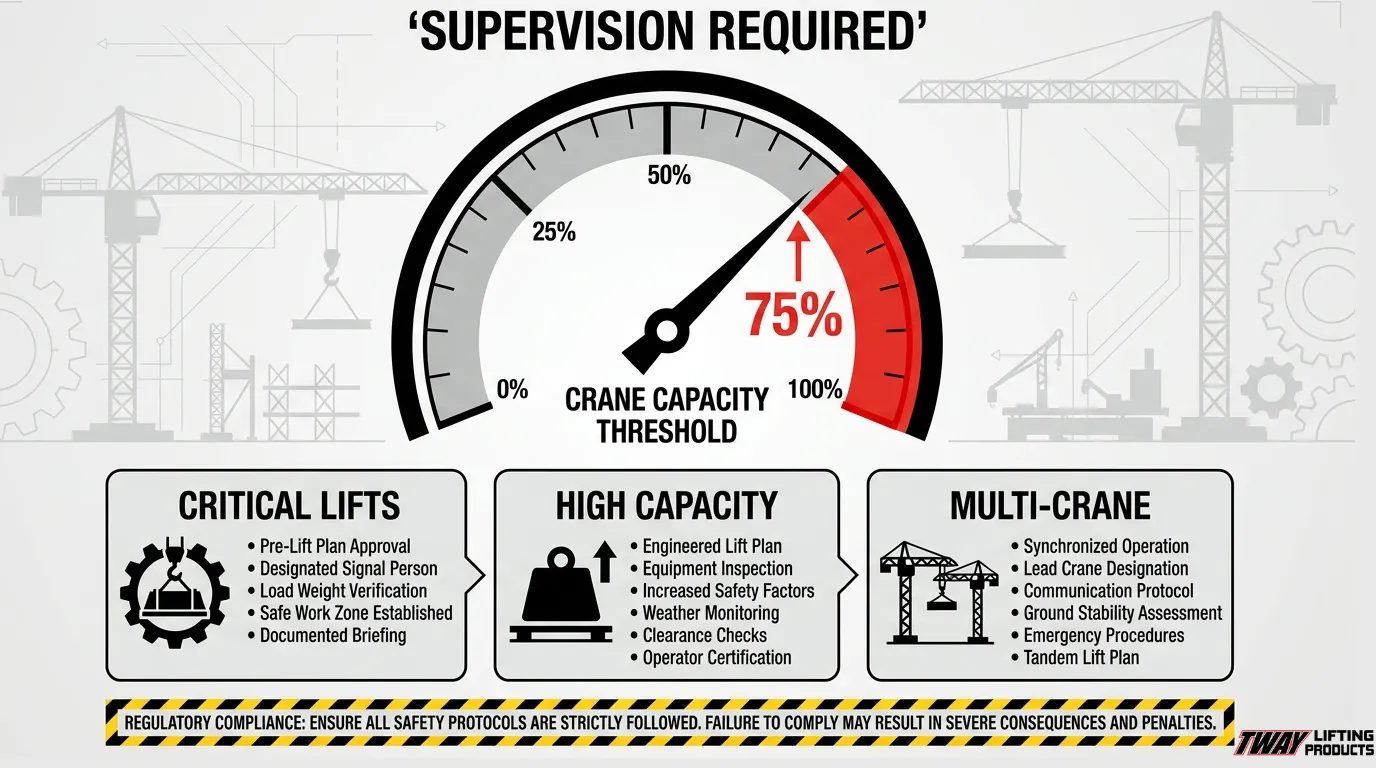
On-site lift supervision is required for critical lifts under both state regulations and federal agency standards. Washington State’s crane rule defines a critical lift as one exceeding 75% of rated load chart capacity or involving more than one crane, and requires the critical lift plan to be in written or digital format and on-site during the lift. The Bonneville Power Administration similarly classifies critical lifts as any non-routine crane lift requiring detailed planning and additional safety precautions, including personnel hoisting and lifts where the load moves outside the operator’s view.
In practice, any lift that crosses these thresholds demands a designated supervisor present throughout the operation, not just during setup.
Is Lift Supervision Required for Picks Over a Certain Percentage of Crane Capacity?
Lift supervision is required for picks approaching or exceeding recognized capacity thresholds, because high-capacity lifts carry disproportionate fatality risk. According to the U.S. Bureau of Labor Statistics, crane-related work produced 297 deaths between 2011 and 2017, averaging 42 fatalities per year. A NIOSH study of crane accidents from 1992 to 2006 found that 32% of deaths resulted from overhead power line electrocutions, and 24 of 40 struck-by fatalities were caused by rigging failure. Both hazard types intensify as loads approach rated capacity, making active supervision at high-percentage picks a critical control measure.
Do Multi-Crane Lifts Require a Dedicated On-Site Lift Supervisor?
Multi-crane lifts require a dedicated on-site lift supervisor under federal regulation. Under 29 CFR 1926.1432, the operation must be planned before it begins, and the lift must be directed by a person who meets the criteria for both a competent person and a qualified person, or by a competent person assisted by one or more qualified persons serving as lift director. That lift director must review the plan in a pre-lift meeting with all workers involved in the operation. No multi-crane lift may proceed without this dedicated supervisory role filled by a fully qualified individual on-site.
What Regulations Govern On-Site Lift Supervision in the US?
On-site lift supervision in the US is governed by OSHA standards, ASME/ANSI technical standards, and federal regulations under 29 CFR 1926 Subpart CC. The sections below cover OSHA enforcement, industry standards, and the specific construction crane rules that apply.
What Does OSHA Say About Crane Lift Supervision Requirements?
OSHA’s crane lift supervision requirements establish that inadequate supervision is a citable and penalizable violation. An OSHA inspection record documents a fatality where an employee was killed when struck by a crane trolley, with “Insufficient Supervision” and “Lack of Work Procedures” listed as violation keywords. That case carried an initial penalty of $23,215, reduced to $15,000. These enforcement records demonstrate that OSHA treats absent or deficient lift supervision as a serious compliance failure, not a procedural technicality.
What ASME and ANSI Standards Apply to On-Site Lift Supervision?
The ASME and ANSI standards that apply to on-site lift supervision include ASME B30.5, which governs mobile and locomotive cranes across construction, inspection, testing, maintenance, and operation. According to ASME, B30.5 “offers comprehensive solutions applying to the construction, inspection, testing, maintenance and operation of mobile and locomotive cranes.” These standards set the technical baseline that supervisors must understand and enforce on site, complementing OSHA’s regulatory authority with detailed operational requirements.
What Are the Lift Supervision Requirements Under OSHA 1926 Subpart CC?
The lift supervision requirements under OSHA 1926 Subpart CC apply specifically to crane and derrick operations in construction. Under 29 CFR 1926.1432, multi-crane lifts must be directed by a person who qualifies as both a competent person and a qualified person, or a competent person supported by qualified persons serving as lift director. That lift director must review the lift plan in a pre-operation meeting with all workers involved. Subpart CC also establishes operator certification, equipment inspection, and assembly/disassembly supervision requirements that collectively define the full supervisory framework for construction crane work.
What Qualifications Must an On-Site Lift Supervisor Hold?
On-site lift supervisor qualifications combine demonstrated rigging knowledge, regulatory competency, and formal training. The following H3s cover rigger certification requirements, crane operator credentials, and pre-supervision training standards.
Does a Lift Supervisor Need to Be a Certified Rigger?
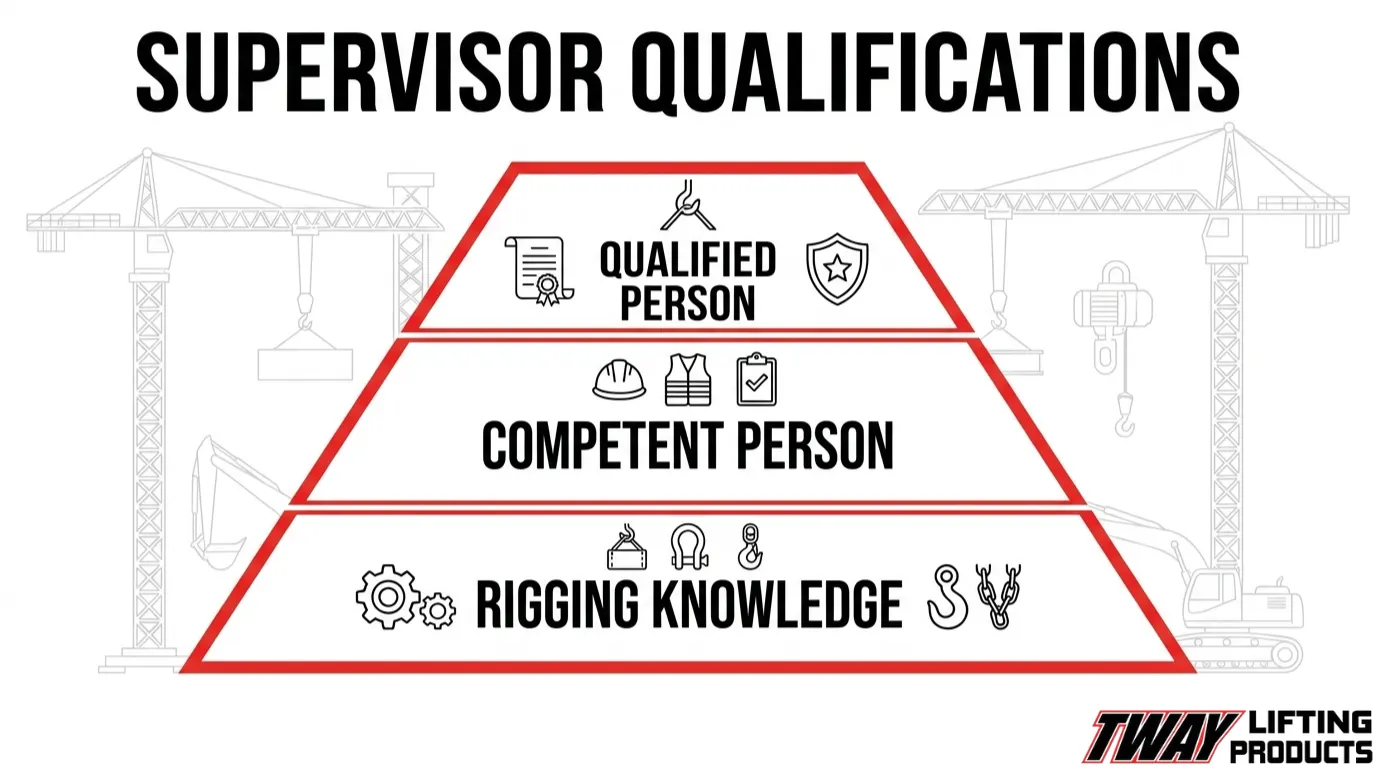
A lift supervisor does not universally require certified rigger status by a single federal mandate, but rigger certification is strongly recommended and often contractually required. OSHA 1926 Subpart CC distinguishes between qualified riggers and supervisory personnel, yet practical oversight of rigging operations demands that a supervisor understand load calculations, sling angles, and hardware inspection. Without hands-on rigging knowledge, a supervisor cannot meaningfully catch errors before they escalate. Most reputable project owners and general contractors require demonstrated rigging competency as a baseline qualification for anyone directing a lift.
Does a Lift Supervisor Need Crane Operator Certification?
A lift supervisor does not need crane operator certification to perform supervisory duties, as the roles are functionally distinct. However, understanding crane capacities, load charts, and operational limits is essential for directing a lift safely. According to the National Commission for the Certification of Crane Operators (NCCCO), candidates must pass both written and practical examinations to be certified for a five-year period. A supervisor with NCCCO familiarity, even without personal operator certification, is better equipped to verify that the assigned crane operator meets site requirements.
What Training Is Required Before Someone Can Supervise a Lift?
The training required before someone can supervise a lift includes formal rigging coursework, site hazard recognition, lift plan interpretation, and competent/qualified person designation. OSHA defines a competent person as someone capable of identifying hazardous conditions and authorized to take corrective action. A qualified person must possess recognized credentials or experience in the technical discipline. Together, these designations set the practical training floor for lift supervision, covering equipment verification, personnel briefing, and emergency response readiness.
What Is the Difference Between a Lift Supervisor and a Lift Rigger?
The difference between a lift supervisor and a rigger is one of authority and scope: the lift supervisor directs the entire operation, while the rigger executes the physical attachment and movement of loads under that direction.
A lift supervisor holds overall accountability for planning, hazard assessment, personnel qualification, and stopping work when unsafe conditions arise. The rigger focuses on hands-on tasks such as selecting, inspecting, and attaching slings, shackles, and other rigging hardware to the load before and during the lift.
These roles are complementary but distinct. A rigger may possess deep technical skill with rigging hardware, yet have no authority to direct the crane operator or halt the operation. The supervisor carries that decision-making authority. On complex or critical lifts, one person rarely fills both roles effectively, and attempting to do so divides attention at the moments when focus matters most.
According to Lawrence Berkeley National Laboratory, all rigging components, including slings and shackles, must be inspected by a qualified rigger prior to use, while the broader lift operation requires qualified supervisory oversight. That division reflects the core distinction: the rigger owns the hardware and its preparation; the supervisor owns the operation and its safety outcome.
What Is a Critical Lift Plan and Why Is It Required?
A critical lift plan is a formal written document that outlines all planning, calculations, personnel roles, and safety requirements before executing a high-risk crane lift. The following H3s cover what the plan must contain, who prepares it, and when it must be revised.
What Must Be Included in a Critical Lift Plan?
A critical lift plan must include crane configuration details, load weight calculations, rigging specifications, personnel assignments, site conditions, and the lift sequence. These elements work together to ensure every variable is identified before the operation begins.
The plan must also account for contingencies. According to New Mexico Tech’s lift planning guidelines, any changes in the crane configuration, placement, rigging, lifting scheme, or calculations require that an entirely new critical lift plan be developed. This means the document is not a one-time formality but a living record that must accurately reflect the actual conditions of every lift.
In practice, the most thorough plans are also the most protective. Incomplete documentation is a liability, not just a compliance gap.
Who Is Responsible for Preparing the Critical Lift Plan?
The qualified person assigned to the lift operation is responsible for preparing the critical lift plan. This individual holds the technical expertise to perform load calculations, assess rigging geometry, evaluate crane capacity, and document site-specific hazards.
On larger or more complex operations, a licensed engineer may develop or review the plan. Across all scenarios, the lift director or supervising qualified person bears final accountability for ensuring the plan is complete, accurate, and understood by all workers before the lift proceeds.
When Does a Lift Plan Need to Be Reviewed or Revised?
A lift plan needs to be reviewed or revised whenever any condition affecting the lift changes from what was originally documented. Triggers for revision include changes to the crane model or setup, revised load weights, altered rigging configurations, different ground conditions, or a shift in pick and set points.
The plan must also be reviewed before the lift begins, typically during the pre-lift meeting, so every crew member understands their role and any updated parameters. Treating the plan as a static document is one of the most common and preventable errors in critical lift management.
What Are the Most Common Risks Managed by On-Site Lift Supervision?
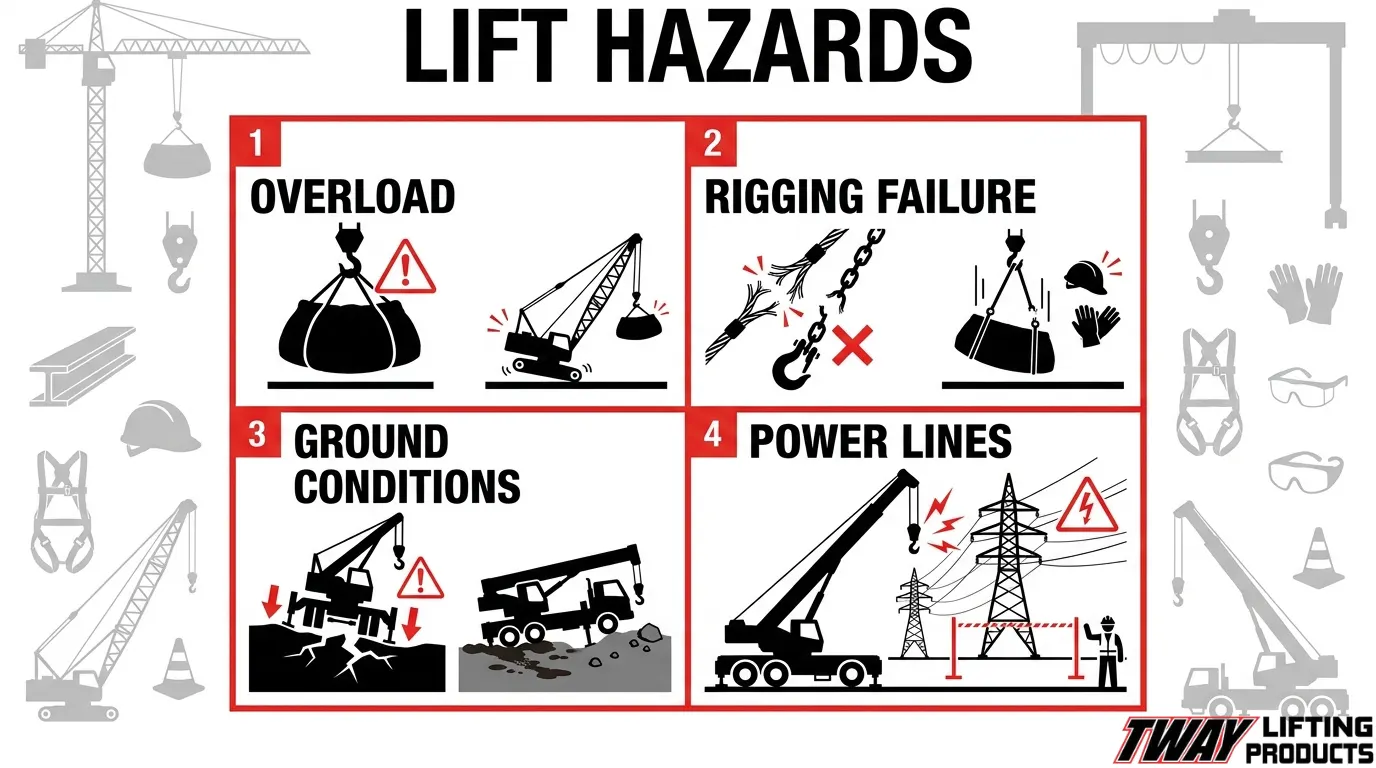
The most common risks managed by on-site lift supervision are crane overload, rigging failure, ground instability, and proximity to energized power lines. Each H3 below covers how a lift supervisor actively controls one of these hazards during a live operation.
How Does Lift Supervision Prevent Crane Overload Incidents?
Lift supervision prevents crane overload incidents by verifying that the combined weight of the load and rigging does not exceed the crane’s rated capacity before and during the pick. According to NASA safety guidelines, when the calculated combined weight of the load and its rigging exceeds 85% of the crane’s rated load, a load cell must be used to confirm actual weight. A supervisor enforces this threshold and halts any pick where load data is unverified or capacity margins are unclear.
Skipping this step is one of the most preventable mistakes in crane operations, yet it remains a leading factor in overload events on job sites without dedicated supervision.
How Does On-Site Supervision Address Rigging Failures During a Lift?
On-site supervision addresses rigging failures by requiring pre-lift inspection of all rigging components and monitoring rigging behavior throughout the lift. A NIOSH analysis of crane-related fatalities found that 24 of 40 deaths from being struck by a load were caused by rigging failure. A supervisor confirms that slings, shackles, and hardware are inspected by a qualified rigger before the hook is ever loaded. Tway Lifting provides professional rigging inspection services performed by certified specialists, including job site safety inspections with detailed reporting to support pre-lift compliance requirements.
How Does a Lift Supervisor Manage Ground Condition and Load Path Hazards?
A lift supervisor manages ground condition and load path hazards by surveying the lift site before operations begin and confirming that outrigger pads, crane positioning, and swing radius are clear of workers and obstacles. In a 2024 U.S. Department of Labor enforcement action, OSHA cited Adcock Cranes with a serious violation after an outrigger gave way on inadequate ground, tipping a 110-ton Liebherr crane into a worker within the swing radius. Supervisors evaluate bearing capacity, identify underground utilities, and enforce exclusion zones along the entire load path.
How Does Supervision Reduce Risk When Working Near Energized Lines?
Supervision reduces risk near energized lines by establishing minimum clearance distances, designating an observer, and stopping work when crane movement approaches those boundaries. A NIOSH study of crane accidents from 1992 to 2006 found that 32% of crane-related deaths were caused by overhead power line electrocutions. No other single hazard category produced a higher share of crane fatalities in that period, making proximity management one of the highest-priority functions a lift supervisor performs on any site with overhead infrastructure.
What Industries Rely Most on On-Site Lift Supervision Services?
The industries that rely most on on-site lift supervision services include construction, industrial manufacturing, and utilities. Each sector presents distinct hazard profiles and regulatory demands that make qualified supervision essential across all three.
How Is On-Site Lift Supervision Used in Construction?
On-site lift supervision in construction manages crane operations during structural steel erection, concrete placement, and heavy equipment installation. Construction accounts for the most crane-related fatalities of any sector. According to the U.S. Bureau of Labor Statistics, crane-related work produced 297 total deaths between 2011 and 2017, averaging 42 fatalities per year. Supervisors coordinate lift zones, verify rigging selection, and enforce exclusion boundaries to protect workers in one of the highest-density hazard environments in any industry.
How Is Lift Supervision Applied in Industrial and Manufacturing Settings?
Lift supervision in industrial and manufacturing settings governs overhead crane operations, machinery relocation, and precision equipment placement inside facilities with confined working envelopes. These environments often involve overhead obstructions, live production equipment, and simultaneous ground-level activity, all of which compound load-path risk. Supervisors verify rigging configurations before each pick and coordinate crane movements to protect both personnel and capital equipment from costly damage.
What Role Does Lift Supervision Play in the Utilities Sector?
Lift supervision plays a critical role in the utilities sector by managing crane and rigging operations during transmission line construction, substation equipment installation, and power plant maintenance. NIOSH data from a study of crane accidents spanning 1992 to 2006 found that 32% of crane-related deaths resulted from overhead power line electrocutions, making energized-line proximity the dominant hazard in utility lifting work. Supervisors enforce safe approach distances, confirm load paths, clear active conductors, and coordinate with line crews before any pick begins.
What Should You Look for When Hiring an On-Site Lift Supervision Provider?
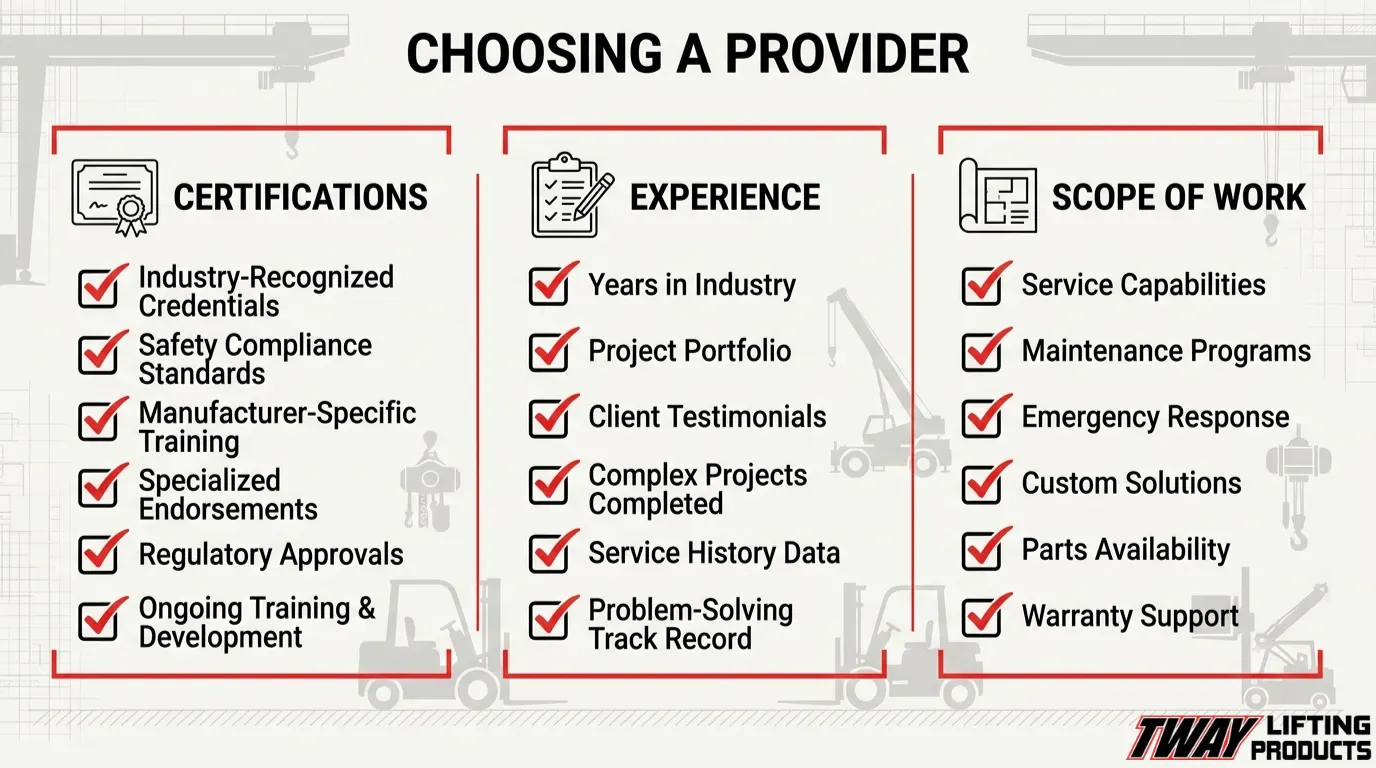
Hiring the right lift supervision provider requires evaluating certifications, verifiable field experience, and a clearly defined scope of work. The following sections cover each criterion in detail.
What Certifications Should a Lift Supervision Company Hold?
The certifications a lift supervision company should hold include credentials from recognized bodies such as NCCCO, ASME, and OSHA-aligned training programs. NCCCO certification requires candidates to pass both written and practical examinations and remains valid for a five-year period, making it a reliable benchmark for competency. At the company level, look for ISO quality certification, documented compliance with ASME B30.5 standards for mobile crane operations, and evidence that supervisors hold current rigger or lift director credentials. Providers should also carry proof of insurance and demonstrate familiarity with federal OSHA 1926 Subpart CC requirements. Certification alone does not guarantee performance, but it establishes a verifiable minimum standard before any conversation about experience begins.
How Do You Verify a Supervisor’s Field Experience Before Hiring?
You verify a supervisor’s field experience by requesting documented project history, reviewing inspection records, and confirming certification status through issuing bodies. Ask for a list of completed lifts by type, including critical lifts, multi-crane picks, and high-capacity operations. Request references from project owners or general contractors who can speak to the supervisor’s conduct on site. For the rigging equipment side of an operation, Tway Lifting offers rental inventory, including wire rope slings, synthetic slings, spreader beams, shackles, hoists, and load cells, along with OSHA-compliant inspection services to ensure all gear meets compliance standards before use. For certificate verification, some organizations provide serial-number-based lookup tools that confirm whether a credential is genuine. Beyond paper qualifications, experienced supervisors should be able to describe specific hazard scenarios they have managed, such as ground instability, congested load paths, or work near energized lines. Field depth matters more than credential count when stakes are high.
What Should a Lift Supervision Quote or Scope of Work Include?
A lift supervision quote or scope of work should include the lift type, site conditions, equipment specifications, number of supervisors, planned duration, and deliverables such as written lift plans and post-lift documentation. It should clearly define whether the supervisor will also coordinate rigging inspection, manage pre-lift meetings, and hold stop-work authority. Regulatory requirements vary by jurisdiction and lift classification, so the scope should reference applicable OSHA standards and any state-specific rules. Vague proposals that list only a day rate without specifying responsibilities create compliance gaps. A well-structured scope protects both parties by documenting exactly what the supervision service covers before work begins.
How Do On-Site Lift Supervision Services Connect to Rigging and Inspection Support?
On-site lift supervision services connect to rigging and inspection support by serving as the coordinating layer that ensures both disciplines happen in the right sequence, by the right personnel, before any load leaves the ground. The sections below cover OSHA-compliant rigging inspection coordination and key takeaways from this article.
Can OSHA-Compliant Rigging Inspections Be Coordinated Alongside Lift Supervision?
Yes, OSHA-compliant rigging inspections can be coordinated alongside lift supervision, and in practice the two functions operate as a unified pre-lift process. According to Lawrence Berkeley National Laboratory’s crane and rigging safety guidelines, each crane or hoist must be inspected by a qualified crane operator before use during any work shift, with the inspection documented on a form, and all rigging components such as slings and shackles must be inspected by a qualified rigger prior to use. A lift supervisor overseeing this process confirms that both the equipment inspection and the rigging inspection are completed and documented before authorizing the lift to proceed. Treating rigging inspection as a standalone checklist item rather than an integrated supervisory step is one of the most common gaps in field-level compliance. Tway Lifting’s rigging inspection services, covering slings, shackles, and associated hardware, are performed by certified specialists and include detailed reporting, providing the documentation trail that integrated supervisory compliance requires.
What Are the Key Takeaways About On-Site Lift Supervision Services We Covered?
The key takeaways about on-site lift supervision services covered in this article are:
- On-site lift supervision is a regulatory requirement for critical lifts, multi-crane operations, and high-capacity picks, not an optional add-on.
- A qualified lift supervisor must be present at the lift site for the entire operation, with authority to stop work for unsafe conditions.
- Critical lift plans must be written, site-specific, and revised whenever crane configuration, rigging, or load calculations change.
- OSHA 29 CFR 1926 Subpart CC, ASME B30.5, and DOE-STD-1090-2020 each impose distinct supervisory and documentation obligations.
- Rigging inspections and crane equipment inspections must be completed and documented before every lift, coordinated directly within the supervision scope.
- Supervisor qualifications, including certified rigger credentials and demonstrated field experience, should be verified before any contract is signed.
Tway Lifting brings over 75 years of rigging expertise to every engagement, supporting clients with OSHA-compliant inspection services, certified rigging specialists, and rigging equipment rental inventory including wire rope slings, synthetic slings, spreader beams, shackles, hoists, and load cells.