






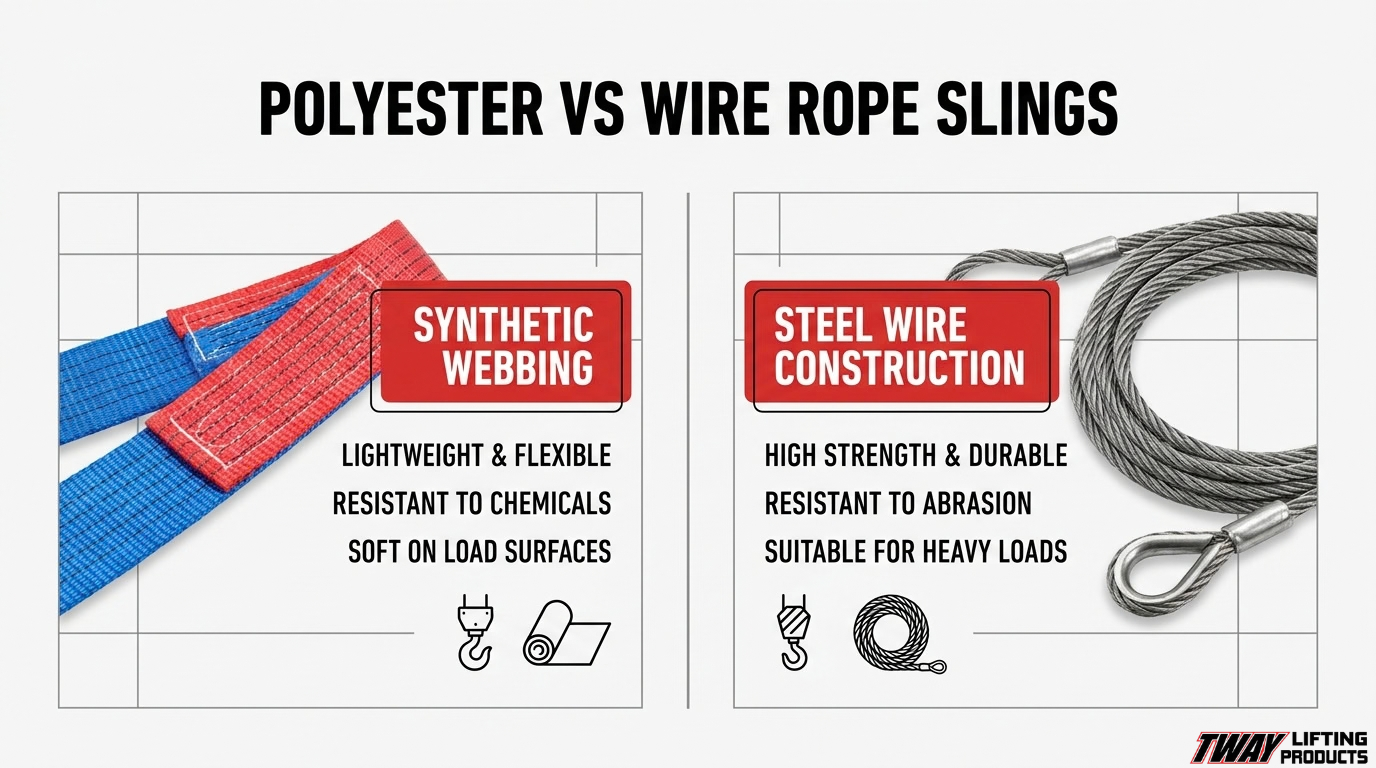

A polyester sling is a synthetic lifting device constructed from polyester fiber yarns woven into flat web, round, or endless loop configurations, used to connect loads to hoisting equipment during rigging operations. A wire rope sling is a steel-based lifting assembly built from helically wound wire strands around a central core, engineered for heavy-duty industrial, construction, and mining applications.
This guide covers sling construction and load ratings, performance differences across five key mechanical properties, environmental tolerances, best use cases for each type, safety and compliance requirements, costs, and inspection criteria.
Polyester and wire rope slings differ in how they are built and what rated loads they carry, with wire rope slings subject to a proof load test factor of 2.0 versus 1.0 for synthetic alternatives, and polyester roundslings carrying safe working loads that vary by hitch type and angle.
Across five mechanical properties, including strength, weight, abrasion resistance, flexibility, and stretch, each sling type holds specific advantages; polyester absorbs shock through approximately 3 percent elongation, while wire rope delivers higher tensile capacity at the cost of elasticity.
Environmental tolerances diverge sharply: polyester slings are restricted to 180°F under federal regulations and resist moisture and corrosion, while wire rope handles extreme heat but develops corrosion pits and fatigue cracks in wet or chemically aggressive conditions.
Polyester slings suit delicate, finished, and automotive loads; wire rope slings are the correct choice for high-temperature environments, heavy industrial operations, and sharp-edged or abrasive materials. Both types require daily pre-use inspection by a competent person, permanently affixed load markings, and compliance with OSHA 29 CFR 1910.184 and ASME B30.9.
What Is a Polyester Sling?
A polyester sling is a synthetic lifting device made from polyester fiber, used to connect loads to hoisting equipment during rigging operations. The sections below cover how polyester slings are constructed, what materials they contain, and what load ratings govern their safe use.
How Is a Polyester Sling Constructed?
A polyester sling is constructed by weaving or bundling polyester fiber yarns into a flat web, round, or endless loop configuration. End fittings are attached exclusively through stitching, which must follow an even thread pattern with enough stitches to develop the sling’s full breaking strength. According to Washington State Legislature (WAC 296-24-29431), stitching is the only permitted method for attaching end fittings to webbing and forming eyes.
What Materials Make Up a Polyester Sling?
A polyester sling is made up of polyester fiber yarns, which serve as the primary load-bearing component, often enclosed within a protective cover. The cover shields the inner yarns from abrasion and damage, while the outer layer may incorporate wear indicators. Hardware fittings, such as eyes or hooks, are secured to the webbing through stitched terminations.
What Are the Standard Load Ratings for Polyester Slings?
Standard load ratings for polyester slings vary by hitch type and sling angle. According to the U.S. Bureau of Reclamation’s Reclamation Safety and Health Standards (Appendix E), a Size 1 single-leg polyester roundsling carries the following safe working loads:
| Hitch Type | Safe Working Load (lbs) |
| Vertical | 2,600 |
| Choker | 2,100 |
| Vertical Basket | 5,200 |
| 60° Basket | 4,500 |
| 45° Basket | 3,700 |
| 30° Basket | 2,600 |
Current OSHA regulations prohibit loading slings beyond the safe working load shown on permanently affixed identification markings, replacing older generic tables. Every polyester sling must carry permanent markings identifying its rated capacity per hitch type. Selecting a sling without these markings is non-compliant and grounds for immediate removal from service.
What Is a Wire Rope Sling?
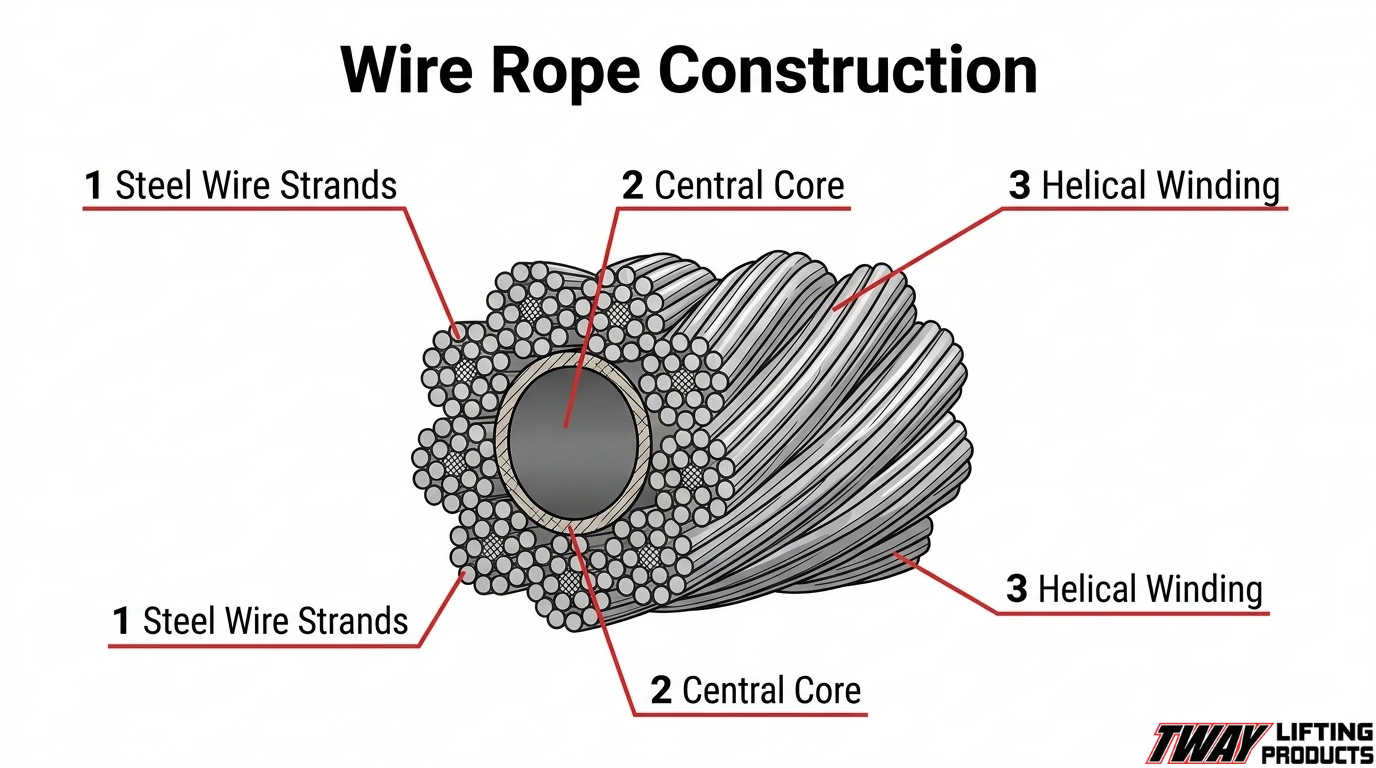
A wire rope sling is a lifting assembly constructed from multiple steel wire strands twisted around a central core, engineered for heavy-duty load handling in industrial, construction, and mining applications. The subsections below cover construction, materials, and standard load ratings.
How Is a Wire Rope Sling Constructed?
A wire rope sling is constructed from multiple wire strands helically wound around a central core, forming a flexible yet high-strength assembly. According to the U.S. Department of the Interior Bureau of Mines, the most common configurations are Classes 6×19 and 6×37 Warrington and Filler wire, preformed, right lay, improved plow steel, with either a fiber rope core (FRC) or independent wire rope core (IWRC). These two classes represent the majority of wire rope in current industrial use. The IWRC variant offers greater resistance to crushing and higher working load limits than the FRC option.
What Materials Make Up a Wire Rope Sling?
A wire rope sling is made primarily from high-carbon steel wire, drawn and twisted into strands. Steel grades include plow steel, improved plow steel, extra improved plow steel, and extra-extra improved plow steel, progressing from lower to higher tensile strength and cost. The core material is either a fiber rope core, which provides flexibility, or an independent wire rope core, which adds crush resistance and increases overall strength. End terminations typically use swaged ferrules, mechanical sleeves, or spelter sockets to secure the wire rope to hooks, rings, or shackles.
What Are the Standard Load Ratings for Wire Rope Slings?
Standard load ratings for wire rope slings are governed by ASME B30.9, which covers fabrication, attachment, use, inspection, testing, and maintenance of slings used for load handling purposes, including those made from wire rope. NASA’s Safety Standard for Lifting Devices and Equipment specifies that wire rope slings carry a proof load test factor of 2.0 times the manufacturer’s rated load, compared to 1.0 for synthetic web slings, reflecting the higher structural demands placed on wire rope assemblies. Ratings vary by rope diameter, grade, core type, and hitch configuration: vertical, choker, and basket hitches each produce different working load limits.
What Are the Key Differences Between Polyester and Wire Rope Slings?
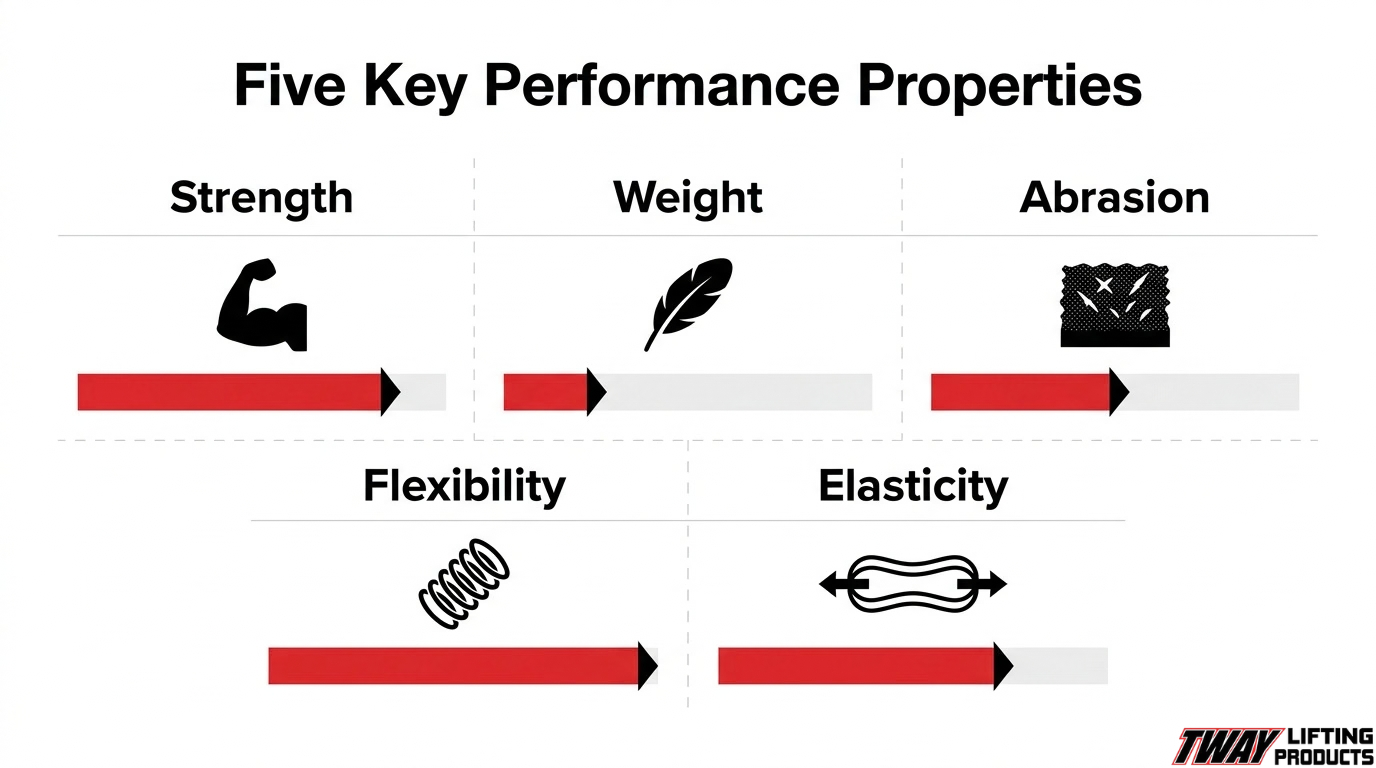
The key differences between polyester and wire rope slings span strength, weight, abrasion resistance, flexibility, and elasticity. The following sections compare each property to help you match the right sling to your application.
How Do Polyester and Wire Rope Slings Differ in Strength and WLL?
Polyester and wire rope slings differ in strength and WLL based on material, construction, and condition. Wire rope delivers high tensile capacity but loses strength over time: an Oregon State University Sea Grant study found that used wire rope has a significantly reduced breaking strength compared to new rope, with degradation accelerating near metal contact surfaces. Bending also costs capacity; according to the U.S. Marine Corps rigging manual, bending wire rope around a sheave or drum reduces strength by approximately 5 to 6 percent even under favorable conditions. Polyester slings maintain consistent WLL throughout their service life, provided they are free from cuts, chemical burns, or abrasion damage.
How Do They Compare in Weight and Ease of Handling?
Polyester slings are significantly lighter than wire rope slings of comparable load rating. That weight difference matters in high-frequency rigging environments, where workers position and reposition slings repeatedly throughout a shift. Wire rope slings are denser and stiffer, which increases fatigue during manual handling but also gives them better resistance to crushing and deformation under load. For applications requiring frequent sling changes or overhead work at height, polyester’s lighter weight is a genuine productivity advantage.
How Do Their Abrasion Resistance Levels Compare?
Abrasion resistance levels differ meaningfully between the two sling types. According to Princeton University Environmental Health and Safety’s rigging guidance, polyester slings are unaffected by mildew, rot, or bacteria, resist some chemical action, and have excellent abrasion resistance. Wire rope slings, built from stranded steel, withstand abrasion from rough or sharp-edged loads that would cut or tear synthetic webbing. In practice, polyester performs well against smooth abrasion, but wire rope is the correct choice when contact surfaces are jagged, serrated, or rough-edged without protective padding.
How Do They Differ in Flexibility and Conformability?
Polyester slings differ from wire rope slings in flexibility by conforming naturally to irregular load shapes. Flat web and round sling constructions distribute contact pressure evenly across wide surface areas, reducing point loading on finished or delicate loads. Wire rope slings are stiffer, holding their shape rather than conforming to the load. That rigidity is an asset when lifting structural steel or heavy machinery where a defined attachment geometry is needed, but it creates a mismatch when wrapping curved or fragile surfaces.
How Do Polyester and Wire Rope Slings Compare in Stretch and Elasticity?
Polyester and wire rope slings compare in stretch and elasticity with polyester allowing more controlled elongation. According to the U.S. Department of Energy’s Hoisting and Rigging Fundamentals, polyester has approximately 3 percent stretch, and that elongation provides a cushion against sudden shock loads. Wire rope has very little elasticity, transmitting shock forces more directly to the load and the rigging hardware. For dynamic lifts or applications where load movement creates brief load spikes, polyester’s built-in shock absorption is a meaningful safety characteristic that wire rope simply cannot replicate.
With these performance differences mapped across five key properties, the right choice depends on matching sling characteristics to the specific demands of each lift.
What Are the Load Capacity Differences Between the Two Sling Types?
The load capacity differences between the two sling types depend on material, hitch configuration, and sling angle. Always select a sling with a rated capacity equal to or greater than the intended load weight. The following sections cover vertical performance for each type and how angle reduces usable capacity.
How Does a Polyester Sling Perform Under Heavy Vertical Loads?
A polyester sling performs reliably under heavy vertical loads because internal wear and sunlight do not compromise fiber integrity. According to Virginia Tech’s Rope Properties research, polyester also delivers excellent repeat loading ability and performs equally under wet or dry conditions. This consistency across environments makes polyester a dependable choice for sustained, repetitive vertical lifts where load conditions vary.
How Does a Wire Rope Sling Perform Under Heavy Vertical Loads?
A wire rope sling delivers high rated loads under vertical configurations, particularly in heavier-duty applications. Per OSHA’s 29 CFR Part 1918 Appendix II, a 1/2-inch Extra Improved Plow Steel wire rope sling with IWRC carries a vertical rated load of 2.0 to 2.3 tons, rising to 4.0 to 4.4 tons in a vertical basket hitch. Wire rope’s steel construction gives it a measurable strength advantage over synthetic alternatives at equivalent diameters.
How Does Sling Angle Affect Capacity for Each Type?
Sling angle reduces the effective load capacity of both polyester and wire rope slings as the angle from vertical decreases. Under California’s DIR General Industry Safety Orders, rated synthetic web sling capacity is published per Table S-22 in pounds per inch of width, varying by hitch type. Per 29 CFR 1910.184, each sling must be marked to show rated capacities for every hitch type. Shallower basket angles, such as 30 degrees, can cut effective capacity by half compared to a straight vertical lift, making angle selection a critical safety decision for both sling types.
How Do Environmental Conditions Affect Each Sling Type?
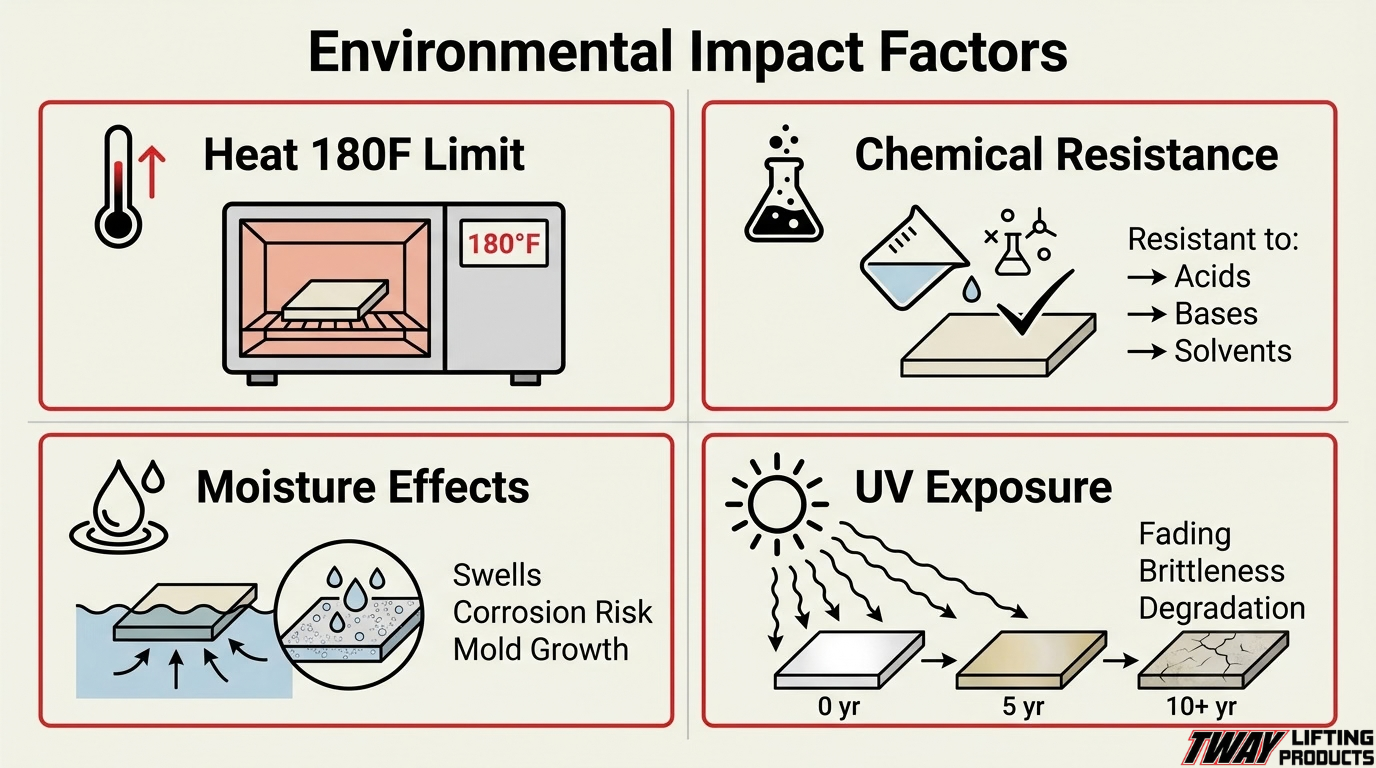
Environmental conditions affect each sling type differently across heat, chemicals, moisture, and UV exposure. The subsections below compare polyester slings and wire rope slings across each environmental factor.
How Does Heat Exposure Impact Polyester Slings vs Wire Rope Slings?
Heat exposure impacts polyester slings and wire rope slings in fundamentally different ways. According to OSHA 29 CFR 1910.184, synthetic web slings of polyester and nylon shall not be used at temperatures exceeding 180°F. Wire rope slings tolerate significantly higher heat without immediate structural degradation, making them the correct choice for foundry work, steel mills, or any application near open flame or extreme heat sources. Polyester slings used beyond their thermal limit risk melting, charring, and sudden load failure. For most ambient industrial environments, polyester performs adequately, but high-heat operations require wire rope without exception.
How Does Chemical Exposure Affect Each Sling Type?
Chemical exposure affects each sling type based on its material composition. Polyester slings resist some chemical action and are unaffected by mildew, rot, and bacteria, making them suitable for moderately corrosive environments. However, acids and caustic substances degrade polyester webbing rapidly and require immediate removal from service. Wire rope slings, being steel, resist many organic solvents but are vulnerable to acids, alkalis, and salt-laden atmospheres that accelerate corrosion. When chemical exposure is unavoidable, identifying the specific agent and matching it to the sling material’s resistance profile is the only safe approach.
How Does Moisture and Corrosion Affect Wire Rope vs Polyester Slings?
Moisture and corrosion affect wire rope and polyester slings very differently. According to the WorkSafe New Zealand Approved Code of Practice for Load-Lifting Rigging, wire ropes should be inspected for broken wires, kinks, deformation, corrosion, damage to terminations, and excessive wear. Prolonged moisture exposure accelerates rust formation on steel wire rope, reducing breaking strength and creating internal degradation that is not always visible externally. Polyester slings, by contrast, perform equally under wet or dry conditions without corrosion risk. For persistently wet environments such as marine, wash-down, or outdoor storage applications, polyester holds a clear practical advantage over wire rope.
How Do Outdoor and UV Conditions Impact Each Sling Type?
Outdoor and UV conditions impact each sling type through different degradation mechanisms. Ultraviolet radiation causes surface damage to polyester fibers via chain scission, progressively reducing tensile strength with cumulative exposure. Michigan OSHA Part 49 Slings specifies that a synthetic web sling must be immediately removed from service if melting, charring, acid burns, snags, punctures, tears, cuts, broken stitching, or distorted fittings are present. Wire rope stored outdoors in environments with harmful gases develops corrosion pits that become stress concentration points, accelerating fatigue crack initiation. Both sling types require increased inspection frequency when used outdoors, but the failure modes differ enough that riggers should understand which damage signs to prioritize for each.
What Are the Best Use Cases for Polyester Slings?
The best use cases for polyester slings involve applications where load surface protection, controlled stretch, and lightweight handling matter most. The sections below cover three core scenarios: delicate or finished loads, overhead construction lifts, and automotive engine removal.
When Should You Choose Polyester Slings for Delicate or Finished Loads?
You should choose polyester slings for delicate or finished loads when surface protection is the primary concern. Their wide, flat webbing distributes contact pressure across the load surface, reducing the risk of marring, denting, or scratching polished metal, glass, prefabricated panels, and coated structural components. Wire rope, by contrast, concentrates contact at discrete wire points and can score finished surfaces immediately on contact. Polyester’s approximately 3% elongation also absorbs minor shock without transmitting sudden force spikes to fragile load geometry. For manufacturers shipping finished goods, fabricators moving coated steel, or riggers handling pre-painted architectural elements, polyester webbing is the clear functional choice. Tway Lifting carries polyester and nylon synthetic slings suited to these applications, available for purchase or short-term rental with free local delivery.
Are Polyester Slings Suitable for Overhead Lifting in Construction?
Polyester slings are suitable for overhead lifting in construction when loads are within rated capacity, rigging angles are correctly observed, and daily pre-use inspection is performed. According to WorkSafe New Zealand’s Approved Code of Practice for Load-Lifting Rigging, wire rope slings should be inspected for broken wires, kinks, deformation, corrosion, and damage to terminations before each lift, a standard that applies equally to synthetic slings under their respective criteria. Polyester slings perform well for overhead placement of precast panels, HVAC units, and framing assemblies where load surfaces must remain undamaged. However, construction environments with sharp edges, abrasive concrete, or elevated heat require edge protection or a sling upgrade to wire rope.
When Are Polyester Slings the Right Choice in Automotive Applications?
Polyester slings are the right choice in automotive applications when raising, removing, or repositioning engines, transmissions, and drivetrain components. According to the U.S. Department of Energy’s Hoisting and Rigging Standard, a shop crane (Portable Automotive Lifting Device) is specifically designed for raising, removing, transporting in the lowered position, and replacing automotive engines, transmissions, and other components. Polyester webbing wraps around irregular cast engine geometry without concentrating load on a single contact point, protecting machined surfaces and oil pan flanges that wire rope would damage. Their light weight also simplifies rigging in confined shop bay environments where overhead clearance is limited.
What Are the Best Use Cases for Wire Rope Slings?
The best use cases for wire rope slings involve high-temperature environments, heavy industrial and mining operations, and abrasive or sharp-edged loads. Each scenario takes advantage of wire rope’s steel construction, which resists heat, cutting damage, and extreme mechanical stress that would destroy synthetic alternatives.
When Should You Choose Wire Rope Slings for High-Temperature Environments?
You should choose wire rope slings for high-temperature environments when operating conditions exceed the safe limits of synthetic slings. Steel wire rope tolerates elevated heat that would melt or degrade polyester webbing. However, heat and corrosive conditions create their own risks. According to a review published in Gels, when steel wire ropes are used outdoors or in environments with harmful gases, corrosion pits form on their surfaces, becoming stress concentration points that accelerate fatigue crack initiation. Proper lubrication and regular inspection are essential to maintain safe working loads in these conditions.
Are Wire Rope Slings Better for Heavy Industrial and Mining Operations?
Wire rope slings are better for heavy industrial and mining operations because their steel construction supports high working load limits over repeated heavy lifts. Mining environments expose slings to rough surfaces, heavy tonnage, and constant mechanical stress. Steel wire rope resists the abrasion and deformation that would quickly retire a synthetic sling in these conditions. From a practical standpoint, wire rope is the only defensible choice for sustained high-cycle lifting in mines, steel mills, and similar facilities. Tway Lifting supplies wire rope slings to industrial customers across mining, steel production, and construction sectors, with same-day fabrication available for custom assemblies.
When Are Wire Rope Slings Preferred for Abrasive or Sharp-Edged Loads?
Wire rope slings are preferred for abrasive or sharp-edged loads because the outer steel wires resist cutting and surface wear that would sever synthetic webbing. Structural steel, raw castings, concrete forms, and fabricated metal components all present edges that damage polyester rapidly. Wire rope’s interlocking wire construction distributes contact forces across multiple wires, slowing wear rather than concentrating it at one failure point.
How Do Polyester and Wire Rope Slings Compare in Safety and Compliance?
Both sling types are governed by federal OSHA regulations and ASME B30.9, but each carries distinct compliance requirements and inspection criteria. The sections below cover applicable standards and inspection differences for polyester and wire rope slings.
What OSHA Standards Apply to Polyester Slings?
The OSHA standards that apply to polyester slings are primarily found in 29 CFR 1910.184 for general industry and 29 CFR 1926.251 for construction. These regulations require that each synthetic web sling be marked or coded to show rated capacities for each hitch type and synthetic web material. OSHA also prohibits loading slings beyond the safe working load prescribed on permanently affixed identification markings, and bans use of any sling lacking those markings. ASME B30.9 supplements these requirements, covering fabrication, use, inspection, testing, and maintenance of slings made from synthetic webbing and polyester fiber yarns.
What OSHA Standards Apply to Wire Rope Slings?
The OSHA standards that apply to wire rope slings are also found in 29 CFR 1910.184 and 29 CFR 1926.251, with additional guidance in OSHA’s maritime regulations at 29 CFR Part 1918. ASME B30.9 governs wire rope sling fabrication and load testing, requiring a proof load test factor of 2.0 times the manufacturers’ rated load for wire rope slings, compared to 1.0 for synthetic web slings, according to NASA’s Safety Standard for Lifting Devices and Equipment. Wire rope slings must also carry permanently affixed identification markings showing rated capacity, and employers are prohibited from exceeding those limits.
How Do Inspection Requirements Differ Between the Two Sling Types?
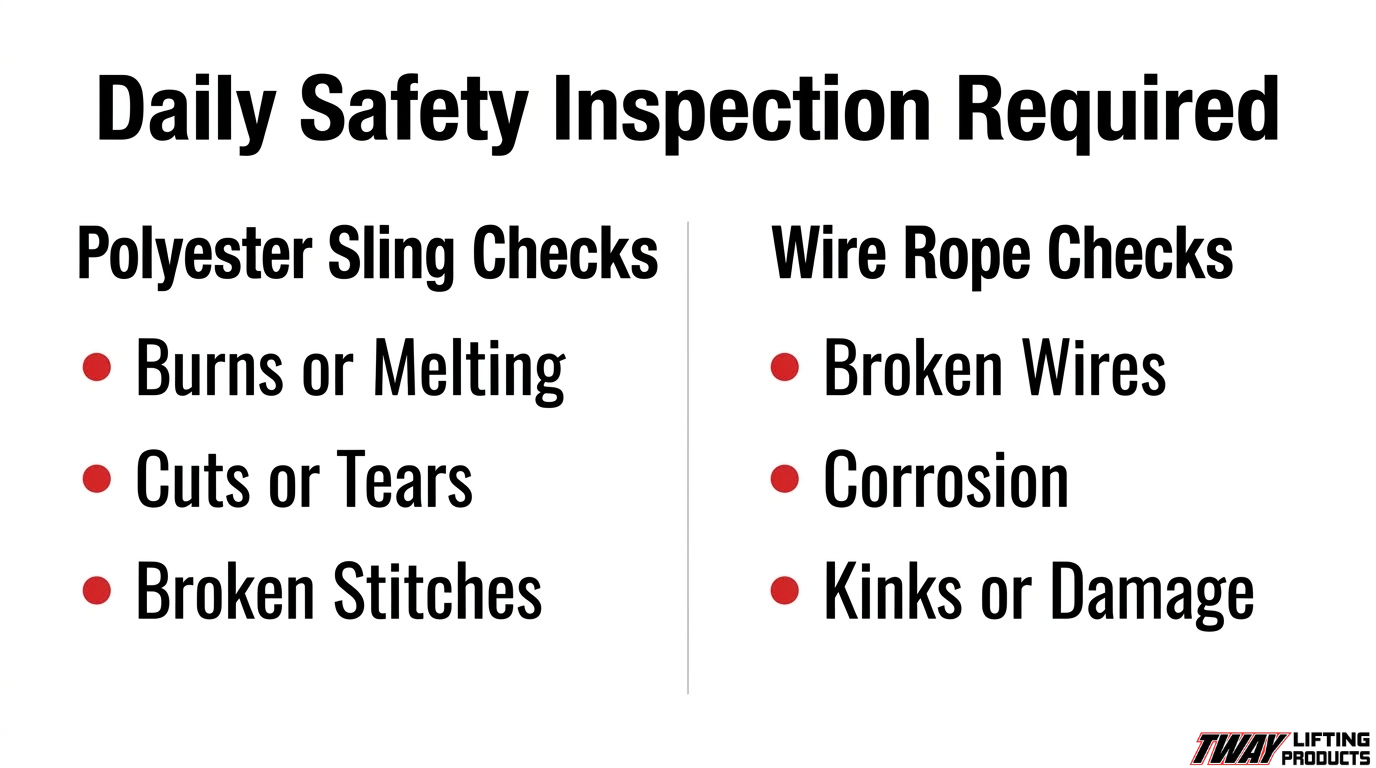
Inspection requirements differ between the two sling types in both frequency and the specific defects each inspector must identify. For both types, 29 CFR 1926.251 requires a competent person to inspect every sling before each use; damaged or defective slings must be immediately removed from service.
Removal criteria differ significantly by material:
Polyester slings must be removed from service for:
- Acid or caustic burns
- Melting or charring of any part of the sling surface
- Snags, punctures, tears, or cuts
- Broken or worn stitches
- Distortion of fittings
Wire rope slings must be removed from service for:
- Five broken wires in one strand in one rope lay, or 10 broken wires across all strands in one rope lay
- Kinks, deformation, or bird-caging
- Corrosion or heat damage
- More than 33% wear on individual wires
- Damaged terminations or thimbles
From a compliance standpoint, wire rope slings carry more quantitative removal thresholds, while polyester sling removal is largely condition-based and visual. Both demand a trained, competent inspector to make the call.
How Do the Costs of Polyester and Wire Rope Slings Compare?
Polyester and wire rope slings differ in both upfront price and long-term maintenance expenses. The sections below break down initial purchase costs and ongoing ownership costs for each sling type.
What Is the Upfront Cost Difference Between Polyester and Wire Rope Slings?
The upfront cost difference between polyester and wire rope slings is significant, with polyester slings typically carrying a lower purchase price. Public procurement records show polyester slings purchased for approximately $47 per unit, while two-leg wire rope slings were bid at $33.75 per leg ($135 for a set of four). Wire rope slings span a wider price range because steel grades, such as plow steel, improved plow steel, and extra improved plow steel, directly affect cost. Polyester slings offer predictable, budget-friendly pricing for standard lifting tasks, making them the practical entry-level choice for most operations.
How Do Long-Term Maintenance Costs Compare Between the Two?
Long-term maintenance costs compare differently between polyester and wire rope slings because each type degrades through distinct mechanisms. Wire rope slings require periodic lubrication, inspection for corrosion and broken wires, and more frequent replacement in harsh or outdoor environments where corrosion accelerates wear. The UK Health and Safety Executive requires thorough examinations of all lifting accessories at least every six months, meaning both types carry recurring inspection costs. Tway Lifting’s certified inspection specialists perform OSHA-required annual inspections and job site safety inspections for both wire rope and synthetic slings, with detailed reporting included.Polyester slings resist mildew, rot, and bacteria, which reduces some maintenance demands, but UV exposure and chemical contact can shorten service life considerably. Over a full service cycle, wire rope slings used in abrasive or high-load conditions often cost more to maintain than polyester alternatives used in controlled environments.
How Do You Inspect and Retire Each Sling Type?
Inspecting and retiring slings correctly is a core safety obligation. Under 29 CFR 1926.251, each sling and all fastenings and attachments shall be inspected for damage or defects by a competent person before each use, and damaged or defective slings shall be immediately removed from service. The sections below cover specific criteria for polyester slings, wire rope slings, and the retirement thresholds for each.
What Are the Inspection Criteria for Polyester Slings?
The inspection criteria for polyester slings focus on visible surface and structural damage. A competent person should examine the sling for the following conditions before each lift:
- Acid or caustic burns on the webbing
- Melting or charring of any part of the sling surface
- Snags, punctures, tears, or cuts through the webbing
- Broken or worn stitching at seams or end fittings
- Distortion of fittings or hardware attachments
Any one of these conditions requires immediate removal from service. Because polyester damage is often visible on the surface, pre-use visual inspection is both practical and effective.
What Are the Inspection Criteria for Wire Rope Slings?
The inspection criteria for wire rope slings include both surface and structural indicators. A competent person should check for:
- Broken wires within individual strands
- Kinks, bird-caging, or deformation of the rope lay
- Corrosion or rust on outer or inner wires
- More than 33% wear on individual wires
- Crushed or flattened sections
- Heat damage or damaged thimbles
- High stranding or adjacent broken wires
Wire rope damage is not always visible from a single angle, making a thorough 360-degree inspection essential. Pulling the rope through gloved hands while looking for protruding broken wires is a reliable field method.
When Should a Polyester Sling Be Taken Out of Service?
A polyester sling should be taken out of service immediately when any of the five removal conditions are present: acid or caustic burns, melting or charring, snags or cuts, broken or worn stitches, or distorted fittings. Because polyester webbing cannot be repaired in the field, retirement is the only safe response once structural integrity is compromised.
When Should a Wire Rope Sling Be Taken Out of Service?
A wire rope sling should be taken out of service when broken wire counts reach defined thresholds. According to Sandia National Laboratories, a wire rope sling must be retired if there are five broken wires in one strand within a single rope lay, or 10 broken wires across all strands in one rope lay. Additional retirement triggers include severe corrosion, kinking, bird-caging, or heat damage identified during inspection.
How Should You Choose Between a Polyester Sling and a Wire Rope Sling?
Choosing between a polyester sling and a wire rope sling depends on load type, environment, budget, and regulatory requirements. The section below connect Tway Lifting’s product range to your application and summarize the article’s core decision factors.
How Do Tway Lifting’s Wire Rope and Synthetic Sling Products Support Your Lifting Needs?
Tway Lifting’s wire rope and synthetic sling products support your lifting needs through a complete range of rigging solutions manufactured, sold, and rented from two Indiana superstore locations. Founded in 1945 and ISO9001-certified, Tway Lifting offers polyester and nylon synthetic slings, wire rope slings, custom-fabricated assemblies, and same-day wire rope sling fabrication. Rigging rental options include wire rope slings, synthetic slings, spreader beams, shackles, and hoists, with free local delivery and pickup. Certified inspection specialists also provide OSHA-required annual inspections, job site safety inspections, and detailed inspection reporting. Whether your application calls for the load-conforming softness of a synthetic sling or the high-capacity durability of wire rope, Tway Lifting carries the product and expertise to match it.
What Are the Key Takeaways About Polyester Slings vs Wire Rope Slings We Covered?
The key takeaways about polyester slings vs wire rope slings center on matching sling type to application demands. The most important decision factors are:
- Load sensitivity: Polyester slings protect finished and delicate surfaces; wire rope slings suit abrasive or sharp-edged loads.
- Capacity and proof load: Wire rope slings carry a proof load test factor of 2.0 versus 1.0 for synthetic web slings, per NASA safety standards, making them the choice for heavy industrial lifts.
- Temperature limits: Polyester slings are restricted to 180°F under OSHA 29 CFR 1910.184; wire rope handles higher heat environments.
- Corrosion risk: Wire rope requires active corrosion management; polyester resists moisture, mildew, and rot.
- Compliance: Both types require daily pre-use inspection and permanently affixed load markings under federal regulations.
- Cost: Polyester slings carry lower upfront cost; wire rope offers longer service life in harsh conditions.
Selecting the right sling is ultimately a safety decision, not just a cost decision.