



Operator training for rental lifting equipment is the process of ensuring every worker who operates hoists, slings, cranes, and fall protection gear is trained, evaluated, and certified before use, regardless of whether that equipment is owned or rented.
This guide covers the legal framework behind training requirements, the equipment types and core competencies involved, training formats and their differences, qualification and documentation standards, and how inspection connects directly to trained operator behavior.
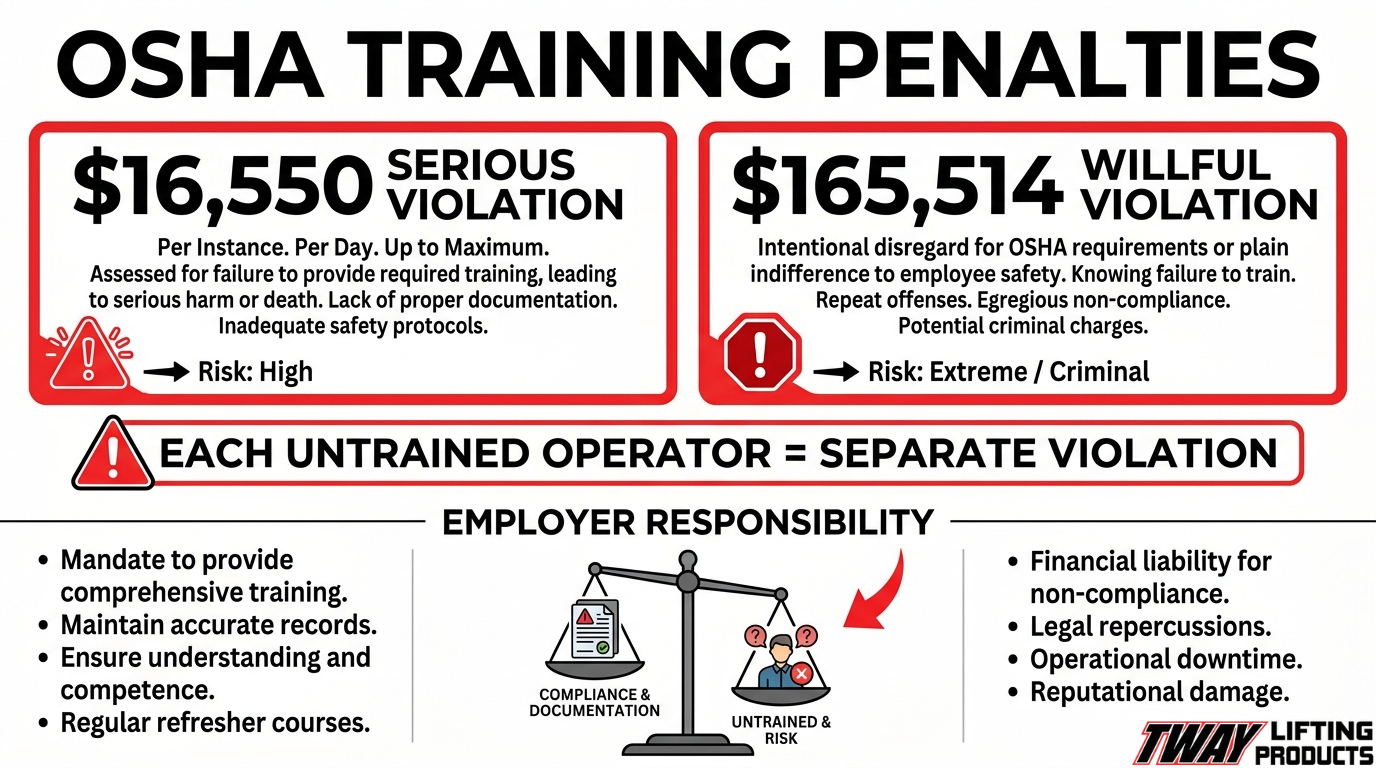
Federal law places full training responsibility on the employer, not the rental company. OSHA 29 CFR 1926 Subpart CC mandates training, certification, and documented evaluation before any covered equipment is operated, with penalties reaching $165,514 per willful violation. Human error and inadequate training remain the leading causes of lifting operation accidents.
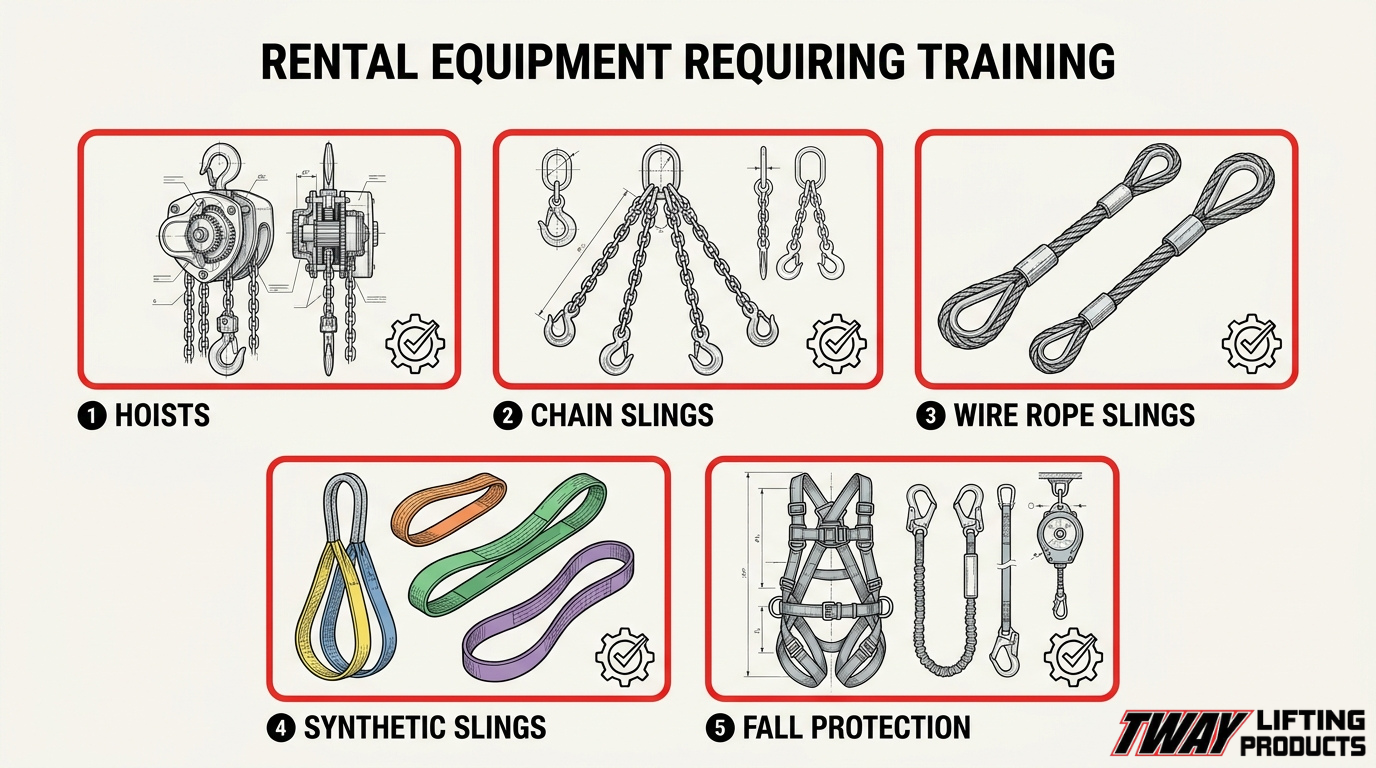
Each equipment category carries distinct hazards. Hoists, chain slings, wire rope slings, synthetic slings, and fall protection gear each require equipment-specific instruction because failure modes and inspection criteria differ across them.
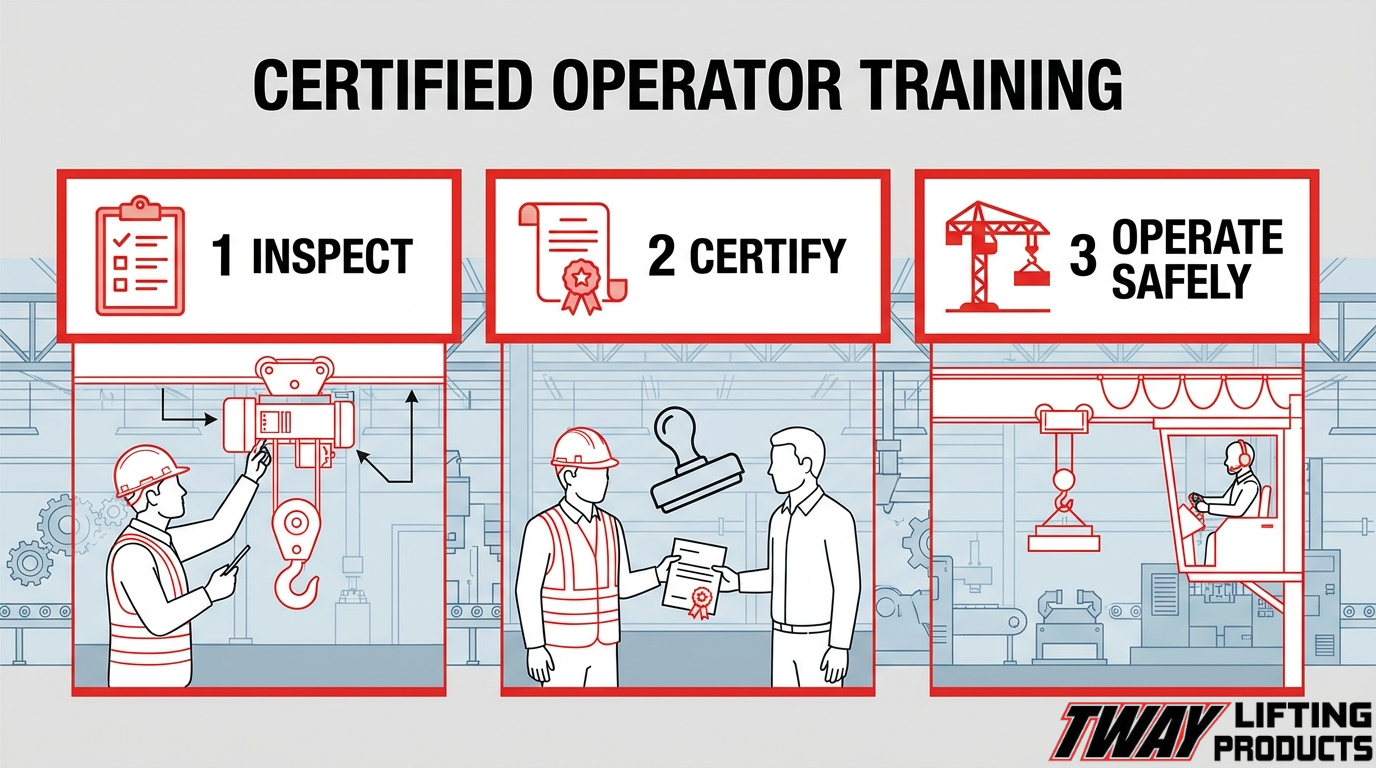
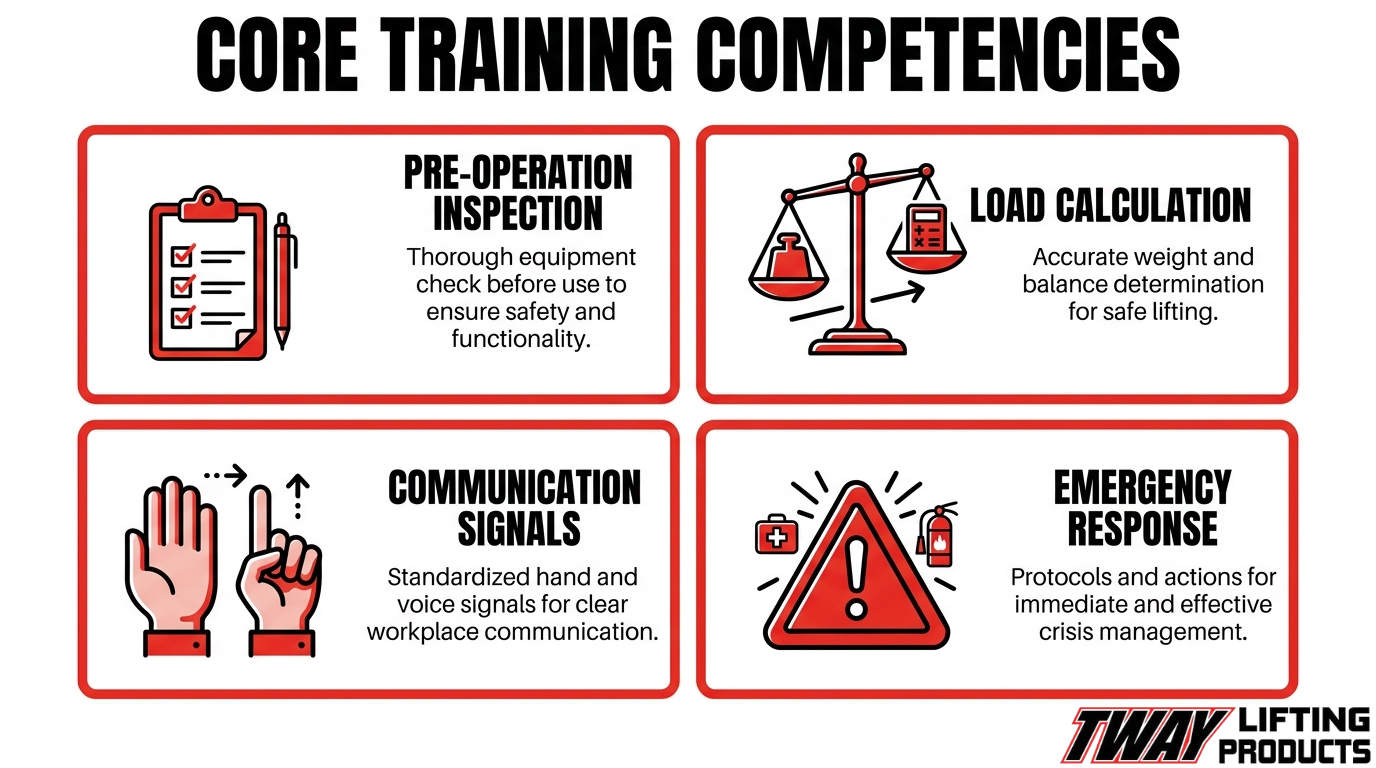
Operator training spans four core competencies: pre-operation inspection, load calculation and rigging principles, communication and signal standards, and emergency response procedures. Training is delivered through classroom instruction, hands-on practical evaluation, online learning, and train-the-trainer programs, with duration ranging from a half-day for basic rigging tools to several months for crane certification.
Qualified trainers must meet recognized competency standards, training records must be maintained and available for audit, and retraining is required whenever conditions change rather than waiting for scheduled renewal. Pre-use inspection of every rental unit before each shift is itself a trained skill and one of the most direct tests of whether operator training has translated into consistent job site behavior.
Why Is Operator Training Required for Rental Lifting Equipment?
Operator training is required for rental lifting equipment because federal law mandates it, untrained operation creates serious injury and fatality risk, and responsibility for compliance falls on the employer regardless of who owns the equipment. The following sections cover the legal mandate, consequences of non-compliance, and how training accountability is assigned in a rental context.
Is Operator Training Legally Mandated for Rental Lifting Equipment?
Yes, operator training is legally mandated for rental lifting equipment under federal OSHA standards. Under 29 CFR 1926.1427, the employer must ensure each operator is trained, certified or licensed, and evaluated before operating covered equipment, and must document completion of that evaluation. ASME B30, which the American National Standards Institute notes now spans 30 separate volumes each addressing a different type of lifting machinery, establishes additional safety standards that apply regardless of whether equipment is owned or rented. A study published via PLOS ONE through PubMed Central found that the main causes of lifting operation accidents are human error, equipment failure, and lack of management and training. Renting equipment does not transfer or waive these obligations.
What Happens If Operators Use Rental Lifting Equipment Without Training?
Operating rental lifting equipment without training exposes workers, employers, and job sites to severe consequences, including:
- Fatalities and serious injuries: The U.S. Bureau of Labor Statistics recorded 297 crane-related deaths between 2011 and 2017, averaging 42 per year, with untrained operation a known contributing factor.
- OSHA penalties: As of January 15, 2025, serious violations carry fines up to $16,550 per violation, while willful or repeated violations reach $165,514 per violation.
- Increased accident likelihood: Human error and inadequate training are among the leading causes of lifting operation accidents.
- Legal and civil liability: Employers who fail to document training face regulatory citations and potential litigation following an incident.
Untrained operators represent the single most preventable risk category in lifting operations.
Who Is Responsible for Training When Equipment Is Rented?
The employer is responsible for training when equipment is rented, not the rental company. OSHA 29 CFR 1926.1427 places the obligation directly on the employer to ensure every operator is trained, evaluated, and certified before use. The NIOSH Centers for Disease Control and Prevention further clarifies that although crane equipment is often rented, construction contractors and subcontractors must have inspection and safety procedures in place for their workers. The rental agreement transfers equipment possession, not safety accountability. Employers must verify operator qualifications, maintain training documentation, and ensure their workforce meets all applicable standards before a rented piece of lifting equipment is put into service.
What Types of Rental Lifting Equipment Require Operator Training?
Several categories of rental lifting equipment require operator training, including hoists, chain slings, wire rope slings, synthetic slings, and fall protection gear. Each equipment type carries distinct hazards, and training requirements reflect those specific risks.
Does Renting a Hoist Require Operator Training?
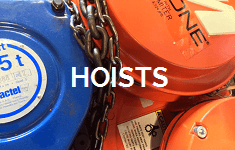
Yes, renting a hoist requires operator training. Hoists lift suspended loads overhead, making untrained operation a direct risk to workers below. OSHA’s Subpart CC mandates that operators of covered equipment be trained, certified, and evaluated before use. Because hoist rental transfers custody of the equipment, training responsibility remains with the employer, not the rental provider.
Does Renting a Chain Sling Require Operator Training?
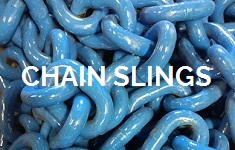
Yes, renting a chain sling requires operator training. Chain slings support and transfer load weight during lifting operations, and improper rigging can cause load drops or sling failure. Trained operators must understand load angle factors, hook attachment, and inspection criteria before each use. The U.S. Army Corps of Engineers requires rigging equipment to be inspected by a Competent Person before every shift.
Does Renting a Wire Rope Sling Require Operator Training?
Yes, renting a wire rope sling requires operator training. Wire rope slings are subject to kinking, crushing, and wear that degrade their rated capacity over time. Operators must be trained to identify broken wires, corrosion, and deformation that render a sling unfit for service. Without this knowledge, a visually compromised sling can be used at full load, creating a serious failure risk. Tway Lifting offers wire rope sling rentals alongside professional rigging inspection services, so employers can access equipment that has been assessed by certified specialists before it reaches the job site.
Does Renting a Synthetic Sling Require Operator Training?
Yes, renting a synthetic sling requires operator training. Synthetic slings made from polyester or nylon are vulnerable to cuts, chemical exposure, and UV degradation that reduce strength invisibly. Trained operators know how to inspect webbing for discoloration, tears, or missing tags, and understand temperature and chemical compatibility limits that differ from chain or wire rope.
Does Renting Fall Protection Gear Require Operator Training?
Yes, renting fall protection gear requires operator training. Under 29 CFR 1926.502, as published by the Legal Information Institute at Cornell Law School, employers must provide and install all required fall protection systems before an employee begins work that necessitates that protection. This means operators must be trained on harness fitting, anchor point selection, and lanyard inspection before ever reaching an elevated work position.
What Are the Core Competencies Covered in Operator Training?
The core competencies covered in operator training include pre-operation inspection, load calculation and rigging principles, communication and signal standards, and emergency response procedures. Each sub-section below addresses one of these skill areas in detail.
What Pre-Operation Inspection Skills Are Taught in Lifting Equipment Training?
Pre-operation inspection skills taught in lifting equipment training include visual checks of structural components, identification of wear or damage, verification of load ratings, and confirmation that controls function correctly. According to the U.S. Department of Energy’s hoisting and rigging guidance, operators should use an appropriate inspection checklist and perform a visual inspection at the beginning of each shift or prior to start-up. Training also covers how to document findings and when to remove equipment from service. Given that rental equipment cycles through multiple job sites, pre-operation inspection skills are arguably the most high-stakes competency a new operator can develop.
What Load Calculation and Rigging Principles Are Covered?
Load calculation and rigging principles covered in operator training include determining load weight, selecting appropriate sling types and configurations, calculating working load limits, and identifying center-of-gravity considerations. The U.S. Army Corps of Engineers requires that rigging equipment be inspected before each shift by a Competent Person who has training equivalent to, or supervision by, a Qualified Rigger. Operators learn to match sling capacity to load requirements and recognize configurations such as vertical, choker, and basket hitches.
What Communication and Signal Standards Must Trained Operators Know?
Trained operators must know standardized hand signals, radio communication protocols, and the roles and responsibilities of signal persons, riggers, and crane operators during a lift. Clear signal standards reduce the risk of miscommunication, which is a documented contributor to lifting operation accidents alongside human error and equipment failure. Training covers ASME B30-referenced signal conventions and the rule that only one designated signal person should direct a lift at a time.
What Emergency Response Procedures Are Included in Training?
Emergency response procedures included in training cover load drop response, power line contact protocols, equipment tip-over actions, and evacuation of lift zones. Operators learn to recognize abort conditions before and during a lift, and to communicate immediately when an unexpected hazard appears. This competency is critical because swift, rehearsed response is what separates a near-miss from a fatality. A PLOS ONE study published via PubMed Central identified human error and lack of training as primary causes of lifting operation accidents, reinforcing why emergency protocol rehearsal belongs at the center of any credible operator training program.
What Are the OSHA Requirements for Lifting Equipment Operator Training?
The OSHA requirements for lifting equipment operator training mandate that employers ensure each operator is trained, certified or licensed, and evaluated before operating any covered equipment under 29 CFR 1926 Subpart CC, with documented proof of evaluation completion required.
The following sub-sections cover the specific crane and hoist standards, penalty exposure for non-compliance, and the role of ASME B30 industry standards.
What Does 29 CFR 1926 Subpart CC Require for Crane Operators?
29 CFR 1926 Subpart CC requires that only designated, trained, and certified personnel operate covered cranes on construction sites. According to the Electronic Code of Federal Regulations, employers must document the completion of each operator’s evaluation, not just verbal confirmation of readiness.
This documentation requirement is often underestimated in practice. Without it, employers remain exposed to violations even when training occurred, because undocumented training is legally indistinguishable from no training at all.
What Are the OSHA Penalty Amounts for Lifting Equipment Training Violations?
The OSHA penalty amounts for lifting equipment training violations reach up to $16,550 per serious violation and up to $165,514 per willful or repeated violation, effective January 15, 2025, per OSHA’s official penalty schedule.
For multi-operator worksites using rented equipment, each untrained operator can represent a separate violation, compounding total exposure rapidly.
How Do ASME B30 Standards Relate to OSHA Operator Training Requirements?
ASME B30 standards relate to OSHA operator training requirements by establishing equipment-specific safety benchmarks that operators must understand to comply with federal law. ASME B30 currently spans 30 separate volumes, each addressing a different type of lifting machinery used in construction, according to the American National Standards Institute.
OSHA and ASME B30 work in parallel: OSHA sets the legal training mandate; ASME B30 defines the technical competency baseline operators must meet for each equipment category.
What Are the Different Formats of Operator Training Available?
The different formats of operator training available include classroom-based instruction, hands-on practical training, online learning, and train-the-trainer programs. Each format serves a different learning need, from foundational knowledge to real-world skill demonstration.
What Is Covered in Classroom-Based Operator Training?
Classroom-based operator training covers the theoretical foundations operators need before touching any equipment. Topics typically include load charts, rigging principles, hand signal standards, hazard recognition, and regulatory requirements under OSHA and ASME B30. Instructors present material in a structured environment, allowing operators to ask questions, review written materials, and work through scenario-based problems before advancing to equipment operation. For many certification pathways, passing a written exam built on this classroom content is a prerequisite to the practical evaluation phase.
What Is Covered in Hands-On Practical Operator Training?
Hands-on practical operator training covers real equipment operation under supervised, progressively challenging conditions. According to the National Commission for the Certification of Crane Operators, the practical examination comprises six main tasks that increase progressively in the skill level tested, and CCO Mobile Crane Operator certification earned through this process is valid for five years. Trainees demonstrate control, precision, load management, and situational awareness in sequence, with each task building on the last. This progressive structure ensures competency is genuinely earned rather than assumed from classroom performance alone.
What Does Online Operator Training for Lifting Equipment Include?
Online operator training for lifting equipment includes virtual instruction, interactive coursework, and on-demand access to regulatory and technical content. According to the Lifting Equipment Engineers Association, the virtual classroom delivers an online interactive environment where trainers and learners can communicate, collaborate, and engage with course content in real time, while e-learning allows access on demand, at any time, in any country. Online formats work best for theory-heavy content, refresher training, and operators who cannot attend in person. However, online training alone does not satisfy the hands-on evaluation requirements that most OSHA-compliant certification programs mandate.
What Is a Train-the-Trainer Program for Lifting Equipment?
A train-the-trainer program for lifting equipment is a structured course that qualifies experienced operators or safety personnel to deliver operator training internally within their organization. Participants learn both the technical subject matter and the instructional methods needed to train colleagues effectively, covering topics such as pre-operation inspection, load handling procedures, and applicable regulatory standards. These programs reduce long-term training costs for employers with large or rotating workforces. Because the internal trainer’s qualifications directly affect the validity of every certification they issue, trainer competency must meet the same regulatory standards as external training providers.
How Long Does Operator Training for Rental Lifting Equipment Take?
Operator training duration varies by equipment type, certification level, and whether training is classroom-based, hands-on, or blended. The sections below cover typical timeframes for basic, specialized, and full certification programs.
How Long Does Basic Lifting Equipment Operator Training Take?
Basic lifting equipment operator training typically takes one to two days. Entry-level programs covering equipment familiarization, pre-use inspection, and fundamental load handling are often structured as half-day or full-day sessions. The actual duration depends on the specific equipment class, the trainee’s prior experience, and the employer’s internal program requirements. For straightforward rigging tools such as synthetic slings or shackles, a focused half-day session may satisfy initial competency requirements. More complex equipment, such as hoists, generally requires a full day to cover all safety-critical tasks adequately. For employers sourcing hoists, synthetic slings, spreader beams, or other lifting equipment on short-term rental, Tway Lifting provides daily, weekly, and monthly rental options with free local delivery and pickup.
How Long Does Crane Operator Certification Training Take?
Crane operator certification training takes significantly longer, often spanning several weeks to months. Candidates pursuing National Commission for the Certification of Crane Operators (NCCCO) credentials must complete both written and practical examinations. According to the NCCCO Mobile Crane Operator Candidate Handbook, the practical examination comprises six tasks that increase progressively in skill level, and the resulting CCO certification is valid for five years. Preparatory training programs typically range from 40 to 160 hours depending on crane type and the candidate’s baseline competency.
How Long Does a Blended or Online Operator Training Program Take?
A blended or online operator training program takes one to five days for most lifting equipment categories. The Lifting Equipment Engineers Association notes that e-learning delivers training on demand, at any time, allowing learners to complete theory modules at their own pace before attending practical assessments. This flexibility shortens total training time by letting operators finish foundational content before in-person sessions begin. Equipment complexity remains the primary factor: a synthetic sling course may wrap up in hours online, while a hoist or overhead crane program requires additional supervised practical hours before competency can be confirmed.
Who Is Qualified to Conduct Operator Training for Rental Lifting Equipment?
Qualified trainers for rental lifting equipment are individuals who meet recognized competency standards, hold relevant certifications, and possess verified practical experience with the specific equipment being taught. The following sections cover trainer roles, certification bodies, and qualification criteria.
What Qualifications Must a Trainer Have to Teach Lifting Equipment Operation?
The qualifications a trainer must have include demonstrated technical knowledge of the equipment, practical field experience, and the ability to evaluate operator performance against established standards. Under OSHA 29 CFR 1926.1427, the employer bears responsibility for ensuring training is conducted by qualified personnel before any operator uses covered equipment. Trainers are typically expected to hold credentials from recognized bodies such as the National Commission for the Certification of Crane Operators (NCCCO) or equivalent accredited programs. A trainer without verifiable competency in the specific equipment type creates a compliance gap the employer cannot legally overlook. Credentials, experience records, and evaluation documentation should all be confirmed before engaging any training provider.
Can an Employer Designate an In-House Trainer for Rental Lifting Equipment?
Yes, an employer can designate an in-house trainer for rental lifting equipment, provided that individual qualifies as a competent person or qualified rigger under applicable standards. The U.S. Army Corps of Engineers specifies that a Competent Person conducting rigging inspections and training must have training and experience equivalent to, or be under the supervision of, a Qualified Rigger. In-house trainers offer scheduling flexibility and equipment-specific familiarity, but they must meet the same competency bar as external providers. Relying on an in-house trainer who lacks formal credentials is one of the most common and costly compliance oversights in rental lifting operations.
What Third-Party Organizations Provide Accredited Lifting Equipment Training?
The third-party organizations that provide accredited lifting equipment training include the NCCCO, the Lifting Equipment Engineers Association (LEEA), and various OSHA-authorized training providers. NCCCO issues CCO certification, which is valid for five years following a practical examination comprising six progressively advanced skill tasks. LEEA delivers training through virtual classrooms and e-learning platforms, providing on-demand access across locations. These organizations maintain accreditation through nationally recognized agencies, satisfying employer obligations under both federal OSHA regulations and state-level requirements such as Washington State WAC 296-155-53300, which mandates certification from an accredited testing organization. Third-party credentials offer portability, auditability, and a level of legal defensibility that informal in-house programs rarely match.
How Often Does Operator Training Need to Be Renewed?
Operator training renewal frequency depends on certification type, regulatory requirements, and specific retraining triggers. The section below covers when early retraining is required before a scheduled renewal deadline.
When Is Retraining Required Before the Renewal Deadline?
Retraining is required before the renewal deadline when an operator demonstrates unsafe behavior, receives a new equipment type, or when regulations change. OSHA enforces compliance through monetary penalties: as of January 15, 2025, serious violations carry fines up to $16,550 per violation, while willful or repeated violations reach up to $165,514 per violation, according to the Occupational Safety and Health Administration. Early retraining is also warranted after a near-miss incident, a failed evaluation, or when an operator returns from extended leave. Waiting for scheduled renewal after any of these triggers creates direct liability exposure that no employer should accept.
What Documentation Is Required After Completing Operator Training?
The documentation required after completing operator training includes training records, evaluation completion records, certifications or licenses, and equipment-specific authorizations. Employers must maintain these records to demonstrate regulatory compliance and support safe operations.
What Training Records Must Employers Maintain?
Training records must document each operator’s completed training, evaluation results, and certification status for every equipment type they are authorized to operate. According to 29 CFR 1926.1427 (Electronic Code of Federal Regulations), employers must document the completion of the evaluation before any operator works under subpart CC crane coverage. At minimum, records should capture:
- Operator name and job title
- Equipment type and model trained on
- Training date and trainer credentials
- Evaluation outcome (pass/fail)
- Certification or license number and expiration date
Keeping these records current and accessible is one of the most practical safeguards against OSHA citations during a job site audit.
How Long Must Operator Training Documentation Be Kept on File?
Operator training documentation must be retained for the duration of the operator’s employment and made available to OSHA upon request. State-level requirements may extend this obligation. Washington State, for example, requires operators to hold a valid certificate issued by a nationally accredited testing organization before operating covered crane or lifting equipment, meaning documentation must remain current and on file throughout active service. Expired or missing records carry the same compliance risk as untrained operators.
How Does Rental Lifting Equipment Inspection Relate to Operator Training?
Rental lifting equipment inspection is a direct extension of operator training: trained operators apply pre-use inspection skills on every shift to verify equipment safety before any lift begins. The following sections cover inspection requirements for operators and the correct response when a rental unit fails inspection.
Are Operators Trained to Inspect Equipment Before Each Use?
Yes, operators are trained to inspect equipment before each use as a core component of their certification requirements. Under 29 CFR 1926 Subpart CC, OSHA requires employers to ensure each operator is trained, certified, and evaluated before operating covered equipment, with documented proof of completion.
Pre-use inspection training covers:
- Visual checks of structural components, controls, and load-bearing elements
- Use of a pre-operation inspection checklist at the beginning of each shift
- Identifying wear, deformation, or damage before loads are applied
According to the National Institute for Occupational Safety and Health, a trained and competent person must inspect rental crane equipment prior to and during use to confirm safe operating condition, and contractors must have formal inspection procedures in place. The U.S. Army Corps of Engineers further requires rigging equipment to be inspected by a Competent Person before each shift, with that person holding training equivalent to a Qualified Rigger.
Pre-shift inspection is not a formality; it is the most practical test of whether training has transferred into consistent, jobsite-level safety behavior. Tway Lifting’s professional rigging inspection services provide detailed reporting that employers can use alongside their internal pre-use inspection programs to maintain a consistent, documented record of equipment condition.
What Should an Operator Do If a Rental Unit Fails Pre-Use Inspection?
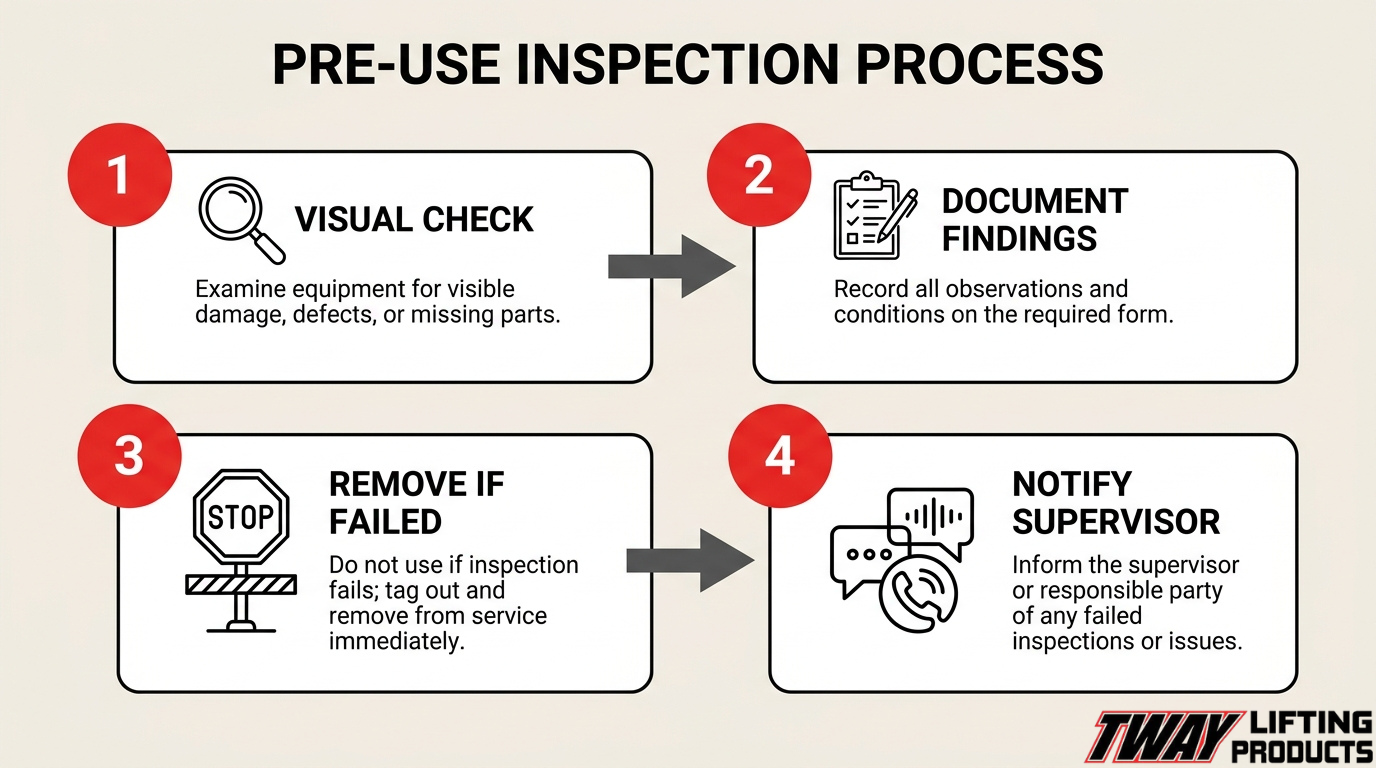
When a rental unit fails pre-use inspection, the operator must remove it from service immediately and notify the supervisor before any lift proceeds. No load should be attached to equipment that has failed inspection, regardless of schedule pressure or availability constraints.
The correct response sequence is:
- Tag the equipment out of service and physically segregate it from in-service gear.
- Document the deficiency in writing, noting the specific condition observed.
- Notify the rental provider so the unit can be assessed, repaired, or replaced.
- Do not resume operations until an equivalent, inspection-ready unit is confirmed safe.
Trained operators understand that equipment failure is one of the primary causes of lifting operation accidents, making the decision to remove a failed unit the single most important action they can take.
How Do Tway Lifting’s Rental and Inspection Services Support Operator Training?
Tway Lifting’s rental and inspection services support operator training by providing inspection-ready equipment and professional compliance support for employers building safer lifting programs. The sections below cover how Tway Lifting’s offerings reinforce training requirements and what the key training takeaways are.
Can Tway Lifting’s Equipment Rentals and Inspections Support a Safer Lifting Program?
Yes, Tway Lifting’s equipment rentals and inspections can support a safer lifting program in several practical ways.
Tway Lifting offers rentals across a wide range of equipment, including wire rope slings, synthetic slings, spreader beams, hoists, shackles, and load cells, available daily, weekly, or monthly. Professional rigging inspection services, performed by certified specialists, help employers meet OSHA-required annual inspection standards and maintain job site compliance.
For employers responsible for ensuring their operators are trained and working with inspection-ready equipment, Tway Lifting’s rental and professional rigging inspection services help reduce compliance gaps before work begins. This is especially valuable on short-duration jobs where rented equipment arrives and must be verified immediately.
What Are the Key Takeaways About Operator Training for Rental Lifting Equipment We Covered?
The key takeaways about operator training for rental lifting equipment cover legal requirements, employer responsibility, inspection duties, and certification standards.
The core lessons from this article include:
- Certification is mandatory before operation. Employers must ensure operators hold a valid crane/equipment operator certificate from an accredited testing organization before operating covered equipment, as required by Washington State WAC 296-155-53300 and federal OSHA regulations.
- The employer bears the training burden. Regardless of whether equipment is owned or rented, the employer is responsible for ensuring operators are trained and evaluated.
- Pre-use inspection is a trained skill. Operators must apply shift-start inspection procedures to every rental unit before use.
- Retraining is required when conditions change. New equipment types, incident history, or observed deficiencies all trigger retraining requirements before the standard renewal deadline.
- Documentation must accompany training. Completed evaluations must be recorded and retained to demonstrate compliance.
Tway Lifting’s rental fleet and professional rigging inspection services help employers bridge the gap between equipment access and operational compliance.