






An industrial hoist is a mechanical device that exerts force to lift or lower freely suspended loads vertically, serving as a foundational tool for moving materials across warehouses, distribution centers, manufacturing floors, and job sites. This guide covers hoist types and how they work, capacity-based selection, industry-specific applications, key technical features, OSHA compliance requirements, hoist-versus-crane distinctions, maintenance practices, and how Tway Lifting’s rental and inspection services support compliant logistics operations.
Electric chain hoists and electric wire rope hoists are the two most widely deployed powered types, differing sharply in capacity range: chain hoists top out around 10 tonnes while wire rope hoists reach up to 40 tonnes, making type selection a direct function of load weight and duty cycle.
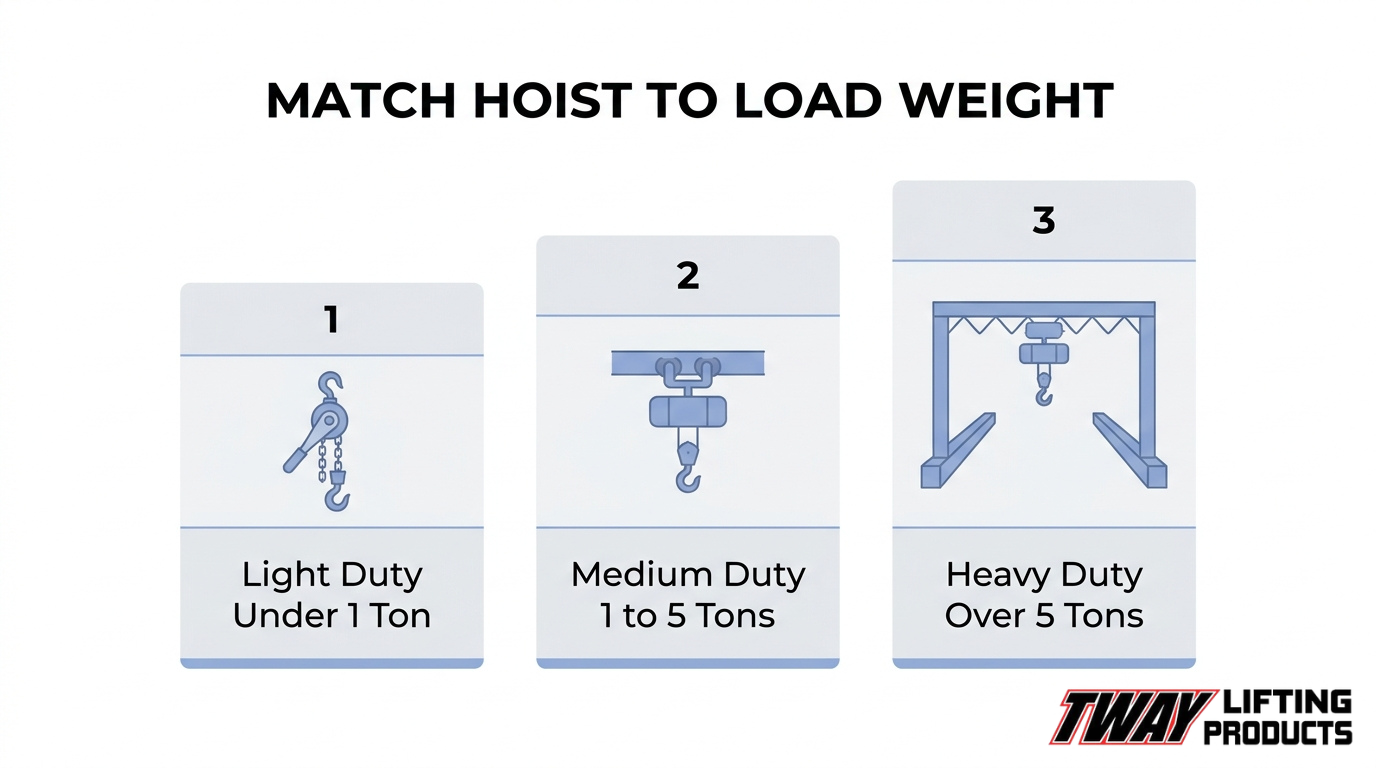
Matching each hoist type to the right load tier, whether light-duty under 1 ton, medium-duty between 1 and 5 tons, or heavy-duty above 5 tons, determines both operational efficiency and structural safety, with rated capacity markings required on every compliant unit under federal and ASME standards.
Manual chain hoists, pneumatic hoists, hydraulic hoists, and lever hoists each fill specific gaps where powered electric equipment is unavailable, impractical, or unsafe, covering applications from spark-sensitive environments to confined-space load tensioning.
OSHA regulations under 29 CFR 1910.179 and the ASME B30 series govern inspection intervals, marking requirements, and safety device installations, with willful violations carrying penalties up to $165,514 per incident under current OSHA schedules.
Ongoing maintenance through pre-use checks, monthly inspections, and documented periodic reviews protects uptime, and Tway Lifting’s certified inspections and flexible rental terms give logistics operations a compliant, cost-effective path to the right equipment.
What Is an Industrial Hoist and How Does It Work in Logistics?
An industrial hoist is a mechanical device that exerts force to lift or lower suspended loads vertically, serving as a foundational tool in logistics for moving materials across warehouses, manufacturing floors, and distribution centers. The following sections cover how hoists operate, the six main hoist types, and how load capacity determines the right choice.
How Does an Industrial Hoist Work?
An industrial hoist works by wrapping a rope, wire, or chain around a drum or wheel to generate lifting force through mechanical, electrical, pneumatic, or hydraulic power. According to the UK Health and Safety Executive, lifting equipment includes any work equipment for lifting and lowering loads, along with accessories used to attach the load. A trolley unit, consisting of a frame, trucks, and hoisting mechanism, moves the hoist laterally along overhead rails, enabling both vertical lift and horizontal load positioning. This two-axis movement is what makes overhead hoists practical for logistics workflows requiring precise load placement.
What Are the Operating Principles of an Industrial Hoist?
The operating principles of an industrial hoist depend on the power source and mechanical components that transfer energy into controlled vertical movement. The four core principles are:
- Electric: A motor drives a drum or sprocket to raise and lower a chain or wire rope with push-button control.
- Pneumatic: Compressed air powers a motor to drive the lifting drum, enabling operation in spark-sensitive environments.
- Hydraulic: Pressurized fluid drives a cylinder or motor, producing high force for heavy or precise lifting tasks.
- Manual: An operator pulls a hand chain through a gear reduction system to raise loads without external power.
Each principle determines the hoist’s suitability for specific load weights, duty cycles, and site conditions.
What Is the Role of an Industrial Hoist in Logistics Operations?
The role of an industrial hoist in logistics operations is to provide controlled, repeatable vertical movement of materials across the supply chain, from receiving docks and storage racks to assembly lines and shipping bays. The U.S. Census Bureau classifies overhead traveling cranes, hoists, and monorail systems as a distinct manufacturing industry, reflecting the scale of hoist use in industrial operations nationwide. Hoists reduce manual handling risk, increase throughput speed, and enable movement of loads that would otherwise require forklifts or cranes. For logistics managers, selecting the right hoist type directly affects operational efficiency, worker safety, and equipment cost. Tway Lifting, headquartered in Indianapolis, Indiana, has supplied, rented, and inspected hoisting and rigging equipment to industrial operations across the U.S. since 1945, offering logistics teams both the product range and technical expertise to make that selection confidently.
What Are the Main Types of Industrial Hoists?
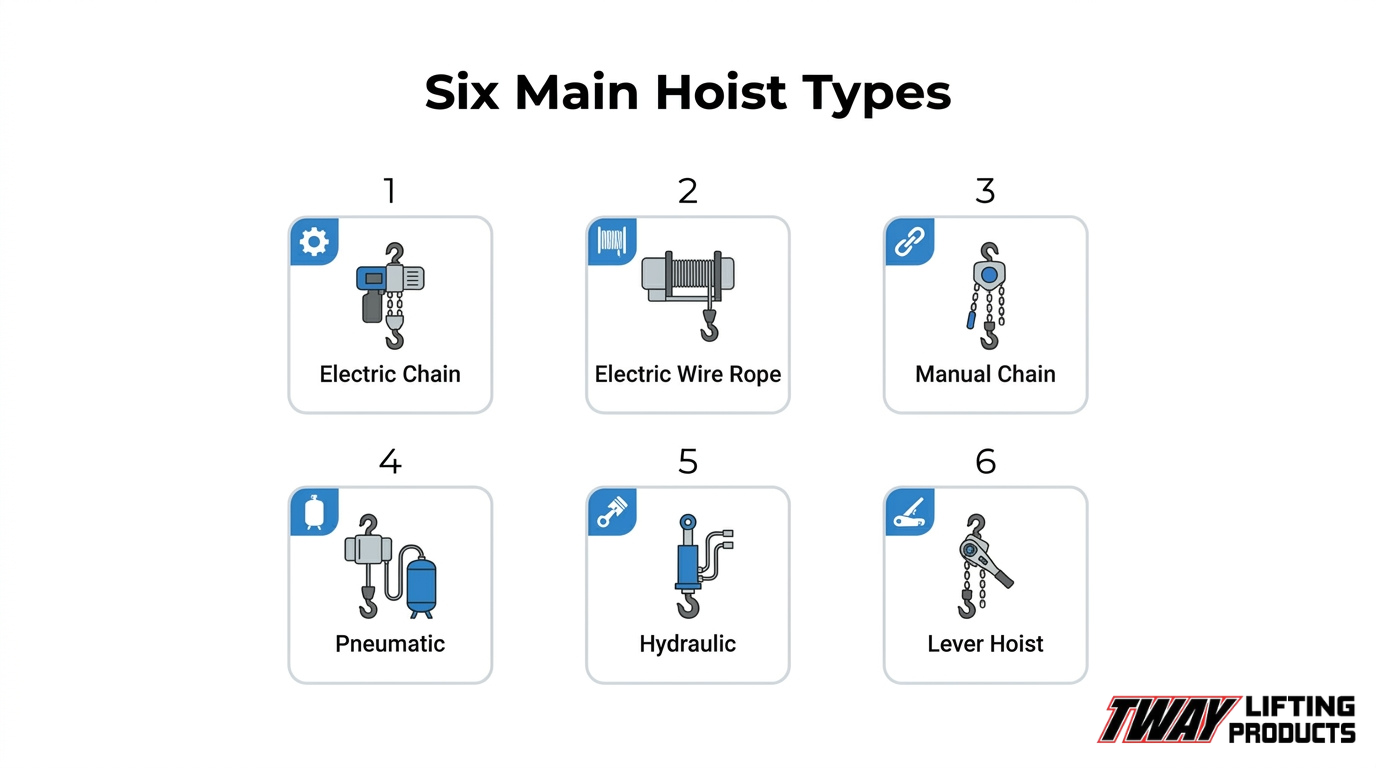
The main types of industrial hoists are electric chain hoists, electric wire rope hoists, manual chain hoists, pneumatic hoists, hydraulic hoists, and lever hoists. Each type differs in power source, load capacity, and best-fit application.
Electric Chain Hoist
An electric chain hoist is a motorized lifting device that uses a looped chain driven by an electric motor to raise and lower loads. According to a U.S. Department of Justice Antitrust Division filing, most electric chain hoists sold in the United States are priced from approximately $2,000 to $6,000, with typical capacities under three tons. A standard specification from a U.S. Department of Defense procurement notice describes a 2-ton unit with an 11-foot lift, 7 FPM lifting speed, and 40 FPM trolley travel speed. Electric chain hoists are well-suited for high-cycle, precision lifting in fixed overhead installations.
Electric Wire Rope Hoist
An electric wire rope hoist is a powered lifting device that uses a steel wire rope wound on a drum to lift heavy loads. Wire rope construction allows these hoists to handle significantly greater capacities than chain models, making them standard equipment in heavy industrial facilities. A government procurement specification from National Fertilizers Limited details a unit rated at 3,000 kg with a total lift of 43 to 45 meters, illustrating the depth and capacity range this hoist type supports.
Manual Chain Hoist (Hand Chain Hoist)
A manual chain hoist is a non-powered lifting device operated by pulling a hand chain to raise or lower a load. According to Eastern Washington University Environmental Health and Safety, manual chain hoists are commonly known as chain blocks and are designed for heavy-duty lifting and materials handling, raising and lowering loads by pulling on the hand chain. They require no electricity or compressed air, making them practical for remote job sites or infrequent lifts where powered equipment is unavailable.
Pneumatic Hoist
A pneumatic hoist is an air-powered lifting device driven by compressed air rather than electricity. A specification from the U.S. Bureau of Reclamation documents a single-drum air hoist with a 1,000-pound lifting capacity at 80 psi, a drum capacity of 325 feet of 1/2-inch cable, and an overall weight of approximately 275 pounds. Pneumatic hoists are preferred in hazardous or explosion-risk environments where electric motors create safety concerns.
Hydraulic Hoist
A hydraulic hoist is a lifting device that uses pressurized hydraulic fluid to generate lifting force. Hydraulic hoists deliver high force output in compact form factors, making them effective where heavy loads must be moved in confined spaces. They are commonly used in vehicle service, mobile equipment maintenance, and specialized industrial lifting applications that demand precise, controlled movement.
Lever Hoist (Ratchet Lever Hoist)
A lever hoist is a manually operated pulling and lifting device that uses a ratchet-and-pawl or friction brake mechanism to tension, lift, or position loads. According to ASME B30.21, lever hoists cover ratchet-and-pawl and friction brake types used for lifting, pulling, and tensioning applications, and Washington State Administrative Code requires riggers to understand ASME B30.21 as part of their compliance obligations. Lever hoists are especially useful for load positioning, lashing, and tension applications in tight or awkward spaces where overhead mounting is not possible.
How Do Electric Chain Hoists Compare to Wire Rope Hoists?
Electric chain hoists and wire rope hoists differ primarily in load capacity, price, and application. The sections below compare both types across capacity range, cost, and safety requirements.
How Do Their Load Capacities Differ?
Electric chain hoists and wire rope hoists differ significantly in maximum load capacity. According to the Lifting Equipment Engineers Association (LEEA), electric chain hoists are generally available in capacities up to 10 tonnes, while wire rope hoists reach up to 40 tonnes. For logistics operations moving loads under three tons, chain hoists are the practical and cost-effective choice. Wire rope hoists serve facilities where heavy-duty throughput demands exceed what chain hoists can handle.
What Are the Price Differences Between Chain and Wire Rope Hoists?
Electric chain hoists cost less upfront than wire rope hoists of comparable build. A 2024 U.S. Department of Justice Antitrust Division market review found that most electric chain hoists sold in the United States are priced between $2,000 and $6,000, with variation based on features and capacity. Wire rope hoists, built for heavier loads and more demanding duty cycles, typically carry a higher capital cost. For budget-constrained operations lifting under three tons, chain hoists deliver strong value.
What Safety Devices Are Required on Both Hoist Types?
Both electric chain hoists and wire rope hoists require protective limit switches as a baseline safety measure. Per the University of Wisconsin-Madison College of Engineering safety program, an upper-limit switch or slip clutch must be installed on all building cranes and hoists, with a lower-limit switch required when insufficient rope remains on the drum to reach the lowest point. These requirements apply equally to both hoist types and are non-negotiable for OSHA-compliant operations.
Selecting the right hoist type comes down to matching capacity and budget to your specific load requirements.
What Type of Industrial Hoist Is Best for Your Load Capacity?
The best industrial hoist for your load capacity depends on the weight range you’re lifting: light-duty under 1 ton, medium-duty between 1 and 5 tons, or heavy-duty over 5 tons. Each tier calls for a different hoist type, power source, and structural support.
What Hoist Type Handles Light-Duty Loads Under 1 Ton?
The hoist type that handles light-duty loads under 1 ton best is the manual chain hoist or a compact electric chain hoist. Both are well-suited for infrequent lifts in confined spaces, maintenance bays, and smaller warehouse applications. Manual chain hoists, also called chain blocks, raise and lower loads by pulling a hand chain, requiring no electrical supply. Electric chain hoists in this range offer faster cycle times while remaining easy for operators to use. Per the University of Wisconsin–Madison’s Crane and Hoist Safety Program, ASME B30.16 governs overhead underhung and stationary hoists in this class, requiring upper-limit switches on all building-mounted units. For light-duty applications, portability and low overhead clearance requirements are the defining selection factors.
What Hoist Type Is Right for Medium-Duty Loads Between 1 and 5 Tons?
The hoist type right for medium-duty loads between 1 and 5 tons is typically an electric chain hoist or a light-capacity electric wire rope hoist paired with a trolley system. A trolley is a unit consisting of a frame, trucks, trolley drive, and hoisting mechanism that moves along bridge rails at right angles to the crane runway, allowing precise horizontal positioning. Electric chain hoists cover most of this range effectively, while wire rope hoists are preferred when lift height or duty cycle demands are higher. Lifting accessories such as slings and shackles provide the critical link between the load and hoist at this capacity tier. For medium-duty logistics applications, matching the CMAA service classification to your actual lift frequency is just as important as rated tonnage.
What Hoist Type Is Best for Heavy-Duty Loads Over 5 Tons?
The hoist type best for heavy-duty loads over 5 tons is an electric wire rope hoist, often integrated into an overhead bridge crane system. According to 29 CFR 1926.554, the safe working load of the overhead hoist, as determined by the manufacturer, shall be indicated on the hoist and must not be exceeded. Wire rope hoists in this range are manufactured by establishments within the U.S. overhead traveling crane and monorail systems industry and can reach capacities well beyond 5 tons for demanding industrial environments. California regulations additionally require that cranes with a maximum rated capacity exceeding 50 tons be equipped with a load indicating device or a device that prevents an overload condition. At this load tier, permanent rated capacity markings on the hoist, load block, and crane superstructure are mandatory under multiple regulatory frameworks.
Matching hoist type to load capacity is the foundation of safe, compliant lifting; selecting the wrong tier creates both operational risk and regulatory exposure.
Which Industrial Hoist Type Works Best by Industry?
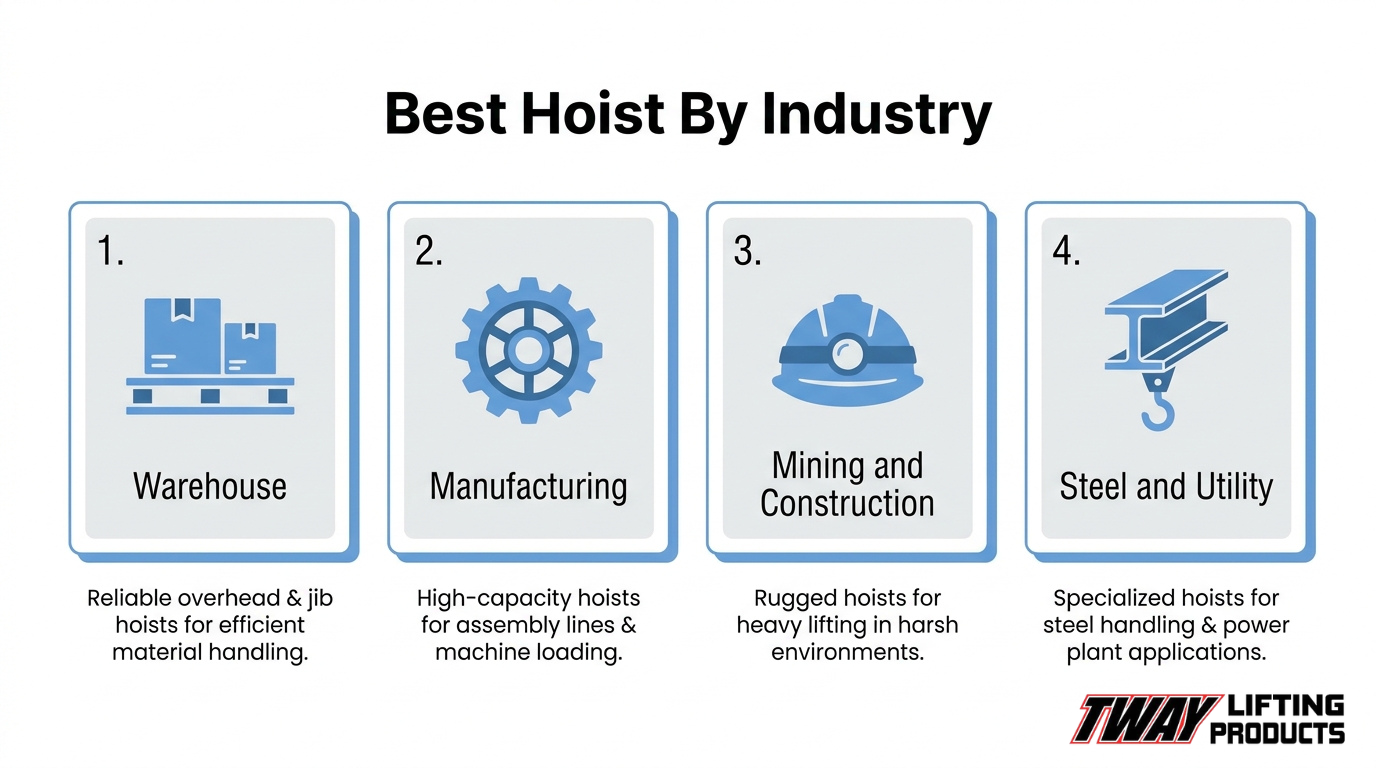
The best hoist type varies by industry based on load weight, environment, duty cycle, and power availability. The following sections cover four key sectors: warehouses and distribution centers, manufacturing and automotive facilities, mining and heavy construction, and utility and steel applications.
What Hoist Type Is Best for Warehouse and Distribution Centers?
The best hoist type for warehouse and distribution centers is the electric chain hoist. Warehouses typically move moderate, repetitive loads across predictable paths, making electric chain hoists well-matched for their speed, ease of operation, and low headroom requirements. These facilities benefit from motor-driven trolley configurations that allow loads to travel along overhead I-beams across broad floor areas. For high-bay distribution centers handling palletized goods over five tons, an electric wire rope hoist mounted on a bridge crane runway provides greater capacity without sacrificing cycle efficiency. Manual chain hoists serve as practical backup tools in staging areas where power is unavailable.
What Hoist Type Is Best for Manufacturing and Automotive Facilities?
The best hoist type for manufacturing and automotive facilities is the electric wire rope hoist, particularly for assembly lines handling engines, chassis components, and heavy tooling. These environments demand consistent, high-frequency lifts across defined work cells. Reactive maintenance in discrete manufacturing carries a real operational cost: according to the National Institute of Standards and Technology, facilities relying on reactive maintenance experienced 3.3 times more downtime than those using proactive approaches. This makes hoist duty cycle rating and scheduled inspection critical selection factors. Lever hoists also serve a valuable role in automotive plants for precision load positioning during assembly or alignment tasks.
What Hoist Type Is Best for Mining and Heavy Construction Sites?
The best hoist type for mining and heavy construction sites is the electric wire rope hoist, supported by pneumatic hoists where explosive atmospheres or remote power access creates constraints. These environments expose equipment to dust, moisture, shock loads, and extreme temperatures, all of which demand robust sealed motors and corrosion-resistant chains or wire rope. Pre-use inspection is non-negotiable in these settings: per UC Davis Safety Services, crane and hoist rigging must be visually inspected and confirmed safe before any lifting work begins. Hydraulic hoists suit specific ground-level or vehicle-mounted heavy lifts, particularly where controlled force application matters more than vertical travel height.
What Hoist Type Is Best for Utility and Steel Industry Applications?
The best hoist type for utility and steel industry applications is the electric wire rope hoist. The U.S. Census Bureau classifies manufacturers of overhead traveling cranes, hoists, and monorail systems as a distinct industry, reflecting the specialized demands of heavy-process sectors like steel production. Steel mills require hoists capable of handling molten metal ladles, structural beams, and coil stock, often exceeding five tons per lift at high duty cycles. Utility infrastructure projects involve lifting transformers, poles, and cable reels in outdoor environments, where pneumatic hoists offer a spark-free alternative when working near energized equipment. Wire rope hoists remain the dominant choice across both sectors for their combination of high capacity and proven reliability under continuous-service conditions.
What Are the Key Features to Compare When Choosing a Hoist?
The key features to compare when choosing a hoist include lift speed, duty cycle, power source, and built-in safety devices. Each sub-section below examines one of these decision factors in detail.
What Lift Speed and Duty Cycle Should Logistics Operations Look For?
Lift speed and duty cycle are the two performance variables that determine whether a hoist can sustain your operation’s workload without premature failure. Duty cycle covers the complete sequence from load preparation through final deposition, including the kind, amount, sequence, frequency, duration, and period of work performed. According to the U.S. Naval Postgraduate School Safety Office, duty cycle is the primary factor in determining the design ratings of motors, gearing, clutches, brakes, bearings, and other components. High-frequency logistics environments require hoists rated for heavier duty classifications; selecting an underrated unit accelerates mechanical wear and increases downtime risk.
How Does Power Source Affect Hoist Performance in Logistics?
Power source directly shapes a hoist’s speed, placement flexibility, and suitability for specific environments. The three main power sources are electric, pneumatic, and manual, each suited to different operating conditions.
- Electric hoists deliver consistent speed and precise control, making them ideal for high-cycle warehouse and manufacturing applications with reliable power infrastructure.
- Pneumatic (air-powered) hoists perform well in wet, explosive, or spark-sensitive environments where electric motors pose a hazard.
- Manual hoists require no power supply, offering portability for low-frequency or remote lifts where neither electricity nor compressed air is available.
Matching power source to facility infrastructure and environment is as critical as matching capacity to load weight.
What Safety Features Should an Industrial Hoist Have?
The safety features an industrial hoist should have include upper-limit switches, load capacity markings, and overload protection devices. According to the University of Wisconsin-Madison College of Engineering, a device such as an upper-limit switch or slip clutch shall be installed on all building cranes and hoists, with a lower-limit switch required when insufficient rope remains on the drum at the lowest point. Rated capacity must also be clearly marked on the hoist and load block, per federal procurement standards. Overload protection, emergency stop controls, and brake systems round out the essential safety package for industrial logistics use.
What Are the OSHA and Safety Compliance Requirements for Industrial Hoists?
The OSHA and safety compliance requirements for industrial hoists cover marking, inspection intervals, and adherence to ASME B30-series standards. The subsections below detail the specific federal regulations and ASME codes that govern safe hoist operation.
29 CFR 1926.554 Overhead-Hoist Marking Requirement
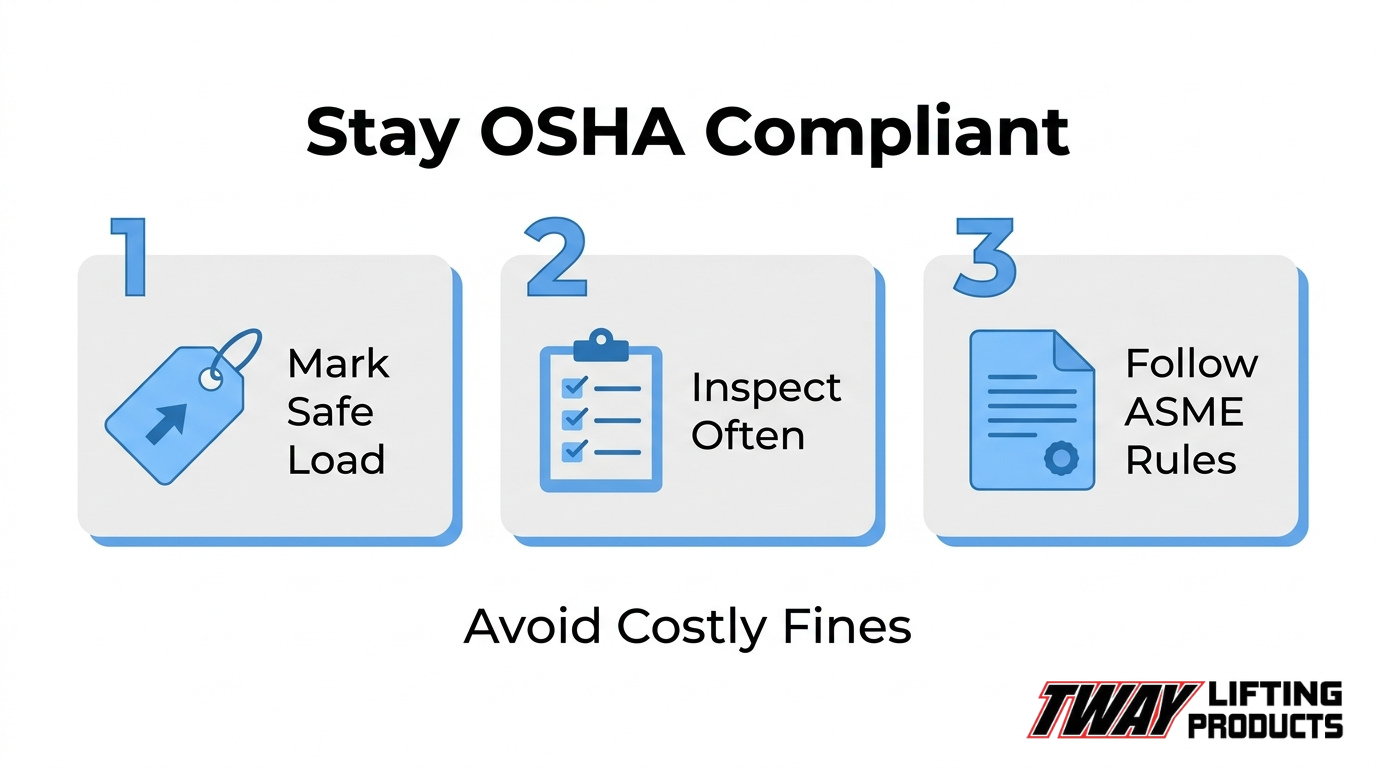
According to 29 CFR 1926.554, the safe working load of an overhead hoist, as determined by the manufacturer, shall be indicated on the hoist, and this safe working load shall not be exceeded. This marking requirement applies to all overhead hoists on construction sites and creates a direct, enforceable link between manufacturer capacity ratings and operator behavior.
ASME B30.16-2022 Scope
ASME B30.16-2022 covers the marking, construction, installation, inspection, testing, maintenance, and operation of overhead underhung and stationary hoists, including hand chain-operated, electric, and air-powered chain and rope hoists. According to the U.S. Department of Energy’s Hanford Site Hoisting and Rigging Manual, facilities using these hoist types must follow B30.16 as their primary technical standard.
ASME B30.21 (2025) Public Scope
ASME B30.21 applies to the construction, installation, operation, inspection, and maintenance of ratchet-and-pawl and friction-brake type lever hoists used for lifting, pulling, and tensioning applications. Any facility using lever hoists must ensure compliance with this standard across all four phases: installation, operation, inspection, and maintenance.
OSHA Maximum Civil Penalties Effective After January 15, 2026
OSHA civil penalties for hoist-related violations carry significant financial exposure. According to OSHA’s published penalty schedule, current maximums are:
| Violation Type | Maximum Penalty |
| Serious / Other-Than-Serious / Posting | $16,550 per violation |
| Failure to Abate | $16,550 per day beyond abatement date |
| Willful or Repeated | $165,514 per violation |
Note: The Federal Register confirmed the 2026 inflation adjustment for these penalties was cancelled entirely, so these figures remain in effect.
Proactive compliance is far less costly than reactive response; a single willful violation can reach nearly $166,000, making regular inspection investment straightforward to justify.
What Is the Difference Between a Hoist and a Crane in Logistics?
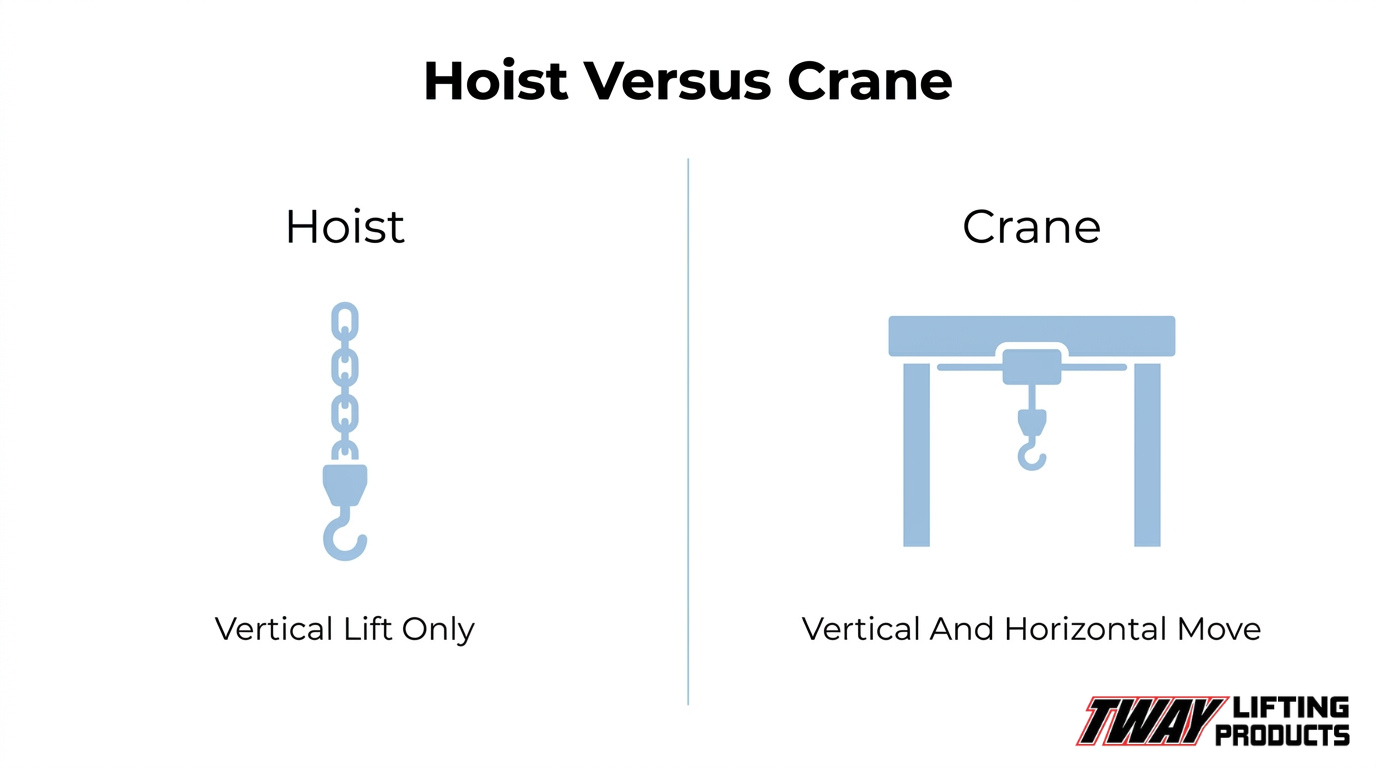
The difference between a hoist and a crane in logistics is defined by function and scope. A hoist performs vertical lifting of freely suspended loads. A crane integrates a hoisting mechanism with horizontal travel, enabling three-dimensional load movement across a workspace.
According to UCLA Environment, Health & Safety, Cal/OSHA defines a crane as a machine for lifting or lowering a load and moving it horizontally, with the hoisting mechanism as an integral part. ANSI/ASME standards define an overhead hoist as a machinery unit used for vertical lifting service involving freely suspended, unguided loads.
In practice, a crane contains a hoist but extends its capability. A bridge crane, for example, moves a hoist laterally on a beam or girder that travels longitudinally on a runway, allowing loads to reach any point within a defined rectangle of coverage.
For logistics operations, this distinction directly shapes equipment selection. Hoists suit fixed lifting points and vertical-only tasks, such as loading bays and mezzanine transfers. Cranes suit production floors and warehouses where loads must travel horizontally between stations.
How Should You Maintain and Inspect Industrial Hoists?
Industrial hoist maintenance and inspection follow two classification intervals established under OSHA regulations. The subsections below cover pre-use checks, periodic inspection schedules, and documentation practices.
What Are the Two OSHA Inspection Classifications for Hoists?
The two OSHA inspection classifications for hoists are frequent inspections and periodic inspections, divided based on the intervals at which inspection should be performed. According to the Electronic Code of Federal Regulations (29 CFR 1910.179), frequent inspections occur daily to monthly depending on service conditions, while periodic inspections occur at one- to twelve-month intervals. Facilities with high-cycle operations should default to shorter intervals for both classifications.
What Should a Pre-Use Hoist Inspection Include?
A pre-use hoist inspection should include a visual check of the hoist, hook, chain or wire rope, load block, and limit switches before any lifting begins. Equipment must be inspected by a competent person before each use, and all deficiencies must be corrected before further use. Inspectors should verify that rated capacity is legibly marked on the hoist and remains visible. Skipping pre-use checks is one of the most common and preventable causes of hoist failure in active logistics environments.
How Often Should In-Service Hoists Be Formally Inspected?
In-service hoists should be formally inspected at least monthly, with results documented. Per University of Tennessee Knoxville Environmental Health and Safety guidelines, all in-service cranes and hoists require monthly inspection and written records. Documentation creates an audit trail that supports OSHA compliance and identifies deterioration patterns before equipment fails. Tway Lifting’s professional rigging inspection services include OSHA-required annual inspections, job site safety assessments, and detailed reporting, performed by certified, factory-trained specialists who can support the documentation requirements logistics operations need to stay compliant.
With consistent inspection schedules in place, pairing that discipline with a qualified service partner protects both uptime and worker safety.
How Can Tway Lifting’s Hoist Rental and Inspection Services Support Your Logistics Operation?
Tway Lifting’s hoist rental and inspection services support logistics operations by providing compliant equipment, certified inspections, and flexible rental terms. The sections below cover OSHA-compliant inspections and a summary of key hoist selection takeaways.
Does Tway Lifting Offer OSHA-Compliant Hoist Inspections and Repairs?
Yes, Tway Lifting offers OSHA-compliant hoist inspections and repairs performed by certified, factory-trained qualified riggers and inspection specialists. A pre-use visual inspection confirming the crane, hoist, and rigging are safe before any lifting work is a recognized industry standard, and Tway Lifting’s inspection services fulfill this requirement. Tway Lifting also provides annual OSHA-required inspections, job site safety assessments, and detailed reporting across a range of lifting and rigging equipment. For operations that need equipment without capital investment, Tway Lifting rents a wide range of rigging and lifting equipment on daily, weekly, or monthly terms, with free local delivery and pickup. According to the U.S. General Services Administration, purchasing industrial equipment becomes cost-effective only above approximately 900 utilization hours per year, making rental the smarter choice for many logistics operations.
What Are the Key Takeaways About Types of Industrial Hoists for Logistics?
The key takeaways about types of industrial hoists for logistics are that each hoist type serves a distinct load range and environment. Selecting the right hoist requires matching three factors: load weight, power source availability, and duty cycle. Electric chain hoists suit lighter, frequent lifts; electric wire rope hoists handle heavier sustained loads; manual and lever hoists serve low-frequency or remote applications; pneumatic hoists work in hazardous or wet environments. Compliance with OSHA 29 CFR 1910.179 and ASME B30 standards is non-negotiable, and regular inspections prevent costly violations. Tway Lifting, founded in 1945 with over 75 years of industry experience, offers the full spectrum: equipment manufacturing, sales, rentals, custom fabrication, and certified inspections to keep any logistics operation lifting safely and legally.