


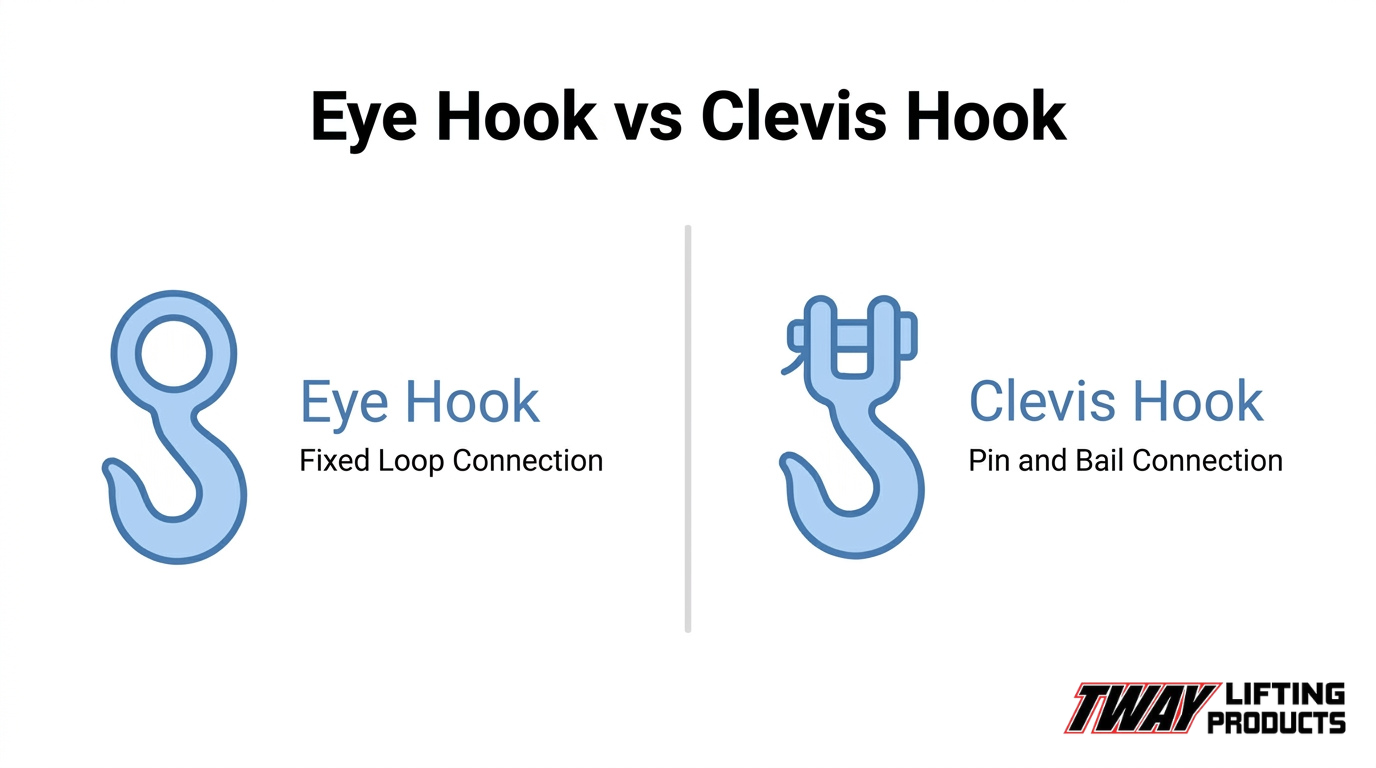

Eye hooks and clevis hooks are the two primary hook types used in industrial lifting and rigging, distinguished by how they connect to a rigging assembly. An eye hook uses a fixed closed loop at the shank end to accept shackles, master links, or wire rope fittings, while a clevis hook uses a forked U-bracket with a removable pin that connects directly to chain links without an intermediate element.
This guide covers hook design and connection method differences, working load limit comparisons by chain size and grade, material and steel grade specifications, safety latch requirements, application-specific performance, governing OSHA and ASME standards, inspection and rejection criteria, and a practical selection framework.
Eye hooks and clevis hooks share similar WLL ranges when chain size and steel grade are matched, with both types available in Grade 80 and Grade 100 alloy steel, individually proof tested to 2.5 times their working load limit. The fixed eye geometry suits versatile, multi-point rigging assemblies and wire rope slings, while the clevis pin system streamlines direct chain integration in high-cycle industrial environments.
Safety latch requirements differ by work activity and governing standard. OSHA mandates self-closing or positive-lock latches in most overhead lifting scenarios across several CFR provisions, and ASME B30.10 sets the foundational technical requirements for hook marking, inspection, and latch operation.
Inspection schedules, rejection thresholds, and hook selection logic based on rigging configuration, industry, and load conditions complete the guide, along with an overview of how Tway Lifting’s OSHA-compliant inspection services support hook verification in the field.
What Is an Eye Hook in Lifting and Rigging?
An eye hook is a lifting hook with a closed circular or oval loop at the top, allowing it to connect to rigging hardware such as shackles, wire rope, and chain slings. The three section below cover how the eye attachment connects, what load ratings apply, and when an eye hook is the right choice.
How Does the Eye Attachment on an Eye Hook Connect to Rigging Hardware?
The eye attachment on an eye hook connects to rigging hardware by accepting a shackle, master link, or hoist hook directly through its closed loop. This fixed eye geometry creates a permanent, low-profile connection point without requiring a pin or bail assembly. According to CICB Senior Instructor Larry Kime, always facing the hook out when applying it to the load prevents dislodging in slack conditions. Because the eye cannot pivot or rotate independently, it transfers load in a fixed orientation, making proper alignment with the intended pull direction essential before every lift.
What Load Ratings Are Standard for Eye Hooks?
Standard load ratings for eye hooks follow the ASME B30.10 Hooks standard, which governs the marking, inspection, and rated capacity of lifting hooks across industrial applications. For the Grade 100 alloy chain, the Crosby S-1316 SHUR-LOC eye hook carries working load limits ranging from 5,700 lbs for 1/4–5/16 in. chain up to 35,300 lbs for 3/4 in. chain, all at a 4:1 design factor. These WLL values are verified through individual proof testing at 2.5 times the working load limit. Every hook must also carry permanently affixed, legible WLL markings per OSHA 29 CFR 1926.251(a)(2)(i).
When Is an Eye Hook the Right Choice for a Lifting Application?
An eye hook is the right choice when the rigging assembly requires a simple, direct connection through a fixed attachment point, such as a shackle or master link, without needing a quick-disconnect pin system. Eye hooks pair efficiently with wire rope and alloy chain slings and are well-suited for overhead lifting where the load path runs in-line with the hook axis. Under OSHA 29 CFR 1926.1433(d)(4), hooks must be equipped with latches that close the throat opening and retain slings when rigging is slack, unless a qualified person has determined otherwise. Products like the Crosby S-1316 address this with a positive-lock latch that self-locks when loaded, making them suitable for Grade 100 and Grade 80 chain assemblies.
For most standard overhead and chain sling applications, an eye hook with a positive-lock latch is one of the most reliable and inspection-friendly configurations available.
What Is a Clevis Hook in Lifting and Rigging?
A clevis hook is a lifting hook that connects to a rigging assembly through a forked clevis mount, coupling pin, and retaining pin rather than a fixed eye. This pin-and-bail attachment system allows the hook to be linked directly to chain links or rigging hardware without a separate connecting element. The following section covers how the clevis system attaches, what load ratings apply, and when this hook type is the right choice.
How Does the Clevis Pin and Bail System Attach to a Rigging Assembly?
The clevis pin and bail system attaches to a rigging assembly by threading the clevis fork directly over a chain link or connecting point, then securing it with a coupling pin and retaining pin. This eliminates the need for an additional connecting element, making assembly faster and more direct than eye-type connections. According to the Web Sling and Tie Down Association (WSTDA), sling use is only one part of a lifting system, and it is your responsibility to consider all risk factors prior to using any rigging device or product. The bail on the hook body must move freely to ensure proper load alignment through the assembly.
What Load Ratings Are Standard for Clevis Hooks?
Standard load ratings for clevis hooks range widely by design and grade. The Crosby L-1339 Clevis Sling Hook, rated for Grade 100 and Grade 80 chain at a 4:1 working load limit, covers the following chain sizes and capacities:
| Chain Size (in) | Chain Size (mm) | Working Load Limit (lb) |
| 1/4 | 7 | 4,300 |
| 5/16 | 8 | 5,700 |
| 3/8 | 10 | 8,800 |
| 1/2 | 13 | 15,000 |
| 5/8 | 16 | 22,600 |
Columbus McKinnon’s Clevlok dual-rated clevis sling hook extends this range from 2,700 to 35,300 lbs for overhead lifting. Grade T80 clevis grab hooks carry a working load limit of 3,500 to 18,100 lbs, though these are designed for load securement with tie-down chains, not overhead lifting.
When Is a Clevis Hook the Right Choice for a Lifting Application?
A clevis hook is the right choice when the rigging assembly requires direct chain integration without an intermediate connector. It performs best in chain sling assemblies, multi-leg lifts, and applications where a rigid, pinned connection is safer than a rotating eye attachment. Choosing the correct grade matters significantly: overhead lifting demands Grade 80 or Grade 100 rated clevis hooks, while Grade T80 grab hooks are limited to load securement only. In practice, the clevis connection’s mechanical positivity makes it one of the more reliable options for high-cycle industrial environments where consistent hook orientation and chain alignment are priorities.
How Do Eye Hooks and Clevis Hooks Differ in Design?
Eye hooks and clevis hooks differ in three core design areas: connection method, load path geometry, and swivel capability. The sections below examine each difference and explain why it matters for rigging selection.
How Does the Connection Method Differ Between Eye Hooks and Clevis Hooks?
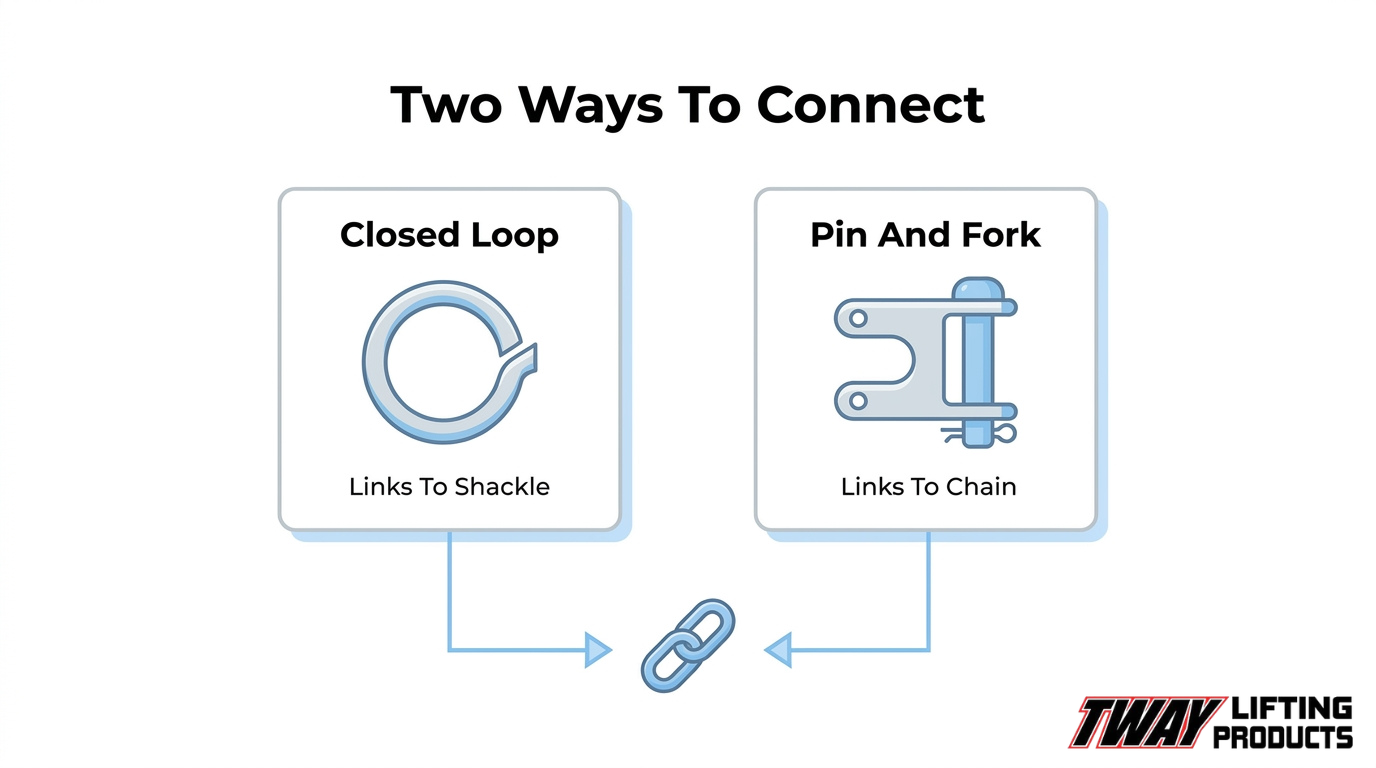
The connection method differs between eye hooks and clevis hooks in how each attaches to a rigging assembly. An eye hook uses a closed circular loop at the shank end, which threads onto a bolt, shackle, or eye fitting. A clevis hook uses a U-shaped bracket with a removable pin, allowing direct attachment to a chain link without a separate connecting element. The clevis system links the chain to hook quickly and simply, which reduces assembly steps in multi-leg chain sling configurations. Under OSHA 29 CFR 1926.1425(c)(2), hooks with self-closing latches must be used when workers are within the fall zone during hooking or unhooking operations, regardless of connection type.
How Does the Load Path Differ Between Eye Hooks and Clevis Hooks?
The load path differs between eye hooks and clevis hooks based on how tensile force travels through the connection point. An eye hook transfers load axially through the eye loop and shank, centering force along a single linear axis. A clevis hook distributes load across the two ears of the clevis bracket and the clevis pin, creating a double-shear load path. Both designs require in-line loading. According to The Crosby Group’s hoist hook warnings, side loading, back loading, and tip loading damage and reduce the capacity of any hook, making proper alignment critical regardless of connection style.
How Does the Swivel Capability Differ Between Eye Hooks and Clevis Hooks?
The swivel capability differs between eye hooks and clevis hooks in that eye hooks are available in fixed and swivel configurations, while standard clevis hooks are fixed. According to The Crosby Group’s Hooks and Swivels technical catalog, eye hooks, shank hooks, and swivel hooks are designed for use with wire rope or chain, with reduced assembly efficiency on synthetic materials. A dedicated swivel eye hook rotates to relieve torsion in the rigging before or after a lift. Clevis hooks, by contrast, are pinned rigidly and do not rotate under load. For applications requiring load rotation, a swivel eye hook is the more practical choice over a fixed clevis design.
What Are the Working Load Limit Differences Between Eye and Clevis Hooks?
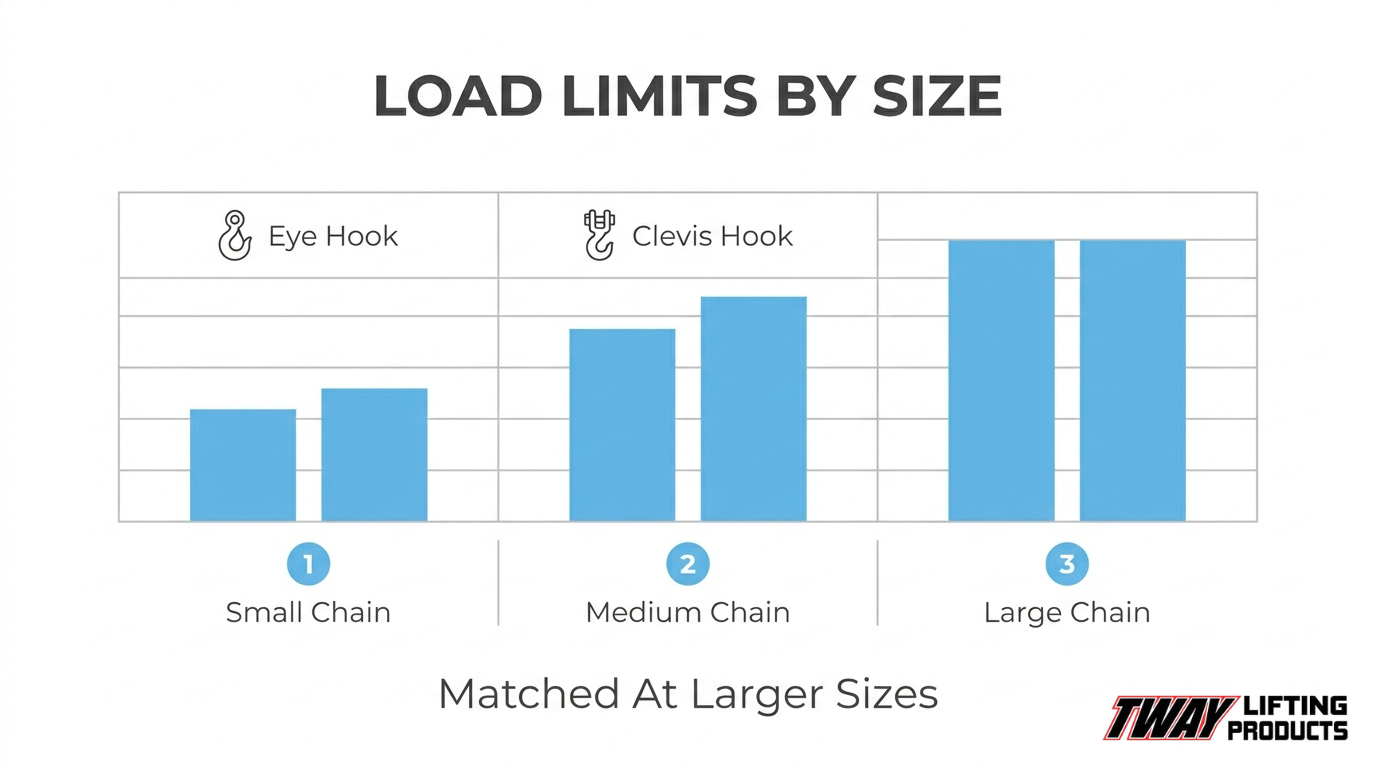
Working load limit differences between eye and clevis hooks depend primarily on chain size, grade compatibility, and connection geometry. Both hook types are individually proof tested to 2.5 times the Working Load Limit with certification and are suitable for use with Grade 100 and Grade 80 chains. The sections below compare WLL data by size for each hook type.
How Does Hook Size Affect Working Load Limits for Eye Hooks?
Hook size directly affects working load limits for eye hooks, with capacity scaling from 5,700 lbs up to 35,300 lbs across the Grade 100 range. All WLLs shown apply to in-line pull only; angle loading reduces rated capacity.
Per Crosby’s Grade 100 SHUR-LOC S-1316 Eye Hook data, the WLL by chain size is:
| Chain Size (in) | Chain Size (mm) | Working Load Limit (lb) |
| 1/4–5/16 | 7–8 | 5,700 |
| 3/8 | 10 | 8,800 |
| 1/2 | 13 | 15,000 |
| 5/8 | 16 | 22,600 |
| 3/4 | 18–20 | 35,300 |
According to 29 CFR 1926.251(a)(1)-(2)(i), rigging equipment must carry permanently affixed, legible WLL markings as prescribed by the manufacturer. Selecting an eye hook without verifying the stamped size against your chain grade is one of the most avoidable errors in rigging configuration.
How Does Hook Size Affect Working Load Limits for Clevis Hooks?
Hook size affects working load limits for clevis hooks across the same capacity range as comparably sized eye hooks, with the Crosby L-1339 Clevis Sling Hook spanning 4,300 lbs to 22,600 lbs for Grade 100 and Grade 80 chain at a 4:1 design factor.
Per Crosby’s L-1339 Clevis Sling Hook data, the WLL by chain size is:
| Chain Size (in) | Chain Size (mm) | Working Load Limit (lb) |
| 1/4 | 7 | 4,300 |
| 5/16 | 8 | 5,700 |
| 3/8 | 10 | 8,800 |
| 1/2 | 13 | 15,000 |
| 5/8 | 16 | 22,600 |
The key practical difference is that the clevis hook’s 1/4 in size carries a lower 4,300 lb rating compared to the eye hook’s combined 1/4–5/16 in entry at 5,700 lbs, reflecting separate size breaks in the clevis format. When chain size and grade are matched correctly, both hook types deliver equivalent WLLs at 3/8 in and above.
What Materials and Grades Are Eye Hooks and Clevis Hooks Made From?
Both eye hooks and clevis hooks are manufactured from quenched and tempered alloy steel, with Grade 80, Grade 100, and Grade 120 representing the primary classifications used in lifting applications. The sections below cover the specific steel grades applied to each hook type.
What Steel Grades Are Used for Alloy Eye Hooks?
The steel grades used for alloy eye hooks are Grade 80 and Grade 100, with Grade 120 available for higher-demand applications. Columbus McKinnon’s Herc-Alloy Eye Sling Hook carries a dual rating for both Grade 80 and Grade 100 chain, manufactured from quenched and tempered alloy steel. The Crosby S-1316 SHUR-LOC eye hook is similarly rated for Grade 100 and Grade 80 chain, proof tested to 2.5 times the working load limit with certification. According to OSHA’s Guidance on Safe Sling Use for Alloy Steel Chain Slings, attachments must carry a rated capacity at least equal to the alloy steel chain with which they are used. For Grade 120 systems, pewag notes exceptional strength and superior fatigue resistance compared to Grade 80.
What Steel Grades Are Used for Alloy Clevis Hooks?
The steel grades used for alloy clevis hooks are Grade 80 and Grade 100, with dual-rated products covering both in a single assembly. The Crosby S-1317 clevis-type SHUR-LOC hook is suitable for Grade 100 and Grade 80 chain, and Columbus McKinnon’s Clevlok dual-rated sling hook carries working load limits from 2,700 to 35,300 lbs when used with either Grade 80 or Grade 100 chain. Grade T80 clevis grab hooks exist as a separate classification, primarily intended for load securement and tie-down applications rather than overhead lifting. RUD’s Grade 100 lifting chains use CrNiMo alloy steel with a proprietary tempering process to maintain toughness at high strength, and hooks must match that chain grade to avoid downgrading the sling system’s rated capacity.
What Safety Latches and Locking Mechanisms Apply to Each Hook Type?
Safety latch requirements vary by hook type, connection style, and the specific OSHA regulation governing the work activity. The following sections cover latch options for eye hooks, latch options for clevis hooks, and when OSHA mandates a safety latch.
What Latch Options Are Available for Eye Hooks?
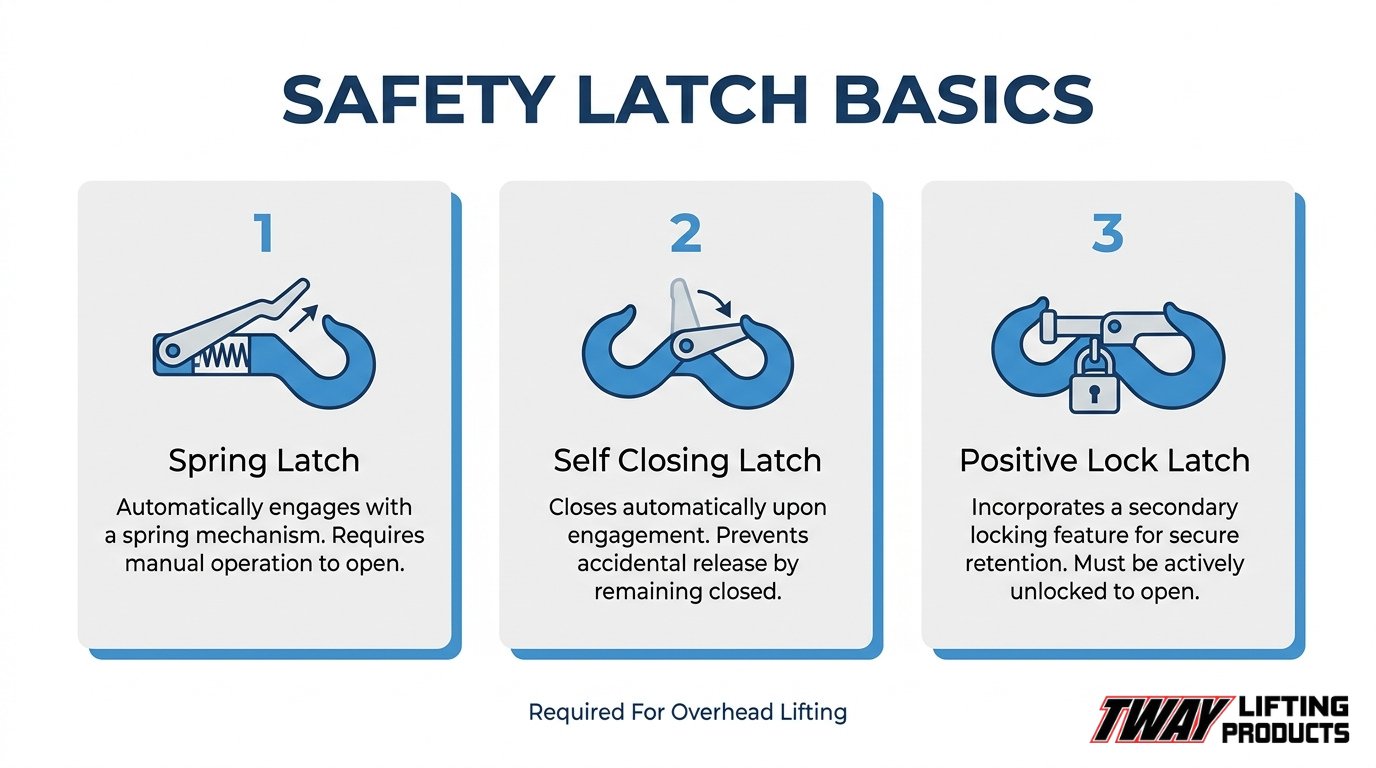
The latch options available for eye hooks include spring-loaded throat latches, self-closing latches, and positive-lock latches. Standard spring-loaded latches close the throat opening to retain slings when the rigging is slack. Positive-lock latches, such as the SHUR-LOC design, are self-locking when the hook is loaded, providing an additional retention layer without requiring manual engagement. For overhead lifting applications with Grade 80 or Grade 100 chain, a positive-lock or self-closing latch is strongly preferred over a basic spring latch, because load dynamics can momentarily slacken the sling and allow disengagement if only a simple spring latch is fitted.
What Latch Options Are Available for Clevis Hooks?
The latch options available for clevis hooks include spring-loaded safety catches, self-closing latches, and positive-lock mechanisms. Clevis sling hooks designed for overhead lifting, such as the Clevlok series, use a self-locking latch that engages automatically under load. Clevis grab hooks used for load securement rather than overhead lifting are less commonly fitted with positive-lock latches, reflecting their different risk profile. According to Columbus McKinnon Training, ASME requires that hooks be equipped with operable latches, which hold rigging in the hook when it is in the slack position.
When Is a Safety Latch Required by OSHA Standards?
A safety latch is required by OSHA standards depending on the work activity, the applicable standard, and the regulatory context. OSHA requirements across relevant standards include:
- 29 CFR 1910.181(j)(2)(ii): States that “safety latch type hooks shall be used wherever possible” for derricks; OSHA compliance officers may enforce the general duty clause under paragraph 5(a)(1) of the Williams-Steiger Act when a throat latch is absent and a hazard exists.
- 29 CFR 1926.1433(d)(4): Requires crane hooks to be equipped with latches that close the throat opening; hooks without latches may only be used when a qualified person determines it is safer and load routes are pre-planned to keep workers out of the fall zone.
- 29 CFR 1926.753(c)(5) and (d)(2)(ii): Prohibits deactivating safety latches during steel erection except when a qualified rigger determines it is safer or when a site-specific erection plan provides equivalent protection; self-closing latches are required when working under suspended loads.
- 29 CFR 1926.1425(c)(2): Requires hooks with self-closing latches when employees are within the fall zone during hooking, unhooking, or guiding; “J” hooks are permitted only for setting wooden trusses.
- 29 CFR 1917.45(e)(2): Requires crane hooks at marine terminals to be latched or otherwise secured; this rule does not extend to ship’s gear under longshoring regulations.
- 29 CFR 1910.184(c)(6): The general slings standard requires slings to be securely attached to their loads but does not explicitly mandate a safety latch on the hook itself.
Per OSHA’s 2006 Letter of Interpretation, whether a latch is required ultimately depends on which standard governs the specific lifting activity. In practice, selecting hooks with self-closing or positive-lock latches for all overhead lifting is the most defensible compliance posture and eliminates ambiguity across multiple regulatory frameworks.
How Do Eye Hooks and Clevis Hooks Perform in Specific Lifting Applications?
Eye hooks and clevis hooks perform differently depending on the application, covering overhead crane lifting, chain sling assemblies, wire rope sling assemblies, below-the-hook devices, and vertical versus angled lifts.
Which Hook Is Better for Overhead Crane Lifting?
Both hook types are used in overhead crane lifting, but hook security is the critical variable. Two NIOSH/OSHA-documented fatalities illustrate what happens when that fails: a 2002 Iowa FACE case recorded a worker killed when an 880-lb stack of cement forms slipped from a crane hook and fell 30 feet; a separate OSHA shipyard accident report describes a worker drowning after a crane load disengaged mid-swing, startling him off a catwalk. In both cases, load disengagement from the hook was the failure point. For overhead crane applications, always select hooks with positive-locking latches and verify the hook faces outward when rigged.
Which Hook Is Better for Chain Sling Assemblies?
Both eye hooks and clevis hooks are engineered for chain sling assemblies, with the clevis hook offering a direct pin-to-chain connection that eliminates the need for an additional connecting element. According to Kito Crosby product data, the S-1316 eye sling hook suits Grade 100 chain at a 4:1 working load limit, while the L-1339 clevis sling hook is dual-rated for Grade 100 and Grade 80 chain at the same 4:1 WLL. The clevis connection is often the more efficient choice when switching chain configurations frequently, since the pin attachment links directly to the chain without intermediate hardware.
Which Hook Is Better for Wire Rope Sling Assemblies?
Eye hooks are the conventional choice for wire rope sling assemblies. According to OSHA’s Guidance on Safe Sling Use, wire rope slings are selected for their strength, durability, abrasion resistance, ability to conform to load shapes, and capacity to lift hot materials. The round eye on an eye hook accepts a swaged or spelter socket fitting cleanly, maintaining a centered inline load path that suits wire rope’s properties. Clevis hooks can be used with wire rope, but the pin-bail system adds connection complexity where a simple eye fitting already works well.
Which Hook Is Better for Below-the-Hook Lifting Devices?
Hook selection for below-the-hook lifting devices depends on the device’s designed attachment point: eye-style or clevis-style. ASME B30.20 governs the marking, construction, installation, inspection, testing, maintenance, and operation of below-the-hook lifting devices used for attaching loads to a hoist. Supporting that standard, ASME BTH-1 provides minimum structural, mechanical, and electrical design criteria for those same devices. Because B30.20 and BTH-1 treat the connection interface as part of the device design, the hook type must match the manufacturer’s specified attachment geometry.
Which Hook Is Better for Vertical Lifts vs. Angled Lifts?
For vertical lifts, both hook types perform reliably when rigged inline. For angled lifts, the sling angle directly reduces the effective working load limit for the entire assembly, and The Crosby Group’s rigging guidance states that sling angles of less than 30 degrees from horizontal are not recommended, directing users to ASME B30.9 for full detail. Neither hook type is inherently superior for angled lifts, but the eye hook’s round connection accommodates angular sling spread more naturally when two sling legs share a single hook. In any angled application, confirm the reduced WLL before lifting and never exceed the hook’s rated capacity at the applied angle.
What Industry Standards and OSHA Regulations Govern Hook Selection?
Industry standards and OSHA regulations governing hook selection span several federal codes and ASME voluntary standards. The key frameworks covered below are ASME B30.10 and OSHA 1910.184.
What ASME B30.10 Requirements Apply to Lifting Hooks?
ASME B30.10 requirements apply to the design, marking, inspection, and safe use of lifting hooks. The 2024 edition of this standard, published by ASME, is intended for manufacturers, owners, employers, and users concerned with the specification, maintenance, training, and safe use of hooks with B30 equipment. According to the ANSI Webstore, careful application of B30 safety standards helps users comply with applicable regulations within their jurisdictions while achieving the operational and safety benefits of industry best practices. ASME also requires that hooks be equipped with operable latches that retain rigging in the hook when slack. From a compliance standpoint, B30.10 functions as the foundational technical reference that OSHA-regulated workplaces should align with for hook selection and use.
What OSHA 1910.184 Rules Cover Hook Use in Rigging?
OSHA 1910.184 rules cover hook use in rigging by requiring that hooks and all attachments have a rated capacity at least equal to that of the alloy steel chain with which they are used. If any component in the assembly is rated lower than the chain, the entire sling must not be used beyond the weakest component’s capacity. OSHA 29 CFR 1910.179 adds that hooks require daily visual inspection and monthly inspection with a written certification record, including the inspection date, the inspector’s signature, and the hook’s serial number or identifier. Construction sites fall under additional regulations: 29 CFR 1926.251 requires rigging equipment to be inspected before each shift, and 29 CFR 1926.1412 requires hooks and latches to be checked for deformation, cracks, excessive wear, and heat or chemical damage. For steel erection work, 29 CFR 1926.753 and 1926.1425 mandate self-closing safety latches whenever workers are within a load’s fall zone.
What Are the Inspection and Maintenance Requirements for Each Hook Type?
Inspection and maintenance requirements for lifting hooks apply equally to eye hooks and clevis hooks, with OSHA setting minimum intervals and rejection thresholds. The following sections cover daily and periodic inspection schedules, plus the specific criteria that require a hook to be removed from service.
How Often Should Eye Hooks Be Inspected Under OSHA Guidelines?
Eye hooks should be inspected visually before every shift and formally documented on a monthly basis. Under OSHA 29 CFR 1910.179(j)(2)(iii), monthly inspections require a certification record that includes the inspection date, the inspector’s signature, and the hook’s serial number or other identifier. Pre-shift visual checks cover deformation, cracks, latch condition, and any visible damage from chemicals or heat. Skipping pre-shift checks on eye hooks is one of the most preventable causes of in-service failures, particularly in high-cycle overhead crane environments. Tway Lifting’s certified, factory-trained inspection specialists offer OSHA-required rigging inspections that cover pre-shift and periodic hook evaluations, helping operations maintain documentation compliance under 29 CFR 1910.179.
How Often Should Clevis Hooks Be Inspected Under OSHA Guidelines?
Clevis hooks should be inspected on the same OSHA-mandated schedule as eye hooks: a visual check before each shift and a certified monthly inspection. OSHA 29 CFR 1926.251(a)(1) further requires that rigging equipment be inspected prior to use on each shift and as necessary during use. Because clevis hooks use a pin-and-bail connection, inspectors should also verify pin retention and latch function at each pre-shift check, in addition to the standard hook body examination.
What Are the Rejection Criteria for a Worn or Damaged Lifting Hook?
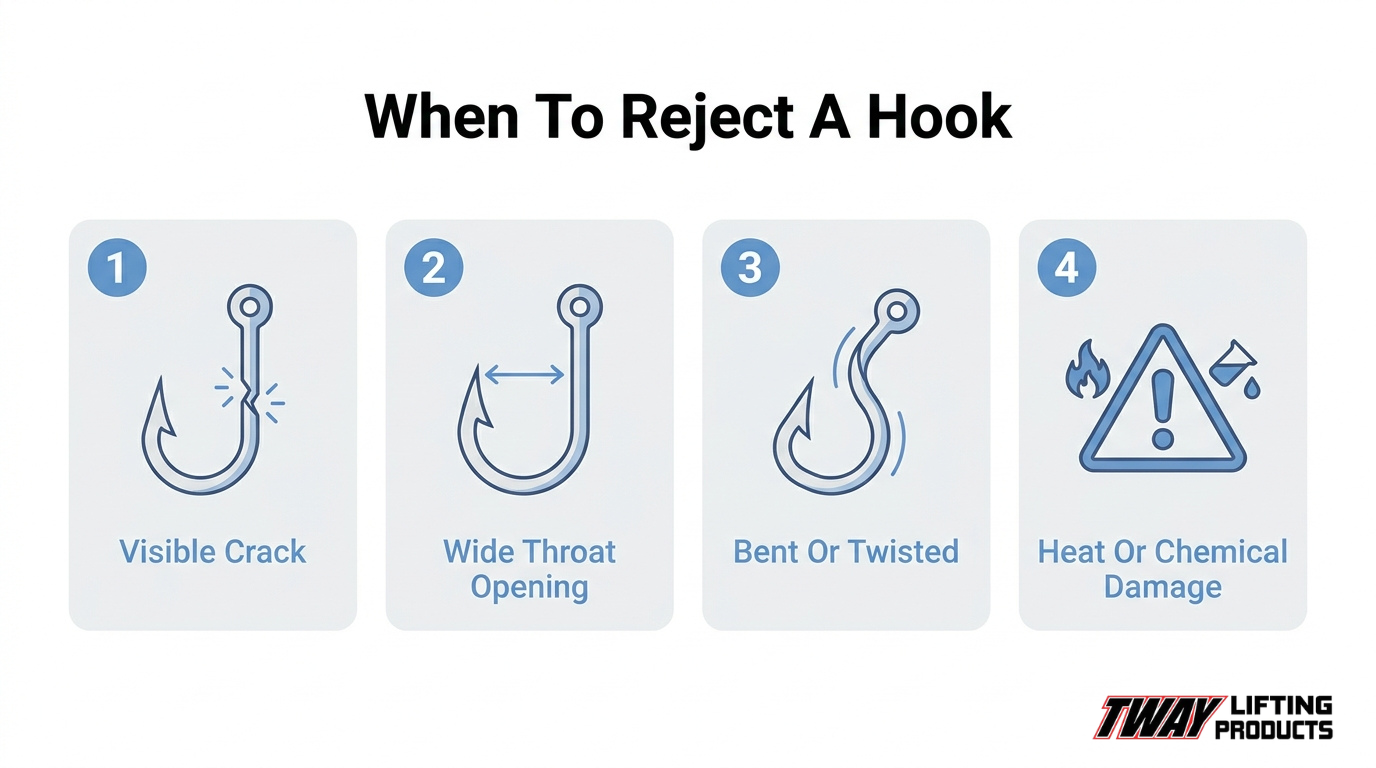
The rejection criteria for a worn or damaged lifting hook include measurable deformation, cracking, and excessive throat opening. According to OSHA 29 CFR 1910.179, hooks with cracks, a throat opening more than 15% in excess of normal, or a twist greater than 10 degrees from the plane of the unbent hook must be removed from service. The U.S. Army Corps of Engineers EM 385-1-1 sets additional thresholds: wear exceeding 10% of the original section or a throat opening increase of 5% (maximum 6 mm) also triggers removal. Any visibly apparent bend, latch distortion, or heat/chemical damage warrants immediate retirement from service.
How Do You Choose Between an Eye Hook and a Clevis Hook for Your Application?
Choosing between an eye hook and a clevis hook depends on your rigging configuration, industry requirements, and load conditions. The following sections break down each decision factor.
Which Hook Type Should You Choose Based on Your Rigging Configuration?
The hook type you should choose based on your rigging configuration depends on how the hook connects to your upper rigging and lower load attachment.
Eye hooks connect through a fixed closed eye, accepting shackles, master links, or swivel attachments. This makes them well-suited for multi-leg sling assemblies where the upper termination is already a shackle or link. Clevis hooks use a pin-and-bail system that attaches directly to chain links, eliminating the need for an intermediate connecting element.
According to The Crosby Group hoist-hook application instructions, when placing two sling legs in a hook, the angle from the vertical to the outermost leg must not exceed 45 degrees, and the included angle between legs must not exceed 90 degrees. This angular constraint applies to both hook types equally, so rigging geometry should be validated before finalizing any selection.
Which Hook Type Should You Choose Based on Your Industry?
The hook type you should choose based on your industry is guided primarily by whether the application involves overhead lifting or load securement.
- Overhead crane lifting (construction, steel production, utilities): Eye sling hooks and clevis sling hooks rated for Grade 80 or Grade 100 chain are both appropriate; always confirm the hook is rated for overhead lifting before use.
- Chain sling assemblies (manufacturing, automotive): Clevis hooks connect directly to chain without additional hardware, streamlining assembly.
- Load securement and tie-down (transportation, mining): Grade T80 clevis grab hooks are designed for this purpose and are not rated for overhead lifting.
- Entertainment rigging (stadiums, motor speedways): Overhead applications require hooks with self-locking latches and verified WLL for the specific assembly.
Matching the hook to its intended duty class, rather than substituting one type for another, is the single most important industry-level decision a rigger can make. Tway Lifting serves many of these industries – including construction, automotive, steel production, and entertainment rigging – providing both the rigging products and inspection expertise to support correct hook selection for each application.
Which Hook Type Should You Choose Based on Load and Environmental Conditions?
The hook type you should choose based on load and environmental conditions depends on load direction, sling angle, and exposure factors.
Both eye and clevis hooks share a critical load-direction requirement. According to The Crosby Group Hoist Hooks Warnings and Application Instructions, never side load, back load, or tip load a hook, as these conditions damage and reduce hook capacity. Working Load Limits stated by manufacturers apply to in-line pull only; angled or off-axis loading reduces rated capacity.
For orientation, CICB Senior Instructor Larry Kime notes that when applying a hook to a load, always face the hook out, which prevents dislodgement during slack conditions. Additionally, always inspect the hook and latch before each use, and never use a latch that is distorted or bent.
In chemically active or corrosive environments, consult the manufacturer directly, as derating data specific to hook alloys requires verified manufacturer guidance before making any selection. For organizations that need hands-on guidance rather than manufacturer documentation alone, Tway Lifting’s rigging inspection specialists can assess hook and sling conditions on-site and provide detailed reporting to support informed replacement or rerating decisions. For organizations that need hands-on guidance rather than manufacturer documentation alone, Tway Lifting’s rigging inspection specialists can assess hook and sling conditions on-site and provide detailed reporting to support informed replacement or rerating decisions.
How Do Tway Lifting’s Rigging Products and Inspections Support Hook Selection?
Tway Lifting supports hook selection through OSHA-compliant rigging inspections, certified rigger expertise, and a broad product inventory spanning chain slings, wire rope slings, synthetic slings, hoists, and related lifting gear. The sections below cover inspection services and final article takeaways.
Can Tway Lifting’s OSHA-Compliant Rigging Inspections Help Verify the Right Hook for Your Setup?
Yes, Tway Lifting’s OSHA-compliant rigging inspections can help verify the right hook for your setup. With over 75 years of experience since 1945, Tway Lifting employs certified, factory-trained rigging inspection specialists who perform OSHA-required annual inspections, job site safety inspections, and detailed reporting. Per 29 CFR 1926.251(a)(1), rigging equipment must be inspected prior to use on each shift, and all equipment must carry legible safe working load markings. Tway Lifting’s inspection process, performed by certified, factory-trained specialists, evaluates rigging equipment for deformation, latch condition, throat opening changes, and grade compatibility, ensuring the selected hook matches the actual rigging configuration. For operations where the wrong hook type creates compliance exposure, professional inspection is one of the most practical risk-reduction steps available.
What Are the Key Takeaways About Eye Hooks vs Clevis Hooks for Lifting Applications?
The key takeaways about eye hooks vs clevis hooks for lifting applications are centered on connection method, load rating, application fit, and compliance. Use these decision points before specifying any hook:
- Connection method: Eye hooks use a fixed loop for versatile attachment to shackles, master links, and swivel fittings; clevis hooks use a pin-and-bail system for direct, toolless chain connection.
- Load ratings: Both types are available across comparable WLL ranges; chain size and steel grade (Grade 80, 100, or 120) determine the actual capacity for a given hook.
- Application fit: Eye hooks suit flexible, multi-point rigging assemblies; clevis hooks excel in dedicated chain sling configurations where quick attachment matters.
- Latch compliance: OSHA and ASME B30.10 require operable safety latches in most overhead lifting scenarios; verify latch condition at every pre-shift inspection.
- Rejection criteria: Remove any hook showing wear exceeding 10%, throat opening increase of 5% or more, or visible bend and twist from the plane of the hook.
- Inspection support: Tway Lifting’s certified specialists can verify hook selection, grade compatibility, and OSHA documentation requirements for your specific setup.