







An industrial sling tag is a permanently affixed label on a lifting sling that identifies the sling’s safe working load, material, size, and manufacturer details required by federal safety standards. It serves as the primary compliance record on the sling itself, giving riggers immediate access to critical load data before and during every lift.
This guide covers the legal basis for sling tag requirements, the specific information each tag must display, how requirements vary by sling type, what happens when tags are missing or damaged, and how working load limits connect directly to tag content.
Federal law under OSHA 29 CFR 1926.251 and 29 CFR 1910.184 mandates permanently affixed, legible identification on all rigging equipment before any lift begins. We explain why OSHA made this mandatory, what worker safety outcomes depend on it, and how the 2011 Standards Improvement Project refined those rules.
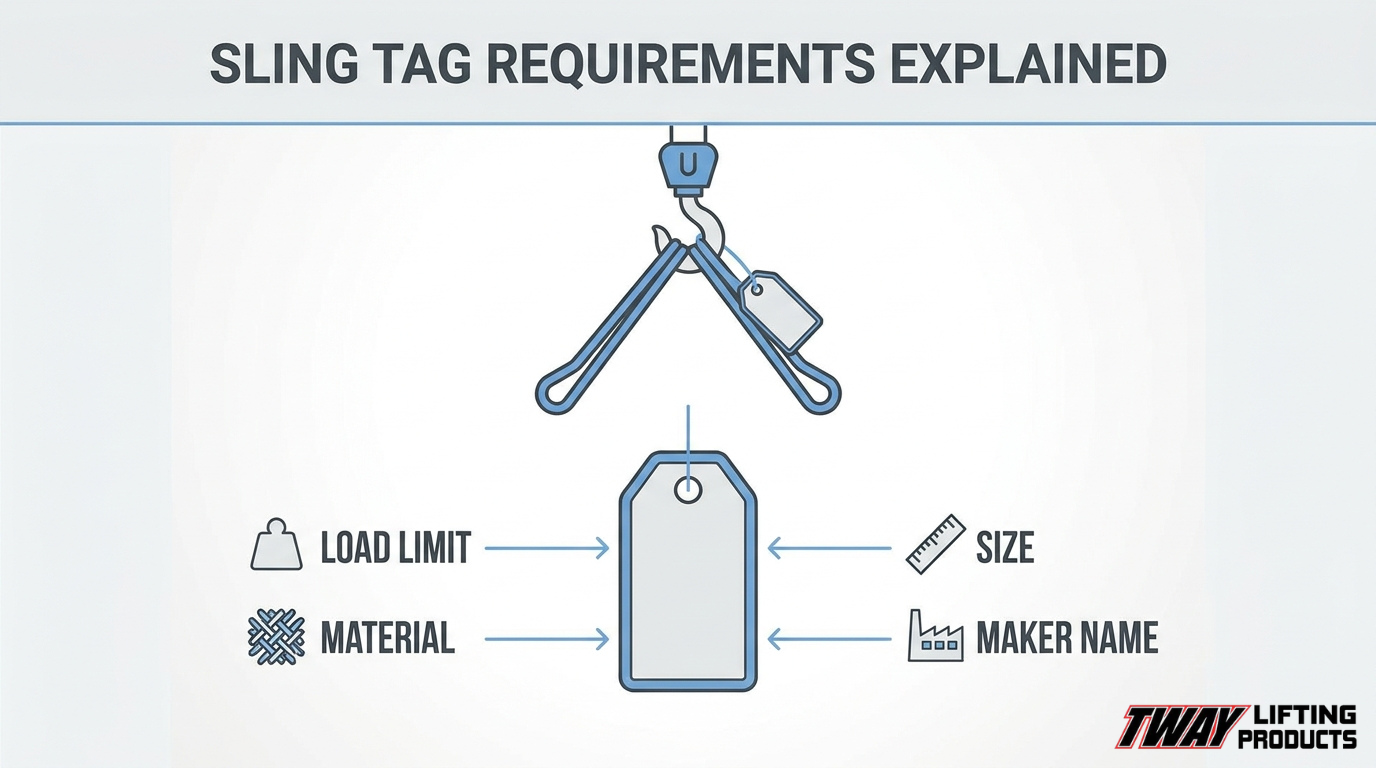
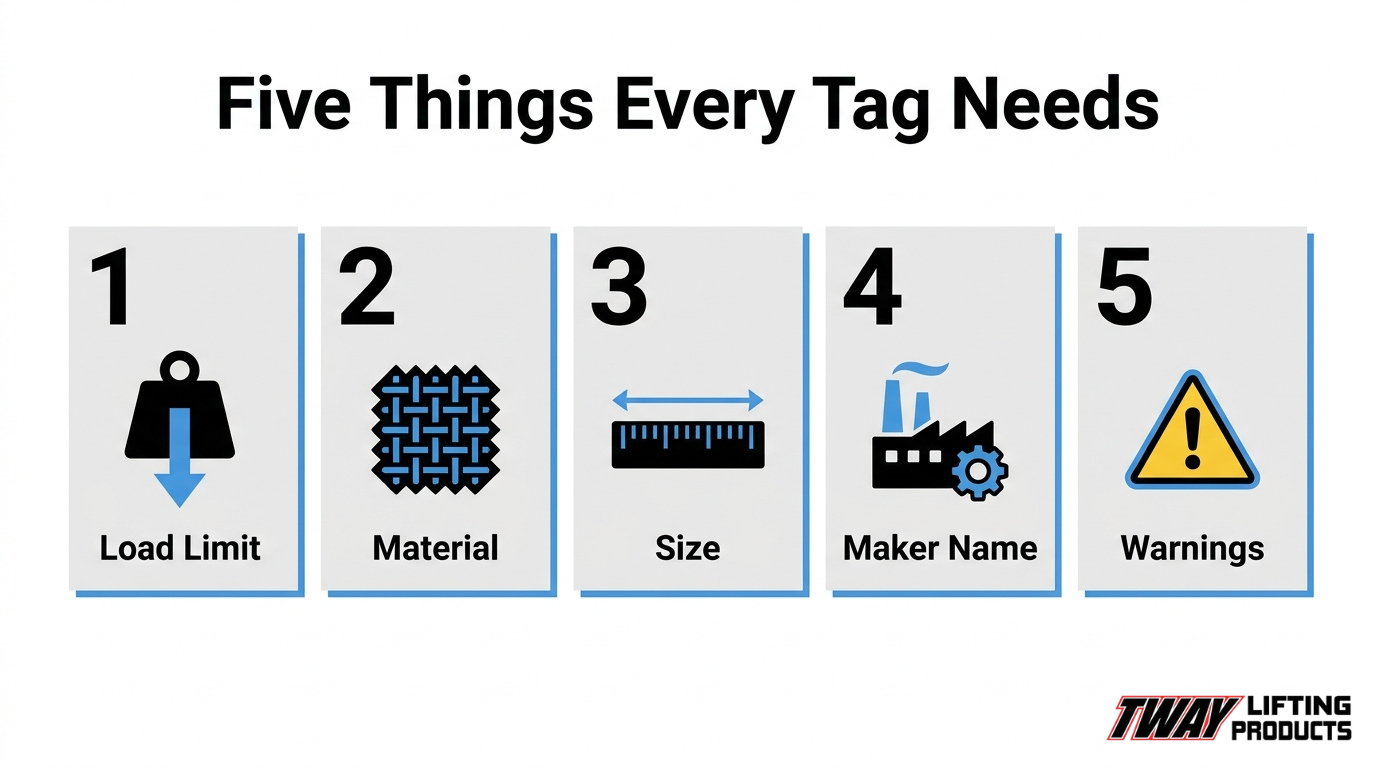
Every compliant sling tag must carry load capacity for each hitch configuration, material type, size and leg count, manufacturer identity, and safety warnings. We break down each required data category and the ASME B30.9 provisions that govern them alongside federal standards.
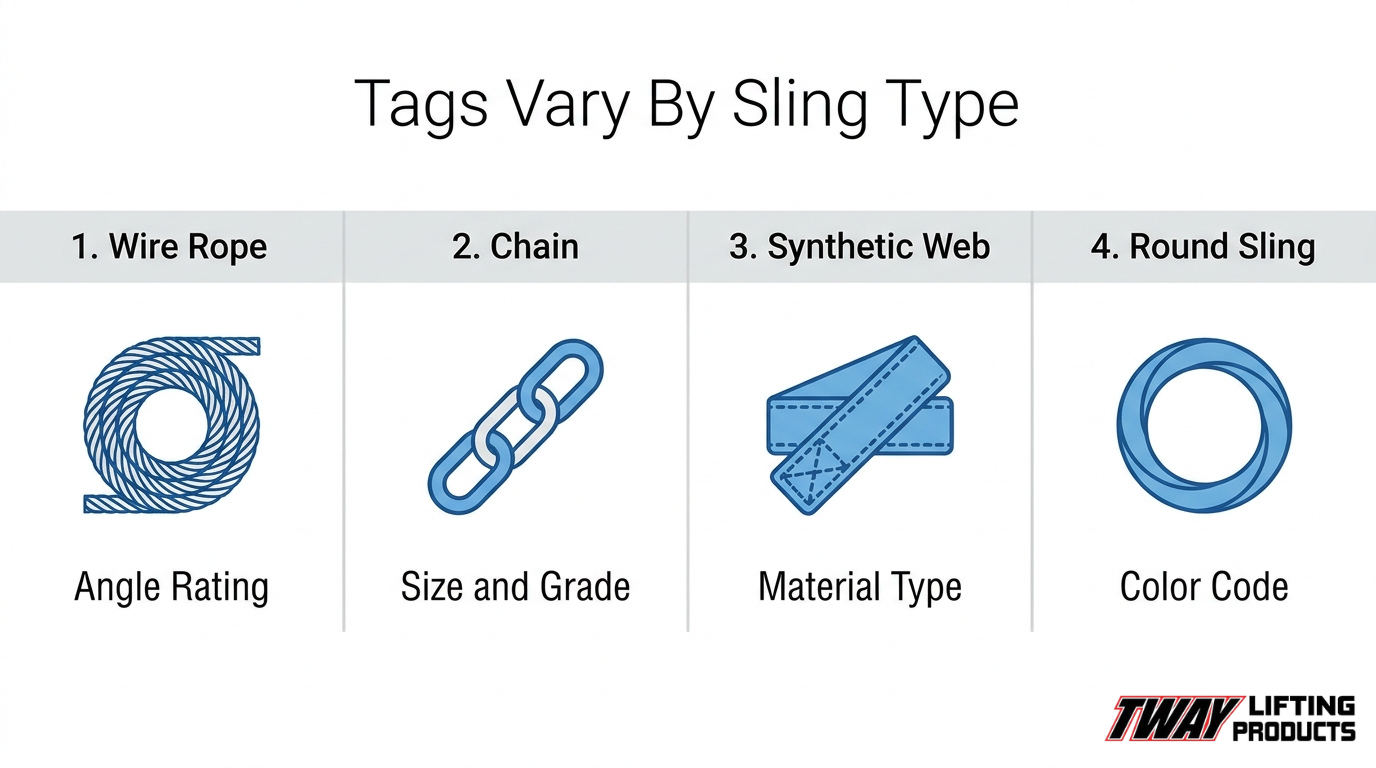
Wire rope, chain, synthetic web, and round slings each carry distinct marking mandates. We cover the specific required fields for each sling type, including how angle-based capacity ratings, reach, and color coding apply depending on material.
A missing or illegible tag requires immediate removal from service, no exceptions. We walk through the OSHA penalty framework for untagged slings, the correct steps when a tag becomes unreadable, and how inspection frequency and employer documentation obligations keep operations compliant.
What Is an Industrial Sling Tag?
An industrial sling tag is a permanently affixed label on a lifting sling that identifies the sling’s safe working load, material, size, and manufacturer details required by federal safety standards. It serves as the primary compliance record on the sling itself, giving riggers immediate access to critical load data before and during every lift.
The following sections cover why sling tags are legally mandated, what specific information they must display, and how requirements vary by sling type.
Why Are Sling Tags Required by Law?
Sling tags are required by law because federal regulations mandate that rigging equipment carry permanently affixed, legible identification before any lift begins. Two primary OSHA standards and ASME B30.9 establish this requirement across both construction and general industry. The section below explains the specific regulatory framework and the worker safety rationale behind it.
What Federal OSHA Regulations Require Sling Tags?
The federal OSHA regulations that require sling tags are 29 CFR 1926.251(a)(2) for construction and 29 CFR 1910.184(e)(1) for general industry. Under 1926.251(a)(2), employers must ensure rigging equipment has permanently affixed, legible markings indicating the recommended safe working load and must not use any sling without those markings. Under 1910.184(e)(1), alloy steel chain slings specifically must carry durable identification stating size, grade, rated capacity, and reach. Together, these two standards cover the broadest range of industrial lifting operations in the United States.
Why Did OSHA Make Sling Identification Mandatory?
OSHA made sling identification mandatory to eliminate confusion about load ratings and to simplify compliance for employers. In the 2011 Standards Improvement Project Phase III (76 FR 33590), OSHA determined that marking requirements would eliminate duplicative, inconsistent, and outdated information, minimizing confusion regarding the rated capacity of any sling type, while ensuring employers use slings with readily available, up-to-date load ratings. Having the rating on the sling itself removes any guesswork at the point of use, which is exactly where overloading decisions happen.
How Do Sling Tag Laws Protect Workers on the Job?
Sling tag laws protect workers by ensuring the working load limit is visible before every lift, preventing overloading that leads to catastrophic failures. Construction and extraction workers experienced 1,032 fatalities in 2024, according to the U.S. Bureau of Labor Statistics Census of Fatal Occupational Injuries. When a sling’s capacity is unknown, riggers cannot make safe rigging decisions, and loads fail without warning. Tagging requirements create a mandatory safety checkpoint that keeps rated capacity information at the point of use, where it matters most.
What Information Must Appear on a Sling Tag?
A sling tag must display load capacity, material type, size, manufacturer details, and safety warnings. The following sections break down each required data category and the standards that govern it.
What Load Capacity Information Is Required on a Sling Tag?
Load capacity information required on a sling tag includes the recommended safe working load for each hitch configuration, displayed permanently and legibly on the sling itself. Under 29 CFR 1926.251(a)(2), OSHA requires rigging equipment to have permanently affixed, legible markings indicating the manufacturer’s recommended safe working load, and prohibits use of any sling without those markings. For alloy steel chain slings specifically, 29 CFR 1910.184(e)(1) mandates that identification state size, grade, rated capacity, and reach. The Web Sling and Tie Down Association’s WSTDA-RS-1 standard similarly requires capacity information on roundslings. According to OSHA’s 2011 Standards Improvement Project (Federal Register, 76 FR 33590), reliance on tag-marked ratings simplifies employer compliance and reduces confusion across all sling types.
What Sling Material Information Must Be Listed on the Tag?
Sling material information must identify the specific construction type used in the sling. ASME B30.9 covers slings fabricated from alloy steel chain, wire rope, metal mesh, synthetic fiber rope, synthetic webbing, and polyester fiber yarns in a protective cover. Each material type carries distinct load characteristics, so material identification on the tag is essential for riggers selecting the correct sling for a given application. Tway Lifting manufactures and distributes slings across all major material categories, including wire rope, chain, synthetic webbing, and polyester roundslings, each carrying proper identification markings in compliance with applicable standards.
What Size and Configuration Details Are Required on a Sling Tag?
Size and configuration details required on a sling tag include the sling’s physical dimensions, such as diameter or width, and its leg count or assembly type where applicable. For chain slings, this includes reach. For multi-leg assemblies, the number of legs must be identified so rated capacity can be applied correctly per hitch type. Without this data, a rigger cannot confirm that the sling matches the lift plan’s geometry.
What Manufacturer Information Must a Sling Tag Include?
Manufacturer information a sling tag must include covers the maker’s identity and product traceability data sufficient to verify the sling’s origin and specifications. OSHA requires that identification markings be “as prescribed by the manufacturer,” meaning the tag must reflect the manufacturer’s own rating system and product data. This traceability supports inspection recordkeeping and allows employers to reference original load ratings when the sling is re-evaluated during service.
What Safety and Warning Information Must Appear on a Sling Tag?
Safety and warning information that must appear on a sling tag covers handling instructions, angle derating notices, and conditions that require removal from service. According to Indiana University’s Crane, Hoist, and Sling Safety Program (Section 3.2.3, August 2014), sling identification tags must remain legible throughout the sling’s service life, and a sling must be removed from service immediately if its tag is damaged, missing, or illegible. Replacement of identification is classified as a repair event and must be recorded. This policy reflects industry best practice: a tag that cannot be read provides no protection, making legibility maintenance as critical as the tag’s original content.
Do Sling Tag Requirements Differ by Sling Type?
Yes, sling tag requirements differ by sling type. Each material category carries its own marking mandates under OSHA, ASME B30.9, and industry standards. The following sections cover wire rope, chain, synthetic web, and round sling tag requirements.
What Information Is Required on a Wire Rope Sling Tag?
Wire rope sling tags are required to carry the recommended safe working load for each hitch type used, the sling angle on which that rating is based, and the number of legs when more than one is present. Per California Title 8 §5045(g)(1)-(2), identification markings must be permanently affixed and legible, and the sling cannot be used without them. ASME B30.9 also governs wire rope sling fabrication, attachment, and maintenance as part of its comprehensive sling standard. The manufacturer’s identification and wire rope diameter or construction should also appear on the tag.
What Information Is Required on a Chain Sling Tag?
Chain sling tags are required to state size, grade, rated capacity, and reach, as prescribed under 29 CFR 1910.184(e)(1) for general-industry alloy steel chain slings. These four data points are the federal minimum for permanent, durable identification. Washington State’s WAC 296-155-33800, Table 2 adds that chain slings in normal service must receive periodic inspection at least once a year, reinforcing the importance of maintaining legible tags that support accurate inspection records.
What Information Is Required on a Synthetic Web Sling Tag?
Synthetic web sling tags are required to include the rated load capacity for each hitch configuration, sling material (such as nylon or polyester), and construction type. ASME B30.9 covers synthetic webbing slings and requires identification markings that enable users to confirm load ratings before each lift. Tags must also indicate reach and any angle-based capacity adjustments. Because web sling material degrades over time through UV exposure and chemical contact, the manufacturer’s name and applicable warnings are especially critical on this sling type.
What Information Is Required on a Round Sling Tag?
Round sling tags are required to identify the sling’s load capacity in each hitch mode, the sling material (typically polyester fiber), and color-coded capacity designations where applicable. According to WSTDA-RS-1, the 2019 roundsling standard from the Web Sling and Tie Down Association covers construction, identification and marking, capacity information, and practical usage guidance for polyester roundslings. The tag must remain legible throughout the sling’s service life; a damaged or missing tag requires immediate removal from service.
What OSHA Standards Govern Sling Tag Requirements?
The OSHA standards that govern sling tag requirements are 29 CFR 1926.251 for construction and 29 CFR 1910.184 for general industry. Both mandate permanently affixed, legible identification on rigging equipment before use.
How Does 29 CFR 1926.251 Apply to Construction Sling Tags?
29 CFR 1926.251(a)(2) requires that rigging equipment used in construction have permanently affixed and legible identification markings as prescribed by the manufacturer, indicating the recommended safe working load. Employers must not load slings beyond the marked capacity and must not use any sling without affixed, legible identification markings. This standard effectively makes a missing or unreadable tag a compliance violation in itself, independent of whether an actual overload occurred.
How Does 29 CFR 1910.184 Apply to General Industry Sling Tags?
29 CFR 1910.184(e)(1) requires that alloy steel chain slings have permanently affixed durable identification stating size, grade, rated capacity, and reach. General industry operations using chain slings outside construction environments fall under this standard. These four required data points establish a minimum floor for tag content that applies across manufacturing, warehousing, and similar facilities.
What Did the 2011 Standards Improvement Project Change About Sling Tag Rules?
The 2011 Standards Improvement Project (76 FR 33590, June 8, 2011) refined OSHA’s approach to sling identification. According to the Federal Register, OSHA determined the revisions would eliminate duplicative, inconsistent, and outdated information, minimizing confusion about rated capacity across all sling types. Reliance on tag-marked information was recognized as the simplest compliance pathway for employers. Understanding these two federal standards is foundational before examining the ASME technical standards that supplement them.
What ASME Standards Apply to Industrial Sling Tags?
The ASME standards that apply to industrial sling tags are found primarily in ASME B30.9, the volume governing slings used for load handling. According to ASME, B30.9 covers fabrication, attachment, use, inspection, testing, and maintenance of slings made from alloy steel chain, wire rope, metal mesh, synthetic fiber rope, synthetic webbing, and polyester fiber yarns in a protective cover. Each material type carries specific identification and marking requirements under this standard.
What Happens if a Sling Tag Is Missing or Damaged?
A missing or damaged sling tag requires immediate removal of the sling from service. The sections below cover whether an untagged sling can legally operate, what OSHA penalties apply, and the correct steps when a tag becomes unreadable.
Can a Sling Still Be Used if Its Tag Is Missing?
No, a sling cannot be used if its tag is missing. Under 29 CFR 1926.251(a)(2), OSHA requires rigging equipment to have permanently affixed, legible identification markings and explicitly prohibits use without them. The same removal-from-service obligation applies when a tag is damaged or illegible. There are no exceptions for “knowing” the sling’s capacity from memory or prior documentation.
What Are the OSHA Penalties for Untagged Slings?
OSHA penalties for untagged slings fall under the standard citation framework for serious or willful violations of 29 CFR 1926.251 or 29 CFR 1910.184. According to the U.S. Department of Labor, 2026 maximum civil monetary penalty amounts remain unchanged from 2025. Serious violations can reach thousands of dollars per citation, while willful or repeat violations carry substantially higher maximums. In Super Excavators, Inc. (OSHRC Docket No. 89-2253), a repeat citation for a missing tag was dismissed only because inspection records showed no systemic deficiency, illustrating that documented inspection programs are a critical defense.
What Should You Do When a Sling Tag Becomes Unreadable?
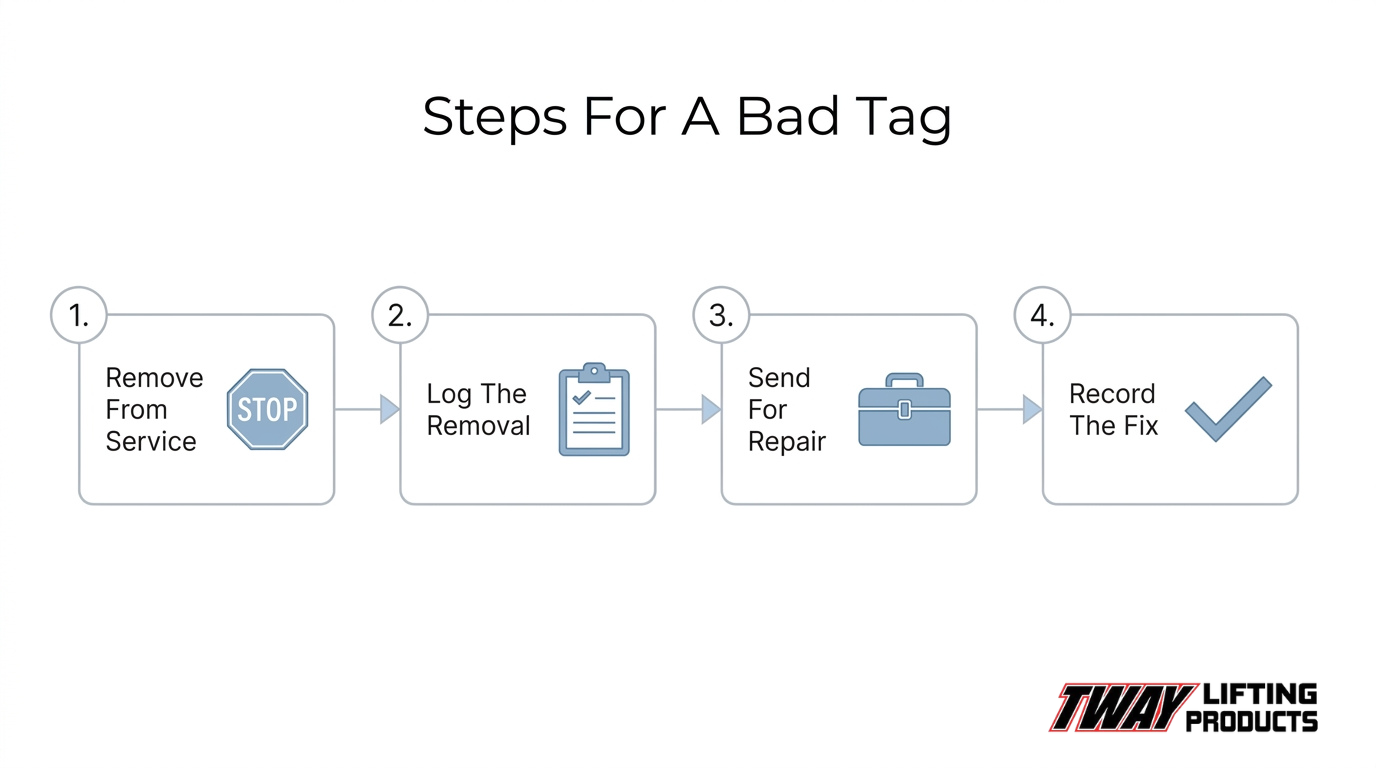
When a sling tag becomes unreadable, remove the sling from service immediately and document the removal as a repair event. According to Indiana University’s Crane, Hoist, and Sling Safety Program (August 15, 2014), replacement of sling identification must be recorded as a repair before the sling returns to use. Steps to follow:
- Remove the sling from service and tag it “Out of Service.”
- Log the removal with date, sling ID (if still traceable), and reason.
- Return the sling to the manufacturer or a qualified rigging shop for tag replacement. Tway Lifting’s repair and reconditioning services, including their Peerless/Acco Welded Sling Repair Center, can handle tag replacement and sling reconditioning with same-day wire rope sling fabrication available.
- Record the repair in your inspection log before returning the sling to operation.
Proactive tag inspections during every pre-use check catch legibility issues before they become compliance violations.
How Often Must Sling Tags Be Inspected?
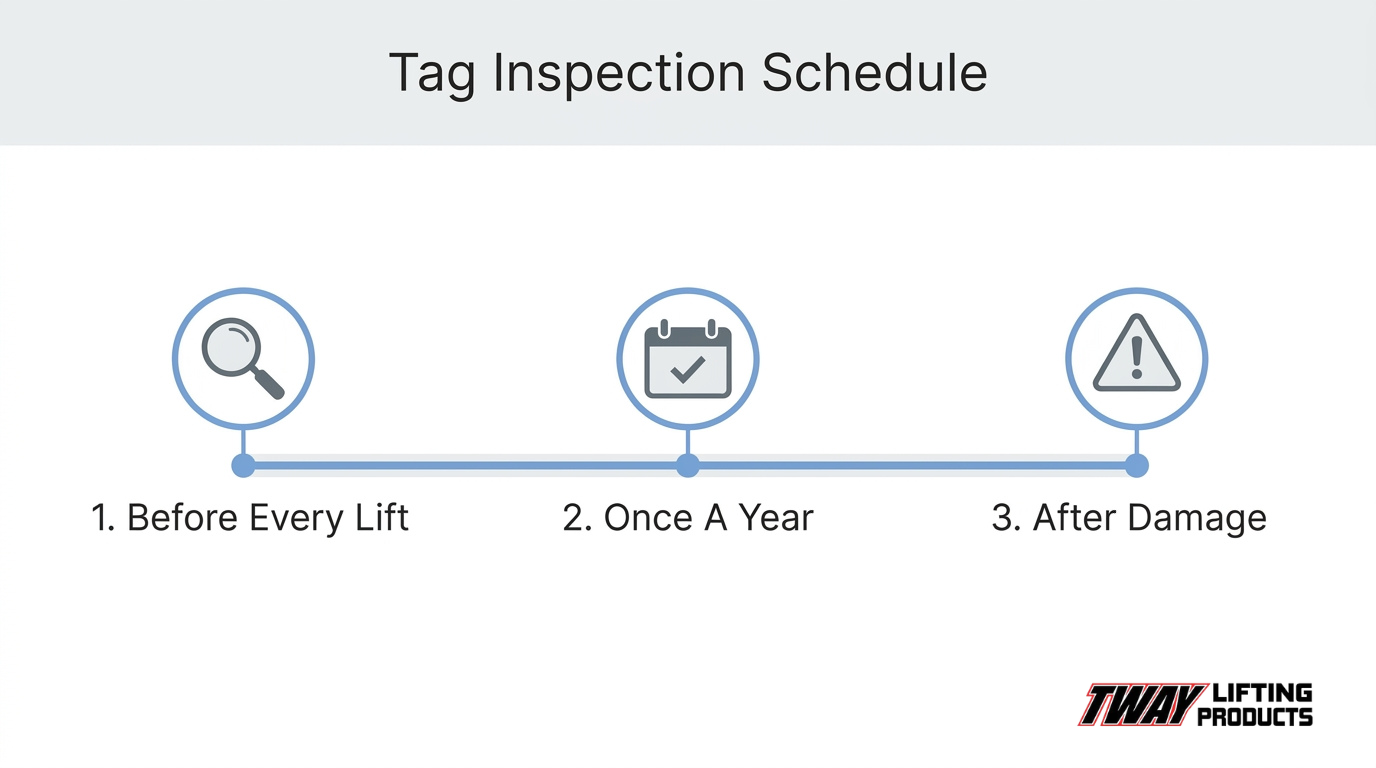
Sling tag inspection follows a tiered schedule aligned with federal standards and industry best practices. The sections below cover before-use checks, periodic inspections, and what triggers removal from service.
How Frequently Should Sling Tags Be Checked Before Each Use?
Sling tags should be checked before every lift as part of a pre-use inspection. OSHA’s general industry standard at 29 CFR 1910.184 requires slings to be inspected prior to use and when service conditions warrant. This check confirms the tag is present, legible, and that the rated capacity listed matches the planned load. A damaged or missing tag is grounds for immediate removal from service before any lift begins.
What Is the Required Periodic Inspection Frequency for Sling Tags?
The required periodic inspection frequency for sling tags is at least once per year for slings in normal service. According to Washington State’s WAC 296-155-33800, Table 2 (effective May 20, 2016), annual inspection is the minimum for slings operating within rated load. Slings in severe or hazardous service require more frequent formal inspections. These periodic inspections must be performed by a qualified person, with records maintained to document compliance. Tway Lifting provides OSHA-required annual inspections and job site safety inspections conducted by certified, factory-trained specialists, with detailed reporting to support employer recordkeeping obligations.
What Conditions Trigger an Immediate Sling Tag Inspection?
Conditions that trigger an immediate sling tag inspection include visible damage to the sling, exposure to shock loading, use in corrosive or high-temperature environments, and any incident involving an overload. Indiana University’s Crane, Hoist, and Sling Safety Program (August 15, 2014) specifies that replacement of sling identification must be recorded as a repair, and the sling must be removed from service if the tag is damaged, missing, or illegible. Waiting for a scheduled inspection after any of these events is not acceptable practice.
With inspection schedules established, accountability for maintaining compliant tags and records falls on designated responsible parties within the operation.
Who Is Responsible for Maintaining Sling Tag Compliance?
Responsibility for maintaining sling tag compliance falls on the employer. The following subsections outline the specific duties shared by employers, riggers, and inspection personnel.
What Are the Employer’s Responsibilities for Sling Tag Compliance?
The employer’s responsibilities for sling tag compliance include ensuring all slings have permanently affixed, legible identification markings before use. Under 29 CFR 1926.251(a)(2), OSHA requires employers to confirm rigging equipment carries manufacturer-prescribed markings indicating the recommended safe working load, and that no sling is used without them.
Employers must also establish inspection schedules, remove damaged or untagged slings from service, and document replacements. Indiana University’s Crane, Hoist, and Sling Safety Program specifies that replacement of sling identification must be recorded as a repair. In practice, employers who delegate tagging duties without verification retain full regulatory liability.
What Role Do Riggers and Operators Play in Sling Tag Compliance?
Riggers and operators play an active daily role in sling tag compliance by conducting pre-use inspections and refusing to use any sling with a missing or illegible tag. While employers hold primary legal responsibility, riggers are the last line of defense before a load is lifted.
Operators should verify that tag information, including rated capacity and sling type, matches the planned lift. Reporting damaged or missing tags to supervisors immediately is a critical habit. A tag that cannot be read is functionally the same as no tag at all, making field-level vigilance essential to preventing incidents.
How Should Employers Document Sling Tag Inspections and Replacements?
Employers should document sling tag inspections and replacements through a formal recordkeeping system that ties each sling to its inspection history. According to the Lifting Equipment Engineers Association (LEEA), best practice assigns each sling a unique identification number recorded on every thorough examination report, ensuring traceability without ambiguity.
Records should capture inspection dates, inspector credentials, condition findings, and any tag replacements performed. This documentation protects employers during OSHA audits and provides clear evidence of due diligence if an incident occurs.
How Do Sling Tags Relate to Sling Working Load Limits?
Sling tags relate to sling working load limits by serving as the primary on-equipment reference that communicates the maximum load a sling can safely handle. Without a legible tag, operators have no reliable way to verify load limits before a lift. The sections below cover how WLL is defined, how it connects to tag information, and what happens when limits are ignored.
What Is a Working Load Limit on a Sling Tag?
A working load limit on a sling tag is the maximum combined static and dynamic load, measured in pounds, that can be applied in direct tension to an undamaged straight length of chain or sling. According to the National Association of Chain Manufacturers (NACM), RR-C-271G, this figure represents the absolute ceiling for safe use under normal service conditions. Riggers should treat the WLL printed on the tag as a hard stop, not a conservative estimate with built-in surplus.
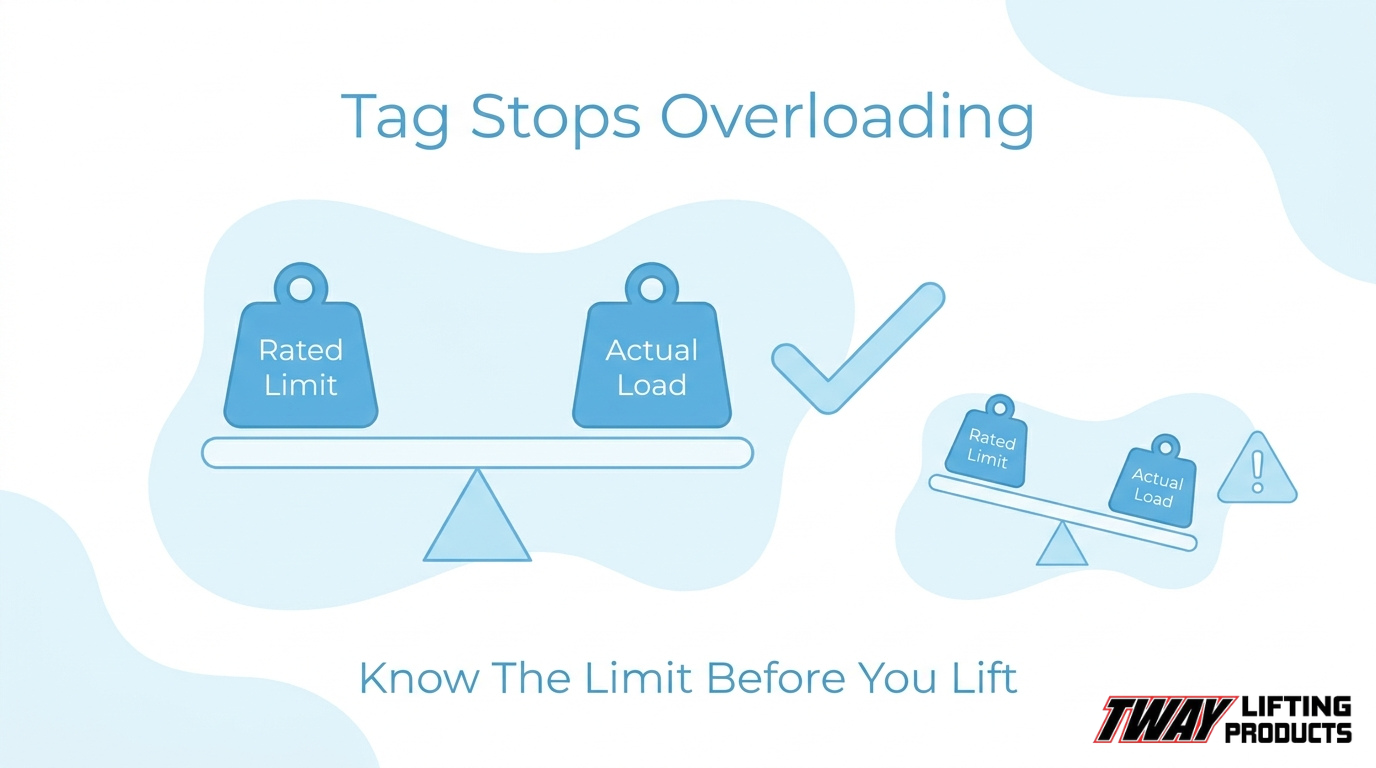
How Does the Sling Tag Prevent Overloading?
The sling tag prevents overloading by placing the rated capacity directly in the hands of the operator at the point of use. UK Health and Safety Executive guidance under LOLER confirms that all lifting equipment and accessories must be clearly marked with their safe working load, the maximum load the equipment can safely lift. This on-equipment marking eliminates the need for operators to consult separate documents during a lift, reducing the risk of load estimation errors.
What Are the Consequences of Ignoring Sling Tag Load Limits?
Ignoring sling tag load limits directly endangers workers below and around a suspended load. A NIOSH FACE Report (02IA003) documented a 2002 fatality in Iowa where a nylon sling eye slipped from a hook mid-swing, causing the load to fall onto a worker passing beneath it. Washington State WAC 296-155-33800, Table 2, further requires slings in normal service to be formally inspected at least once a year, reinforcing that staying within rated loads and maintaining tag legibility are interdependent safety obligations.
How Does Tway Lifting Support Sling Tag Compliance and Inspections?
Tway Lifting supports sling tag compliance and inspections through professional inspection services, certified factory-trained specialists, and over 75 years of rigging manufacturing and distribution expertise. The sections below cover Tway Lifting’s OSHA inspection capabilities and key article takeaways.
Can Tway Lifting Perform OSHA Sling Inspections for Your Operation?
Yes, Tway Lifting can perform OSHA sling inspections for your operation. Tway Lifting provides professional rigging inspection services conducted by certified, factory-trained specialists, covering OSHA-required annual inspections and job site safety inspections with detailed reporting. Founded in 1945 and ISO9001-2008 certified, Tway Lifting brings over 75 years of institutional knowledge to rigging inspections.
Services available include:
- Annual OSHA-required sling inspections with documented reporting.
- Job site safety inspections for compliance verification.
- Repair and reconditioning through the Peerless/Acco Welded Sling Repair Center.
- Custom wire rope sling fabrication with same-day service.
- Complimentary inspection services available.
What Are the Key Takeaways About Industrial Sling Tag Requirements We Covered?
The key takeaways about industrial sling tag requirements are that compliant tagging is both a legal obligation and a direct safety control. Every sling must carry a permanently affixed, legible tag showing rated capacity, material, size, and manufacturer data under OSHA 29 CFR 1910.184 and 29 CFR 1926.251. A missing or illegible tag requires immediate removal from service. Inspection frequency, tag legibility maintenance, and traceability to examination records are all non-negotiable under ASME B30.9 and applicable state standards. Tway Lifting can help operations stay ahead of these requirements before an inspection finds gaps.